Earthquake in Geology
What is an Eartquake?
• The vibration of earth due to
sudden release of energy within
earth caused by explosion is called
earthquake. This is due to
• Plate tectonics activity
• Active faulting
Eartquake Waves
Sismogram
How sismograph work
Seismogram Printout
Magnitude & Intensity
• Magnitude is a measure of the size of an
earthquake, based in the amplitude of elastic
waves it generates.
• Intensity is a qualitative measure of the actual
shaking at a location during an earthquake
and is assigned as Roman capital numerals (I,
II, III,…….XII)
Difference between Magnitude and Intensity
• The magnitude of an earthquake is a measure of its size. For
instance, one can measure the size of an earthquake by the
amount of strain energy released by the fault rupture. This
means that the magnitude of the earthquake is a single value
for a given earthquake.
• On the other hand, intensity is an indicator of the severity of
shaking generated at a given location. Clearly, this severity of
shaking is much higher near the epicenter than further away.
So during the same earthquake of a certain magnitude different
locations experience different level of intensity.
Richter Magnitude Scale
Magnitude Description Earthquake effects
Less than
2.0
Micro Micro earthquakes, not felt.
2.0–2.9
Minor
Generally not felt, but recorded.
3.0–3.9 Often felt, but rarely causes damage.
4.0–4.9 Light Noticeable shaking of indoor items, rattling noises. Significant
damage unlikely.
5.0–5.9 Moderate Can cause major damage to poorly constructed buildings over small
regions. At most slight damage to well-designed buildings.
6.0–6.9 Strong Can be destructive in areas up to about 160 kilometers (99 mi)
across in populated areas.
7.0–7.9 Major Can cause serious damage over larger areas.
8.0–8.9
Great
Can cause serious damage in areas several hundred kilometers
across.
9.0–9.9 Devastating in areas several thousand kilometers across.
10.0+ Massive Never recorded
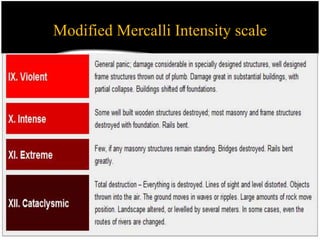
Modified Mercalli Intensity Scale
Modified Mercalli Intensity scale
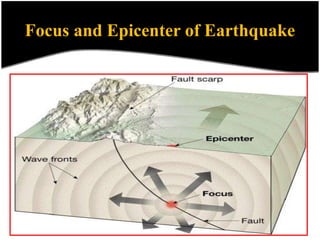
Focus and Epicenter of Earthquake
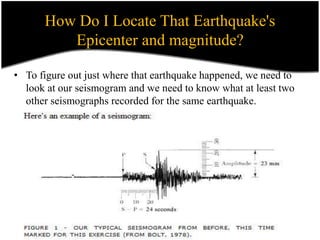
How Do I Locate That Earthquake's
Epicenter and magnitude?
• To figure out just where that earthquake happened, we need to
look at our seismogram and we need to know what at least two
other seismographs recorded for the same earthquake.
Magnitude & Distance
of Epicenter
Determination Chart
Finding the Distance to the Epicenter and the
Earthquake's Magnitude
A. Measure the distance between the first P wave and the first S wave.
In this case, the first P and S waves are 24 seconds apart.
B. Find the point for 24 seconds on the left side of the chart below and
mark that point. According to the chart, this earthquake's epicenter
was 215 kilometers away
C. Measure the amplitude of the strongest wave. The amplitude is the
height (on paper) of the strongest wave. On this seismogram, the
amplitude is 23 millimeters. Find 23 millimeters on the right side of
the chart and mark that point.
D. Place a ruler (or straight edge) on the chart between the points you
marked for the distance to the epicenter and the amplitude. The point
where your ruler crosses the middle line on the chart marks the
magnitude (strength) of the earthquake. This earthquake had a
magnitude of 5.0.
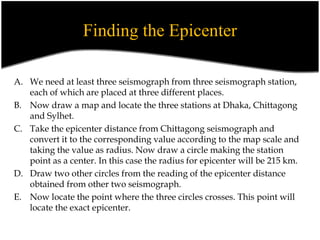
Finding the Epicenter
A. We need at least three seismograph from three seismograph station,
each of which are placed at three different places.
B. Now draw a map and locate the three stations at Dhaka, Chittagong
and Sylhet.
C. Take the epicenter distance from Chittagong seismograph and
convert it to the corresponding value according to the map scale and
taking the value as radius. Now draw a circle making the station
point as a center. In this case the radius for epicenter will be 215 km.
D. Draw two other circles from the reading of the epicenter distance
obtained from other two seismograph.
E. Now locate the point where the three circles crosses. This point will
locate the exact epicenter.
Thank You
Shubhagata Roy
Lceturer
Fareast International University

Earthquake 02

  • 1.
  • 2.
    What is anEartquake? • The vibration of earth due to sudden release of energy within earth caused by explosion is called earthquake. This is due to • Plate tectonics activity • Active faulting
  • 3.
  • 4.
  • 5.
  • 6.
  • 7.
    Magnitude & Intensity •Magnitude is a measure of the size of an earthquake, based in the amplitude of elastic waves it generates. • Intensity is a qualitative measure of the actual shaking at a location during an earthquake and is assigned as Roman capital numerals (I, II, III,…….XII)
  • 8.
    Difference between Magnitudeand Intensity • The magnitude of an earthquake is a measure of its size. For instance, one can measure the size of an earthquake by the amount of strain energy released by the fault rupture. This means that the magnitude of the earthquake is a single value for a given earthquake. • On the other hand, intensity is an indicator of the severity of shaking generated at a given location. Clearly, this severity of shaking is much higher near the epicenter than further away. So during the same earthquake of a certain magnitude different locations experience different level of intensity.
  • 9.
    Richter Magnitude Scale MagnitudeDescription Earthquake effects Less than 2.0 Micro Micro earthquakes, not felt. 2.0–2.9 Minor Generally not felt, but recorded. 3.0–3.9 Often felt, but rarely causes damage. 4.0–4.9 Light Noticeable shaking of indoor items, rattling noises. Significant damage unlikely. 5.0–5.9 Moderate Can cause major damage to poorly constructed buildings over small regions. At most slight damage to well-designed buildings. 6.0–6.9 Strong Can be destructive in areas up to about 160 kilometers (99 mi) across in populated areas. 7.0–7.9 Major Can cause serious damage over larger areas. 8.0–8.9 Great Can cause serious damage in areas several hundred kilometers across. 9.0–9.9 Devastating in areas several thousand kilometers across. 10.0+ Massive Never recorded
  • 10.
  • 11.
  • 12.
  • 13.
    Focus and Epicenterof Earthquake
  • 14.
    How Do ILocate That Earthquake's Epicenter and magnitude? • To figure out just where that earthquake happened, we need to look at our seismogram and we need to know what at least two other seismographs recorded for the same earthquake.
  • 15.
    Magnitude & Distance ofEpicenter Determination Chart
  • 16.
    Finding the Distanceto the Epicenter and the Earthquake's Magnitude A. Measure the distance between the first P wave and the first S wave. In this case, the first P and S waves are 24 seconds apart. B. Find the point for 24 seconds on the left side of the chart below and mark that point. According to the chart, this earthquake's epicenter was 215 kilometers away C. Measure the amplitude of the strongest wave. The amplitude is the height (on paper) of the strongest wave. On this seismogram, the amplitude is 23 millimeters. Find 23 millimeters on the right side of the chart and mark that point. D. Place a ruler (or straight edge) on the chart between the points you marked for the distance to the epicenter and the amplitude. The point where your ruler crosses the middle line on the chart marks the magnitude (strength) of the earthquake. This earthquake had a magnitude of 5.0.
  • 17.
    Finding the Epicenter A.We need at least three seismograph from three seismograph station, each of which are placed at three different places. B. Now draw a map and locate the three stations at Dhaka, Chittagong and Sylhet. C. Take the epicenter distance from Chittagong seismograph and convert it to the corresponding value according to the map scale and taking the value as radius. Now draw a circle making the station point as a center. In this case the radius for epicenter will be 215 km. D. Draw two other circles from the reading of the epicenter distance obtained from other two seismograph. E. Now locate the point where the three circles crosses. This point will locate the exact epicenter.
  • 18.