

Earthquakes
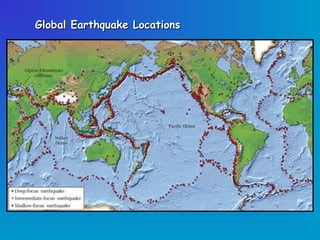
Global Earthquake Locations
Earthquakes
•   Shaking of earth due to movement of rocks along a fault.
•   Rocks under stress accumulate strain energy over time.
•   When stress exceeds strength of rocks, rock breaks.
•   Strain energy is released as seismic waves. The longer that
    energy is stored up and is maintained without release, the more
    likely that a strong earthquake will occur.
Types of seismic waves
1. Body waves -- travel through interior
2. Surface waves -- travel on surface of earth

 
Surface or "Love" (“L”) Waves
Cause vertical & horizontal shaking
Travel exclusively along surface of earth

Specific Body Waves
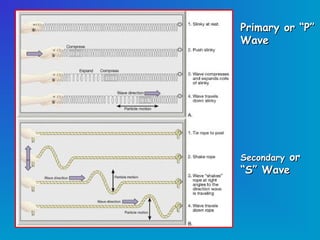
Primary or "P" Waves: Primary waves Highest velocity.
   Causes compression and expansion in direction of wave travel.
Secondary or "S" Waves: Secondary or shear waves Slower than
   P waves but faster than surface waves. Causes shearing of rock
   perpendicular to direction of wave propagation. Cannot travel
   through liquids
Primary or “P”
Wave


Secondary or
“S” Wave
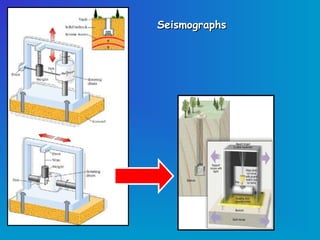
Seismographs
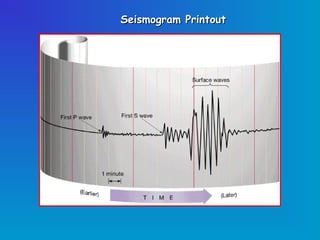
Seismogram Printout
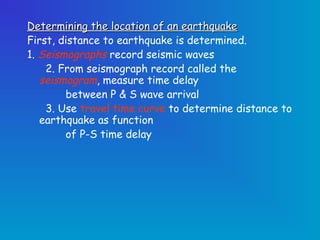
Determining the location of an earthquake
First, distance to earthquake is determined.
1. Seismographs record seismic waves
    2. From seismograph record called the
   seismogram, measure time delay
        between P & S wave arrival
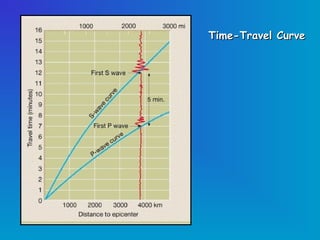
    3. Use travel time curve to determine distance to
   earthquake as function
        of P-S time delay
 
 
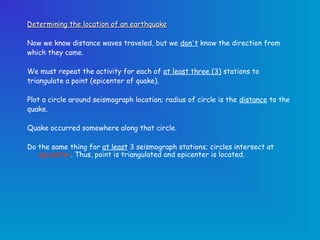
Determining the location of an earthquake
 
Now we know distance waves traveled, but we don't know the direction from
which they came.

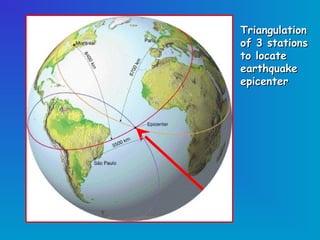
We must repeat the activity for each of at least three (3) stations to
triangulate a point (epicenter of quake).
 
Plot a circle around seismograph location; radius of circle is the distance to the
quake.

Quake occurred somewhere along that circle.

Do the same thing for at least 3 seismograph stations; circles intersect at
   epicenter. Thus, point is triangulated and epicenter is located.
 
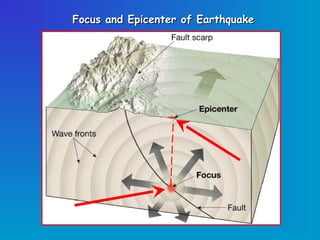
Focus and Epicenter of Earthquake
Time-Travel Curve
Triangulation
of 3 stations
to locate
earthquake
epicenter
Determining the magnitude of an earthquake
Magnitude -- measure of energy released during earthquake.
There are several different ways to measure magnitude.
Most common magnitude measure is Richter Magnitude, named for the renowned
   seismologist, Charles Richter.
 
Richter Magnitude
• Measure amplitude of largest S wave on seismograph record.
• Take into account distance between seismograph & epicenter.
 
Richter Scale
• Logarithmic numerical (NOT a physical) scale
• Increasing one whole unit on Richter Scale represents 10 times greater
   magnitude.
• Going up one whole unit on Richter Scale represents about a 30 times greater
   release of energy.
Intensity
• Intensity refers to the amount of damage done in an earthquake
• Mercalli Scale is used to express damage
Hazards associated with Quakes
• Shaking:
  Frequency of shaking differs for different seismic waves.
  High frequency body waves shake low buildings more.
  Low frequency surface waves shake high buildings more.
  Intensity of shaking also depends on type of subsurface
  material.
  Unconsolidated materials amplify shaking more than rocks do.
  Fine-grained, sensitive materials can lose strength when
  shaken. They lose strength by liquefaction.
  Buildings respond differently to shaking depending on
  construction styles, materials
  Wood -- more flexible, holds up well
  Earthen materials -- very vulnerable to shaking.
Hazards associated with Quakes
• Ground displacement:
  Ground surface may shift during an earthquake (esp. if focus
  is shallow).
  Vertical displacements of surface produce fault scarps.
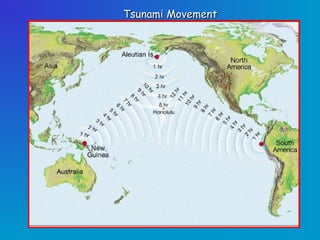
• Tsunamis (NOT tidal waves)
  Tsunamis are huge waves generated by earthquakes undersea
  or below coastal areas.
  If earthquake displaces sea surface, wave is generated that
  can grow as it moves over sea surface.
• Fires
  Usually occurs from shifting of subsurface utilities (gas lines)
Tsunami Movement
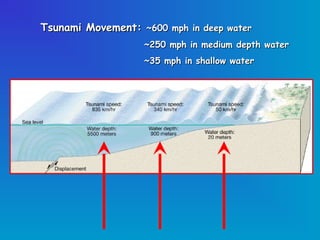
Tsunami Movement: ~600 mph in deep water
                   ~250 mph in medium depth water
                   ~35 mph in shallow water
Earthquake Prediction (?)

How can scientists predict an earthquake?

Currently, that is not possible.

Future technology will monitor subsurface seismic waves and
  periodic shifting indicative of future slippage.

Tracking organic movement is also a source of future study.
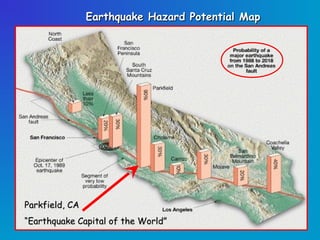
Earthquake Hazard Potential Map


Parkfield, CA
“Earthquake Capital of the World”
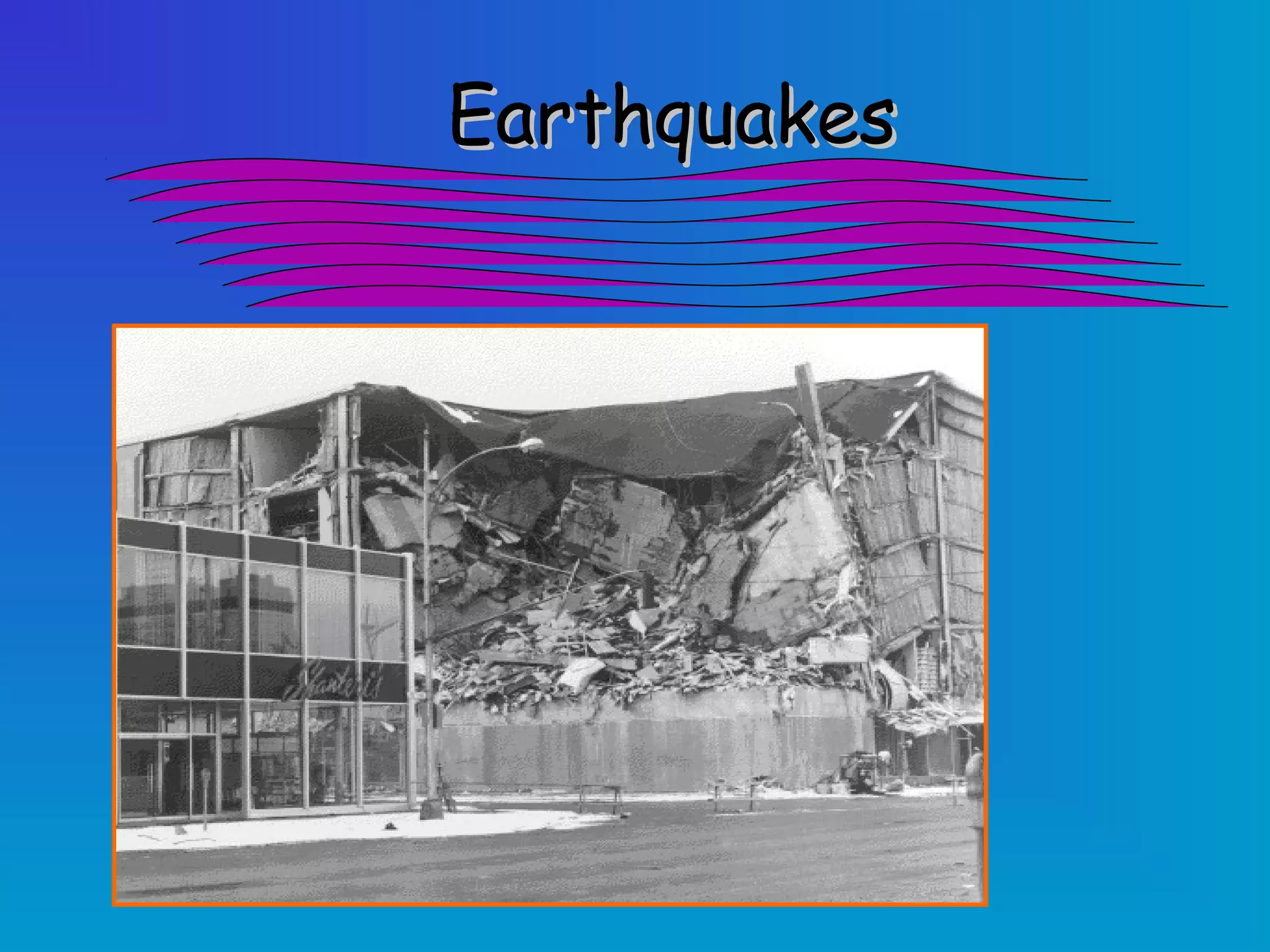
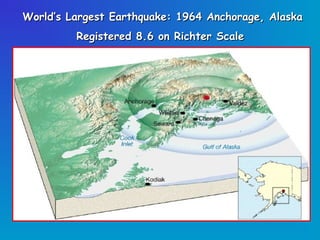
World’s Largest Earthquake: 1964 Anchorage, Alaska
         Registered 8.6 on Richter Scale

Earthquakes

  • 1.
  • 2.
  • 3.
    Earthquakes • Shaking of earth due to movement of rocks along a fault. • Rocks under stress accumulate strain energy over time. • When stress exceeds strength of rocks, rock breaks. • Strain energy is released as seismic waves. The longer that energy is stored up and is maintained without release, the more likely that a strong earthquake will occur. Types of seismic waves 1. Body waves -- travel through interior 2. Surface waves -- travel on surface of earth  
  • 4.
    Surface or "Love"(“L”) Waves Cause vertical & horizontal shaking Travel exclusively along surface of earth Specific Body Waves Primary or "P" Waves: Primary waves Highest velocity. Causes compression and expansion in direction of wave travel. Secondary or "S" Waves: Secondary or shear waves Slower than P waves but faster than surface waves. Causes shearing of rock perpendicular to direction of wave propagation. Cannot travel through liquids
  • 5.
  • 7.
  • 9.
  • 10.
    Determining the locationof an earthquake First, distance to earthquake is determined. 1. Seismographs record seismic waves 2. From seismograph record called the seismogram, measure time delay between P & S wave arrival 3. Use travel time curve to determine distance to earthquake as function of P-S time delay    
  • 11.
    Determining the locationof an earthquake   Now we know distance waves traveled, but we don't know the direction from which they came. We must repeat the activity for each of at least three (3) stations to triangulate a point (epicenter of quake).   Plot a circle around seismograph location; radius of circle is the distance to the quake. Quake occurred somewhere along that circle. Do the same thing for at least 3 seismograph stations; circles intersect at epicenter. Thus, point is triangulated and epicenter is located.  
  • 12.
    Focus and Epicenterof Earthquake
  • 13.
  • 14.
    Triangulation of 3 stations tolocate earthquake epicenter
  • 15.
    Determining the magnitudeof an earthquake Magnitude -- measure of energy released during earthquake. There are several different ways to measure magnitude. Most common magnitude measure is Richter Magnitude, named for the renowned seismologist, Charles Richter.   Richter Magnitude • Measure amplitude of largest S wave on seismograph record. • Take into account distance between seismograph & epicenter.   Richter Scale • Logarithmic numerical (NOT a physical) scale • Increasing one whole unit on Richter Scale represents 10 times greater magnitude. • Going up one whole unit on Richter Scale represents about a 30 times greater release of energy. Intensity • Intensity refers to the amount of damage done in an earthquake • Mercalli Scale is used to express damage
  • 16.
    Hazards associated withQuakes • Shaking: Frequency of shaking differs for different seismic waves. High frequency body waves shake low buildings more. Low frequency surface waves shake high buildings more. Intensity of shaking also depends on type of subsurface material. Unconsolidated materials amplify shaking more than rocks do. Fine-grained, sensitive materials can lose strength when shaken. They lose strength by liquefaction. Buildings respond differently to shaking depending on construction styles, materials Wood -- more flexible, holds up well Earthen materials -- very vulnerable to shaking.
  • 17.
    Hazards associated withQuakes • Ground displacement: Ground surface may shift during an earthquake (esp. if focus is shallow). Vertical displacements of surface produce fault scarps. • Tsunamis (NOT tidal waves) Tsunamis are huge waves generated by earthquakes undersea or below coastal areas. If earthquake displaces sea surface, wave is generated that can grow as it moves over sea surface. • Fires Usually occurs from shifting of subsurface utilities (gas lines)
  • 18.
  • 19.
    Tsunami Movement: ~600mph in deep water ~250 mph in medium depth water ~35 mph in shallow water
  • 20.
    Earthquake Prediction (?) Howcan scientists predict an earthquake? Currently, that is not possible. Future technology will monitor subsurface seismic waves and periodic shifting indicative of future slippage. Tracking organic movement is also a source of future study.
  • 21.
    Earthquake Hazard PotentialMap Parkfield, CA “Earthquake Capital of the World”
  • 22.
    World’s Largest Earthquake:1964 Anchorage, Alaska Registered 8.6 on Richter Scale