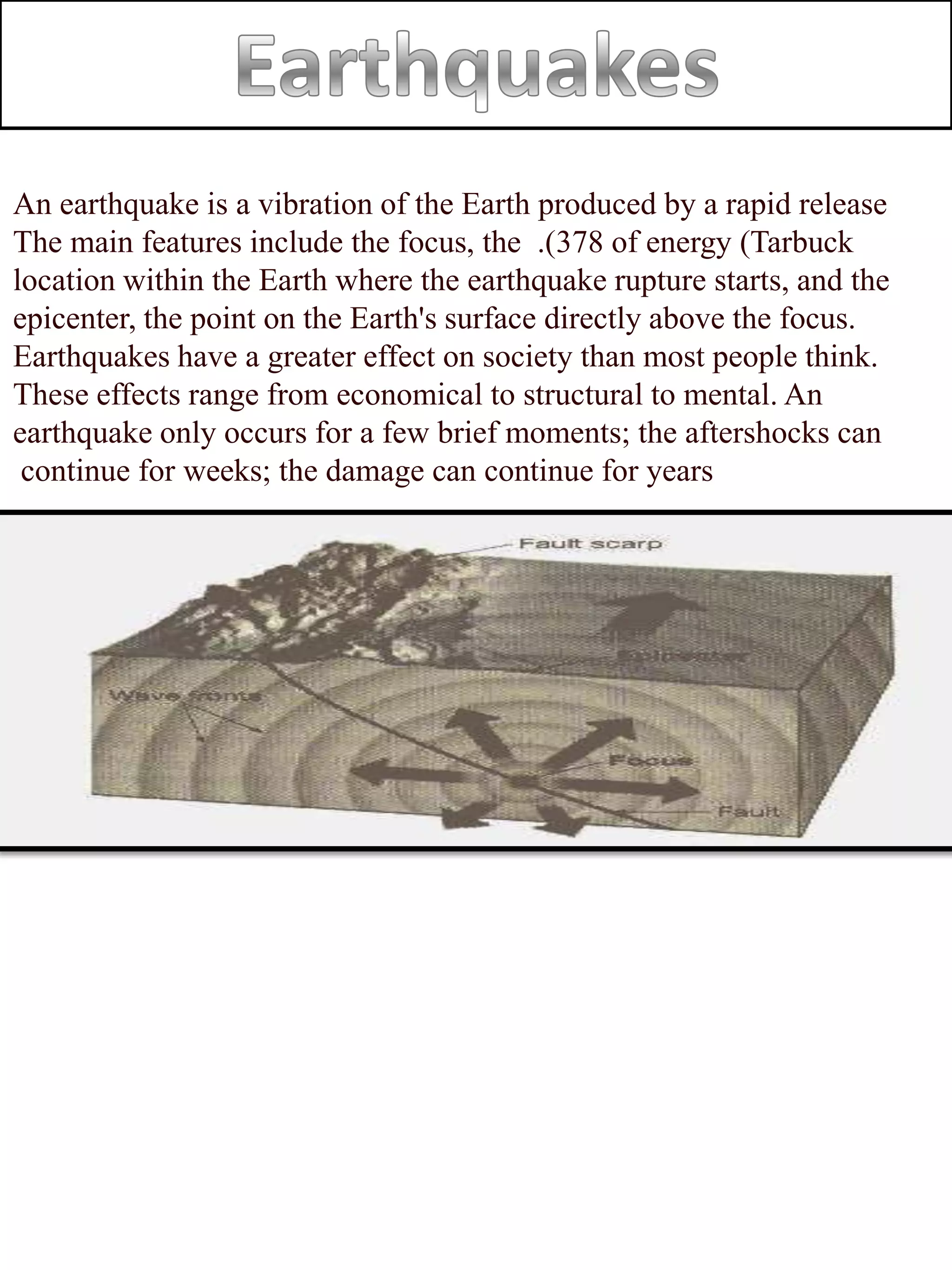
Earthquakes   An earthquake is a vibration of the Earth produced by a rapid release of energy (Tarbuck 378). The main features include the focus, the location within the Earth where the earthquake rupture starts, and the epicenter, the point on the Earth's surface directly above the focus. Earthquakes have a greater effect on society than most people think. These effects range from economical to structural to mental. An earthquake only occurs for a few brief moments; the aftershocks can continue for weeks; the damage can continue for years.
Earthquakes and SeismicitySeismic WavesTwo types of waves are generated during an earthquake, body waves and surface waves. Bodywaves travel through the Earth, emanating from the earthquake focus, or 'hypocenter' (e.g., a ruptured fault). Body waves are useful in determining the surface location above the earthquake source, or 'epicenter', and for determining the amount of energy released, or magnitude. Body waves can be further classified as either:compression or P-waves - these have the highest velocity of all seismic waves (ca. 6 km/s) and are the first (Primary) waves to be recorded by a seismograph after an earthquakeshear or S-waves - these oscillate perpendicular to the direction of wave propagation, are slower than P-waves (ca. 3.5 km/s) and arrive later (Secondary)Surface waves travel along or near the Earth's surface, generally arriving later than body waves. Because they travel along the surface, their effects on society may be significant, including structure collapse, mass movement (landslides), disruption of utilities, and secondary effects such as fires. Energy released from an earthquake may be recorded as motions of the Earth's surface by a seismograph; a seismogram is a written or digital recording of these motions. Examples of actual seismograms vary in complexity due to dispersal of seismic energy via reflections at velocity discontinuities and refraction (bending) as waves pass through velocity gradients within the Earth.See further examples of seismograms from the Rice Seismic Station and the IRIS map of current seismicity - these are also displayed on the monitors in the Keith-Wiess Geological Laboratories.Locating Earthquakes
The surface point above the hypocenter is known as the epicenter. As the distance from an earthquake increases, the arrival time difference between the p-wave and s-waves ('S-P difference') increases proportionately. Thus, epicenter locations can be determined by triangulation using a travel-time curve and data recorded at three or more seismic stations.Hands-on examples of calculating location (as well as Richter magnitude) for real earthquakes can be found at the very cool Virtual Earthquake WWW site. Give it a try, and become a virtual seismologist!Estimating Intensity of EarthquakesStrength of earthquakes (intensity) can be estimated from the maximum amplitude of the P wave, which is proportional to seismic energy released in small to moderate earthquakes. In the Richter scale, the assigned magnitude increases by one unit for every tenfold increase in the recorded amplitude (implicitly, all seismometers must be calibrated to give identical responses). In fact, the energy released by earthquakes increases more rapidly than amplitude of the seismic wave - about a factor of 40 for each magnitude step! Fortunately, the energy of larger earthquakes is more widely distributed in space and time than for smaller ones, such that surface hazards do not increase at this high rate.Strength of earthquakes can also be measured using the Modified Mercalli (MM) Intensity Scale, which is a qualitative scheme based on extent of damage. Because surface damage is most intense near the epicenter and generally decreases with distance, for any given earthquake this scale may vary widely with geographic location. For comparison, see the MM maps for the 1811-1812 New Madrid (MO)and the 1906 San Francisco (CA) earthquakes; the greater extent of MM zones for the former event reflects the greater crustal elasticity in the mid-continent and eastern US.Seismic moment (Mo), defined as the product of [rock shear strength]*[surface area of faults]*[average displacement], is a more consistent measure of earthquake size (energy release) than is magnitude; a magnitude scale based on this parameter (Mw = 2/3*log[Mo] - 10.7) is now used widely as it shows near-linear variation with energy release. This measure can be used to predict such things as size of earthquake for a given fault geometry and displacement.

Earthquakes

  • 1.
    Earthquakes   An earthquakeis a vibration of the Earth produced by a rapid release of energy (Tarbuck 378). The main features include the focus, the location within the Earth where the earthquake rupture starts, and the epicenter, the point on the Earth's surface directly above the focus. Earthquakes have a greater effect on society than most people think. These effects range from economical to structural to mental. An earthquake only occurs for a few brief moments; the aftershocks can continue for weeks; the damage can continue for years.
  • 2.
    Earthquakes and SeismicitySeismicWavesTwo types of waves are generated during an earthquake, body waves and surface waves. Bodywaves travel through the Earth, emanating from the earthquake focus, or 'hypocenter' (e.g., a ruptured fault). Body waves are useful in determining the surface location above the earthquake source, or 'epicenter', and for determining the amount of energy released, or magnitude. Body waves can be further classified as either:compression or P-waves - these have the highest velocity of all seismic waves (ca. 6 km/s) and are the first (Primary) waves to be recorded by a seismograph after an earthquakeshear or S-waves - these oscillate perpendicular to the direction of wave propagation, are slower than P-waves (ca. 3.5 km/s) and arrive later (Secondary)Surface waves travel along or near the Earth's surface, generally arriving later than body waves. Because they travel along the surface, their effects on society may be significant, including structure collapse, mass movement (landslides), disruption of utilities, and secondary effects such as fires. Energy released from an earthquake may be recorded as motions of the Earth's surface by a seismograph; a seismogram is a written or digital recording of these motions. Examples of actual seismograms vary in complexity due to dispersal of seismic energy via reflections at velocity discontinuities and refraction (bending) as waves pass through velocity gradients within the Earth.See further examples of seismograms from the Rice Seismic Station and the IRIS map of current seismicity - these are also displayed on the monitors in the Keith-Wiess Geological Laboratories.Locating Earthquakes
  • 3.
    The surface pointabove the hypocenter is known as the epicenter. As the distance from an earthquake increases, the arrival time difference between the p-wave and s-waves ('S-P difference') increases proportionately. Thus, epicenter locations can be determined by triangulation using a travel-time curve and data recorded at three or more seismic stations.Hands-on examples of calculating location (as well as Richter magnitude) for real earthquakes can be found at the very cool Virtual Earthquake WWW site. Give it a try, and become a virtual seismologist!Estimating Intensity of EarthquakesStrength of earthquakes (intensity) can be estimated from the maximum amplitude of the P wave, which is proportional to seismic energy released in small to moderate earthquakes. In the Richter scale, the assigned magnitude increases by one unit for every tenfold increase in the recorded amplitude (implicitly, all seismometers must be calibrated to give identical responses). In fact, the energy released by earthquakes increases more rapidly than amplitude of the seismic wave - about a factor of 40 for each magnitude step! Fortunately, the energy of larger earthquakes is more widely distributed in space and time than for smaller ones, such that surface hazards do not increase at this high rate.Strength of earthquakes can also be measured using the Modified Mercalli (MM) Intensity Scale, which is a qualitative scheme based on extent of damage. Because surface damage is most intense near the epicenter and generally decreases with distance, for any given earthquake this scale may vary widely with geographic location. For comparison, see the MM maps for the 1811-1812 New Madrid (MO)and the 1906 San Francisco (CA) earthquakes; the greater extent of MM zones for the former event reflects the greater crustal elasticity in the mid-continent and eastern US.Seismic moment (Mo), defined as the product of [rock shear strength]*[surface area of faults]*[average displacement], is a more consistent measure of earthquake size (energy release) than is magnitude; a magnitude scale based on this parameter (Mw = 2/3*log[Mo] - 10.7) is now used widely as it shows near-linear variation with energy release. This measure can be used to predict such things as size of earthquake for a given fault geometry and displacement.