LESSON 3.1
TECTONIC
ACTIVITY AND
EARTHQUAKES
INTRODUCTION
• In Greek mythology, it was thought
that Poseidon, Greek god of the
sea, would sometimes induce
quaking, using his mighty trident.
• Because of this myth, Poseidon
was also dubbed as the
“Earthshaker”.
• On the other hand, Japanese mythology introduced the giant
catfish, Namazu, which lived and roamed in a sea located
beneath the land of Japan.
• Namazu was believed to have caused the trembling of Earth
which often led to the occurrence of tsunamis along Japanese
coastlines.
• A heroic god of thunder named Takemikazuchi-no-mikoto
subdued the giant sea monster by pinning its head down with the
special stone called kaname-ishi.
• Takemikazuchi-no-mikoto’s actions were said to have reduced
the damaging impact of the earthquake on the lives of the
Japanese people.
• In some depictions of the story, the Japanese people themselves
were shown to be attacking Namazu as punishment for the
destruction he has caused.
• In Philippine mythology, a big, muscular hero named
Bernardo Carpio was believed to have caused
earthquakes when he tried to escape from his
imprisonment.
• According to some versions of the tale, the hero was
unjustly chained up in prison by his enemies and, in
a fit of rage, would tug forcefully on the chains to
break free.
• He thought that if he pulled hard enough, he could
break the chains; thus, he gave an earthshaking tug
that trembled through the islands of the Philippines,
until finally he set himself free.
• While these stories have presented interesting
explanations for the occurrence of earthquakes, in
today’s world, an EARTHQUAKE is defined as a
natural shaking of Earth’s lithosphere caused by the
release of energy stored in the lithospheric rocks.
• When plates move, they either drift apart or collide as
Earth recycles itself.
• The plates, however, will continue to move, and
eventually, the portions stuck together will release the
pressure and break apart, sending strong energy waves
through the various layers of the planet.
• The waves travel through the ground towards different
directions and the resulting vibrations are felt as an
earthquake.
THE ANATOMY OF AN EARTHQUAKE
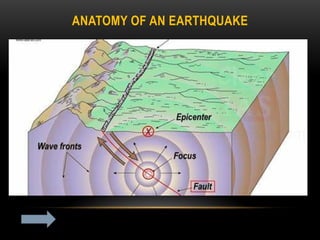
• Earthquakes happen through accumulated
pressure in the rocks which carries energy
given off as seismic waves.
• These are energy waves that travel outward
from an origin known as the focus or the
hypocenter.
• There are two major types of seismic
waves: body waves and surface waves.
THE ANATOMY OF AN EARTHQUAKE
• Body waves are very fast seismic
waves that move through or inside the
earth.
• They are considered the most
damaging type of seismic waves.
• Body waves are further categorized into
two: primary and secondary waves,
which travel at varying speeds.
THE ANATOMY OF AN EARTHQUAKE
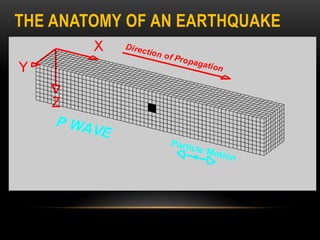
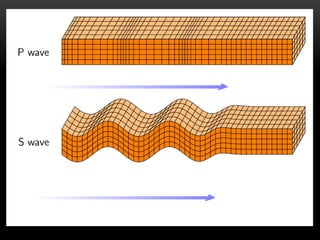
• The primary waves, or P waves, travel
faster than the other and are felt first
after the shaking of the ground begins.
• P waves generally move in a horizontal
motion, compressing and extending the
rocks backwards and forwards.
THE ANATOMY OF AN EARTHQUAKE
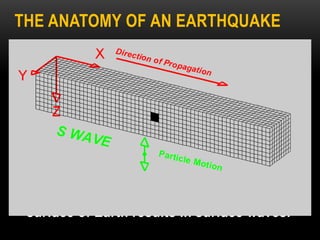
• On the other hand, secondary waves, or S
waves, travel slower, shaking the rocks up
and down and from side to side.
• S waves are considered as the more
dangerous and damaging type because they
push and crack the ground in different
directions.
• The interaction of P and S waves on the
surface of Earth results in surface waves.
THE ANATOMY OF AN EARTHQUAKE
• Surface waves are very slow, long waves
that move along the surface of earth.
• They produce rocking movement that cause
only little damage on structures.
• The Love wave and the Rayleigh wave are
considered as types of surface waves.
THE ANATOMY OF AN EARTHQUAKE
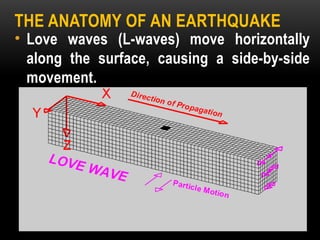
• Love waves (L-waves) move horizontally
along the surface, causing a side-by-side
movement.
THE ANATOMY OF AN EARTHQUAKE
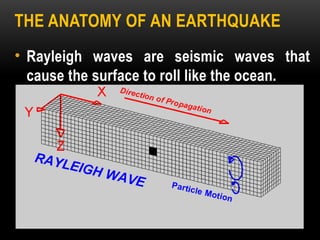
• Rayleigh waves are seismic waves that
cause the surface to roll like the ocean.
THE ANATOMY OF AN EARTHQUAKE
• The location on Earth’s crust situated
directly above the focus is known as the
epicenter.
• These points on Earth’s surface are
frequently plotted on maps of a location
where an earthquake has occurred.
THE ANATOMY OF AN EARTHQUAKE
• Identifying the magnitude of an earthquake
and locating its epicenter requires the use
of a seismograph.
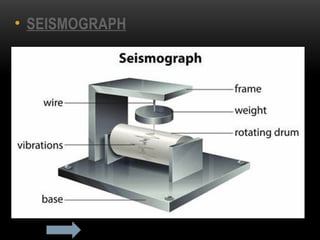
• A seismograph is an instrument that
records on paper the amplitudes of the
seismic waves in order to determine the
strength of Earth’s movement.
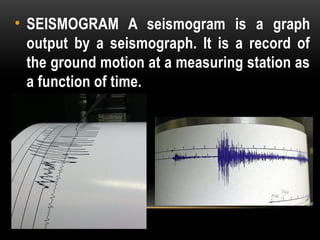
• The recorded graph of seismic waves is
called a seismogram.
• The term “seismo” is used quite
frequently; it comes from the Greek
word seismos which means
“earthquake”.
• The study of earthquakes is
referred to as seismology, while the
scientists who investigate this
phenomenon are called
seismologists.
• Modern-day seismologists use the seismograph to
measure the location and strength of an earthquake’s
vibrations.
• The main parts of a seismograph include the
following:
1. a paper where the vibrations are recorded;
2. a spring connecting a weight to a stand;
3. a cylindrical rotating drum that rotates the paper;
4. a weight that holds the pen; and
5. a pen which draws jagged lines on the rotating paper
as the device records the vibrations. The more jagged
lines drawn, the more intense an earthquake is.
• Note that a single seismogram
does not tell seismologists the
precise location of an epicenter;
seismologists have to compare
recordings in other parts of the
world in order to pinpoint the exact
location of an earthquake.
TYPES OF EARTHQUAKES
BASED ON FOCUS
• There are two particular
kinds of earthquakes based
on the depth of the focus:
shallow-focus earthquake
and deep-focus earthquake.
TYPES OF EARTHQUAKES BASED ON FOCUS
1. A shallow-focus earthquake is caused by a sub
ducting slab that is not deeper than 70 km beneath
Earth’s crust. Recall that during the convergence of
two plates, one plate is pushed downward to the
mantle below the other plate. As the plate pushes
deep into the mantle at a depth not more than 70 km,
it generates movement that is felt as strong
earthquakes. Shallow- focus earthquakes account for
about 75% of the total energy released by
earthquakes throughout a whole year. Their impact on
the crustal layer is highly noticeable; thus, they are
considered more dangerous than deep-focus
earthquakes.
TYPES OF EARTHQUAKES BASED ON FOCUS
2. Deep-focus earthquakes occur when the
subducting slab has plunged deeper than 70
km into the mantle. They likewise take place in
subduction zones below ocean trenches or
island arcs in oceanic plates. During a deep-
focus earthquake, the movement of the slab
towards the deeper part of Earth does not
induce as much crustal shaking as the slab in
a shallow-focus earthquake. Nonetheless,
extreme shallow- focus earthquakes can
trigger deep-focus earthquakes.
MAGNITUDE AND INTENSITY
• Seismographs also measure an earthquake’s
magnitude, the amount of energy released from
the focus of an earthquake.
• A closely related property is intensity, which is
a measure of the earthquake’s strength, based
on its impact on a specific location.
• Basically, the closer a location is to the
epicenter, the greater is its risk for damages.
MAGNITUDE AND INTENSITY
• Both magnitude and intensity are measured
through scales.
• The Richter magnitude scale is an apparatus
that indicates the magnitude of an earthquake,
using a logarithm that interprets the wave
amplitudes on a seismogram.
• The scale was developed in 1935 by the
American seismologist, Charles F. Richter.
• Table 3.1 shows The Richter Magnitude Scale
MAGNITUDE AND INTENSITY
• On the other hand, some countries in the world,
including the Philippines, use their own intensity
scales to measure the severity of an
earthquake’s impact.
• The Rossi-Forel Intensity Scale, developed by
the Italian Michele de Rossi and the Swiss
François-Alphonse Forel in the late 19th century,
was used formerly by PHIVOLCS before
developing its own intensity scale.
MAGNITUDE AND INTENSITY
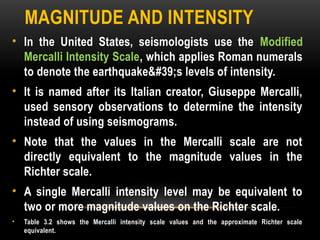
• In the United States, seismologists use the Modified
Mercalli Intensity Scale, which applies Roman numerals
to denote the earthquake's levels of intensity.
• It is named after its Italian creator, Giuseppe Mercalli,
used sensory observations to determine the intensity
instead of using seismograms.
• Note that the values in the Mercalli scale are not
directly equivalent to the magnitude values in the
Richter scale.
• A single Mercalli intensity level may be equivalent to
two or more magnitude values on the Richter scale.
• Table 3.2 shows the Mercalli intensity scale values and the approximate Richter scale
equivalent.
MAGNITUDE AND INTENSITY
• PHIVOLCS has developed an official intensity scale
used for measuring the impact of an earthquake that
strikes the country.
• This is known as the PHIVOLCS Earthquake Intensity
Scale (PEIS).
• Table 3.3 shows PHIVOLCS Earthquake Intensity Scale.
LOCATING THE EPICENTER OF AN
EARTHQUAKE
• Scientists can determine the central point
of an earthquake on the surface of Earth
with the use of seismograms. To locate the
epicenter, consider the following steps:
1.In locating an earthquake’s epicenter, you
will need at least three seismograms from
three different places. Consider the
following example below.
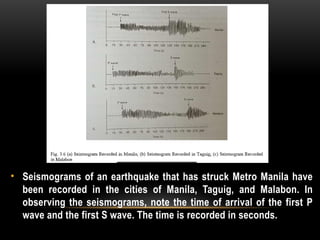
• Seismograms of an earthquake that has struck Metro Manila have
been recorded in the cities of Manila, Taguig, and Malabon. In
observing the seismograms, note the time of arrival of the first P
wave and the first S wave. The time is recorded in seconds.
LOCATING THE EPICENTER OF AN
EARTHQUAKE
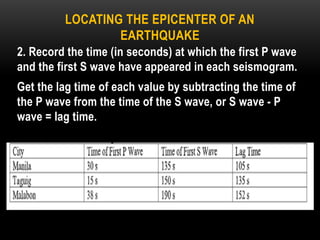
2. Record the time (in seconds) at which the first P wave
and the first S wave have appeared in each seismogram.
Get the lag time of each value by subtracting the time of
the P wave from the time of the S wave, or S wave - P
wave = lag time.
LOCATING THE EPICENTER OF AN
EARTHQUAKE
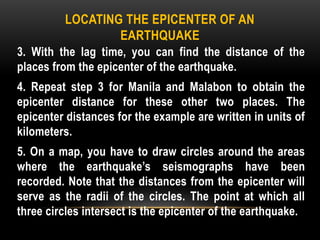
3. With the lag time, you can find the distance of the
places from the epicenter of the earthquake.
4. Repeat step 3 for Manila and Malabon to obtain the
epicenter distance for these other two places. The
epicenter distances for the example are written in units of
kilometers.
5. On a map, you have to draw circles around the areas
where the earthquake’s seismographs have been
recorded. Note that the distances from the epicenter will
serve as the radii of the circles. The point at which all
three circles intersect is the epicenter of the earthquake.
ANATOMY OF AN EARTHQUAKE
• SEISMOGRAPH
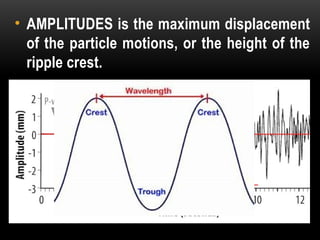
• AMPLITUDES is the maximum displacement
of the particle motions, or the height of the
ripple crest.
• SEISMOGRAM A seismogram is a graph
output by a seismograph. It is a record of
the ground motion at a measuring station as
a function of time.
LESSON 3.pptx presentation lesson powerpoint

LESSON 3.pptx presentation lesson powerpoint

  • 1.
  • 2.
    INTRODUCTION • In Greekmythology, it was thought that Poseidon, Greek god of the sea, would sometimes induce quaking, using his mighty trident. • Because of this myth, Poseidon was also dubbed as the “Earthshaker”.
  • 3.
    • On theother hand, Japanese mythology introduced the giant catfish, Namazu, which lived and roamed in a sea located beneath the land of Japan. • Namazu was believed to have caused the trembling of Earth which often led to the occurrence of tsunamis along Japanese coastlines. • A heroic god of thunder named Takemikazuchi-no-mikoto subdued the giant sea monster by pinning its head down with the special stone called kaname-ishi. • Takemikazuchi-no-mikoto’s actions were said to have reduced the damaging impact of the earthquake on the lives of the Japanese people. • In some depictions of the story, the Japanese people themselves were shown to be attacking Namazu as punishment for the destruction he has caused.
  • 4.
    • In Philippinemythology, a big, muscular hero named Bernardo Carpio was believed to have caused earthquakes when he tried to escape from his imprisonment. • According to some versions of the tale, the hero was unjustly chained up in prison by his enemies and, in a fit of rage, would tug forcefully on the chains to break free. • He thought that if he pulled hard enough, he could break the chains; thus, he gave an earthshaking tug that trembled through the islands of the Philippines, until finally he set himself free.
  • 5.
    • While thesestories have presented interesting explanations for the occurrence of earthquakes, in today’s world, an EARTHQUAKE is defined as a natural shaking of Earth’s lithosphere caused by the release of energy stored in the lithospheric rocks. • When plates move, they either drift apart or collide as Earth recycles itself. • The plates, however, will continue to move, and eventually, the portions stuck together will release the pressure and break apart, sending strong energy waves through the various layers of the planet. • The waves travel through the ground towards different directions and the resulting vibrations are felt as an earthquake.
  • 6.
    THE ANATOMY OFAN EARTHQUAKE • Earthquakes happen through accumulated pressure in the rocks which carries energy given off as seismic waves. • These are energy waves that travel outward from an origin known as the focus or the hypocenter. • There are two major types of seismic waves: body waves and surface waves.
  • 7.
    THE ANATOMY OFAN EARTHQUAKE • Body waves are very fast seismic waves that move through or inside the earth. • They are considered the most damaging type of seismic waves. • Body waves are further categorized into two: primary and secondary waves, which travel at varying speeds.
  • 8.
    THE ANATOMY OFAN EARTHQUAKE • The primary waves, or P waves, travel faster than the other and are felt first after the shaking of the ground begins. • P waves generally move in a horizontal motion, compressing and extending the rocks backwards and forwards.
  • 9.
    THE ANATOMY OFAN EARTHQUAKE • On the other hand, secondary waves, or S waves, travel slower, shaking the rocks up and down and from side to side. • S waves are considered as the more dangerous and damaging type because they push and crack the ground in different directions. • The interaction of P and S waves on the surface of Earth results in surface waves.
  • 11.
    THE ANATOMY OFAN EARTHQUAKE • Surface waves are very slow, long waves that move along the surface of earth. • They produce rocking movement that cause only little damage on structures. • The Love wave and the Rayleigh wave are considered as types of surface waves.
  • 12.
    THE ANATOMY OFAN EARTHQUAKE • Love waves (L-waves) move horizontally along the surface, causing a side-by-side movement.
  • 13.
    THE ANATOMY OFAN EARTHQUAKE • Rayleigh waves are seismic waves that cause the surface to roll like the ocean.
  • 14.
    THE ANATOMY OFAN EARTHQUAKE • The location on Earth’s crust situated directly above the focus is known as the epicenter. • These points on Earth’s surface are frequently plotted on maps of a location where an earthquake has occurred.
  • 15.
    THE ANATOMY OFAN EARTHQUAKE • Identifying the magnitude of an earthquake and locating its epicenter requires the use of a seismograph. • A seismograph is an instrument that records on paper the amplitudes of the seismic waves in order to determine the strength of Earth’s movement. • The recorded graph of seismic waves is called a seismogram.
  • 16.
    • The term“seismo” is used quite frequently; it comes from the Greek word seismos which means “earthquake”. • The study of earthquakes is referred to as seismology, while the scientists who investigate this phenomenon are called seismologists.
  • 17.
    • Modern-day seismologistsuse the seismograph to measure the location and strength of an earthquake’s vibrations. • The main parts of a seismograph include the following: 1. a paper where the vibrations are recorded; 2. a spring connecting a weight to a stand; 3. a cylindrical rotating drum that rotates the paper; 4. a weight that holds the pen; and 5. a pen which draws jagged lines on the rotating paper as the device records the vibrations. The more jagged lines drawn, the more intense an earthquake is.
  • 18.
    • Note thata single seismogram does not tell seismologists the precise location of an epicenter; seismologists have to compare recordings in other parts of the world in order to pinpoint the exact location of an earthquake.
  • 19.
    TYPES OF EARTHQUAKES BASEDON FOCUS • There are two particular kinds of earthquakes based on the depth of the focus: shallow-focus earthquake and deep-focus earthquake.
  • 20.
    TYPES OF EARTHQUAKESBASED ON FOCUS 1. A shallow-focus earthquake is caused by a sub ducting slab that is not deeper than 70 km beneath Earth’s crust. Recall that during the convergence of two plates, one plate is pushed downward to the mantle below the other plate. As the plate pushes deep into the mantle at a depth not more than 70 km, it generates movement that is felt as strong earthquakes. Shallow- focus earthquakes account for about 75% of the total energy released by earthquakes throughout a whole year. Their impact on the crustal layer is highly noticeable; thus, they are considered more dangerous than deep-focus earthquakes.
  • 21.
    TYPES OF EARTHQUAKESBASED ON FOCUS 2. Deep-focus earthquakes occur when the subducting slab has plunged deeper than 70 km into the mantle. They likewise take place in subduction zones below ocean trenches or island arcs in oceanic plates. During a deep- focus earthquake, the movement of the slab towards the deeper part of Earth does not induce as much crustal shaking as the slab in a shallow-focus earthquake. Nonetheless, extreme shallow- focus earthquakes can trigger deep-focus earthquakes.
  • 22.
    MAGNITUDE AND INTENSITY •Seismographs also measure an earthquake’s magnitude, the amount of energy released from the focus of an earthquake. • A closely related property is intensity, which is a measure of the earthquake’s strength, based on its impact on a specific location. • Basically, the closer a location is to the epicenter, the greater is its risk for damages.
  • 23.
    MAGNITUDE AND INTENSITY •Both magnitude and intensity are measured through scales. • The Richter magnitude scale is an apparatus that indicates the magnitude of an earthquake, using a logarithm that interprets the wave amplitudes on a seismogram. • The scale was developed in 1935 by the American seismologist, Charles F. Richter. • Table 3.1 shows The Richter Magnitude Scale
  • 24.
    MAGNITUDE AND INTENSITY •On the other hand, some countries in the world, including the Philippines, use their own intensity scales to measure the severity of an earthquake’s impact. • The Rossi-Forel Intensity Scale, developed by the Italian Michele de Rossi and the Swiss François-Alphonse Forel in the late 19th century, was used formerly by PHIVOLCS before developing its own intensity scale.
  • 25.
    MAGNITUDE AND INTENSITY •In the United States, seismologists use the Modified Mercalli Intensity Scale, which applies Roman numerals to denote the earthquake's levels of intensity. • It is named after its Italian creator, Giuseppe Mercalli, used sensory observations to determine the intensity instead of using seismograms. • Note that the values in the Mercalli scale are not directly equivalent to the magnitude values in the Richter scale. • A single Mercalli intensity level may be equivalent to two or more magnitude values on the Richter scale. • Table 3.2 shows the Mercalli intensity scale values and the approximate Richter scale equivalent.
  • 26.
    MAGNITUDE AND INTENSITY •PHIVOLCS has developed an official intensity scale used for measuring the impact of an earthquake that strikes the country. • This is known as the PHIVOLCS Earthquake Intensity Scale (PEIS). • Table 3.3 shows PHIVOLCS Earthquake Intensity Scale.
  • 28.
    LOCATING THE EPICENTEROF AN EARTHQUAKE • Scientists can determine the central point of an earthquake on the surface of Earth with the use of seismograms. To locate the epicenter, consider the following steps: 1.In locating an earthquake’s epicenter, you will need at least three seismograms from three different places. Consider the following example below.

  • 29.
    • Seismograms ofan earthquake that has struck Metro Manila have been recorded in the cities of Manila, Taguig, and Malabon. In observing the seismograms, note the time of arrival of the first P wave and the first S wave. The time is recorded in seconds.
  • 30.
    LOCATING THE EPICENTEROF AN EARTHQUAKE 2. Record the time (in seconds) at which the first P wave and the first S wave have appeared in each seismogram. Get the lag time of each value by subtracting the time of the P wave from the time of the S wave, or S wave - P wave = lag time.
  • 31.
    LOCATING THE EPICENTEROF AN EARTHQUAKE 3. With the lag time, you can find the distance of the places from the epicenter of the earthquake. 4. Repeat step 3 for Manila and Malabon to obtain the epicenter distance for these other two places. The epicenter distances for the example are written in units of kilometers. 5. On a map, you have to draw circles around the areas where the earthquake’s seismographs have been recorded. Note that the distances from the epicenter will serve as the radii of the circles. The point at which all three circles intersect is the epicenter of the earthquake.
  • 33.
    ANATOMY OF ANEARTHQUAKE
  • 34.
  • 35.
    • AMPLITUDES isthe maximum displacement of the particle motions, or the height of the ripple crest.
  • 36.
    • SEISMOGRAM Aseismogram is a graph output by a seismograph. It is a record of the ground motion at a measuring station as a function of time.

Editor's Notes

  • #2 Back when scientists have not yet found means to detect tectonic activity, people in ancient civilizations formulated their own theories about the shaking of the ground.
  • #15 MAGNITUDE IS THE SIZE OF THE EARTHQUAKE.