Beyond Earth: Exploring Our
Universe
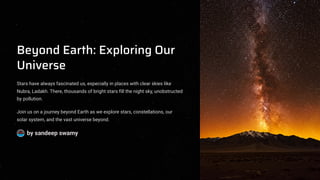
Stars have always fascinated us, especially in places with clear skies like
Nubra, Ladakh. There, thousands of bright stars fill the night sky, unobstructed
by pollution.
Join us on a journey beyond Earth as we explore stars, constellations, our
solar system, and the vast universe beyond.
by sandeep swamy
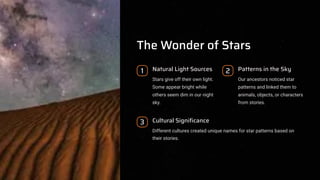
The Wonder of Stars
1 Natural Light Sources
Stars give off their own light.
Some appear bright while
others seem dim in our night
sky.
2 Patterns in the Sky
Our ancestors noticed star
patterns and linked them to
animals, objects, or characters
from stories.
3 Cultural Significance
Different cultures created unique names for star patterns based on
their stories.
Stars as Ancient Navigation
Tools
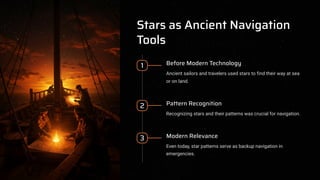
1 Before Modern Technology
Ancient sailors and travelers used stars to find their way at sea
or on land.
2 Pattern Recognition
Recognizing stars and their patterns was crucial for navigation.
3 Modern Relevance
Even today, star patterns serve as backup navigation in
emergencies.
Understanding Constellations
Definition
Constellations are groups of stars
forming patterns, connected by
imaginary lines.
Famous Example
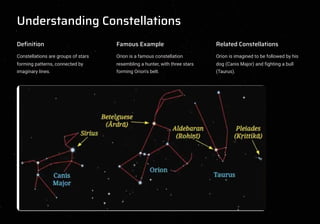
Orion is a famous constellation
resembling a hunter, with three stars
forming Orion's belt.
Related Constellations
Orion is imagined to be followed by his
dog (Canis Major) and fighting a bull
(Taurus).
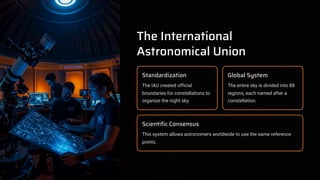
The International
Astronomical Union
Standardization
The IAU created official
boundaries for constellations to
organize the night sky.
Global System
The entire sky is divided into 88
regions, each named after a
constellation.
Scientific Consensus
This system allows astronomers worldwide to use the same reference
points.
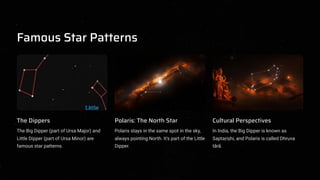
Famous Star Patterns
The Dippers
The Big Dipper (part of Ursa Major) and
Little Dipper (part of Ursa Minor) are
famous star patterns.
Polaris: The North Star
Polaris stays in the same spot in the sky,
always pointing North. It's part of the Little
Dipper.
Cultural Perspectives
In India, the Big Dipper is known as
Sapta i hi, and Polaris is called Dhruva
tr.
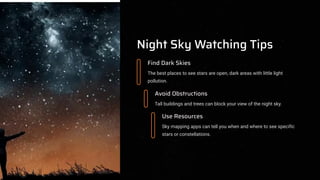
Night Sky Watching Tips
Find Dark Skies
The best places to see stars are open, dark areas with little light
pollution.
Avoid Obstructions
Tall buildings and trees can block your view of the night sky.
Use Resources
Sky mapping apps can tell you when and where to see specific
stars or constellations.
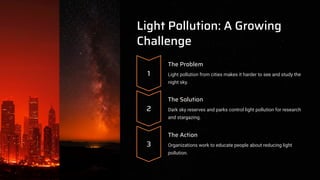
Light Pollution: A Growing
Challenge
1
The Problem
Light pollution from cities makes it harder to see and study the
night sky.
2
The Solution
Dark sky reserves and parks control light pollution for research
and stargazing.
3
The Action
Organizations work to educate people about reducing light
pollution.
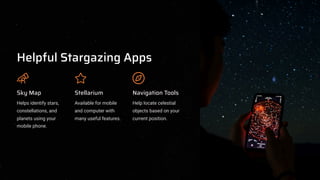
Helpful Stargazing Apps
Sky Map
Helps identify stars,
constellations, and
planets using your
mobile phone.
Stellarium
Available for mobile
and computer with
many useful features.
Navigation Tools
Help locate celestial
objects based on your
current position.
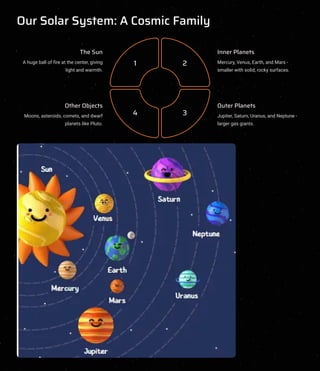
Our Solar System: A Cosmic Family
1 2
3
4
The Sun
A huge ball of fire at the center, giving
light and warmth.
Inner Planets
Mercury, Venus, Earth, and Mars -
smaller with solid, rocky surfaces.
Outer Planets
Jupiter, Saturn, Uranus, and Neptune -
larger gas giants.
Other Objects
Moons, asteroids, comets, and dwarf
planets like Pluto.
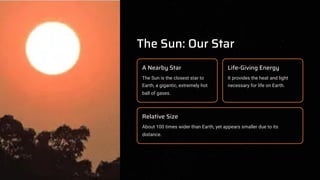
The Sun: Our Star
A Nearby Star
The Sun is the closest star to
Earth, a gigantic, extremely hot
ball of gases.
Life-Giving Energy
It provides the heat and light
necessary for life on Earth.
Relative Size
About 100 times wider than Earth, yet appears smaller due to its
distance.
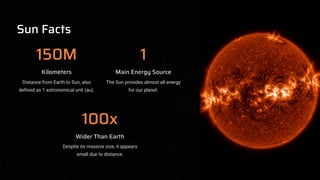
Sun Facts
150M
Kilometers
Distance from Earth to Sun, also
defined as 1 astronomical unit (au).
1
Main Energy Source
The Sun provides almost all energy
for our planet.
100x
Wider Than Earth
Despite its massive size, it appears
small due to distance.
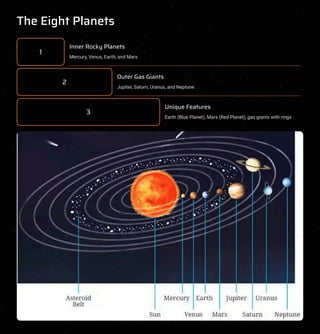
The Eight Planets
1
Inner Rocky Planets
Mercury, Venus, Earth, and Mars
2
Outer Gas Giants
Jupiter, Saturn, Uranus, and Neptune
3
Unique Features
Earth (Blue Planet), Mars (Red Planet), gas giants with rings
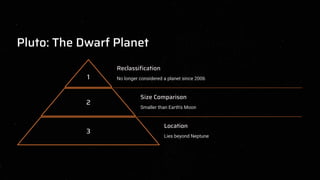
Pluto: The Dwarf Planet
1
Reclassification
No longer considered a planet since 2006
2
Size Comparison
Smaller than Earth's Moon
3
Location
Lies beyond Neptune
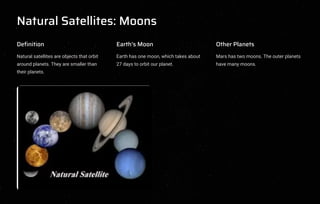
Natural Satellites: Moons
Definition
Natural satellites are objects that orbit
around planets. They are smaller than
their planets.
Earth's Moon
Earth has one moon, which takes about
27 days to orbit our planet.
Other Planets
Mars has two moons. The outer planets
have many moons.
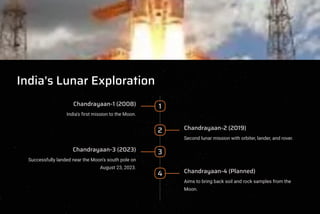
India's Lunar Exploration
1
Chandrayaan-1 (2008)
India's first mission to the Moon.
2 Chandrayaan-2 (2019)
Second lunar mission with orbiter, lander, and rover.
3
Chandrayaan-3 (2023)
Successfully landed near the Moon's south pole on
August 23, 2023.
4 Chandrayaan-4 (Planned)
Aims to bring back soil and rock samples from the
Moon.
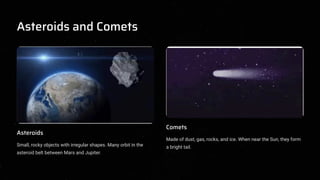
Asteroids and Comets
Asteroids
Small, rocky objects with irregular shapes. Many orbit in the
asteroid belt between Mars and Jupiter.
Comets
Made of dust, gas, rocks, and ice. When near the Sun, they form
a bright tail.
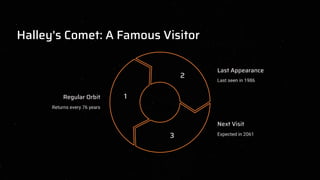
Halley's Comet: A Famous Visitor
1
2
3
Regular Orbit
Returns every 76 years
Last Appearance
Last seen in 1986
Next Visit
Expected in 2061
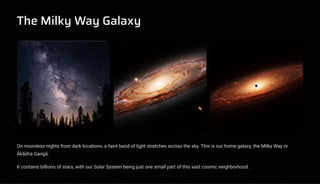
The Milky Way Galaxy
On moonless nights from dark locations, a faint band of light stretches across the sky. This is our home galaxy, the Milky Way or
k[ha Gang.
It contains billions of stars, with our Solar System being just one small part of this vast cosmic neighborhood.
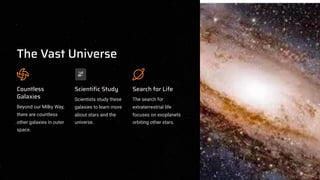
The Vast Universe
Countless
Galaxies
Beyond our Milky Way,
there are countless
other galaxies in outer
space.
Scientific Study
Scientists study these
galaxies to learn more
about stars and the
universe.
Search for Life
The search for
extraterrestrial life
focuses on exoplanets
orbiting other stars.