CHAPTER -11
LIGHT , SHADOW
AND REFLECTION
Contents :
◦ Introduction
◦ Sources of Light
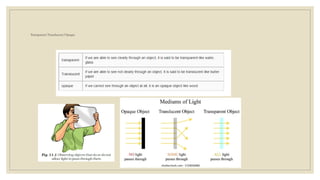
◦ Transparent/Translucent/Opaque
◦ Formation of shadows
◦ A Pin-Hole Camera
◦ Natural Pin-hole Camera
◦ Rectilinear Propagation of Light
◦ Reflection of Light
WHAT IS LIGHT?
◦ The devices such as mobile phones, microwave ovens, remote control and scanning
machine use electromagnetic radiations(radio waves, microwaves, infrared waves and X-
rays) to work.
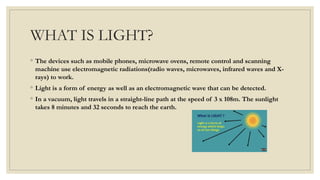
◦ Light is a form of energy as well as an electromagnetic wave that can be detected.
◦ In a vacuum, light travels in a straight-line path at the speed of 3 x 10⁸m. The sunlight
takes 8 minutes and 32 seconds to reach the earth.
Importance of Light
◦ Light is the main source of energy for animals and plants.
◦ The sunlight provides natural warmth that creates suitable conditions for the growth and
development of life.
◦ The green plants required sunlight to make their food by the process of photosynthesis.
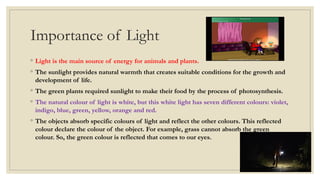
◦ The natural colour of light is white, but this white light has seven different colours: violet,
indigo, blue, green, yellow, orange and red.
◦ The objects absorb specific colours of light and reflect the other colours. This reflected
colour declare the colour of the object. For example, grass cannot absorb the green
colour. So, the green colour is reflected that comes to our eyes.
Sources of Light:
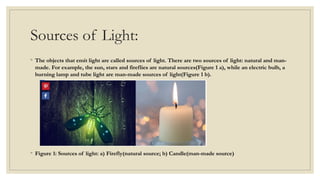
◦ The objects that emit light are called sources of light. There are two sources of light: natural and man-
made. For example, the sun, stars and fireflies are natural sources(Figure 1 a), while an electric bulb, a
burning lamp and tube light are man-made sources of light(Figure 1 b).
◦ Figure 1: Sources of light: a) Firefly(natural source; b) Candle(man-made source)
Sources of Light:
◦ The objects that become hot when they emit light are called hot sources of light. For example, the
sun, a burning candle or lamp and an electric bulb, etc(Figure 2)
◦ Figure 2: Hot source of light: the sun.
Bioluminescence, Luminous and Non-
Luminous Object:
◦ Bioluminescence: A natural phenomenon of emitting light by the objects. In bioluminescence, the
objects covert chemical energy into light energy. Some of the examples are phytoplankton, fireflies,
jellyfish and algae, etc.
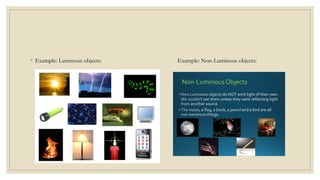
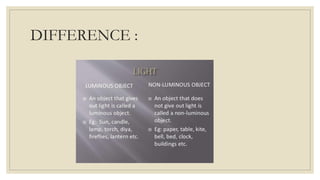
◦ Luminous objects: The objects that have their own light. For example, the sun, stars and torch, etc.
◦ Non-luminous objects: The objects that do not produce their own light. For example, tables, chairs
and books, etc.
◦ Example :Bioluminescence:
◦ Example: Luminous objects: Example: Non-Luminous objects:
DIFFERENCE :
Transparent/Translucent/Opaque
What is Shadow ?
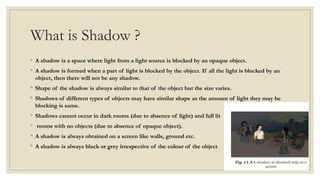
◦ A shadow is a space where light from a light source is blocked by an opaque object.
◦ A shadow is formed when a part of light is blocked by the object. If all the light is blocked by an
object, then there will not be any shadow.
◦ Shape of the shadow is always similar to that of the object but the size varies.
◦ Shadows of different types of objects may have similar shape as the amount of light they may be
blocking is same.
◦ Shadows cannot occur in dark rooms (due to absence of light) and full lit
◦ rooms with no objects (due to absence of opaque object).
◦ A shadow is always obtained on a screen like walls, ground etc.
◦ A shadow is always black or grey irrespective of the colour of the object
Formation of shadows
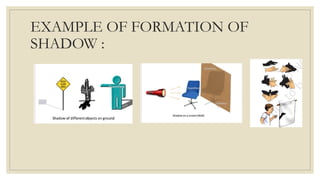
◦ When an opaque object is placed in path of light, a dark portion is formed on the opposite side of
object on the screen. This dark portion is shadow.
◦ (1) The size of shadow depends on the distance of source of light and on the angle at which the
light rays fall on the object.
◦ (2) If the source of light is closer to the object, a larger shadow is formed than when the source of
light is far from the object.
◦ (3) The shadow can be seen only on a screen. The ground, walls of the rooms, a building, or other
such surfaces act as a screen for the shadows you observe in everyday life
◦ (4) Shadows sometimes gives lot of information about the object.
◦ (5) Shadows are in black in colour and this is not changed by the colour of the opaque objects. So a
red and yellow rose will have same black shadows.
EXAMPLE OF FORMATION OF
SHADOW :
Nature of a Shadow:
◦ The shadow is categorised into two parts based on the brightness of the dark patches:-
◦ i. Umbra: It is the darkest part of the shadow present in the middle of it, which forms due to the absence of
light.
◦ ii. Penumbra: It is the faintest part of the shadow present at the corners of it. It is formed when the light is
not completely blocked(Figure 7).
Characteristics of a Shadow
◦ An opaque screen is required to form a shadow. If there is no screen then no shadow will
form.
◦ The colour of the shadow is always black.
◦ A shadow casts the shape of the opaque object only.
Characteristics of a Shadow
◦ The size of the shadow varies according to the presence of light coming from the different angles:-
◦ If the distance between the source of light and an opaque object is decreased then the size of the
shadow forms large dark patches.
◦ If the distance between the source of light and an opaque object is increased then the shadow is
small.
◦ If the distance between the object and the screen is decreased
◦ then the shadow is small.
◦ If the distance between the object and the screen is increased then
◦ the shadow is large.
ECLIPSES:
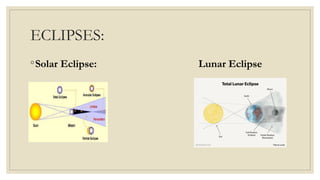
◦ The eclipses are formed on the basis of rectilinear propagation. They are shadows formed naturally
when the sun, moon and earth aligned in a straight line.
◦ Solar Eclipse:
◦ When the sun, moon and earth align in a straight line and the moon falls between the sun
and the earth casts its shadow on earth then this phenomenon is known as solar eclipse.
◦ During a solar eclipse, the dark side of the moon faces the earth. This phenomenon takes
place on a new moon day.
Solar Eclipse:
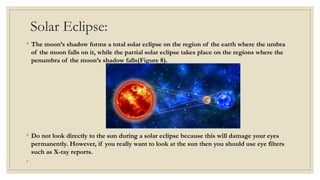
◦ The moon’s shadow forms a total solar eclipse on the region of the earth where the umbra
of the moon falls on it, while the partial solar eclipse takes place on the regions where the
penumbra of the moon’s shadow falls(Figure 8).
◦ Do not look directly to the sun during a solar eclipse because this will damage your eyes
permanently. However, if you really want to look at the sun then you should use eye filters
such as X-ray reports.
◦
LUNAR ECLIPSE
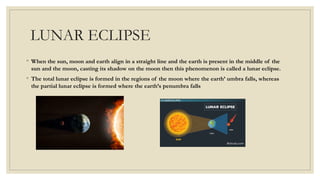
◦ When the sun, moon and earth align in a straight line and the earth is present in the middle of the
sun and the moon, casting its shadow on the moon then this phenomenon is called a lunar eclipse.
◦ The total lunar eclipse is formed in the regions of the moon where the earth’ umbra falls, whereas
the partial lunar eclipse is formed where the earth’s penumbra falls
ECLIPSES:
◦Solar Eclipse: Lunar Eclipse
A Pin-Hole Camera
◦ How to prepare it
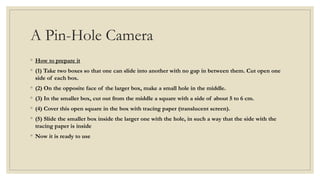
◦ (1) Take two boxes so that one can slide into another with no gap in between them. Cut open one
side of each box.
◦ (2) On the opposite face of the larger box, make a small hole in the middle.
◦ (3) In the smaller box, cut out from the middle a square with a side of about 5 to 6 cm.
◦ (4) Cover this open square in the box with tracing paper (translucent screen).
◦ (5) Slide the smaller box inside the larger one with the hole, in such a way that the side with the
tracing paper is inside
◦ Now it is ready to use
A Pin-Hole Camera
◦ How to use it
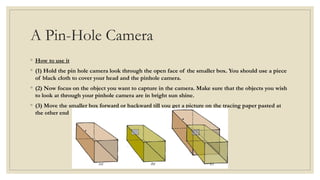
◦ (1) Hold the pin hole camera look through the open face of the smaller box. You should use a piece
of black cloth to cover your head and the pinhole camera.
◦ (2) Now focus on the object you want to capture in the camera. Make sure that the objects you wish
to look at through your pinhole camera are in bright sun shine.
◦ (3) Move the smaller box forward or backward till you get a picture on the tracing paper pasted at
the other end
How the Images looks like pin-hole
camera?
◦ Upside down (inverted) images are formed. Image in a pin hole camera is real , inverted and
smaller in size.
◦ A pinhole camera that is used to capture the images of the sun is called solargraphy.
Natural Pin-hole Camera
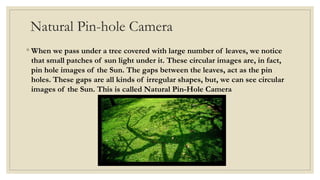
◦ When we pass under a tree covered with large number of leaves, we notice
that small patches of sun light under it. These circular images are, in fact,
pin hole images of the Sun. The gaps between the leaves, act as the pin
holes. These gaps are all kinds of irregular shapes, but, we can see circular
images of the Sun. This is called Natural Pin-Hole Camera
Rectilinear Propagation of Light
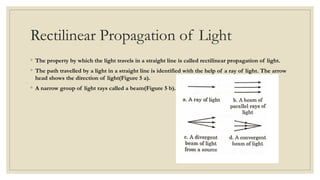
◦ The property by which the light travels in a straight line is called rectilinear propagation of light.
◦ The path travelled by a light in a straight line is identified with the help of a ray of light. The arrow
head shows the direction of light(Figure 5 a).
◦ A narrow group of light rays called a beam(Figure 5 b).
Rectilinear Propagation of Light
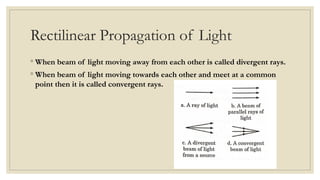
◦ When beam of light moving away from each other is called divergent rays.
◦ When beam of light moving towards each other and meet at a common
point then it is called convergent rays.
Producing a Beam of Light
◦ We produce a beam of light by using a light box.
◦ The light box is composed of a cardboard box with a tiny hole on one of its faces and an electric
bulb.
◦ When an electric bulb glows, the light comes out of the hole producing a beam of light.
Mirror
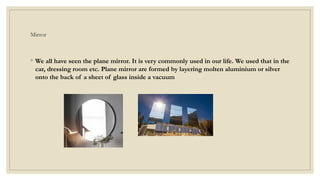
◦ We all have seen the plane mirror. It is very commonly used in our life. We used that in the
car, dressing room etc. Plane mirror are formed by layering molten aluminium or silver
onto the back of a sheet of glass inside a vacuum
Reflection of Light
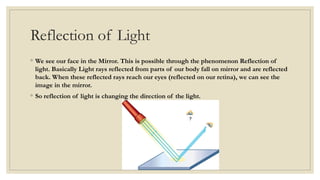
◦ We see our face in the Mirror. This is possible through the phenomenon Reflection of
light. Basically Light rays reflected from parts of our body fall on mirror and are reflected
back. When these reflected rays reach our eyes (reflected on our retina), we can see the
image in the mirror.
◦ So reflection of light is changing the direction of the light.
Refraction of Light :
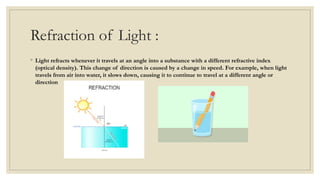
◦ Light refracts whenever it travels at an angle into a substance with a different refractive index
(optical density). This change of direction is caused by a change in speed. For example, when light
travels from air into water, it slows down, causing it to continue to travel at a different angle or
direction
Image formation by Plane Mirror
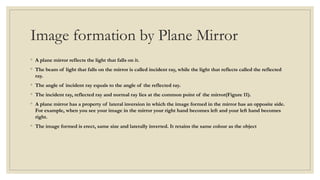
◦ A plane mirror reflects the light that falls on it.
◦ The beam of light that falls on the mirror is called incident ray, while the light that reflects called the reflected
ray.
◦ The angle of incident ray equals to the angle of the reflected ray.
◦ The incident ray, reflected ray and normal ray lies at the common point of the mirror(Figure 11).
◦ A plane mirror has a property of lateral inversion in which the image formed in the mirror has an opposite side.
For example, when you see your image in the mirror your right hand becomes left and your left hand becomes
right.
◦ The image formed is erect, same size and laterally inverted. It retains the same colour as the object
SOME LIGHT TERMS :
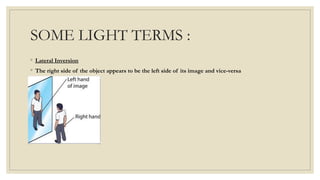
◦ Lateral Inversion
◦ The right side of the object appears to be the left side of its image and vice-versa
SOME LIGHT TERMS :
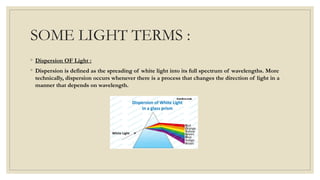
◦ Dispersion OF Light :
◦ Dispersion is defined as the spreading of white light into its full spectrum of wavelengths. More
technically, dispersion occurs whenever there is a process that changes the direction of light in a
manner that depends on wavelength.
◦Chapter – 11
◦Light Shadow and Reflection
◦COMPLETED