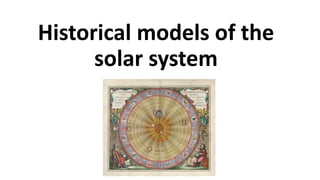
Historical models of the
solar system
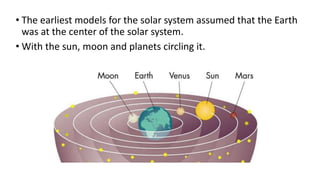
• The earliest models for the solar system assumed that the Earth
was at the center of the solar system.
• With the sun, moon and planets circling it.
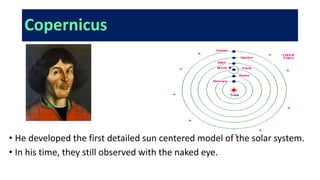
Copernicus
• He developed the first detailed sun centered model of the solar system.
• In his time, they still observed with the naked eye.
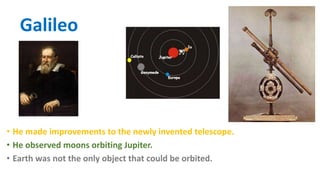
Galileo
• He made improvements to the newly invented telescope.
• He observed moons orbiting Jupiter.
• Earth was not the only object that could be orbited.
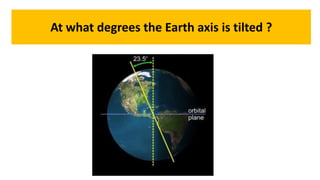
At what degrees the Earth axis is tilted ?
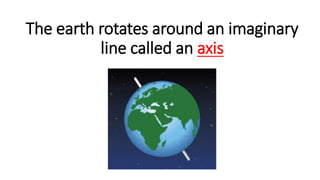
The earth rotates around an imaginary
line called an axis
Earth spins around itself
Rotation – rotate
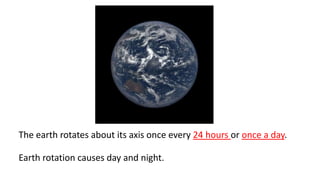
The earth rotates about its axis once every 24 hours or once a day.
Earth rotation causes day and night.
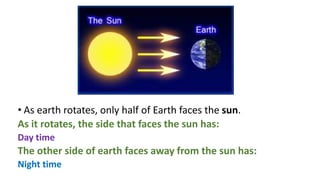
• As earth rotates, only half of Earth faces the sun.
As it rotates, the side that faces the sun has:
Day time
The other side of earth faces away from the sun has:
Night time
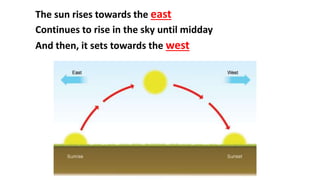
The sun rises towards the east
Continues to rise in the sky until midday
And then, it sets towards the west
How would night and day be different if Earth
did not rotate ?
Half of the Earth would always face the sun and have day
The other half of earth would always face away from the
sun and have night.
Where is Earth’s axis ?
Through its center
Why is one half of Earth lit?
It is facing the sun, so the sun is shining on it
Why is the other half of Earth dark ?
It is facing away from the sun, so there is no light on it.
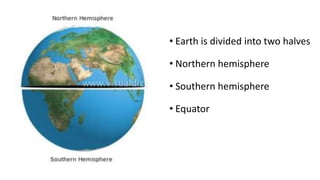
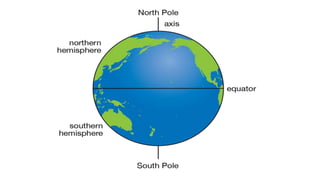
• Earth is divided into two halves
• Northern hemisphere
• Southern hemisphere
• Equator
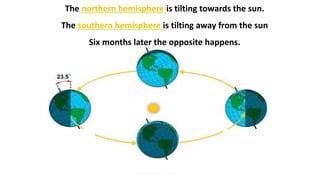
The northern hemisphere is tilting towards the sun.
The southern hemisphere is tilting away from the sun
Six months later the opposite happens.
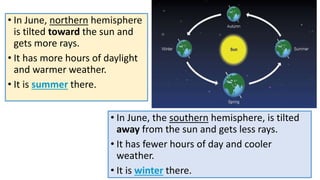
• In June, northern hemisphere
is tilted toward the sun and
gets more rays.
• It has more hours of daylight
and warmer weather.
• It is summer there.
• In June, the southern hemisphere, is tilted
away from the sun and gets less rays.
• It has fewer hours of day and cooler
weather.
• It is winter there.
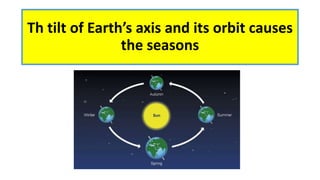
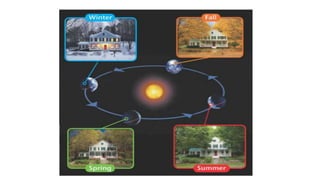
Th tilt of Earth’s axis and its orbit causes
the seasons
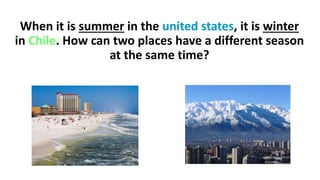
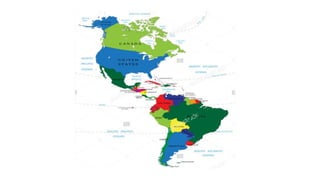
When it is summer in the united states, it is winter
in Chile. How can two places have a different season
at the same time?
What causes the seasons ?
Earth’s tilt on its axis as it revolves around the sun
In which direction does Earth’s northern hemisphere
point when it is winter there?
Away from the sun
In which direction does the northern hemisphere
point when it is summer there ?
Toward the sun
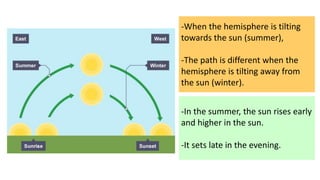
-In the summer, the sun rises early
and higher in the sun.
-It sets late in the evening.
-When the hemisphere is tilting
towards the sun (summer),
-The path is different when the
hemisphere is tilting away from
the sun (winter).
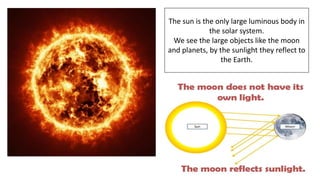
The sun is the only large luminous body in
the solar system.
We see the large objects like the moon
and planets, by the sunlight they reflect to
the Earth.
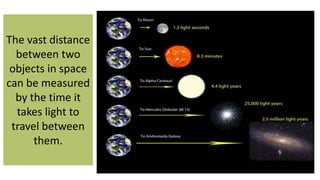
The vast distance
between two
objects in space
can be measured
by the time it
takes light to
travel between
them.
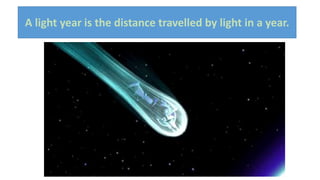
A light year is the distance travelled by light in a year.
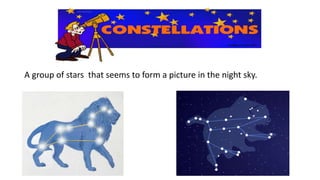
A group of stars that seems to form a picture in the night sky.
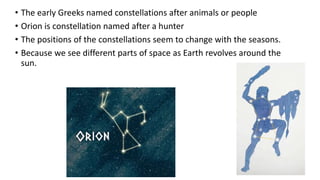
• The early Greeks named constellations after animals or people
• Orion is constellation named after a hunter
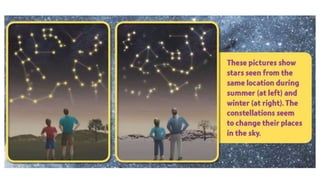
• The positions of the constellations seem to change with the seasons.
• Because we see different parts of space as Earth revolves around the
sun.
What do you see when you look up at the night sky ?
Stars, the moon
Why do you think people in the southern hemisphere
see some different constellations than people in the
northern hemisphere ?
People who live in different hemispheres of Earth see
different parts of the sky
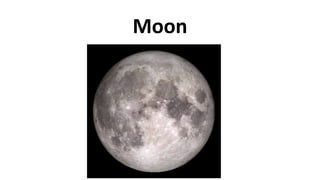
Moon
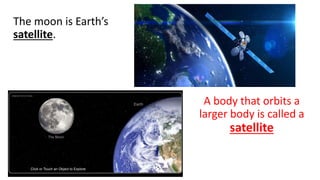
The moon is Earth’s
satellite.
A body that orbits a
larger body is called a
satellite
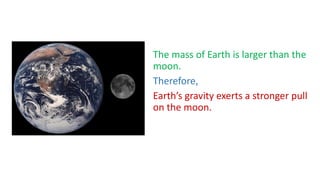
The mass of Earth is larger than the
moon.
Therefore,
Earth’s gravity exerts a stronger pull
on the moon.
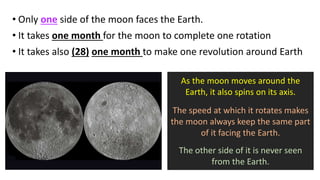
• Only one side of the moon faces the Earth.
• It takes one month for the moon to complete one rotation
• It takes also (28) one month to make one revolution around Earth
As the moon moves around the
Earth, it also spins on its axis.
The speed at which it rotates makes
the moon always keep the same part
of it facing the Earth.
The other side of it is never seen
from the Earth.
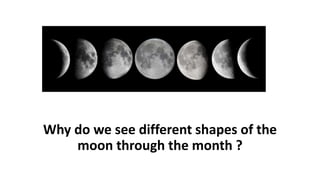
Why do we see different shapes of the
moon through the month ?
What causes the moon’s appearance to change
in the night sky ?
As the moon revolves around Earth, different amounts
of its lit side can be seen from Earth.
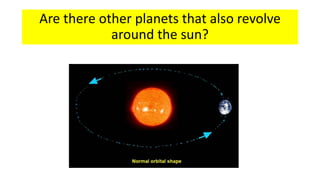
Are there other planets that also revolve
around the sun?
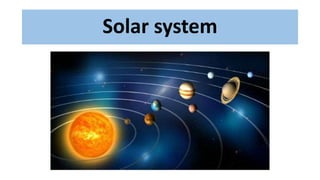
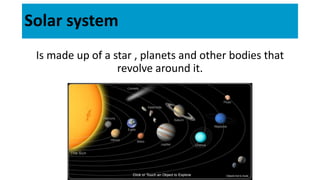
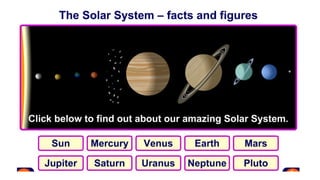
Solar system
Solar system
Is made up of a star , planets and other bodies that
revolve around it.
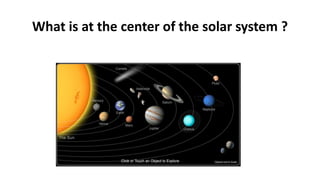
What is at the center of the solar system ?
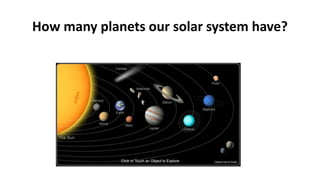
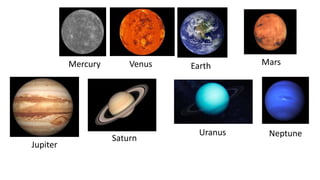
How many planets our solar system have?
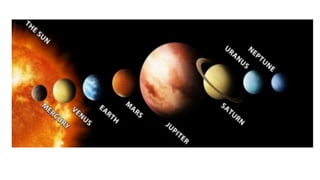
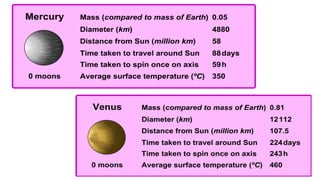
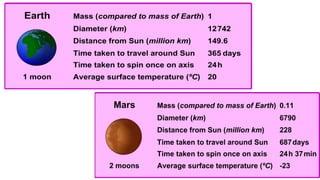
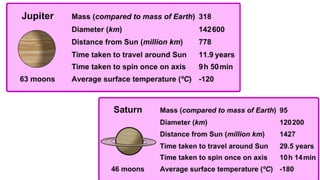
MarsVenusMercury Earth
Uranus
Saturn
Neptune
Jupiter
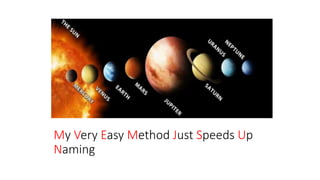
My Very Easy Method Just Speeds Up
Naming
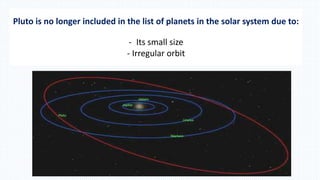
Pluto is no longer included in the list of planets in the solar system due to:
- Its small size
- Irregular orbit
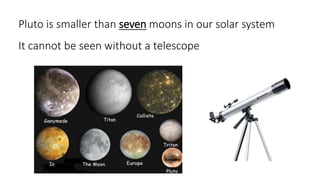
Pluto is smaller than seven moons in our solar system
It cannot be seen without a telescope
The earth and beyond 1

The earth and beyond 1

  • 1.
    Historical models ofthe solar system
  • 2.
    • The earliestmodels for the solar system assumed that the Earth was at the center of the solar system. • With the sun, moon and planets circling it.
  • 3.
    Copernicus • He developedthe first detailed sun centered model of the solar system. • In his time, they still observed with the naked eye.
  • 4.
    Galileo • He madeimprovements to the newly invented telescope. • He observed moons orbiting Jupiter. • Earth was not the only object that could be orbited.
  • 5.
    At what degreesthe Earth axis is tilted ?
  • 6.
    The earth rotatesaround an imaginary line called an axis
  • 7.
    Earth spins arounditself Rotation – rotate
  • 8.
    The earth rotatesabout its axis once every 24 hours or once a day. Earth rotation causes day and night.
  • 9.
    • As earthrotates, only half of Earth faces the sun. As it rotates, the side that faces the sun has: Day time The other side of earth faces away from the sun has: Night time
  • 10.
    The sun risestowards the east Continues to rise in the sky until midday And then, it sets towards the west
  • 12.
    How would nightand day be different if Earth did not rotate ? Half of the Earth would always face the sun and have day The other half of earth would always face away from the sun and have night.
  • 13.
    Where is Earth’saxis ? Through its center
  • 14.
    Why is onehalf of Earth lit? It is facing the sun, so the sun is shining on it
  • 15.
    Why is theother half of Earth dark ? It is facing away from the sun, so there is no light on it.
  • 16.
    • Earth isdivided into two halves • Northern hemisphere • Southern hemisphere • Equator
  • 18.
    The northern hemisphereis tilting towards the sun. The southern hemisphere is tilting away from the sun Six months later the opposite happens.
  • 19.
    • In June,northern hemisphere is tilted toward the sun and gets more rays. • It has more hours of daylight and warmer weather. • It is summer there. • In June, the southern hemisphere, is tilted away from the sun and gets less rays. • It has fewer hours of day and cooler weather. • It is winter there.
  • 20.
    Th tilt ofEarth’s axis and its orbit causes the seasons
  • 22.
    When it issummer in the united states, it is winter in Chile. How can two places have a different season at the same time?
  • 24.
    What causes theseasons ? Earth’s tilt on its axis as it revolves around the sun
  • 25.
    In which directiondoes Earth’s northern hemisphere point when it is winter there? Away from the sun
  • 26.
    In which directiondoes the northern hemisphere point when it is summer there ? Toward the sun
  • 27.
    -In the summer,the sun rises early and higher in the sun. -It sets late in the evening. -When the hemisphere is tilting towards the sun (summer), -The path is different when the hemisphere is tilting away from the sun (winter).
  • 28.
    The sun isthe only large luminous body in the solar system. We see the large objects like the moon and planets, by the sunlight they reflect to the Earth.
  • 29.
    The vast distance betweentwo objects in space can be measured by the time it takes light to travel between them.
  • 30.
    A light yearis the distance travelled by light in a year.
  • 31.
    A group ofstars that seems to form a picture in the night sky.
  • 32.
    • The earlyGreeks named constellations after animals or people • Orion is constellation named after a hunter • The positions of the constellations seem to change with the seasons. • Because we see different parts of space as Earth revolves around the sun.
  • 34.
    What do yousee when you look up at the night sky ? Stars, the moon
  • 35.
    Why do youthink people in the southern hemisphere see some different constellations than people in the northern hemisphere ? People who live in different hemispheres of Earth see different parts of the sky
  • 36.
  • 37.
    The moon isEarth’s satellite. A body that orbits a larger body is called a satellite
  • 38.
    The mass ofEarth is larger than the moon. Therefore, Earth’s gravity exerts a stronger pull on the moon.
  • 39.
    • Only oneside of the moon faces the Earth. • It takes one month for the moon to complete one rotation • It takes also (28) one month to make one revolution around Earth As the moon moves around the Earth, it also spins on its axis. The speed at which it rotates makes the moon always keep the same part of it facing the Earth. The other side of it is never seen from the Earth.
  • 40.
    Why do wesee different shapes of the moon through the month ?
  • 41.
    What causes themoon’s appearance to change in the night sky ? As the moon revolves around Earth, different amounts of its lit side can be seen from Earth.
  • 42.
    Are there otherplanets that also revolve around the sun?
  • 43.
  • 44.
    Solar system Is madeup of a star , planets and other bodies that revolve around it.
  • 45.
    What is atthe center of the solar system ?
  • 46.
    How many planetsour solar system have?
  • 48.
  • 49.
    My Very EasyMethod Just Speeds Up Naming
  • 50.
    Pluto is nolonger included in the list of planets in the solar system due to: - Its small size - Irregular orbit
  • 51.
    Pluto is smallerthan seven moons in our solar system It cannot be seen without a telescope