THE EARTH AND BEYOND
TEZASVI JAYAKUMAR
6-A
THE EARTH AND THE SUN
The earth is constantly moving, which means we are constantly on the move. Even when we are
standing still, we are moving. Not just us, but everything in the solar system is constantly moving. Our
solar system consists of the sun in the centre and all the other bodies revolving around it. The other
bodies would be the eight planets and their moons, comets and asteroids. These objects are
sometimes called celestial bodies that are also constantly moving.
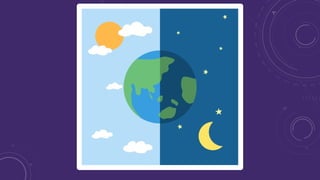
The earth is in the shape of a sphere (like a ball). It is constantly spinning, and as it spins it also
revolves around the Sun. The earth takes 24 hours to rotate once around the sun. As it rotates around
the Sun, only one half of the earth receives sunlight. The other half remains dark. This makes one half
day and one half night.
THE SUN
The Sun is a 4.5 billion-year-old yellow dwarf star – a hot glowing ball of hydrogen and
helium – at the center of our solar system. It's about 93 million miles (150 million
kilometers) from Earth and it's our solar system's only star. Without the Sun's energy, life
as we know it could not exist on our home planet.
The Sun is the largest object in our solar system. Its gravity holds the solar system
together, keeping everything from the biggest planets to the smallest bits of debris in orbit
around it.
THE MOON
The Moon is a large ball of rock, about a hundredth of the mass of the Earth, and it orbits
us once in about every 28 days. Because the Moon is obvious in the sky it has been
studied in great detail.
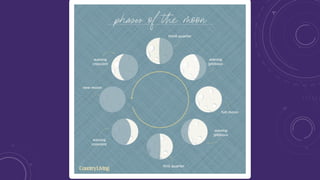
The moon has 8 phases, with the moon orbiting the Earth every 29½ days. When the
illuminated part of the moon is getting bigger it is called a waxing moon. When it is getting
smaller it is called a waning moon.
PHASES OF THE MOON
New Moon : The illuminated side of moon is facing away from earth (not seen)
Waxing Crescent : Less than ½ of the illuminated side of the moon is facing the earth (right
crescent visible)
First Quarter : ½ of the illuminated side is facing the earth (right half visible)
Waxing Gibbous : More than ½ of the illuminated side is facing the earth (right side visible)
Full Moon : The illuminated part of the moon can be seen fully
Waning Gibbous : The illuminated part of the moon begins to shrink, with more than ½
facing the earth (left side visible)
Last Quarter : The illuminated part of the moon shrinks, with ½ facing the earth (left half
visible)
Waning Crescent : The illuminated part of the moon shrinks, with less than ½ facing the
earth (left crescent visible)
This cycle starts from the New Moon again and continues.
SOLAR ECLIPSE
SOLAR ECLIPSE :
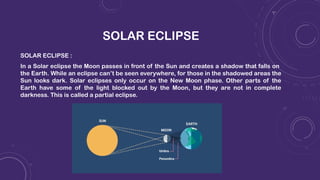
In a Solar eclipse the Moon passes in front of the Sun and creates a shadow that falls on
the Earth. While an eclipse can’t be seen everywhere, for those in the shadowed areas the
Sun looks dark. Solar eclipses only occur on the New Moon phase. Other parts of the
Earth have some of the light blocked out by the Moon, but they are not in complete
darkness. This is called a partial eclipse.
LUNAR ECLIPSE
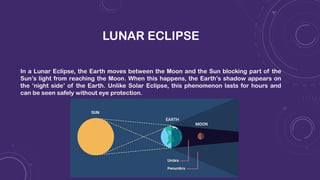
In a Lunar Eclipse, the Earth moves between the Moon and the Sun blocking part of the
Sun’s light from reaching the Moon. When this happens, the Earth’s shadow appears on
the ‘night side’ of the Earth. Unlike Solar Eclipse, this phenomenon lasts for hours and
can be seen safely without eye protection.
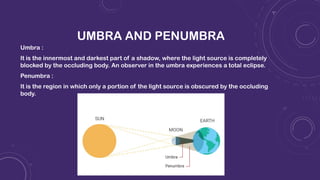
UMBRA AND PENUMBRA
Umbra :
It is the innermost and darkest part of a shadow, where the light source is completely
blocked by the occluding body. An observer in the umbra experiences a total eclipse.
Penumbra :
It is the region in which only a portion of the light source is obscured by the occluding
body.
THE PLANETS
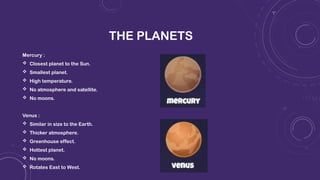
Mercury :
 Closest planet to the Sun.
 Smallest planet.
 High temperature.
 No atmosphere and satellite.
 No moons.
Venus :
 Similar in size to the Earth.
 Thicker atmosphere.
 Greenhouse effect.
 Hottest planet.
 No moons.
 Rotates East to West.
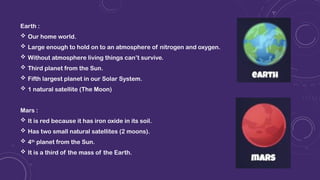
Earth :
 Our home world.
 Large enough to hold on to an atmosphere of nitrogen and oxygen.
 Without atmosphere living things can’t survive.
 Third planet from the Sun.
 Fifth largest planet in our Solar System.
 1 natural satellite (The Moon)
Mars :
 It is red because it has iron oxide in its soil.
 Has two small natural satellites (2 moons).
 4th
planet from the Sun.
 It is a third of the mass of the Earth.
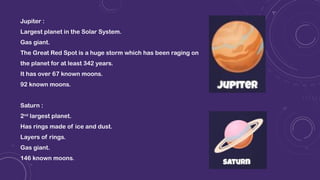
Jupiter :
Largest planet in the Solar System.
Gas giant.
The Great Red Spot is a huge storm which has been raging on
the planet for at least 342 years.
It has over 67 known moons.
92 known moons.
Saturn :
2nd
largest planet.
Has rings made of ice and dust.
Layers of rings.
Gas giant.
146 known moons.
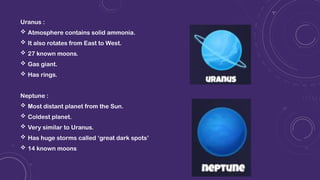
Uranus :
 Atmosphere contains solid ammonia.
 It also rotates from East to West.
 27 known moons.
 Gas giant.
 Has rings.
Neptune :
 Most distant planet from the Sun.
 Coldest planet.
 Very similar to Uranus.
 Has huge storms called ‘great dark spots’
 14 known moons
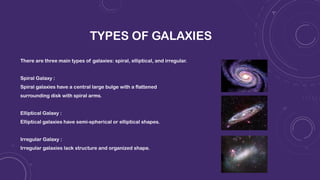
TYPES OF GALAXIES
There are three main types of galaxies: spiral, elliptical, and irregular.
Spiral Galaxy :
Spiral galaxies have a central large bulge with a flattened
surrounding disk with spiral arms.
Elliptical Galaxy :
Elliptical galaxies have semi-spherical or elliptical shapes.
Irregular Galaxy :
Irregular galaxies lack structure and organized shape.
ASTEROIDS, COMETS, AND
CONSTELLATIONS
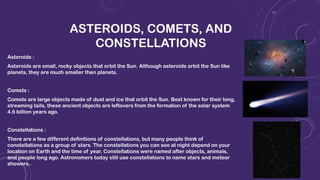
Asteroids :
Asteroids are small, rocky objects that orbit the Sun. Although asteroids orbit the Sun like
planets, they are much smaller than planets.
Comets :
Comets are large objects made of dust and ice that orbit the Sun. Best known for their long,
streaming tails, these ancient objects are leftovers from the formation of the solar system
4.6 billion years ago.
Constellations :
There are a few different definitions of constellations, but many people think of
constellations as a group of stars. The constellations you can see at night depend on your
location on Earth and the time of year. Constellations were named after objects, animals,
and people long ago. Astronomers today still use constellations to name stars and meteor
showers.
GEOCENTRIC, HELIOCENTRIC, AND LIGHT
YEAR
Geocentric :
In astronomy, the geocentric model is a superseded description of the Universe with Earth at
the center. Under most geocentric models, the Sun, Moon, stars, and planets all orbit Earth.
Heliocentric :
Heliocentrism is the astronomical model in which the Earth and planets revolve around the
Sun at the center of the universe. Historically, heliocentrism was opposed to geocentrism,
which placed the Earth at the center.
Light year :
Light-year is the distance light travels in one year. Light zips through interstellar space at
186,000 miles (300,000 kilometers) per second and 5.88 trillion miles (9.46 trillion kilometers)
per year.
THANK YOU

PHYSICS – THE EARTH AND BEYOND_Tezasvi.pptx

  • 1.
    THE EARTH ANDBEYOND TEZASVI JAYAKUMAR 6-A
  • 2.
    THE EARTH ANDTHE SUN The earth is constantly moving, which means we are constantly on the move. Even when we are standing still, we are moving. Not just us, but everything in the solar system is constantly moving. Our solar system consists of the sun in the centre and all the other bodies revolving around it. The other bodies would be the eight planets and their moons, comets and asteroids. These objects are sometimes called celestial bodies that are also constantly moving. The earth is in the shape of a sphere (like a ball). It is constantly spinning, and as it spins it also revolves around the Sun. The earth takes 24 hours to rotate once around the sun. As it rotates around the Sun, only one half of the earth receives sunlight. The other half remains dark. This makes one half day and one half night.
  • 4.
    THE SUN The Sunis a 4.5 billion-year-old yellow dwarf star – a hot glowing ball of hydrogen and helium – at the center of our solar system. It's about 93 million miles (150 million kilometers) from Earth and it's our solar system's only star. Without the Sun's energy, life as we know it could not exist on our home planet. The Sun is the largest object in our solar system. Its gravity holds the solar system together, keeping everything from the biggest planets to the smallest bits of debris in orbit around it.
  • 5.
    THE MOON The Moonis a large ball of rock, about a hundredth of the mass of the Earth, and it orbits us once in about every 28 days. Because the Moon is obvious in the sky it has been studied in great detail. The moon has 8 phases, with the moon orbiting the Earth every 29½ days. When the illuminated part of the moon is getting bigger it is called a waxing moon. When it is getting smaller it is called a waning moon.
  • 6.
    PHASES OF THEMOON New Moon : The illuminated side of moon is facing away from earth (not seen) Waxing Crescent : Less than ½ of the illuminated side of the moon is facing the earth (right crescent visible) First Quarter : ½ of the illuminated side is facing the earth (right half visible) Waxing Gibbous : More than ½ of the illuminated side is facing the earth (right side visible) Full Moon : The illuminated part of the moon can be seen fully Waning Gibbous : The illuminated part of the moon begins to shrink, with more than ½ facing the earth (left side visible) Last Quarter : The illuminated part of the moon shrinks, with ½ facing the earth (left half visible) Waning Crescent : The illuminated part of the moon shrinks, with less than ½ facing the earth (left crescent visible) This cycle starts from the New Moon again and continues.
  • 8.
    SOLAR ECLIPSE SOLAR ECLIPSE: In a Solar eclipse the Moon passes in front of the Sun and creates a shadow that falls on the Earth. While an eclipse can’t be seen everywhere, for those in the shadowed areas the Sun looks dark. Solar eclipses only occur on the New Moon phase. Other parts of the Earth have some of the light blocked out by the Moon, but they are not in complete darkness. This is called a partial eclipse.
  • 9.
    LUNAR ECLIPSE In aLunar Eclipse, the Earth moves between the Moon and the Sun blocking part of the Sun’s light from reaching the Moon. When this happens, the Earth’s shadow appears on the ‘night side’ of the Earth. Unlike Solar Eclipse, this phenomenon lasts for hours and can be seen safely without eye protection.
  • 10.
    UMBRA AND PENUMBRA Umbra: It is the innermost and darkest part of a shadow, where the light source is completely blocked by the occluding body. An observer in the umbra experiences a total eclipse. Penumbra : It is the region in which only a portion of the light source is obscured by the occluding body.
  • 11.
    THE PLANETS Mercury : Closest planet to the Sun.  Smallest planet.  High temperature.  No atmosphere and satellite.  No moons. Venus :  Similar in size to the Earth.  Thicker atmosphere.  Greenhouse effect.  Hottest planet.  No moons.  Rotates East to West.
  • 12.
    Earth :  Ourhome world.  Large enough to hold on to an atmosphere of nitrogen and oxygen.  Without atmosphere living things can’t survive.  Third planet from the Sun.  Fifth largest planet in our Solar System.  1 natural satellite (The Moon) Mars :  It is red because it has iron oxide in its soil.  Has two small natural satellites (2 moons).  4th planet from the Sun.  It is a third of the mass of the Earth.
  • 13.
    Jupiter : Largest planetin the Solar System. Gas giant. The Great Red Spot is a huge storm which has been raging on the planet for at least 342 years. It has over 67 known moons. 92 known moons. Saturn : 2nd largest planet. Has rings made of ice and dust. Layers of rings. Gas giant. 146 known moons.
  • 14.
    Uranus :  Atmospherecontains solid ammonia.  It also rotates from East to West.  27 known moons.  Gas giant.  Has rings. Neptune :  Most distant planet from the Sun.  Coldest planet.  Very similar to Uranus.  Has huge storms called ‘great dark spots’  14 known moons
  • 15.
    TYPES OF GALAXIES Thereare three main types of galaxies: spiral, elliptical, and irregular. Spiral Galaxy : Spiral galaxies have a central large bulge with a flattened surrounding disk with spiral arms. Elliptical Galaxy : Elliptical galaxies have semi-spherical or elliptical shapes. Irregular Galaxy : Irregular galaxies lack structure and organized shape.
  • 16.
    ASTEROIDS, COMETS, AND CONSTELLATIONS Asteroids: Asteroids are small, rocky objects that orbit the Sun. Although asteroids orbit the Sun like planets, they are much smaller than planets. Comets : Comets are large objects made of dust and ice that orbit the Sun. Best known for their long, streaming tails, these ancient objects are leftovers from the formation of the solar system 4.6 billion years ago. Constellations : There are a few different definitions of constellations, but many people think of constellations as a group of stars. The constellations you can see at night depend on your location on Earth and the time of year. Constellations were named after objects, animals, and people long ago. Astronomers today still use constellations to name stars and meteor showers.
  • 17.
    GEOCENTRIC, HELIOCENTRIC, ANDLIGHT YEAR Geocentric : In astronomy, the geocentric model is a superseded description of the Universe with Earth at the center. Under most geocentric models, the Sun, Moon, stars, and planets all orbit Earth. Heliocentric : Heliocentrism is the astronomical model in which the Earth and planets revolve around the Sun at the center of the universe. Historically, heliocentrism was opposed to geocentrism, which placed the Earth at the center. Light year : Light-year is the distance light travels in one year. Light zips through interstellar space at 186,000 miles (300,000 kilometers) per second and 5.88 trillion miles (9.46 trillion kilometers) per year.
  • 18.