Baseline Schedule Review
and Analysis
ADITYA GHUMARE, PMP
Content
 Baseline Schedule
 Contractual Requirements
 Baseline Review
 References
Baseline Schedule
Baseline Schedule
 Initial Schedule
 Contractor’s intent to reach project completion
 Integrating all contractual requirements and Project
Activities
 Consented to by the Employer under the contract, when
it is deemed satisfactory
Baseline Schedule
Baseline Schedule
 Monitoring the Time control and Project progress (Planned vs Actual)
 Record and Track changes
 Forecasting the Project duration and cost
 Analyze delays and impacts
 Establish accountability of parties
 Establish cash flow projections for future payments and funding
purposes
 Reporting to other Project Stakeholders
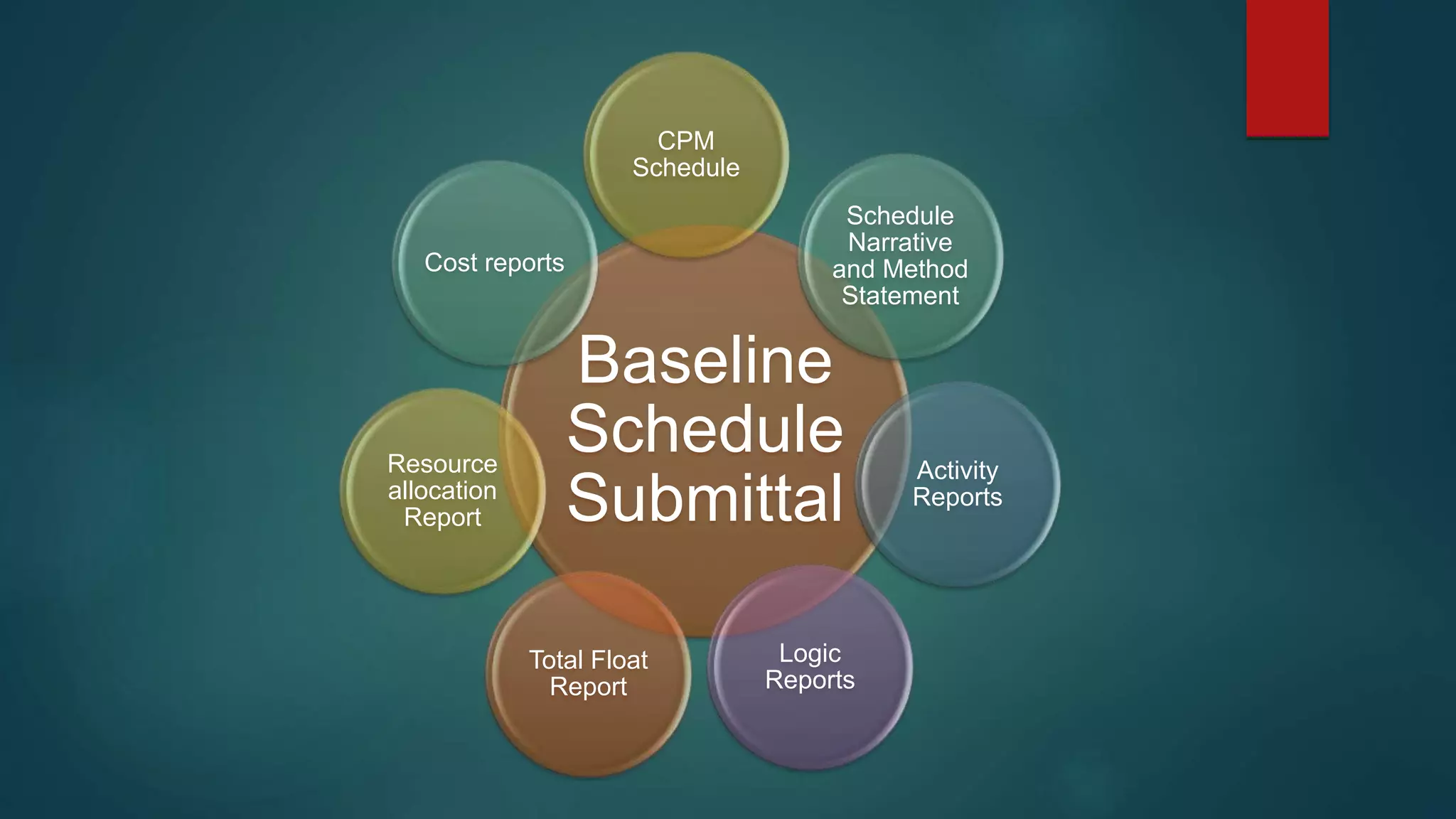
Baseline
Schedule
Submittal
CPM
Schedule
Schedule
Narrative
and Method
Statement
Activity
Reports
Logic
Reports
Total Float
Report
Resource
allocation
Report
Cost reports
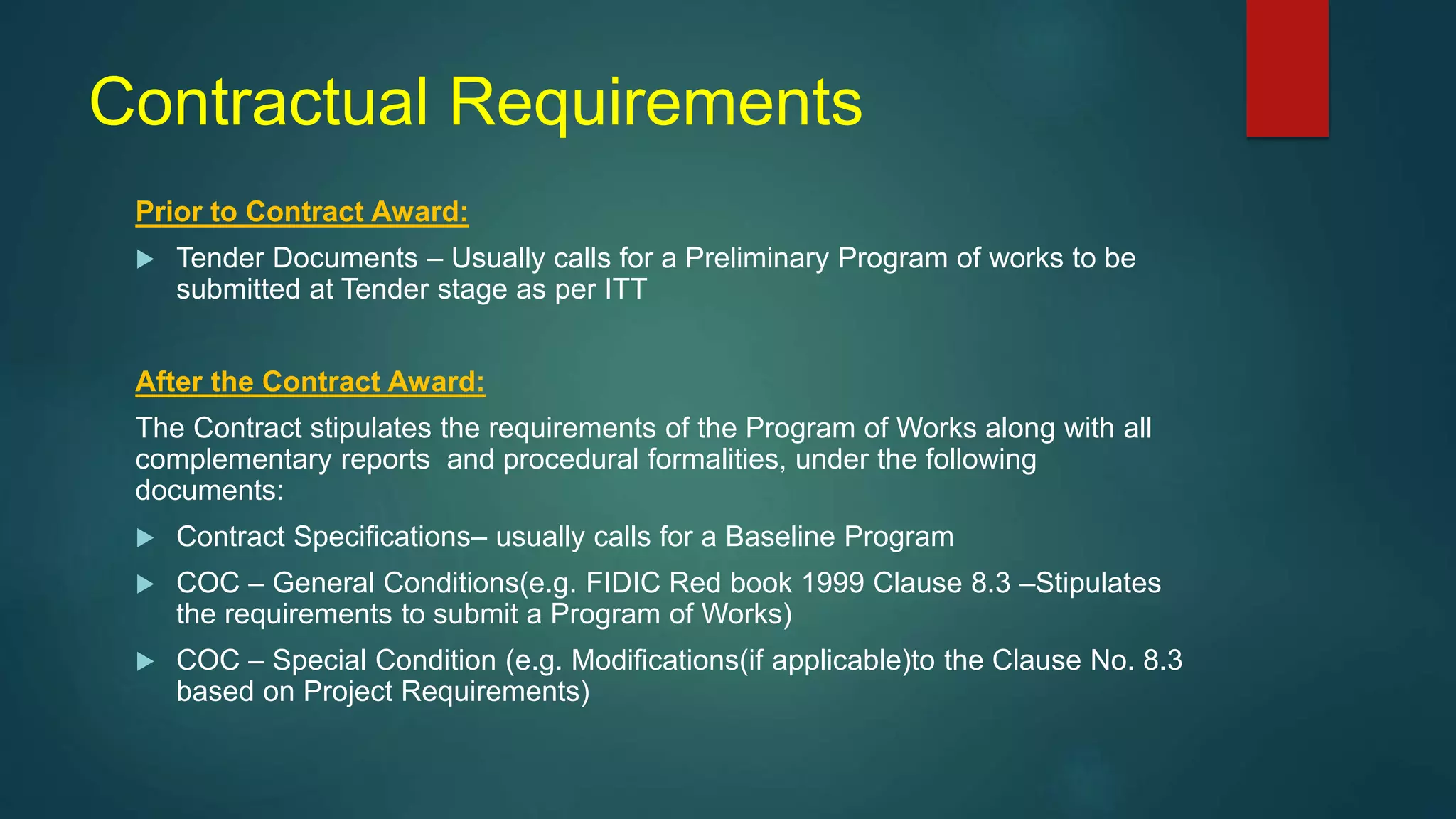
Contractual Requirements
Prior to Contract Award:
 Tender Documents – Usually calls for a Preliminary Program of works to be
submitted at Tender stage as per ITT
After the Contract Award:
The Contract stipulates the requirements of the Program of Works along with all
complementary reports and procedural formalities, under the following
documents:
 Contract Specifications– usually calls for a Baseline Program
 COC – General Conditions(e.g. FIDIC Red book 1999 Clause 8.3 –Stipulates
the requirements to submit a Program of Works)
 COC – Special Condition (e.g. Modifications(if applicable)to the Clause No. 8.3
based on Project Requirements)
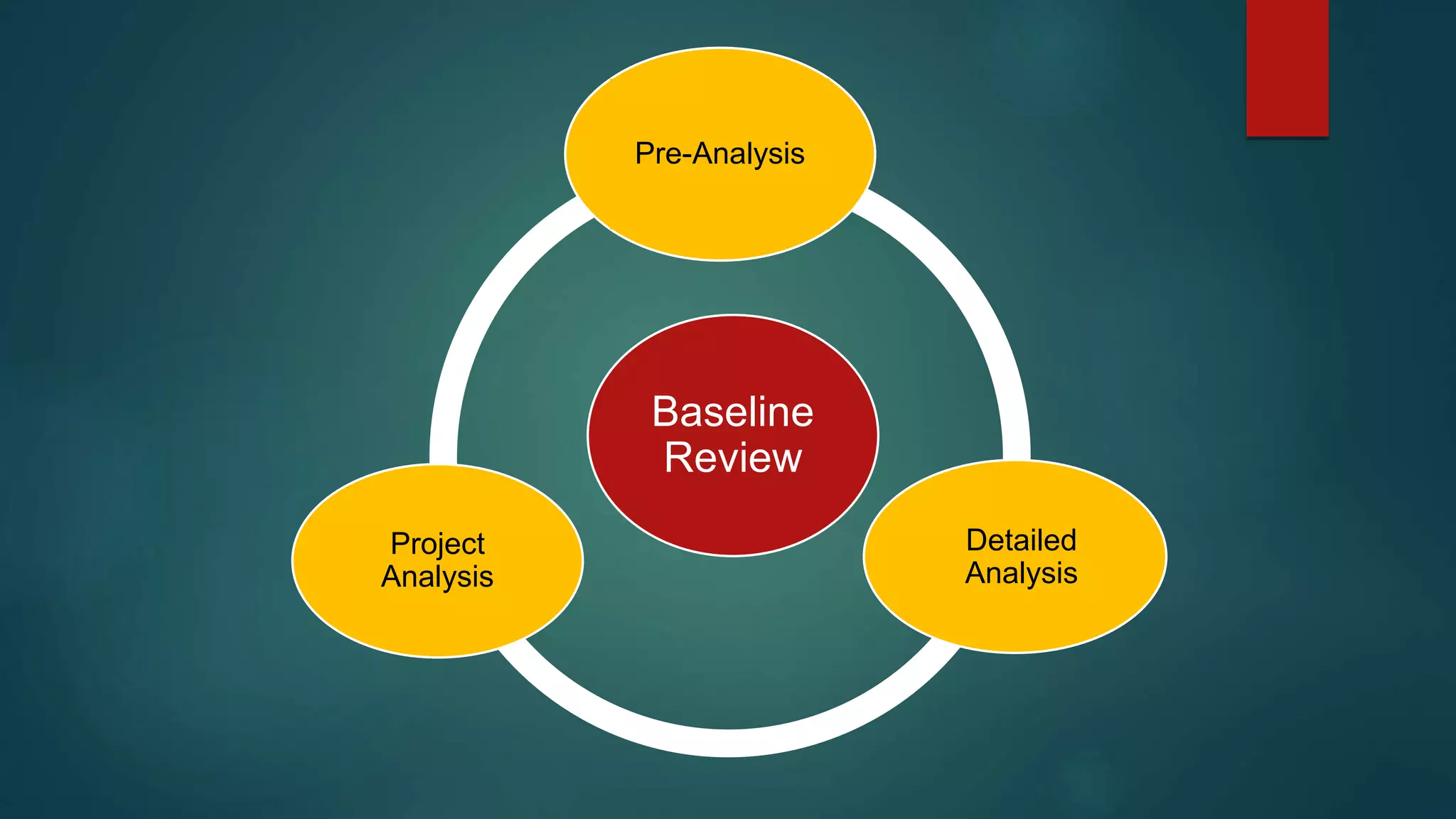
Baseline
Review
Pre-Analysis
Detailed
Analysis
Project
Analysis
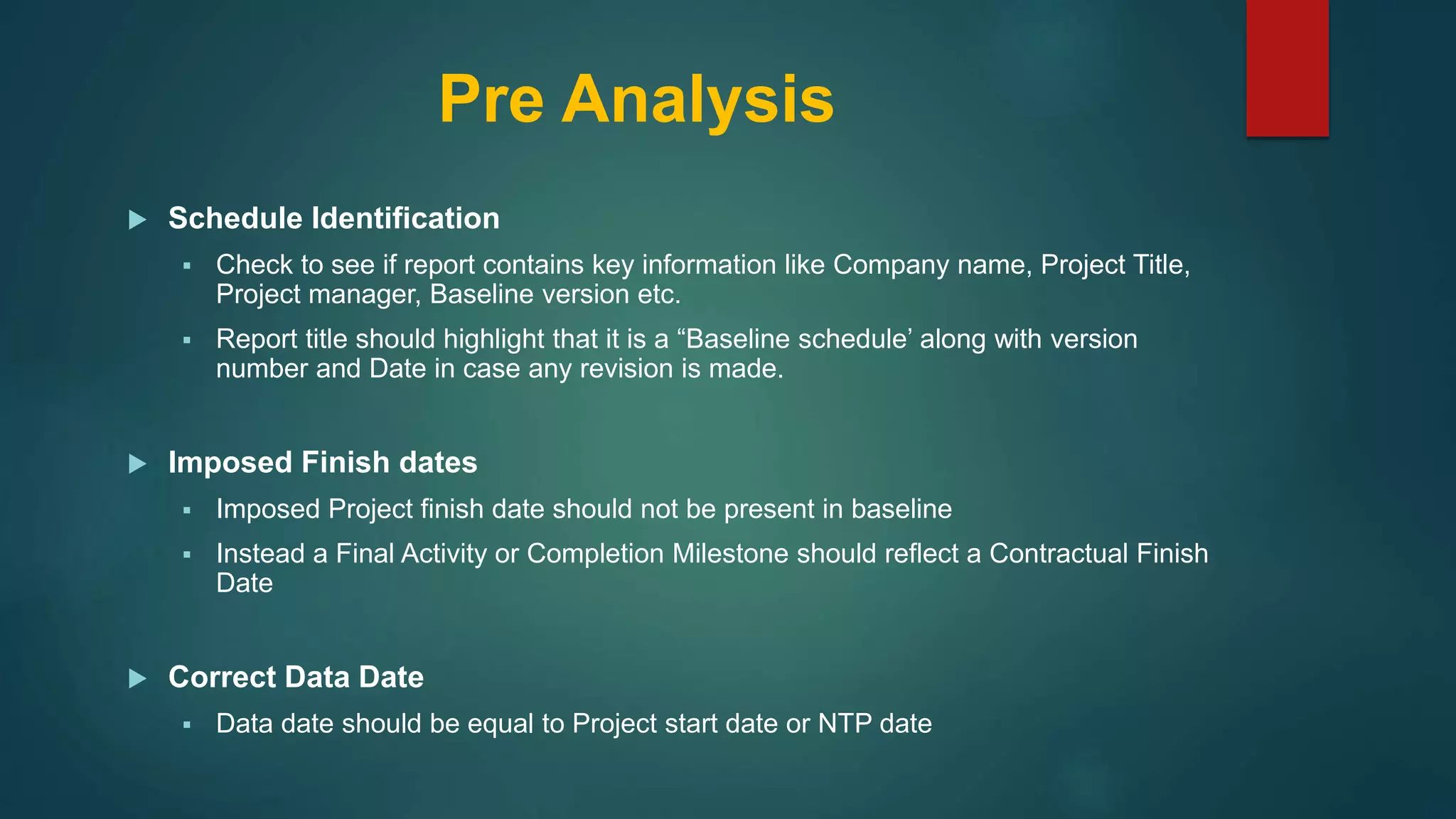
Pre Analysis
 Schedule Identification
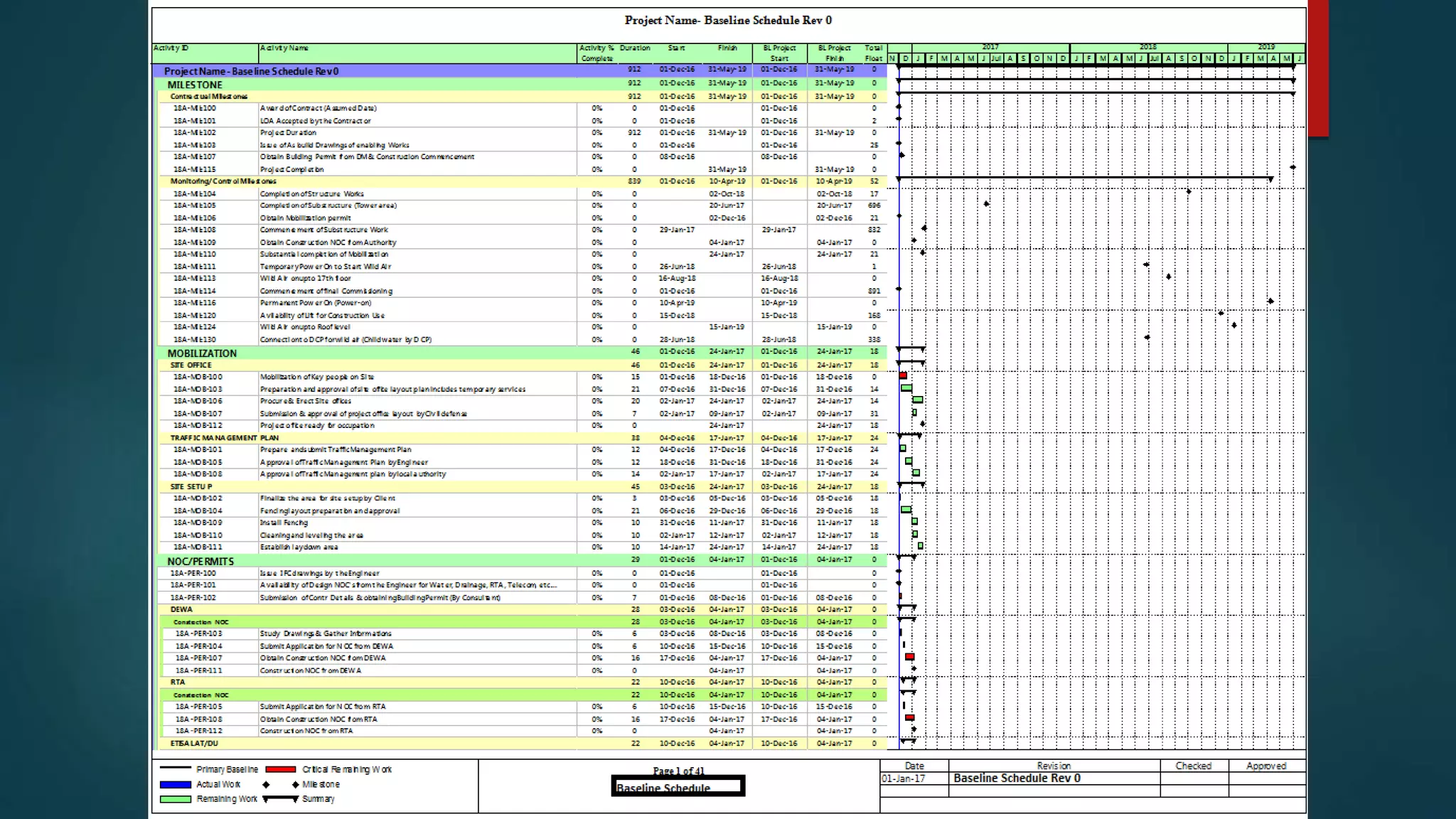
 Check to see if report contains key information like Company name, Project Title,
Project manager, Baseline version etc.
 Report title should highlight that it is a “Baseline schedule’ along with version
number and Date in case any revision is made.
 Imposed Finish dates
 Imposed Project finish date should not be present in baseline
 Instead a Final Activity or Completion Milestone should reflect a Contractual Finish
Date
 Correct Data Date
 Data date should be equal to Project start date or NTP date
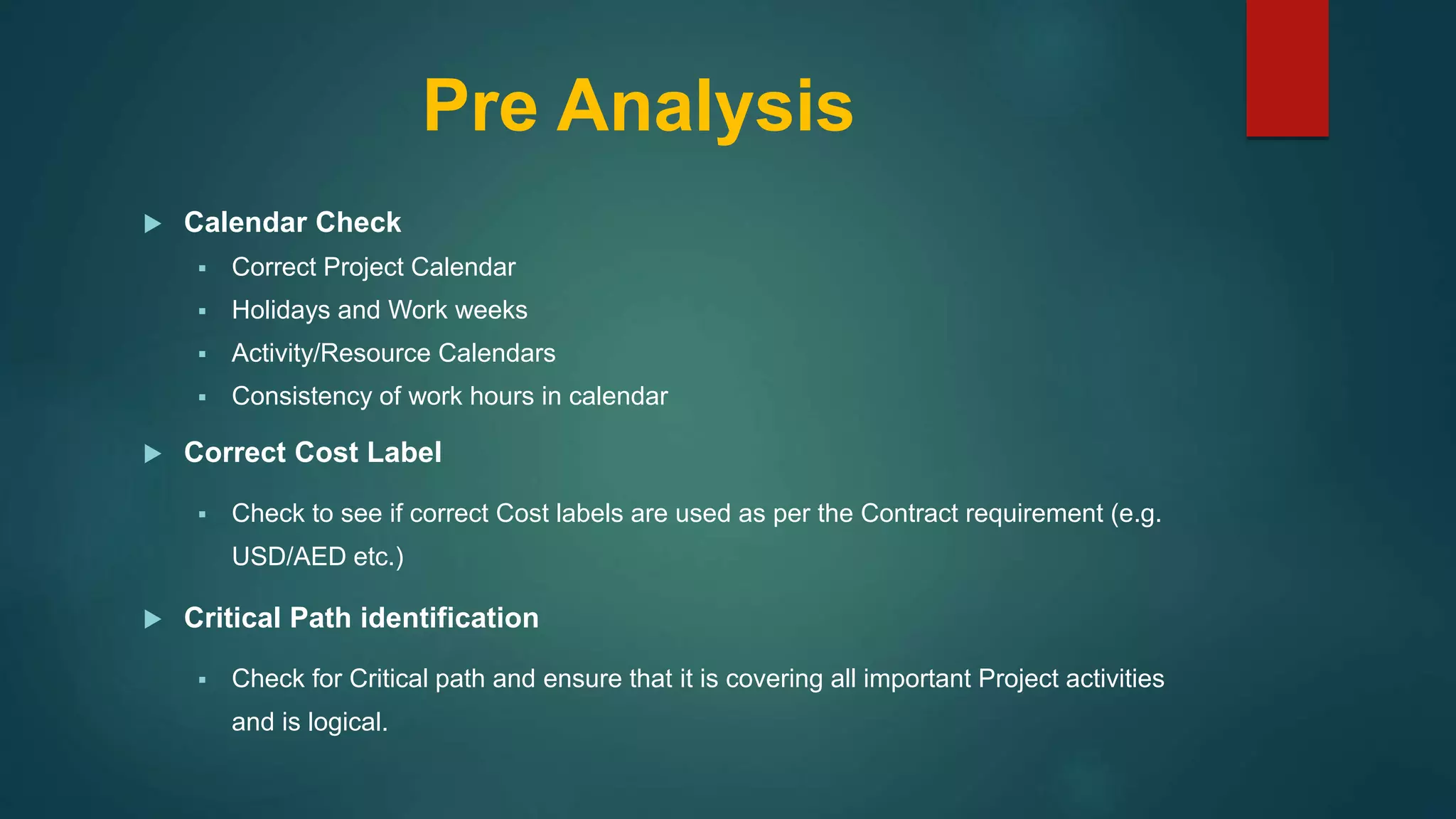
Pre Analysis
 Calendar Check
 Correct Project Calendar
 Holidays and Work weeks
 Activity/Resource Calendars
 Consistency of work hours in calendar
 Correct Cost Label
 Check to see if correct Cost labels are used as per the Contract requirement (e.g.
USD/AED etc.)
 Critical Path identification
 Check for Critical path and ensure that it is covering all important Project activities
and is logical.
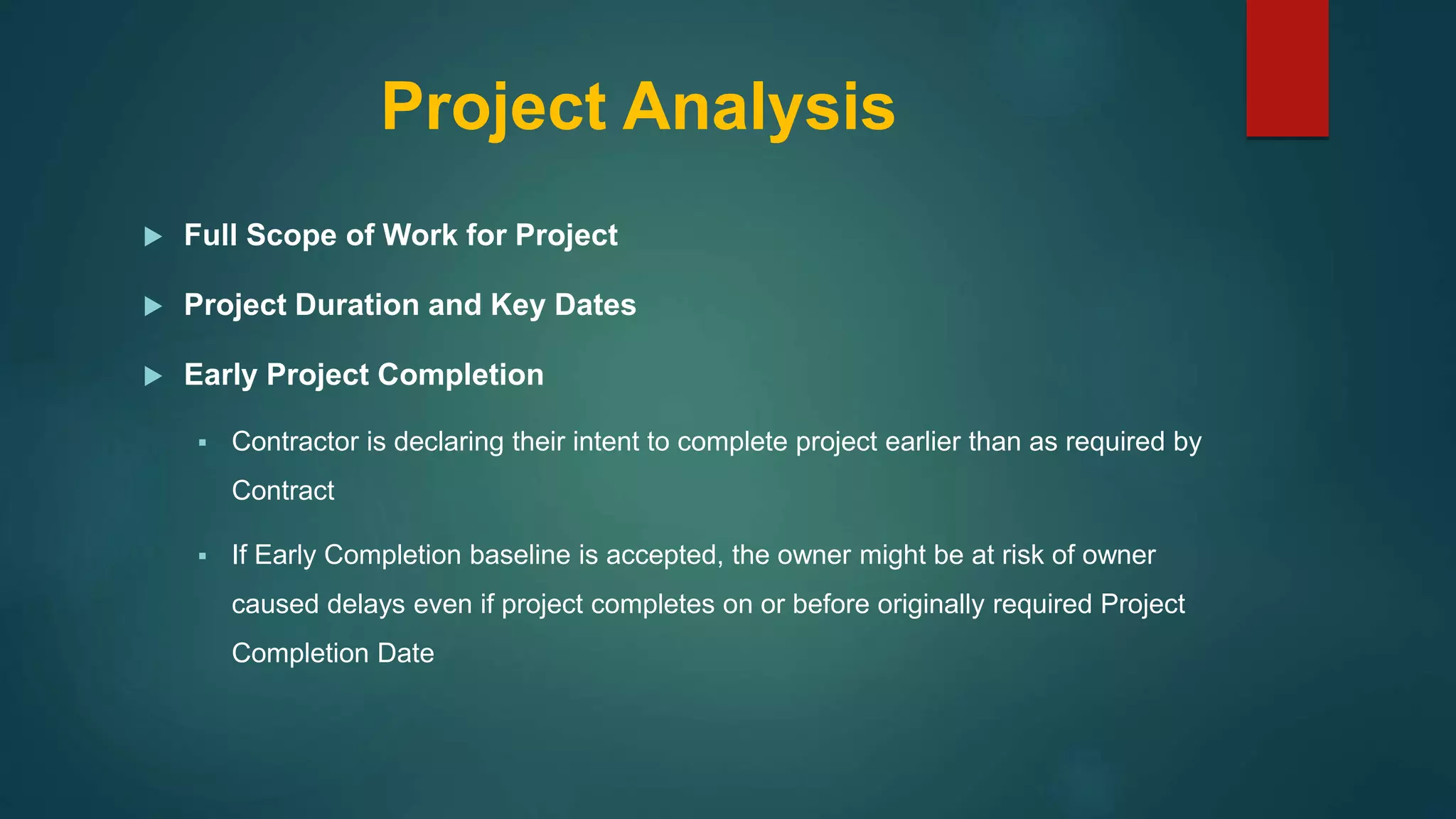
Project Analysis
 Full Scope of Work for Project
 Project Duration and Key Dates
 Early Project Completion
 Contractor is declaring their intent to complete project earlier than as required by
Contract
 If Early Completion baseline is accepted, the owner might be at risk of owner
caused delays even if project completes on or before originally required Project
Completion Date
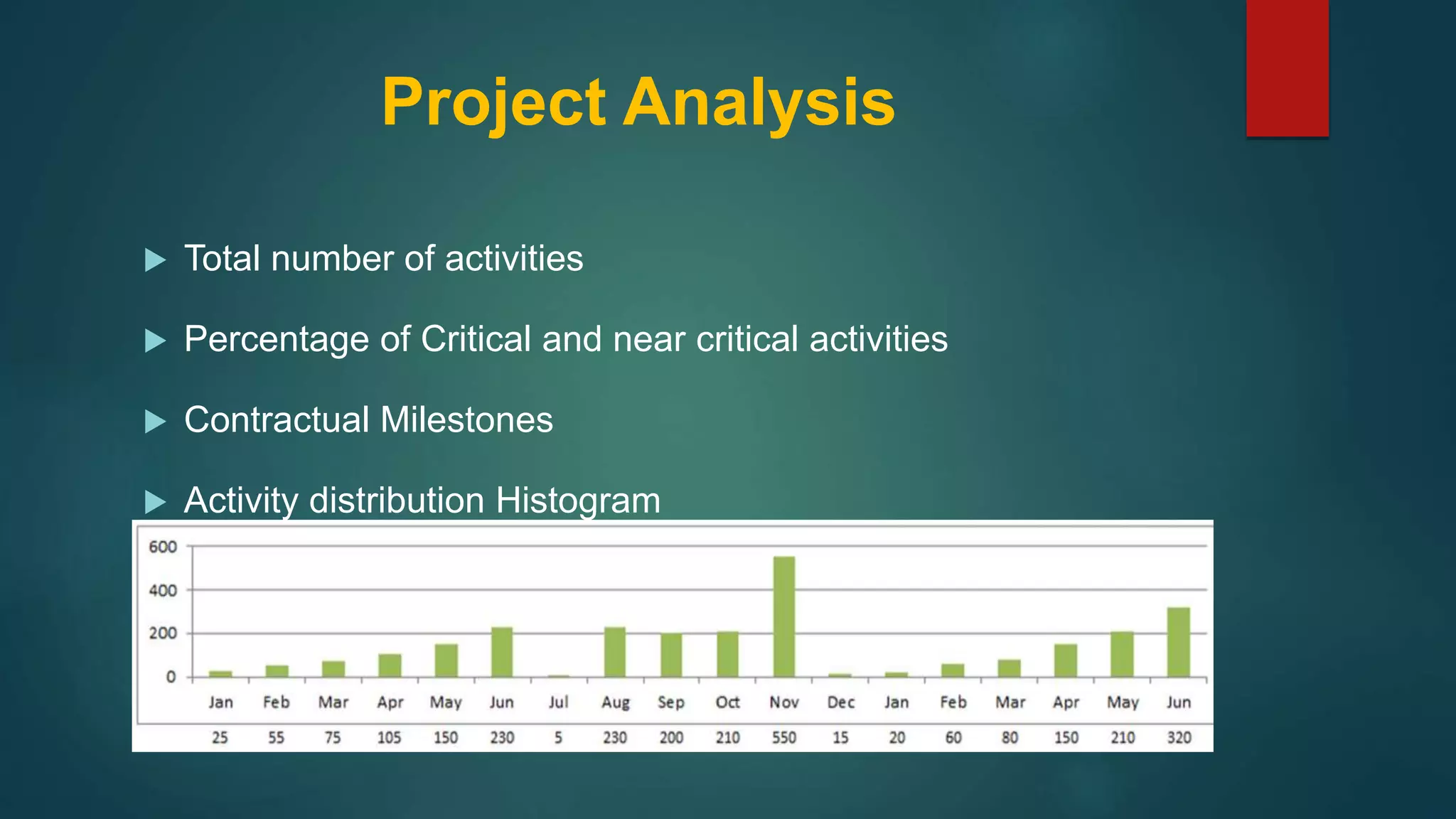
Project Analysis
 Total number of activities
 Percentage of Critical and near critical activities
 Contractual Milestones
 Activity distribution Histogram
 Contractual Milestones
Detailed Analysis
 Activity Analysis
 WBS Analysis
 Relationship Analysis
 Constraint Analysis
 Lead and Lag check
 Cost and resource loading
Activity Analysis
 Activity ID Check
 Duplicate Activity ID and description
 Mechanically incorrect dates
 No Actual Dates in Baseline
 Proper Activity Types
 Activity Percentage Completion type
 No Negative Float
 Activity Duration Checks
 Suspicious Activity Duration
Activity Analysis
Activity Analysis
 All scope of work must be included
 Notice to Proceed
 Field Mobilization
 Substantial completion
 Startup, testing and commissioning activities
 Submittal Activities
 Review and Approval Activities
 Material purchases and Delivery
 Temporary Activities
 Inspection Activities
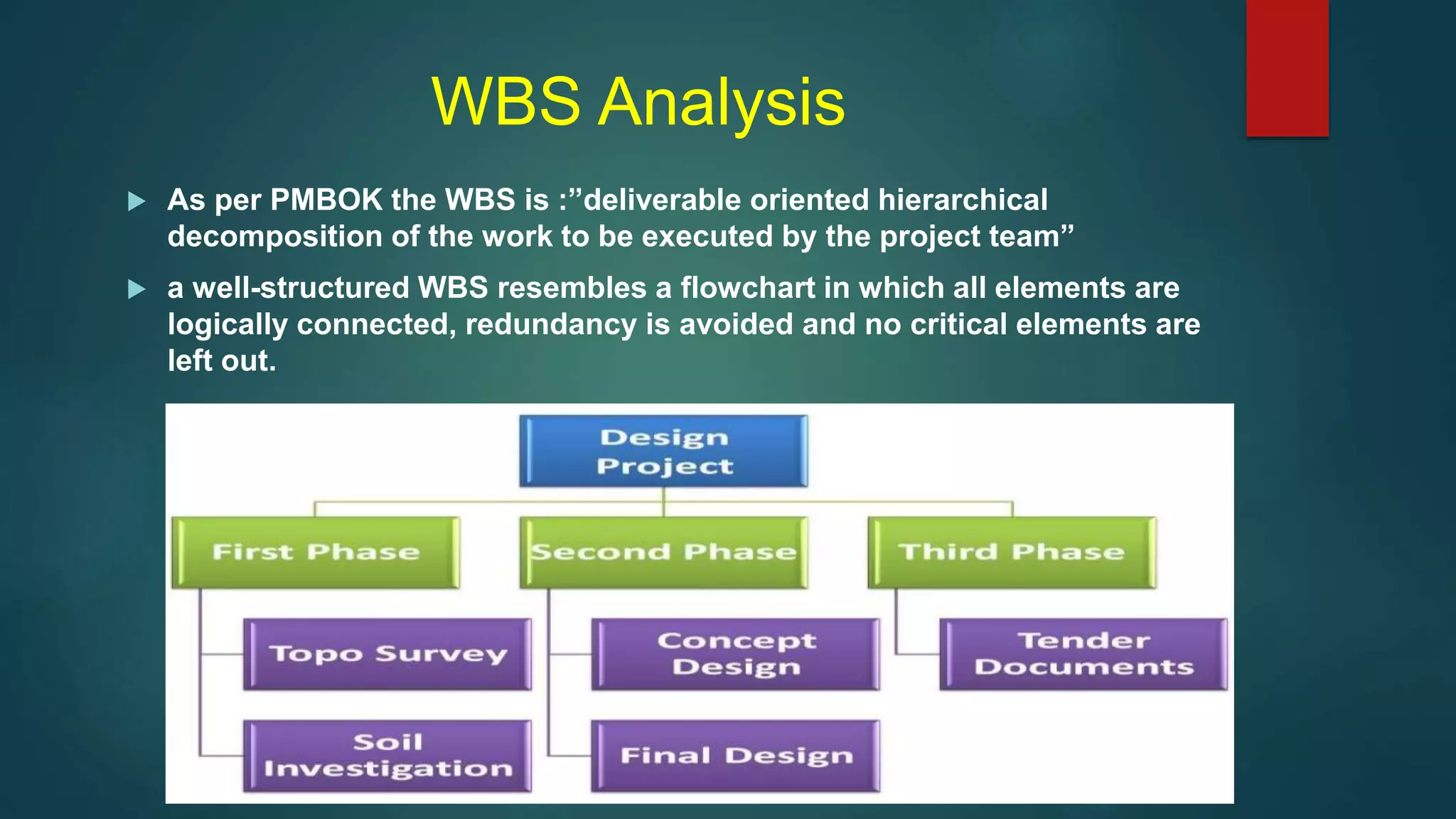
WBS Analysis
 As per PMBOK the WBS is :”deliverable oriented hierarchical
decomposition of the work to be executed by the project team”
 a well-structured WBS resembles a flowchart in which all elements are
logically connected, redundancy is avoided and no critical elements are
left out.
WBS Analysis
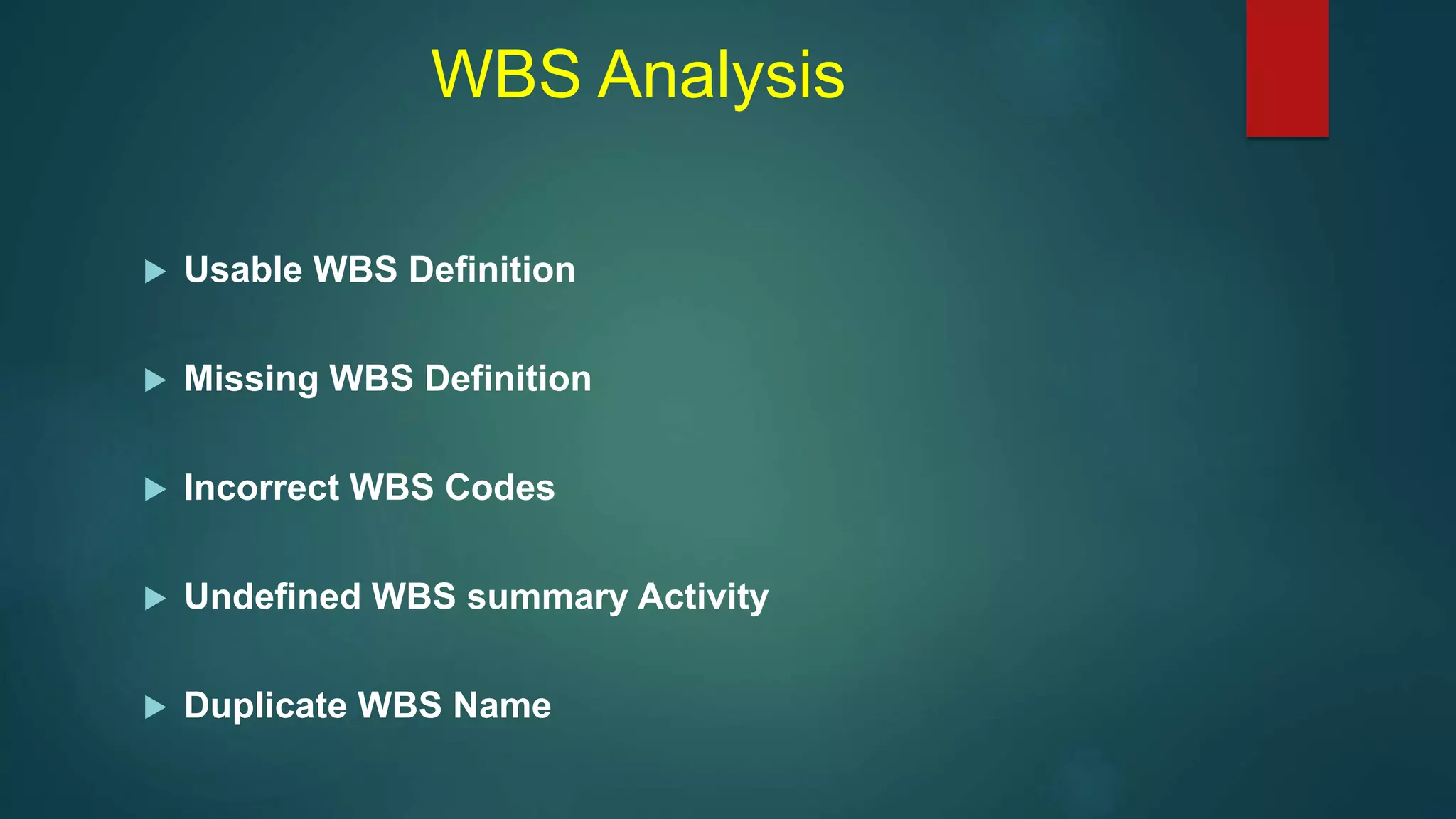
 Usable WBS Definition
 Missing WBS Definition
 Incorrect WBS Codes
 Undefined WBS summary Activity
 Duplicate WBS Name
Relationship Analysis
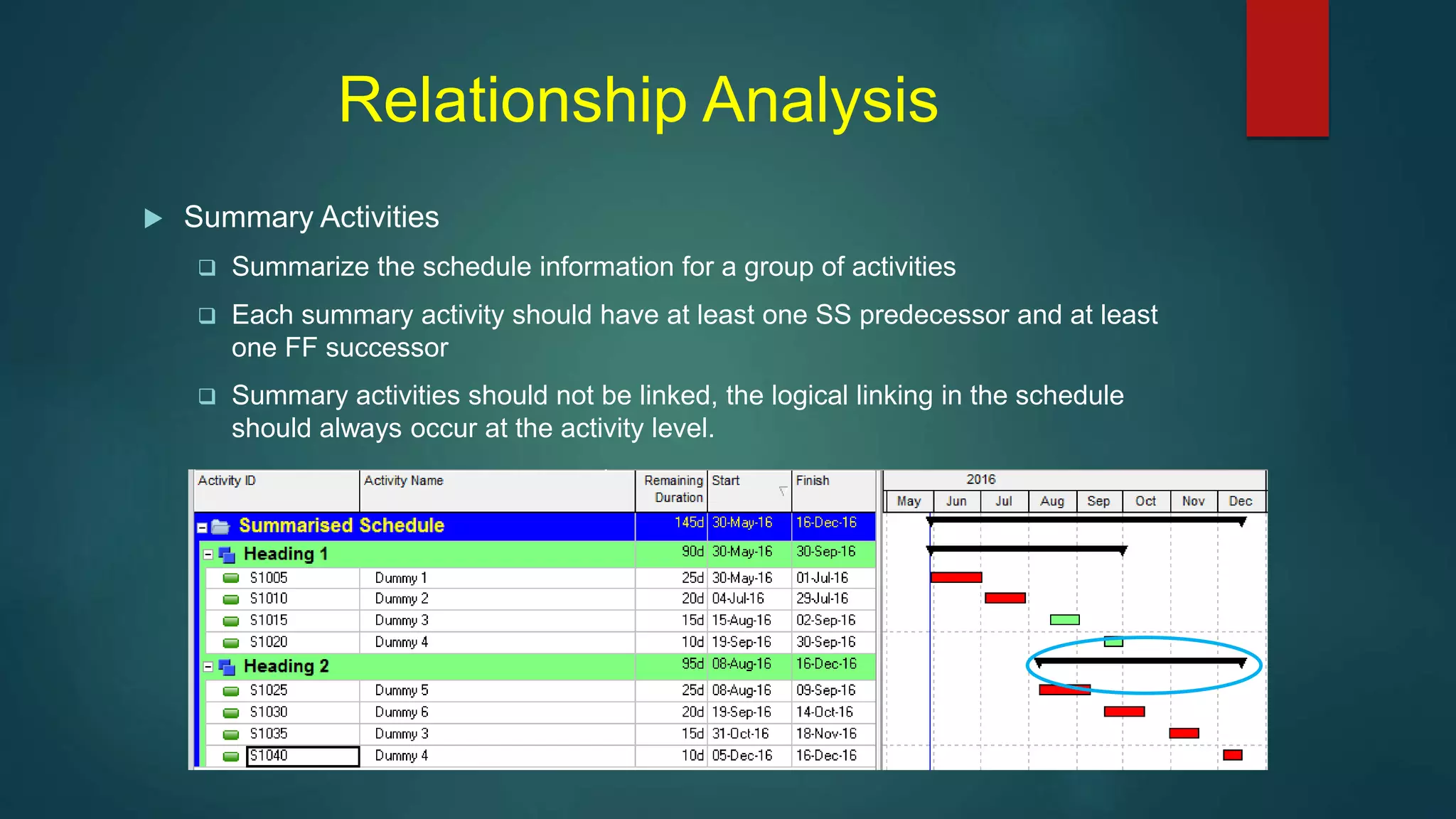
 Summary Activities
 Summarize the schedule information for a group of activities
 Each summary activity should have at least one SS predecessor and at least
one FF successor
 Summary activities should not be linked, the logical linking in the schedule
should always occur at the activity level.
Relationship Analysis
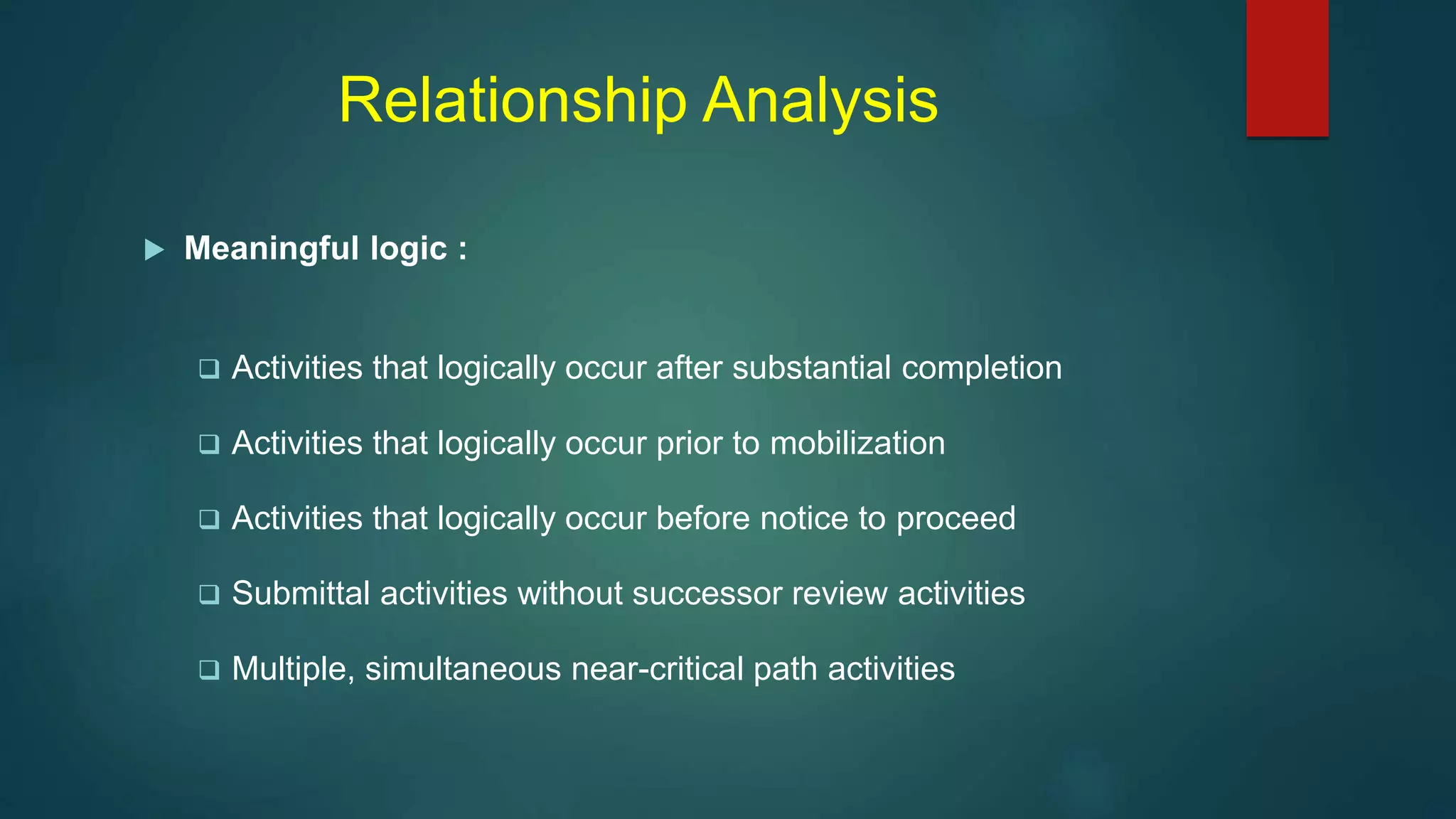
 Meaningful logic :
 Activities that logically occur after substantial completion
 Activities that logically occur prior to mobilization
 Activities that logically occur before notice to proceed
 Submittal activities without successor review activities
 Multiple, simultaneous near-critical path activities
Relationship Analysis
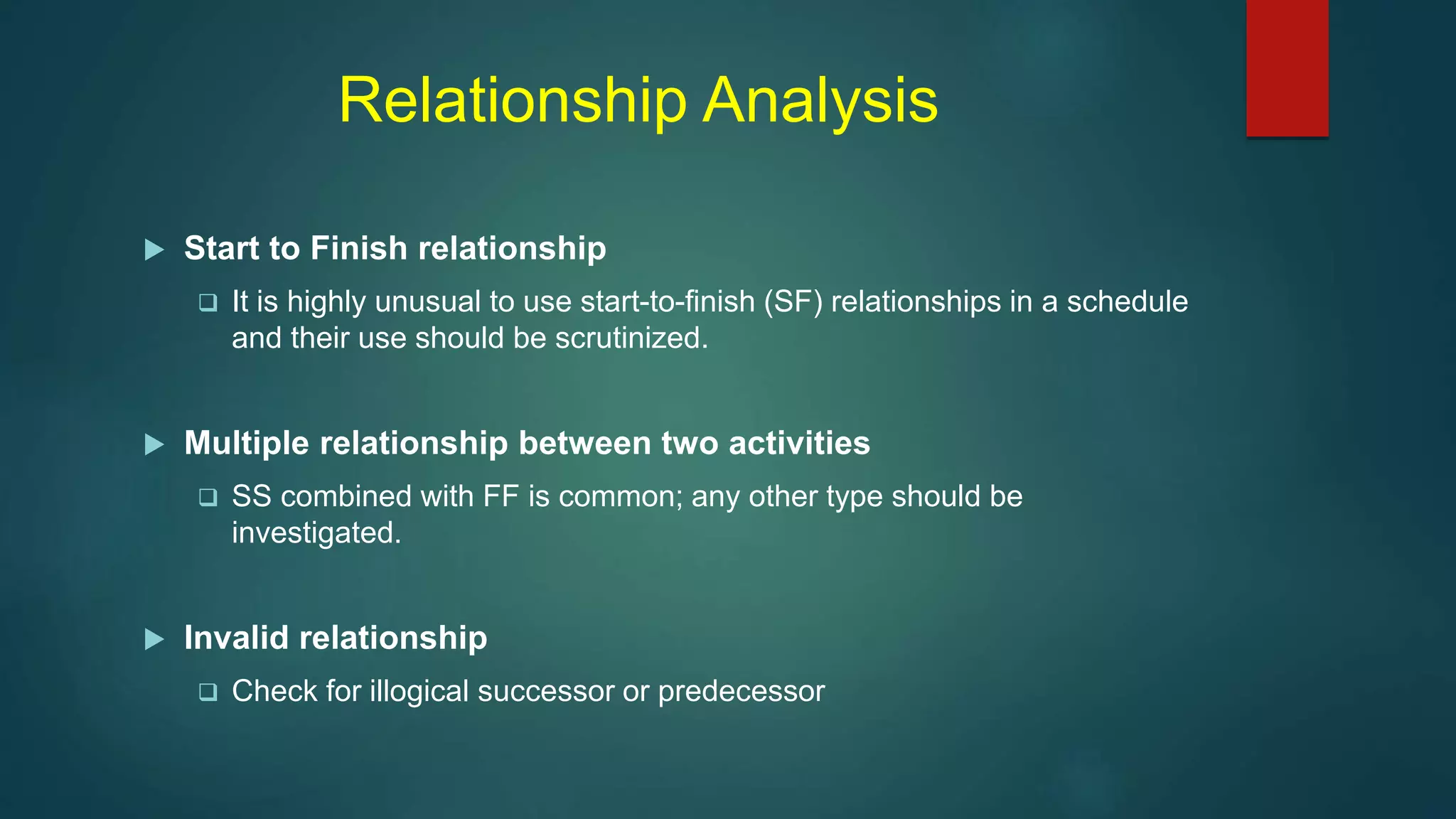
 Start to Finish relationship
 It is highly unusual to use start-to-finish (SF) relationships in a schedule
and their use should be scrutinized.
 Multiple relationship between two activities
 SS combined with FF is common; any other type should be
investigated.
 Invalid relationship
 Check for illogical successor or predecessor
Relationship Analysis
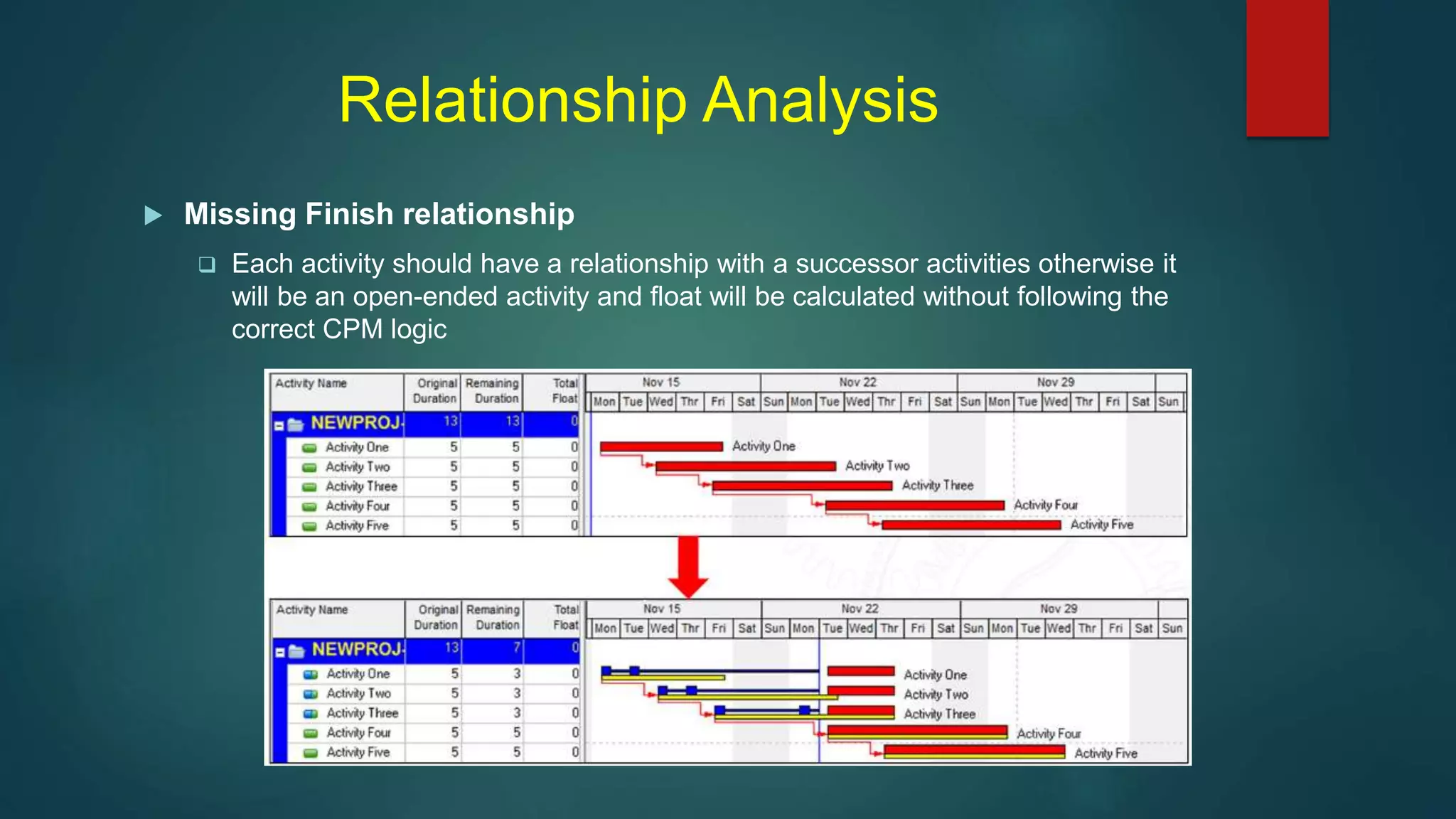
 Missing Finish relationship
 Each activity should have a relationship with a successor activities otherwise it
will be an open-ended activity and float will be calculated without following the
correct CPM logic
Constraint Analysis
 Zero free float constraint
 Allows an activity to finish just before it will impact the early start of its successor.
 If the successor is on the critical path the ZFF activity will also be displayed as
critical
 Special concern should be made for owner-supplied material as the owner would
then be at risk of delaying the project.
 Expected Finish Constraint
 Convenient for long duration activities
 May be based on best available information or a commitment
 Needs justification in the narrative
 Zero total float constraint
 Impact the schedule total float
 Forces an activity and its successors to be critical
 Artificially being coded as critical without regard to network logic
Constraint Analysis
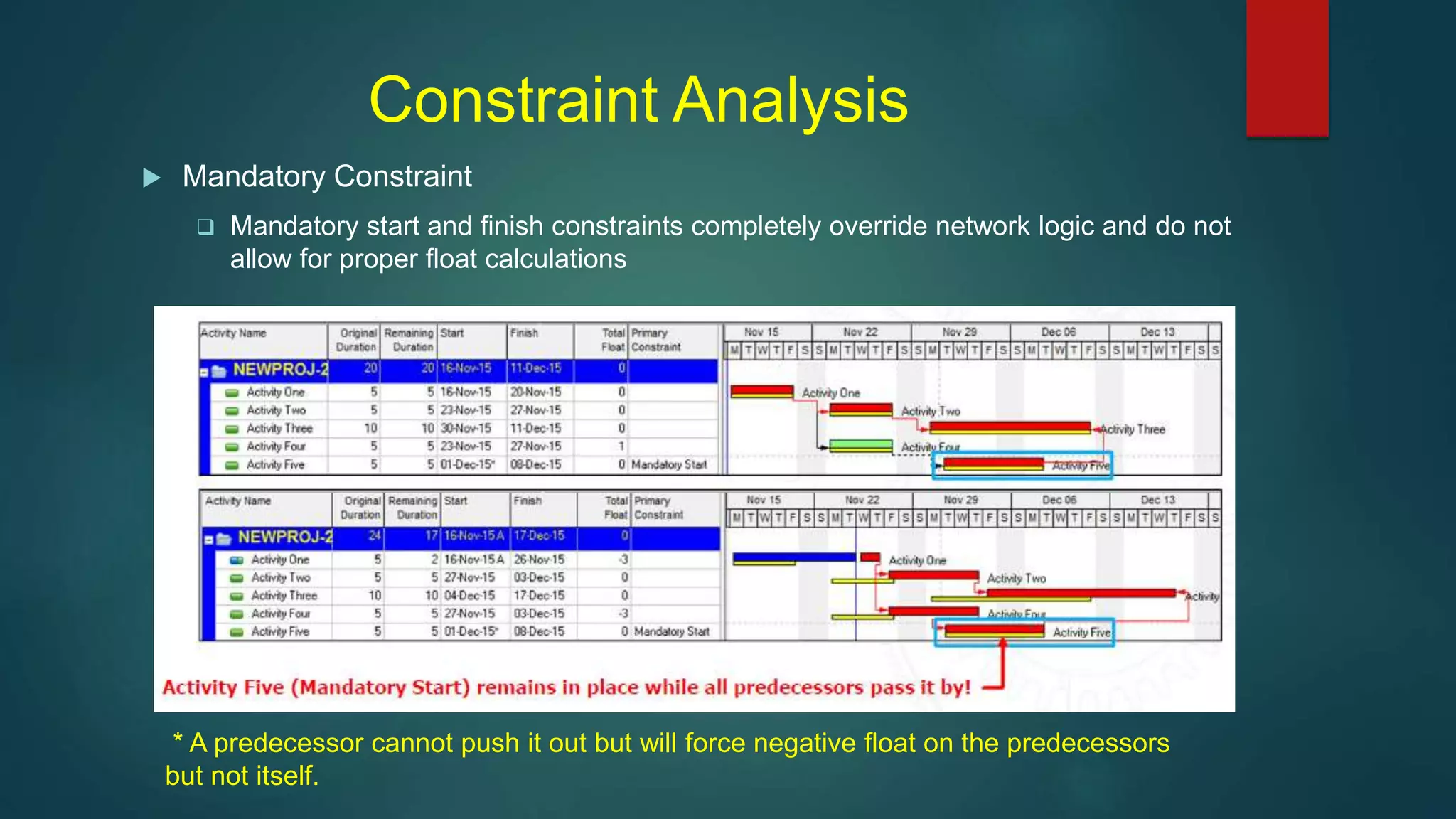
 Mandatory Constraint
 Mandatory start and finish constraints completely override network logic and do not
allow for proper float calculations
* A predecessor cannot push it out but will force negative float on the predecessors
but not itself.
Constraint Analysis
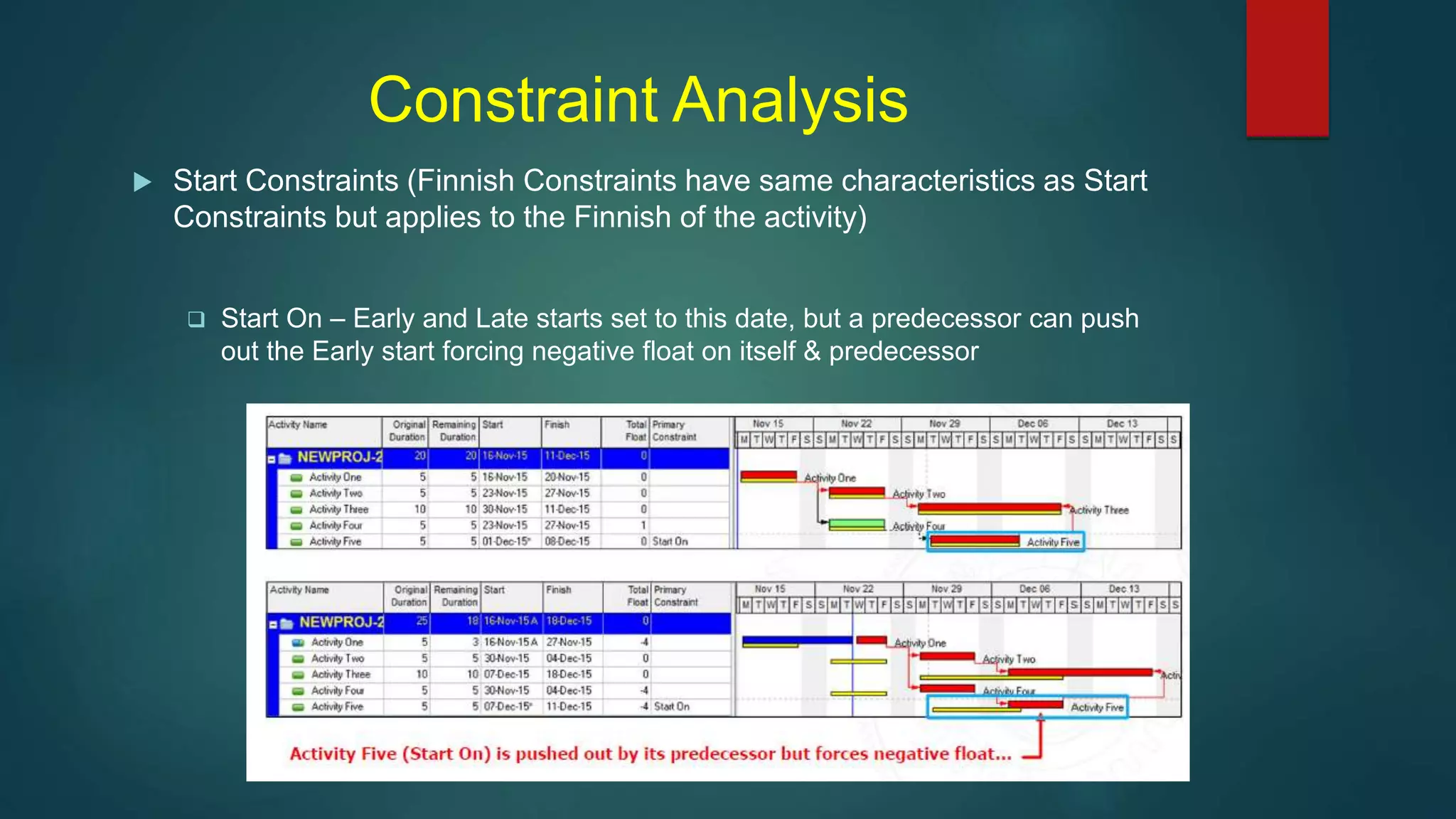
 Start Constraints (Finnish Constraints have same characteristics as Start
Constraints but applies to the Finnish of the activity)
 Start On – Early and Late starts set to this date, but a predecessor can push
out the Early start forcing negative float on itself & predecessor
Constraint Analysis
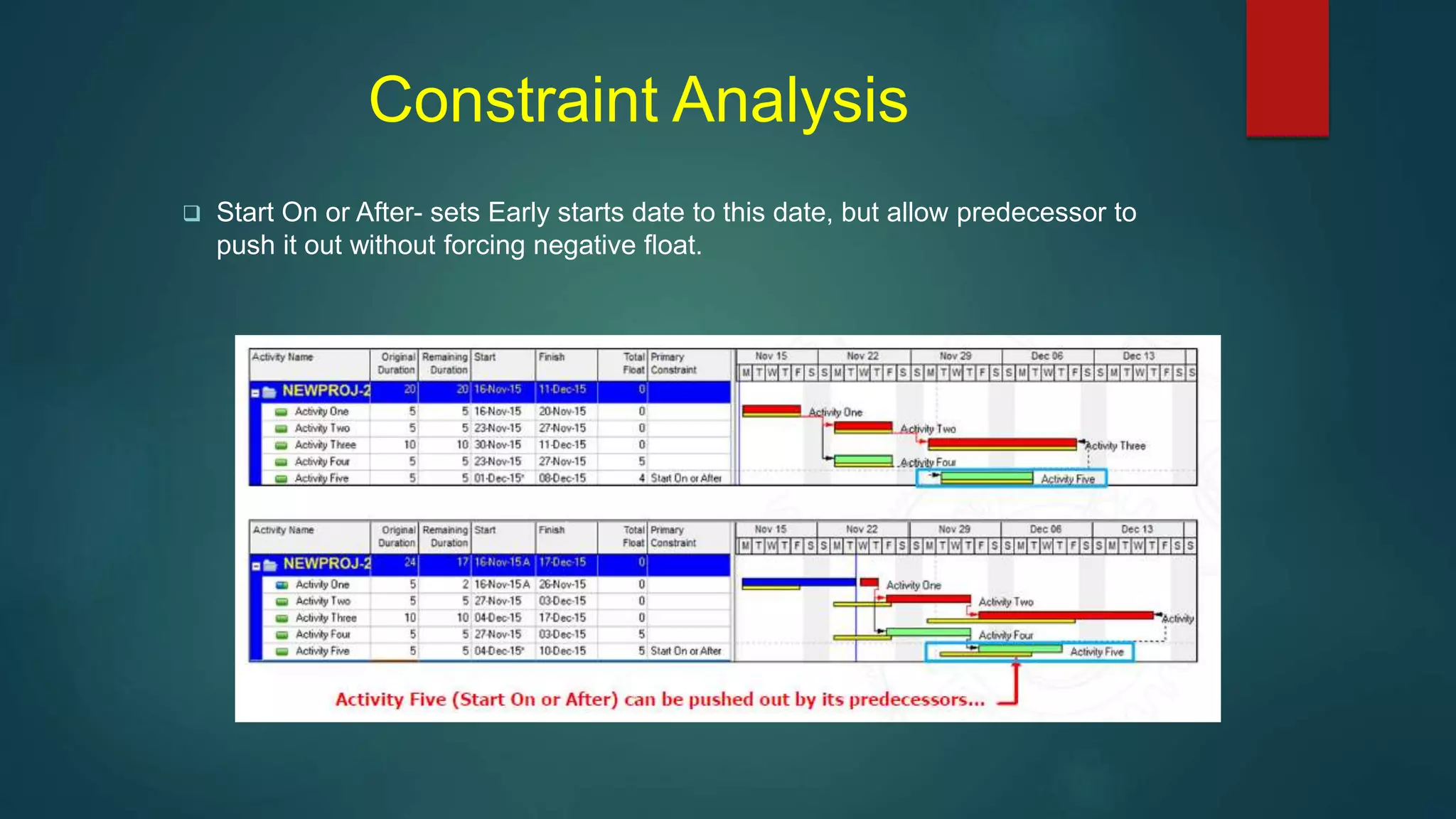
 Start On or After- sets Early starts date to this date, but allow predecessor to
push it out without forcing negative float.
Constraint Analysis
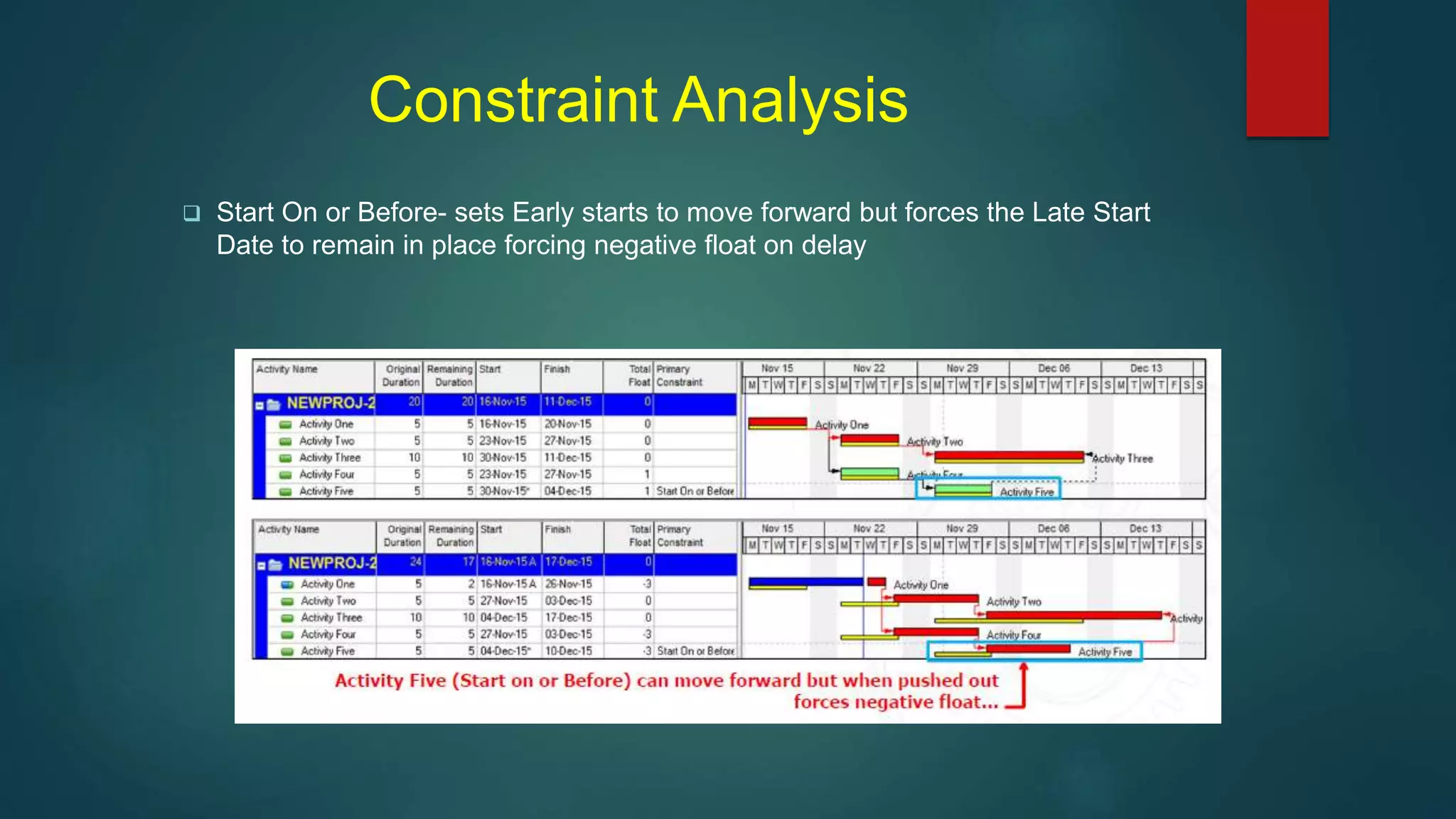
 Start On or Before- sets Early starts to move forward but forces the Late Start
Date to remain in place forcing negative float on delay
Lead and Lag check
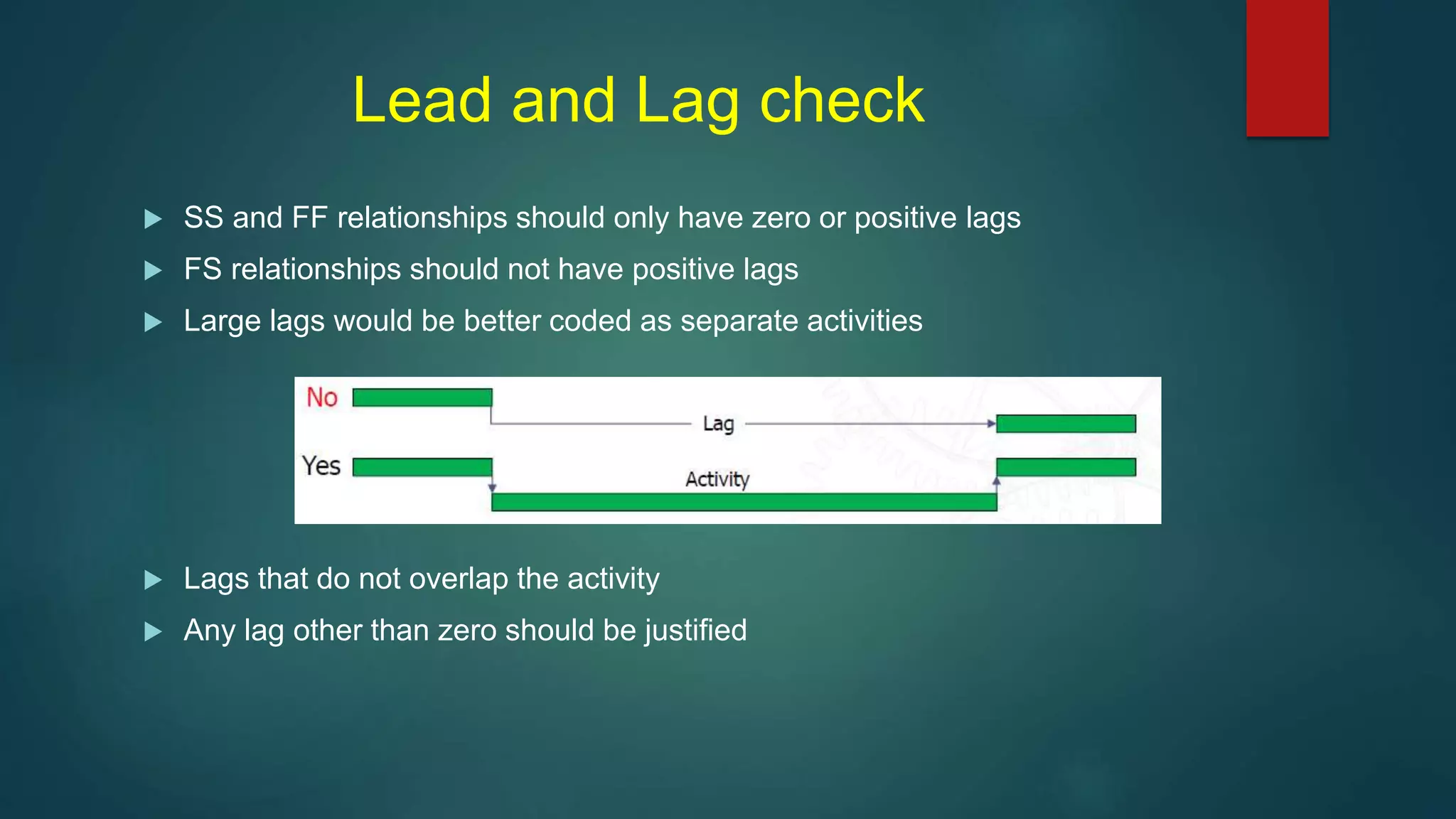
 SS and FF relationships should only have zero or positive lags
 FS relationships should not have positive lags
 Large lags would be better coded as separate activities
 Lags that do not overlap the activity
 Any lag other than zero should be justified
Cost and Resource loading
 Check for negative values
 Budgeted Cost and Actual Cost should not be negative in a Baseline schedule.
 Earned value
 Earned Value Should be zero in Baseline Schedule
 Activities with automatically adjustable durations and costs
 Check for hammock or level of efforts activities for which cost is assigned and
for which costs will vary as duration of activity changes
 Consistency with bid items or schedule of values
 Overall budgeted Cost of Project should match with the Contract bid amount
Cost and Resource loading
 Resource Levelling
 An automatic resource leveled schedule is a CPM schedule that has been further
adjusted to override and invalidate the CPM early and late date calculations
 This means a resource levelled schedule does not follow the CPM logic
 If the Resource levelling setting has been used, then the contractor should state
so in the schedule narrative.
 If the owner wishes to accept automatic resource leveled schedules, then it is the
responsibility of the contractor to explain exactly what changes were made in
addition to the ones made during the actual CPM calculation process
 Most of the resource leveled schedules cannot be said to be the best, precise
plan for project execution
Baseline Revision
 When Employer/Engineer instruct the contractor to do so, Contractor should within
stipulated time period in contract, submit the Baseline Revision
 When Contract conditions asks for Program revision at some periodic intervals
(Biweekly, monthly etc.)
 When contractor chooses to submit a revised program in case of any changes to
Work methodology or sequence of work in originally accepted baseline
 When a compensation delay event has occurred and Contractor is awarded with an
extension of Time, He should submit a revised baseline program reflecting the new
finish date of Project and updated schedule logic
References
 Ron Winter, “Reviewing a baseline Schedule”,
http://www.ronwinterconsulting.com/Reviewing_a_Baseline_Schedule.pdf
 Donald R Mcnatty, “ Baseline Schedule Metrics”,
http://www.drmcnatty.com/wordpress/wp-
content/uploads/2015/11/November-2015-Webinar-Baseline-Metrics.pdf
 Roger Gibson, “Construction Delays-Extension of Time and Prolongation
Claims”, Taylor and Francis Group
 Specifications Division 1 section 13200
 FIDIC Red Book 1999
THANK YOU !

Baseline schedule review and analysis

  • 1.
    Baseline Schedule Review andAnalysis ADITYA GHUMARE, PMP
  • 2.
    Content  Baseline Schedule Contractual Requirements  Baseline Review  References
  • 3.
  • 4.
    Baseline Schedule  InitialSchedule  Contractor’s intent to reach project completion  Integrating all contractual requirements and Project Activities  Consented to by the Employer under the contract, when it is deemed satisfactory
  • 5.
  • 6.
    Baseline Schedule  Monitoringthe Time control and Project progress (Planned vs Actual)  Record and Track changes  Forecasting the Project duration and cost  Analyze delays and impacts  Establish accountability of parties  Establish cash flow projections for future payments and funding purposes  Reporting to other Project Stakeholders
  • 7.
  • 8.
    Contractual Requirements Prior toContract Award:  Tender Documents – Usually calls for a Preliminary Program of works to be submitted at Tender stage as per ITT After the Contract Award: The Contract stipulates the requirements of the Program of Works along with all complementary reports and procedural formalities, under the following documents:  Contract Specifications– usually calls for a Baseline Program  COC – General Conditions(e.g. FIDIC Red book 1999 Clause 8.3 –Stipulates the requirements to submit a Program of Works)  COC – Special Condition (e.g. Modifications(if applicable)to the Clause No. 8.3 based on Project Requirements)
  • 9.
  • 10.
    Pre Analysis  ScheduleIdentification  Check to see if report contains key information like Company name, Project Title, Project manager, Baseline version etc.  Report title should highlight that it is a “Baseline schedule’ along with version number and Date in case any revision is made.  Imposed Finish dates  Imposed Project finish date should not be present in baseline  Instead a Final Activity or Completion Milestone should reflect a Contractual Finish Date  Correct Data Date  Data date should be equal to Project start date or NTP date
  • 12.
    Pre Analysis  CalendarCheck  Correct Project Calendar  Holidays and Work weeks  Activity/Resource Calendars  Consistency of work hours in calendar  Correct Cost Label  Check to see if correct Cost labels are used as per the Contract requirement (e.g. USD/AED etc.)  Critical Path identification  Check for Critical path and ensure that it is covering all important Project activities and is logical.
  • 13.
    Project Analysis  FullScope of Work for Project  Project Duration and Key Dates  Early Project Completion  Contractor is declaring their intent to complete project earlier than as required by Contract  If Early Completion baseline is accepted, the owner might be at risk of owner caused delays even if project completes on or before originally required Project Completion Date
  • 14.
    Project Analysis  Totalnumber of activities  Percentage of Critical and near critical activities  Contractual Milestones  Activity distribution Histogram  Contractual Milestones
  • 15.
    Detailed Analysis  ActivityAnalysis  WBS Analysis  Relationship Analysis  Constraint Analysis  Lead and Lag check  Cost and resource loading
  • 16.
    Activity Analysis  ActivityID Check  Duplicate Activity ID and description  Mechanically incorrect dates  No Actual Dates in Baseline  Proper Activity Types  Activity Percentage Completion type  No Negative Float  Activity Duration Checks  Suspicious Activity Duration
  • 17.
  • 18.
    Activity Analysis  Allscope of work must be included  Notice to Proceed  Field Mobilization  Substantial completion  Startup, testing and commissioning activities  Submittal Activities  Review and Approval Activities  Material purchases and Delivery  Temporary Activities  Inspection Activities
  • 19.
    WBS Analysis  Asper PMBOK the WBS is :”deliverable oriented hierarchical decomposition of the work to be executed by the project team”  a well-structured WBS resembles a flowchart in which all elements are logically connected, redundancy is avoided and no critical elements are left out.
  • 20.
    WBS Analysis  UsableWBS Definition  Missing WBS Definition  Incorrect WBS Codes  Undefined WBS summary Activity  Duplicate WBS Name
  • 21.
    Relationship Analysis  SummaryActivities  Summarize the schedule information for a group of activities  Each summary activity should have at least one SS predecessor and at least one FF successor  Summary activities should not be linked, the logical linking in the schedule should always occur at the activity level.
  • 22.
    Relationship Analysis  Meaningfullogic :  Activities that logically occur after substantial completion  Activities that logically occur prior to mobilization  Activities that logically occur before notice to proceed  Submittal activities without successor review activities  Multiple, simultaneous near-critical path activities
  • 23.
    Relationship Analysis  Startto Finish relationship  It is highly unusual to use start-to-finish (SF) relationships in a schedule and their use should be scrutinized.  Multiple relationship between two activities  SS combined with FF is common; any other type should be investigated.  Invalid relationship  Check for illogical successor or predecessor
  • 24.
    Relationship Analysis  MissingFinish relationship  Each activity should have a relationship with a successor activities otherwise it will be an open-ended activity and float will be calculated without following the correct CPM logic
  • 25.
    Constraint Analysis  Zerofree float constraint  Allows an activity to finish just before it will impact the early start of its successor.  If the successor is on the critical path the ZFF activity will also be displayed as critical  Special concern should be made for owner-supplied material as the owner would then be at risk of delaying the project.  Expected Finish Constraint  Convenient for long duration activities  May be based on best available information or a commitment  Needs justification in the narrative  Zero total float constraint  Impact the schedule total float  Forces an activity and its successors to be critical  Artificially being coded as critical without regard to network logic
  • 26.
    Constraint Analysis  MandatoryConstraint  Mandatory start and finish constraints completely override network logic and do not allow for proper float calculations * A predecessor cannot push it out but will force negative float on the predecessors but not itself.
  • 27.
    Constraint Analysis  StartConstraints (Finnish Constraints have same characteristics as Start Constraints but applies to the Finnish of the activity)  Start On – Early and Late starts set to this date, but a predecessor can push out the Early start forcing negative float on itself & predecessor
  • 28.
    Constraint Analysis  StartOn or After- sets Early starts date to this date, but allow predecessor to push it out without forcing negative float.
  • 29.
    Constraint Analysis  StartOn or Before- sets Early starts to move forward but forces the Late Start Date to remain in place forcing negative float on delay
  • 30.
    Lead and Lagcheck  SS and FF relationships should only have zero or positive lags  FS relationships should not have positive lags  Large lags would be better coded as separate activities  Lags that do not overlap the activity  Any lag other than zero should be justified
  • 31.
    Cost and Resourceloading  Check for negative values  Budgeted Cost and Actual Cost should not be negative in a Baseline schedule.  Earned value  Earned Value Should be zero in Baseline Schedule  Activities with automatically adjustable durations and costs  Check for hammock or level of efforts activities for which cost is assigned and for which costs will vary as duration of activity changes  Consistency with bid items or schedule of values  Overall budgeted Cost of Project should match with the Contract bid amount
  • 32.
    Cost and Resourceloading  Resource Levelling  An automatic resource leveled schedule is a CPM schedule that has been further adjusted to override and invalidate the CPM early and late date calculations  This means a resource levelled schedule does not follow the CPM logic  If the Resource levelling setting has been used, then the contractor should state so in the schedule narrative.  If the owner wishes to accept automatic resource leveled schedules, then it is the responsibility of the contractor to explain exactly what changes were made in addition to the ones made during the actual CPM calculation process  Most of the resource leveled schedules cannot be said to be the best, precise plan for project execution
  • 33.
    Baseline Revision  WhenEmployer/Engineer instruct the contractor to do so, Contractor should within stipulated time period in contract, submit the Baseline Revision  When Contract conditions asks for Program revision at some periodic intervals (Biweekly, monthly etc.)  When contractor chooses to submit a revised program in case of any changes to Work methodology or sequence of work in originally accepted baseline  When a compensation delay event has occurred and Contractor is awarded with an extension of Time, He should submit a revised baseline program reflecting the new finish date of Project and updated schedule logic
  • 34.
    References  Ron Winter,“Reviewing a baseline Schedule”, http://www.ronwinterconsulting.com/Reviewing_a_Baseline_Schedule.pdf  Donald R Mcnatty, “ Baseline Schedule Metrics”, http://www.drmcnatty.com/wordpress/wp- content/uploads/2015/11/November-2015-Webinar-Baseline-Metrics.pdf  Roger Gibson, “Construction Delays-Extension of Time and Prolongation Claims”, Taylor and Francis Group  Specifications Division 1 section 13200  FIDIC Red Book 1999
  • 35.