FIRST LANGUAGE
ACQUISITION

O’GRADY AND CHO, 2011
ABOUT L1 ACQUISITION

• Most important milestone in a child‟s development


• Children acquire language effortlessly giving the
  impression that the entire process is simple and
  straightforward.


• Grammar is the end result of L1 Acquisition
PHONOLOGICAL
DEVELOPMENT
A few facts:


•   Children are born with a perceptual system that is
    specifically designed for speech.


•   Children respond differently to human voices than other
    sounds.


•   Children show preference for the language of their parents
    than any other language by the time they are two days old.


•   Children can recognize their mother‟s voice within a matter of
    weeks.
PHONOLOGICAL
DEVELOPMENT:
BABBLING

• Around 6 months of age: the opportunity for infants to
  experiment and gain control over their vocal apparatus.


• Children who - for medical reasons- are unable to babble,
  can subsequently acquire normal pronunciation, but their
  speech development is significantly delayed.


• Children from different languages exhibit significant
  similarities in their babbling.
GENERAL TENDANCIES
IN SOUND ACQUISITION

• Vowels are generally acquired before consonants (as a
  group – 3 yrs. old)
• Stops (p, t, k, n, d, g, m, n) tend to be acquired before
  other consonants.
• Labials are often acquired first followed by alveolars,
  velars and alveopalatals.
• Interdentals (ð, θ) are acquired last.
• Children produce phonemic contrasts of their language
  well before they can produce them (comprehension tasks).
VOCABULARY
DEVELOPMENT


• 18 mts. Vocabulary: 50 words (nouns are the single largest
  class in a child‟s early vocabulary).


• Verbs and adjectives are next.


• 6 yr. olds: thirteen or fourteen thousand words.
STRATEGIES FOR
ACQUIRING MEANING

• The Whole Object Assumption
   • A new word refers to the whole subject.

• The Type Assumption
   • A new word refers to a type of thing, not just a particular
     thing.

• The Basic Level Assumption
   • A new word refers to objects that are alike in basic ways
     (appearance, behaviour etc.)
MORPHOLOGICAL
DEVELOPMENT

• Initially: affixes are systematically absent and most words
  consist of single root morphemes.


OVERGENERALIZATION & OVERREGULATION


• Plural –s
• Past –ed
DEVELOPMENTAL
SEQUENCE
BOUND MORPHEMES AND FUNCTIONAL CATEGORIES


1. -ing
2. - s (plurals)
3. -s (possessive)
4. The, a (determiners)
5. -ed past tense
6. -s (third person singular)
7. Auxiliary „be‟
SYNTACTIC
DEVELOPMENT

• Takes place in an orderly manner.


1.     one-word stage
2. two-word stage
3. telegraphic stage
4. later development
THE INTERPRETATION
OF SENTENCE
STRUCTURE

PASSIVES
• Children have an easier time interpreting active sentences
  than they do passive ones (although they produce
  passives from around age 3)


WHY?
• Canonical Sentence Strategy
   • Children expect the first NP to be the agent and the
     second NP to be the theme. (NP … V … NP agent-action-
     theme)
THE INTERPRETATION
OF SENTENCE
STRUCTURE

PRONOMINAL AND REFLEXIVES


• Children do not have a lot of trouble distinguishing
  between pronominal and reflexive pronouns.


I hurt myself with the stapler.
*You hurt myself with the stapler.


*I hurt me with the stapler.
You hurt me with the stapler.
WHAT MAKES LANGUAGE
ACQUISITION POSSIBLE?

• The role of adult speech
   • Childcare talk (motherease)

• The role of feedback


• Recasts
THE ROLE OF COGNITIVE
DEVELOPMENT

• Considerable evidence against language acquisition as
  dependent on other types of cognitive development.


   • Example:
        •   Individuals with deficient general cognitive development
            with highly developed language skills.

        •   People with average IQ with difficulties with inflection for
            the past tense and plural.
THE ROLE OF INBORN
KNOWLEDGE

• Nativism: certain grammatical knowledge is inborn


• Universal Grammar: children are born with prior
  knowledge of the type of categories, operations and
  principles that are found in the grammar of any human
  language.


• Chomsky: grammars for human languages are too
  complex and abstract to be learned solely from experience
  children are exposed to.
UNIVERSAL
PRINCIPLES

PRINCIPLE A
• A reflexive pronoun must have an antecedent that C-
  commands it in the same IP.


PRINCIPLE B
• A pronominal must not have an antecedent that C-
  commands it in the same IP.
PARAMETERS

• Not every feature in the grammar of a language can be
  inborn: vocabulary, morphology and some parts of syntax
  are learned.


• UG stipulates that an X constituent can include a head and
  its complements, but it does not specify the order of these
  elements.
THE CRITICAL PERIOD

• Is there a critical period?


Some examples:
• Genie (see video)
• Victor
• Deaf children
HOW DO WE STUDY L1
ACQUISITION?


   1. Naturalistic observation


      1. Experimentation
NTURALISTIC
OBSERVATION


• Observe and record children‟s spontaneous speech –
  Diary Study.


• Usually longitudinal.


• CHILDES (Child Language Data Exchange System)
PROS & CONS OF
NATURALISTIC
OBSERVATION


• Provides important information of how the language
  acquisition process unfolds.


• Makes it hard to test hypothesis and draw firm
  conclusions (particular structures and phenomena may
  occur rarely in children‟s everyday speech).
EXPERIMENTAL
STUDIES
• Specifically designed tasks to elicit linguistic activity
  relevant to the phenomenon that is being investigated.


• Typically cross-sectional: investigates and compares the
  linguistic knowledge of different children at a particular
  point in development.


• What do they test?
   • Comprehension
   • Production
   • Imitation skills
TESTING
COMPREHENSION


• Children judge the truth of statements being made about
  particular pictures or situations presented about the
  experimenter.


• Supply children with a set of toys and ask them to act out
  a sentence (passives: the truck was hit by the car)
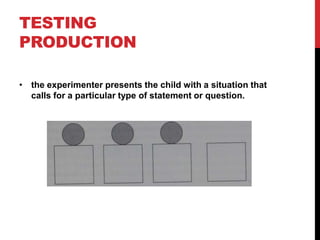
TESTING
PRODUCTION

• the experimenter presents the child with a situation that
  calls for a particular type of statement or question.
IMITATION TASKS

• Children‟s ability to repeat a particular structure provides
  a good indication of how well they have mastered it.


For example:
A child that has not acquired auxiliary verbs will repeat a
sentence such as “Mickey is laughing” by saying: “Mickey
laughing”

L1 acquisition

  • 1.
  • 2.
    ABOUT L1 ACQUISITION •Most important milestone in a child‟s development • Children acquire language effortlessly giving the impression that the entire process is simple and straightforward. • Grammar is the end result of L1 Acquisition
  • 3.
    PHONOLOGICAL DEVELOPMENT A few facts: • Children are born with a perceptual system that is specifically designed for speech. • Children respond differently to human voices than other sounds. • Children show preference for the language of their parents than any other language by the time they are two days old. • Children can recognize their mother‟s voice within a matter of weeks.
  • 4.
    PHONOLOGICAL DEVELOPMENT: BABBLING • Around 6months of age: the opportunity for infants to experiment and gain control over their vocal apparatus. • Children who - for medical reasons- are unable to babble, can subsequently acquire normal pronunciation, but their speech development is significantly delayed. • Children from different languages exhibit significant similarities in their babbling.
  • 5.
    GENERAL TENDANCIES IN SOUNDACQUISITION • Vowels are generally acquired before consonants (as a group – 3 yrs. old) • Stops (p, t, k, n, d, g, m, n) tend to be acquired before other consonants. • Labials are often acquired first followed by alveolars, velars and alveopalatals. • Interdentals (ð, θ) are acquired last. • Children produce phonemic contrasts of their language well before they can produce them (comprehension tasks).
  • 6.
    VOCABULARY DEVELOPMENT • 18 mts.Vocabulary: 50 words (nouns are the single largest class in a child‟s early vocabulary). • Verbs and adjectives are next. • 6 yr. olds: thirteen or fourteen thousand words.
  • 7.
    STRATEGIES FOR ACQUIRING MEANING •The Whole Object Assumption • A new word refers to the whole subject. • The Type Assumption • A new word refers to a type of thing, not just a particular thing. • The Basic Level Assumption • A new word refers to objects that are alike in basic ways (appearance, behaviour etc.)
  • 8.
    MORPHOLOGICAL DEVELOPMENT • Initially: affixesare systematically absent and most words consist of single root morphemes. OVERGENERALIZATION & OVERREGULATION • Plural –s • Past –ed
  • 9.
    DEVELOPMENTAL SEQUENCE BOUND MORPHEMES ANDFUNCTIONAL CATEGORIES 1. -ing 2. - s (plurals) 3. -s (possessive) 4. The, a (determiners) 5. -ed past tense 6. -s (third person singular) 7. Auxiliary „be‟
  • 10.
    SYNTACTIC DEVELOPMENT • Takes placein an orderly manner. 1. one-word stage 2. two-word stage 3. telegraphic stage 4. later development
  • 11.
    THE INTERPRETATION OF SENTENCE STRUCTURE PASSIVES •Children have an easier time interpreting active sentences than they do passive ones (although they produce passives from around age 3) WHY? • Canonical Sentence Strategy • Children expect the first NP to be the agent and the second NP to be the theme. (NP … V … NP agent-action- theme)
  • 12.
    THE INTERPRETATION OF SENTENCE STRUCTURE PRONOMINALAND REFLEXIVES • Children do not have a lot of trouble distinguishing between pronominal and reflexive pronouns. I hurt myself with the stapler. *You hurt myself with the stapler. *I hurt me with the stapler. You hurt me with the stapler.
  • 13.
    WHAT MAKES LANGUAGE ACQUISITIONPOSSIBLE? • The role of adult speech • Childcare talk (motherease) • The role of feedback • Recasts
  • 14.
    THE ROLE OFCOGNITIVE DEVELOPMENT • Considerable evidence against language acquisition as dependent on other types of cognitive development. • Example: • Individuals with deficient general cognitive development with highly developed language skills. • People with average IQ with difficulties with inflection for the past tense and plural.
  • 15.
    THE ROLE OFINBORN KNOWLEDGE • Nativism: certain grammatical knowledge is inborn • Universal Grammar: children are born with prior knowledge of the type of categories, operations and principles that are found in the grammar of any human language. • Chomsky: grammars for human languages are too complex and abstract to be learned solely from experience children are exposed to.
  • 16.
    UNIVERSAL PRINCIPLES PRINCIPLE A • Areflexive pronoun must have an antecedent that C- commands it in the same IP. PRINCIPLE B • A pronominal must not have an antecedent that C- commands it in the same IP.
  • 17.
    PARAMETERS • Not everyfeature in the grammar of a language can be inborn: vocabulary, morphology and some parts of syntax are learned. • UG stipulates that an X constituent can include a head and its complements, but it does not specify the order of these elements.
  • 18.
    THE CRITICAL PERIOD •Is there a critical period? Some examples: • Genie (see video) • Victor • Deaf children
  • 19.
    HOW DO WESTUDY L1 ACQUISITION? 1. Naturalistic observation 1. Experimentation
  • 20.
    NTURALISTIC OBSERVATION • Observe andrecord children‟s spontaneous speech – Diary Study. • Usually longitudinal. • CHILDES (Child Language Data Exchange System)
  • 21.
    PROS & CONSOF NATURALISTIC OBSERVATION • Provides important information of how the language acquisition process unfolds. • Makes it hard to test hypothesis and draw firm conclusions (particular structures and phenomena may occur rarely in children‟s everyday speech).
  • 22.
    EXPERIMENTAL STUDIES • Specifically designedtasks to elicit linguistic activity relevant to the phenomenon that is being investigated. • Typically cross-sectional: investigates and compares the linguistic knowledge of different children at a particular point in development. • What do they test? • Comprehension • Production • Imitation skills
  • 23.
    TESTING COMPREHENSION • Children judgethe truth of statements being made about particular pictures or situations presented about the experimenter. • Supply children with a set of toys and ask them to act out a sentence (passives: the truck was hit by the car)
  • 24.
    TESTING PRODUCTION • the experimenterpresents the child with a situation that calls for a particular type of statement or question.
  • 25.
    IMITATION TASKS • Children‟sability to repeat a particular structure provides a good indication of how well they have mastered it. For example: A child that has not acquired auxiliary verbs will repeat a sentence such as “Mickey is laughing” by saying: “Mickey laughing”