
Psycolinguistics and 
Language Acquisition 
Group I 
Ahmad Rusli 
Indah Nindia Iswar 
Iin Widya Lestari
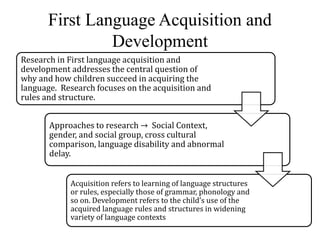
First Language Acquisition and 
Development 
Research in First language acquisition and 
development addresses the central question of 
why and how children succeed in acquiring the 
language. Research focuses on the acquisition and 
rules and structure. 
Approaches to research → Social Context, 
gender, and social group, cross cultural 
comparison, language disability and abnormal 
delay. 
Acquisition refers to learning of language structures 
or rules, especially those of grammar, phonology and 
so on. Development refers to the child’s use of the 
acquired language rules and structures in widening 
variety of language contexts
The CHILDES Database 
• Child Language Data exchange System refers 
to a computer system based collection of 
corpora accumulated by individuals and 
group of researcher.
Working with Children 
• Dealing with school, researcher should write formally letter 
to head teacher about the research that will relate to 
children. 
• Children may well wonder about the research, so the 
researcher should realize about it and anticipate it soon. 
• Children have shorten attention than adult, so researcher 
should realize about it. 
• If using some media such as pictures and etc, make sure to 
check that children at particular age can make sense of 
picture. 
• Children usually are curious about research equipment 
such as recorder, and etc, so be careful
• Make sure that researcher establish good 
relationship with them. 
• Children tend to be active and like to move 
around, so researcher has to be able in 
handling to record or use video 
• Dealing with recording or et as documents, 
researcher should realize that the reording 
need to be save in right hands. 
• introduce them to avoid misinterpretation of 
children’s voice
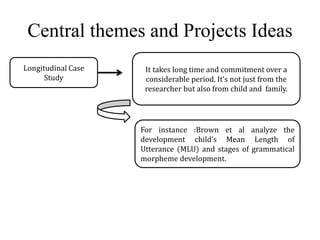
Central themes and Projects Ideas 
Longitudinal Case 
Study 
It takes long time and commitment over a 
considerable period. It’s not just from the 
researcher but also from child and family. 
For instance :Brown et al analyze the 
development child’s Mean Length of 
Utterance (MLU) and stages of grammatical 
morpheme development.
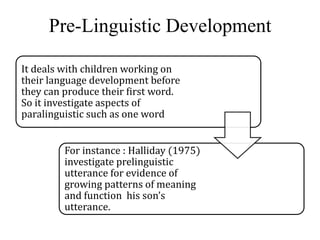
Pre-Linguistic Development 
It deals with children working on 
their language development before 
they can produce their first word. 
So it investigate aspects of 
paralinguistic such as one word 
For instance : Halliday (1975) 
investigate prelinguistic 
utterance for evidence of 
growing patterns of meaning 
and function his son’s 
utterance.
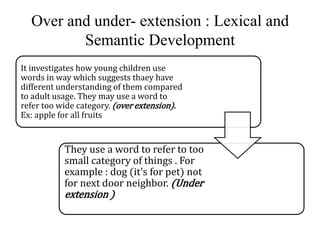
Over and under- extension : Lexical and 
Semantic Development 
It investigates how young children use 
words in way which suggests thaey have 
different understanding of them compared 
to adult usage. They may use a word to 
refer too wide category. (over extension). 
Ex: apple for all fruits 
They use a word to refer to too 
small category of things . For 
example : dog (it’s for pet) not 
for next door neighbor. (Under 
extension )
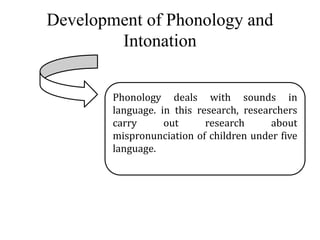
Development of Phonology and 
Intonation 
Phonology deals with sounds in 
language. in this research, researchers 
carry out research about 
mispronunciation of children under five 
language.
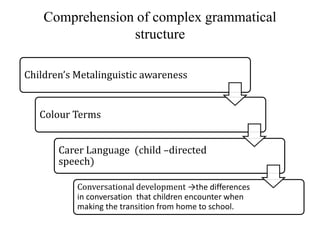
Comprehension of complex grammatical 
structure 
Children’s Metalinguistic awareness 
Colour Terms 
Carer Language (child –directed 
speech) 
Conversational development →the differences 
in conversation that children encounter when 
making the transition from home to school.
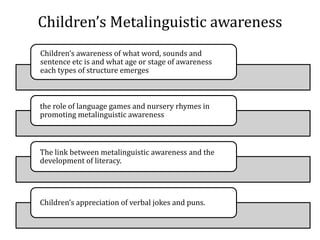
Children’s Metalinguistic awareness 
Children’s awareness of what word, sounds and 
sentence etc is and what age or stage of awareness 
each types of structure emerges 
the role of language games and nursery rhymes in 
promoting metalinguistic awareness 
The link between metalinguistic awareness and the 
development of literacy. 
Children’s appreciation of verbal jokes and puns.
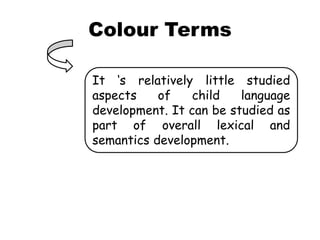
Colour Terms 
It ‘s relatively little studied 
aspects of child language 
development. It can be studied as 
part of overall lexical and 
semantics development.
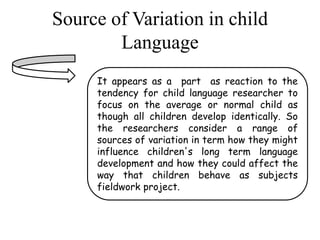
Source of Variation in child 
Language 
It appears as a part as reaction to the 
tendency for child language researcher to 
focus on the average or normal child as 
though all children develop identically. So 
the researchers consider a range of 
sources of variation in term how they might 
influence children's long term language 
development and how they could affect the 
way that children behave as subjects 
fieldwork project.
Example of First Language Acquisition 
and Development 
• Dr. Casasola (Associate Professor in the 
Department of Human Development, Cornell 
University) analyzed how language and 
learning interact in everyday circumstances 
She seeks to understand how babies learn 
words and how learning language helps to 
solidify what babies already know and, 
perhaps, how it leads babies to learn what 
they may not have learned otherwise.
One strategy that adults use to develop babies’ language acquisition is 
labeling. By labeling an object, a parent or caregiver identifies the 
names of specific objects for the baby. For example, when a baby picks up 
a ball, a parent may respond, “that’s a ball.” Researchers assert that 
babies’ early vocabulary development is stimulated when adults label 
items, thereby facilitating babies’ ability to associate words with 
objects. 
In one experiment, Casasola & Bhagwat examined the extent to which 
labeling objects helps babies learn. In this study, 18-month-old infants 
were shown 4 different videos of a support relation (two objects placed 
together): a car placed on top of another car, a cup placed on an inverted 
bowl, a Duplo figure placed on a Duplo car, and a turtle placed on a pole. 
One group of infants heard a novel word to describe the objects occupying 
the space as they viewed these events: “Wow! She puts it toke.” A second 
group of infants received the same novel word as a count noun (“Wow! It is 
a toke.”) A third group simply viewed the events in silence to establish 
how infants attend to the support relation when not hearing any language.
The results demonstrate that providing a label to 
an event helps 
infants learn about what they see. Providing a 
spatial word, even an unfamiliar one, can aid 18- 
month-old infants in recognizing a support 
relation as familiar. 
Infants learn language according to a highly 
organized set of rules containing five systems: 
phonology, morphology, syntax, semantics and 
pragmatics.

Psycolinguistics and language acquisition copy

  • 1.
    Psycolinguistics and LanguageAcquisition Group I Ahmad Rusli Indah Nindia Iswar Iin Widya Lestari
  • 2.
    First Language Acquisitionand Development Research in First language acquisition and development addresses the central question of why and how children succeed in acquiring the language. Research focuses on the acquisition and rules and structure. Approaches to research → Social Context, gender, and social group, cross cultural comparison, language disability and abnormal delay. Acquisition refers to learning of language structures or rules, especially those of grammar, phonology and so on. Development refers to the child’s use of the acquired language rules and structures in widening variety of language contexts
  • 3.
    The CHILDES Database • Child Language Data exchange System refers to a computer system based collection of corpora accumulated by individuals and group of researcher.
  • 4.
    Working with Children • Dealing with school, researcher should write formally letter to head teacher about the research that will relate to children. • Children may well wonder about the research, so the researcher should realize about it and anticipate it soon. • Children have shorten attention than adult, so researcher should realize about it. • If using some media such as pictures and etc, make sure to check that children at particular age can make sense of picture. • Children usually are curious about research equipment such as recorder, and etc, so be careful
  • 5.
    • Make surethat researcher establish good relationship with them. • Children tend to be active and like to move around, so researcher has to be able in handling to record or use video • Dealing with recording or et as documents, researcher should realize that the reording need to be save in right hands. • introduce them to avoid misinterpretation of children’s voice
  • 6.
    Central themes andProjects Ideas Longitudinal Case Study It takes long time and commitment over a considerable period. It’s not just from the researcher but also from child and family. For instance :Brown et al analyze the development child’s Mean Length of Utterance (MLU) and stages of grammatical morpheme development.
  • 7.
    Pre-Linguistic Development Itdeals with children working on their language development before they can produce their first word. So it investigate aspects of paralinguistic such as one word For instance : Halliday (1975) investigate prelinguistic utterance for evidence of growing patterns of meaning and function his son’s utterance.
  • 8.
    Over and under-extension : Lexical and Semantic Development It investigates how young children use words in way which suggests thaey have different understanding of them compared to adult usage. They may use a word to refer too wide category. (over extension). Ex: apple for all fruits They use a word to refer to too small category of things . For example : dog (it’s for pet) not for next door neighbor. (Under extension )
  • 9.
    Development of Phonologyand Intonation Phonology deals with sounds in language. in this research, researchers carry out research about mispronunciation of children under five language.
  • 10.
    Comprehension of complexgrammatical structure Children’s Metalinguistic awareness Colour Terms Carer Language (child –directed speech) Conversational development →the differences in conversation that children encounter when making the transition from home to school.
  • 11.
    Children’s Metalinguistic awareness Children’s awareness of what word, sounds and sentence etc is and what age or stage of awareness each types of structure emerges the role of language games and nursery rhymes in promoting metalinguistic awareness The link between metalinguistic awareness and the development of literacy. Children’s appreciation of verbal jokes and puns.
  • 12.
    Colour Terms It‘s relatively little studied aspects of child language development. It can be studied as part of overall lexical and semantics development.
  • 13.
    Source of Variationin child Language It appears as a part as reaction to the tendency for child language researcher to focus on the average or normal child as though all children develop identically. So the researchers consider a range of sources of variation in term how they might influence children's long term language development and how they could affect the way that children behave as subjects fieldwork project.
  • 14.
    Example of FirstLanguage Acquisition and Development • Dr. Casasola (Associate Professor in the Department of Human Development, Cornell University) analyzed how language and learning interact in everyday circumstances She seeks to understand how babies learn words and how learning language helps to solidify what babies already know and, perhaps, how it leads babies to learn what they may not have learned otherwise.
  • 15.
    One strategy thatadults use to develop babies’ language acquisition is labeling. By labeling an object, a parent or caregiver identifies the names of specific objects for the baby. For example, when a baby picks up a ball, a parent may respond, “that’s a ball.” Researchers assert that babies’ early vocabulary development is stimulated when adults label items, thereby facilitating babies’ ability to associate words with objects. In one experiment, Casasola & Bhagwat examined the extent to which labeling objects helps babies learn. In this study, 18-month-old infants were shown 4 different videos of a support relation (two objects placed together): a car placed on top of another car, a cup placed on an inverted bowl, a Duplo figure placed on a Duplo car, and a turtle placed on a pole. One group of infants heard a novel word to describe the objects occupying the space as they viewed these events: “Wow! She puts it toke.” A second group of infants received the same novel word as a count noun (“Wow! It is a toke.”) A third group simply viewed the events in silence to establish how infants attend to the support relation when not hearing any language.
  • 16.
    The results demonstratethat providing a label to an event helps infants learn about what they see. Providing a spatial word, even an unfamiliar one, can aid 18- month-old infants in recognizing a support relation as familiar. Infants learn language according to a highly organized set of rules containing five systems: phonology, morphology, syntax, semantics and pragmatics.