WEST MINISTER ABBEY
- GOTHIC
ARCHITECTURE -
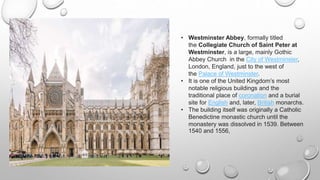
• Westminster Abbey, formally titled
the Collegiate Church of Saint Peter at
Westminster, is a large, mainly Gothic
Abbey Church in the City of Westminster,
London, England, just to the west of
the Palace of Westminster.
• It is one of the United Kingdom’s most
notable religious buildings and the
traditional place of coronation and a burial
site for English and, later, British monarchs.
• The building itself was originally a Catholic
Benedictine monastic church until the
monastery was dissolved in 1539. Between
1540 and 1556,
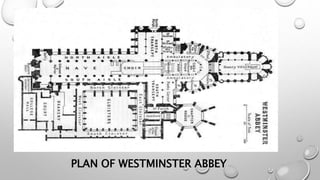
PLAN OF WESTMINSTER ABBEY
• A narthex (a portico or entrance hall) for the west
front was designed by Sir Edwin Lutyens in the
mid 20th century but was not executed. the
Abbey's official website states that the building
was without towers following Yevele's renovation,
with just the lower segments beneath the roof
level of the Nave completed.
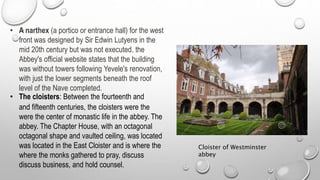
• The cloisters: Between the fourteenth and
and fifteenth centuries, the cloisters were the
were the center of monastic life in the abbey. The
abbey. The Chapter House, with an octagonal
octagonal shape and vaulted ceiling, was located
was located in the East Cloister and is where the
where the monks gathered to pray, discuss
discuss business, and hold counsel.
Cloister of Westminster
abbey
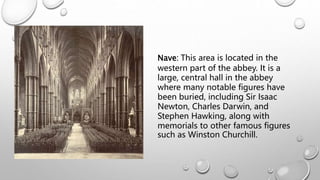
Nave: This area is located in the
western part of the abbey. It is a
large, central hall in the abbey
where many notable figures have
been buried, including Sir Isaac
Newton, Charles Darwin, and
Stephen Hawking, along with
memorials to other famous figures
such as Winston Churchill.
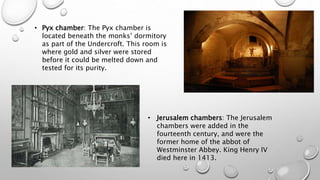
• Pyx chamber: The Pyx chamber is
located beneath the monks’ dormitory
as part of the Undercroft. This room is
where gold and silver were stored
before it could be melted down and
tested for its purity.
• Jerusalem chambers: The Jerusalem
chambers were added in the
fourteenth century, and were the
former home of the abbot of
Westminster Abbey. King Henry IV
died here in 1413.
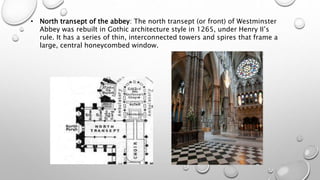
• North transept of the abbey: The north transept (or front) of Westminster
Abbey was rebuilt in Gothic architecture style in 1265, under Henry II’s
rule. It has a series of thin, interconnected towers and spires that frame a
large, central honeycombed window.
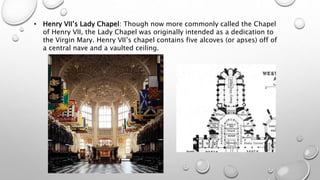
• Henry VII’s Lady Chapel: Though now more commonly called the Chapel
of Henry VII, the Lady Chapel was originally intended as a dedication to
the Virgin Mary. Henry VII’s chapel contains five alcoves (or apses) off of
a central nave and a vaulted ceiling.
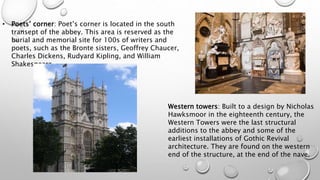
• Poets’ corner: Poet’s corner is located in the south
transept of the abbey. This area is reserved as the
burial and memorial site for 100s of writers and
poets, such as the Bronte sisters, Geoffrey Chaucer,
Charles Dickens, Rudyard Kipling, and William
Shakespeare.
Western towers: Built to a design by Nicholas
Hawksmoor in the eighteenth century, the
Western Towers were the last structural
additions to the abbey and some of the
earliest installations of Gothic Revival
architecture. They are found on the western
end of the structure, at the end of the nave.
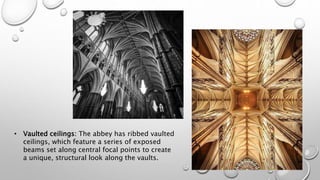
• Vaulted ceilings: The abbey has ribbed vaulted
ceilings, which feature a series of exposed
beams set along central focal points to create
a unique, structural look along the vaults.
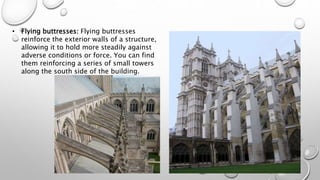
• Flying buttresses: Flying buttresses
reinforce the exterior walls of a structure,
allowing it to hold more steadily against
adverse conditions or force. You can find
them reinforcing a series of small towers
along the south side of the building.
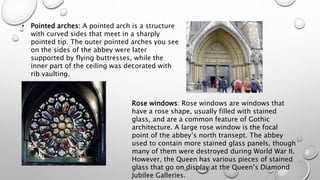
• Pointed arches: A pointed arch is a structure
with curved sides that meet in a sharply
pointed tip. The outer pointed arches you see
on the sides of the abbey were later
supported by flying buttresses, while the
inner part of the ceiling was decorated with
rib vaulting.
Rose windows: Rose windows are windows that
have a rose shape, usually filled with stained
glass, and are a common feature of Gothic
architecture. A large rose window is the focal
point of the abbey’s north transept. The abbey
used to contain more stained glass panels, though
many of them were destroyed during World War II.
However, the Queen has various pieces of stained
glass that go on display at the Queen’s Diamond
Jubilee Galleries.
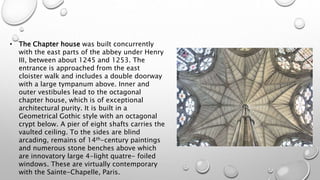
• The Chapter house was built concurrently
with the east parts of the abbey under Henry
III, between about 1245 and 1253. The
entrance is approached from the east
cloister walk and includes a double doorway
with a large tympanum above. Inner and
outer vestibules lead to the octagonal
chapter house, which is of exceptional
architectural purity. It is built in a
Geometrical Gothic style with an octagonal
crypt below. A pier of eight shafts carries the
vaulted ceiling. To the sides are blind
arcading, remains of 14th-century paintings
and numerous stone benches above which
are innovatory large 4-light quatre- foiled
windows. These are virtually contemporary
with the Sainte-Chapelle, Paris.
FUNCTIONS OF THE WESTMINSTER
ABBEY
• Coronations
• Royal weddings
• Burials
• memorials Since

Westminster Abbey. .pptx

  • 1.
    WEST MINISTER ABBEY -GOTHIC ARCHITECTURE -
  • 2.
    • Westminster Abbey,formally titled the Collegiate Church of Saint Peter at Westminster, is a large, mainly Gothic Abbey Church in the City of Westminster, London, England, just to the west of the Palace of Westminster. • It is one of the United Kingdom’s most notable religious buildings and the traditional place of coronation and a burial site for English and, later, British monarchs. • The building itself was originally a Catholic Benedictine monastic church until the monastery was dissolved in 1539. Between 1540 and 1556,
  • 3.
  • 4.
    • A narthex(a portico or entrance hall) for the west front was designed by Sir Edwin Lutyens in the mid 20th century but was not executed. the Abbey's official website states that the building was without towers following Yevele's renovation, with just the lower segments beneath the roof level of the Nave completed. • The cloisters: Between the fourteenth and and fifteenth centuries, the cloisters were the were the center of monastic life in the abbey. The abbey. The Chapter House, with an octagonal octagonal shape and vaulted ceiling, was located was located in the East Cloister and is where the where the monks gathered to pray, discuss discuss business, and hold counsel. Cloister of Westminster abbey
  • 5.
    Nave: This areais located in the western part of the abbey. It is a large, central hall in the abbey where many notable figures have been buried, including Sir Isaac Newton, Charles Darwin, and Stephen Hawking, along with memorials to other famous figures such as Winston Churchill.
  • 6.
    • Pyx chamber:The Pyx chamber is located beneath the monks’ dormitory as part of the Undercroft. This room is where gold and silver were stored before it could be melted down and tested for its purity. • Jerusalem chambers: The Jerusalem chambers were added in the fourteenth century, and were the former home of the abbot of Westminster Abbey. King Henry IV died here in 1413.
  • 7.
    • North transeptof the abbey: The north transept (or front) of Westminster Abbey was rebuilt in Gothic architecture style in 1265, under Henry II’s rule. It has a series of thin, interconnected towers and spires that frame a large, central honeycombed window.
  • 8.
    • Henry VII’sLady Chapel: Though now more commonly called the Chapel of Henry VII, the Lady Chapel was originally intended as a dedication to the Virgin Mary. Henry VII’s chapel contains five alcoves (or apses) off of a central nave and a vaulted ceiling.
  • 9.
    • Poets’ corner:Poet’s corner is located in the south transept of the abbey. This area is reserved as the burial and memorial site for 100s of writers and poets, such as the Bronte sisters, Geoffrey Chaucer, Charles Dickens, Rudyard Kipling, and William Shakespeare. Western towers: Built to a design by Nicholas Hawksmoor in the eighteenth century, the Western Towers were the last structural additions to the abbey and some of the earliest installations of Gothic Revival architecture. They are found on the western end of the structure, at the end of the nave.
  • 10.
    • Vaulted ceilings:The abbey has ribbed vaulted ceilings, which feature a series of exposed beams set along central focal points to create a unique, structural look along the vaults.
  • 11.
    • Flying buttresses:Flying buttresses reinforce the exterior walls of a structure, allowing it to hold more steadily against adverse conditions or force. You can find them reinforcing a series of small towers along the south side of the building.
  • 12.
    • Pointed arches:A pointed arch is a structure with curved sides that meet in a sharply pointed tip. The outer pointed arches you see on the sides of the abbey were later supported by flying buttresses, while the inner part of the ceiling was decorated with rib vaulting. Rose windows: Rose windows are windows that have a rose shape, usually filled with stained glass, and are a common feature of Gothic architecture. A large rose window is the focal point of the abbey’s north transept. The abbey used to contain more stained glass panels, though many of them were destroyed during World War II. However, the Queen has various pieces of stained glass that go on display at the Queen’s Diamond Jubilee Galleries.
  • 13.
    • The Chapterhouse was built concurrently with the east parts of the abbey under Henry III, between about 1245 and 1253. The entrance is approached from the east cloister walk and includes a double doorway with a large tympanum above. Inner and outer vestibules lead to the octagonal chapter house, which is of exceptional architectural purity. It is built in a Geometrical Gothic style with an octagonal crypt below. A pier of eight shafts carries the vaulted ceiling. To the sides are blind arcading, remains of 14th-century paintings and numerous stone benches above which are innovatory large 4-light quatre- foiled windows. These are virtually contemporary with the Sainte-Chapelle, Paris.
  • 14.
    FUNCTIONS OF THEWESTMINSTER ABBEY • Coronations • Royal weddings • Burials • memorials Since