HISTORY OF ARCHITECTURE
Byzantine Empire
AND
The Romanesque Architecture
THE BYZANTINE EMPIRE
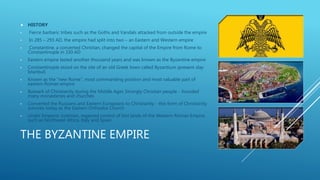
 HISTORY
• Fierce barbaric tribes such as the Goths and Vandals attacked from outside the empire
• In 285 – 293 AD, the empire had split into two – an Eastern and Western empire
• Constantine, a converted Christian, changed the capital of the Empire from Rome to
Constantinople in 330 AD
• Eastern empire lasted another thousand years and was known as the Byzantine empire
• Constantinople stood on the site of an old Greek town called Byzantium (present-day
Istanbul)
• Known as the "new Rome", most commanding position and most valuable part of
eastern Roman empire
• Bulwark of Christianity during the Middle Ages Strongly Christian people - founded
many monasteries and churches
• Converted the Russians and Eastern Europeans to Christianity - this form of Christianity
survives today as the Eastern Orthodox Church
• Under Emperor Justinian, regained control of lost lands of the Western Roman Empire,
such as Northwest Africa, Italy and Spain
ARCHITECTURAL
CHARACTER
 DESCRIPTION
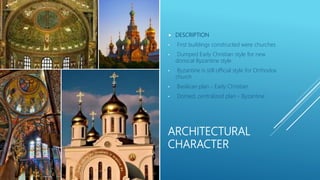
• First buildings constructed were churches
• Dumped Early Christian style for new
domical Byzantine style
• Byzantine is still official style for Orthodox
church
• Basilican plan - Early Christian
• Domed, centralized plan - Byzantine
BYZANTINE VS.
EARLY CHRISTIAN
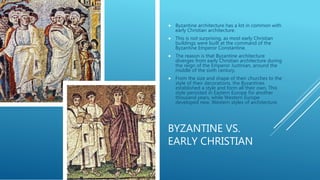
 Byzantine architecture has a lot in common with
early Christian architecture.
 This is not surprising, as most early Christian
buildings were built at the command of the
Byzantine Emperor Constantine.
 The reason is that Byzantine architecture
diverges from early Christian architecture during
the reign of the Emperor Justinian, around the
middle of the sixth century.
 From the size and shape of their churches to the
style of their decorations, the Byzantines
established a style and form all their own. This
style persisted in Eastern Europe for another
thousand years, while Western Europe
developed new, Western styles of architecture.
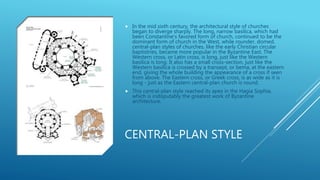
CENTRAL-PLAN STYLE
 In the mid sixth century, the architectural style of churches
began to diverge sharply. The long, narrow basilica, which had
been Constantine's favored form of church, continued to be the
dominant form of church in the West, while rounder, domed,
central-plan styles of churches, like the early Christian circular
baptistries, became more popular in the Byzantine East. The
Western cross, or Latin cross, is long, just like the Western
basilica is long. It also has a small cross-section, just like the
Western basilica is crossed by a transept, or bema, at the eastern
end, giving the whole building the appearance of a cross if seen
from above. The Eastern cross, or Greek cross, is as wide as it is
long - just as the Eastern central-plan church is round.
 This central-plan style reached its apex in the Hagia Sophia,
which is indisputably the greatest work of Byzantine
architecture.
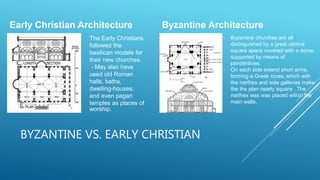
BYZANTINE VS. EARLY CHRISTIAN
Early Christian Architecture Byzantine Architecture
The Early Christians
followed the
basilican models for
their new churches.
- May also have
used old Roman
halls, baths,
dwelling-houses,
and even pagan
temples as places of
worship.
- Byzantine churches are all
distinguished by a great central
square space covered with a dome,
supported by means of
pendentives.
- On each side extend short arms,
forming a Greek cross, which with
the narthex and side galleries make
the the plan nearly square . The
narthex was was placed within the
main walls.
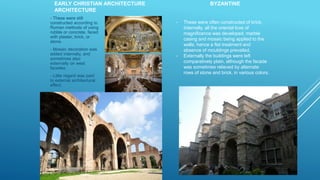
EARLY CHRISTIAN ARCHITECTURE BYZANTINE
ARCHITECTURE
- These were still
constructed according to
Roman methods of using
rubble or concrete, faced
with plaster, brick, or
stone.
- Mosaic decoration was
added internally, and
sometimes also
externally on west
facades.
- Little regard was paid
to external architectural
effect.
- These were often constructed of brick.
Internally, all the oriental love of
magnificence was developed, marble
casing and mosaic being applied to the
walls; hence a flat treatment and
absence of mouldings prevailed.
- Externally the buildings were left
comparatively plain, although the facade
was sometimes relieved by alternate
rows of stone and brick, in various colors.
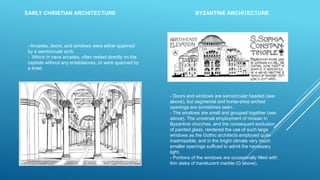
- Doors and windows are semicircular headed (see
above), but segmental and horse-shoe arched
openings are sometimes seen.
- The windows are small and grouped together (see
above). The universal employment of mosaic in
Byzantine churches, and the consequent exclusion
of painted glass, rendered the use of such large
windows as the Gothic architects employed quite
inadmissible, and in the bright climate very much
smaller openings sufficed to admit the necessary
light.
- Portions of the windows are occasionally filled with
thin slabs of translucent marble (G above).
- Arcades, doors, and windows were either spanned
by a semicircular arch.
- Which in nave arcades, often rested directly on the
capitals without any entablatures, or were spanned by
a lintel.
EARLY CHRISTIAN ARCHITECTURE BYZANTINE ARCHITECTURE
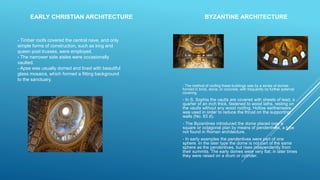
- The method of roofing these buildings was by a series of domes
formed in brick, stone, or concrete, with frequently no further external
covering.
- In S. Sophia the vaults are covered with sheets of lead, a
quarter of an inch thick, fastened to wood laths, resting on
the vaults without any wood roofing. Hollow earthenware
was used in order to reduce the thrust on the supporting
walls (No. 83 d).
- The Byzantines introduced the dome placed over a
square or octagonal plan by means of pendentives, a type
not found in Roman architecture.
- In early examples the pendentives were part of one
sphere. In the later type the dome is not part of the same
sphere as the pendentives, but rises independently from
their summits. The early domes were very flat; in later times
they were raised on a drum or cylinder.
- Timber roofs covered the central nave, and only
simple forms of construction, such as king and
queen post trusses, were employed.
- The narrower side aisles were occasionally
vaulted.
- Apse was usually domed and lined with beautiful
glass mosaics, which formed a fitting background
to the sanctuary.
EARLY CHRISTIAN ARCHITECTURE BYZANTINE ARCHITECTURE
ARCHITECTURAL CHARACTER
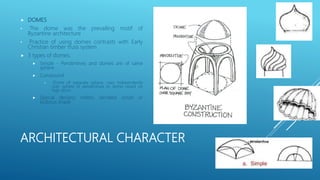
 DOMES
• The dome was the prevailing motif of
Byzantine architecture
• Practice of using domes contrasts with Early
Christian timber truss system
 3 types of domes:
 Simple - Pendentives and domes are of same
sphere
 Compound
• Dome of separate sphere, rises independently
over sphere of pendentives or dome raised on
high drum
 Special designs: melon, serrated, onion or
bulbous shape
ARCHITECTURE
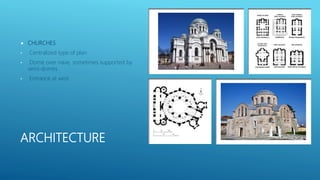
 CHURCHES
• Centralized type of plan
• Dome over nave, sometimes supported by
semi-domes
• Entrance at west
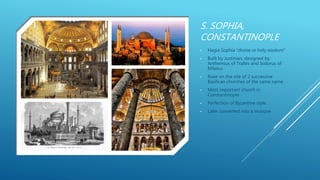
S. SOPHIA,
CONSTANTINOPLE
• Hagia Sophia "divine or holy wisdom"
• Built by Justinian, designed by
Anthemius of Tralles and Isidorus of
Miletus
• Rose on the site of 2 successive
Basilican churches of the same name
• Most important church in
Constantinople
• Perfection of Byzantine style
• Later converted into a mosque
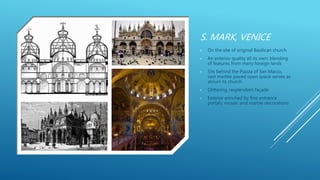
S. MARK, VENICE
• On the site of original Basilican church
• An exterior quality all its own: blending
of features from many foreign lands
• Sits behind the Piazza of San Marco,
vast marble-paved open space serves as
atrium to church
• Glittering, resplendent façade
• Exterior enriched by fine entrance
portals, mosaic and marble decorations
ROMANESQUE
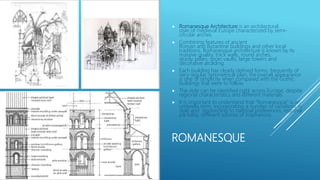
 Romanesque Architecture is an architectural
style of medieval Europe characterized by semi-
circular arches.
 Combining features of ancient
Roman and Byzantine buildings and other local
traditions, Romanesque architecture is known by its
massive quality, thick walls, round arches,
sturdy pillars, groin vaults, large towers and
decorative arcading.
 Each building has clearly defined forms, frequently of
very regular, symmetrical plan; the overall appearance
is one of simplicity when compared with the Gothic
buildings that were to follow.
 The style can be identified right across Europe, despite
regional characteristics and different materials.
 It is important to understand that “Romanesque” is an
umbrella term, incorporating a number of variations in
style and responding to national preferences, regional
partiality, different sources of inspirarions.
ARCHITECTURAL
CHARACTER
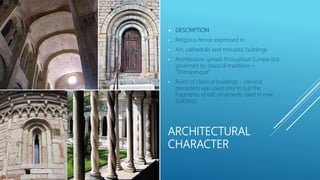
 DESCRIPTION
• Religious fervor expressed in:
• Art, cathedrals and monastic buildings
• Architecture spread throughout Europe but
governed by classical traditions –
“Romanesque”
• Ruins of classical buildings - classical
precedent was used only to suit the
fragments of old ornaments used in new
buildings
ARCHITECTURAL
CHARACTER
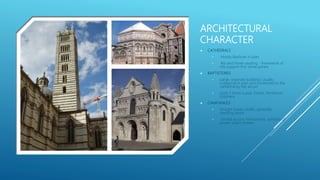
 CATHEDRALS
• Mostly Basilican in plan
• Rib and Panel vaulting - framework of
ribs support thin stone panels
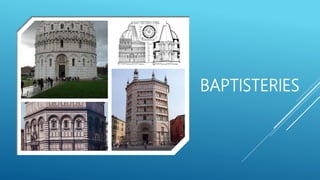
 BAPTISTERIES
• Large, separate buildings usually
octagonal in plan and connected to the
cathedral by the atrium
• Used 3 times a year: Easter, Pentecost,
Epiphany
 CAMPANILES
• Straight towers shafts, generally
standing alone
• Served as civic monuments, symbols of
power, watch towers
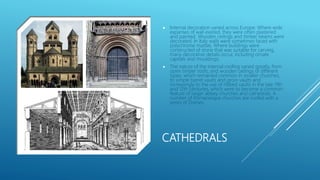
CATHEDRALS
 Internal decoration varied across Europe. Where wide
expanses of wall existed, they were often plastered
and painted. Wooden ceilings and timber beams were
decorated. In Italy walls were sometimes faced with
polychrome marble. Where buildings were
constructed of stone that was suitable for carving,
many decorative details occur, including ornate
capitals and mouldings.
 The nature of the internal roofing varied greatly, from
open timber roofs, and wooden ceilings of different
types, which remained common in smaller churches,
to simple barrel vaults and groin vaults and
increasingly to the use of ribbed vaults in the late 11th
and 12th centuries, which were to become a common
feature of larger abbey churches and cathedrals. A
number of Romanesque churches are roofed with a
series of Domes.
CATHEDRALS
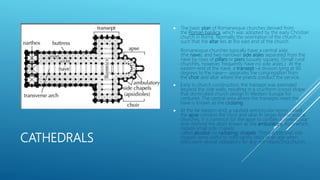
 The basic plan of Romanesque churches derived from
the Roman basilica, which was adopted by the early Christian
church in Rome. Normally the orientation of the church is
such that the altar lies at the east end of the church.
Romanesque churches typically have a central aisle
(the nave), and two narrower side aisles separated from the
nave by rows of pillars or piers (usually square). (Small rural
churches, however, frequently have no side aisles.) At the
eastern end of the nave, a transept –a division lying at 90
degrees to the nave— separates the congregation from
the choir and altar where the priests conduct the service.
 Early in church construction, the transept was extended
beyond the side walls, resulting in a cruciform (cross) shape
that dominated church design in Western Europe for
centuries. The central area where the transepts meet the
nave is known as the crossing.
 At the far eastern end, a vaulted semicircular recess called
the apse contains the choir and altar. In larger Romanesque
churches, it is common for the apse to contain a semicircular
aisle (behind the altar) known as the ambulatory, from which
radiate small side chapels
called absidial (or radiating) chapels. These additional side
chapels were useful to hold saintly relics in an age when
relics were almost obligatory for any self-respecting church.
CATHEDRALS
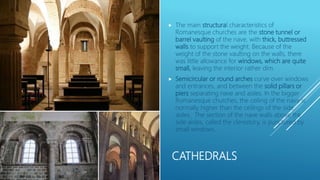
 The main structural characteristics of
Romanesque churches are the stone tunnel or
barrel vaulting of the nave, with thick, buttressed
walls to support the weight. Because of the
weight of the stone vaulting on the walls, there
was little allowance for windows, which are quite
small, leaving the interior rather dim.
 Semicircular or round arches curve over windows
and entrances, and between the solid pillars or
piers separating nave and aisles. In the bigger
Romanesque churches, the ceiling of the nave is
normally higher than the ceilings of the side
aisles. The section of the nave walls above the
side aisles, called the clerestory, is punctured by
small windows.
CATHEDRALS
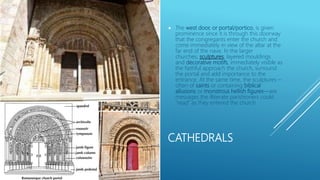
 The west door, or portal/portico, is given
prominence since it is through this doorway
that the congregants enter the church and
come immediately in view of the altar at the
far end of the nave. In the larger
churches, sculptures, layered mouldings
and decorative motifs, immediately visible as
the faithful approach the church, surround
the portal and add importance to the
entrance. At the same time, the sculptures –
often of saints or containing biblical
allusions or monstrous hellish figures—are
messages the illiterate parishioners could
“read” as they entered the church.
BAPTISTERIES
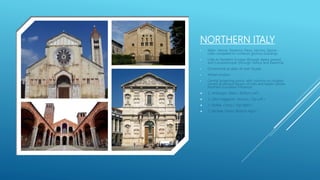
NORTHERN ITALY
• Milan, Venice, Ravenna, Pavia, Verona, Genoa -
cities competed to construct glorious buildings
• Links to Northern Europe (through alpine passes)
and Constantinople (through Venice and Ravenna)
• Ornamental arcades all over façade
• Wheel window
• Central projecting porch, with columns on roughly-
carved grotesque figures of men and beasts (shows
Northern European influence)
 S. Ambrogio, Milan ( Bottom Left )
 S. Zeno Maggiore, Verona ( Top Left )
 S. Fedele, Como ( Top Right )
 S. Michele, Pavia ( Bottom Right )
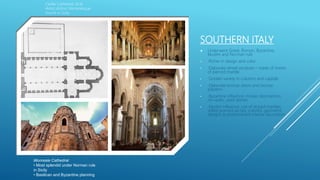
SOUTHERN ITALY
 Underwent Greek, Roman, Byzantine,
Muslim and Norman rule
• Richer in design and color
• Elaborate wheel windows – made of sheets
of pierced marble
• Greater variety in columns and capitals
• Elaborate bronze doors and bronze
pilasters
• Byzantine influence: mosaic decorations,
no vaults, used domes
• Muslim influence: use of striped marbles,
stilted pointed arches, colorful, geometric
designs as predominant interior decoration
Monreale Cathedral
• Most splendid under Norman rule
in Sicily
• Basilican and Byzantine planning
Cefalu Cathedral, Sicily
•Most distinct Romanesque
church in Sicily
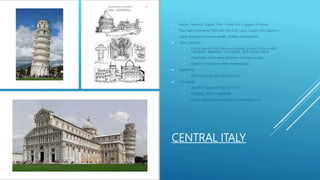
CENTRAL ITALY
• Rome, Florence, Naples, Pisa – cities rich in pagan influence
• Pisa had commercial links with the Holy Land; fought with Muslims
• Great stone and mineral wealth, brilliant atmosphere
 Pisa Cathedral
• Forms one of most famous building groups in the world -
Cathedral, Baptistery, Campanile, and Campo Santo
• Resembles other early Basilican churches in plan
• Exterior of red and white marble bands
 Baptistery
• 39.3 m circular plan by Dioti Salvi
 Campanile
• aka The “Leaning Tower of Pisa”
• 8 storeys, 16 m in diameter
• Due to failure of foundations, overhangs 4.2 m
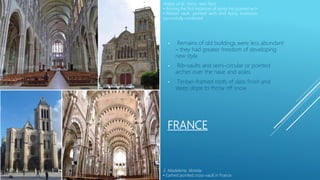
FRANCE
• Remains of old buildings were less abundant
– they had greater freedom of developing
new style
• Rib-vaults and semi-circular or pointed
arches over the nave and aisles
• Timber-framed roofs of slate finish and
steep slope to throw off snow
Abbey of St. Denis, near Paris
• Among the first instances of using the pointed arch
• Ribbed vault, pointed arch and flying buttresses
successfully combined
S. Madeleine, Vezelay
• Earliest pointed cross-vault in France
CENTRAL EUROPE
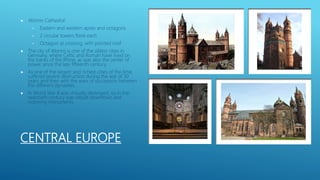
 Worms Cathedral
• Eastern and western apses and octagons
• 2 circular towers flank each
• Octagon at crossing, with pointed roof
 The city of Worms is one of the oldest cities in
Germany, where Celtic and Roman have lived on
the banks of the Rhine, as was also the center of
power since the late fifteenth century.
 As one of the largest and richest cities of the time,
suffered severe destruction during the war of 30
years and then with the wars of succession between
the different dynasties.
 In World War II was virtually destroyed, so in the
twentieth century was rebuilt downtown and
restoring monuments.
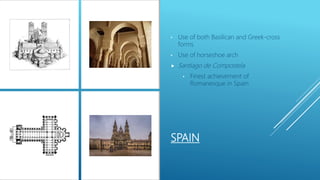
SPAIN
• Use of both Basilican and Greek-cross
forms
• Use of horseshoe arch
 Santiago de Compostela
• Finest achievement of
Romanesque in Spain
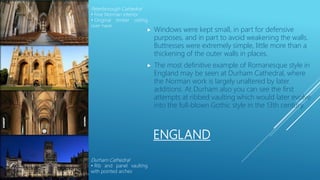
ENGLAND
 Windows were kept small, in part for defensive
purposes, and in part to avoid weakening the walls.
Buttresses were extremely simple, little more than a
thickening of the outer walls in places.
 The most definitive example of Romanesque style in
England may be seen at Durham Cathedral, where
the Norman work is largely unaltered by later
additions. At Durham also you can see the first
attempts at ribbed vaulting which would later evolve
into the full-blown Gothic style in the 13th century.
Peterborough Cathedral
• Fine Norman interior
• Original timber ceiling
over nave
Durham Cathedral
• Rib and panel vaulting
with pointed arches
HISTORY OF
ROMANESQUE
FURNITURE
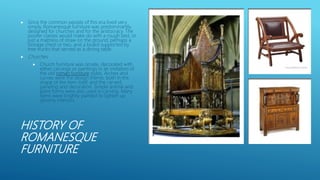
 Since the common people of this era lived very
simply, Romanesque furniture was predominantly
designed for churches and for the aristocracy. The
poorer classes would make do with a rough bed, or
just a mattress of straw on the ground, perhaps a
storage chest or two, and a board supported by
tree trunks that served as a dining table.
 Churches
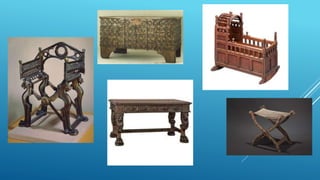
 Church furniture was ornate, decorated with
either carvings or paintings in an imitation of
the old roman furniture styles. Arches and
curves were the design theme, both in the
shape of the item itself, and the carved
paneling and decoration. Simple animal and
plant forms were also used in carving. Many
items were brightly painted to lighten up
gloomy interiors.
REFERENCES
 https://en.wikipedia.org/wiki/Romanesque_architecture
 https://en.wikiarquitectura.com/building/worms-cathedral/
 http://www.spainthenandnow.com/spanish-architecture/romanesque-architecture-
background/default_170.aspx
 http://smarthistory.khanacademy.org/church-architecture-an-overview.html
 http://smarthistory.khanacademy.org/Romanesque.html
 http://www.furniturestyles.net/medieval/romanesque/
 http://study.com/academy/lesson/byzantine-architecture.html

Byzantine empire

  • 1.
    HISTORY OF ARCHITECTURE ByzantineEmpire AND The Romanesque Architecture
  • 2.
    THE BYZANTINE EMPIRE HISTORY • Fierce barbaric tribes such as the Goths and Vandals attacked from outside the empire • In 285 – 293 AD, the empire had split into two – an Eastern and Western empire • Constantine, a converted Christian, changed the capital of the Empire from Rome to Constantinople in 330 AD • Eastern empire lasted another thousand years and was known as the Byzantine empire • Constantinople stood on the site of an old Greek town called Byzantium (present-day Istanbul) • Known as the "new Rome", most commanding position and most valuable part of eastern Roman empire • Bulwark of Christianity during the Middle Ages Strongly Christian people - founded many monasteries and churches • Converted the Russians and Eastern Europeans to Christianity - this form of Christianity survives today as the Eastern Orthodox Church • Under Emperor Justinian, regained control of lost lands of the Western Roman Empire, such as Northwest Africa, Italy and Spain
  • 3.
    ARCHITECTURAL CHARACTER  DESCRIPTION • Firstbuildings constructed were churches • Dumped Early Christian style for new domical Byzantine style • Byzantine is still official style for Orthodox church • Basilican plan - Early Christian • Domed, centralized plan - Byzantine
  • 4.
    BYZANTINE VS. EARLY CHRISTIAN Byzantine architecture has a lot in common with early Christian architecture.  This is not surprising, as most early Christian buildings were built at the command of the Byzantine Emperor Constantine.  The reason is that Byzantine architecture diverges from early Christian architecture during the reign of the Emperor Justinian, around the middle of the sixth century.  From the size and shape of their churches to the style of their decorations, the Byzantines established a style and form all their own. This style persisted in Eastern Europe for another thousand years, while Western Europe developed new, Western styles of architecture.
  • 5.
    CENTRAL-PLAN STYLE  Inthe mid sixth century, the architectural style of churches began to diverge sharply. The long, narrow basilica, which had been Constantine's favored form of church, continued to be the dominant form of church in the West, while rounder, domed, central-plan styles of churches, like the early Christian circular baptistries, became more popular in the Byzantine East. The Western cross, or Latin cross, is long, just like the Western basilica is long. It also has a small cross-section, just like the Western basilica is crossed by a transept, or bema, at the eastern end, giving the whole building the appearance of a cross if seen from above. The Eastern cross, or Greek cross, is as wide as it is long - just as the Eastern central-plan church is round.  This central-plan style reached its apex in the Hagia Sophia, which is indisputably the greatest work of Byzantine architecture.
  • 6.
    BYZANTINE VS. EARLYCHRISTIAN Early Christian Architecture Byzantine Architecture The Early Christians followed the basilican models for their new churches. - May also have used old Roman halls, baths, dwelling-houses, and even pagan temples as places of worship. - Byzantine churches are all distinguished by a great central square space covered with a dome, supported by means of pendentives. - On each side extend short arms, forming a Greek cross, which with the narthex and side galleries make the the plan nearly square . The narthex was was placed within the main walls.
  • 7.
    EARLY CHRISTIAN ARCHITECTUREBYZANTINE ARCHITECTURE - These were still constructed according to Roman methods of using rubble or concrete, faced with plaster, brick, or stone. - Mosaic decoration was added internally, and sometimes also externally on west facades. - Little regard was paid to external architectural effect. - These were often constructed of brick. Internally, all the oriental love of magnificence was developed, marble casing and mosaic being applied to the walls; hence a flat treatment and absence of mouldings prevailed. - Externally the buildings were left comparatively plain, although the facade was sometimes relieved by alternate rows of stone and brick, in various colors.
  • 8.
    - Doors andwindows are semicircular headed (see above), but segmental and horse-shoe arched openings are sometimes seen. - The windows are small and grouped together (see above). The universal employment of mosaic in Byzantine churches, and the consequent exclusion of painted glass, rendered the use of such large windows as the Gothic architects employed quite inadmissible, and in the bright climate very much smaller openings sufficed to admit the necessary light. - Portions of the windows are occasionally filled with thin slabs of translucent marble (G above). - Arcades, doors, and windows were either spanned by a semicircular arch. - Which in nave arcades, often rested directly on the capitals without any entablatures, or were spanned by a lintel. EARLY CHRISTIAN ARCHITECTURE BYZANTINE ARCHITECTURE
  • 9.
    - The methodof roofing these buildings was by a series of domes formed in brick, stone, or concrete, with frequently no further external covering. - In S. Sophia the vaults are covered with sheets of lead, a quarter of an inch thick, fastened to wood laths, resting on the vaults without any wood roofing. Hollow earthenware was used in order to reduce the thrust on the supporting walls (No. 83 d). - The Byzantines introduced the dome placed over a square or octagonal plan by means of pendentives, a type not found in Roman architecture. - In early examples the pendentives were part of one sphere. In the later type the dome is not part of the same sphere as the pendentives, but rises independently from their summits. The early domes were very flat; in later times they were raised on a drum or cylinder. - Timber roofs covered the central nave, and only simple forms of construction, such as king and queen post trusses, were employed. - The narrower side aisles were occasionally vaulted. - Apse was usually domed and lined with beautiful glass mosaics, which formed a fitting background to the sanctuary. EARLY CHRISTIAN ARCHITECTURE BYZANTINE ARCHITECTURE
  • 10.
    ARCHITECTURAL CHARACTER  DOMES •The dome was the prevailing motif of Byzantine architecture • Practice of using domes contrasts with Early Christian timber truss system  3 types of domes:  Simple - Pendentives and domes are of same sphere  Compound • Dome of separate sphere, rises independently over sphere of pendentives or dome raised on high drum  Special designs: melon, serrated, onion or bulbous shape
  • 11.
    ARCHITECTURE  CHURCHES • Centralizedtype of plan • Dome over nave, sometimes supported by semi-domes • Entrance at west
  • 12.
    S. SOPHIA, CONSTANTINOPLE • HagiaSophia "divine or holy wisdom" • Built by Justinian, designed by Anthemius of Tralles and Isidorus of Miletus • Rose on the site of 2 successive Basilican churches of the same name • Most important church in Constantinople • Perfection of Byzantine style • Later converted into a mosque
  • 13.
    S. MARK, VENICE •On the site of original Basilican church • An exterior quality all its own: blending of features from many foreign lands • Sits behind the Piazza of San Marco, vast marble-paved open space serves as atrium to church • Glittering, resplendent façade • Exterior enriched by fine entrance portals, mosaic and marble decorations
  • 14.
    ROMANESQUE  Romanesque Architectureis an architectural style of medieval Europe characterized by semi- circular arches.  Combining features of ancient Roman and Byzantine buildings and other local traditions, Romanesque architecture is known by its massive quality, thick walls, round arches, sturdy pillars, groin vaults, large towers and decorative arcading.  Each building has clearly defined forms, frequently of very regular, symmetrical plan; the overall appearance is one of simplicity when compared with the Gothic buildings that were to follow.  The style can be identified right across Europe, despite regional characteristics and different materials.  It is important to understand that “Romanesque” is an umbrella term, incorporating a number of variations in style and responding to national preferences, regional partiality, different sources of inspirarions.
  • 15.
    ARCHITECTURAL CHARACTER  DESCRIPTION • Religiousfervor expressed in: • Art, cathedrals and monastic buildings • Architecture spread throughout Europe but governed by classical traditions – “Romanesque” • Ruins of classical buildings - classical precedent was used only to suit the fragments of old ornaments used in new buildings
  • 16.
    ARCHITECTURAL CHARACTER  CATHEDRALS • MostlyBasilican in plan • Rib and Panel vaulting - framework of ribs support thin stone panels  BAPTISTERIES • Large, separate buildings usually octagonal in plan and connected to the cathedral by the atrium • Used 3 times a year: Easter, Pentecost, Epiphany  CAMPANILES • Straight towers shafts, generally standing alone • Served as civic monuments, symbols of power, watch towers
  • 17.
    CATHEDRALS  Internal decorationvaried across Europe. Where wide expanses of wall existed, they were often plastered and painted. Wooden ceilings and timber beams were decorated. In Italy walls were sometimes faced with polychrome marble. Where buildings were constructed of stone that was suitable for carving, many decorative details occur, including ornate capitals and mouldings.  The nature of the internal roofing varied greatly, from open timber roofs, and wooden ceilings of different types, which remained common in smaller churches, to simple barrel vaults and groin vaults and increasingly to the use of ribbed vaults in the late 11th and 12th centuries, which were to become a common feature of larger abbey churches and cathedrals. A number of Romanesque churches are roofed with a series of Domes.
  • 18.
    CATHEDRALS  The basicplan of Romanesque churches derived from the Roman basilica, which was adopted by the early Christian church in Rome. Normally the orientation of the church is such that the altar lies at the east end of the church. Romanesque churches typically have a central aisle (the nave), and two narrower side aisles separated from the nave by rows of pillars or piers (usually square). (Small rural churches, however, frequently have no side aisles.) At the eastern end of the nave, a transept –a division lying at 90 degrees to the nave— separates the congregation from the choir and altar where the priests conduct the service.  Early in church construction, the transept was extended beyond the side walls, resulting in a cruciform (cross) shape that dominated church design in Western Europe for centuries. The central area where the transepts meet the nave is known as the crossing.  At the far eastern end, a vaulted semicircular recess called the apse contains the choir and altar. In larger Romanesque churches, it is common for the apse to contain a semicircular aisle (behind the altar) known as the ambulatory, from which radiate small side chapels called absidial (or radiating) chapels. These additional side chapels were useful to hold saintly relics in an age when relics were almost obligatory for any self-respecting church.
  • 19.
    CATHEDRALS  The mainstructural characteristics of Romanesque churches are the stone tunnel or barrel vaulting of the nave, with thick, buttressed walls to support the weight. Because of the weight of the stone vaulting on the walls, there was little allowance for windows, which are quite small, leaving the interior rather dim.  Semicircular or round arches curve over windows and entrances, and between the solid pillars or piers separating nave and aisles. In the bigger Romanesque churches, the ceiling of the nave is normally higher than the ceilings of the side aisles. The section of the nave walls above the side aisles, called the clerestory, is punctured by small windows.
  • 20.
    CATHEDRALS  The westdoor, or portal/portico, is given prominence since it is through this doorway that the congregants enter the church and come immediately in view of the altar at the far end of the nave. In the larger churches, sculptures, layered mouldings and decorative motifs, immediately visible as the faithful approach the church, surround the portal and add importance to the entrance. At the same time, the sculptures – often of saints or containing biblical allusions or monstrous hellish figures—are messages the illiterate parishioners could “read” as they entered the church.
  • 21.
  • 22.
    NORTHERN ITALY • Milan,Venice, Ravenna, Pavia, Verona, Genoa - cities competed to construct glorious buildings • Links to Northern Europe (through alpine passes) and Constantinople (through Venice and Ravenna) • Ornamental arcades all over façade • Wheel window • Central projecting porch, with columns on roughly- carved grotesque figures of men and beasts (shows Northern European influence)  S. Ambrogio, Milan ( Bottom Left )  S. Zeno Maggiore, Verona ( Top Left )  S. Fedele, Como ( Top Right )  S. Michele, Pavia ( Bottom Right )
  • 23.
    SOUTHERN ITALY  UnderwentGreek, Roman, Byzantine, Muslim and Norman rule • Richer in design and color • Elaborate wheel windows – made of sheets of pierced marble • Greater variety in columns and capitals • Elaborate bronze doors and bronze pilasters • Byzantine influence: mosaic decorations, no vaults, used domes • Muslim influence: use of striped marbles, stilted pointed arches, colorful, geometric designs as predominant interior decoration Monreale Cathedral • Most splendid under Norman rule in Sicily • Basilican and Byzantine planning Cefalu Cathedral, Sicily •Most distinct Romanesque church in Sicily
  • 24.
    CENTRAL ITALY • Rome,Florence, Naples, Pisa – cities rich in pagan influence • Pisa had commercial links with the Holy Land; fought with Muslims • Great stone and mineral wealth, brilliant atmosphere  Pisa Cathedral • Forms one of most famous building groups in the world - Cathedral, Baptistery, Campanile, and Campo Santo • Resembles other early Basilican churches in plan • Exterior of red and white marble bands  Baptistery • 39.3 m circular plan by Dioti Salvi  Campanile • aka The “Leaning Tower of Pisa” • 8 storeys, 16 m in diameter • Due to failure of foundations, overhangs 4.2 m
  • 25.
    FRANCE • Remains ofold buildings were less abundant – they had greater freedom of developing new style • Rib-vaults and semi-circular or pointed arches over the nave and aisles • Timber-framed roofs of slate finish and steep slope to throw off snow Abbey of St. Denis, near Paris • Among the first instances of using the pointed arch • Ribbed vault, pointed arch and flying buttresses successfully combined S. Madeleine, Vezelay • Earliest pointed cross-vault in France
  • 26.
    CENTRAL EUROPE  WormsCathedral • Eastern and western apses and octagons • 2 circular towers flank each • Octagon at crossing, with pointed roof  The city of Worms is one of the oldest cities in Germany, where Celtic and Roman have lived on the banks of the Rhine, as was also the center of power since the late fifteenth century.  As one of the largest and richest cities of the time, suffered severe destruction during the war of 30 years and then with the wars of succession between the different dynasties.  In World War II was virtually destroyed, so in the twentieth century was rebuilt downtown and restoring monuments.
  • 27.
    SPAIN • Use ofboth Basilican and Greek-cross forms • Use of horseshoe arch  Santiago de Compostela • Finest achievement of Romanesque in Spain
  • 28.
    ENGLAND  Windows werekept small, in part for defensive purposes, and in part to avoid weakening the walls. Buttresses were extremely simple, little more than a thickening of the outer walls in places.  The most definitive example of Romanesque style in England may be seen at Durham Cathedral, where the Norman work is largely unaltered by later additions. At Durham also you can see the first attempts at ribbed vaulting which would later evolve into the full-blown Gothic style in the 13th century. Peterborough Cathedral • Fine Norman interior • Original timber ceiling over nave Durham Cathedral • Rib and panel vaulting with pointed arches
  • 29.
    HISTORY OF ROMANESQUE FURNITURE  Sincethe common people of this era lived very simply, Romanesque furniture was predominantly designed for churches and for the aristocracy. The poorer classes would make do with a rough bed, or just a mattress of straw on the ground, perhaps a storage chest or two, and a board supported by tree trunks that served as a dining table.  Churches  Church furniture was ornate, decorated with either carvings or paintings in an imitation of the old roman furniture styles. Arches and curves were the design theme, both in the shape of the item itself, and the carved paneling and decoration. Simple animal and plant forms were also used in carving. Many items were brightly painted to lighten up gloomy interiors.
  • 31.
    REFERENCES  https://en.wikipedia.org/wiki/Romanesque_architecture  https://en.wikiarquitectura.com/building/worms-cathedral/ http://www.spainthenandnow.com/spanish-architecture/romanesque-architecture- background/default_170.aspx  http://smarthistory.khanacademy.org/church-architecture-an-overview.html  http://smarthistory.khanacademy.org/Romanesque.html  http://www.furniturestyles.net/medieval/romanesque/  http://study.com/academy/lesson/byzantine-architecture.html