HISTORY OF ARCHITECTURE
ART DECO STYLE
INTRODUCTION
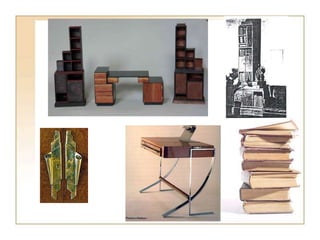
• Art Deco is essentially a style of decoration
which was applied to buildings as well as
home decor, jewelry, and clothing.
• Vivid color and stark, geometric shapes
influenced architecture, furniture, and fashion
worldwide. Everything was geometric and
cubic.
• Art Deco also incorporates a lot of contrasts,
such as color palates of chrome and cobalt
blue, and crystal and black.
• Clean shapes and elegant lines are
emphasized; ornate moldings and scrolled
protrusions that perform no practical function
are left out to allow for the curves, sleek lines
and streamlined geometric shapes, including
stylized flowers and foliage.
• The architecture and applied arts of the
period reveal a varied mix.
• From luxurious objects made from exotic
materials to mass produced, streamlined items
available to a growing middle class, the world
of Art Deco represents a "graciousness of
form" from a simpler time.
• Art deco is similar to the earlier Art Nouveau
style, but with a more Modernist esthetic.
• Art Nouveau is characterized by intricately
detailed patterns of curving lines and is
rooted in the British Arts & Crafts movement
of William Morris. Art deco style is more
reminiscent of the Precisionist art movement,
which developed at about the same time.
• Art deco architects and artists include:
– Rene Lalique (French glassmaker),
– Jean Dunand (Swiss designer),
– Frank Lloyd Wright and Raymond Hood
(American architects),
– Jean Dupas (French designer),
– William Van Alen (American architect),
– Paul Manship (American sculptor),
– C. Paul Jennewein (German sculptor),
– Erte (Russian/French painter & designer),
– Tamara de Lempicka (Polish painter)
– Jacques-Emile Ruhlmann (French furniture
designer),
– Josef Hoffmann and Koloman Moser (Austrian
jewelry designers),
– Edgar Brandt (French wrought iron sculptor),
– Louis Sullivan (American architect),
– J.A. Louis Hay (Napier architect),
– Sue et Mare (French designer) and
– Cassandre (Ukrainian/French printmaker).
• Art Deco is widely used in many areas as a
decoration style, such as architecture,
interiors, furnishing, fine arts, handmade
crafts, posters, and industrial design.
• Art Deco was influenced by the modern art
movements of Cubism, Futurism, and
Constructivism; however, it also took some
ideas from the ancient geometrical design
styles, such as Egypt, Assyria and Persia.
• Art Deco designers use stepped forms,
rounded corners, triple- striped decorative
elements and black decoration quite a lot. The
most important thing is that they are all in
geometrical order, and simple formats.
How Did It Start?
• At the beginning of the 20th century the death
of Queen Victoria in 1901 ended the Victorian
era and technology caused the pace of life to
speed up. The ornate floral styles of the pre-
Twenties gave way to a more simple style.
After World War I ended in 1919, life had
changed drastically.
• Art Deco was born in 1925. The name was
derived from the 1925 Exposition
Internationale des Arts Decoratifs Industriels
et Modernes, held in Paris, which celebrated
living in the modern world.
• Today, "Art Deco" is used to refer to a mix of
styles from the 1920s and 1930s.
In Architecture, Interior Design,
and Furniture Design
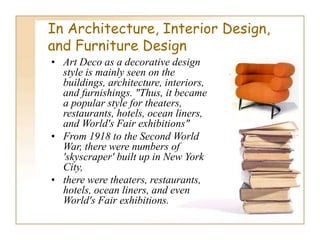
• Art Deco as a decorative design
style is mainly seen on the
buildings, architecture, interiors,
and furnishings. "Thus, it became
a popular style for theaters,
restaurants, hotels, ocean liners,
and World's Fair exhibitions"
• From 1918 to the Second World
War, there were numbers of
'skyscraper' built up in New York
City,
• there were theaters, restaurants,
hotels, ocean liners, and even
World's Fair exhibitions.
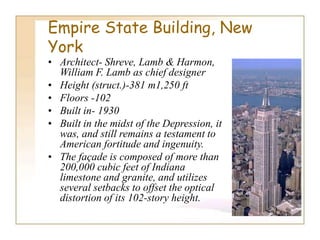
Empire State Building, New
York
• Architect- Shreve, Lamb & Harmon,
William F. Lamb as chief designer
• Height (struct.)-381 m1,250 ft
• Floors -102
• Built in- 1930
• Built in the midst of the Depression, it
was, and still remains a testament to
American fortitude and ingenuity.
• The façade is composed of more than
200,000 cubic feet of Indiana
limestone and granite, and utilizes
several setbacks to offset the optical
distortion of its 102-story height.
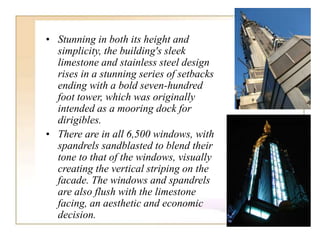
• Stunning in both its height and
simplicity, the building's sleek
limestone and stainless steel design
rises in a stunning series of setbacks
ending with a bold seven-hundred
foot tower, which was originally
intended as a mooring dock for
dirigibles.
• There are in all 6,500 windows, with
spandrels sandblasted to blend their
tone to that of the windows, visually
creating the vertical striping on the
facade. The windows and spandrels
are also flush with the limestone
facing, an aesthetic and economic
decision.
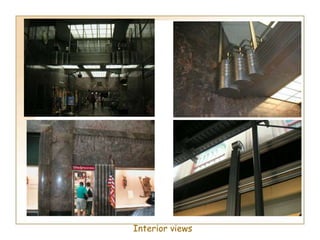
Interior views
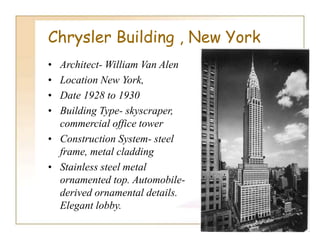
Chrysler Building , New York
• Architect- William Van Alen
• Location New York,
• Date 1928 to 1930
• Building Type- skyscraper,
commercial office tower
• Construction System- steel
frame, metal cladding
• Stainless steel metal
ornamented top. Automobile-
derived ornamental details.
Elegant lobby.
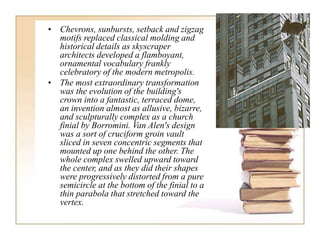
• Chevrons, sunbursts, setback and zigzag
motifs replaced classical molding and
historical details as skyscraper
architects developed a flamboyant,
ornamental vocabulary frankly
celebratory of the modern metropolis.
• The most extraordinary transformation
was the evolution of the building's
crown into a fantastic, terraced dome,
an invention almost as allusive, bizarre,
and sculpturally complex as a church
finial by Borromini. Van Alen's design
was a sort of cruciform groin vault
sliced in seven concentric segments that
mounted up one behind the other. The
whole complex swelled upward toward
the center, and as they did their shapes
were progressively distorted from a pure
semicircle at the bottom of the finial to a
thin parabola that stretched toward the
vertex.
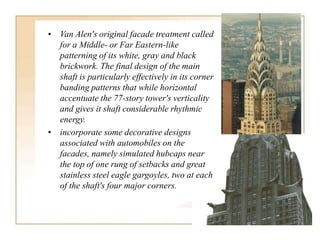
• Van Alen's original facade treatment called
for a Middle- or Far Eastern-like
patterning of its white, gray and black
brickwork. The final design of the main
shaft is particularly effectively in its corner
banding patterns that while horizontal
accentuate the 77-story tower's verticality
and gives it shaft considerable rhythmic
energy.
• incorporate some decorative designs
associated with automobiles on the
facades, namely simulated hubcaps near
the top of one rung of setbacks and great
stainless steel eagle gargoyles, two at each
of the shaft's four major corners.
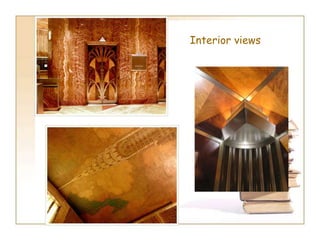
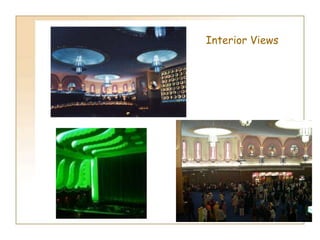
Interior views
Raj Mandir Cinema,
Jaipur
• Architect- W M Namjoshi
• Built in 1975
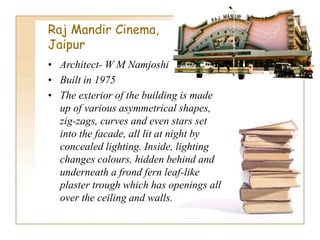
• The exterior of the building is made
up of various asymmetrical shapes,
zig-zags, curves and even stars set
into the facade, all lit at night by
concealed lighting. Inside, lighting
changes colours, hidden behind and
underneath a frond fern leaf-like
plaster trough which has openings all
over the ceiling and walls.
Interior Views
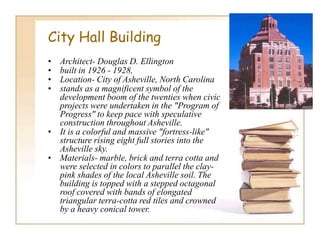
City Hall Building
• Architect- Douglas D. Ellington
• built in 1926 - 1928,
• Location- City of Asheville, North Carolina
• stands as a magnificent symbol of the
development boom of the twenties when civic
projects were undertaken in the "Program of
Progress" to keep pace with speculative
construction throughout Asheville.
• It is a colorful and massive "fortress-like"
structure rising eight full stories into the
Asheville sky.
• Materials- marble, brick and terra cotta and
were selected in colors to parallel the clay-
pink shades of the local Asheville soil. The
building is topped with a stepped octagonal
roof covered with bands of elongated
triangular terra-cotta red tiles and crowned
by a heavy conical tower.
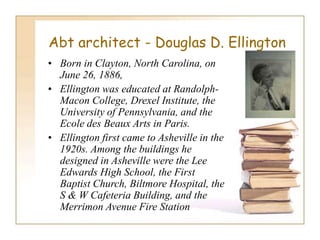
Abt architect - Douglas D. Ellington
• Born in Clayton, North Carolina, on
June 26, 1886,
• Ellington was educated at Randolph-
Macon College, Drexel Institute, the
University of Pennsylvania, and the
Ecole des Beaux Arts in Paris.
• Ellington first came to Asheville in the
1920s. Among the buildings he
designed in Asheville were the Lee
Edwards High School, the First
Baptist Church, Biltmore Hospital, the
S & W Cafeteria Building, and the
Merrimon Avenue Fire Station
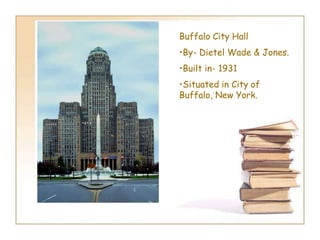
Buffalo City Hall
•By- Dietel Wade & Jones.
•Built in- 1931
•Situated in City of
Buffalo, New York.
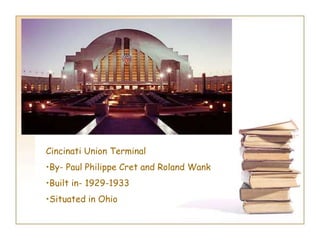
Cincinati Union Terminal
•By- Paul Philippe Cret and Roland Wank
•Built in- 1929-1933
•Situated in Ohio
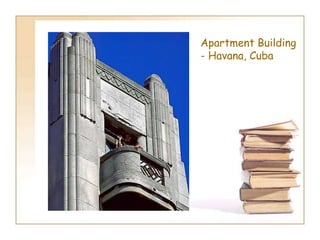
Apartment Building
- Havana, Cuba
Department Stores
• Acknowledging the appeal of art deco
requires that one address the role of style and
fashion in the modern design economy and
recognize the importance of department stores
in the modern metropolis.
• Like the tall office building, the department
store emerged as a distinctive building type in
the 19 century and grew in size until it often
occupied entire city blocks.
• Department stores played a crucial role in the
promotion of all types and styles of goods for
an increasingly broad spectrum of consumers.
• With the popularity of art deco, some
department stores assumed a more flamboyant
presence in the cityscape.
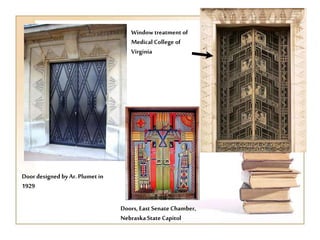
Door designed byAr. Plumet in
1929
Window treatment of
Medical College of
Virginia
Doors, East Senate Chamber,
NebraskaStateCapitol
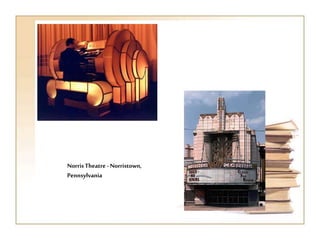
NorrisTheatre -Norristown,
Pennsylvania
Bibliography
• Twentieth century Architecture
• Sir. Benister Fletcher
• Annolated architecture
• History of western architecture
• www.wikipedia.com
• www.greatbuildingsonline.com

Art deco

  • 1.
  • 2.
    INTRODUCTION • Art Decois essentially a style of decoration which was applied to buildings as well as home decor, jewelry, and clothing. • Vivid color and stark, geometric shapes influenced architecture, furniture, and fashion worldwide. Everything was geometric and cubic. • Art Deco also incorporates a lot of contrasts, such as color palates of chrome and cobalt blue, and crystal and black. • Clean shapes and elegant lines are emphasized; ornate moldings and scrolled protrusions that perform no practical function are left out to allow for the curves, sleek lines and streamlined geometric shapes, including stylized flowers and foliage.
  • 3.
    • The architectureand applied arts of the period reveal a varied mix. • From luxurious objects made from exotic materials to mass produced, streamlined items available to a growing middle class, the world of Art Deco represents a "graciousness of form" from a simpler time. • Art deco is similar to the earlier Art Nouveau style, but with a more Modernist esthetic. • Art Nouveau is characterized by intricately detailed patterns of curving lines and is rooted in the British Arts & Crafts movement of William Morris. Art deco style is more reminiscent of the Precisionist art movement, which developed at about the same time.
  • 4.
    • Art decoarchitects and artists include: – Rene Lalique (French glassmaker), – Jean Dunand (Swiss designer), – Frank Lloyd Wright and Raymond Hood (American architects), – Jean Dupas (French designer), – William Van Alen (American architect), – Paul Manship (American sculptor), – C. Paul Jennewein (German sculptor), – Erte (Russian/French painter & designer), – Tamara de Lempicka (Polish painter) – Jacques-Emile Ruhlmann (French furniture designer), – Josef Hoffmann and Koloman Moser (Austrian jewelry designers), – Edgar Brandt (French wrought iron sculptor), – Louis Sullivan (American architect), – J.A. Louis Hay (Napier architect), – Sue et Mare (French designer) and – Cassandre (Ukrainian/French printmaker).
  • 5.
    • Art Decois widely used in many areas as a decoration style, such as architecture, interiors, furnishing, fine arts, handmade crafts, posters, and industrial design. • Art Deco was influenced by the modern art movements of Cubism, Futurism, and Constructivism; however, it also took some ideas from the ancient geometrical design styles, such as Egypt, Assyria and Persia. • Art Deco designers use stepped forms, rounded corners, triple- striped decorative elements and black decoration quite a lot. The most important thing is that they are all in geometrical order, and simple formats.
  • 6.
    How Did ItStart? • At the beginning of the 20th century the death of Queen Victoria in 1901 ended the Victorian era and technology caused the pace of life to speed up. The ornate floral styles of the pre- Twenties gave way to a more simple style. After World War I ended in 1919, life had changed drastically. • Art Deco was born in 1925. The name was derived from the 1925 Exposition Internationale des Arts Decoratifs Industriels et Modernes, held in Paris, which celebrated living in the modern world. • Today, "Art Deco" is used to refer to a mix of styles from the 1920s and 1930s.
  • 7.
    In Architecture, InteriorDesign, and Furniture Design • Art Deco as a decorative design style is mainly seen on the buildings, architecture, interiors, and furnishings. "Thus, it became a popular style for theaters, restaurants, hotels, ocean liners, and World's Fair exhibitions" • From 1918 to the Second World War, there were numbers of 'skyscraper' built up in New York City, • there were theaters, restaurants, hotels, ocean liners, and even World's Fair exhibitions.
  • 8.
    Empire State Building,New York • Architect- Shreve, Lamb & Harmon, William F. Lamb as chief designer • Height (struct.)-381 m1,250 ft • Floors -102 • Built in- 1930 • Built in the midst of the Depression, it was, and still remains a testament to American fortitude and ingenuity. • The façade is composed of more than 200,000 cubic feet of Indiana limestone and granite, and utilizes several setbacks to offset the optical distortion of its 102-story height.
  • 9.
    • Stunning inboth its height and simplicity, the building's sleek limestone and stainless steel design rises in a stunning series of setbacks ending with a bold seven-hundred foot tower, which was originally intended as a mooring dock for dirigibles. • There are in all 6,500 windows, with spandrels sandblasted to blend their tone to that of the windows, visually creating the vertical striping on the facade. The windows and spandrels are also flush with the limestone facing, an aesthetic and economic decision.
  • 10.
  • 11.
    Chrysler Building ,New York • Architect- William Van Alen • Location New York, • Date 1928 to 1930 • Building Type- skyscraper, commercial office tower • Construction System- steel frame, metal cladding • Stainless steel metal ornamented top. Automobile- derived ornamental details. Elegant lobby.
  • 12.
    • Chevrons, sunbursts,setback and zigzag motifs replaced classical molding and historical details as skyscraper architects developed a flamboyant, ornamental vocabulary frankly celebratory of the modern metropolis. • The most extraordinary transformation was the evolution of the building's crown into a fantastic, terraced dome, an invention almost as allusive, bizarre, and sculpturally complex as a church finial by Borromini. Van Alen's design was a sort of cruciform groin vault sliced in seven concentric segments that mounted up one behind the other. The whole complex swelled upward toward the center, and as they did their shapes were progressively distorted from a pure semicircle at the bottom of the finial to a thin parabola that stretched toward the vertex.
  • 13.
    • Van Alen'soriginal facade treatment called for a Middle- or Far Eastern-like patterning of its white, gray and black brickwork. The final design of the main shaft is particularly effectively in its corner banding patterns that while horizontal accentuate the 77-story tower's verticality and gives it shaft considerable rhythmic energy. • incorporate some decorative designs associated with automobiles on the facades, namely simulated hubcaps near the top of one rung of setbacks and great stainless steel eagle gargoyles, two at each of the shaft's four major corners.
  • 14.
  • 15.
    Raj Mandir Cinema, Jaipur •Architect- W M Namjoshi • Built in 1975 • The exterior of the building is made up of various asymmetrical shapes, zig-zags, curves and even stars set into the facade, all lit at night by concealed lighting. Inside, lighting changes colours, hidden behind and underneath a frond fern leaf-like plaster trough which has openings all over the ceiling and walls.
  • 16.
  • 17.
    City Hall Building •Architect- Douglas D. Ellington • built in 1926 - 1928, • Location- City of Asheville, North Carolina • stands as a magnificent symbol of the development boom of the twenties when civic projects were undertaken in the "Program of Progress" to keep pace with speculative construction throughout Asheville. • It is a colorful and massive "fortress-like" structure rising eight full stories into the Asheville sky. • Materials- marble, brick and terra cotta and were selected in colors to parallel the clay- pink shades of the local Asheville soil. The building is topped with a stepped octagonal roof covered with bands of elongated triangular terra-cotta red tiles and crowned by a heavy conical tower.
  • 18.
    Abt architect -Douglas D. Ellington • Born in Clayton, North Carolina, on June 26, 1886, • Ellington was educated at Randolph- Macon College, Drexel Institute, the University of Pennsylvania, and the Ecole des Beaux Arts in Paris. • Ellington first came to Asheville in the 1920s. Among the buildings he designed in Asheville were the Lee Edwards High School, the First Baptist Church, Biltmore Hospital, the S & W Cafeteria Building, and the Merrimon Avenue Fire Station
  • 19.
    Buffalo City Hall •By-Dietel Wade & Jones. •Built in- 1931 •Situated in City of Buffalo, New York.
  • 20.
    Cincinati Union Terminal •By-Paul Philippe Cret and Roland Wank •Built in- 1929-1933 •Situated in Ohio
  • 21.
  • 22.
    Department Stores • Acknowledgingthe appeal of art deco requires that one address the role of style and fashion in the modern design economy and recognize the importance of department stores in the modern metropolis. • Like the tall office building, the department store emerged as a distinctive building type in the 19 century and grew in size until it often occupied entire city blocks. • Department stores played a crucial role in the promotion of all types and styles of goods for an increasingly broad spectrum of consumers. • With the popularity of art deco, some department stores assumed a more flamboyant presence in the cityscape.
  • 23.
    Door designed byAr.Plumet in 1929 Window treatment of Medical College of Virginia Doors, East Senate Chamber, NebraskaStateCapitol
  • 25.
  • 26.
    Bibliography • Twentieth centuryArchitecture • Sir. Benister Fletcher • Annolated architecture • History of western architecture • www.wikipedia.com • www.greatbuildingsonline.com