Presented by:
deependra
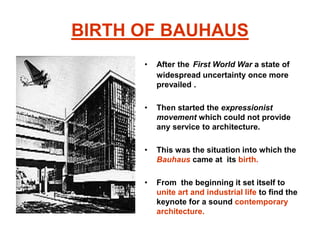
BIRTH OF BAUHAUS
• After the First World War a state of
widespread uncertainty once more
prevailed .
• Then started the expressionist
movement which could not provide
any service to architecture.
• This was the situation into which the
Bauhaus came at its birth.
• From the beginning it set itself to
unite art and industrial life to find the
keynote for a sound contemporary
architecture.
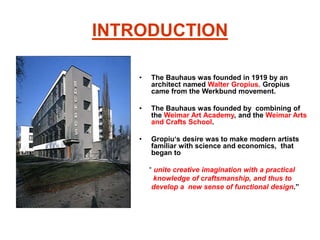
INTRODUCTION
• The Bauhaus was founded in 1919 by an
architect named Walter Gropius. Gropius
came from the Werkbund movement.
• The Bauhaus was founded by combining of
the Weimar Art Academy, and the Weimar Arts
and Crafts School.
• Gropiu‘s desire was to make modern artists
familiar with science and economics, that
began to
“ unite creative imagination with a practical
knowledge of craftsmanship, and thus to
develop a new sense of functional design.”
IDEOLOGIES
The school had three aims at its
inception
• Rescue all of the arts from the isolation in
which each then found itself.
• The school set out to elevate the status of
crafts, chairs, lamps, teapots, etc., to the
same level enjoyed by fine arts, painting,
sculpting, etc.
• To maintain contact with the leaders of
industry and craft in an attempt to
eventually gain independence from
government support by selling designs to
industry.
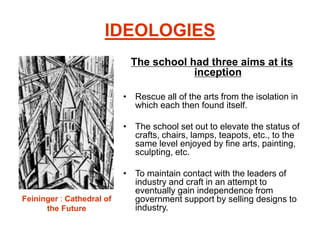
Feininger : Cathedral of
the Future
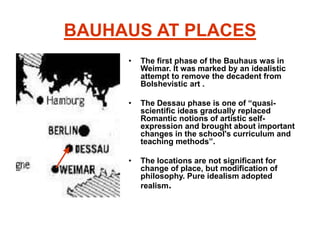
BAUHAUS AT PLACES
• The first phase of the Bauhaus was in
Weimar. It was marked by an idealistic
attempt to remove the decadent from
Bolshevistic art .
• The Dessau phase is one of “quasi-
scientific ideas gradually replaced
Romantic notions of artistic self-
expression and brought about important
changes in the school's curriculum and
teaching methods”.
• The locations are not significant for
change of place, but modification of
philosophy. Pure idealism adopted
realism.
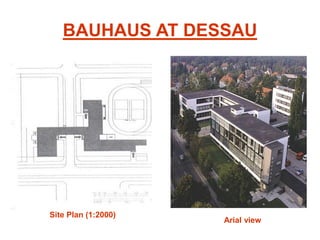
BAUHAUS AT DESSAU
Site Plan (1:2000)
Arial view
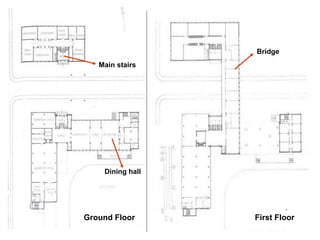
Ground Floor First Floor
Bridge
Main stairs
Dining hall
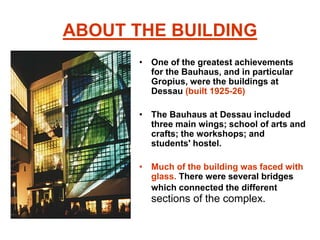
ABOUT THE BUILDING
• One of the greatest achievements
for the Bauhaus, and in particular
Gropius, were the buildings at
Dessau (built 1925-26)
• The Bauhaus at Dessau included
three main wings; school of arts and
crafts; the workshops; and
students' hostel.
• Much of the building was faced with
glass. There were several bridges
which connected the different
sections of the complex.
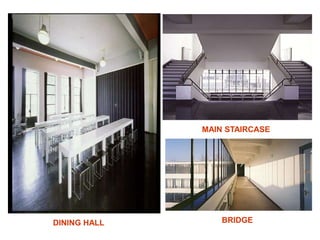
DINING HALL
MAIN STAIRCASE
BRIDGE
BAUHAUS PEOPLE
• Walter Gropius was the founder of
the Bauhaus School in Dessau. He
became Chair of the Graduate
School of Design at Harvard
University in 1937.
• Ludwig Mies van der Rohe was the
Director of Bauhaus from 1930
until the school's closing in 1933.
In 1938 he became Director of
Architecture at the Illinois Institute
of Technology.
The Museum of Modern Art, New
York (MoMA), houses 20,000 of
van der Rohe's drawings
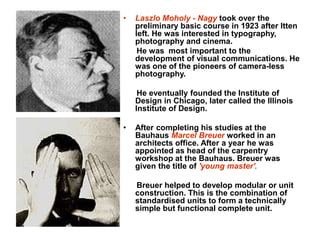
• Laszlo Moholy - Nagy took over the
preliminary basic course in 1923 after Itten
left. He was interested in typography,
photography and cinema.
He was most important to the
development of visual communications. He
was one of the pioneers of camera-less
photography.
He eventually founded the Institute of
Design in Chicago, later called the Illinois
Institute of Design.
• After completing his studies at the
Bauhaus Marcel Breuer worked in an
architects office. After a year he was
appointed as head of the carpentry
workshop at the Bauhaus. Breuer was
given the title of 'young master'.
Breuer helped to develop modular or unit
construction. This is the combination of
standardised units to form a technically
simple but functional complete unit.
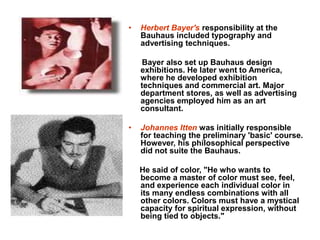
• Herbert Bayer's responsibility at the
Bauhaus included typography and
advertising techniques.
Bayer also set up Bauhaus design
exhibitions. He later went to America,
where he developed exhibition
techniques and commercial art. Major
department stores, as well as advertising
agencies employed him as an art
consultant.
• Johannes Itten was initially responsible
for teaching the preliminary 'basic' course.
However, his philosophical perspective
did not suite the Bauhaus.
He said of color, "He who wants to
become a master of color must see, feel,
and experience each individual color in
its many endless combinations with all
other colors. Colors must have a mystical
capacity for spiritual expression, without
being tied to objects."
WORKSHOP
• Practical work in the workshops was the core training element
at the Bauhaus.
• Each of the workshops had two heads throughout the Weimar
years. A master of form, an artist responsible for the design
and aesthetic aspect of work, always had at his side a master of
crafts, a craftsman who passed on technical skills and abilities.
• A limited company, Bauhaus GmbH, was formed in 1925 to sell
the products developed at the Bauhaus.
• Furniture and other everyday objects were designed for mass
production to enable large sections of the population to buy
quality items at prices they could afford.
• The forms and significance of workshop activities declined
considerably under the third Bauhaus director, Mies van der
Rohe, who subordinated them to architecture employing the
designs and materials of the time.
BAUHAUS PRODUCTS
• The workshops were functional, and
a corporation was created to handle
the products they produced
• The Bauhaus at Dessau included;
metal, furniture, weaving,
typography, photography, wall-
painting and sculpture workshops
as well as departments for
architecture, exhibition techniques
and graphic design.
• The workshops utilized new
techniques and materials of mass
production in their creations.
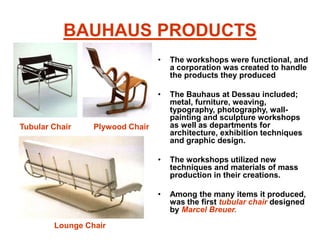
• Among the many items it produced,
was the first tubular chair designed
by Marcel Breuer.
Plywood Chair
Lounge Chair
Tubular Chair
INFLUENCE OF BAUHAUS
• The Bauhaus influenced Later art movements such as Abstract
Expressionist and Op-Art .
• Abstract Expressionist's theme revolved around the color theories
which evolved from the Bauhaus classes. The Hard-Edge and Minimal
movements of the Abstract Expressionists explored color through clean,
clear edges of solid color.
• Op-Art is optical art, which tricks the retina to create the illusion of
movement. Op-Art is widely used in modern commercial graphic design.
• The effects of the Bauhaus stretches beyond our furniture and light
fixtures, into the realms of architecture, theater, and typography, where
the designs and style of the Bauhaus are still spoken of today.
• The practical innovations developed by the Bauhaus have profoundly
effected designs favored by industry as shown by the desks and chairs
that fill offices, lobbies, and lounges across America .
END AND THE NEW BEGNNING
OF BAUHAUS
• The Bauhaus school existed not even 15 years before it was shut
down by the Nazis. Most of the artists went to the US and there they
had great success.
• Although the Bauhaus was a product of a social ideology, these
aspects became in America less and less important and in the end the
Bauhaus ideas became fully stripped of their ideological guise.
• The new Bauhaus was founded in 1937 in Chicago by master Laszlo
Moholy-Nagy.
• The focus on natural and human sciences was increased . Training in
mechanical techniques was more sophisticated than it had been in
Germany.
• Bauhaus is still part of the Illinois Institute of Technology, and rates as
a respected and professionally oriented school of design till today.
BIBLIOGRAPHY
• Space, Time and Architecture, Harvard (Pg.485-497)
• Modern Architecture, Kenneth Frampton (Pg. 123)
• Architecture Today, James Steele (Pg.12-14,181,254,255,432,433)
• Observations of Young Architects
• Encyclopedia World Architecture
• http://people.ucsc.edu/~gflores/bauhaus/b1.html
• http://architecture.about.com/library/blgloss-bauhaus.htm
• http://www.chrissnider.com/academic/bauhaus/front.html

Bauhaus2

  • 1.
  • 2.
    BIRTH OF BAUHAUS •After the First World War a state of widespread uncertainty once more prevailed . • Then started the expressionist movement which could not provide any service to architecture. • This was the situation into which the Bauhaus came at its birth. • From the beginning it set itself to unite art and industrial life to find the keynote for a sound contemporary architecture.
  • 3.
    INTRODUCTION • The Bauhauswas founded in 1919 by an architect named Walter Gropius. Gropius came from the Werkbund movement. • The Bauhaus was founded by combining of the Weimar Art Academy, and the Weimar Arts and Crafts School. • Gropiu‘s desire was to make modern artists familiar with science and economics, that began to “ unite creative imagination with a practical knowledge of craftsmanship, and thus to develop a new sense of functional design.”
  • 4.
    IDEOLOGIES The school hadthree aims at its inception • Rescue all of the arts from the isolation in which each then found itself. • The school set out to elevate the status of crafts, chairs, lamps, teapots, etc., to the same level enjoyed by fine arts, painting, sculpting, etc. • To maintain contact with the leaders of industry and craft in an attempt to eventually gain independence from government support by selling designs to industry. Feininger : Cathedral of the Future
  • 5.
    BAUHAUS AT PLACES •The first phase of the Bauhaus was in Weimar. It was marked by an idealistic attempt to remove the decadent from Bolshevistic art . • The Dessau phase is one of “quasi- scientific ideas gradually replaced Romantic notions of artistic self- expression and brought about important changes in the school's curriculum and teaching methods”. • The locations are not significant for change of place, but modification of philosophy. Pure idealism adopted realism.
  • 6.
    BAUHAUS AT DESSAU SitePlan (1:2000) Arial view
  • 7.
    Ground Floor FirstFloor Bridge Main stairs Dining hall
  • 8.
    ABOUT THE BUILDING •One of the greatest achievements for the Bauhaus, and in particular Gropius, were the buildings at Dessau (built 1925-26) • The Bauhaus at Dessau included three main wings; school of arts and crafts; the workshops; and students' hostel. • Much of the building was faced with glass. There were several bridges which connected the different sections of the complex.
  • 9.
  • 10.
    BAUHAUS PEOPLE • WalterGropius was the founder of the Bauhaus School in Dessau. He became Chair of the Graduate School of Design at Harvard University in 1937. • Ludwig Mies van der Rohe was the Director of Bauhaus from 1930 until the school's closing in 1933. In 1938 he became Director of Architecture at the Illinois Institute of Technology. The Museum of Modern Art, New York (MoMA), houses 20,000 of van der Rohe's drawings
  • 11.
    • Laszlo Moholy- Nagy took over the preliminary basic course in 1923 after Itten left. He was interested in typography, photography and cinema. He was most important to the development of visual communications. He was one of the pioneers of camera-less photography. He eventually founded the Institute of Design in Chicago, later called the Illinois Institute of Design. • After completing his studies at the Bauhaus Marcel Breuer worked in an architects office. After a year he was appointed as head of the carpentry workshop at the Bauhaus. Breuer was given the title of 'young master'. Breuer helped to develop modular or unit construction. This is the combination of standardised units to form a technically simple but functional complete unit.
  • 12.
    • Herbert Bayer'sresponsibility at the Bauhaus included typography and advertising techniques. Bayer also set up Bauhaus design exhibitions. He later went to America, where he developed exhibition techniques and commercial art. Major department stores, as well as advertising agencies employed him as an art consultant. • Johannes Itten was initially responsible for teaching the preliminary 'basic' course. However, his philosophical perspective did not suite the Bauhaus. He said of color, "He who wants to become a master of color must see, feel, and experience each individual color in its many endless combinations with all other colors. Colors must have a mystical capacity for spiritual expression, without being tied to objects."
  • 13.
    WORKSHOP • Practical workin the workshops was the core training element at the Bauhaus. • Each of the workshops had two heads throughout the Weimar years. A master of form, an artist responsible for the design and aesthetic aspect of work, always had at his side a master of crafts, a craftsman who passed on technical skills and abilities. • A limited company, Bauhaus GmbH, was formed in 1925 to sell the products developed at the Bauhaus. • Furniture and other everyday objects were designed for mass production to enable large sections of the population to buy quality items at prices they could afford. • The forms and significance of workshop activities declined considerably under the third Bauhaus director, Mies van der Rohe, who subordinated them to architecture employing the designs and materials of the time.
  • 14.
    BAUHAUS PRODUCTS • Theworkshops were functional, and a corporation was created to handle the products they produced • The Bauhaus at Dessau included; metal, furniture, weaving, typography, photography, wall- painting and sculpture workshops as well as departments for architecture, exhibition techniques and graphic design. • The workshops utilized new techniques and materials of mass production in their creations. • Among the many items it produced, was the first tubular chair designed by Marcel Breuer. Plywood Chair Lounge Chair Tubular Chair
  • 15.
    INFLUENCE OF BAUHAUS •The Bauhaus influenced Later art movements such as Abstract Expressionist and Op-Art . • Abstract Expressionist's theme revolved around the color theories which evolved from the Bauhaus classes. The Hard-Edge and Minimal movements of the Abstract Expressionists explored color through clean, clear edges of solid color. • Op-Art is optical art, which tricks the retina to create the illusion of movement. Op-Art is widely used in modern commercial graphic design. • The effects of the Bauhaus stretches beyond our furniture and light fixtures, into the realms of architecture, theater, and typography, where the designs and style of the Bauhaus are still spoken of today. • The practical innovations developed by the Bauhaus have profoundly effected designs favored by industry as shown by the desks and chairs that fill offices, lobbies, and lounges across America .
  • 16.
    END AND THENEW BEGNNING OF BAUHAUS • The Bauhaus school existed not even 15 years before it was shut down by the Nazis. Most of the artists went to the US and there they had great success. • Although the Bauhaus was a product of a social ideology, these aspects became in America less and less important and in the end the Bauhaus ideas became fully stripped of their ideological guise. • The new Bauhaus was founded in 1937 in Chicago by master Laszlo Moholy-Nagy. • The focus on natural and human sciences was increased . Training in mechanical techniques was more sophisticated than it had been in Germany. • Bauhaus is still part of the Illinois Institute of Technology, and rates as a respected and professionally oriented school of design till today.
  • 17.
    BIBLIOGRAPHY • Space, Timeand Architecture, Harvard (Pg.485-497) • Modern Architecture, Kenneth Frampton (Pg. 123) • Architecture Today, James Steele (Pg.12-14,181,254,255,432,433) • Observations of Young Architects • Encyclopedia World Architecture • http://people.ucsc.edu/~gflores/bauhaus/b1.html • http://architecture.about.com/library/blgloss-bauhaus.htm • http://www.chrissnider.com/academic/bauhaus/front.html