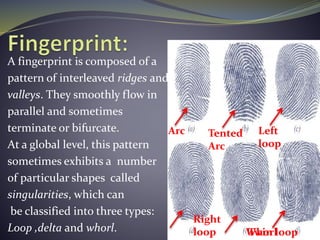
A fingerprint is composed of a
pattern of interleaved ridges and
valleys. They smoothly flow in
parallel and sometimes
terminate or bifurcate.
At a global level, this pattern
sometimes exhibits a number
of particular shapes called
singularities, which can
be classified into three types:
Loop ,delta and whorl.
Arc Tented
Arc
Left
loop
Right
loop WhorlTwin loop
 In 1858, Sir William James Herschel initiated finger
printing in India.
In 1877 at Hooghly (near Kolkata) he instituted the use
of fingerprints on contracts.
In 1880, Dr. Henry Faulds, a Scottish surgeon in a Tokyo
hospital, published his first paper in the scientific
journal Nature, discussing the usefulness of fingerprints for
identification
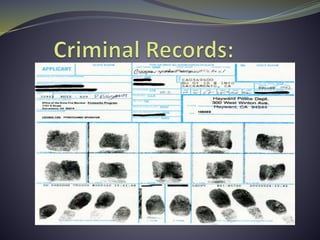
A Fingerprint Bureau was established in Kolkata, India,
in 1897, after the Council of the Governor General approved
a committee report that fingerprints should be used for the
classification of criminal records.
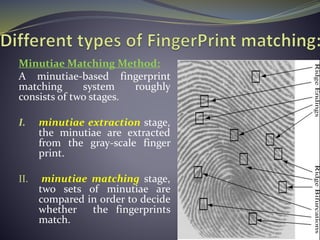
Minutiae Matching Method:
A minutiae-based fingerprint
matching system roughly
consists of two stages.
I. minutiae extraction stage,
the minutiae are extracted
from the gray-scale finger
print.
II. minutiae matching stage,
two sets of minutiae are
compared in order to decide
whether the fingerprints
match.
Likelihood Ratio –Based Method;
The system determines the likelihood ratio L(v) , given by:
L(v) = p(v|wk )/p(v|wk‘)
v  a test feature vector of a user requesting access to a
biometric system.
wk  a class that represents the users claimed identity
p(v|wk‘)  the probability that v is NOT a member of class wk.
p(v|wk)  the probability that v is a member of class wk.
The user is granted access to the system if likelihood ratio of
test feature vector v exceeds a threshold t ∈ [0,∞].
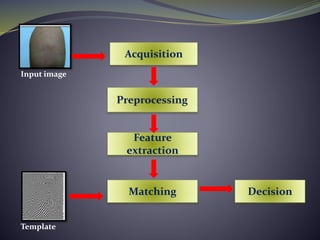
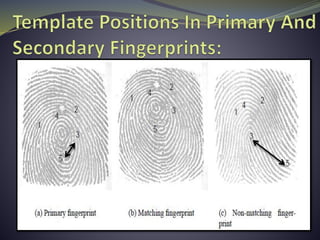
First selects appropriate templates in the primary
fingerprint.
Locates the above template in the secondary print.
 And compares the template positions of both fingerprints.
The correlation-based fingerprint verification system is
capable of dealing with low quality images from which no
minutiae can be extracted .
This system has participated in the Fingerprint
Verification Competition 2000 where it obtained an
average rating.
Input image
Template
Acquisition
Feature
extraction
Matching Decision
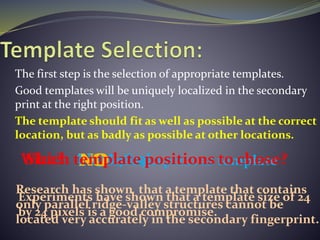
The first step is the selection of appropriate templates.
Good templates will be uniquely localized in the secondary
print at the right position.
The template should fit as well as possible at the correct
location, but as badly as possible at other locations.
Size? Entire fingerprint as templateNO1 by 1 pixelNO
Experiments have shown that a template size of 24
by 24 pixels is a good compromise.
Which template positions to chose?
Research has shown that a template that contains
only parallel ridge-valley structures cannot be
located very accurately in the secondary fingerprint.
Step 1: Binarization:
Converts the gray scale image in binary image, i.e, the
intensity of the image has only two value: black,
representing the ridges, and white, representing the valleys
and the background.
binarization
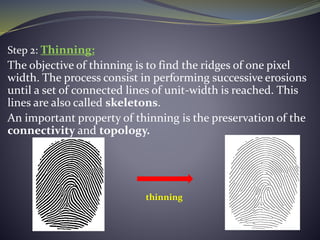
Step 2: Thinning:
The objective of thinning is to find the ridges of one pixel
width. The process consist in performing successive erosions
until a set of connected lines of unit-width is reached. This
lines are also called skeletons.
An important property of thinning is the preservation of the
connectivity and topology.
thinning
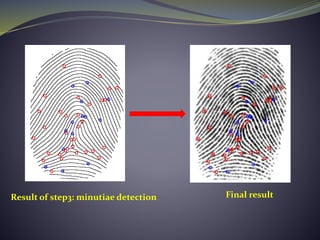
Step 3: Minutiae detection:
From the binary thinned image, the minutia are
detected by using 3x3 pattern masks.
masks for bifurcation detection
masks of termination detection
Result of step3: minutiae detection Final result
Two Decision Stages:
First, elementary decisions are made by classifying the
individual template position pairs to be matching or not.
Second, the information of all template pairs is merged in
order to make a final decision whether the primary and
secondary fingerprint match or not.
where x = [x1, . . . , xn]T and y = [y1, . . . , yn]T are the
coordinates of the templates
(xis , yis)?≈(xip , yip) for 1 ≤ i ≤ n (1)
[(xis , yis)-(xjs , yjs)] ?≈ [(xip , yip) –(xjp , yjp)] for 1 ≤ i,j ≤ n (2)
The method is also capable of dealing with fingerprints of
low image quality from which no minutiae can be extracted
reliably.
False and missed minutiae do not decrease the matching
performance.
The template locations are paired, which results in much
simpler matching methods.
Template matching is a method that demands a rather
high computational power.
The method is at the moment not capable of dealing
with rotations of more than about 10 degrees.
Makes the method less applicable for real time
applications.
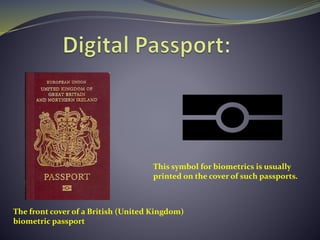
A biometric passport, also known as an ePassport or
a digital passport, is a combined paper and
electronic passport that contains biometric information that
can be used to authenticate the identity of travellers.
 It uses contactless smart card technology, including a
microprocessor chip (computer chip) and antenna (for both
power to the chip and communication) embedded in the front
or back cover, or center page, of the passport.
The currently standardized biometrics used for this type of
identification system are facial recognition, fingerprint
recognition, and iris recognition.
The front cover of a British (United Kingdom)
biometric passport
This symbol for biometrics is usually
printed on the cover of such passports.
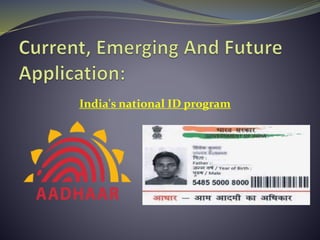
India's national ID program
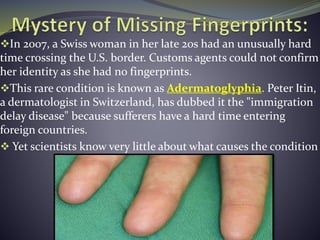
In 2007, a Swiss woman in her late 20s had an unusually hard
time crossing the U.S. border. Customs agents could not confirm
her identity as she had no fingerprints.
This rare condition is known as Adermatoglyphia. Peter Itin,
a dermatologist in Switzerland, has dubbed it the "immigration
delay disease" because sufferers have a hard time entering
foreign countries.
 Yet scientists know very little about what causes the condition
Correlation based Fingerprint Recognition

Correlation based Fingerprint Recognition

  • 3.
    A fingerprint iscomposed of a pattern of interleaved ridges and valleys. They smoothly flow in parallel and sometimes terminate or bifurcate. At a global level, this pattern sometimes exhibits a number of particular shapes called singularities, which can be classified into three types: Loop ,delta and whorl. Arc Tented Arc Left loop Right loop WhorlTwin loop
  • 4.
     In 1858,Sir William James Herschel initiated finger printing in India. In 1877 at Hooghly (near Kolkata) he instituted the use of fingerprints on contracts. In 1880, Dr. Henry Faulds, a Scottish surgeon in a Tokyo hospital, published his first paper in the scientific journal Nature, discussing the usefulness of fingerprints for identification A Fingerprint Bureau was established in Kolkata, India, in 1897, after the Council of the Governor General approved a committee report that fingerprints should be used for the classification of criminal records.
  • 5.
    Minutiae Matching Method: Aminutiae-based fingerprint matching system roughly consists of two stages. I. minutiae extraction stage, the minutiae are extracted from the gray-scale finger print. II. minutiae matching stage, two sets of minutiae are compared in order to decide whether the fingerprints match.
  • 6.
    Likelihood Ratio –BasedMethod; The system determines the likelihood ratio L(v) , given by: L(v) = p(v|wk )/p(v|wk‘) v  a test feature vector of a user requesting access to a biometric system. wk  a class that represents the users claimed identity p(v|wk‘)  the probability that v is NOT a member of class wk. p(v|wk)  the probability that v is a member of class wk. The user is granted access to the system if likelihood ratio of test feature vector v exceeds a threshold t ∈ [0,∞].
  • 7.
    First selects appropriatetemplates in the primary fingerprint. Locates the above template in the secondary print.  And compares the template positions of both fingerprints. The correlation-based fingerprint verification system is capable of dealing with low quality images from which no minutiae can be extracted . This system has participated in the Fingerprint Verification Competition 2000 where it obtained an average rating.
  • 8.
  • 9.
    The first stepis the selection of appropriate templates. Good templates will be uniquely localized in the secondary print at the right position. The template should fit as well as possible at the correct location, but as badly as possible at other locations. Size? Entire fingerprint as templateNO1 by 1 pixelNO Experiments have shown that a template size of 24 by 24 pixels is a good compromise. Which template positions to chose? Research has shown that a template that contains only parallel ridge-valley structures cannot be located very accurately in the secondary fingerprint.
  • 10.
    Step 1: Binarization: Convertsthe gray scale image in binary image, i.e, the intensity of the image has only two value: black, representing the ridges, and white, representing the valleys and the background. binarization
  • 11.
    Step 2: Thinning: Theobjective of thinning is to find the ridges of one pixel width. The process consist in performing successive erosions until a set of connected lines of unit-width is reached. This lines are also called skeletons. An important property of thinning is the preservation of the connectivity and topology. thinning
  • 12.
    Step 3: Minutiaedetection: From the binary thinned image, the minutia are detected by using 3x3 pattern masks. masks for bifurcation detection masks of termination detection
  • 13.
    Result of step3:minutiae detection Final result
  • 14.
    Two Decision Stages: First,elementary decisions are made by classifying the individual template position pairs to be matching or not. Second, the information of all template pairs is merged in order to make a final decision whether the primary and secondary fingerprint match or not.
  • 15.
    where x =[x1, . . . , xn]T and y = [y1, . . . , yn]T are the coordinates of the templates (xis , yis)?≈(xip , yip) for 1 ≤ i ≤ n (1) [(xis , yis)-(xjs , yjs)] ?≈ [(xip , yip) –(xjp , yjp)] for 1 ≤ i,j ≤ n (2)
  • 17.
    The method isalso capable of dealing with fingerprints of low image quality from which no minutiae can be extracted reliably. False and missed minutiae do not decrease the matching performance. The template locations are paired, which results in much simpler matching methods.
  • 18.
    Template matching isa method that demands a rather high computational power. The method is at the moment not capable of dealing with rotations of more than about 10 degrees. Makes the method less applicable for real time applications.
  • 21.
    A biometric passport,also known as an ePassport or a digital passport, is a combined paper and electronic passport that contains biometric information that can be used to authenticate the identity of travellers.  It uses contactless smart card technology, including a microprocessor chip (computer chip) and antenna (for both power to the chip and communication) embedded in the front or back cover, or center page, of the passport. The currently standardized biometrics used for this type of identification system are facial recognition, fingerprint recognition, and iris recognition.
  • 22.
    The front coverof a British (United Kingdom) biometric passport This symbol for biometrics is usually printed on the cover of such passports.
  • 24.
  • 25.
    In 2007, aSwiss woman in her late 20s had an unusually hard time crossing the U.S. border. Customs agents could not confirm her identity as she had no fingerprints. This rare condition is known as Adermatoglyphia. Peter Itin, a dermatologist in Switzerland, has dubbed it the "immigration delay disease" because sufferers have a hard time entering foreign countries.  Yet scientists know very little about what causes the condition