Introduction To Parallel Computing


1   © 2012 WIPRO LTD | WWW.WIPRO.COM
Outline

    • Overview
    • Theoretical background
    • Parallel computing systems
    • Parallel programming models
    • MPI/OpenMP examples


2                    © 2012 WIPRO LTD | WWW.WIPRO.COM
OVERVIEW


3              © 2012 WIPRO LTD | WWW.WIPRO.COM
What is Parallel Computing?
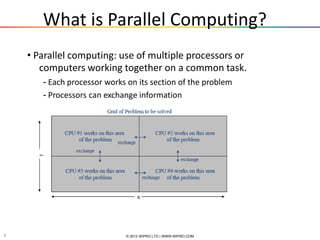
    • Parallel computing: use of multiple processors or
       computers working together on a common task.
       - Each processor works on its section of the problem
       - Processors can exchange information


4                            © 2012 WIPRO LTD | WWW.WIPRO.COM
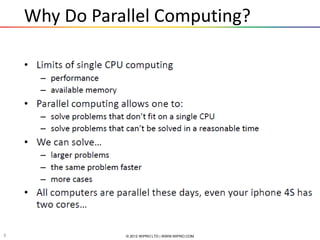
Why Do Parallel Computing?


5              © 2012 WIPRO LTD | WWW.WIPRO.COM
Parallelism


6         © 2012 WIPRO LTD | WWW.WIPRO.COM
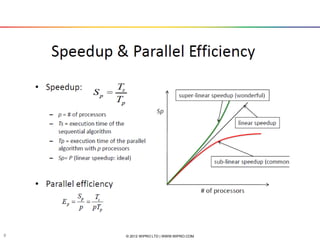
7   © 2012 WIPRO LTD | WWW.WIPRO.COM
8   © 2012 WIPRO LTD | WWW.WIPRO.COM
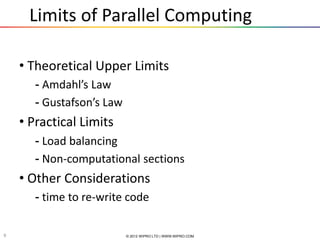
Limits of Parallel Computing

    • Theoretical Upper Limits
       - Amdahl’s Law
       - Gustafson’s Law
    • Practical Limits
       - Load balancing
       - Non-computational sections
    • Other Considerations
       - time to re-write code

9                          © 2012 WIPRO LTD | WWW.WIPRO.COM
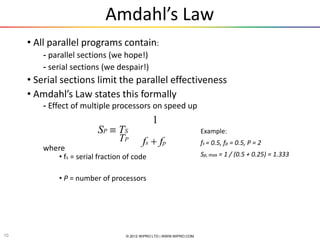
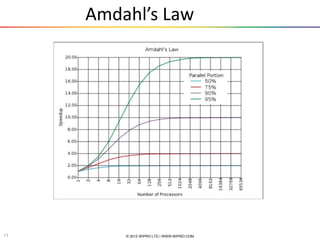
Amdahl’s Law
     • All parallel programs contain:
         - parallel sections (we hope!)
         - serial sections (we despair!)
     • Serial sections limit the parallel effectiveness
     • Amdahl’s Law states this formally
         - Effect of multiple processors on speed up
                                                1
                          SP  T S                                     Example:
                                 TP        fs  fp                     fs = 0.5, fp = 0.5, P = 2
         where
             • fs = serial fraction of code                            Sp, max = 1 / (0.5 + 0.25) = 1.333


             • P = number of processors


10                                  © 2012 WIPRO LTD | WWW.WIPRO.COM
Amdahl’s Law


11       © 2012 WIPRO LTD | WWW.WIPRO.COM
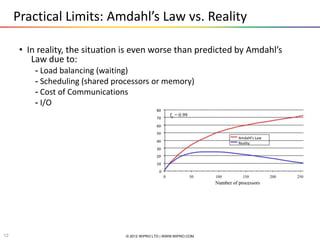
Practical Limits: Amdahl’s Law vs. Reality

      • In reality, the situation is even worse than predicted by Amdahl’s
         Law due to:
          - Load balancing (waiting)
          - Scheduling (shared processors or memory)
          - Cost of Communications
          - I/O


12                                © 2012 WIPRO LTD | WWW.WIPRO.COM
PARALLEL SYSTEMS


13              © 2012 WIPRO LTD | WWW.WIPRO.COM
“Old school” hardware classification

                               Single Instruction Multiple Instruction
               Single Data            SISD                            MISD
               Multiple Data         SIMD                             MIMD

     SISD No parallelism in either instruction or data streams (mainframes)
     SIMD Exploit data parallelism (stream processors, GPUs)
     MISD Multiple instructions operating on the same data stream. Unusual,
        mostly for fault-tolerance purposes (space shuttle flight computer)

     MIMD Multiple instructions operating independently on multiple data
       streams (most modern general purpose computers, head nodes)
                                                    NOTE: GPU references frequently refer to
                                                    SIMT, or single instruction multiple thread

14                                 © 2012 WIPRO LTD | WWW.WIPRO.COM
Hardware in parallel computing

     Memory access                                    Processor type
     • Shared memory                                  •     Single core CPU
                                                              - Intel Xeon (Prestonia, Wallatin)
         - SGI Altix                                          - AMD Opteron (Sledgehammer, Venus)
         - IBM Power series nodes                             - IBM POWER (3, 4)

                                                      •     Multi-core CPU (since 2005)
     • Distributed memory                                     - Intel Xeon (Paxville, Woodcrest,
                                                                  Harpertown, Westmere, Sandy Bridge…)
         - Uniprocessor clusters                              - AMD Opteron (Barcelona, Shanghai,

                                                              - IBM POWER (5, 6…)
     • Hybrid/Multi-processor                                 - Fujitsu SPARC64 VIIIfx (8 cores)

        clusters (Ranger, Lonestar)                   •     Accelerators
                                                              - GPGPU
                                                              - MIC
     • Flash based (e.g. Gordon)


15                                  © 2012 WIPRO LTD | WWW.WIPRO.COM
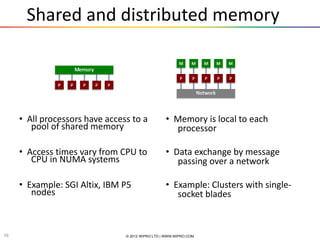
Shared and distributed memory


     • All processors have access to a            • Memory is local to each
        pool of shared memory                       processor

     • Access times vary from CPU to              • Data exchange by message
        CPU in NUMA systems                          passing over a network

     • Example: SGI Altix, IBM P5                 • Example: Clusters with single-
        nodes                                        socket blades


16                              © 2012 WIPRO LTD | WWW.WIPRO.COM
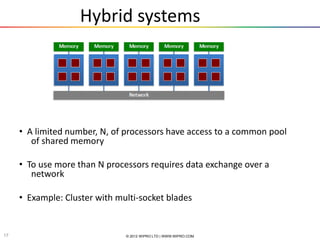
Hybrid systems


     • A limited number, N, of processors have access to a common pool
        of shared memory

     • To use more than N processors requires data exchange over a
        network

     • Example: Cluster with multi-socket blades


17                             © 2012 WIPRO LTD | WWW.WIPRO.COM
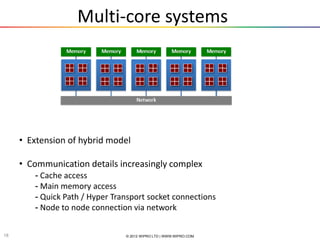
Multi-core systems


     • Extension of hybrid model

     • Communication details increasingly complex
        - Cache access
        - Main memory access
        - Quick Path / Hyper Transport socket connections
        - Node to node connection via network

18                              © 2012 WIPRO LTD | WWW.WIPRO.COM
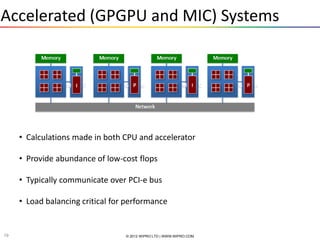
Accelerated (GPGPU and MIC) Systems


     • Calculations made in both CPU and accelerator

     • Provide abundance of low-cost flops

     • Typically communicate over PCI-e bus

     • Load balancing critical for performance


19                                © 2012 WIPRO LTD | WWW.WIPRO.COM
PROGRAMMING MODELS


20            © 2012 WIPRO LTD | WWW.WIPRO.COM
Types of parallelism

     • Data Parallelism
       - Each processor performs the same task on
       different data (remember SIMD, MIMD)

     • Task Parallelism
       - Each processor performs a different task on the
       same data (remember MISD, MIMD)

     • Many applications incorporate both

21                        © 2012 WIPRO LTD | WWW.WIPRO.COM
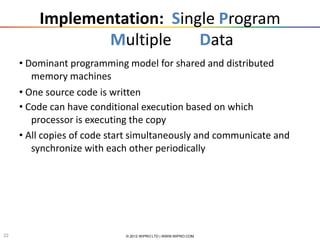
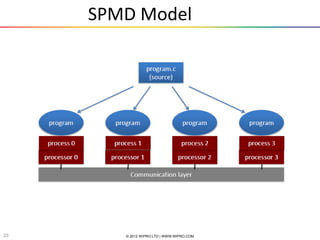
Implementation: Single Program
                 Multiple    Data
     • Dominant programming model for shared and distributed
        memory machines
     • One source code is written
     • Code can have conditional execution based on which
        processor is executing the copy
     • All copies of code start simultaneously and communicate and
        synchronize with each other periodically


22                           © 2012 WIPRO LTD | WWW.WIPRO.COM
SPMD Model


23      © 2012 WIPRO LTD | WWW.WIPRO.COM
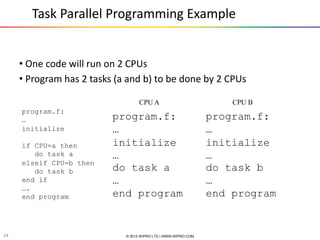
Task Parallel Programming Example


     • One code will run on 2 CPUs
     • Program has 2 tasks (a and b) to be done by 2 CPUs

                                   CPU A                            CPU B
     program.f:
     …                    program.f:                            program.f:
     initialize           …                                     …
     if CPU=a then        initialize                            initialize
        do task a         …                                     …
     elseif CPU=b then
        do task b         do task a                             do task b
     end if               …                                     …
     ….
     end program          end program                           end program


24                           © 2012 WIPRO LTD | WWW.WIPRO.COM
Shared Memory Programming: pthreads


     • Shared memory systems (SMPs, ccNUMAs)
     have a single address space
     • applications can be developed in which loop
     iterations (with no dependencies) are
     executed by different processors
     • Threads are ‘lightweight processes’ (same PID)
     • Allows ‘MIMD’ codes to execute in shared
     address space

25                     © 2012 WIPRO LTD | WWW.WIPRO.COM
Shared Memory Programming: OpenMP


     • Built on top of pthreads
     • shared memory codes are mostly data
     parallel, ‘SIMD’ kinds of codes
     • OpenMP is a standard for shared memory
     programming (compiler directives)
     • Vendors offer native compiler directives


26                    © 2012 WIPRO LTD | WWW.WIPRO.COM
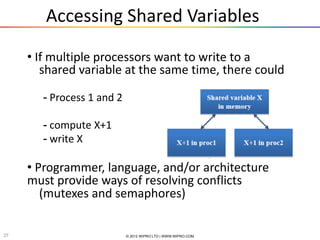
Accessing Shared Variables

     • If multiple processors want to write to a
        shared variable at the same time, there could

       - Process 1 and 2

       - compute X+1
       - write X

     • Programmer, language, and/or architecture
     must provide ways of resolving conflicts
        (mutexes and semaphores)

27                         © 2012 WIPRO LTD | WWW.WIPRO.COM
OpenMP Example #1: Parallel Loop

         !$OMP PARALLEL DO
           do i=1,128
            b(i) = a(i) + c(i)
           end do
         !$OMP END PARALLEL DO

     • The first directive specifies that the loop immediately following should be
        executed in parallel.

     • The second directive specifies the end of the parallel section (optional).

     • For codes that spend the majority of their time executing the content of
        simple loops, the PARALLEL DO directive can result in significant parallel
        performance.


28                                   © 2012 WIPRO LTD | WWW.WIPRO.COM
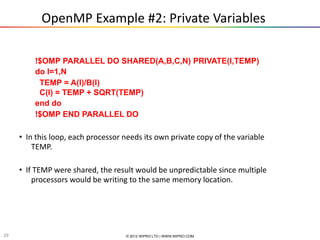
OpenMP Example #2: Private Variables

         !$OMP PARALLEL DO SHARED(A,B,C,N) PRIVATE(I,TEMP)
         do I=1,N
          TEMP = A(I)/B(I)
          C(I) = TEMP + SQRT(TEMP)
         end do
         !$OMP END PARALLEL DO

     • In this loop, each processor needs its own private copy of the variable
         TEMP.

     • If TEMP were shared, the result would be unpredictable since multiple
         processors would be writing to the same memory location.


29                                  © 2012 WIPRO LTD | WWW.WIPRO.COM
Distributed Memory Programming: MPI

     • Distributed memory systems have separate address spaces
        for each processor

     • Local memory accessed faster than remote memory

     • Data must be manually decomposed

     • MPI is the de facto standard for distributed memory
        programming (library of subprogram calls)

     • Vendors typically have native libraries such as SHMEM
        (T3E) and LAPI (IBM)


30                          © 2012 WIPRO LTD | WWW.WIPRO.COM
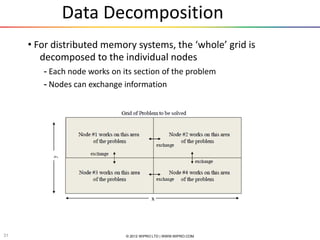
Data Decomposition
     • For distributed memory systems, the ‘whole’ grid is
        decomposed to the individual nodes
        - Each node works on its section of the problem
        - Nodes can exchange information


31                            © 2012 WIPRO LTD | WWW.WIPRO.COM
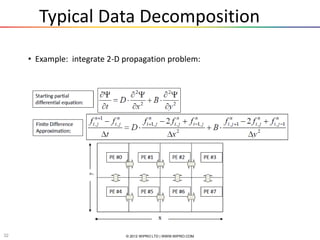
Typical Data Decomposition

     • Example: integrate 2-D propagation problem:


32                            © 2012 WIPRO LTD | WWW.WIPRO.COM
MPI Example #1
     • Every MPI program needs these:

     #include “mpi.h”
     int main(int argc, char *argv[])
     {
       int nPEs, iam;
       /* Initialize MPI */
       ierr = MPI_Init(&argc, &argv);
       /* How many total PEs are there */
       ierr = MPI_Comm_size(MPI_COMM_WORLD, &nPEs);
       /* What node am I (what is my rank?) */
       ierr = MPI_Comm_rank(MPI_COMM_WORLD, &iam);

         ierr = MPI_Finalize();
     }


33                            © 2012 WIPRO LTD | WWW.WIPRO.COM
MPI Example #2

     #include “mpi.h”
     int main(int argc, char *argv[])
     {
         int numprocs, myid;
         MPI_Init(&argc,&argv);
         MPI_Comm_size(MPI_COMM_WORLD,&numprocs);
         MPI_Comm_rank(MPI_COMM_WORLD,&myid);
         /* print out my rank and this run's PE size */
         printf("Hello from %d of %dn", myid, numprocs);
         MPI_Finalize();
     }


34                             © 2012 WIPRO LTD | WWW.WIPRO.COM
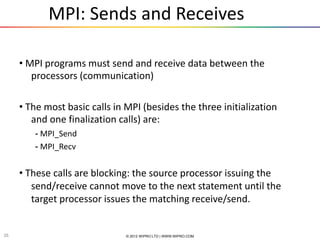
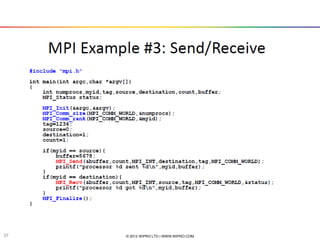
MPI: Sends and Receives

     • MPI programs must send and receive data between the
        processors (communication)

     • The most basic calls in MPI (besides the three initialization
        and one finalization calls) are:
        - MPI_Send
        - MPI_Recv


     • These calls are blocking: the source processor issuing the
        send/receive cannot move to the next statement until the
        target processor issues the matching receive/send.


35                             © 2012 WIPRO LTD | WWW.WIPRO.COM
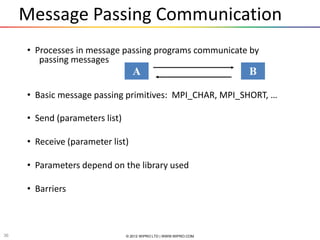
Message Passing Communication
     • Processes in message passing programs communicate by
        passing messages


     • Basic message passing primitives: MPI_CHAR, MPI_SHORT, …

     • Send (parameters list)

     • Receive (parameter list)

     • Parameters depend on the library used

     • Barriers


36                              © 2012 WIPRO LTD | WWW.WIPRO.COM
37   © 2012 WIPRO LTD | WWW.WIPRO.COM
Final Thoughts

     • These are exciting and turbulent times in HPC.
     • Systems with multiple shared memory nodes and
     multiple cores per node are the norm.
     • Accelerators are rapidly gaining acceptance.
     • Going forward, the most practical programming
     paradigms to learn are:
         - Pure MPI
         - MPI plus multithreading (OpenMP or pthreads)
         - Accelerator models (MPI or multithreading for
         MIC, CUDA or OpenCL for GPU)

38                       © 2012 WIPRO LTD | WWW.WIPRO.COM
THANK YOU


39    © 2012 WIPRO LTD | WWW.WIPRO.COM

Intro to parallel computing

  • 1.
    Introduction To ParallelComputing 1 © 2012 WIPRO LTD | WWW.WIPRO.COM
  • 2.
    Outline • Overview • Theoretical background • Parallel computing systems • Parallel programming models • MPI/OpenMP examples 2 © 2012 WIPRO LTD | WWW.WIPRO.COM
  • 3.
    OVERVIEW 3 © 2012 WIPRO LTD | WWW.WIPRO.COM
  • 4.
    What is ParallelComputing? • Parallel computing: use of multiple processors or computers working together on a common task. - Each processor works on its section of the problem - Processors can exchange information 4 © 2012 WIPRO LTD | WWW.WIPRO.COM
  • 5.
    Why Do ParallelComputing? 5 © 2012 WIPRO LTD | WWW.WIPRO.COM
  • 6.
    Parallelism 6 © 2012 WIPRO LTD | WWW.WIPRO.COM
  • 7.
    7 © 2012 WIPRO LTD | WWW.WIPRO.COM
  • 8.
    8 © 2012 WIPRO LTD | WWW.WIPRO.COM
  • 9.
    Limits of ParallelComputing • Theoretical Upper Limits - Amdahl’s Law - Gustafson’s Law • Practical Limits - Load balancing - Non-computational sections • Other Considerations - time to re-write code 9 © 2012 WIPRO LTD | WWW.WIPRO.COM
  • 10.
    Amdahl’s Law • All parallel programs contain: - parallel sections (we hope!) - serial sections (we despair!) • Serial sections limit the parallel effectiveness • Amdahl’s Law states this formally - Effect of multiple processors on speed up 1 SP  T S Example: TP fs  fp fs = 0.5, fp = 0.5, P = 2 where • fs = serial fraction of code Sp, max = 1 / (0.5 + 0.25) = 1.333 • P = number of processors 10 © 2012 WIPRO LTD | WWW.WIPRO.COM
  • 11.
    Amdahl’s Law 11 © 2012 WIPRO LTD | WWW.WIPRO.COM
  • 12.
    Practical Limits: Amdahl’sLaw vs. Reality • In reality, the situation is even worse than predicted by Amdahl’s Law due to: - Load balancing (waiting) - Scheduling (shared processors or memory) - Cost of Communications - I/O 12 © 2012 WIPRO LTD | WWW.WIPRO.COM
  • 13.
    PARALLEL SYSTEMS 13 © 2012 WIPRO LTD | WWW.WIPRO.COM
  • 14.
    “Old school” hardwareclassification Single Instruction Multiple Instruction Single Data SISD MISD Multiple Data SIMD MIMD SISD No parallelism in either instruction or data streams (mainframes) SIMD Exploit data parallelism (stream processors, GPUs) MISD Multiple instructions operating on the same data stream. Unusual, mostly for fault-tolerance purposes (space shuttle flight computer) MIMD Multiple instructions operating independently on multiple data streams (most modern general purpose computers, head nodes) NOTE: GPU references frequently refer to SIMT, or single instruction multiple thread 14 © 2012 WIPRO LTD | WWW.WIPRO.COM
  • 15.
    Hardware in parallelcomputing Memory access Processor type • Shared memory • Single core CPU - Intel Xeon (Prestonia, Wallatin) - SGI Altix - AMD Opteron (Sledgehammer, Venus) - IBM Power series nodes - IBM POWER (3, 4) • Multi-core CPU (since 2005) • Distributed memory - Intel Xeon (Paxville, Woodcrest, Harpertown, Westmere, Sandy Bridge…) - Uniprocessor clusters - AMD Opteron (Barcelona, Shanghai, - IBM POWER (5, 6…) • Hybrid/Multi-processor - Fujitsu SPARC64 VIIIfx (8 cores) clusters (Ranger, Lonestar) • Accelerators - GPGPU - MIC • Flash based (e.g. Gordon) 15 © 2012 WIPRO LTD | WWW.WIPRO.COM
  • 16.
    Shared and distributedmemory • All processors have access to a • Memory is local to each pool of shared memory processor • Access times vary from CPU to • Data exchange by message CPU in NUMA systems passing over a network • Example: SGI Altix, IBM P5 • Example: Clusters with single- nodes socket blades 16 © 2012 WIPRO LTD | WWW.WIPRO.COM
  • 17.
    Hybrid systems • A limited number, N, of processors have access to a common pool of shared memory • To use more than N processors requires data exchange over a network • Example: Cluster with multi-socket blades 17 © 2012 WIPRO LTD | WWW.WIPRO.COM
  • 18.
    Multi-core systems • Extension of hybrid model • Communication details increasingly complex - Cache access - Main memory access - Quick Path / Hyper Transport socket connections - Node to node connection via network 18 © 2012 WIPRO LTD | WWW.WIPRO.COM
  • 19.
    Accelerated (GPGPU andMIC) Systems • Calculations made in both CPU and accelerator • Provide abundance of low-cost flops • Typically communicate over PCI-e bus • Load balancing critical for performance 19 © 2012 WIPRO LTD | WWW.WIPRO.COM
  • 20.
    PROGRAMMING MODELS 20 © 2012 WIPRO LTD | WWW.WIPRO.COM
  • 21.
    Types of parallelism • Data Parallelism - Each processor performs the same task on different data (remember SIMD, MIMD) • Task Parallelism - Each processor performs a different task on the same data (remember MISD, MIMD) • Many applications incorporate both 21 © 2012 WIPRO LTD | WWW.WIPRO.COM
  • 22.
    Implementation: Single Program Multiple Data • Dominant programming model for shared and distributed memory machines • One source code is written • Code can have conditional execution based on which processor is executing the copy • All copies of code start simultaneously and communicate and synchronize with each other periodically 22 © 2012 WIPRO LTD | WWW.WIPRO.COM
  • 23.
    SPMD Model 23 © 2012 WIPRO LTD | WWW.WIPRO.COM
  • 24.
    Task Parallel ProgrammingExample • One code will run on 2 CPUs • Program has 2 tasks (a and b) to be done by 2 CPUs CPU A CPU B program.f: … program.f: program.f: initialize … … if CPU=a then initialize initialize do task a … … elseif CPU=b then do task b do task a do task b end if … … …. end program end program end program 24 © 2012 WIPRO LTD | WWW.WIPRO.COM
  • 25.
    Shared Memory Programming:pthreads • Shared memory systems (SMPs, ccNUMAs) have a single address space • applications can be developed in which loop iterations (with no dependencies) are executed by different processors • Threads are ‘lightweight processes’ (same PID) • Allows ‘MIMD’ codes to execute in shared address space 25 © 2012 WIPRO LTD | WWW.WIPRO.COM
  • 26.
    Shared Memory Programming:OpenMP • Built on top of pthreads • shared memory codes are mostly data parallel, ‘SIMD’ kinds of codes • OpenMP is a standard for shared memory programming (compiler directives) • Vendors offer native compiler directives 26 © 2012 WIPRO LTD | WWW.WIPRO.COM
  • 27.
    Accessing Shared Variables • If multiple processors want to write to a shared variable at the same time, there could - Process 1 and 2 - compute X+1 - write X • Programmer, language, and/or architecture must provide ways of resolving conflicts (mutexes and semaphores) 27 © 2012 WIPRO LTD | WWW.WIPRO.COM
  • 28.
    OpenMP Example #1:Parallel Loop !$OMP PARALLEL DO do i=1,128 b(i) = a(i) + c(i) end do !$OMP END PARALLEL DO • The first directive specifies that the loop immediately following should be executed in parallel. • The second directive specifies the end of the parallel section (optional). • For codes that spend the majority of their time executing the content of simple loops, the PARALLEL DO directive can result in significant parallel performance. 28 © 2012 WIPRO LTD | WWW.WIPRO.COM
  • 29.
    OpenMP Example #2:Private Variables !$OMP PARALLEL DO SHARED(A,B,C,N) PRIVATE(I,TEMP) do I=1,N TEMP = A(I)/B(I) C(I) = TEMP + SQRT(TEMP) end do !$OMP END PARALLEL DO • In this loop, each processor needs its own private copy of the variable TEMP. • If TEMP were shared, the result would be unpredictable since multiple processors would be writing to the same memory location. 29 © 2012 WIPRO LTD | WWW.WIPRO.COM
  • 30.
    Distributed Memory Programming:MPI • Distributed memory systems have separate address spaces for each processor • Local memory accessed faster than remote memory • Data must be manually decomposed • MPI is the de facto standard for distributed memory programming (library of subprogram calls) • Vendors typically have native libraries such as SHMEM (T3E) and LAPI (IBM) 30 © 2012 WIPRO LTD | WWW.WIPRO.COM
  • 31.
    Data Decomposition • For distributed memory systems, the ‘whole’ grid is decomposed to the individual nodes - Each node works on its section of the problem - Nodes can exchange information 31 © 2012 WIPRO LTD | WWW.WIPRO.COM
  • 32.
    Typical Data Decomposition • Example: integrate 2-D propagation problem: 32 © 2012 WIPRO LTD | WWW.WIPRO.COM
  • 33.
    MPI Example #1 • Every MPI program needs these: #include “mpi.h” int main(int argc, char *argv[]) { int nPEs, iam; /* Initialize MPI */ ierr = MPI_Init(&argc, &argv); /* How many total PEs are there */ ierr = MPI_Comm_size(MPI_COMM_WORLD, &nPEs); /* What node am I (what is my rank?) */ ierr = MPI_Comm_rank(MPI_COMM_WORLD, &iam); ierr = MPI_Finalize(); } 33 © 2012 WIPRO LTD | WWW.WIPRO.COM
  • 34.
    MPI Example #2 #include “mpi.h” int main(int argc, char *argv[]) { int numprocs, myid; MPI_Init(&argc,&argv); MPI_Comm_size(MPI_COMM_WORLD,&numprocs); MPI_Comm_rank(MPI_COMM_WORLD,&myid); /* print out my rank and this run's PE size */ printf("Hello from %d of %dn", myid, numprocs); MPI_Finalize(); } 34 © 2012 WIPRO LTD | WWW.WIPRO.COM
  • 35.
    MPI: Sends andReceives • MPI programs must send and receive data between the processors (communication) • The most basic calls in MPI (besides the three initialization and one finalization calls) are: - MPI_Send - MPI_Recv • These calls are blocking: the source processor issuing the send/receive cannot move to the next statement until the target processor issues the matching receive/send. 35 © 2012 WIPRO LTD | WWW.WIPRO.COM
  • 36.
    Message Passing Communication • Processes in message passing programs communicate by passing messages • Basic message passing primitives: MPI_CHAR, MPI_SHORT, … • Send (parameters list) • Receive (parameter list) • Parameters depend on the library used • Barriers 36 © 2012 WIPRO LTD | WWW.WIPRO.COM
  • 37.
    37 © 2012 WIPRO LTD | WWW.WIPRO.COM
  • 38.
    Final Thoughts • These are exciting and turbulent times in HPC. • Systems with multiple shared memory nodes and multiple cores per node are the norm. • Accelerators are rapidly gaining acceptance. • Going forward, the most practical programming paradigms to learn are: - Pure MPI - MPI plus multithreading (OpenMP or pthreads) - Accelerator models (MPI or multithreading for MIC, CUDA or OpenCL for GPU) 38 © 2012 WIPRO LTD | WWW.WIPRO.COM
  • 39.
    THANK YOU 39 © 2012 WIPRO LTD | WWW.WIPRO.COM