IOSR Journal of Electrical and Electronics Engineering (IOSR-JEEE)
e-ISSN: 2278-1676,p-ISSN: 2320-3331, Volume 11, Issue 3 Ver. I (May. – Jun. 2016), PP 37-43
www.iosrjournals.org
DOI: 10.9790/1676-1103013743 www.iosrjournals.org 37 | Page
Information Fusion in Wireless Sensar Network
1
M.S.Kanamadi
1
Asst. Professor, Ece Department, Bldea’s Dr. P. G. Halakatti College Of Engineering And Technology
Bijapur, Karnataka, India
Abstract: A Wireless Sensor Network (Wsn) Is A Collection Of Nodes Organized Into A Co-Operative Network.
These Constitute Part Of A Network, Which Consist Of Individual Nodes That Are Able To Interact With Their
Environment By Sensing Or Controlling Physical Parameters; These Nodes Have To Collaborate In Order To
Fulfill Their Tasks As, Usually, A Single Node Is Incapable Of Doing So; And They Use Wireless
Communication To Enable This Communication. The Field Of Application Of Wsn Is Constrained By The
Capacity To Instrument The Nodes With Sensors And By The Required Processing Of The Generated
Information. Wsn Were Invented To Study, Control And Monitor Events And Phenomena. Some Of The
Commonly Applied Sensors Used Are For Measuring Flow, Temperature, Humidity, Vibrations, Pressures,
Brightness, Mechanical Stress, And Proximity. The Use Of Wsn Has Foreseen Big Changes In Data Gathering,
Processing, And Dissemination For Different Environments And Specific Applications.Wireless Sensor
Networks Are Gaining Importance Because Of Development In Miniaturized Sensors. Information Fusion Is
One Of Important Problem In Wireless Sensor Networks, Where Data, Critical Images, Etc., Are Collected
Form Sensor Nodes. To Have The Complete Idea Of Visual Would One Needs To Fuse The Information From
Different Sensors, This Works Proposes An Agent Based Distributed Sensor Network (Adsn) To Form An
Improved Infrastructure For Multi-Sensor Information Fusion. The Proposed Scheme Is Based On The
Clustering Concept In Which Sensor Nodes Form The Clusters. Each Of The Cluster Has Cluster Head Node.
The Fusing Request Will Be Generated By The User At The Sink Node By Using A Mobile Agent. The Mobile
Agent Roams Different Active Sensor Nodes In Each Of The Clusters To Perform Information Fusion Based On
Predetermined Signal Strength Finally, Once All The Relevant Nodes Have Been Visited Agent Transmits The
Fused Information To The Sink Node.
Keywords: Wireless Sensor, Information Fusion, Cluster Head Node, Sensor Node, Sink Node, Fuse Manager.
I. Introduction
Information Fusion Is An Important Component Of Applications For System That
Use Correlated Data From Multiple Sources To Determine The State Of A System.
Information May Be Data, Image Or Audio/Video. As The State Of The System Being
Monitored And Available Resources Change, The General Information Fusion Framework
Should Change Dynamically Based On The Current Environment And Available Resources
In The System (5) An Objective Of An Information Fusion System Is To Combine Data
From Many Different Sources To Make A Decision, /For Instance, Classification Of An
Entity (An Object Or An Objects State) Or A Situation Assessment, Etc Heterogeneity In The
Fusion Process Is A Result Of The Diversity Of Possible Data Structures, Differences In Data
Specification Representation And Units, Differences In Data Nature And So On.
The Information Fusion Process Is Divided Into Different Main Levels Low,
Intermediate, And High Level Information Fusion. It Combines Several Sources Of Raw Data
To Produce New Raw Data That Is Expected To Be More Informative And Synthetic
(Meaningful) Than The Inputs An Example Of Input Signals To Low-Level Information
Fusion (Raw Information Fusion) Can Be Voltage Readings In Time Form An Accelerometer
In A Seismic Ground Sensor Or Magnitude Readings From An Acoustic.
Fusion Combines Various Features That May Come From Seven Different Raw Data
Sources Or From The Same Source But Then Fused In Time This Level Can Also Be Called
Feature Level Fusion Or More Common, Information Fusion To Tackle The Problem Of
Unreliable Connectivity, Latency, And Communication Overheads, Agent Technology
Seems To Provide Better Solution For Information Fusion In Wireless Sensor Network. An
Agents In An Autonomous Program, Which Can Perform Task On Behalf Of A User/Process
Autonomously And Asynchronously. Generally Speaking, Mobile Agent Is A Special Kind
Of Software That Has Ability To Roam In The Network To Perform A Given Task.
Information Fusion In Wireless Sensar Network
DOI: 10.9790/1676-1103013743 www.iosrjournals.org 38 | Page
II. Proposed Method
2.1. Agencies:
The Proposed Work Is Based On Clustering Concept That Consists Of Several Nodes In Each Cluster,
And One Of The Node Of Each Cluster Acts As A Head. Several Agencies Exist At Each Of The Nodes Based
On Their Role In Wsn. The Cluster Head Node, Sensor Node, Sink Node Consists Of Fusing Agency,
Monitoring Agency And Information Managing Agency, Respectively. Here We Describe All The Agencies.
The Fusing Agency Comprises Of Fuse Manager Agent (Fma), Monitoring Agent (Ma), And A Fusing
Blackboard (Fbb) For Inter-Agent Communication.
Fusing Agency : Fusing Agency Is Shown In Figure 1 The Fusing Agency Comprises Of Fuse Manager
Agent(Fma) Monitoring Agent(Ma) And A Fusing Backboard (Fbb) For Inter-Agent Communication.
Fuse Manager Agent (Fma):
This Is A Static Agent That Generates All The Agents And Fbb In The Agency And Facilitates
Coordination Among The Agents. It Periodically Generates The Optimal Routing Table Using The Standard
Wsn Cluster Based Routing Protocol [14] And Updates Fbb. Fma Seeks Information From The Active Nodes In
Its Cluster And Updates Fbb. Agent Also Allows A Fusing Agent (Fa) From A Sink Node Or The Neighboring
Cluster Head Node To Migrate To It And Perform Fusing Of Information From Cluster’s Active Nodes
(Relevant Nodes As Desired By The Sink).
Fusing Black Board (Fbb):
It Is The Knowledge Base That Can Be Read And Updated By The Agents. The Knowledge Base
Facilitates Inter-Agent Communication. A Blackboard Stores The Information About The Nodes (Identification
And Its Information Status, Drift Values Of The Relevant Nodes And Their Index) In The Cluster. Each Node Is
Associated With A Status Tag, Active Or Inactive. For Each Of The Active Nodes, Associated Parameters Are
Type Of Information, Time Of Sensing, Required Transmission Power, Battery Life, Information Signal
Strength, And Threshold Signal Strength Of Information. It Also Has Information About The Routes To Reach
Each Sensor Node And The Sink Nodes In Wsn Through The Neighbor Cluster Heads. Also, It Has Status
Information About Itself.
Sensor Monitoring Agent (Sma):
It Is A Static Agent That Monitors The Sensed Information From Itself And Updates The Fbb. It
Monitors The Information (Image/Data From The Sensor), Bandwidth Required To Transmit The Information,
Required Transmission Power To Reach The Nearest Cluster Head, Node Status (Active/Inactive) Based On
Signal Strength Of Information (I.E., If Sensed Information Is More Than Predefined Threshold Signal
Strength).
2.Sink Agency:
Sink Agency Is Shown In figure 2. The Sink Agency Comprises Of Fusing Agent, Information
Manager Agent (Ima), And An Information Blackboard (Ibb) For Inter- Agent Communication.
Figure 1 : Fusing Agency
Information Fusion In Wireless Sensar Network
DOI: 10.9790/1676-1103013743 www.iosrjournals.org 39 | Page
Information Manager Agent (Ima):
This Is A Static Agent That Creates The Ibb And Fusing Agents Whenever Required To Fuse The
Information From The Sensor Nodes. Ima Broadcasts The Threshold Signal Information To All The Nodes Of
Wsn. This Agent Is Triggered By The Application Run By The User At The Data-Collecting Center. It Updates
The Information Blackboard (Ibb) With Cluster Head Node Identity (Id), And Location Of Cluster Head Node
Information, Routes To Reach All Sensor Nodes Via Cluster Heads And The Fused Information Obtained By
Fa. It Also Transmits Predetermined Value To The One Cluster Head Nodes.
Fusing Agent (Fa):
 These Are Mobile Agents Equipped With Information Fusion Code That Migrate From One To
Another Node Depending On The Routing Information Provided By The Ima Using Cloning Concept (A Clone
Is A Copy Of The Agent Which Is Given Destination Node Address To Migrate To Accomplish Task And
Returns The Result To Its Parent Agent). Routing Information Consists Of A Sequence Of Cluster Head And
Desired Sensor Nodes. It Searches For The Active Nodes Among The Desired Nodes Whenever It Visits A
Cluster And Fuses The Information From Such Active Nodes. While Doing So, It Clones Itself And Sends The
Clones To All Other Clusters To Be Visited As Given By Ima. A Cloned Agent Will Return Its Fused Results
To Parent Agent. Parent Agent Will Fuse The Entire Information, Sends The Fused Information And Drift
Values Of The Nodes To The Sink Node Ima. Fa Is Embedded With Information Fusion Code.
Information Black Board (Ibb):
It Is The Knowledge Base That Can Read And Updated By Ima. It Stores The In-Formation About
The Cluster Head Nodes And Its Connected Nodes, Type Of Sensors, Fused Information, Drift Values Of The
Nodes And Their Indices, Time Of Fusing, Routes To Reach The Nodes And The Threshold Signal Values For
Sensors, Etc.
2.2 . Node Agency:
Node Agency Is Shown In figure 3. It Comprises Of Node Manager Agent (Nma), Monitoring Agent
(Ma), And Node Blackboard (Nbb) For Inter Agent Communication.
Figure 2 : Sink Agency
Information Fusion In Wireless Sensar Network
DOI: 10.9790/1676-1103013743 www.iosrjournals.org 40 | Page
Node Manager Agent (Nma):
It Is A Static Agent That Resides In All The Non Cluster Head Nodes Of Wsn. It Creates The
Monitoring Agent And Nbb. Nma Makes The Node To Operate In Sleeping And Active Mode. In Sleeping
Mode, Node Will Not Transmit Any Information. It Also Monitors The Battery Life, If It Is Getting Down Then
Sends The Status Of The Battery To Its Sink Nodes. In Active Mode, It Updates The Sensed Information And
Drift Of The Node In Nbb.
Node Black Board (Nbb):
It Is The Knowledge Base Which Can Be Read And Updated By The Agents. It Comprises Of Node
Id, Active/Sleeping Mode, Time Of Sensing, Re-Quired Transmission Power, Battery Life, Information Signal
Strength, And Threshold Signal Of Information And Drift Of That Node.
Monitoring Agent (Ma):
It Monitors The Information Available Such As Signal Strength, Type Of Information Present
(Data/Image/Video, Audio. Etc), Transmission Power To Its Cluster Head And Bandwidth Required To
Transmit And Updates The Nbb Periodically.
2.3.Agent Interactions:
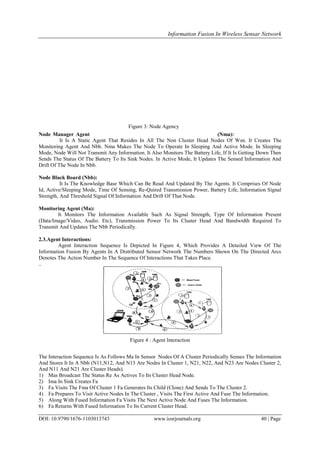
Agent Interaction Sequence Is Depicted In Figure 4, Which Provides A Detailed View Of The
Information Fusion By Agents In A Distributed Sensor Network The Numbers Shown On The Directed Arcs
Denotes The Action Number In The Sequence Of Interactions That Takes Place.
..
The Interaction Sequence Is As Follows Ma In Sensor Nodes Of A Cluster Periodically Senses The Information
And Stores It In A Nbb (N11,N12, And N13 Are Nodes In Cluster 1, N21, N22, And N23 Are Nodes Cluster 2,
And N11 And N21 Are Cluster Heads).
1) Mas Broadcast The Status Re As Actives To Its Cluster Head Node.
2) Ima In Sink Creates Fa
3) Fa Visits The Fma Of Cluster 1 Fa Generates Its Child (Clone) And Sends To The Cluster 2.
4) Fa Prepares To Visit Active Nodes In The Cluster , Visits The First Active And Fuse The Information.
5) Along With Fused Information Fa Visits The Next Active Node And Fuses The Information.
6) Fa Returns With Fused Information To Its Current Cluster Head.
Figure 3: Node Agency
Figure 4 : Agent Interaction
Information Fusion In Wireless Sensar Network
DOI: 10.9790/1676-1103013743 www.iosrjournals.org 41 | Page
7) Cloned Fa Will Send Its Fused Information To Parent Fa In Cluster 1
8) Parent Fa Will Fuse Complete Information And Sends To Ima In Sink.
2.4. Algorithm
Nomenclature : N = Total Number Of Nodes In Wsn, Tth= Predetermined Thoshold Value, Nactive =
Active Node, Ninactive = Inactive Node, And Savailable = Available Signal Strength Of Information, Drifti = Drift
Value Of The Node, I Is The Index Of The Node
Node Agent
Begin
For I=1 To N Do,
N M Ai Monitors The Information And Updates The
Nbb Periodically;
If( Savailable > Tth)
Then
Status= Nactive
Drifti = Savailable – Tth
If (Drifti> 30% Of Tth)
Else
Drift Value Of The Node And Its Index (Drifti) Will
Transmitted To Cluster Head Node
Else
Status = Ninactive
End.
Fusing Agent
Begin
For I = 1 To N Do,
 User Asks For Certain Information From The Sensor Nodes To Ima In Sink.
 Ima Generates The Fa And Provides Routing Information To Reach Desired Sensor Nodes.
 Fa Visits The First Clones And Send One Clone To Other Cluster Heads Which Of Desired Nodes.
 Fa Performs Following After Reaching A Cluster Head
Detects The Active Node Status The Desired Nodes Though Fma And Fbb
Migrate To Active Nodes And Fuses The Information .A Cloned Fa Will Migrate Of The Cluster And Move
From There To Its Parent Agent Cluster Head By Getting The Routing Information From Fma
* Parent Fa Fuses All The Information From Child Nodes And Sends The Fused
Information And Drift Information To Sink Ima
* Ima Upates Its Ibb And Provides Information To User.
* Stop
End.
III. Results And Discussions
The Performance Parameters To Be Compared With Each Other For The System Performance
Measurements Are Under Different Possible Conditions That May Be Encountered In An Agent Based
Information Fusion Wsn Networks Scenario Are Mentioned Above. In This Section We Give A Comparison Of
Each Parameter Over The Other In A Detailed Way. We Consider And Compare The Number Of Fused Data
V/S Number Of Active Nodes, Fusing Time V/S Number Of Active Nodes, Etc.
Due To Randomness In The Initial Position, Mobility And The Direction Of The Readings Vary A Lot
For The Same Condition And The Graphs May Not Be Smooth. We Discuss All The Graphs One By One.
Information Fusion In Wireless Sensar Network
DOI: 10.9790/1676-1103013743 www.iosrjournals.org 42 | Page
Figure 5
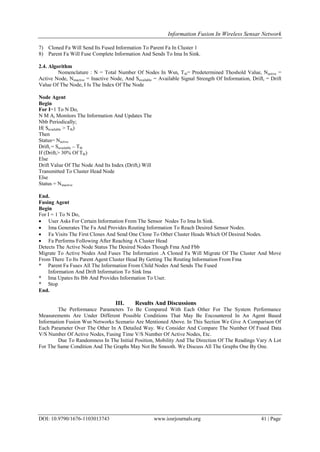
In The Figure 5 We See That The Fusing Data Of Clusters Changes With The Total Number Of Active
Nodes In The Entire Network. As The Total Number of Actives Nodes Increase, The Number Of Fusing Data
Also Increases
Figure 6
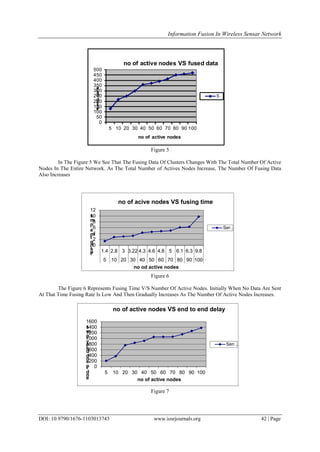
The Figure 6 Represents Fusing Time V/S Number Of Active Nodes. Initially When No Data Are Sent
At That Time Fusing Rate Is Low And Then Gradually Increases As The Number Of Active Nodes Increases.
Figure 7
0
50
100
150
200
250
300
350
400
450
500
5 10 20 30 40 50 60 70 80 90 100
fu
s
e
d
d
a
ta
no of active nodes
no of active nodes VS fused data
S…
0
2
4
6
8
10
12
1.4 2.8 3 3.22 4.3 4.6 4.8 5 6.1 6.3 9.8
5 10 20 30 40 50 60 70 80 90 100
fu
s
in
g
tim
e
in
m
s
no od active nodes
no of acive nodes VS fusing time
Ser…
0
200
400
600
800
1000
1200
1400
1600
5 10 20 30 40 50 60 70 80 90 100
e
n
d
to
e
n
d
d
e
la
y
in
m
s
no of active nodes
no of active nodes VS end to end delay
Seri…
Information Fusion In Wireless Sensar Network
DOI: 10.9790/1676-1103013743 www.iosrjournals.org 43 | Page
The Figure 7 Represents Average End To End Delay V/S The Number Of Active Nodes, The Average
Tma Increases Relatively Slowly With Respect To The Number Of Active Nodes.
References
[1.] C. Intanagonwiwat, R. Govindan, D. Estrin, “Directed Diffusion: A Scalable And Robust Communication Paradigm For Sensor
Networks”, Proceedings Of The Acm Mobicom’00, Boston, Ma, 2000, Pp. 56–67.
[2.] I.F. Akyildiz, W. Su*, Y. Sankarasubramaniam, E. Cayirci, “Wireless Sensor Networks: A Survey” Computer Networks: The
International Journal Of Computer And Telecommunications Networking, Volume 38 (2002) Pages:393–422 Issn: 1389-1286
[3.] D. Estrin, R. Govindan, J. Heidemann, S. Kumar, “Next Century Challenges: Scalable Coordination In Sensor Networks”, Acm
Mobicom’99, Washington, Usa, 1999, Pages: 263–270.
[4.] G,J, Pottie And W, J. Kaiser., “ Wireless Integrated Network Sensor,” Communications Of The Acm, 43(5) :51-58, May 2000.
[5.] Deepak Ganesan, Ben Greenstein, Denis Perelyubskiy, Deborah Estrin, And John Heidemann. “An Evaluation Of Multi-Resolution
Search And Storage In Resource-Constrained Sensor Networks”. In Proceedings Of The First Acm Conference On Embedded
Networked Sensor Systems (Sensys)., 2003. Http://Citeseer.Ist.Psu.Edu/Article/Ganesan03evaluation.Html
[6.] I. F. Akyildiz, W. Su, Y. Sankarasubramaniam, And E. Cayirci, "A Survey On Sensor Networks," Ieee Communications Magazine,
Vol. 40, No. 8, Pp. 102-114, August 2002
[7.] C. Intanagonwiwat, R. Govindan, And D. Estrin, “Directed Diffusion: A Scalable And Robust Communication Paradigm For
Sensor Networks,” In Proc. Mobicom’00, Boston, Ma, Aug. 2000, Pp. 56–67.
[8.] V. Mhatre And C. Rosenberg, “Design Guidelines For Wireless Sensor Networks: Communication, Clustering And Aggregation,”
Ad Hoc Networks Journal, Vol. 2, No. 1, Pp. 45–63, 2004.

E1103013743

  • 1.
    IOSR Journal ofElectrical and Electronics Engineering (IOSR-JEEE) e-ISSN: 2278-1676,p-ISSN: 2320-3331, Volume 11, Issue 3 Ver. I (May. – Jun. 2016), PP 37-43 www.iosrjournals.org DOI: 10.9790/1676-1103013743 www.iosrjournals.org 37 | Page Information Fusion in Wireless Sensar Network 1 M.S.Kanamadi 1 Asst. Professor, Ece Department, Bldea’s Dr. P. G. Halakatti College Of Engineering And Technology Bijapur, Karnataka, India Abstract: A Wireless Sensor Network (Wsn) Is A Collection Of Nodes Organized Into A Co-Operative Network. These Constitute Part Of A Network, Which Consist Of Individual Nodes That Are Able To Interact With Their Environment By Sensing Or Controlling Physical Parameters; These Nodes Have To Collaborate In Order To Fulfill Their Tasks As, Usually, A Single Node Is Incapable Of Doing So; And They Use Wireless Communication To Enable This Communication. The Field Of Application Of Wsn Is Constrained By The Capacity To Instrument The Nodes With Sensors And By The Required Processing Of The Generated Information. Wsn Were Invented To Study, Control And Monitor Events And Phenomena. Some Of The Commonly Applied Sensors Used Are For Measuring Flow, Temperature, Humidity, Vibrations, Pressures, Brightness, Mechanical Stress, And Proximity. The Use Of Wsn Has Foreseen Big Changes In Data Gathering, Processing, And Dissemination For Different Environments And Specific Applications.Wireless Sensor Networks Are Gaining Importance Because Of Development In Miniaturized Sensors. Information Fusion Is One Of Important Problem In Wireless Sensor Networks, Where Data, Critical Images, Etc., Are Collected Form Sensor Nodes. To Have The Complete Idea Of Visual Would One Needs To Fuse The Information From Different Sensors, This Works Proposes An Agent Based Distributed Sensor Network (Adsn) To Form An Improved Infrastructure For Multi-Sensor Information Fusion. The Proposed Scheme Is Based On The Clustering Concept In Which Sensor Nodes Form The Clusters. Each Of The Cluster Has Cluster Head Node. The Fusing Request Will Be Generated By The User At The Sink Node By Using A Mobile Agent. The Mobile Agent Roams Different Active Sensor Nodes In Each Of The Clusters To Perform Information Fusion Based On Predetermined Signal Strength Finally, Once All The Relevant Nodes Have Been Visited Agent Transmits The Fused Information To The Sink Node. Keywords: Wireless Sensor, Information Fusion, Cluster Head Node, Sensor Node, Sink Node, Fuse Manager. I. Introduction Information Fusion Is An Important Component Of Applications For System That Use Correlated Data From Multiple Sources To Determine The State Of A System. Information May Be Data, Image Or Audio/Video. As The State Of The System Being Monitored And Available Resources Change, The General Information Fusion Framework Should Change Dynamically Based On The Current Environment And Available Resources In The System (5) An Objective Of An Information Fusion System Is To Combine Data From Many Different Sources To Make A Decision, /For Instance, Classification Of An Entity (An Object Or An Objects State) Or A Situation Assessment, Etc Heterogeneity In The Fusion Process Is A Result Of The Diversity Of Possible Data Structures, Differences In Data Specification Representation And Units, Differences In Data Nature And So On. The Information Fusion Process Is Divided Into Different Main Levels Low, Intermediate, And High Level Information Fusion. It Combines Several Sources Of Raw Data To Produce New Raw Data That Is Expected To Be More Informative And Synthetic (Meaningful) Than The Inputs An Example Of Input Signals To Low-Level Information Fusion (Raw Information Fusion) Can Be Voltage Readings In Time Form An Accelerometer In A Seismic Ground Sensor Or Magnitude Readings From An Acoustic. Fusion Combines Various Features That May Come From Seven Different Raw Data Sources Or From The Same Source But Then Fused In Time This Level Can Also Be Called Feature Level Fusion Or More Common, Information Fusion To Tackle The Problem Of Unreliable Connectivity, Latency, And Communication Overheads, Agent Technology Seems To Provide Better Solution For Information Fusion In Wireless Sensor Network. An Agents In An Autonomous Program, Which Can Perform Task On Behalf Of A User/Process Autonomously And Asynchronously. Generally Speaking, Mobile Agent Is A Special Kind Of Software That Has Ability To Roam In The Network To Perform A Given Task.
  • 2.
    Information Fusion InWireless Sensar Network DOI: 10.9790/1676-1103013743 www.iosrjournals.org 38 | Page II. Proposed Method 2.1. Agencies: The Proposed Work Is Based On Clustering Concept That Consists Of Several Nodes In Each Cluster, And One Of The Node Of Each Cluster Acts As A Head. Several Agencies Exist At Each Of The Nodes Based On Their Role In Wsn. The Cluster Head Node, Sensor Node, Sink Node Consists Of Fusing Agency, Monitoring Agency And Information Managing Agency, Respectively. Here We Describe All The Agencies. The Fusing Agency Comprises Of Fuse Manager Agent (Fma), Monitoring Agent (Ma), And A Fusing Blackboard (Fbb) For Inter-Agent Communication. Fusing Agency : Fusing Agency Is Shown In Figure 1 The Fusing Agency Comprises Of Fuse Manager Agent(Fma) Monitoring Agent(Ma) And A Fusing Backboard (Fbb) For Inter-Agent Communication. Fuse Manager Agent (Fma): This Is A Static Agent That Generates All The Agents And Fbb In The Agency And Facilitates Coordination Among The Agents. It Periodically Generates The Optimal Routing Table Using The Standard Wsn Cluster Based Routing Protocol [14] And Updates Fbb. Fma Seeks Information From The Active Nodes In Its Cluster And Updates Fbb. Agent Also Allows A Fusing Agent (Fa) From A Sink Node Or The Neighboring Cluster Head Node To Migrate To It And Perform Fusing Of Information From Cluster’s Active Nodes (Relevant Nodes As Desired By The Sink). Fusing Black Board (Fbb): It Is The Knowledge Base That Can Be Read And Updated By The Agents. The Knowledge Base Facilitates Inter-Agent Communication. A Blackboard Stores The Information About The Nodes (Identification And Its Information Status, Drift Values Of The Relevant Nodes And Their Index) In The Cluster. Each Node Is Associated With A Status Tag, Active Or Inactive. For Each Of The Active Nodes, Associated Parameters Are Type Of Information, Time Of Sensing, Required Transmission Power, Battery Life, Information Signal Strength, And Threshold Signal Strength Of Information. It Also Has Information About The Routes To Reach Each Sensor Node And The Sink Nodes In Wsn Through The Neighbor Cluster Heads. Also, It Has Status Information About Itself. Sensor Monitoring Agent (Sma): It Is A Static Agent That Monitors The Sensed Information From Itself And Updates The Fbb. It Monitors The Information (Image/Data From The Sensor), Bandwidth Required To Transmit The Information, Required Transmission Power To Reach The Nearest Cluster Head, Node Status (Active/Inactive) Based On Signal Strength Of Information (I.E., If Sensed Information Is More Than Predefined Threshold Signal Strength). 2.Sink Agency: Sink Agency Is Shown In figure 2. The Sink Agency Comprises Of Fusing Agent, Information Manager Agent (Ima), And An Information Blackboard (Ibb) For Inter- Agent Communication. Figure 1 : Fusing Agency
  • 3.
    Information Fusion InWireless Sensar Network DOI: 10.9790/1676-1103013743 www.iosrjournals.org 39 | Page Information Manager Agent (Ima): This Is A Static Agent That Creates The Ibb And Fusing Agents Whenever Required To Fuse The Information From The Sensor Nodes. Ima Broadcasts The Threshold Signal Information To All The Nodes Of Wsn. This Agent Is Triggered By The Application Run By The User At The Data-Collecting Center. It Updates The Information Blackboard (Ibb) With Cluster Head Node Identity (Id), And Location Of Cluster Head Node Information, Routes To Reach All Sensor Nodes Via Cluster Heads And The Fused Information Obtained By Fa. It Also Transmits Predetermined Value To The One Cluster Head Nodes. Fusing Agent (Fa): These Are Mobile Agents Equipped With Information Fusion Code That Migrate From One To Another Node Depending On The Routing Information Provided By The Ima Using Cloning Concept (A Clone Is A Copy Of The Agent Which Is Given Destination Node Address To Migrate To Accomplish Task And Returns The Result To Its Parent Agent). Routing Information Consists Of A Sequence Of Cluster Head And Desired Sensor Nodes. It Searches For The Active Nodes Among The Desired Nodes Whenever It Visits A Cluster And Fuses The Information From Such Active Nodes. While Doing So, It Clones Itself And Sends The Clones To All Other Clusters To Be Visited As Given By Ima. A Cloned Agent Will Return Its Fused Results To Parent Agent. Parent Agent Will Fuse The Entire Information, Sends The Fused Information And Drift Values Of The Nodes To The Sink Node Ima. Fa Is Embedded With Information Fusion Code. Information Black Board (Ibb): It Is The Knowledge Base That Can Read And Updated By Ima. It Stores The In-Formation About The Cluster Head Nodes And Its Connected Nodes, Type Of Sensors, Fused Information, Drift Values Of The Nodes And Their Indices, Time Of Fusing, Routes To Reach The Nodes And The Threshold Signal Values For Sensors, Etc. 2.2 . Node Agency: Node Agency Is Shown In figure 3. It Comprises Of Node Manager Agent (Nma), Monitoring Agent (Ma), And Node Blackboard (Nbb) For Inter Agent Communication. Figure 2 : Sink Agency
  • 4.
    Information Fusion InWireless Sensar Network DOI: 10.9790/1676-1103013743 www.iosrjournals.org 40 | Page Node Manager Agent (Nma): It Is A Static Agent That Resides In All The Non Cluster Head Nodes Of Wsn. It Creates The Monitoring Agent And Nbb. Nma Makes The Node To Operate In Sleeping And Active Mode. In Sleeping Mode, Node Will Not Transmit Any Information. It Also Monitors The Battery Life, If It Is Getting Down Then Sends The Status Of The Battery To Its Sink Nodes. In Active Mode, It Updates The Sensed Information And Drift Of The Node In Nbb. Node Black Board (Nbb): It Is The Knowledge Base Which Can Be Read And Updated By The Agents. It Comprises Of Node Id, Active/Sleeping Mode, Time Of Sensing, Re-Quired Transmission Power, Battery Life, Information Signal Strength, And Threshold Signal Of Information And Drift Of That Node. Monitoring Agent (Ma): It Monitors The Information Available Such As Signal Strength, Type Of Information Present (Data/Image/Video, Audio. Etc), Transmission Power To Its Cluster Head And Bandwidth Required To Transmit And Updates The Nbb Periodically. 2.3.Agent Interactions: Agent Interaction Sequence Is Depicted In Figure 4, Which Provides A Detailed View Of The Information Fusion By Agents In A Distributed Sensor Network The Numbers Shown On The Directed Arcs Denotes The Action Number In The Sequence Of Interactions That Takes Place. .. The Interaction Sequence Is As Follows Ma In Sensor Nodes Of A Cluster Periodically Senses The Information And Stores It In A Nbb (N11,N12, And N13 Are Nodes In Cluster 1, N21, N22, And N23 Are Nodes Cluster 2, And N11 And N21 Are Cluster Heads). 1) Mas Broadcast The Status Re As Actives To Its Cluster Head Node. 2) Ima In Sink Creates Fa 3) Fa Visits The Fma Of Cluster 1 Fa Generates Its Child (Clone) And Sends To The Cluster 2. 4) Fa Prepares To Visit Active Nodes In The Cluster , Visits The First Active And Fuse The Information. 5) Along With Fused Information Fa Visits The Next Active Node And Fuses The Information. 6) Fa Returns With Fused Information To Its Current Cluster Head. Figure 3: Node Agency Figure 4 : Agent Interaction
  • 5.
    Information Fusion InWireless Sensar Network DOI: 10.9790/1676-1103013743 www.iosrjournals.org 41 | Page 7) Cloned Fa Will Send Its Fused Information To Parent Fa In Cluster 1 8) Parent Fa Will Fuse Complete Information And Sends To Ima In Sink. 2.4. Algorithm Nomenclature : N = Total Number Of Nodes In Wsn, Tth= Predetermined Thoshold Value, Nactive = Active Node, Ninactive = Inactive Node, And Savailable = Available Signal Strength Of Information, Drifti = Drift Value Of The Node, I Is The Index Of The Node Node Agent Begin For I=1 To N Do, N M Ai Monitors The Information And Updates The Nbb Periodically; If( Savailable > Tth) Then Status= Nactive Drifti = Savailable – Tth If (Drifti> 30% Of Tth) Else Drift Value Of The Node And Its Index (Drifti) Will Transmitted To Cluster Head Node Else Status = Ninactive End. Fusing Agent Begin For I = 1 To N Do,  User Asks For Certain Information From The Sensor Nodes To Ima In Sink.  Ima Generates The Fa And Provides Routing Information To Reach Desired Sensor Nodes.  Fa Visits The First Clones And Send One Clone To Other Cluster Heads Which Of Desired Nodes.  Fa Performs Following After Reaching A Cluster Head Detects The Active Node Status The Desired Nodes Though Fma And Fbb Migrate To Active Nodes And Fuses The Information .A Cloned Fa Will Migrate Of The Cluster And Move From There To Its Parent Agent Cluster Head By Getting The Routing Information From Fma * Parent Fa Fuses All The Information From Child Nodes And Sends The Fused Information And Drift Information To Sink Ima * Ima Upates Its Ibb And Provides Information To User. * Stop End. III. Results And Discussions The Performance Parameters To Be Compared With Each Other For The System Performance Measurements Are Under Different Possible Conditions That May Be Encountered In An Agent Based Information Fusion Wsn Networks Scenario Are Mentioned Above. In This Section We Give A Comparison Of Each Parameter Over The Other In A Detailed Way. We Consider And Compare The Number Of Fused Data V/S Number Of Active Nodes, Fusing Time V/S Number Of Active Nodes, Etc. Due To Randomness In The Initial Position, Mobility And The Direction Of The Readings Vary A Lot For The Same Condition And The Graphs May Not Be Smooth. We Discuss All The Graphs One By One.
  • 6.
    Information Fusion InWireless Sensar Network DOI: 10.9790/1676-1103013743 www.iosrjournals.org 42 | Page Figure 5 In The Figure 5 We See That The Fusing Data Of Clusters Changes With The Total Number Of Active Nodes In The Entire Network. As The Total Number of Actives Nodes Increase, The Number Of Fusing Data Also Increases Figure 6 The Figure 6 Represents Fusing Time V/S Number Of Active Nodes. Initially When No Data Are Sent At That Time Fusing Rate Is Low And Then Gradually Increases As The Number Of Active Nodes Increases. Figure 7 0 50 100 150 200 250 300 350 400 450 500 5 10 20 30 40 50 60 70 80 90 100 fu s e d d a ta no of active nodes no of active nodes VS fused data S… 0 2 4 6 8 10 12 1.4 2.8 3 3.22 4.3 4.6 4.8 5 6.1 6.3 9.8 5 10 20 30 40 50 60 70 80 90 100 fu s in g tim e in m s no od active nodes no of acive nodes VS fusing time Ser… 0 200 400 600 800 1000 1200 1400 1600 5 10 20 30 40 50 60 70 80 90 100 e n d to e n d d e la y in m s no of active nodes no of active nodes VS end to end delay Seri…
  • 7.
    Information Fusion InWireless Sensar Network DOI: 10.9790/1676-1103013743 www.iosrjournals.org 43 | Page The Figure 7 Represents Average End To End Delay V/S The Number Of Active Nodes, The Average Tma Increases Relatively Slowly With Respect To The Number Of Active Nodes. References [1.] C. Intanagonwiwat, R. Govindan, D. Estrin, “Directed Diffusion: A Scalable And Robust Communication Paradigm For Sensor Networks”, Proceedings Of The Acm Mobicom’00, Boston, Ma, 2000, Pp. 56–67. [2.] I.F. Akyildiz, W. Su*, Y. Sankarasubramaniam, E. Cayirci, “Wireless Sensor Networks: A Survey” Computer Networks: The International Journal Of Computer And Telecommunications Networking, Volume 38 (2002) Pages:393–422 Issn: 1389-1286 [3.] D. Estrin, R. Govindan, J. Heidemann, S. Kumar, “Next Century Challenges: Scalable Coordination In Sensor Networks”, Acm Mobicom’99, Washington, Usa, 1999, Pages: 263–270. [4.] G,J, Pottie And W, J. Kaiser., “ Wireless Integrated Network Sensor,” Communications Of The Acm, 43(5) :51-58, May 2000. [5.] Deepak Ganesan, Ben Greenstein, Denis Perelyubskiy, Deborah Estrin, And John Heidemann. “An Evaluation Of Multi-Resolution Search And Storage In Resource-Constrained Sensor Networks”. In Proceedings Of The First Acm Conference On Embedded Networked Sensor Systems (Sensys)., 2003. Http://Citeseer.Ist.Psu.Edu/Article/Ganesan03evaluation.Html [6.] I. F. Akyildiz, W. Su, Y. Sankarasubramaniam, And E. Cayirci, "A Survey On Sensor Networks," Ieee Communications Magazine, Vol. 40, No. 8, Pp. 102-114, August 2002 [7.] C. Intanagonwiwat, R. Govindan, And D. Estrin, “Directed Diffusion: A Scalable And Robust Communication Paradigm For Sensor Networks,” In Proc. Mobicom’00, Boston, Ma, Aug. 2000, Pp. 56–67. [8.] V. Mhatre And C. Rosenberg, “Design Guidelines For Wireless Sensor Networks: Communication, Clustering And Aggregation,” Ad Hoc Networks Journal, Vol. 2, No. 1, Pp. 45–63, 2004.