INFORMATION FUSION AND MAP 
BUILDING IN DISTRIBUTED SYSTEMS 
Submitted By : 
PARESH SAO(11118049) 
SHIVANI SINGH(11118068) 
TARUN BEHRA(11118079) 
VINIT PAYAL(11118085) 
VII SEM 
INFORMATION TECHNOLOGY 
NIT RAIPUR 
11/19/2014 INFORMATION FUSION 1
What Is Fusion ? 
Fusion Is the process of the joining two or more things together to form a single entity . 
Two Types of fusions in the field of computer science:- 
1. Data Fusion 
2. Information Fusion 
Data Fusion:- 
Data fusion is used for raw data (obtained directly from the sensors) 
 Information Fusion:- 
Information fusion is employed to define already processed data.
Information fusion implies a higher semantic level than data fusion. 
Data or information to be fused can be from two sources:- 
1. Sensors 
2. Databases 
The goal of using data/Information fusion in multi sensor environments is to obtain a lower 
detection error probability and a higher reliability by using data from multiple sources.
Information Fusion:- 
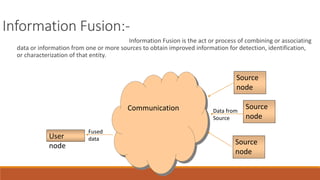
Information Fusion is the act or process of combining or associating 
data or information from one or more sources to obtain improved information for detection, identification, 
or characterization of that entity. 
User 
node 
Communication 
Source 
node 
Data from 
Source 
Source 
node 
Fused 
data 
Source 
node
Classification of Data Fusion Techniques 
1. Classification Based on the Relations between the Data Sources:- 
a) Complementary:- 
when the information provided by the input sources 
represents different parts of the scene and could thus be used to obtain more 
complete global information. For example, in the case of visual sensor networks, 
the information on the same target provided by two cameras with different fields 
of view is considered complementary. 
b) Redundant:- 
when two or more input sources provide information about the 
same target and could thus be fused to increment the confidence. For example, 
the data coming from overlapped areas in visual sensor networks are considered 
redundant.
c) cooperative:- 
when the provided information is combined into new 
information that is typically more complex than the original information. For example, 
multi-modal (audio and video) data fusion is considered cooperative. 
2. Classification Based on the Abstraction Levels:- 
A. low level fusion 
B. medium level fusion 
C. high level fusion 
D. multiple level fusion
A. low level fusion:- 
The raw data are directly provided as an input to the data fusion process, which provide more 
accurate data (a lower signal-to-noise ratio) than the individual sources; 
B. Medium level:- 
Characteristics or features (shape, texture, and position) are fused to obtain features that could 
be employed for other tasks. This level is also known as the feature or characteristic level 
C. High Level:- 
This level, which is also known as decision fusion, takes symbolic representations as sources and 
combines them to obtain a more accurate decision. Bayesian’s methods are typically employed at this level 
D. Multiple level fusion: 
This level addresses data provided from different levels of abstraction (i.e., when a 
measurement is combined with a feature to obtain a decision) :-
3. Dasarathy’s Classification:- 
A. data in-data out (DAI-DAO) 
B. data in-feature out (DAI-FEO) 
C. feature in-feature out (FEI-FEO) 
D. feature in-decision out (FEI-DEO) 
E. Decision In-Decision Out (DEI-DEO)
A. Data in-data out (DAI-DAO):- 
This type of data fusion process inputs and outputs 
raw data; the results are typically more reliable or accurate. Data fusion at 
this level is conducted immediately after the data are gathered from the 
sensors. The algorithms employed at this level are based on signal and image 
processing algorithms . 
B. data in-feature out (DAI-FEO):- 
At this level, the data fusion process employs 
raw data from the sources to extract features or characteristics that describe 
an entity in the environment . 
C. feature in-feature out (FEI-FEO):- 
At this level, both the input and output of the 
data fusion process are features. Thus, the data fusion process addresses a 
set of features with to improve, refine or obtain new features. This process is 
also known as feature fusion, symbolic fusion, information fusion or 
intermediate-level fusion
D. feature in-decision out (FEI-DEO):- 
This level obtains a set of features as input 
and provides a set of decisions as output. Most of the classification systems 
that perform a decision based on a sensor’s inputs fall into this category of 
classification. 
E. Decision In-Decision Out (DEI-DEO):- 
This type of classification is also known as 
decision fusion. It fuses input decisions to obtain better or new decisions.
INFORMATION FUSION ARCHITECTURE 
There are three types of Information fusion Architecture 
•Centralized 
•Decentralize 
•Hierarchal 
11/19/2014 INFORMATION FUSION 11
CENTRALIZED 
• It is the Simplest of all the architecture. 
• In this a central processor fuses the reports collected by all other sensing 
nodes i.e. the data is collected from different nodes and a centralized node 
produces the final output. 
Advantage: 
Erroneous report(s) can be easily detected. 
Disadvantage: 
Inflexible to sensor changes and the workload is concentrated at a single 
point. 
11/19/2014 INFORMATION FUSION 12
CENTRALIZED FUSION 
Arch. Type : Centralized 
Processing : Moderate 
Bandwidth : Moderate 
Central Timeliness : Poor 
node 
11/19/2014 INFORMATION FUSION 13
DECENTRALIZED 
• Data fusion occurs locally at each node on the basis of local 
observations and the information obtained from neighboring nodes. 
• No central processor node. 
Advantages: 
Scalable and tolerant to the addition or loss of sensing nodes or 
dynamic changes in the network. 
11/19/2014 INFORMATION FUSION 14
HIERARCHICAL 
•Nodes are partitioned into hierarchical levels. 
•The sensing nodes are at level 0 and the BS at the highest level. 
•Reports move from the lower levels to higher ones. 
Advantage: 
Workload is balanced among nodes 
11/19/2014 INFORMATION FUSION 15
HIERARCHICAL INFORMATION FUSION ARCHITECTURE 
Arch. Type : Hierarchical 
Processing : High at mid levels 
Bandwidth : Moderate 
Timeliness : Good 
Fusion 
Node 
Sensor data 1 
Sensor data 2 
Sensor data 3 
11/19/2014 INFORMATION FUSION 16
BENEFITS FROM INFORMATION FUSION SYSTEM 
•Fusion process is necessary most of all to reduce (to filter) input 
information through its integration (merging) and generalization. 
•Fusion process is necessary to improve accuracy. 
Fusion process is necessary to reduce uncertainty. 
11/19/2014 INFORMATION FUSION 17
INFORMATION FUSION APPLICATION 
MILITARY APPLICATION : 
•Location and characterization of enemy units and weapons 
•High level inferences about enemy situation 
•Air to air or surface to air defense 
•Ocean monitoring 
•Battlefield intelligence 
•Strategic warning 
NON MILITARY APPLICATIONS: 
•Condition based maintenance 
•Detection of system faults 
•Robotics 
•Medical 
•Environmental monitoring 
•Location and identification 
of natural phenomena 
11/19/2014 INFORMATION FUSION 18
Coding Part 
Node 1 
Turtle_bot 
Node 2 
Navigation Ser. 
Use data 
for 
robot navigation 
Robot 
navigation 
Send /scan data 
Send /cmd_vel_nev 
Map 
Generation 
Processed /cmd_vel_nev 
With 
SLAM 
11/19/2014 INFORMATION FUSION 19
Andersson, L. A. (2008). Multi-robot Information Fusion. Sweden: UniTryck, Link¨oping. 
Arwin Datumaya, W. S. (2008). Design and Implementation of Multi Agent-based 
information Fusion System for Decision Making Support. 
Kiril Alexiev, I. N. (2006). Methods for Data and Information Fusion . 
Xiang Li, M. S. (2009). Autonomous Information Fusion for Robust Obstacle Localization 
on a Humanoid Robot. The Latin American Robotics Symposium . 
11/19/2014 INFORMATION FUSION 20

Information fusion

  • 1.
    INFORMATION FUSION ANDMAP BUILDING IN DISTRIBUTED SYSTEMS Submitted By : PARESH SAO(11118049) SHIVANI SINGH(11118068) TARUN BEHRA(11118079) VINIT PAYAL(11118085) VII SEM INFORMATION TECHNOLOGY NIT RAIPUR 11/19/2014 INFORMATION FUSION 1
  • 2.
    What Is Fusion? Fusion Is the process of the joining two or more things together to form a single entity . Two Types of fusions in the field of computer science:- 1. Data Fusion 2. Information Fusion Data Fusion:- Data fusion is used for raw data (obtained directly from the sensors)  Information Fusion:- Information fusion is employed to define already processed data.
  • 3.
    Information fusion impliesa higher semantic level than data fusion. Data or information to be fused can be from two sources:- 1. Sensors 2. Databases The goal of using data/Information fusion in multi sensor environments is to obtain a lower detection error probability and a higher reliability by using data from multiple sources.
  • 4.
    Information Fusion:- InformationFusion is the act or process of combining or associating data or information from one or more sources to obtain improved information for detection, identification, or characterization of that entity. User node Communication Source node Data from Source Source node Fused data Source node
  • 5.
    Classification of DataFusion Techniques 1. Classification Based on the Relations between the Data Sources:- a) Complementary:- when the information provided by the input sources represents different parts of the scene and could thus be used to obtain more complete global information. For example, in the case of visual sensor networks, the information on the same target provided by two cameras with different fields of view is considered complementary. b) Redundant:- when two or more input sources provide information about the same target and could thus be fused to increment the confidence. For example, the data coming from overlapped areas in visual sensor networks are considered redundant.
  • 6.
    c) cooperative:- whenthe provided information is combined into new information that is typically more complex than the original information. For example, multi-modal (audio and video) data fusion is considered cooperative. 2. Classification Based on the Abstraction Levels:- A. low level fusion B. medium level fusion C. high level fusion D. multiple level fusion
  • 7.
    A. low levelfusion:- The raw data are directly provided as an input to the data fusion process, which provide more accurate data (a lower signal-to-noise ratio) than the individual sources; B. Medium level:- Characteristics or features (shape, texture, and position) are fused to obtain features that could be employed for other tasks. This level is also known as the feature or characteristic level C. High Level:- This level, which is also known as decision fusion, takes symbolic representations as sources and combines them to obtain a more accurate decision. Bayesian’s methods are typically employed at this level D. Multiple level fusion: This level addresses data provided from different levels of abstraction (i.e., when a measurement is combined with a feature to obtain a decision) :-
  • 8.
    3. Dasarathy’s Classification:- A. data in-data out (DAI-DAO) B. data in-feature out (DAI-FEO) C. feature in-feature out (FEI-FEO) D. feature in-decision out (FEI-DEO) E. Decision In-Decision Out (DEI-DEO)
  • 9.
    A. Data in-dataout (DAI-DAO):- This type of data fusion process inputs and outputs raw data; the results are typically more reliable or accurate. Data fusion at this level is conducted immediately after the data are gathered from the sensors. The algorithms employed at this level are based on signal and image processing algorithms . B. data in-feature out (DAI-FEO):- At this level, the data fusion process employs raw data from the sources to extract features or characteristics that describe an entity in the environment . C. feature in-feature out (FEI-FEO):- At this level, both the input and output of the data fusion process are features. Thus, the data fusion process addresses a set of features with to improve, refine or obtain new features. This process is also known as feature fusion, symbolic fusion, information fusion or intermediate-level fusion
  • 10.
    D. feature in-decisionout (FEI-DEO):- This level obtains a set of features as input and provides a set of decisions as output. Most of the classification systems that perform a decision based on a sensor’s inputs fall into this category of classification. E. Decision In-Decision Out (DEI-DEO):- This type of classification is also known as decision fusion. It fuses input decisions to obtain better or new decisions.
  • 11.
    INFORMATION FUSION ARCHITECTURE There are three types of Information fusion Architecture •Centralized •Decentralize •Hierarchal 11/19/2014 INFORMATION FUSION 11
  • 12.
    CENTRALIZED • Itis the Simplest of all the architecture. • In this a central processor fuses the reports collected by all other sensing nodes i.e. the data is collected from different nodes and a centralized node produces the final output. Advantage: Erroneous report(s) can be easily detected. Disadvantage: Inflexible to sensor changes and the workload is concentrated at a single point. 11/19/2014 INFORMATION FUSION 12
  • 13.
    CENTRALIZED FUSION Arch.Type : Centralized Processing : Moderate Bandwidth : Moderate Central Timeliness : Poor node 11/19/2014 INFORMATION FUSION 13
  • 14.
    DECENTRALIZED • Datafusion occurs locally at each node on the basis of local observations and the information obtained from neighboring nodes. • No central processor node. Advantages: Scalable and tolerant to the addition or loss of sensing nodes or dynamic changes in the network. 11/19/2014 INFORMATION FUSION 14
  • 15.
    HIERARCHICAL •Nodes arepartitioned into hierarchical levels. •The sensing nodes are at level 0 and the BS at the highest level. •Reports move from the lower levels to higher ones. Advantage: Workload is balanced among nodes 11/19/2014 INFORMATION FUSION 15
  • 16.
    HIERARCHICAL INFORMATION FUSIONARCHITECTURE Arch. Type : Hierarchical Processing : High at mid levels Bandwidth : Moderate Timeliness : Good Fusion Node Sensor data 1 Sensor data 2 Sensor data 3 11/19/2014 INFORMATION FUSION 16
  • 17.
    BENEFITS FROM INFORMATIONFUSION SYSTEM •Fusion process is necessary most of all to reduce (to filter) input information through its integration (merging) and generalization. •Fusion process is necessary to improve accuracy. Fusion process is necessary to reduce uncertainty. 11/19/2014 INFORMATION FUSION 17
  • 18.
    INFORMATION FUSION APPLICATION MILITARY APPLICATION : •Location and characterization of enemy units and weapons •High level inferences about enemy situation •Air to air or surface to air defense •Ocean monitoring •Battlefield intelligence •Strategic warning NON MILITARY APPLICATIONS: •Condition based maintenance •Detection of system faults •Robotics •Medical •Environmental monitoring •Location and identification of natural phenomena 11/19/2014 INFORMATION FUSION 18
  • 19.
    Coding Part Node1 Turtle_bot Node 2 Navigation Ser. Use data for robot navigation Robot navigation Send /scan data Send /cmd_vel_nev Map Generation Processed /cmd_vel_nev With SLAM 11/19/2014 INFORMATION FUSION 19
  • 20.
    Andersson, L. A.(2008). Multi-robot Information Fusion. Sweden: UniTryck, Link¨oping. Arwin Datumaya, W. S. (2008). Design and Implementation of Multi Agent-based information Fusion System for Decision Making Support. Kiril Alexiev, I. N. (2006). Methods for Data and Information Fusion . Xiang Li, M. S. (2009). Autonomous Information Fusion for Robust Obstacle Localization on a Humanoid Robot. The Latin American Robotics Symposium . 11/19/2014 INFORMATION FUSION 20

Editor's Notes

  • #6 . Observation fusion involves fusing information from different sensors of the same physical phenomenon, such as image intelligence (IMINT), and also fusing information from sensors of different phenomena, such as fusing laser imaging detection and ranging, hyperspectral (images recording visible plus infrared and/or ultraviolet light), and overhead persistent infrared. . Object/feature fusion involves fusing different data types from different INTs, such as fusing IMINT and SIGINT to yield information resources that are more powerful, flexible and accurate than the original sources. . Decision fusion is the act or process of supporting a human’s ability to make a decision by providing an environment of interoperable network services for situation assessment, impact assessment and decision support, using information from multiple sensors and processed information such as multi-INT sources.