E-WASTE & ITS RECYCLINGErase your E-Waste, it’s not for your
Landfills.
PRESENTED BY -
SHUBHAM KUMAR SINHA
DEPARTMENT OF ELECTRONICS AND COMMUNICATION ENGINEERING
DR. B.C.ROY ENGINEERING COLLEGE, DURGAPUR
PRESENTATION OVERVIEW
• Introduction
• Sources Of E-Waste
• Waste Flow within India
• Quantity
• Economic & Social Effects Of Recycling
• Perception Of The Problem
• Proposals
• Conclusion
INTRODUCTION
What is E-waste ?
 Describes discarded electrical
or electronic devices.
 Used electronics which are
destined for reuse, resale.
 Waste that has a circuit board or
Cathode ray tube(CRT).
• India is, in addition to China, one of the
biggest importers of e-waste.
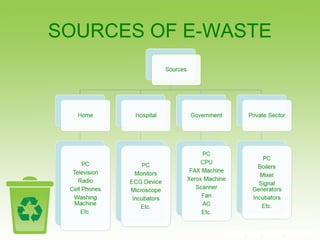
SOURCES OF E-WASTE
WASTE FLOW WITHIN INDIA
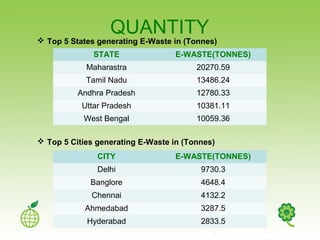
QUANTITY
STATE E-WASTE(TONNES)
Maharastra 20270.59
Tamil Nadu 13486.24
Andhra Pradesh 12780.33
Uttar Pradesh 10381.11
West Bengal 10059.36
 Top 5 States generating E-Waste in (Tonnes)
CITY E-WASTE(TONNES)
Delhi 9730.3
Banglore 4648.4
Chennai 4132.2
Ahmedabad 3287.5
Hyderabad 2833.5
 Top 5 Cities generating E-Waste in (Tonnes)
ECONOMIC & SOCIAL
AFFECTS OF RECYCLING
 Lead in CRTs & circuit
boards.
 Cadmium in switches.
 Hazard to human
health and the
environment if
improperly managed.
 TOXICITY OF E-WASTE RECYCLING
PERCEPTION OF THE PROBLEM
 PUBLIC AWARENESS
• the issue of e-waste, as it is a rather new issue and has no
directly visible consequences for the general public
 AWARENESS AMONG DISMANTLERS AND
RECYCLERS
 AWARENESS AMONG MANUFACTURES
• The majority of the brands had no information on their take-
back systems on their websites and none of them had spent a
considerable amount of money on raising awareness.
PROPOSALS
• Cost-Effectiveness
• Domestic Solution
• Value of E-Waste
• Non-toxic Hydrometallurgical Treatment
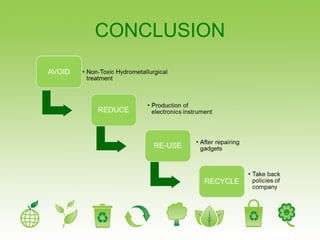
CONCLUSION
“THANKS FOR YOUR KIND
ATTENTION”

E waste

  • 1.
    E-WASTE & ITSRECYCLINGErase your E-Waste, it’s not for your Landfills. PRESENTED BY - SHUBHAM KUMAR SINHA DEPARTMENT OF ELECTRONICS AND COMMUNICATION ENGINEERING DR. B.C.ROY ENGINEERING COLLEGE, DURGAPUR
  • 2.
    PRESENTATION OVERVIEW • Introduction •Sources Of E-Waste • Waste Flow within India • Quantity • Economic & Social Effects Of Recycling • Perception Of The Problem • Proposals • Conclusion
  • 3.
    INTRODUCTION What is E-waste?  Describes discarded electrical or electronic devices.  Used electronics which are destined for reuse, resale.  Waste that has a circuit board or Cathode ray tube(CRT). • India is, in addition to China, one of the biggest importers of e-waste.
  • 4.
  • 5.
  • 6.
    QUANTITY STATE E-WASTE(TONNES) Maharastra 20270.59 TamilNadu 13486.24 Andhra Pradesh 12780.33 Uttar Pradesh 10381.11 West Bengal 10059.36  Top 5 States generating E-Waste in (Tonnes) CITY E-WASTE(TONNES) Delhi 9730.3 Banglore 4648.4 Chennai 4132.2 Ahmedabad 3287.5 Hyderabad 2833.5  Top 5 Cities generating E-Waste in (Tonnes)
  • 7.
    ECONOMIC & SOCIAL AFFECTSOF RECYCLING  Lead in CRTs & circuit boards.  Cadmium in switches.  Hazard to human health and the environment if improperly managed.  TOXICITY OF E-WASTE RECYCLING
  • 8.
    PERCEPTION OF THEPROBLEM  PUBLIC AWARENESS • the issue of e-waste, as it is a rather new issue and has no directly visible consequences for the general public  AWARENESS AMONG DISMANTLERS AND RECYCLERS  AWARENESS AMONG MANUFACTURES • The majority of the brands had no information on their take- back systems on their websites and none of them had spent a considerable amount of money on raising awareness.
  • 9.
    PROPOSALS • Cost-Effectiveness • DomesticSolution • Value of E-Waste • Non-toxic Hydrometallurgical Treatment
  • 10.
  • 11.
    “THANKS FOR YOURKIND ATTENTION”