Presented By:
Nitesh Kumar Singh
BME 7th SEM
The term E-waste is applied to all waste
caused by discarding electronic devices,
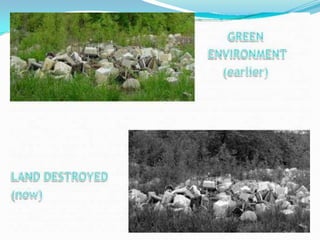
especially consumer electronics. Ewaste is a major concern in areas
of personal computing and wireless
devices that are quickly discarded by
consumers. The lifespan of these
electronics are short-lived due to rapid
technological advances and lower costs
to purchase each year.
• The term E-waste applies to all the waste from or
caused by electronic items.
• IRG (International Resource Group) vastly deals
with this types of hazards to the environment.
• Technological development is the main reason.
• Slowly but strongly, E-waste is becoming a
threat to the world.
• Reduce the risks to the population & the pollution of
the environment resulting from unsafe handling.
• Focus on knowledge transfer to & skills upgrade of all
involve stakeholders through training & seminars.
• Target mainly the existing informal recycle allowing
for their maximum but safe participation in future ewaste management by facilitating their evolution &
integration in formal structures.
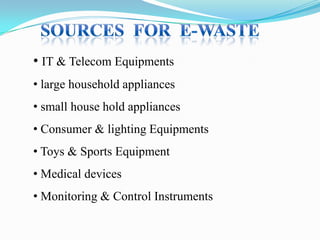
• IT & Telecom Equipments
• large household appliances
• small house hold appliances
• Consumer & lighting Equipments
• Toys & Sports Equipment
• Medical devices
• Monitoring & Control Instruments
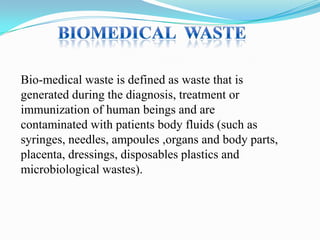
Bio-medical waste is defined as waste that is
generated during the diagnosis, treatment or
immunization of human beings and are
contaminated with patients body fluids (such as
syringes, needles, ampoules ,organs and body parts,
placenta, dressings, disposables plastics and
microbiological wastes).
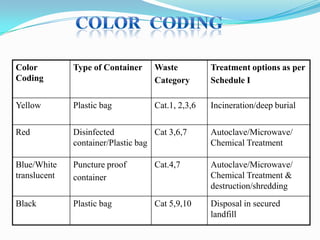
Color
Coding

Type of Container

Waste
Category

Treatment options as per
Schedule I

Yellow

Plastic bag

Cat.1, 2,3,6

Incineration/deep burial

Red

Disinfected
Cat 3,6,7
container/Plastic bag

Autoclave/Microwave/
Chemical Treatment

Blue/White
translucent

Puncture proof
container

Cat.4,7

Autoclave/Microwave/
Chemical Treatment &
destruction/shredding

Black

Plastic bag

Cat 5,9,10

Disposal in secured
landfill
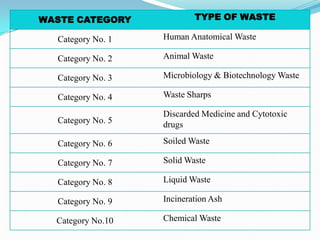
WASTE CATEGORY

TYPE OF WASTE

Category No. 1

Human Anatomical Waste

Category No. 2

Animal Waste

Category No. 3

Microbiology & Biotechnology Waste

Category No. 4

Waste Sharps

Category No. 5

Discarded Medicine and Cytotoxic
drugs

Category No. 6

Soiled Waste

Category No. 7

Solid Waste

Category No. 8

Liquid Waste

Category No. 9

Incineration Ash

Category No.10

Chemical Waste
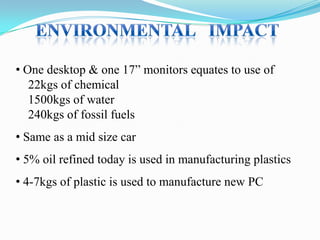
• One desktop & one 17” monitors equates to use of
22kgs of chemical
1500kgs of water
240kgs of fossil fuels

• Same as a mid size car
• 5% oil refined today is used in manufacturing plastics
• 4-7kgs of plastic is used to manufacture new PC
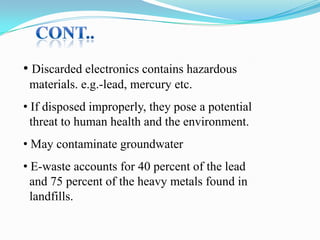
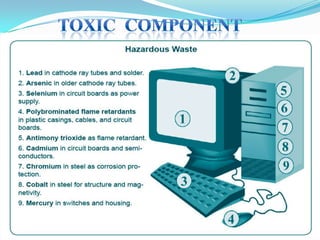
• Discarded electronics contains hazardous
materials. e.g.-lead, mercury etc.

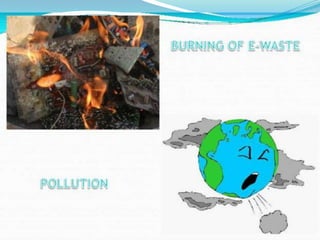
• If disposed improperly, they pose a potential
threat to human health and the environment.
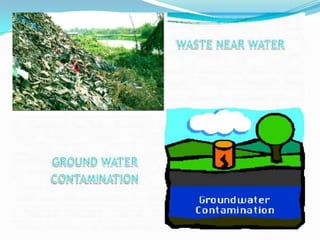
• May contaminate groundwater
• E-waste accounts for 40 percent of the lead
and 75 percent of the heavy metals found in
landfills.
HAZARDS
• Arsenic
• Beryllium
• Brominated Flame Retardants
• Cadmium
• Lead
• Mercury
• PVC (Polyvinyl Chloride Plastics)
There is also evidence of cytotixic and genotoxic effects
of some chemicals, which have been shown to inhibit
cell proliferation, cause cell membrane lesion, cause
DNA single-strand breaks, and elevate Reactive
Oxygen Species (ROS) levels.
Arsenic
• Arsenic is a notoriously potent poison.
• Causes serves damage to the digestive tract, lung cancer
nerve damage and various skin diseases.
• Arsine gas (AsH3), used in tech manufacturing, is the
most toxic form of arsenic.
Beryllium
• Long term exposure can cause lung cancer and chronic
Beryllium diseases.

• Extreme exposure lead to a potentially fatal condition
known as acute Beryllium Disease.
Brominated Flame Retardants
• Exposure to these chemicals in early life could induce
neurotoxic effects.
• Exposure to Polybrominated Biphenyls (PBBs) are
believed to cause an increased risk of cancer of the
digestive and lymph systems.
• Suspected of hormonal interference and reproductive
harm.
• BFRs are used to make materials more resistant.
Cadmium
• potentially carcinogenic;
• Repeated exposure can damage the lungs, kidneys,
liver & bone density.
Lead
• Extremely harmful to the body;
• Damages both the central & peripheral nervous system;

• Can cause seizures, retardation, high blood pressure,
damage to the kidneys and liver;
• Adversely effects child development
Mercury
• Attacks the central nervous & endocrine systems
• harmful to mouth, teeth & gums;
• poses risk in the neurological development of
unborn features
PVC (Polyvinyl Chloride Plastics)
•

The production and burning of PVC products
generates dioxins and furans, which contribute to air
pollution and respiratory ailments.

•

PVC is the most used plastic, found in electronics.
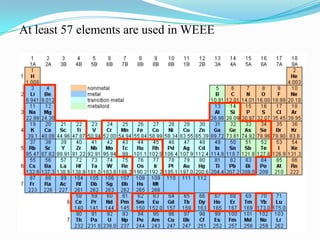
At least 57 elements are used in WEEE

Nicht gleich Wert
E-WASTE IN
INDIA
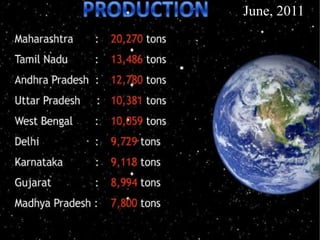
June, 2011
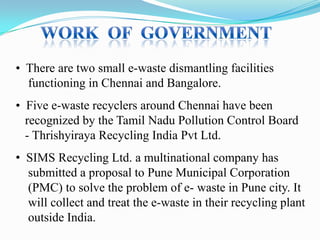
• There are two small e-waste dismantling facilities
functioning in Chennai and Bangalore.
• Five e-waste recyclers around Chennai have been
recognized by the Tamil Nadu Pollution Control Board
- Thrishyiraya Recycling India Pvt Ltd.
• SIMS Recycling Ltd. a multinational company has
submitted a proposal to Pune Municipal Corporation
(PMC) to solve the problem of e- waste in Pune city. It
will collect and treat the e-waste in their recycling plant
outside India.
•

In Mumbai, Eco Reco Company that has been
authorized by Maharashtra Pollution Control Board is
involved in the management of e-waste. It collects ewaste across India and recycles it in an environment
friendly manner. TCS, SBI, Castrol, M & M, Oberoi
Groups of Hotels, Gati, Alfa Laval, Pfizer, HDFC,
Aventis Pharma, GPEC, Tata Ficosa are recycling their
e-waste with the help of Eco Reco.
1) E-Waste collection, sorting and transportation
2) E-Waste recycling; it involves dismantling,
recovery of valuable resources, sale of dismantled
parts & export of processed waste for precious metal
recovery.
The stakeholders, I.E., the people who can help in
overcoming the challenges posed by E-waste, are:
i. Manufacturers
ii. Users
iii. Recyclers
iv. Policy makers
• Physical characteristics
 Unsorted waste – Mixed waste of biodegradable
and non-biodegradable
 Low calorific value
 High moisture content
 Presence of hazardous waste
• Lack of awareness
• Unplanned growth & development of cities
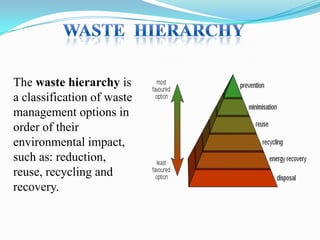
The waste hierarchy is
a classification of waste
management options in
order of their
environmental impact,
such as: reduction,
reuse, recycling and
recovery.
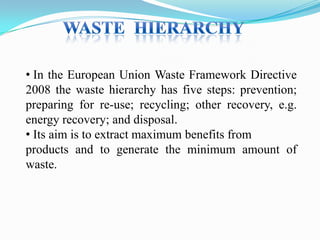
• In the European Union Waste Framework Directive
2008 the waste hierarchy has five steps: prevention;
preparing for re-use; recycling; other recovery, e.g.
energy recovery; and disposal.
• Its aim is to extract maximum benefits from
products and to generate the minimum amount of
waste.
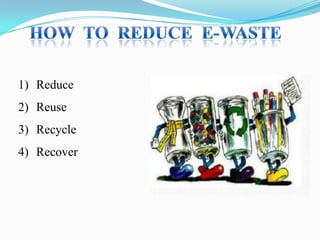
1) Reduce
2) Reuse

3) Recycle
4) Recover
• Reduce: to make something smaller or use less,
resulting in a smaller amount of waste.

• "Source reduction" is reducing waste before you
purchase it, or by purchasing products that are not
wasteful in their packaging or use.
• A key part of waste "reduction" is "conservation" –
using natural resources wisely, and using less than usual
in order avoid waste.
• Reuse: to use again or more than once
• Reuse materials and items so that they have longer life
spans and don’t get thrown away after the first use.
• Many items found around the home can be used for
different purposes.

• So before you throw those items away, think about how
they can be reused.
• This can be achieved through repairing, upgrading used
electrical equipment. e.g.- adding memory to a
computer, upgrading software.
• Recycle: to convert materials/waste into reusable
material
• Landfills are full of items that could be recycled.
• Recycling puts objects through a process that allows
them to be used again.
• The silver, gold, lead and other heavy metal are
recyclable.
Energy recovery includes any technique or
method of minimizing the input of energy to an
overall system by the exchange of energy from
one sub-system of the overall system with
another. The energy can be in any form in either
subsystem, but most energy recovery systems
exchange thermal energy in either sensible or
latent form.
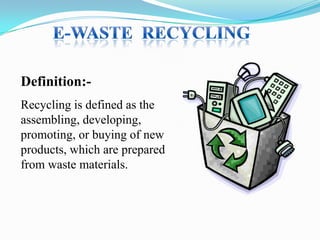
Definition:Recycling is defined as the
assembling, developing,
promoting, or buying of new
products, which are prepared
from waste materials.
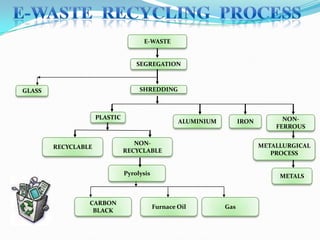
E-WASTE

SEGREGATION

SHREDDING

GLASS

PLASTIC

RECYCLABLE

ALUMINIUM

IRON

NONRECYCLABLE

NONFERROUS
METALLURGICAL
PROCESS

Pyrolysis

CARBON
BLACK

METALS

Furnace Oil

All content is the proprietary and confidential property of ATTERO Recycling, not to be copy or distributed.

Gas

1/7/2014

41
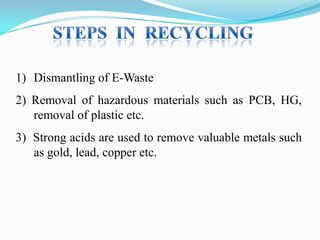
1) Dismantling of E-Waste
2) Removal of hazardous materials such as PCB, HG,
removal of plastic etc.
3) Strong acids are used to remove valuable metals such
as gold, lead, copper etc.
• Recycled materials can be used in developing new
equipments

• Valuable Materials are retrieved
• Helps environment by avoiding pollution
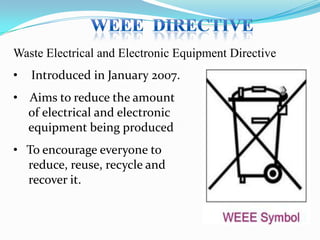
Waste Electrical and Electronic Equipment Directive
•

Introduced in January 2007.

• Aims to reduce the amount
of electrical and electronic
equipment being produced
• To encourage everyone to
reduce, reuse, recycle and
recover it.
• Large household appliances
• Lighting Equipment
• Electric and Electronic Tools
• Toys, sports Equipment
• IT and telecommunications equipment
• Office, Information & Communication Equipment

• Entertainment & Consumer Electronics
• Medical devices
• Proper laws and policies should be made
• Awareness among consumers and manufacturers

• Recycling should be preferred
• Products should be made recyclable

• Make usage of recycled products
• Do not throw away old equipments
“Electronic products should actually considered
chemical waste products. Their number is increasing
and their life is decreasing. Electronics waste piles
are growing, as is their pollution potential. Most of
these problems have their source in the development
and design of the products concerned.”
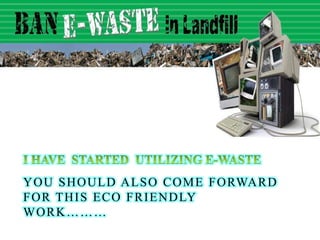
Y O U S H O U L D A L S O C O M E F O RWA R D
F O R T H I S E C O F R I E N D LY
WORK………
E waste

E waste

  • 1.
    Presented By: Nitesh KumarSingh BME 7th SEM
  • 2.
    The term E-wasteis applied to all waste caused by discarding electronic devices, especially consumer electronics. Ewaste is a major concern in areas of personal computing and wireless devices that are quickly discarded by consumers. The lifespan of these electronics are short-lived due to rapid technological advances and lower costs to purchase each year.
  • 3.
    • The termE-waste applies to all the waste from or caused by electronic items. • IRG (International Resource Group) vastly deals with this types of hazards to the environment. • Technological development is the main reason. • Slowly but strongly, E-waste is becoming a threat to the world.
  • 4.
    • Reduce therisks to the population & the pollution of the environment resulting from unsafe handling. • Focus on knowledge transfer to & skills upgrade of all involve stakeholders through training & seminars. • Target mainly the existing informal recycle allowing for their maximum but safe participation in future ewaste management by facilitating their evolution & integration in formal structures.
  • 5.
    • IT &Telecom Equipments • large household appliances • small house hold appliances • Consumer & lighting Equipments • Toys & Sports Equipment • Medical devices • Monitoring & Control Instruments
  • 6.
    Bio-medical waste isdefined as waste that is generated during the diagnosis, treatment or immunization of human beings and are contaminated with patients body fluids (such as syringes, needles, ampoules ,organs and body parts, placenta, dressings, disposables plastics and microbiological wastes).
  • 7.
    Color Coding Type of Container Waste Category Treatmentoptions as per Schedule I Yellow Plastic bag Cat.1, 2,3,6 Incineration/deep burial Red Disinfected Cat 3,6,7 container/Plastic bag Autoclave/Microwave/ Chemical Treatment Blue/White translucent Puncture proof container Cat.4,7 Autoclave/Microwave/ Chemical Treatment & destruction/shredding Black Plastic bag Cat 5,9,10 Disposal in secured landfill
  • 8.
    WASTE CATEGORY TYPE OFWASTE Category No. 1 Human Anatomical Waste Category No. 2 Animal Waste Category No. 3 Microbiology & Biotechnology Waste Category No. 4 Waste Sharps Category No. 5 Discarded Medicine and Cytotoxic drugs Category No. 6 Soiled Waste Category No. 7 Solid Waste Category No. 8 Liquid Waste Category No. 9 Incineration Ash Category No.10 Chemical Waste
  • 10.
    • One desktop& one 17” monitors equates to use of 22kgs of chemical 1500kgs of water 240kgs of fossil fuels • Same as a mid size car • 5% oil refined today is used in manufacturing plastics • 4-7kgs of plastic is used to manufacture new PC
  • 11.
    • Discarded electronicscontains hazardous materials. e.g.-lead, mercury etc. • If disposed improperly, they pose a potential threat to human health and the environment. • May contaminate groundwater • E-waste accounts for 40 percent of the lead and 75 percent of the heavy metals found in landfills.
  • 12.
  • 13.
    • Arsenic • Beryllium •Brominated Flame Retardants • Cadmium • Lead • Mercury • PVC (Polyvinyl Chloride Plastics) There is also evidence of cytotixic and genotoxic effects of some chemicals, which have been shown to inhibit cell proliferation, cause cell membrane lesion, cause DNA single-strand breaks, and elevate Reactive Oxygen Species (ROS) levels.
  • 14.
    Arsenic • Arsenic isa notoriously potent poison. • Causes serves damage to the digestive tract, lung cancer nerve damage and various skin diseases. • Arsine gas (AsH3), used in tech manufacturing, is the most toxic form of arsenic.
  • 15.
    Beryllium • Long termexposure can cause lung cancer and chronic Beryllium diseases. • Extreme exposure lead to a potentially fatal condition known as acute Beryllium Disease.
  • 16.
    Brominated Flame Retardants •Exposure to these chemicals in early life could induce neurotoxic effects. • Exposure to Polybrominated Biphenyls (PBBs) are believed to cause an increased risk of cancer of the digestive and lymph systems. • Suspected of hormonal interference and reproductive harm. • BFRs are used to make materials more resistant.
  • 17.
    Cadmium • potentially carcinogenic; •Repeated exposure can damage the lungs, kidneys, liver & bone density.
  • 18.
    Lead • Extremely harmfulto the body; • Damages both the central & peripheral nervous system; • Can cause seizures, retardation, high blood pressure, damage to the kidneys and liver; • Adversely effects child development
  • 19.
    Mercury • Attacks thecentral nervous & endocrine systems • harmful to mouth, teeth & gums; • poses risk in the neurological development of unborn features
  • 20.
    PVC (Polyvinyl ChloridePlastics) • The production and burning of PVC products generates dioxins and furans, which contribute to air pollution and respiratory ailments. • PVC is the most used plastic, found in electronics.
  • 22.
    At least 57elements are used in WEEE Nicht gleich Wert
  • 26.
  • 27.
  • 28.
    • There aretwo small e-waste dismantling facilities functioning in Chennai and Bangalore. • Five e-waste recyclers around Chennai have been recognized by the Tamil Nadu Pollution Control Board - Thrishyiraya Recycling India Pvt Ltd. • SIMS Recycling Ltd. a multinational company has submitted a proposal to Pune Municipal Corporation (PMC) to solve the problem of e- waste in Pune city. It will collect and treat the e-waste in their recycling plant outside India.
  • 29.
    • In Mumbai, EcoReco Company that has been authorized by Maharashtra Pollution Control Board is involved in the management of e-waste. It collects ewaste across India and recycles it in an environment friendly manner. TCS, SBI, Castrol, M & M, Oberoi Groups of Hotels, Gati, Alfa Laval, Pfizer, HDFC, Aventis Pharma, GPEC, Tata Ficosa are recycling their e-waste with the help of Eco Reco.
  • 30.
    1) E-Waste collection,sorting and transportation 2) E-Waste recycling; it involves dismantling, recovery of valuable resources, sale of dismantled parts & export of processed waste for precious metal recovery. The stakeholders, I.E., the people who can help in overcoming the challenges posed by E-waste, are: i. Manufacturers ii. Users iii. Recyclers iv. Policy makers
  • 32.
    • Physical characteristics Unsorted waste – Mixed waste of biodegradable and non-biodegradable  Low calorific value  High moisture content  Presence of hazardous waste • Lack of awareness • Unplanned growth & development of cities
  • 33.
    The waste hierarchyis a classification of waste management options in order of their environmental impact, such as: reduction, reuse, recycling and recovery.
  • 34.
    • In theEuropean Union Waste Framework Directive 2008 the waste hierarchy has five steps: prevention; preparing for re-use; recycling; other recovery, e.g. energy recovery; and disposal. • Its aim is to extract maximum benefits from products and to generate the minimum amount of waste.
  • 35.
    1) Reduce 2) Reuse 3)Recycle 4) Recover
  • 36.
    • Reduce: tomake something smaller or use less, resulting in a smaller amount of waste. • "Source reduction" is reducing waste before you purchase it, or by purchasing products that are not wasteful in their packaging or use. • A key part of waste "reduction" is "conservation" – using natural resources wisely, and using less than usual in order avoid waste.
  • 37.
    • Reuse: touse again or more than once • Reuse materials and items so that they have longer life spans and don’t get thrown away after the first use. • Many items found around the home can be used for different purposes. • So before you throw those items away, think about how they can be reused. • This can be achieved through repairing, upgrading used electrical equipment. e.g.- adding memory to a computer, upgrading software.
  • 38.
    • Recycle: toconvert materials/waste into reusable material • Landfills are full of items that could be recycled. • Recycling puts objects through a process that allows them to be used again. • The silver, gold, lead and other heavy metal are recyclable.
  • 39.
    Energy recovery includesany technique or method of minimizing the input of energy to an overall system by the exchange of energy from one sub-system of the overall system with another. The energy can be in any form in either subsystem, but most energy recovery systems exchange thermal energy in either sensible or latent form.
  • 40.
    Definition:Recycling is definedas the assembling, developing, promoting, or buying of new products, which are prepared from waste materials.
  • 41.
  • 42.
    1) Dismantling ofE-Waste 2) Removal of hazardous materials such as PCB, HG, removal of plastic etc. 3) Strong acids are used to remove valuable metals such as gold, lead, copper etc.
  • 43.
    • Recycled materialscan be used in developing new equipments • Valuable Materials are retrieved • Helps environment by avoiding pollution
  • 44.
    Waste Electrical andElectronic Equipment Directive • Introduced in January 2007. • Aims to reduce the amount of electrical and electronic equipment being produced • To encourage everyone to reduce, reuse, recycle and recover it.
  • 45.
    • Large householdappliances • Lighting Equipment • Electric and Electronic Tools • Toys, sports Equipment • IT and telecommunications equipment • Office, Information & Communication Equipment • Entertainment & Consumer Electronics • Medical devices
  • 46.
    • Proper lawsand policies should be made • Awareness among consumers and manufacturers • Recycling should be preferred • Products should be made recyclable • Make usage of recycled products • Do not throw away old equipments
  • 47.
    “Electronic products shouldactually considered chemical waste products. Their number is increasing and their life is decreasing. Electronics waste piles are growing, as is their pollution potential. Most of these problems have their source in the development and design of the products concerned.”
  • 48.
    Y O US H O U L D A L S O C O M E F O RWA R D F O R T H I S E C O F R I E N D LY WORK………