SEMINAR REPORT ON “SAILFISH OS”
DEPARTMENT OF COMPUTER SCIENCE AND
ENGINEERING
BACHELOR OF TECHNOLOGY
SUBMITTED BY
Name: - Hiyadeep Bhattacharjee
Branch: - CSE
Roll No.:- 7413025
SAMALKHA GROUP OF INSTITUTIONS,
SAMALKHA, DIST.-PANIPAT, HARYANA
STUDENT’S DECLARATION
We hereby certify that the work which is being presented in the seminar
project report entitled “SAILFISH OS” in fullfilment of the
requirement for the award of the Degree of Bachelor of Technology in
Department of Computer Science of Samalkha Group of Institutions,
Samalkha, Kurukshetra University, Kurukshetra, Haryana is an authentic
record of my own work carried out during 5th semester.
Hiyadeep Bhattacharjee
(Roll No. 7413025)
B.Tech, 5th
semester
CSE Branch
ACKNOWLEDGEMENT
I am highly grateful to the, Samalkha Group of Institution, Samalkha
for providing this opportunity.
The constant guidance and encouragement received from Mr. AMIT
VERMA, HOD (CSE, dept.), SGI, Samalkha has been of great help in
carrying out the project work and is acknowledged with reverential
thanks.
I would like to express a deep sense of gratitude and thanks profusely to
MS.ARPANA DUREJA, ASSISTANT PROFESSOR OF CSE
DEPARTMENT and report guide, without the wise counsel and able
guidance, it would have been impossible to complete the report in this
manner.
I express gratitude to other faculty members of CSE department of SGI
for their intellectual support throughout the course of this work.
Finally, the authors are indebted to all whosoever have contributed in
this report work.
Hiyadeep Bhattacharjee
ABSTRACT
This Seminar Report defines “SAILFISH OS” as a Linux-based
Operating System, widely known as a Mobile Operating System
combining the Linux Kernel for a particular hardware platform
use and we will define its software architecture, its application
programming interfaces and how the android software is running
on this system.
CONTENTS
INTRODUCTION
HISTORY AND DEVELOPMENT
SOTWAREARCHITECTURE
APPLICATION PROGRAMMING INTERFACES
ANDROID SOFTWAREON SAILFISH OS
DEVICES RUNNING ON SAILFISH OS
OS DEVELOPMENTSTATUS
SNAPSHOTS
CONCLUSION
FUTURE SCOPE
REFERENCES
INTRODUCTION
Sailfish OS (also styled Sailfish OS) is a Linux-basedgeneral-purpose
operatingsystem,widely known as a mobile operating system
combining the Linux Kernel for a particularhardwareplatform use,
the open sourceMer Core middleware,the proprietary UI contributed
by Jolla, and other third party components some of which are free
software,and others of which are proprietary.
Sailfish is being developed by Jolla in permanentcooperationwith
the Sailfish community,the Mer projectand its community,corporate
membersof the Sailfish Alliance and various opencommunity
members.The Sailfish community makes developmentrequests and
decides developmentprioritiesby voting. The Merprojectreceives
contributionsfrom the Jolla community,and Mer contributes
middleware for Jolla, thereby assuring compatibility of both projects.
Sailfish is used in the Jolla SmartPhone,the upcoming Jolla Tablet,
and by other licensees.
HISTORY AND DEVELOPMENT
The OS is an evolved continuationof the Linux MeeGo OS previously
developed by allianceof Nokia and Intel. The MeeGolegacyis
containedin the Mer core in about80% of its code; the Mername thus
expands to MEegoReconstructed.
Jolla and MERproject.orgfollow a meritocratic system to avoid the
mistakes that lead to the MeeGo project's then-unanticipated
discontinuation.
Sailfish 2.0 is currently in developmentfor mobiles and the
announced Jolla Tablet.Sailfish OS 2.0 is developedwith a
continuous integrationmodel,with the aim to providemonthly
software updates to all Sailfish OS users and developmentpartners.
Customers using Sailfish 1.x with any device can upgrade to Sailfish
2.0.
The main elements for Sailfish OS 2.0 include:
 Technically stronger OS core
 ImprovedAndroid application compatibility
 Supportfor Intel architecture,including the Intel Atom x3
processor
 Design to provide visibility in the UI for digital contentproviders
and to enable OS levelintegration for mobile commerce
 Strong multitasking (oneof the most importantadvantage of the
OS and declared to be the bestone at market)
 Strong privacy and personalization features
 Enhanceduser interfacewith new UI/UX features,including
simpler swipe accessto main functions,enhanced notifications
and events views.
SOFTWARE ARCHITECTURE
The Sailfish OS and the Sailfish Software Development Kit (SDK) are based on
the Linux Kernel and Mer. Sailfish OS includes a multi-tasking graphical
shell called "Lipstick" built by Jolla on top of the Wayland display server
protocol. Jolla uses Free and open-source graphics device drivers but
the Hybris library allows use of proprietary graphics device drivers for
Android. Jolla's stated goal is for Sailfish to be open source eventually. Sailfish
OS can run Android applications through a proprietary compatibility layer.
Targeted device classes
Sailfish is commonly known to be targeted at mobile devices, although like
MeeGo previously and as part of its legacy because around 80% of Sailfish code
is de facto MeeGo code, Sailfish can be used with any device as it is a complete
general-purpose Linux OS, for devices such as IVI, navigation, smart TV,
desktops and notebooks, yachts, automotive, e-commerce, house goods,
measuring and control equipment, intelligent building equipment etc.; See use
cases of original Meego to compare. See the Devices section for devices that run
the Sailfish OS.
Sailfish OS SDK
The Sailfish OS SDK was announced in Helsinki at Slush in 2012, and the alpha waspublished in
February 2013, The SDK, installation and coding tutorials are available for free download from the
Sailfish OS website although the overall license is not open source.
Sailfish SDK uses Qt with Virtual Box for development, compiling and emulation purposes, in
contrast to simulation method. This technique allows compilation on the Sailfish OS and full
testing of developed software in the virtual machine, emulating but not simulating the whole
Sailfish OS. The technique also separates development activities and side effects from everything
else running on the host particular computer, leaving it undisturbed by developments and tests.
According to Jolla, development with Sailfish SDK is development on Sailfish OS itself; there are
no differences between developed software appearance and behaviour in the SDK and on a device
running Sailfish OS.
The availability of source code to the SDK allowsshaping and rebuilding for companies' or
developers' specific needs, creating a context-specific environment that is set once and needs no
preparation when the device is booted. The SDK runs on the operating systems Android and 32-
and 64-bit versions of Linux, 64-bit versions of OS X, and Microsoft Windows. It can be used for
compiling software for Sailfish OS devices from Linux sources. Its general console/terminal mode
follows a commonly used standard. Compatible binaries or libraries can also be used.
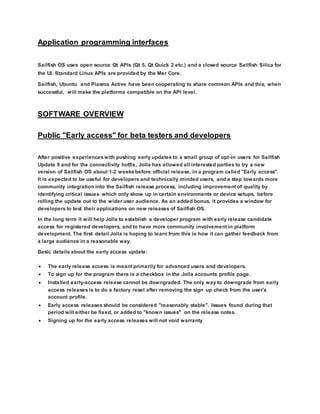
Application programming interfaces
Sailfish OS uses open source Qt APIs (Qt 5, Qt Quick 2 etc.) and a closed source Sailfish Silica for
the UI. Standard Linux APIs are provided by the Mer Core.
Sailfish, Ubuntu and Plasma Active have been cooperating to share common APIs and this, when
successful, will make the platforms compatible on the API level.
SOFTWARE OVERVIEW
Public "Early access" for beta testers and developers
After positive experienceswith pushing early updates to a small group of opt-in users for Sailfish
Update 9 and for the connectivity hotfix, Jolla has allowed all interested parties to try a new
version of Sailfish OS about 1-2 weeksbefore official release, in a program called "Early access".
It is expected to be useful for developers and technically minded users, and a step towards more
community integration into the Sailfish release process, including improvement of quality by
identifying critical issues which only show up in certain environments or device setups, before
rolling the update out to the wider user audience. As an added bonus, it provides a window for
developers to test their applications on new releases of Sailfish OS.
In the long term it will help Jolla to establish a developer program with early release candidate
access for registered developers, and to have more community involvement in platform
development. The first detail Jolla is hoping to learn from this is how it can gather feedback from
a large audience in a reasonable way.
Basic details about the early access update:
 The early release access is meant primarily for advanced users and developers.
 To sign up for the program there is a checkbox in the Jolla accounts profile page.
 Installed early-access release cannot be downgraded. The only way to downgrade from early
access releases is to do a factory reset after removing the sign up check from the user's
account profile.
 Early access releases should be considered "reasonably stable". Issues found during that
period will either be fixed, or added to "known issues" on the release notes.
 Signing up for the early access releases will not void warranty
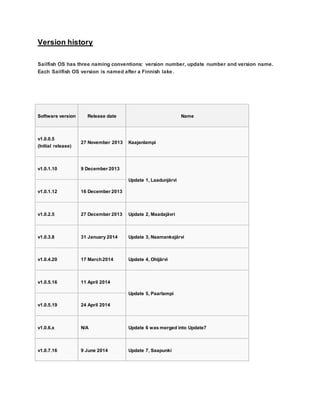
Version history
Sailfish OS has three naming conventions: version number, update number and version name.
Each Sailfish OS version is named after a Finnish lake.
Software version Release date Name
v1.0.0.5
(Initial release)
27 November 2013 Kaajanlampi
v1.0.1.10 9 December 2013
Update 1, Laadunjärvi
v1.0.1.12 16 December 2013
v1.0.2.5 27 December 2013 Update 2, Maadajävri
v1.0.3.8 31 January 2014 Update 3, Naamankajärvi
v1.0.4.20 17 March2014 Update 4, Ohijärvi
v1.0.5.16 11 April 2014
Update 5, Paarlampi
v1.0.5.19 24 April 2014
v1.0.6.x N/A Update 6 was merged into Update7
v1.0.7.16 9 June 2014 Update 7, Saapunki
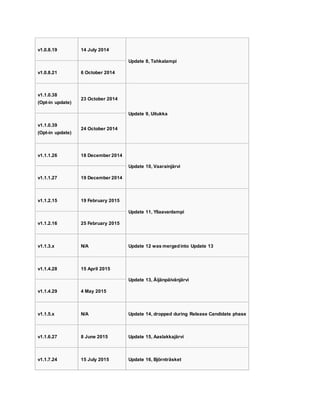
v1.0.8.19 14 July 2014
Update 8, Tahkalampi
v1.0.8.21 6 October 2014
v1.1.0.38
(Opt-in update)
23 October 2014
Update 9, Uitukka
v1.1.0.39
(Opt-in update)
24 October 2014
v1.1.1.26 18 December 2014
Update 10, Vaarainjärvi
v1.1.1.27 19 December 2014
v1.1.2.15 19 February 2015
Update 11, Yliaavanlampi
v1.1.2.16 25 February 2015
v1.1.3.x N/A Update 12 was mergedinto Update 13
v1.1.4.28 15 April 2015
Update 13, Äijänpäivänjärvi
v1.1.4.29 4 May 2015
v1.1.5.x N/A Update 14, dropped during Release Candidate phase
v1.1.6.27 8 June 2015 Update 15, Aaslakkajärvi
v1.1.7.24 15 July 2015 Update 16, Björnträsket
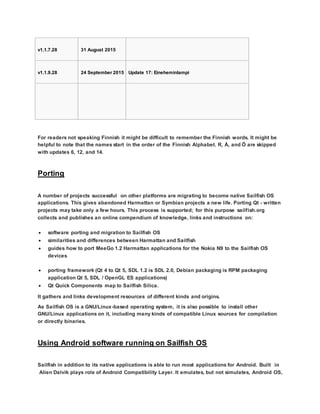
v1.1.7.28 31 August 2015
v1.1.9.28 24 September 2015 Update 17: Eineheminlampi
For readers not speaking Finnish it might be difficult to remember the Finnish words. It might be
helpful to note that the names start in the order of the Finnish Alphabet. R, Å, and Ö are skipped
with updates 6, 12, and 14.
Porting
A number of projects successful on other platforms are migrating to become native Sailfish OS
applications. This gives abandoned Harmattan or Symbian projects a new life. Porting Qt - written
projects may take only a few hours. This process is supported; for this purpose sailfish.org
collects and publishes an online compendium of knowledge, links and instructions on:
 software porting and migration to Sailfish OS
 similarities and differences between Harmattan and Sailfish
 guides how to port MeeGo 1.2 Harmattan applications for the Nokia N9 to the Sailfish OS
devices
 porting framework (Qt 4 to Qt 5, SDL 1.2 is SDL 2.0, Debian packaging is RPM packaging
application Qt 5, SDL / OpenGL ES applications)
 Qt Quick Components map to Sailfish Silica.
It gathers and links development resources of different kinds and origins.
As Sailfish OS is a GNU/Linux-based operating system, it is also possible to install other
GNU/Linux applications on it, including many kinds of compatible Linux sources for compilation
or directly binaries.
Using Android software running on Sailfish OS
Sailfish in addition to its native applications is able to run most applications for Android. Built in
Alien Dalvik plays role of Android Compatibility Layer. It emulates, but not simulates, Android OS,
and the environment is recognised as such by Android software. The Android software runs at
native speed without any perceivable lag. Sailfish multitasking can be enabled with native Sailfish
software on the fly, and vice versa. In collaboration with Myriad Group which has created the Alien
Dalvik module, which was subsequently implemented into the Sailfish Operating system,
providing the necessary environment to execute native android apps.
HARDWARE OVERVIEW
Advantages of the Mer standard
Sailfish OS can be used on any hardware with Linux kernel support and compatible with
the middleware of the the Mer core stock distribution. A list of devices running ported
this way has been created by enthusiasts from community. Instead of designation to a
specific reference hardware platform, a Virtual Box implementation with the Sailfish OS
SDK is available for development on popular operating systems Linux, OS X and
Windows. This virtual machine implementation contains the whole Sailfish OS isolated
from local resources and the local OS to enable comfortable evaluation of the behaviour
and performance of coded or ported software before deployment on real devices.
Devices running Sailfish OS
Sailfish runs on the Jolla Tablet and Jolla Phone. It has also been ported to other devices
including:
 Acer Iconia Tab W500
 Exo PC
 Google Nexus One
 Google Nexus 4
 Google Nexus 5
 Google Nexus 7
 HP Mini
 HTC Desire HD
 HTC Desire Z
 Nokia N950 and Nokia N9 - during several presentations given by Jolla
 O2 Joggler
 One Plus One
 Packard Bell Butterfly Touch
 Raspberry Pi2 - because it uses the ARM Cortex-A7 CPU. (Raspberry Pi1's ARMv6 CPU has a
different architecture, and Sailfish requires ARMv7.)
 Samsung Galaxy S3
 Samsung Galaxy Nexus
 Sony Ericsson Xperia Pro codename Iyokan
 Sony Xperia SP
 Xiaomi Mi2
Sailfish runs on the following devices as the OS licensed by its manufacturers including:
 Aqua Fish
OS Development Status
Sailfish OS is promoted and supported by the open Sailfish Alliance established in 2011, a group
established to unite OEM and ODM manufacturers, chipset providers, operators, application
developers and retailers. On 16 August 2012, the user interface was reported to be ready for
release. Jolla's CEO Jussi Hurmola stated in a ZDNet interview, " Our UI is ready now, we haven't
released it yet, we will save it for the product launch and the platform is getting up now so the
project looks pretty nice".
The next day, Jolla's CEO Marc Dillon said on social networking website Twitter that the company
had reached the first development target. Sailfish wasdebuted by the Jolla team, including a
worldwide internet stream, as a demo of the OS, and the UI and SDK during the Slush event
in Helsinki, Finland, on 21–22 November 2012. The alpha stage of Sailfish OS SDK was published
at the end of February 2013 and was made available for free download.
On 16 September 2013, Jolla announced that its OS had been made compatible with Android
applications and hardware. The first telephone to use it waslaunched on 27 November 2013 at a
pop-up DNA Kauppa shop in Helsinki. The first 450 telephones were sold at this event, while the
rest of the preordered devices were shipped shortly after.
On 18 May 2015, it was announced that the Russian government intends to make it official for use
in its country.
In September 2015, version 1.1.9.28 "Eineheminlampi" was released, which added the main
elements of the revamped Sailfish OS 2.0 user interface.
Sailfish 2.0 will be launched with the Jolla Tablet, and existing devices will receive an update to
Sailfish 2.0.

Seminar report on sailfish os

  • 1.
    SEMINAR REPORT ON“SAILFISH OS” DEPARTMENT OF COMPUTER SCIENCE AND ENGINEERING BACHELOR OF TECHNOLOGY SUBMITTED BY Name: - Hiyadeep Bhattacharjee Branch: - CSE Roll No.:- 7413025 SAMALKHA GROUP OF INSTITUTIONS, SAMALKHA, DIST.-PANIPAT, HARYANA
  • 2.
    STUDENT’S DECLARATION We herebycertify that the work which is being presented in the seminar project report entitled “SAILFISH OS” in fullfilment of the requirement for the award of the Degree of Bachelor of Technology in Department of Computer Science of Samalkha Group of Institutions, Samalkha, Kurukshetra University, Kurukshetra, Haryana is an authentic record of my own work carried out during 5th semester. Hiyadeep Bhattacharjee (Roll No. 7413025) B.Tech, 5th semester CSE Branch
  • 3.
    ACKNOWLEDGEMENT I am highlygrateful to the, Samalkha Group of Institution, Samalkha for providing this opportunity. The constant guidance and encouragement received from Mr. AMIT VERMA, HOD (CSE, dept.), SGI, Samalkha has been of great help in carrying out the project work and is acknowledged with reverential thanks. I would like to express a deep sense of gratitude and thanks profusely to MS.ARPANA DUREJA, ASSISTANT PROFESSOR OF CSE DEPARTMENT and report guide, without the wise counsel and able guidance, it would have been impossible to complete the report in this manner. I express gratitude to other faculty members of CSE department of SGI for their intellectual support throughout the course of this work. Finally, the authors are indebted to all whosoever have contributed in this report work. Hiyadeep Bhattacharjee
  • 4.
    ABSTRACT This Seminar Reportdefines “SAILFISH OS” as a Linux-based Operating System, widely known as a Mobile Operating System combining the Linux Kernel for a particular hardware platform use and we will define its software architecture, its application programming interfaces and how the android software is running on this system.
  • 5.
    CONTENTS INTRODUCTION HISTORY AND DEVELOPMENT SOTWAREARCHITECTURE APPLICATIONPROGRAMMING INTERFACES ANDROID SOFTWAREON SAILFISH OS DEVICES RUNNING ON SAILFISH OS OS DEVELOPMENTSTATUS SNAPSHOTS CONCLUSION FUTURE SCOPE REFERENCES
  • 6.
    INTRODUCTION Sailfish OS (alsostyled Sailfish OS) is a Linux-basedgeneral-purpose operatingsystem,widely known as a mobile operating system combining the Linux Kernel for a particularhardwareplatform use, the open sourceMer Core middleware,the proprietary UI contributed by Jolla, and other third party components some of which are free software,and others of which are proprietary. Sailfish is being developed by Jolla in permanentcooperationwith the Sailfish community,the Mer projectand its community,corporate membersof the Sailfish Alliance and various opencommunity members.The Sailfish community makes developmentrequests and decides developmentprioritiesby voting. The Merprojectreceives contributionsfrom the Jolla community,and Mer contributes middleware for Jolla, thereby assuring compatibility of both projects. Sailfish is used in the Jolla SmartPhone,the upcoming Jolla Tablet, and by other licensees.
  • 7.
    HISTORY AND DEVELOPMENT TheOS is an evolved continuationof the Linux MeeGo OS previously developed by allianceof Nokia and Intel. The MeeGolegacyis containedin the Mer core in about80% of its code; the Mername thus expands to MEegoReconstructed. Jolla and MERproject.orgfollow a meritocratic system to avoid the mistakes that lead to the MeeGo project's then-unanticipated discontinuation. Sailfish 2.0 is currently in developmentfor mobiles and the announced Jolla Tablet.Sailfish OS 2.0 is developedwith a continuous integrationmodel,with the aim to providemonthly software updates to all Sailfish OS users and developmentpartners. Customers using Sailfish 1.x with any device can upgrade to Sailfish 2.0. The main elements for Sailfish OS 2.0 include:  Technically stronger OS core  ImprovedAndroid application compatibility  Supportfor Intel architecture,including the Intel Atom x3 processor  Design to provide visibility in the UI for digital contentproviders and to enable OS levelintegration for mobile commerce  Strong multitasking (oneof the most importantadvantage of the OS and declared to be the bestone at market)  Strong privacy and personalization features  Enhanceduser interfacewith new UI/UX features,including simpler swipe accessto main functions,enhanced notifications and events views.
  • 8.
    SOFTWARE ARCHITECTURE The SailfishOS and the Sailfish Software Development Kit (SDK) are based on the Linux Kernel and Mer. Sailfish OS includes a multi-tasking graphical shell called "Lipstick" built by Jolla on top of the Wayland display server protocol. Jolla uses Free and open-source graphics device drivers but the Hybris library allows use of proprietary graphics device drivers for Android. Jolla's stated goal is for Sailfish to be open source eventually. Sailfish OS can run Android applications through a proprietary compatibility layer. Targeted device classes Sailfish is commonly known to be targeted at mobile devices, although like MeeGo previously and as part of its legacy because around 80% of Sailfish code is de facto MeeGo code, Sailfish can be used with any device as it is a complete general-purpose Linux OS, for devices such as IVI, navigation, smart TV, desktops and notebooks, yachts, automotive, e-commerce, house goods, measuring and control equipment, intelligent building equipment etc.; See use cases of original Meego to compare. See the Devices section for devices that run the Sailfish OS. Sailfish OS SDK The Sailfish OS SDK was announced in Helsinki at Slush in 2012, and the alpha waspublished in February 2013, The SDK, installation and coding tutorials are available for free download from the Sailfish OS website although the overall license is not open source. Sailfish SDK uses Qt with Virtual Box for development, compiling and emulation purposes, in contrast to simulation method. This technique allows compilation on the Sailfish OS and full testing of developed software in the virtual machine, emulating but not simulating the whole Sailfish OS. The technique also separates development activities and side effects from everything else running on the host particular computer, leaving it undisturbed by developments and tests. According to Jolla, development with Sailfish SDK is development on Sailfish OS itself; there are no differences between developed software appearance and behaviour in the SDK and on a device running Sailfish OS. The availability of source code to the SDK allowsshaping and rebuilding for companies' or developers' specific needs, creating a context-specific environment that is set once and needs no preparation when the device is booted. The SDK runs on the operating systems Android and 32- and 64-bit versions of Linux, 64-bit versions of OS X, and Microsoft Windows. It can be used for compiling software for Sailfish OS devices from Linux sources. Its general console/terminal mode follows a commonly used standard. Compatible binaries or libraries can also be used.
  • 9.
    Application programming interfaces SailfishOS uses open source Qt APIs (Qt 5, Qt Quick 2 etc.) and a closed source Sailfish Silica for the UI. Standard Linux APIs are provided by the Mer Core. Sailfish, Ubuntu and Plasma Active have been cooperating to share common APIs and this, when successful, will make the platforms compatible on the API level. SOFTWARE OVERVIEW Public "Early access" for beta testers and developers After positive experienceswith pushing early updates to a small group of opt-in users for Sailfish Update 9 and for the connectivity hotfix, Jolla has allowed all interested parties to try a new version of Sailfish OS about 1-2 weeksbefore official release, in a program called "Early access". It is expected to be useful for developers and technically minded users, and a step towards more community integration into the Sailfish release process, including improvement of quality by identifying critical issues which only show up in certain environments or device setups, before rolling the update out to the wider user audience. As an added bonus, it provides a window for developers to test their applications on new releases of Sailfish OS. In the long term it will help Jolla to establish a developer program with early release candidate access for registered developers, and to have more community involvement in platform development. The first detail Jolla is hoping to learn from this is how it can gather feedback from a large audience in a reasonable way. Basic details about the early access update:  The early release access is meant primarily for advanced users and developers.  To sign up for the program there is a checkbox in the Jolla accounts profile page.  Installed early-access release cannot be downgraded. The only way to downgrade from early access releases is to do a factory reset after removing the sign up check from the user's account profile.  Early access releases should be considered "reasonably stable". Issues found during that period will either be fixed, or added to "known issues" on the release notes.  Signing up for the early access releases will not void warranty
  • 10.
    Version history Sailfish OShas three naming conventions: version number, update number and version name. Each Sailfish OS version is named after a Finnish lake. Software version Release date Name v1.0.0.5 (Initial release) 27 November 2013 Kaajanlampi v1.0.1.10 9 December 2013 Update 1, Laadunjärvi v1.0.1.12 16 December 2013 v1.0.2.5 27 December 2013 Update 2, Maadajävri v1.0.3.8 31 January 2014 Update 3, Naamankajärvi v1.0.4.20 17 March2014 Update 4, Ohijärvi v1.0.5.16 11 April 2014 Update 5, Paarlampi v1.0.5.19 24 April 2014 v1.0.6.x N/A Update 6 was merged into Update7 v1.0.7.16 9 June 2014 Update 7, Saapunki
  • 11.
    v1.0.8.19 14 July2014 Update 8, Tahkalampi v1.0.8.21 6 October 2014 v1.1.0.38 (Opt-in update) 23 October 2014 Update 9, Uitukka v1.1.0.39 (Opt-in update) 24 October 2014 v1.1.1.26 18 December 2014 Update 10, Vaarainjärvi v1.1.1.27 19 December 2014 v1.1.2.15 19 February 2015 Update 11, Yliaavanlampi v1.1.2.16 25 February 2015 v1.1.3.x N/A Update 12 was mergedinto Update 13 v1.1.4.28 15 April 2015 Update 13, Äijänpäivänjärvi v1.1.4.29 4 May 2015 v1.1.5.x N/A Update 14, dropped during Release Candidate phase v1.1.6.27 8 June 2015 Update 15, Aaslakkajärvi v1.1.7.24 15 July 2015 Update 16, Björnträsket
  • 12.
    v1.1.7.28 31 August2015 v1.1.9.28 24 September 2015 Update 17: Eineheminlampi For readers not speaking Finnish it might be difficult to remember the Finnish words. It might be helpful to note that the names start in the order of the Finnish Alphabet. R, Å, and Ö are skipped with updates 6, 12, and 14. Porting A number of projects successful on other platforms are migrating to become native Sailfish OS applications. This gives abandoned Harmattan or Symbian projects a new life. Porting Qt - written projects may take only a few hours. This process is supported; for this purpose sailfish.org collects and publishes an online compendium of knowledge, links and instructions on:  software porting and migration to Sailfish OS  similarities and differences between Harmattan and Sailfish  guides how to port MeeGo 1.2 Harmattan applications for the Nokia N9 to the Sailfish OS devices  porting framework (Qt 4 to Qt 5, SDL 1.2 is SDL 2.0, Debian packaging is RPM packaging application Qt 5, SDL / OpenGL ES applications)  Qt Quick Components map to Sailfish Silica. It gathers and links development resources of different kinds and origins. As Sailfish OS is a GNU/Linux-based operating system, it is also possible to install other GNU/Linux applications on it, including many kinds of compatible Linux sources for compilation or directly binaries. Using Android software running on Sailfish OS Sailfish in addition to its native applications is able to run most applications for Android. Built in Alien Dalvik plays role of Android Compatibility Layer. It emulates, but not simulates, Android OS,
  • 13.
    and the environmentis recognised as such by Android software. The Android software runs at native speed without any perceivable lag. Sailfish multitasking can be enabled with native Sailfish software on the fly, and vice versa. In collaboration with Myriad Group which has created the Alien Dalvik module, which was subsequently implemented into the Sailfish Operating system, providing the necessary environment to execute native android apps. HARDWARE OVERVIEW Advantages of the Mer standard Sailfish OS can be used on any hardware with Linux kernel support and compatible with the middleware of the the Mer core stock distribution. A list of devices running ported this way has been created by enthusiasts from community. Instead of designation to a specific reference hardware platform, a Virtual Box implementation with the Sailfish OS SDK is available for development on popular operating systems Linux, OS X and Windows. This virtual machine implementation contains the whole Sailfish OS isolated from local resources and the local OS to enable comfortable evaluation of the behaviour and performance of coded or ported software before deployment on real devices. Devices running Sailfish OS Sailfish runs on the Jolla Tablet and Jolla Phone. It has also been ported to other devices including:  Acer Iconia Tab W500  Exo PC  Google Nexus One  Google Nexus 4  Google Nexus 5  Google Nexus 7  HP Mini  HTC Desire HD  HTC Desire Z  Nokia N950 and Nokia N9 - during several presentations given by Jolla  O2 Joggler  One Plus One  Packard Bell Butterfly Touch  Raspberry Pi2 - because it uses the ARM Cortex-A7 CPU. (Raspberry Pi1's ARMv6 CPU has a different architecture, and Sailfish requires ARMv7.)  Samsung Galaxy S3  Samsung Galaxy Nexus  Sony Ericsson Xperia Pro codename Iyokan
  • 14.
     Sony XperiaSP  Xiaomi Mi2 Sailfish runs on the following devices as the OS licensed by its manufacturers including:  Aqua Fish OS Development Status Sailfish OS is promoted and supported by the open Sailfish Alliance established in 2011, a group established to unite OEM and ODM manufacturers, chipset providers, operators, application developers and retailers. On 16 August 2012, the user interface was reported to be ready for release. Jolla's CEO Jussi Hurmola stated in a ZDNet interview, " Our UI is ready now, we haven't released it yet, we will save it for the product launch and the platform is getting up now so the project looks pretty nice". The next day, Jolla's CEO Marc Dillon said on social networking website Twitter that the company had reached the first development target. Sailfish wasdebuted by the Jolla team, including a worldwide internet stream, as a demo of the OS, and the UI and SDK during the Slush event
  • 15.
    in Helsinki, Finland,on 21–22 November 2012. The alpha stage of Sailfish OS SDK was published at the end of February 2013 and was made available for free download. On 16 September 2013, Jolla announced that its OS had been made compatible with Android applications and hardware. The first telephone to use it waslaunched on 27 November 2013 at a pop-up DNA Kauppa shop in Helsinki. The first 450 telephones were sold at this event, while the rest of the preordered devices were shipped shortly after. On 18 May 2015, it was announced that the Russian government intends to make it official for use in its country. In September 2015, version 1.1.9.28 "Eineheminlampi" was released, which added the main elements of the revamped Sailfish OS 2.0 user interface. Sailfish 2.0 will be launched with the Jolla Tablet, and existing devices will receive an update to Sailfish 2.0.