A platform is a basic technology, on which other
technologies are developed and if these technologies are
equipped with tools that enable the creation of virtual
learning environments, we can speak of e-learning
platforms, inside of which the issuing of learning modules
as well as the management and monitoring of skills. In
this context we can speak of LMS (learning management
systems) as application platforms that enable the
provision of e-learning courses and LCMS (learning
content management systems), platforms that directly
manage the contents.
An integrated set of interactive online services that
provide a community of learners and facilitators with
information, tools and resources to support the delivery
and management of teaching and learning activities.
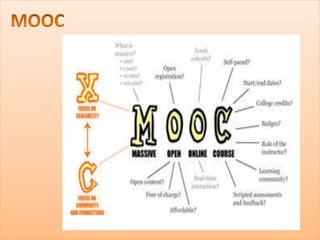
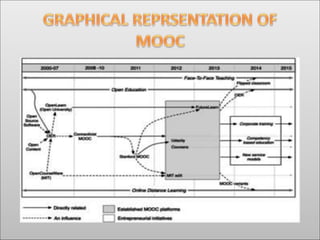
• A massive open online course (MOOC) is an online course aimed at
unlimited participation and open access via the web.. MOOCs are a
recent and widely researched development in distance education,
first introduced in 2006 and emerged as a popular mode of learning
in 2012.
• MOOCs are typically provided by higher education institutions,
often in partnership with “organizers” such as Coursera, edX, and
Udacity, though some MOOCs are being offered directly by a
college or university. MOOCs arise from the confluence of several
important trends, and they raise important questions and spark
essential conversations about curriculum design,
accreditation, what constitutes a valid learning experience, and
who has access to higher education.
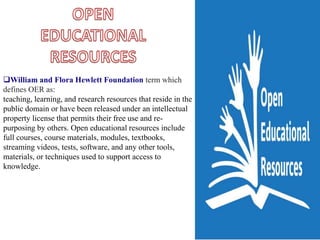
William and Flora Hewlett Foundation term which
defines OER as:
teaching, learning, and research resources that reside in the
public domain or have been released under an intellectual
property license that permits their free use and re-
purposing by others. Open educational resources include
full courses, course materials, modules, textbooks,
streaming videos, tests, software, and any other tools,
materials, or techniques used to support access to
knowledge.
 Improving access to higher education:-MOOCs are regarded by
many as an important tool to widen access to higher education (HE) for millions of
people, including those in the developing world, and ultimately enhance their
quality of life. MOOCs may be regarded as contributing to the democratization of
HE, not only locally or regionally but globally as well. MOOCs can help
democratise content and make knowledge reachable for everyone. Students are able
to access complete courses offered by universities all over the world, something
previously unattainable. With the availability of affordable technologies, MOOCs
increase access to an extraordinary number of courses offered by world-renowned
institutions and teachers.
• Providing an affordable alternative to formal education:-The costs of tertiary
education continue to increase because institutions tend to bundle too many
services. With MOOCs, some of these services can be transferred to other suitable
players in the public or private sector. MOOCs are for large numbers of
participants, can be accessed by anyone anywhere as long as they have an Internet
connection, are open to everyone without entry qualifications and offer a
full/complete course experience online for free.
• Sustainable Development Goals:- MOOCs can be seen as a form of open
education offered for free through online platforms. The (initial)
philosophy of MOOCs is to open up quality Higher Education to a wider
audience. As such, MOOCs are an important tool to achieve Goal 4 of the
2030 Agenda for Sustainable Development.
• Offers a flexible learning schedule:- Certain lectures, videos, and tests
through MOOCs can be accessed at any time compared to scheduled class
times. By allowing learners to complete their coursework in their own time,
this provides flexibility to learners based on their own personal schedules.
• Online collaboration:- The learning environments of MOOCs make it
easier for learners across the globe to work together on common goals.
Instead of having to physically meet one another, online collaboration
creates partnerships among learners. While time zones may have an effect
on the hours that learners communicate, projects, assignments, and more
can be completed to incorporate the skills and resources that different
learners offer no matter where they are located.
• SWAYAM (Study Webs of Active–Learning for Young Aspiring Minds) is a
programme initiated by Government of India and designed to achieve the three
cardinal principles of Education Policy viz., access, equity and quality. The
objective of this effort is to take the best teaching learning resources to all,
including the most disadvantaged.
• SWAYAM seeks to bridge the digital divide for students who have hitherto
remained untouched by the digital revolution and have not been able to join the
mainstream of the knowledge economy. This is done through an indigenous
developed IT platform that facilitates hosting of all the courses taught in classrooms
to be accessed by anyone, anywhere at any time.
• All the courses are interactive, prepared by the best teachers in the country
and are available, free of cost to the residents in India.
• SWAYAM platform is indigenously developed by Ministry of Human Resource
Development (MHRD) and All India Council for Technical Education (AICTE)
with the help of Microsoft and would be ultimately capable of hosting 2000 courses
and 80000 hours of learning: covering school, under-graduate, post-graduate,
engineering, law and other professional courses.
• Categories of courses include - Engineering, Science, Humanities,
Management, Language, Mathematics, Arts and Recreation,
Commerce, General, Library, Education.
• Courses delivered through SWAYAM are available free of cost to
the learners.
• Students wanting certifications need to register and shall be offered
a certificate on successful completion of the course, with a little fee.
• At the end of each course, there will be an assessment of the student
through proctored examination and the marks/grades secured in this
exam could be transferred to the academic record of the students.
UGC has already issued the UGC (Credit Framework for online
learning courses through SWAYAM) Regulation 2016 advising the
Universities to identify courses where credits can be transferred on
to the academic record of the students for courses done on
SWAYAM
 You know already that eLearning videos can be a very powerful learning tool, as they
add a dynamic element to your eLearning courses, improve knowledge transfer,
demonstrate complex procedures, and help explain difficult topics. They can also be
particularly entertaining and re-watched as many times as your learners wish. This is
why the video-sharing website YouTube can provide unlimited opportunities to
enhance your eLearning course by not only using the countless videos you can find
there, but also creating your own to help your audience achieve their learning
goals and objectives. The only thing you should pay attention to is ensuring that the
videos you are using are aligned with your expected learning outcomes and are
appropriate for your eLearning audience. In this article, I'll share 8 reasons why you
should use YouTube in eLearning , so that you can make sure that including it in your
eLearning course can truly enhance your audience’s eLearning experience.
 1.It is really easy to integrate.
Adding YouTube videos to your eLearning course is an easy task, due to the variety of
authoring tools and learning management systems out there. You can use YouTube
videos to introduce a topic, explain an online activity, motivate your learners, or simply
extend the information conveyed by your eLearning course.
• 2.It can be used to create an eLearning community.
As you have probably seen for yourself, everyone has a voice in YouTube. Using it as
a social learning platform offers you the opportunity to build a strong eLearning
community where everyone can comment, contribute, and share their opinions and
ideas.
• 3.It generates and promotes online discussion.
eLearning videos are particularly effective facilitators for analysis. After viewing a
YouTube video, you can encourage online discussion by asking your learners to add their
personal insights: What did they like about the video? Was there anything they didn’t
understand? How did the eLearning video relate to their personal experiences and
feelings? You can also ask them to share other YouTube video references to
extend online discussions, as video enhanced eLearning courses increase interest
and engagement levels by presenting different perspectives.
• 4.It is ideal for mobile learning.
Uploading eLearning content to YouTube makes it available throughout the YouTube
network, which means that your learners can access it and view it on the go via their
smart phones and tablets, devices used in mobile learning. It doesn’t matter how small
the screen is; you can use YouTube as a platform for not only searching online video
resources, but also sharing presentations, and inviting your learners to take an active
part through their commenting
It allows for micro learning.
How about short, effective
instructional videos on YouTube?
Using videos for micro learning
ensures that complex procedures and
demonstrations of specific skills are
delivered in small quantities,
which enhances knowledge retention.
Furthermore, because YouTube is
available on all devices and allows
your learners to watch longer
eLearning videos in short segments,
your audience can watch the videos
whenever they like and take their own
time to absorb the information being
offered.
E educational learning resources

E educational learning resources

  • 2.
    A platform isa basic technology, on which other technologies are developed and if these technologies are equipped with tools that enable the creation of virtual learning environments, we can speak of e-learning platforms, inside of which the issuing of learning modules as well as the management and monitoring of skills. In this context we can speak of LMS (learning management systems) as application platforms that enable the provision of e-learning courses and LCMS (learning content management systems), platforms that directly manage the contents. An integrated set of interactive online services that provide a community of learners and facilitators with information, tools and resources to support the delivery and management of teaching and learning activities.
  • 4.
    • A massiveopen online course (MOOC) is an online course aimed at unlimited participation and open access via the web.. MOOCs are a recent and widely researched development in distance education, first introduced in 2006 and emerged as a popular mode of learning in 2012. • MOOCs are typically provided by higher education institutions, often in partnership with “organizers” such as Coursera, edX, and Udacity, though some MOOCs are being offered directly by a college or university. MOOCs arise from the confluence of several important trends, and they raise important questions and spark essential conversations about curriculum design, accreditation, what constitutes a valid learning experience, and who has access to higher education.
  • 6.
    William and FloraHewlett Foundation term which defines OER as: teaching, learning, and research resources that reside in the public domain or have been released under an intellectual property license that permits their free use and re- purposing by others. Open educational resources include full courses, course materials, modules, textbooks, streaming videos, tests, software, and any other tools, materials, or techniques used to support access to knowledge.
  • 7.
     Improving accessto higher education:-MOOCs are regarded by many as an important tool to widen access to higher education (HE) for millions of people, including those in the developing world, and ultimately enhance their quality of life. MOOCs may be regarded as contributing to the democratization of HE, not only locally or regionally but globally as well. MOOCs can help democratise content and make knowledge reachable for everyone. Students are able to access complete courses offered by universities all over the world, something previously unattainable. With the availability of affordable technologies, MOOCs increase access to an extraordinary number of courses offered by world-renowned institutions and teachers. • Providing an affordable alternative to formal education:-The costs of tertiary education continue to increase because institutions tend to bundle too many services. With MOOCs, some of these services can be transferred to other suitable players in the public or private sector. MOOCs are for large numbers of participants, can be accessed by anyone anywhere as long as they have an Internet connection, are open to everyone without entry qualifications and offer a full/complete course experience online for free.
  • 8.
    • Sustainable DevelopmentGoals:- MOOCs can be seen as a form of open education offered for free through online platforms. The (initial) philosophy of MOOCs is to open up quality Higher Education to a wider audience. As such, MOOCs are an important tool to achieve Goal 4 of the 2030 Agenda for Sustainable Development. • Offers a flexible learning schedule:- Certain lectures, videos, and tests through MOOCs can be accessed at any time compared to scheduled class times. By allowing learners to complete their coursework in their own time, this provides flexibility to learners based on their own personal schedules. • Online collaboration:- The learning environments of MOOCs make it easier for learners across the globe to work together on common goals. Instead of having to physically meet one another, online collaboration creates partnerships among learners. While time zones may have an effect on the hours that learners communicate, projects, assignments, and more can be completed to incorporate the skills and resources that different learners offer no matter where they are located.
  • 9.
    • SWAYAM (StudyWebs of Active–Learning for Young Aspiring Minds) is a programme initiated by Government of India and designed to achieve the three cardinal principles of Education Policy viz., access, equity and quality. The objective of this effort is to take the best teaching learning resources to all, including the most disadvantaged. • SWAYAM seeks to bridge the digital divide for students who have hitherto remained untouched by the digital revolution and have not been able to join the mainstream of the knowledge economy. This is done through an indigenous developed IT platform that facilitates hosting of all the courses taught in classrooms to be accessed by anyone, anywhere at any time. • All the courses are interactive, prepared by the best teachers in the country and are available, free of cost to the residents in India. • SWAYAM platform is indigenously developed by Ministry of Human Resource Development (MHRD) and All India Council for Technical Education (AICTE) with the help of Microsoft and would be ultimately capable of hosting 2000 courses and 80000 hours of learning: covering school, under-graduate, post-graduate, engineering, law and other professional courses.
  • 10.
    • Categories ofcourses include - Engineering, Science, Humanities, Management, Language, Mathematics, Arts and Recreation, Commerce, General, Library, Education. • Courses delivered through SWAYAM are available free of cost to the learners. • Students wanting certifications need to register and shall be offered a certificate on successful completion of the course, with a little fee. • At the end of each course, there will be an assessment of the student through proctored examination and the marks/grades secured in this exam could be transferred to the academic record of the students. UGC has already issued the UGC (Credit Framework for online learning courses through SWAYAM) Regulation 2016 advising the Universities to identify courses where credits can be transferred on to the academic record of the students for courses done on SWAYAM
  • 11.
     You knowalready that eLearning videos can be a very powerful learning tool, as they add a dynamic element to your eLearning courses, improve knowledge transfer, demonstrate complex procedures, and help explain difficult topics. They can also be particularly entertaining and re-watched as many times as your learners wish. This is why the video-sharing website YouTube can provide unlimited opportunities to enhance your eLearning course by not only using the countless videos you can find there, but also creating your own to help your audience achieve their learning goals and objectives. The only thing you should pay attention to is ensuring that the videos you are using are aligned with your expected learning outcomes and are appropriate for your eLearning audience. In this article, I'll share 8 reasons why you should use YouTube in eLearning , so that you can make sure that including it in your eLearning course can truly enhance your audience’s eLearning experience.  1.It is really easy to integrate. Adding YouTube videos to your eLearning course is an easy task, due to the variety of authoring tools and learning management systems out there. You can use YouTube videos to introduce a topic, explain an online activity, motivate your learners, or simply extend the information conveyed by your eLearning course.
  • 12.
    • 2.It canbe used to create an eLearning community. As you have probably seen for yourself, everyone has a voice in YouTube. Using it as a social learning platform offers you the opportunity to build a strong eLearning community where everyone can comment, contribute, and share their opinions and ideas. • 3.It generates and promotes online discussion. eLearning videos are particularly effective facilitators for analysis. After viewing a YouTube video, you can encourage online discussion by asking your learners to add their personal insights: What did they like about the video? Was there anything they didn’t understand? How did the eLearning video relate to their personal experiences and feelings? You can also ask them to share other YouTube video references to extend online discussions, as video enhanced eLearning courses increase interest and engagement levels by presenting different perspectives. • 4.It is ideal for mobile learning. Uploading eLearning content to YouTube makes it available throughout the YouTube network, which means that your learners can access it and view it on the go via their smart phones and tablets, devices used in mobile learning. It doesn’t matter how small the screen is; you can use YouTube as a platform for not only searching online video resources, but also sharing presentations, and inviting your learners to take an active part through their commenting
  • 13.
    It allows formicro learning. How about short, effective instructional videos on YouTube? Using videos for micro learning ensures that complex procedures and demonstrations of specific skills are delivered in small quantities, which enhances knowledge retention. Furthermore, because YouTube is available on all devices and allows your learners to watch longer eLearning videos in short segments, your audience can watch the videos whenever they like and take their own time to absorb the information being offered.