ICT EDUCATION
TOPIC
E-educational Resources & Platforms : MOOC’S,
SWAYAM, Gyan Darshan . Gyan Vani , Sakshat
Portal, e-Gyan Kosh . Wikipedia, Facebook , You
tube , Google Scholar
INTRODUCTION OF E-EDUCATIONAL RESOURCES & PLATFORMS
A online learning platform is an integrated set of interactive online services that provide trainers,
learners, & others involved in education with information, tools & resources to support & enhance
education delivery & management.
E-resource learning platforms allow effective complete overall control of administration,
automisation , communication with users, teachers & trainers, & of course content management. They
allow efficient management of registrations/sign ups. & creation of groups & courses.
Intentional use of electronic media & information & communication technology (ICT) in teaching &
learning process is referred to as e-learning , where “e” denotes “electronic” . It ac also be described
learning , network & web based learning , e-learning includes all educational activities carried out by
individuals/groups working online/offline & synchronously/asynchronously through
network/standalone computers & electronic devices.
An electronic resource is any information source that the library provides access to in an electronic
format. The library has purchased subscriptions to many electronic information resources in order to
provide you with access to them free of charge. Computers & related electronic resources have come to
play a central role in education. Teachers can benefit from these resources as well by employing a series
of useful tools. Electronic resources consist of data representing number s. Text, graphic, image, maps,
moving images, music, sounds etc. & programs of instruction sets. E-resources & e-learning are
increasingly important to all levels of education.
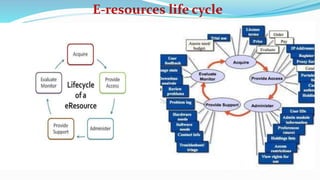
E-resources life cycle
MOOC’S
A massive open online course (MOOC) is an online course aimed at unlimited participation & open
access via the web..MOOCs are a recent & widely researched development is distance education, first
introduced in 2006 & emerged as a popular mode of learning in 2012.
MOOCs are typically provided by higher education institutions, often in partnership with
“organizers” such as coursera , edX & Udacity , through some MOOCs are being offered directly by a
college or university. MOOCs arise important questions & spark essential conversations about
curriculum design, accreditation, what constitutes a valid learning learning experience, & who has access
to higher education.
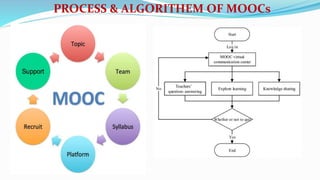
PROCESS & ALGORITHEM OF MOOCs
BENEFITS OF MOOCs
Improving access to higher education.
Providing an affordable alternative to formal education.
Sustainable development goals.
Offers a flexible learning schedule.
Online collaboration.
Offer a variety of subjects.
They are open to everyone.
MOOCs are available in different language.
SWAYAM
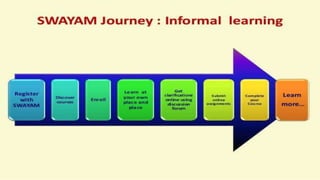
SWAYAM is a programme initiated by Government of India & designed to achieve
the three cardinal principles of Education policy viz., access, equity & quality. The
objective of this effort is to take the best teaching learning resources to all.
All the course are interactive, prepared by the best teachers in the country & are
available ,free of cost to the residents in India.
SWAYAM platform is indigenously developed by Ministry of Human Resource with
the help of Microsoft & would be ultimately capable of hosting 2000 courses & 8000
hours of learning : covering school , under-graduate, post-graduate , engineering ,law
& other professional courses.
BENEFITS OF SWAYAM
Categories of courses include-Engineering, Science ,Humanities, Management, Language,
Mathematics, Arts & Recreation, Commerce, General, Library , Education.
Course delivered through SWAYAM are available free of cost to the learners.
Students wanting certifications need to register & shall be offered a certificate on successful
completion of the course, with a little free.
At the end of each course, there will be an assessment of the student through proctored examination
& the marks/grades secured in this exam could be transferred to the academic record of the students.
UGC has already issued the UGC (Credit Framework for online learning courses through SWAYAM)
Regulation 2016 advising the Universities to identify courses where credits can be transferred on to the
academic record of the students for courses done on SWAYAM.
The course content developed for four quadrant approach:- Quadrant-I:- (e-Tutorial), Quadrant-II
(e-Content), Quadrant-III(web -resources), Quadrant-IV (self-assessment) .
Syllabus Template
Pre-and post-course surveys.
Course overview.
Course timeline for scheduling learning activities.
List of Announcements to deliver reminders for due dates & course transitions.
GYAN DARSHAN
. Gyan Darshan is a set of educational television channels that release
programmes from various that release programmes from various Doordarshan
kendras using satellite transmission in different languages.
It was launched as the exclusive educational television channel of India.
Gyan Darshan was launched by the Ministry of Human Resource Development,
Information & Broadcasting, the prasar Bharti & IGNOU jointly on 26th January
2000.
IGNOU was given the responsibility to be the nodal agency for up
linking/transmission.
BEFEFITS OF GYAN DARSHAN
Television can bring the whole world into the class room & makes the past
alive.
TV combines both sound & picture, moving & still, gets the attention of
viewers & has great motivation power.
It is a mass medium & can reach vast number of viewer s simultaneously &
at distant places, It can bring distant objects , place , which can be seen by
several students at a time & it can also show events in slow & fast motions.
Live & dramatized situations presented through television can be used to
educate the viewers. Equipments & materials not generally available in
school laboratories can be shown on television.
Gyan Vani
Gyan Vani is an educational FM radio station in several cities of India.
Each Gyan Vani station has a range of adjoining rural areas.
Organised by Ministry of Human Resource Development.
BENEFITS OF GYAN VANI
Gyan Vani helps them become better citizens .
In Pravakaran’s words Gyan Vani is helping year into service & already, Gyan Vani has collected
positive feedbacks from everywhere.
Radio is an effectual system for delivery of education to larger number of people.
In facilitates information exchange at the community level , acting as a “community telephone” .
Radio plays a vital educational role as the sole medium for formal & non-formal education.
SAKSHAT PORTAL
It’s an MHRD project to identify & give strength to NGO’s & people who are really working hard to
uplift the economy as well as education system of India.
It is a pilot project of the Govt. Of India, which is being spearheaded by IGNOU.
Intended to be a portal for students of all levels (elementary to higher & further education)
It provides update on the National Mission on Education through ICT.(NMEICT)
BENEFITS OF SAKSHAT PORTAL
It provide barrier –free web based learning resources uniformly across the country.
It develop a repository of world class interactive multimedia learning content.
It provides a platform for sharing of knowledge & experience among teachers & learners.
It facilitate learners to make informed decision on choice of profession through online career
counselling facility.
e- Gyankosh
E-Gyankosh=Electronic Gyan(knowledge ) & Kosh is National Digital Library
It is implemented & maintained by IGNOU
E-Gyankosh is a national repository for storing the digital learning resources developed by Open & Distance
learning institutions in the country.
Benefits of e-Gyankosh
It compensates for shortages of academic staff.
It provides administrative support such as registration .
It also maintained classroom management & evaluation.
It provides all study material for free of cost.
1600 video programmes available on YouTube with the metadata link in the repository.
Webcasting of Broadcast channels.
Wikipedia
Wikipedia is a multilingual online encyclopaedia created &
maintained as an open collaboration project by a community of
volunteer editors, using a wiki-based editing system.
It is a summary of knowledge.
BENEFITS OF WIKIPEDIA
Wikipedia’s most known & controversial feature is its editing tool.
Free editing can be very helpful to the sites users.
If a fact is incorrect it can be changed within seconds by one of Wikis register users.
It is increasingly used by people in the academic community , from freshman students to professors , as an easly
accessible tertiary source for information about anything & everything & as a quick “ready reference”. To get a sense
of a concept or idea.
Facebook
Facebook is an American social media & technology company based in
Menlo Park.
The Facebook .com –today’s Facebook, a popular global social networking
website.
Facebook offers other products & services beyond its social networking
platform, including facebook Messenger, Facebook Watch. & Facebook
portal.
Benefits of facebook
Facebook encourage to learn students ICT skills without the need for boring step-by-step
instruction.
They gain skills through peer learning as well, feeding back into interpersonal communication &
group collaboration.
There are four inter-related potential benefits :- creating a sense of community & promoting
collaboration, enhancing communication between instructors & students, developing computer
literacy & language skills. & incorporating current student culture into the learning environment.
You Tube
YouTube is a video sharing service that allows user s to watch videos
posted by other user & upload videos of their own.
YouTube creates a open platform to the learners as well as everyone.
We can easily learn every thing .
YouTube is a content community with provision for individuals to
post their own user generated Content(UGC) for use by other users.
Benefits of YouTube
YouTube for school is a network setting that allows schools to access education content on YouTube
EDU while limiting access to non-educational content.
Students can watch & search only YouTube EDU videos & their school adds.
YouTube is a great entertainment tool & learning tool as well.
Everyone can create their own channel, share their videos, & comment on others.
Videos can be used to generate students ideas.
In the first grader classroom, students are working on writing how-to books.(something they know
how to do)
Google Scholar
Google Scholar is a freely accessible web search engine that indexes
the full text or metadata of scholarly literature across an array of
publishing formats & disciplines.
It provides a simple way to broadly search for scholarly literature.
From one place you can search across many disciplines & sources :
Articles, Theses , books , abstracts & court opinions, from academic
publishers, professional societies, online repositories, universities &
other web sites.
Benefits of Google Scholar
It helps you find relevant work across the world of scholarly research.
Search all scholarly literature from one convenient place.
Explore related works, citations, authors, & publications.
Locate the complete document through your library or on the web.
Check who’s citing your publications, create a public author profile.
Advantages of E-Resources
Up-to-date information.
Convenient: Information is at your fingertips.
Saves time
E-resources can be viewed from most electronic devices.
Numerous value –added featured: search facilities, audio, video, graphics. Dictionary, links to other
databases. Etc.
Easy to use & disseminate.
Saves space in library.
Saves human resources/staff time in some areas.
No more missing books.
Disadvantages
Technical barriers-hardware 7 software, network connection, etc.
Infrastructure snags- bandwidth & load shedding issues, etc.
Require skills 7 training.
Costs to acquire e-resources can be high –technology & content.
Thank you

E- Educational Resources

  • 1.
  • 2.
    TOPIC E-educational Resources &Platforms : MOOC’S, SWAYAM, Gyan Darshan . Gyan Vani , Sakshat Portal, e-Gyan Kosh . Wikipedia, Facebook , You tube , Google Scholar
  • 3.
    INTRODUCTION OF E-EDUCATIONALRESOURCES & PLATFORMS A online learning platform is an integrated set of interactive online services that provide trainers, learners, & others involved in education with information, tools & resources to support & enhance education delivery & management. E-resource learning platforms allow effective complete overall control of administration, automisation , communication with users, teachers & trainers, & of course content management. They allow efficient management of registrations/sign ups. & creation of groups & courses. Intentional use of electronic media & information & communication technology (ICT) in teaching & learning process is referred to as e-learning , where “e” denotes “electronic” . It ac also be described learning , network & web based learning , e-learning includes all educational activities carried out by individuals/groups working online/offline & synchronously/asynchronously through network/standalone computers & electronic devices. An electronic resource is any information source that the library provides access to in an electronic format. The library has purchased subscriptions to many electronic information resources in order to provide you with access to them free of charge. Computers & related electronic resources have come to play a central role in education. Teachers can benefit from these resources as well by employing a series of useful tools. Electronic resources consist of data representing number s. Text, graphic, image, maps, moving images, music, sounds etc. & programs of instruction sets. E-resources & e-learning are increasingly important to all levels of education.
  • 4.
  • 5.
    MOOC’S A massive openonline course (MOOC) is an online course aimed at unlimited participation & open access via the web..MOOCs are a recent & widely researched development is distance education, first introduced in 2006 & emerged as a popular mode of learning in 2012. MOOCs are typically provided by higher education institutions, often in partnership with “organizers” such as coursera , edX & Udacity , through some MOOCs are being offered directly by a college or university. MOOCs arise important questions & spark essential conversations about curriculum design, accreditation, what constitutes a valid learning learning experience, & who has access to higher education.
  • 6.
  • 7.
    BENEFITS OF MOOCs Improvingaccess to higher education. Providing an affordable alternative to formal education. Sustainable development goals. Offers a flexible learning schedule. Online collaboration. Offer a variety of subjects. They are open to everyone. MOOCs are available in different language.
  • 8.
    SWAYAM SWAYAM is aprogramme initiated by Government of India & designed to achieve the three cardinal principles of Education policy viz., access, equity & quality. The objective of this effort is to take the best teaching learning resources to all. All the course are interactive, prepared by the best teachers in the country & are available ,free of cost to the residents in India. SWAYAM platform is indigenously developed by Ministry of Human Resource with the help of Microsoft & would be ultimately capable of hosting 2000 courses & 8000 hours of learning : covering school , under-graduate, post-graduate , engineering ,law & other professional courses.
  • 10.
    BENEFITS OF SWAYAM Categoriesof courses include-Engineering, Science ,Humanities, Management, Language, Mathematics, Arts & Recreation, Commerce, General, Library , Education. Course delivered through SWAYAM are available free of cost to the learners. Students wanting certifications need to register & shall be offered a certificate on successful completion of the course, with a little free. At the end of each course, there will be an assessment of the student through proctored examination & the marks/grades secured in this exam could be transferred to the academic record of the students. UGC has already issued the UGC (Credit Framework for online learning courses through SWAYAM) Regulation 2016 advising the Universities to identify courses where credits can be transferred on to the academic record of the students for courses done on SWAYAM. The course content developed for four quadrant approach:- Quadrant-I:- (e-Tutorial), Quadrant-II (e-Content), Quadrant-III(web -resources), Quadrant-IV (self-assessment) . Syllabus Template Pre-and post-course surveys. Course overview. Course timeline for scheduling learning activities. List of Announcements to deliver reminders for due dates & course transitions.
  • 11.
    GYAN DARSHAN . GyanDarshan is a set of educational television channels that release programmes from various that release programmes from various Doordarshan kendras using satellite transmission in different languages. It was launched as the exclusive educational television channel of India. Gyan Darshan was launched by the Ministry of Human Resource Development, Information & Broadcasting, the prasar Bharti & IGNOU jointly on 26th January 2000. IGNOU was given the responsibility to be the nodal agency for up linking/transmission.
  • 12.
    BEFEFITS OF GYANDARSHAN Television can bring the whole world into the class room & makes the past alive. TV combines both sound & picture, moving & still, gets the attention of viewers & has great motivation power. It is a mass medium & can reach vast number of viewer s simultaneously & at distant places, It can bring distant objects , place , which can be seen by several students at a time & it can also show events in slow & fast motions. Live & dramatized situations presented through television can be used to educate the viewers. Equipments & materials not generally available in school laboratories can be shown on television.
  • 13.
    Gyan Vani Gyan Vaniis an educational FM radio station in several cities of India. Each Gyan Vani station has a range of adjoining rural areas. Organised by Ministry of Human Resource Development. BENEFITS OF GYAN VANI Gyan Vani helps them become better citizens . In Pravakaran’s words Gyan Vani is helping year into service & already, Gyan Vani has collected positive feedbacks from everywhere. Radio is an effectual system for delivery of education to larger number of people. In facilitates information exchange at the community level , acting as a “community telephone” . Radio plays a vital educational role as the sole medium for formal & non-formal education.
  • 14.
    SAKSHAT PORTAL It’s anMHRD project to identify & give strength to NGO’s & people who are really working hard to uplift the economy as well as education system of India. It is a pilot project of the Govt. Of India, which is being spearheaded by IGNOU. Intended to be a portal for students of all levels (elementary to higher & further education) It provides update on the National Mission on Education through ICT.(NMEICT) BENEFITS OF SAKSHAT PORTAL It provide barrier –free web based learning resources uniformly across the country. It develop a repository of world class interactive multimedia learning content. It provides a platform for sharing of knowledge & experience among teachers & learners. It facilitate learners to make informed decision on choice of profession through online career counselling facility.
  • 15.
    e- Gyankosh E-Gyankosh=Electronic Gyan(knowledge) & Kosh is National Digital Library It is implemented & maintained by IGNOU E-Gyankosh is a national repository for storing the digital learning resources developed by Open & Distance learning institutions in the country. Benefits of e-Gyankosh It compensates for shortages of academic staff. It provides administrative support such as registration . It also maintained classroom management & evaluation. It provides all study material for free of cost. 1600 video programmes available on YouTube with the metadata link in the repository. Webcasting of Broadcast channels.
  • 16.
    Wikipedia Wikipedia is amultilingual online encyclopaedia created & maintained as an open collaboration project by a community of volunteer editors, using a wiki-based editing system. It is a summary of knowledge. BENEFITS OF WIKIPEDIA Wikipedia’s most known & controversial feature is its editing tool. Free editing can be very helpful to the sites users. If a fact is incorrect it can be changed within seconds by one of Wikis register users. It is increasingly used by people in the academic community , from freshman students to professors , as an easly accessible tertiary source for information about anything & everything & as a quick “ready reference”. To get a sense of a concept or idea.
  • 17.
    Facebook Facebook is anAmerican social media & technology company based in Menlo Park. The Facebook .com –today’s Facebook, a popular global social networking website. Facebook offers other products & services beyond its social networking platform, including facebook Messenger, Facebook Watch. & Facebook portal. Benefits of facebook Facebook encourage to learn students ICT skills without the need for boring step-by-step instruction. They gain skills through peer learning as well, feeding back into interpersonal communication & group collaboration. There are four inter-related potential benefits :- creating a sense of community & promoting collaboration, enhancing communication between instructors & students, developing computer literacy & language skills. & incorporating current student culture into the learning environment.
  • 18.
    You Tube YouTube isa video sharing service that allows user s to watch videos posted by other user & upload videos of their own. YouTube creates a open platform to the learners as well as everyone. We can easily learn every thing . YouTube is a content community with provision for individuals to post their own user generated Content(UGC) for use by other users. Benefits of YouTube YouTube for school is a network setting that allows schools to access education content on YouTube EDU while limiting access to non-educational content. Students can watch & search only YouTube EDU videos & their school adds. YouTube is a great entertainment tool & learning tool as well. Everyone can create their own channel, share their videos, & comment on others. Videos can be used to generate students ideas. In the first grader classroom, students are working on writing how-to books.(something they know how to do)
  • 19.
    Google Scholar Google Scholaris a freely accessible web search engine that indexes the full text or metadata of scholarly literature across an array of publishing formats & disciplines. It provides a simple way to broadly search for scholarly literature. From one place you can search across many disciplines & sources : Articles, Theses , books , abstracts & court opinions, from academic publishers, professional societies, online repositories, universities & other web sites. Benefits of Google Scholar It helps you find relevant work across the world of scholarly research. Search all scholarly literature from one convenient place. Explore related works, citations, authors, & publications. Locate the complete document through your library or on the web. Check who’s citing your publications, create a public author profile.
  • 20.
    Advantages of E-Resources Up-to-dateinformation. Convenient: Information is at your fingertips. Saves time E-resources can be viewed from most electronic devices. Numerous value –added featured: search facilities, audio, video, graphics. Dictionary, links to other databases. Etc. Easy to use & disseminate. Saves space in library. Saves human resources/staff time in some areas. No more missing books.
  • 21.
    Disadvantages Technical barriers-hardware 7software, network connection, etc. Infrastructure snags- bandwidth & load shedding issues, etc. Require skills 7 training. Costs to acquire e-resources can be high –technology & content.
  • 22.