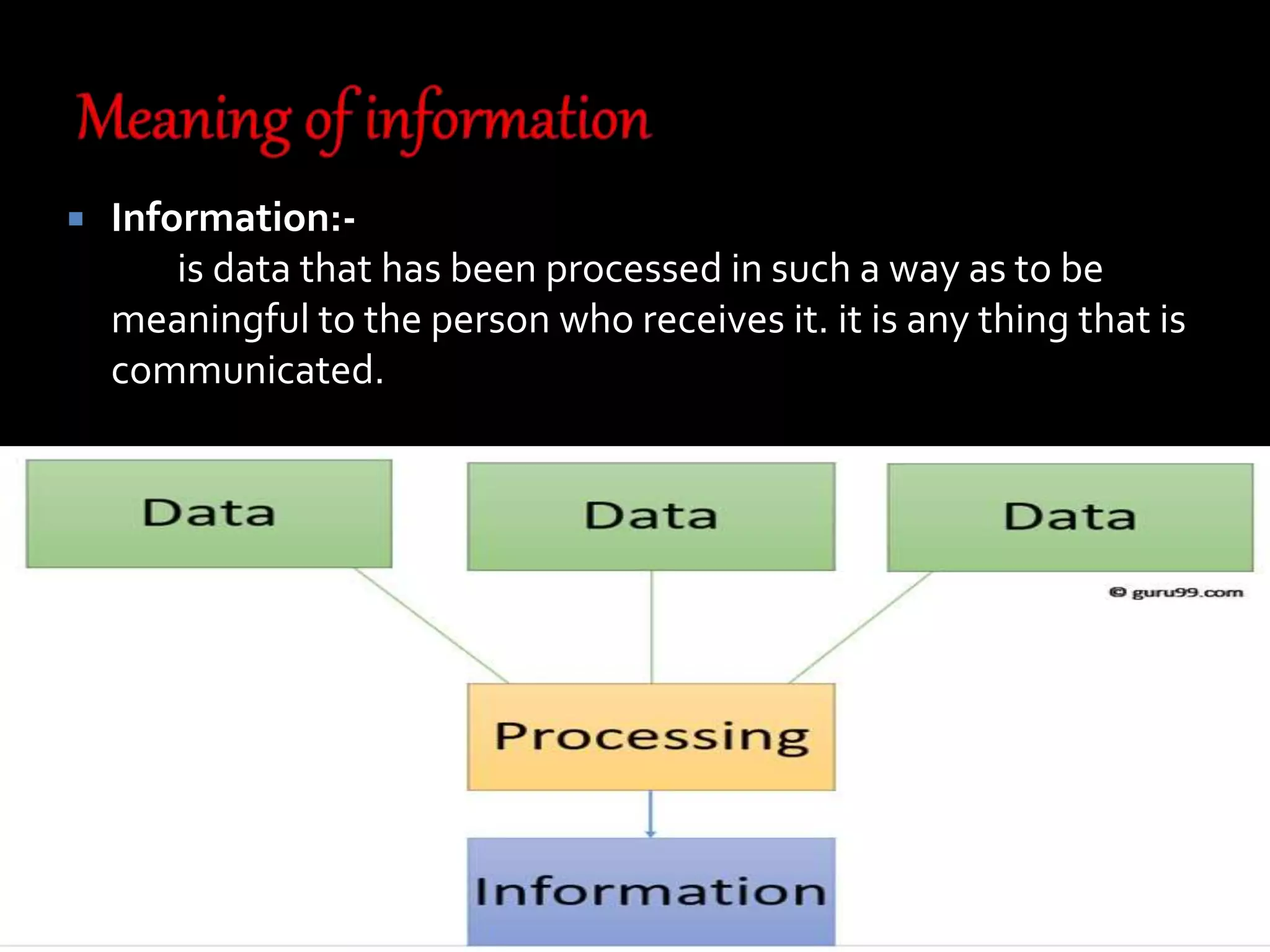
 Information:-
is data that has been processed in such a way as to be
meaningful to the person who receives it. it is any thing that is
communicated.
 Every communication involves (at least) one sender, a message
and a recipient.This may sound simple, but communication is
actually a very complex subject.
 Technology :- is the collection of techniques, skills, methods,
and processes used in the production of goods or services or
in the accomplishment of objectives, such as scientific
investigation
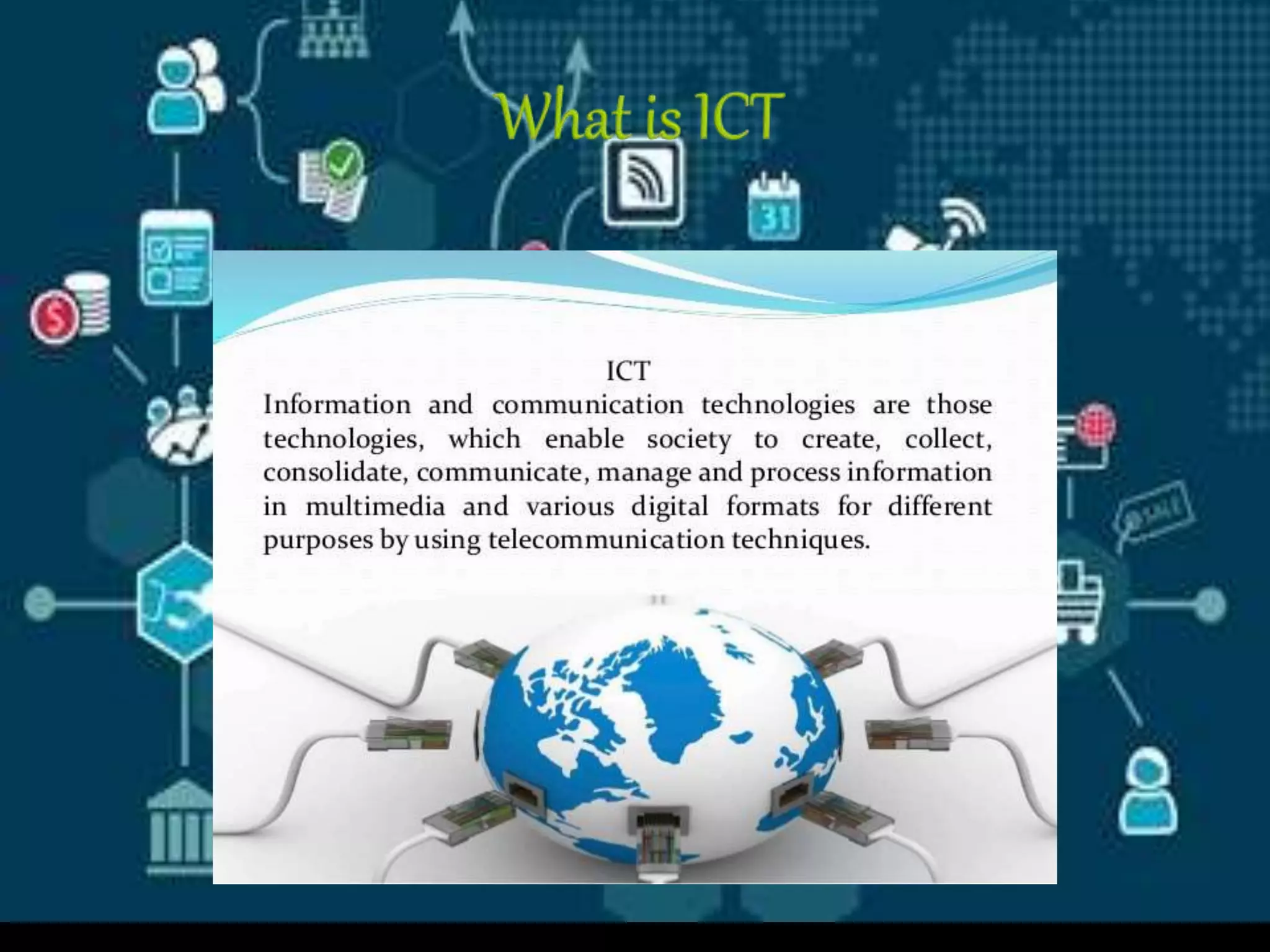
 Information and CommunicationTechnology’ (ICT) first
appeared in the mid-1980s.
 It defined as “All kinds of electronic systems used for
broadcasting telecommunications and mediated
communications”,
 with examples including personal computers, video games,
cell phones, internet, and electronic payment systems and
computer S/W etc.
 The computer technology is the tool for storing and
processing information in digital form while communication
technology helps us to transfer and disseminate digital
information.
 There are many special characteristics of ICT
application. Some special characteristics are
as follows:
 Effectiveness:
 – Most interactive
 – Fewer errors
 – Customized
 – Personalized
 – Achievable
 –Transparent
 – Searchable
 – Acceptable
 Efficiency:
– Faster
– Cheaper
– Fewer steps
– Lower costs
– Fewer people
– Less paperwork
 Innovation:
– New product
– New technologies
 LACK OF KNOWLEDGE AND SKILLS
1.TraditionalTeacher
2. ModernTeacher
 LACK OFTIME
 LACK OF EQUIPMENT
EX- EDUSAT.-2004, PROJECTOR, COMPUTER
 MAINTENANCE
 INTERNET
 TECHNICAL SUPPORT SPECIALIST
 CONTENT DEVELOPERS
 There are so many challenges in order to achieve the goal digital
literacy but continuous effort is taking by government as well as
educational institution in the field of digital literacy.
Introduction  of ICT

Introduction of ICT

  • 2.
     Information:- is datathat has been processed in such a way as to be meaningful to the person who receives it. it is any thing that is communicated.
  • 3.
     Every communicationinvolves (at least) one sender, a message and a recipient.This may sound simple, but communication is actually a very complex subject.
  • 4.
     Technology :-is the collection of techniques, skills, methods, and processes used in the production of goods or services or in the accomplishment of objectives, such as scientific investigation
  • 6.
     Information andCommunicationTechnology’ (ICT) first appeared in the mid-1980s.  It defined as “All kinds of electronic systems used for broadcasting telecommunications and mediated communications”,  with examples including personal computers, video games, cell phones, internet, and electronic payment systems and computer S/W etc.  The computer technology is the tool for storing and processing information in digital form while communication technology helps us to transfer and disseminate digital information.
  • 7.
     There aremany special characteristics of ICT application. Some special characteristics are as follows:  Effectiveness:  – Most interactive  – Fewer errors  – Customized  – Personalized  – Achievable  –Transparent  – Searchable  – Acceptable
  • 8.
     Efficiency: – Faster –Cheaper – Fewer steps – Lower costs – Fewer people – Less paperwork  Innovation: – New product – New technologies
  • 10.
     LACK OFKNOWLEDGE AND SKILLS 1.TraditionalTeacher 2. ModernTeacher  LACK OFTIME  LACK OF EQUIPMENT EX- EDUSAT.-2004, PROJECTOR, COMPUTER  MAINTENANCE  INTERNET  TECHNICAL SUPPORT SPECIALIST  CONTENT DEVELOPERS
  • 11.
     There areso many challenges in order to achieve the goal digital literacy but continuous effort is taking by government as well as educational institution in the field of digital literacy.