Emerging Technologies in Education
Md Haider Ali
Research Scholar
Department of E & T
E-learning
E-learning, or electronic learning, is a form of
education that utilizes electronic technologies to
deliver educational materials outside of a traditional
classroom setting. It encompasses a wide range of
activities, from accessing online courses and lectures
to participating in virtual classrooms, interactive
quizzes, and multimedia presentations
Features or Importance
Accessibility: E-learning provides
students with the flexibility to
access educational materials from
anywhere with an internet
connection.
Flexibility: Unlike traditional
classroom settings with fixed
schedules, e-learning allows
students to learn at their own pace
and on their own schedule.
Interactive Learning: E-learning
platforms often incorporate
interactive elements such as videos,
simulations, quizzes, and discussion
forums. These interactive features
engage students in active learning,
enhancing their understanding and
retention of course material.
Personalized Learning: E-learning
platforms can adapt to individual
student needs and preferences through
personalized learning paths and
adaptive assessment strategies. This
personalized approach allows students
to focus on areas where they need the
most support and progress at their own
pace.
Cost-effectiveness: E-learning can
be more cost-effective than
traditional classroom-based
education, as it eliminates the need
for physical infrastructure and
reduces expenses associated with
commuting and accommodation.
Collaboration: Despite being virtual, e-
learning environments facilitate collaboration
among students through online discussions,
group projects, and collaborative
assignments. These collaborative
opportunities enable students to develop
teamwork and communication skills essential
for their academic and professional success.
Continuous Feedback: E-learning
platforms often provide immediate
feedback on assessments and
assignments, allowing students to
identify areas for improvement
promptly. This continuous feedback
loop supports ongoing learning and
skill development.
Diverse Learning Resources: E-
learning platforms offer access to a wide
range of learning resources, including e-
books, articles, videos, and multimedia
presentations. These diverse resources
cater to different learning styles and
preferences, enhancing the overall
learning experience for undergraduate
students.
Methods of E-Learning
Asynchronous Learning: In
asynchronous learning, students
access educational materials and
complete assignments at their own
pace and convenience. This method
is ideal for accommodating diverse
schedules and allows learners to
engage with course content at any
time.
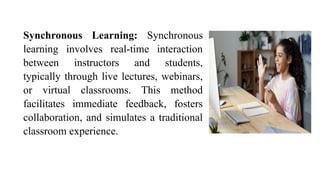
Synchronous Learning: Synchronous
learning involves real-time interaction
between instructors and students,
typically through live lectures, webinars,
or virtual classrooms. This method
facilitates immediate feedback, fosters
collaboration, and simulates a traditional
classroom experience.
Blended Learning: Blended learning
combines online learning with face-to-face
instruction. It integrates traditional classroom
teaching with digital tools and resources,
offering students the benefits of both in-
person and online learning modalities. This
approach provides flexibility while
maintaining opportunities for direct
interaction and hands-on activities.
Flipped Classroom: In a flipped classroom
model, students review instructional
materials, such as pre-recorded lectures or
reading assignments, outside of class time.
Class time is then used for interactive
activities, discussions, and problem-solving
exercises, allowing instructors to focus on
facilitating deeper understanding and
application of concepts.
Interactive Multimedia: E-learning
platforms often incorporate interactive
multimedia elements such as videos,
animations, simulations, and games to
enhance engagement and facilitate active
learning. These multimedia resources
cater to different learning styles and
preferences, making the learning
experience more dynamic and engaging.
Adaptive Learning: Adaptive learning
technologies personalize the learning experience
for each student based on their individual needs,
preferences, and learning progress. These
systems use data analytics and algorithms to
adjust the difficulty level of course materials,
provide targeted feedback, and offer customized
learning paths, optimizing learning outcomes.
Mobile Learning: Mobile learning, or m-
learning, allows students to access
educational content and participate in
learning activities using mobile devices such
as smartphones and tablets. M-learning
offers flexibility and convenience, enabling
students to learn anytime, anywhere, and is
particularly well-suited for microlearning,
just-in-time learning, and informal learning
scenarios.
Media of E-learning
Software Hardware and Internet
LMS
LMS stands for Learning Management System.
It's a software application or platform designed to
manage, deliver, and track educational content
and activities. LMSs are used in various
educational settings, including schools,
universities, corporate training programs, and
online courses. They provide a centralized
platform for administrators, instructors, and
learners to access course materials, participate in
learning activities, and monitor progress.
LMS components and functionalities
Course Management: LMSs allow
administrators and instructors to
create, organize, and manage
courses within the system. This
includes defining course objectives,
uploading course materials (such as
lectures, assignments, and quizzes),
setting due dates, and managing
enrollment.
User Management: LMSs enable
administrators to manage user
accounts and roles within the system.
This includes adding users (students,
instructors, administrators), assigning
roles and permissions, and managing
user profiles and access privileges.
Content Management: LMSs
provide tools for creating, uploading,
organizing, and delivering educational
content. This may include text-based
materials, multimedia resources (such
as videos, images, and audio files),
interactive modules, and external
links.
Communication and Collaboration: LMSs
facilitate communication and collaboration
among users through features such as
discussion forums, messaging systems, chat
rooms, and email notifications. These tools
enable learners to interact with instructors and
peers, ask questions, participate in
discussions, and collaborate on group
projects.
Assessment and Grading: LMSs support
various assessment methods, including
quizzes, exams, assignments, and surveys.
Instructors can create assessments, define
grading criteria, and track learners' progress
and performance. Some LMSs also offer
automated grading and feedback
functionalities.
Tracking and Reporting: LMSs track
learners' activities and progress within
courses, including logins, participation,
completion of assignments, and assessment
scores. Administrators and instructors can
generate reports and analytics to assess
learner engagement, performance, and course
effectiveness.
Integration and Customization: LMSs
often integrate with other software
applications and tools, such as video
conferencing platforms, content authoring
tools, and learning analytics systems.
Additionally, many LMSs offer
customization options, allowing
organizations to tailor the platform to their
specific needs and branding requirements.
Example: popular example of LMS are
Moodle and Google Classroom.
Virtual Universities
Virtual universities, also known as online universities
or cyber universities, are educational institutions that
offer degree programs and courses entirely or
primarily through online platforms. These universities
utilize digital technologies to deliver educational
content, facilitate communication and collaboration,
and support various learning activities. Virtual
universities provide an alternative to traditional
universities, offering flexible and accessible learning
opportunities to students worldwide
Key characteristics of virtual universities
Online Delivery: Virtual universities
deliver courses and degree programs
entirely or predominantly online, allowing
students to access educational materials,
lectures, assignments, and assessments
through web-based platforms or learning
management systems (LMS).
Flexibility: Virtual universities offer
flexible scheduling options, allowing
students to study at their own pace and
on their own schedule. This flexibility is
particularly beneficial for working
professionals, adult learners, and
individuals with other commitments.
Accessibility: Virtual universities provide
access to education regardless of
geographical location, enabling students to
enrol in courses and pursue degrees from
anywhere with an internet connection. This
accessibility reduces barriers to education and
expands opportunities for individuals who
may not have access to traditional higher
education institutions.
Multimedia Learning: Virtual
universities leverage multimedia
technologies such as video lectures,
interactive simulations, virtual labs,
and multimedia presentations to
enhance learning experiences and
engage students effectively.
Communication and Collaboration:
Virtual universities facilitate
communication and collaboration among
students, instructors, and peers through
online discussion forums, chat rooms,
video conferencing, and collaborative
tools. These communication channels
enable interaction, knowledge sharing,
and peer learning.
Assessment and Feedback: Virtual
universities employ various methods of
assessment, including online quizzes,
exams, assignments, and projects.
Instructors provide feedback and support
to students through digital platforms,
ensuring continuous learning and
improvement.
Support Services: Virtual universities
offer online support services to assist
students throughout their academic
journey. These services may include
academic advising, tutoring, technical
support, library resources, and career
counseling.
Accreditation and Quality Assurance:
Virtual universities adhere to
accreditation standards and quality
assurance processes to ensure the rigor
and credibility of their programs.
Accredited virtual universities provide
degrees and credentials that are
recognized and respected by employers
and other academic institutions.
MOOCS (Massive Open Online Courses)
MOOCs stands for Massive Open Online
Courses. MOOCs are online courses that are
designed to be open to unlimited participation and
are typically offered by universities, colleges, or
other educational organizations. MOOCs provide
free or low-cost access to educational content on a
wide range of subjects, delivered through web-
based platforms or learning management
systems(LMS).
Key features of MOOCs
Massive Scale: MOOCs are
designed to accommodate a large
number of participants, often
numbering in the thousands or even
tens of thousands. This massive
scale allows MOOC providers to
reach a diverse and global audience
of learners.
Open Access: MOOCs are open
to anyone with an internet
connection, regardless of their
location, educational background,
or prior qualifications. This
openness democratizes access to
education and expands learning
opportunities for individuals
around the world
Online Delivery: MOOCs are delivered
entirely online, with course materials,
lectures, assignments, and assessments
accessible through web-based platforms
or learning management systems. This
online delivery format enables flexible
and self-paced learning, accommodating
learners' schedules and preferences.
Diverse Content: MOOCs cover a wide
range of subjects and disciplines, including
humanities, social sciences, STEM (science,
technology, engineering, and mathematics),
business, healthcare, and more. MOOC
providers collaborate with universities,
professors, experts, and industry professionals
to offer high-quality educational content.
Self-Paced Learning: MOOCs typically
offer self-paced learning options,
allowing participants to progress through
course materials at their own pace and
convenience. Learners can access course
content, review lectures, complete
assignments, and take assessments
according to their individual learning
schedules.
Certification and Credentialing: Many
MOOCs offer certificates of completion or
digital badges to participants who
successfully complete course requirements,
such as passing assessments or achieving a
certain level of proficiency. These
certificates can serve as evidence of learning
and may be recognized by employers or
educational institutions.
Popular platforms for MOOCs include
Coursera, edX, Swayam, Udacity,
FutureLearn, and Khan Academy,
among others. Most of these platforms
partner with universities, colleges, and
organizations worldwide to offer a
diverse range of courses and programs
to learners of all ages and backgrounds.
Challenges:
MOOCs face distinct challenges. Completion rates can be
low due to distractions, lack of support structures, and
limited motivation in self-directed learning environments.
Ensuring engagement and providing adequate support
systems are crucial for maximizing the effectiveness of
MOOCs.
Also quality variation exists, with not all MOOCs adhering
to rigorous academic standards.
Indian MOOCs
SWAYAM
(Study Webs of Active–Learning for Young Aspiring Minds)
SWAYAM (Study Webs of Active-
Learning for Young Aspiring Minds) is
an initiative by the Government of India
aimed at providing open online courses
for students at various levels, from
school to postgraduate education.
key points about SWAYAM
Online Platform: SWAYAM
operates as an online platform that
hosts courses across a wide range of
subjects and disciplines.
Content: Courses offered on
SWAYAM cover diverse topics
including humanities, engineering,
management, sciences, and more.
The content is curated by expert
faculty members from renowned
institutions in India and abroad.
Flexibility: One of the main
advantages of SWAYAM is its
flexibility. Learners can access
course materials at their own pace
and convenience, allowing for self-
paced learning.
Certification: SWAYAM provides
certification for courses completed
successfully. These certificates are
recognized by various educational
institutions and employers,
enhancing the learners' credentials.
Accessibility: SWAYAM aims to
make quality education accessible
to all, including those in remote
areas who may not have access to
traditional educational resources.
The platform is free to use, making
it inclusive and equitable.
Integration with Institutions:
SWAYAM collaborates with
universities and educational
institutions to offer credit transfer
options, allowing learners to use the
credits earned on SWAYAM
towards their academic
qualifications.
Emerging Technologies Emerging Technologies.pptx

Emerging Technologies Emerging Technologies.pptx

  • 1.
    Emerging Technologies inEducation Md Haider Ali Research Scholar Department of E & T
  • 2.
    E-learning E-learning, or electroniclearning, is a form of education that utilizes electronic technologies to deliver educational materials outside of a traditional classroom setting. It encompasses a wide range of activities, from accessing online courses and lectures to participating in virtual classrooms, interactive quizzes, and multimedia presentations
  • 3.
  • 4.
    Accessibility: E-learning provides studentswith the flexibility to access educational materials from anywhere with an internet connection.
  • 5.
    Flexibility: Unlike traditional classroomsettings with fixed schedules, e-learning allows students to learn at their own pace and on their own schedule.
  • 6.
    Interactive Learning: E-learning platformsoften incorporate interactive elements such as videos, simulations, quizzes, and discussion forums. These interactive features engage students in active learning, enhancing their understanding and retention of course material.
  • 7.
    Personalized Learning: E-learning platformscan adapt to individual student needs and preferences through personalized learning paths and adaptive assessment strategies. This personalized approach allows students to focus on areas where they need the most support and progress at their own pace.
  • 8.
    Cost-effectiveness: E-learning can bemore cost-effective than traditional classroom-based education, as it eliminates the need for physical infrastructure and reduces expenses associated with commuting and accommodation.
  • 9.
    Collaboration: Despite beingvirtual, e- learning environments facilitate collaboration among students through online discussions, group projects, and collaborative assignments. These collaborative opportunities enable students to develop teamwork and communication skills essential for their academic and professional success.
  • 10.
    Continuous Feedback: E-learning platformsoften provide immediate feedback on assessments and assignments, allowing students to identify areas for improvement promptly. This continuous feedback loop supports ongoing learning and skill development.
  • 11.
    Diverse Learning Resources:E- learning platforms offer access to a wide range of learning resources, including e- books, articles, videos, and multimedia presentations. These diverse resources cater to different learning styles and preferences, enhancing the overall learning experience for undergraduate students.
  • 12.
  • 13.
    Asynchronous Learning: In asynchronouslearning, students access educational materials and complete assignments at their own pace and convenience. This method is ideal for accommodating diverse schedules and allows learners to engage with course content at any time.
  • 14.
    Synchronous Learning: Synchronous learninginvolves real-time interaction between instructors and students, typically through live lectures, webinars, or virtual classrooms. This method facilitates immediate feedback, fosters collaboration, and simulates a traditional classroom experience.
  • 15.
    Blended Learning: Blendedlearning combines online learning with face-to-face instruction. It integrates traditional classroom teaching with digital tools and resources, offering students the benefits of both in- person and online learning modalities. This approach provides flexibility while maintaining opportunities for direct interaction and hands-on activities.
  • 16.
    Flipped Classroom: Ina flipped classroom model, students review instructional materials, such as pre-recorded lectures or reading assignments, outside of class time. Class time is then used for interactive activities, discussions, and problem-solving exercises, allowing instructors to focus on facilitating deeper understanding and application of concepts.
  • 17.
    Interactive Multimedia: E-learning platformsoften incorporate interactive multimedia elements such as videos, animations, simulations, and games to enhance engagement and facilitate active learning. These multimedia resources cater to different learning styles and preferences, making the learning experience more dynamic and engaging.
  • 18.
    Adaptive Learning: Adaptivelearning technologies personalize the learning experience for each student based on their individual needs, preferences, and learning progress. These systems use data analytics and algorithms to adjust the difficulty level of course materials, provide targeted feedback, and offer customized learning paths, optimizing learning outcomes.
  • 19.
    Mobile Learning: Mobilelearning, or m- learning, allows students to access educational content and participate in learning activities using mobile devices such as smartphones and tablets. M-learning offers flexibility and convenience, enabling students to learn anytime, anywhere, and is particularly well-suited for microlearning, just-in-time learning, and informal learning scenarios.
  • 20.
  • 21.
  • 22.
    LMS LMS stands forLearning Management System. It's a software application or platform designed to manage, deliver, and track educational content and activities. LMSs are used in various educational settings, including schools, universities, corporate training programs, and online courses. They provide a centralized platform for administrators, instructors, and learners to access course materials, participate in learning activities, and monitor progress.
  • 23.
    LMS components andfunctionalities
  • 24.
    Course Management: LMSsallow administrators and instructors to create, organize, and manage courses within the system. This includes defining course objectives, uploading course materials (such as lectures, assignments, and quizzes), setting due dates, and managing enrollment.
  • 25.
    User Management: LMSsenable administrators to manage user accounts and roles within the system. This includes adding users (students, instructors, administrators), assigning roles and permissions, and managing user profiles and access privileges.
  • 26.
    Content Management: LMSs providetools for creating, uploading, organizing, and delivering educational content. This may include text-based materials, multimedia resources (such as videos, images, and audio files), interactive modules, and external links.
  • 27.
    Communication and Collaboration:LMSs facilitate communication and collaboration among users through features such as discussion forums, messaging systems, chat rooms, and email notifications. These tools enable learners to interact with instructors and peers, ask questions, participate in discussions, and collaborate on group projects.
  • 28.
    Assessment and Grading:LMSs support various assessment methods, including quizzes, exams, assignments, and surveys. Instructors can create assessments, define grading criteria, and track learners' progress and performance. Some LMSs also offer automated grading and feedback functionalities.
  • 29.
    Tracking and Reporting:LMSs track learners' activities and progress within courses, including logins, participation, completion of assignments, and assessment scores. Administrators and instructors can generate reports and analytics to assess learner engagement, performance, and course effectiveness.
  • 30.
    Integration and Customization:LMSs often integrate with other software applications and tools, such as video conferencing platforms, content authoring tools, and learning analytics systems. Additionally, many LMSs offer customization options, allowing organizations to tailor the platform to their specific needs and branding requirements.
  • 31.
    Example: popular exampleof LMS are Moodle and Google Classroom.
  • 33.
  • 34.
    Virtual universities, alsoknown as online universities or cyber universities, are educational institutions that offer degree programs and courses entirely or primarily through online platforms. These universities utilize digital technologies to deliver educational content, facilitate communication and collaboration, and support various learning activities. Virtual universities provide an alternative to traditional universities, offering flexible and accessible learning opportunities to students worldwide
  • 35.
    Key characteristics ofvirtual universities
  • 36.
    Online Delivery: Virtualuniversities deliver courses and degree programs entirely or predominantly online, allowing students to access educational materials, lectures, assignments, and assessments through web-based platforms or learning management systems (LMS).
  • 37.
    Flexibility: Virtual universitiesoffer flexible scheduling options, allowing students to study at their own pace and on their own schedule. This flexibility is particularly beneficial for working professionals, adult learners, and individuals with other commitments.
  • 38.
    Accessibility: Virtual universitiesprovide access to education regardless of geographical location, enabling students to enrol in courses and pursue degrees from anywhere with an internet connection. This accessibility reduces barriers to education and expands opportunities for individuals who may not have access to traditional higher education institutions.
  • 39.
    Multimedia Learning: Virtual universitiesleverage multimedia technologies such as video lectures, interactive simulations, virtual labs, and multimedia presentations to enhance learning experiences and engage students effectively.
  • 40.
    Communication and Collaboration: Virtualuniversities facilitate communication and collaboration among students, instructors, and peers through online discussion forums, chat rooms, video conferencing, and collaborative tools. These communication channels enable interaction, knowledge sharing, and peer learning.
  • 41.
    Assessment and Feedback:Virtual universities employ various methods of assessment, including online quizzes, exams, assignments, and projects. Instructors provide feedback and support to students through digital platforms, ensuring continuous learning and improvement.
  • 42.
    Support Services: Virtualuniversities offer online support services to assist students throughout their academic journey. These services may include academic advising, tutoring, technical support, library resources, and career counseling.
  • 43.
    Accreditation and QualityAssurance: Virtual universities adhere to accreditation standards and quality assurance processes to ensure the rigor and credibility of their programs. Accredited virtual universities provide degrees and credentials that are recognized and respected by employers and other academic institutions.
  • 44.
    MOOCS (Massive OpenOnline Courses)
  • 45.
    MOOCs stands forMassive Open Online Courses. MOOCs are online courses that are designed to be open to unlimited participation and are typically offered by universities, colleges, or other educational organizations. MOOCs provide free or low-cost access to educational content on a wide range of subjects, delivered through web- based platforms or learning management systems(LMS).
  • 46.
  • 47.
    Massive Scale: MOOCsare designed to accommodate a large number of participants, often numbering in the thousands or even tens of thousands. This massive scale allows MOOC providers to reach a diverse and global audience of learners.
  • 48.
    Open Access: MOOCsare open to anyone with an internet connection, regardless of their location, educational background, or prior qualifications. This openness democratizes access to education and expands learning opportunities for individuals around the world
  • 49.
    Online Delivery: MOOCsare delivered entirely online, with course materials, lectures, assignments, and assessments accessible through web-based platforms or learning management systems. This online delivery format enables flexible and self-paced learning, accommodating learners' schedules and preferences.
  • 50.
    Diverse Content: MOOCscover a wide range of subjects and disciplines, including humanities, social sciences, STEM (science, technology, engineering, and mathematics), business, healthcare, and more. MOOC providers collaborate with universities, professors, experts, and industry professionals to offer high-quality educational content.
  • 51.
    Self-Paced Learning: MOOCstypically offer self-paced learning options, allowing participants to progress through course materials at their own pace and convenience. Learners can access course content, review lectures, complete assignments, and take assessments according to their individual learning schedules.
  • 52.
    Certification and Credentialing:Many MOOCs offer certificates of completion or digital badges to participants who successfully complete course requirements, such as passing assessments or achieving a certain level of proficiency. These certificates can serve as evidence of learning and may be recognized by employers or educational institutions.
  • 53.
    Popular platforms forMOOCs include Coursera, edX, Swayam, Udacity, FutureLearn, and Khan Academy, among others. Most of these platforms partner with universities, colleges, and organizations worldwide to offer a diverse range of courses and programs to learners of all ages and backgrounds.
  • 54.
  • 55.
    MOOCs face distinctchallenges. Completion rates can be low due to distractions, lack of support structures, and limited motivation in self-directed learning environments. Ensuring engagement and providing adequate support systems are crucial for maximizing the effectiveness of MOOCs. Also quality variation exists, with not all MOOCs adhering to rigorous academic standards.
  • 56.
  • 57.
    SWAYAM (Study Webs ofActive–Learning for Young Aspiring Minds)
  • 58.
    SWAYAM (Study Websof Active- Learning for Young Aspiring Minds) is an initiative by the Government of India aimed at providing open online courses for students at various levels, from school to postgraduate education.
  • 59.
  • 60.
    Online Platform: SWAYAM operatesas an online platform that hosts courses across a wide range of subjects and disciplines.
  • 61.
    Content: Courses offeredon SWAYAM cover diverse topics including humanities, engineering, management, sciences, and more. The content is curated by expert faculty members from renowned institutions in India and abroad.
  • 62.
    Flexibility: One ofthe main advantages of SWAYAM is its flexibility. Learners can access course materials at their own pace and convenience, allowing for self- paced learning.
  • 63.
    Certification: SWAYAM provides certificationfor courses completed successfully. These certificates are recognized by various educational institutions and employers, enhancing the learners' credentials.
  • 64.
    Accessibility: SWAYAM aimsto make quality education accessible to all, including those in remote areas who may not have access to traditional educational resources. The platform is free to use, making it inclusive and equitable.
  • 65.
    Integration with Institutions: SWAYAMcollaborates with universities and educational institutions to offer credit transfer options, allowing learners to use the credits earned on SWAYAM towards their academic qualifications.