
Commonwealth Educational
Media Centre for Asia


Open Educational
Resources and
eLearning
Indian Experiences


Sanjaya Mishra
Director, Commonwealth Educational Media Centre for Asia
Structure of the Presentation
•   Contexts
•   Personal Experiences
•   Challenges
•   Possibilities and Future
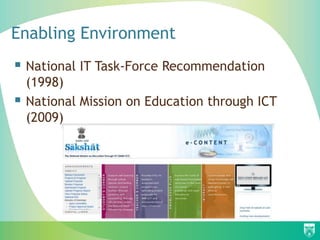
Enabling Environment
 National IT Task-Force Recommendation
    (1998)
   National Mission on Education through ICT
    (2009)
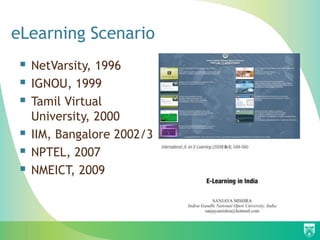
eLearning Scenario
    NetVarsity, 1996
    IGNOU, 1999
    Tamil Virtual
     University, 2000
    IIM, Bangalore 2002/3
    NPTEL, 2007
    NMEICT, 2009
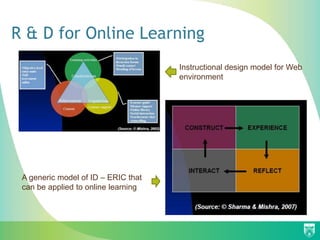
R & D for Online Learning
                                     Instructional design model for Web
                                     environment


 A generic model of ID – ERIC that
 can be applied to online learning
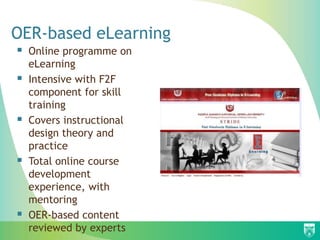
OER-based eLearning
 Online programme on
    eLearning
   Intensive with F2F
    component for skill
    training
   Covers instructional
    design theory and
    practice
   Total online course
    development
    experience, with
    mentoring
   OER-based content
    reviewed by experts
Open Educational Resources
 teaching, learning and research materials in
 any medium, digital or otherwise, that reside
 in the public domain or have been released
 under an open license that permits no-cost
 access, use, adaptation and redistribution by
 others with no or limited restrictions. Open
 licensing is built within the existing
 framework of intellectual property rights as
 defined by relevant international conventions
 and respects the authorship of the work
History and Developments
 MIT OpenCourseWare, 2001
 UNESCO Forum on the Impact of Open
    Courseware for Higher Education in
    Developing Countries, 2002
   OLI-CMU, 2002
   OER Paris Declaration 2012
What is “Open”?
 It’s about open license used to share
    educational material
   Reuse
   Revise
   Remix
   Redistribute
   No permission required as long as the open
    license is respected
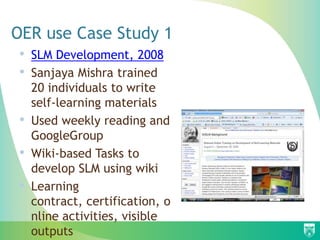
OER use Case Study 1
•   SLM Development, 2008
•   Sanjaya Mishra trained
    20 individuals to write
    self-learning materials
•   Used weekly reading and
    GoogleGroup
•   Wiki-based Tasks to
    develop SLM using wiki
•   Learning
    contract, certification, o
    nline activities, visible
    outputs
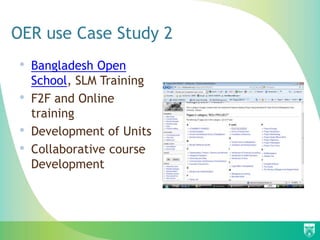
OER use Case Study 2
•   Bangladesh Open
    School, SLM Training
•   F2F and Online
    training
•   Development of Units
•   Collaborative course
    Development
Advantages of Wiki-based OER
 Updating and revision of courses become easy
 Learner participation in course, and their engagement
    will improve
   Some of the user generated content may be useful in
    revision
   Courses will become live and dynamic rather than static
    and outdated
   Quality of the course would improve as it will adhere to
    copyright regulations (as it will be open)
   Open content licensing policy can be adopted
   Courses can be developed fast using OER
Advantages of Wiki-based OER
 Print copies can be developed automatically using
    PediaPress PDF server
   Print-on-demand facility can be used
   Less paper use, and digital preservation of content with
    each editing recorded
   Resources other than main text can also be integrated
    including Slideshare, YouTube, MindMap, Google
    Calender, etc.
   Online quiz, and self-assessment activities can be in-
    built within the learning material
   Discussion Forum can be built around lessons
Integrating LMS and Wiki
 Use wiki to develop open courses
 Educational transaction happen within
    Learning Management System
   Integrate multiple media to provide multi-
    channel learning
   Learning as service, content as product,
    certification as quality assurance
Challenges
 Growing demands for higher education
 Assuring Quality of mass individualized
    instruction
   Capacity building of teachers
   Meeting the needs of NEW learner (digital
    natives)
   Reducing Digital Divide by NKN
   Oral content to Digital Content creation
   Rethinking Assessment and evaluation
Possibilities and Future
 Bandwidth problem reduced… IP6 and
    Internet 2 coming up
   Teacher Empowerment by Read-Write Web
   Culture of sharing and transparency
   Collaborative Learning, Mastery
    Learning, Just in Time Learning possible
   Increased quality of educational transaction
   Value for money – for the students, for the
    parents and for the Govt.
CEMCA’s engagement
 Developing a course on OER-based eLearning
    to promote capacity building of teachers
   Promoting the concept of Virtual Open
    Schooling
   Encouraging integration of ICT in teacher
    education
   Developing vocational courses on need-based
    areas for release as OER
   Offering scholarships to women teachers to
    study eLearning
THANK YOU

Open Educational Resources and eLearning

  • 1.
    Commonwealth Educational Media Centrefor Asia Open Educational Resources and eLearning Indian Experiences Sanjaya Mishra Director, Commonwealth Educational Media Centre for Asia
  • 2.
    Structure of thePresentation • Contexts • Personal Experiences • Challenges • Possibilities and Future
  • 3.
    Enabling Environment  NationalIT Task-Force Recommendation (1998)  National Mission on Education through ICT (2009)
  • 4.
    eLearning Scenario  NetVarsity, 1996  IGNOU, 1999  Tamil Virtual University, 2000  IIM, Bangalore 2002/3  NPTEL, 2007  NMEICT, 2009
  • 5.
    R & Dfor Online Learning Instructional design model for Web environment A generic model of ID – ERIC that can be applied to online learning
  • 6.
    OER-based eLearning  Onlineprogramme on eLearning  Intensive with F2F component for skill training  Covers instructional design theory and practice  Total online course development experience, with mentoring  OER-based content reviewed by experts
  • 7.
    Open Educational Resources teaching, learning and research materials in any medium, digital or otherwise, that reside in the public domain or have been released under an open license that permits no-cost access, use, adaptation and redistribution by others with no or limited restrictions. Open licensing is built within the existing framework of intellectual property rights as defined by relevant international conventions and respects the authorship of the work
  • 8.
    History and Developments MIT OpenCourseWare, 2001  UNESCO Forum on the Impact of Open Courseware for Higher Education in Developing Countries, 2002  OLI-CMU, 2002  OER Paris Declaration 2012
  • 9.
    What is “Open”? It’s about open license used to share educational material  Reuse  Revise  Remix  Redistribute  No permission required as long as the open license is respected
  • 10.
    OER use CaseStudy 1 • SLM Development, 2008 • Sanjaya Mishra trained 20 individuals to write self-learning materials • Used weekly reading and GoogleGroup • Wiki-based Tasks to develop SLM using wiki • Learning contract, certification, o nline activities, visible outputs
  • 11.
    OER use CaseStudy 2 • Bangladesh Open School, SLM Training • F2F and Online training • Development of Units • Collaborative course Development
  • 12.
    Advantages of Wiki-basedOER  Updating and revision of courses become easy  Learner participation in course, and their engagement will improve  Some of the user generated content may be useful in revision  Courses will become live and dynamic rather than static and outdated  Quality of the course would improve as it will adhere to copyright regulations (as it will be open)  Open content licensing policy can be adopted  Courses can be developed fast using OER
  • 13.
    Advantages of Wiki-basedOER  Print copies can be developed automatically using PediaPress PDF server  Print-on-demand facility can be used  Less paper use, and digital preservation of content with each editing recorded  Resources other than main text can also be integrated including Slideshare, YouTube, MindMap, Google Calender, etc.  Online quiz, and self-assessment activities can be in- built within the learning material  Discussion Forum can be built around lessons
  • 14.
    Integrating LMS andWiki  Use wiki to develop open courses  Educational transaction happen within Learning Management System  Integrate multiple media to provide multi- channel learning  Learning as service, content as product, certification as quality assurance
  • 15.
    Challenges  Growing demandsfor higher education  Assuring Quality of mass individualized instruction  Capacity building of teachers  Meeting the needs of NEW learner (digital natives)  Reducing Digital Divide by NKN  Oral content to Digital Content creation  Rethinking Assessment and evaluation
  • 16.
    Possibilities and Future Bandwidth problem reduced… IP6 and Internet 2 coming up  Teacher Empowerment by Read-Write Web  Culture of sharing and transparency  Collaborative Learning, Mastery Learning, Just in Time Learning possible  Increased quality of educational transaction  Value for money – for the students, for the parents and for the Govt.
  • 17.
    CEMCA’s engagement  Developinga course on OER-based eLearning to promote capacity building of teachers  Promoting the concept of Virtual Open Schooling  Encouraging integration of ICT in teacher education  Developing vocational courses on need-based areas for release as OER  Offering scholarships to women teachers to study eLearning
  • 18.