ONLINE E-LEARNING PLATFORMS
ANISHMA L RAJ
ROLL NO:-17
1ST B ED MATHEMATICS
E-LEARNING PLATFORMS
 A learning system based on formalised teaching but with the help of electronic resources is known
as E-learning.
 While teaching can be based in or out of the classrooms, the use of computers and the Internet
forms the major component of E-learning.
 E-learning can also be termed as a network enabled transfer of skills and knowledge, and the
delivery of education is made to a large number of recipients at the same or different times.
 An e-Learning Platform is also called "Course Management System", "Pedagogical Platform" or "e-Learning
Management System".
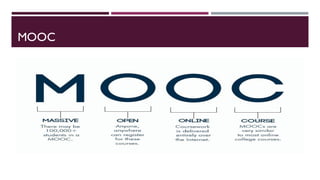
MOOC
WHAT IS MOOC?
• In Massive Open Online Courses(MOOCs) there is creativity and the
openness and it allow the participants to share reading, videos, and
activities.
• The discussion is occuring between people that are staying far from
each other.Anyone can join MOOC since it doesn’t have the limitations
in respect of whether the person have degree or have passed grade 12.
MAIN OBJECTIVES
• To widen access to higher education for millions of people and enhance
the quality of education.
• Contributing to the democratisation of Higher Education.
• To access complete courses offered by universities all over the world.
• MOOCs increase access to an extraordinary number of courses offered
by word – renowned institutions and teachers.
• To open up quality higher education to a wider audience.
HISTORY OF MOOC
 MOOC is within networks that learning can generate quite interesting
experiences.This leads us to the raise of MOOCs.The first MOOC was
launched in 2008.It was called 'Connectivism and Connective
Knowledge/2008’(CCK8), created by educators Stephen Downes and
George Siemens. Building off a for-credit courses at the University of
Manitoba, Canada, this was the first class designed behind the acronym of
'MOOC’ and used many different platforms to engage students with the
topic, including Facebook group,Wiki pages, blogs, forums and other
resources.
HOW TO USE MASSIVE OPEN ONLINE COURSES
• Since MOOC does not have curriculum, it can be a self-directed.
• It does not limit the number of participants.
• The number of teachers or instructors can also participate because the
main aim is to gain knowledge or to attain the certain goel.
• MOOCs can also be created by students discussing the certain content
or the chapter of the subject in order to improve their learning.
TYPE OF MOOC
• xMOOC. Is the type of the learning where by the learners
share the ideas and there is only one instructor on the
discussion.
• cMOOC. Hear the learners control their own learning, and
they create their own goal.The learners,are not assessed or
tested weather they have met the outcomes that they where
aiming at.
MOOCs Providers – world
• Coursera
• Edx
• P2PU- Peer to Peer University
• Alison
• Open2study
• Open learning
• Open classroom
• Khan Academy
• Stanford online
• Future Learn
• Shaw Academy
MOOC PROVIDERS - INDIA
• SWAYAM
• epg-pathshala
National MOOCs Co-ordinators.
UGC
NPTEL
NCERT
CEC
IGNOU
NIOS
IIS BANGALORE
ADVANTAGES
• No tuition fees.
• Open access, exposing top level professors at schools that would
otherwise be unavailable to much of the world’s population
• Open courses for all interested, regardless of location, resulting in a
more diverse student base.
• Students can collaborate with their peers from different parts of the
world.
DISADVANTAGES
• They make it easy for students to drop out.
• MOOCs do not provide active feedback due to large number of students.
• Students need to be responsible for their own work because MOOCs provide self-
directed learning.
• Technical problems.
SWAYAM
 SWAYAM:-StudyWebs ofActive – Learning forYoungAspiring Minds.
 SWAYAM platforms is indigenSWAYAM:-StudyWebs ofActive – Learning forYoung Aspiring
Minds.
 Initiated by Government of India
 Achieve the three cardinal principles of Education policy- Access,Equity and Quality.
 Provide best learning resources to all, including the most disadvantages
 Seeks to bridge the digital divide.
The disseminate educational contentto masses, the MHRD has launched 32 DTH educational
TV channels called SWAYAM Prabha.
FEATURES
1. One-stop web and mobile-based interactive e-content for all coursesfrom High
School to University level.
2. High-quality learning experience using multimedia on anytime,anywhere basis.
3. State of the art system that allows easy access, monitoring andcertification.
4. Peer group interaction and discussion forum to clarify doubts
5. A Hybrid model of delivery that adds to the quality of classroomteaching.
SCOPE OF SWAYAM
• Courses to meet the needs of life-long learners
• Skill based courses
• Curriculum based courses from diverse disciplines
• Advanced curriculum & professional certification
• Independent courses
• School education (9-12 levels) modules
COURSERA
 Coursera is a U.S.-based massive open online course provider
founded in 2012 by Stanford University computer science
professors Andrew Ng and Daphne Koller.
 Coursera works with universities and other organizations to offer online
courses, certifications, and degrees in a variety of subjects.
FEATURES
Resourscience : Open traditional University Courses ( knowledge)
Time Commitment : 4-12 weeks courses
Subject areas : Computer science, humanities and social science, mathematics and
statistics, healthcare and medicine, economics and finance, society and network.
HOW IT WORKS
 Discover a course and sign up
 Learn on your schedule
 Achieve your goals
CLASS WEBSITE OVERVIEW
 Syllabus
 Homework & assignment
 Quizzes
 Video lectures
 Discussion forum
THANKYOU

EDU O3 _e learning platforms

  • 1.
    ONLINE E-LEARNING PLATFORMS ANISHMAL RAJ ROLL NO:-17 1ST B ED MATHEMATICS
  • 2.
    E-LEARNING PLATFORMS  Alearning system based on formalised teaching but with the help of electronic resources is known as E-learning.  While teaching can be based in or out of the classrooms, the use of computers and the Internet forms the major component of E-learning.  E-learning can also be termed as a network enabled transfer of skills and knowledge, and the delivery of education is made to a large number of recipients at the same or different times.  An e-Learning Platform is also called "Course Management System", "Pedagogical Platform" or "e-Learning Management System".
  • 3.
  • 4.
    WHAT IS MOOC? •In Massive Open Online Courses(MOOCs) there is creativity and the openness and it allow the participants to share reading, videos, and activities. • The discussion is occuring between people that are staying far from each other.Anyone can join MOOC since it doesn’t have the limitations in respect of whether the person have degree or have passed grade 12.
  • 5.
    MAIN OBJECTIVES • Towiden access to higher education for millions of people and enhance the quality of education. • Contributing to the democratisation of Higher Education. • To access complete courses offered by universities all over the world. • MOOCs increase access to an extraordinary number of courses offered by word – renowned institutions and teachers. • To open up quality higher education to a wider audience.
  • 6.
    HISTORY OF MOOC MOOC is within networks that learning can generate quite interesting experiences.This leads us to the raise of MOOCs.The first MOOC was launched in 2008.It was called 'Connectivism and Connective Knowledge/2008’(CCK8), created by educators Stephen Downes and George Siemens. Building off a for-credit courses at the University of Manitoba, Canada, this was the first class designed behind the acronym of 'MOOC’ and used many different platforms to engage students with the topic, including Facebook group,Wiki pages, blogs, forums and other resources.
  • 7.
    HOW TO USEMASSIVE OPEN ONLINE COURSES • Since MOOC does not have curriculum, it can be a self-directed. • It does not limit the number of participants. • The number of teachers or instructors can also participate because the main aim is to gain knowledge or to attain the certain goel. • MOOCs can also be created by students discussing the certain content or the chapter of the subject in order to improve their learning.
  • 8.
    TYPE OF MOOC •xMOOC. Is the type of the learning where by the learners share the ideas and there is only one instructor on the discussion. • cMOOC. Hear the learners control their own learning, and they create their own goal.The learners,are not assessed or tested weather they have met the outcomes that they where aiming at.
  • 9.
    MOOCs Providers –world • Coursera • Edx • P2PU- Peer to Peer University • Alison • Open2study • Open learning • Open classroom • Khan Academy • Stanford online • Future Learn • Shaw Academy
  • 10.
    MOOC PROVIDERS -INDIA • SWAYAM • epg-pathshala National MOOCs Co-ordinators. UGC NPTEL NCERT CEC IGNOU NIOS IIS BANGALORE
  • 11.
    ADVANTAGES • No tuitionfees. • Open access, exposing top level professors at schools that would otherwise be unavailable to much of the world’s population • Open courses for all interested, regardless of location, resulting in a more diverse student base. • Students can collaborate with their peers from different parts of the world.
  • 12.
    DISADVANTAGES • They makeit easy for students to drop out. • MOOCs do not provide active feedback due to large number of students. • Students need to be responsible for their own work because MOOCs provide self- directed learning. • Technical problems.
  • 14.
    SWAYAM  SWAYAM:-StudyWebs ofActive– Learning forYoungAspiring Minds.  SWAYAM platforms is indigenSWAYAM:-StudyWebs ofActive – Learning forYoung Aspiring Minds.  Initiated by Government of India  Achieve the three cardinal principles of Education policy- Access,Equity and Quality.  Provide best learning resources to all, including the most disadvantages  Seeks to bridge the digital divide. The disseminate educational contentto masses, the MHRD has launched 32 DTH educational TV channels called SWAYAM Prabha.
  • 15.
    FEATURES 1. One-stop weband mobile-based interactive e-content for all coursesfrom High School to University level. 2. High-quality learning experience using multimedia on anytime,anywhere basis. 3. State of the art system that allows easy access, monitoring andcertification. 4. Peer group interaction and discussion forum to clarify doubts 5. A Hybrid model of delivery that adds to the quality of classroomteaching.
  • 16.
    SCOPE OF SWAYAM •Courses to meet the needs of life-long learners • Skill based courses • Curriculum based courses from diverse disciplines • Advanced curriculum & professional certification • Independent courses • School education (9-12 levels) modules
  • 18.
    COURSERA  Coursera isa U.S.-based massive open online course provider founded in 2012 by Stanford University computer science professors Andrew Ng and Daphne Koller.  Coursera works with universities and other organizations to offer online courses, certifications, and degrees in a variety of subjects.
  • 19.
    FEATURES Resourscience : Opentraditional University Courses ( knowledge) Time Commitment : 4-12 weeks courses Subject areas : Computer science, humanities and social science, mathematics and statistics, healthcare and medicine, economics and finance, society and network.
  • 20.
    HOW IT WORKS Discover a course and sign up  Learn on your schedule  Achieve your goals
  • 21.
    CLASS WEBSITE OVERVIEW Syllabus  Homework & assignment  Quizzes  Video lectures  Discussion forum
  • 22.