SUBMITED BY
AB-Bashir
Azhar Qureashi
Ehtasham
INTRODUCTION
E-COMMERCE
TABLE OF CONTENT
 Definition of e-commerce .
 E-commerce categories.
 Brief history of e-commerce .
 Examples
 Advantage and disadvantage.
 References
 Conclusion
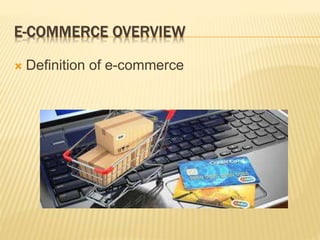
E-COMMERCE OVERVIEW
 Definition of e-commerce
DEFINITION OF E-COMMERCE
 E-commerce or electronic commerce is a
process of buying, and selling, transferring,
or exchange products ,services ,and /or
information via electronic networks and
computers
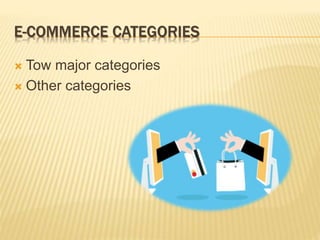
E-COMMERCE CATEGORIES
 Tow major categories
 Other categories
TOW MAJOR CATEGORIES
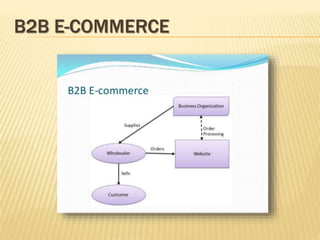
o Business to business (B2B)
Business that sells products or
provides services to other business.
B2B E-COMMERCE
TOW MAJOR CATEGORIES
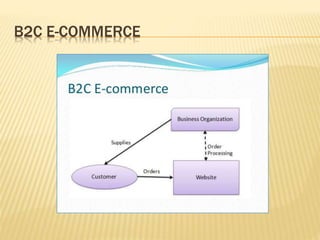
o business to consumer (B2C)
 business that sells products or provides
services to end –user consumer
B2C E-COMMERCE
OTHER CATEGORIES
 consumer to consumer (C2C)
 government to business (G2B)
 mobile commerce (m-commerce )
Brief history of e-commerce
1970
o E-commerce meant the facilitation of commercial
transaction electronically, using technology such as
electronic data interchange (EDI)and electronic funds
transfer (EFT),allowing business to send commercial
documents like purchase orders or invoices
electronically
History of E-Commerce
 1980 s
 The growth and acceptance of credit card .
 Automated teller machines (ATM)
 Telephone banking
 Airline reservation system
History of E-commerce (cont)…
1990s
 The internet commercialized and users flocked to
participate in the form of doc-coms , or internet start
up
History of E-commerce (cont)…
2000s
 Many European and American business companies
offered their services through the world wide web.
 Since then, people began to associate a word “e-
commerce “
History of E-commerce (cont)…
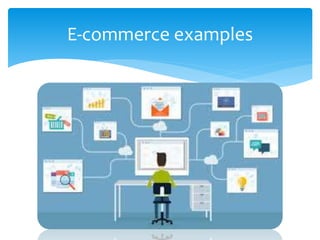
E-commerce examples
Advantage and Disadvantage
Advantage for costumers
 Convenience. Every product is at the tip of your fingers on
the internet, literally.
 Time saving. With e-commerce there is no driving in
circles while looking and digging in hopes of finding what
you need.
 Options, options, options! Without driving from store to
store the consumer can easily compare and contrast
products.
 Easy to find reviews. Because the competition is high,
companies online want you to look at other consumer
reviews.
 Easy to compare. Side by side comparisons are readily
available and easy to do.
Advantages for Businesses
 Increasing customer base. The customer base is every
business’s main concern, online or off.
 Rise in sales. By not managing a storefront, any business
will have more sales online with a higher profit margin.
 Recurring payments made easy. With a little research,
every business can set up recurring payments.
 Instant transactions. With e-commerce there is no more
waiting for the check to clear, or a 30-day wait for certain
other types of payment.
 Expand business reach. A great tool on the internet
is…translation! A business online does not have to make a
site for every language.
Disadvantage for customers
 Privacy and security. Before making instant transactions
online, be sure to check the sites certificates of security.
 Quality. While e-commerce makes everything easily
accessible, a consumer cannot actually touch products
until they are delivered to the door.
 Hidden costs. When making purchases, the consumer is
aware of the product cost, shipping, handling and possible
taxes.
 Delay in receiving goods. Although delivery of products
is often quicker than expected, be prepared for delays. A
snow storm in one place may throw off the shipping system
Conclusion
 By using electronic technology through the internet, it
achieved
* More competitions, more marketplaces, faster
transactions, and more advanced technologies to make
activities between customers and producers more
active.
* We as customers and internet users are
responsible to keep our e-commerce healthy and safe
so that e-business can be more reliable in the future.
Disadvantages for Businesses
 Credit card issues. Many credit card businesses will take
the side of the consumer when there is dispute about
billing—they want to keep their clients, too.
 Extra expense and expertise for e-commerce
infrastructure. To be sure an online business is running
correctly, money will have to be invested.
 Constant upkeep. When a business has started as e-
commerce, they must be ready to make changes to stay
compatible.
 Needs for expanded reverse logistics. The infrastructure
of an online business must be on point.
E-COMMERECE

E-COMMERECE

  • 1.
  • 2.
  • 3.
    TABLE OF CONTENT Definition of e-commerce .  E-commerce categories.  Brief history of e-commerce .  Examples  Advantage and disadvantage.  References  Conclusion
  • 4.
  • 5.
    DEFINITION OF E-COMMERCE E-commerce or electronic commerce is a process of buying, and selling, transferring, or exchange products ,services ,and /or information via electronic networks and computers
  • 6.
    E-COMMERCE CATEGORIES  Towmajor categories  Other categories
  • 7.
    TOW MAJOR CATEGORIES oBusiness to business (B2B) Business that sells products or provides services to other business.
  • 8.
  • 9.
    TOW MAJOR CATEGORIES obusiness to consumer (B2C)  business that sells products or provides services to end –user consumer
  • 10.
  • 11.
    OTHER CATEGORIES  consumerto consumer (C2C)  government to business (G2B)  mobile commerce (m-commerce )
  • 12.
    Brief history ofe-commerce
  • 13.
    1970 o E-commerce meantthe facilitation of commercial transaction electronically, using technology such as electronic data interchange (EDI)and electronic funds transfer (EFT),allowing business to send commercial documents like purchase orders or invoices electronically History of E-Commerce
  • 14.
     1980 s The growth and acceptance of credit card .  Automated teller machines (ATM)  Telephone banking  Airline reservation system History of E-commerce (cont)…
  • 15.
    1990s  The internetcommercialized and users flocked to participate in the form of doc-coms , or internet start up History of E-commerce (cont)…
  • 16.
    2000s  Many Europeanand American business companies offered their services through the world wide web.  Since then, people began to associate a word “e- commerce “ History of E-commerce (cont)…
  • 17.
  • 18.
  • 19.
    Advantage for costumers Convenience. Every product is at the tip of your fingers on the internet, literally.  Time saving. With e-commerce there is no driving in circles while looking and digging in hopes of finding what you need.  Options, options, options! Without driving from store to store the consumer can easily compare and contrast products.  Easy to find reviews. Because the competition is high, companies online want you to look at other consumer reviews.  Easy to compare. Side by side comparisons are readily available and easy to do.
  • 20.
    Advantages for Businesses Increasing customer base. The customer base is every business’s main concern, online or off.  Rise in sales. By not managing a storefront, any business will have more sales online with a higher profit margin.  Recurring payments made easy. With a little research, every business can set up recurring payments.  Instant transactions. With e-commerce there is no more waiting for the check to clear, or a 30-day wait for certain other types of payment.  Expand business reach. A great tool on the internet is…translation! A business online does not have to make a site for every language.
  • 21.
    Disadvantage for customers Privacy and security. Before making instant transactions online, be sure to check the sites certificates of security.  Quality. While e-commerce makes everything easily accessible, a consumer cannot actually touch products until they are delivered to the door.  Hidden costs. When making purchases, the consumer is aware of the product cost, shipping, handling and possible taxes.  Delay in receiving goods. Although delivery of products is often quicker than expected, be prepared for delays. A snow storm in one place may throw off the shipping system
  • 23.
    Conclusion  By usingelectronic technology through the internet, it achieved * More competitions, more marketplaces, faster transactions, and more advanced technologies to make activities between customers and producers more active. * We as customers and internet users are responsible to keep our e-commerce healthy and safe so that e-business can be more reliable in the future.
  • 24.
    Disadvantages for Businesses Credit card issues. Many credit card businesses will take the side of the consumer when there is dispute about billing—they want to keep their clients, too.  Extra expense and expertise for e-commerce infrastructure. To be sure an online business is running correctly, money will have to be invested.  Constant upkeep. When a business has started as e- commerce, they must be ready to make changes to stay compatible.  Needs for expanded reverse logistics. The infrastructure of an online business must be on point.