E-COMMERCE
PRESENTED BY-
• HIMANSHU KAUSHIK
• SUKHDEV YADAV
• YASH JAIN
• NISHITA CHAWLA
• VANSHIKA
• ANKIT KUMAR GUPTA
• AZAD YADAV
E-Commerce Overview
 Definition of E-Commerce
 Brief History of E-Commerce
1
Definition of E-Commerce
 E-Commerce or Electronic commerce is a
process of buying, selling, transferring, or
exchanging products, services, and/or
information via electronic networks and
computers
Brief History of E-Commerce
 1970s
E- commerce meant the facilitation of
commercial transactions electronically, using
technology such as Electronic Data
Interchange (EDI) and Electronic Funds
Transfer (EFT), allowing businesses to send
commercial documents like purchase orders
or invoices electronically.
Brief History of E-Commerce (cont)..
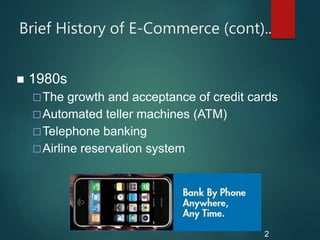
 1980s
The growth and acceptance of credit cards
Automated teller machines (ATM)
Telephone banking
Airline reservation system
2
Brief History of E-Commerce
(cont)..
 1990s
The Internet commercialized and users
flocked to participate in the form of dot-coms,
or Internet start-ups
Innovative applications ranging from online
direct sales to e-learning experiences
Brief History of E-Commerce
(cont)..
 2000s
Many European and American business
companies offered their services through the
World Wide Web.
Since then, People began to associate a word
“e-commerce”
E-Commerce Categories
 Two major categories
 Other categories
3
Two Major Categories
 Business-to-consumer (B2C) :
Online transactions are made between
businesses and individual consumers. E.g.
Amazon.com, eBay.com.
 Business-to-business (B2B):
Businesses make online transactions with other
businesses.
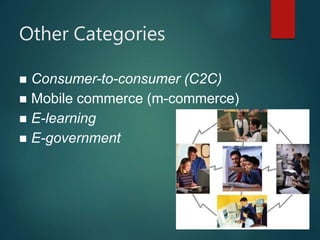
Other Categories
 Consumer-to-consumer (C2C)
 Mobile commerce (m-commerce)
 E-learning
 E-government
4
Benefits of E-Commerce
 Benefits to organizations
 Benefits to consumers
5
Benefits to organizations
 Global reach
 Cost reduction
 Supply chain improvements
 Extended hours: 24/7/365
 Customization
 Improved customer relations
Benefits to consumers
 More products and services
 Cheaper products and services
 Instant delivery
 Information availability
 Participation in auctions
Business applications
 Email
 Instant messaging
 Online shopping and order tracking
 Online banking
 Shopping cart software
 Teleconferencing
 Electronic tickets
Online Shopping
 Online shopping is the process of buying
goods and services from merchants who
sell on the Internet.
 Online consumers are evenly split
between men and women and tend to be
better educated, younger, and more
affluent than the general population.
Online Shopping (cont)..
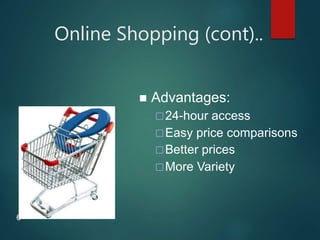
 Advantages:
24-hour access
Easy price comparisons
Better prices
More Variety
6
Online Shopping
(cont)
 DISADVANTAGES:
 Delay in delivery.
 Lack of close examination in online shopping
 Frauds in online shopping.
 Lack of touch and feel of merchandise
in online shopping.
Online Shopping (cont)..
How do you buy something
7
Interesting Facts and Statistics
 Every 1.2 seconds, a Canadian makes a
purchase with their PayPal account
 Almost 20 per cent of Canadians make three or
more online purchases per month.
8
Summary and Conclusion
 The Internet has lead to the birth and evolution
E-commerce. E-commerce has now become a
key component of many organizations in the
daily running of their business.
 As the Internet and in turn E-commerce has
developed, and continues to evolve and grow, it
is vital that any organization, in any particular
industry, must base its strategic planning around
such a rapidly growing medium.
Thank You

Are there any
questions?

Electronic Commerce

  • 1.
  • 2.
    PRESENTED BY- • HIMANSHUKAUSHIK • SUKHDEV YADAV • YASH JAIN • NISHITA CHAWLA • VANSHIKA • ANKIT KUMAR GUPTA • AZAD YADAV
  • 3.
    E-Commerce Overview  Definitionof E-Commerce  Brief History of E-Commerce 1
  • 4.
    Definition of E-Commerce E-Commerce or Electronic commerce is a process of buying, selling, transferring, or exchanging products, services, and/or information via electronic networks and computers
  • 5.
    Brief History ofE-Commerce  1970s E- commerce meant the facilitation of commercial transactions electronically, using technology such as Electronic Data Interchange (EDI) and Electronic Funds Transfer (EFT), allowing businesses to send commercial documents like purchase orders or invoices electronically.
  • 6.
    Brief History ofE-Commerce (cont)..  1980s The growth and acceptance of credit cards Automated teller machines (ATM) Telephone banking Airline reservation system 2
  • 7.
    Brief History ofE-Commerce (cont)..  1990s The Internet commercialized and users flocked to participate in the form of dot-coms, or Internet start-ups Innovative applications ranging from online direct sales to e-learning experiences
  • 8.
    Brief History ofE-Commerce (cont)..  2000s Many European and American business companies offered their services through the World Wide Web. Since then, People began to associate a word “e-commerce”
  • 9.
    E-Commerce Categories  Twomajor categories  Other categories 3
  • 10.
    Two Major Categories Business-to-consumer (B2C) : Online transactions are made between businesses and individual consumers. E.g. Amazon.com, eBay.com.  Business-to-business (B2B): Businesses make online transactions with other businesses.
  • 11.
    Other Categories  Consumer-to-consumer(C2C)  Mobile commerce (m-commerce)  E-learning  E-government 4
  • 12.
    Benefits of E-Commerce Benefits to organizations  Benefits to consumers 5
  • 13.
    Benefits to organizations Global reach  Cost reduction  Supply chain improvements  Extended hours: 24/7/365  Customization  Improved customer relations
  • 14.
    Benefits to consumers More products and services  Cheaper products and services  Instant delivery  Information availability  Participation in auctions
  • 15.
    Business applications  Email Instant messaging  Online shopping and order tracking  Online banking  Shopping cart software  Teleconferencing  Electronic tickets
  • 16.
    Online Shopping  Onlineshopping is the process of buying goods and services from merchants who sell on the Internet.  Online consumers are evenly split between men and women and tend to be better educated, younger, and more affluent than the general population.
  • 17.
    Online Shopping (cont).. Advantages: 24-hour access Easy price comparisons Better prices More Variety 6
  • 18.
    Online Shopping (cont)  DISADVANTAGES: Delay in delivery.  Lack of close examination in online shopping  Frauds in online shopping.  Lack of touch and feel of merchandise in online shopping.
  • 19.
    Online Shopping (cont).. Howdo you buy something 7
  • 20.
    Interesting Facts andStatistics  Every 1.2 seconds, a Canadian makes a purchase with their PayPal account  Almost 20 per cent of Canadians make three or more online purchases per month. 8
  • 21.
    Summary and Conclusion The Internet has lead to the birth and evolution E-commerce. E-commerce has now become a key component of many organizations in the daily running of their business.  As the Internet and in turn E-commerce has developed, and continues to evolve and grow, it is vital that any organization, in any particular industry, must base its strategic planning around such a rapidly growing medium.
  • 22.