E-Commerce in
Bangladesh
Electronic commerce popularly known as
ecommerce is a type of industry where buying and
selling of product is done by internet or computer
networks. It includes technologies like mobile
commerce, supply chain management, internet
marketing, automated data collection system etc.
E-commerce is divided mainly to 4 categories
 1.B to B(business to business)
 2.B to C(business to consumer)
 3.C to B(consumer to business)
 4.C to C(consumer to consumer)
Today's e-commerce was certainly not in this
manner years back.
So, lets see how it was started.
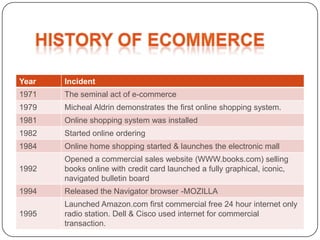
Year Incident
1971 The seminal act of e-commerce
1979 Micheal Aldrin demonstrates the first online shopping system.
1981 Online shopping system was installed
1982 Started online ordering
1984 Online home shopping started & launches the electronic mall
1992
Opened a commercial sales website (WWW.books.com) selling
books online with credit card launched a fully graphical, iconic,
navigated bulletin board
1994 Released the Navigator browser -MOZILLA
1995
Launched Amazon.com first commercial free 24 hour internet only
radio station. Dell & Cisco used internet for commercial
transaction.
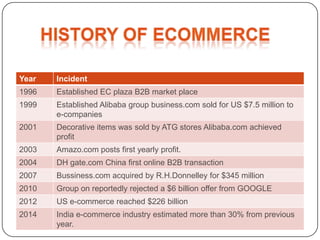
Year Incident
1996 Established EC plaza B2B market place
1999 Established Alibaba group business.com sold for US $7.5 million to
e-companies
2001 Decorative items was sold by ATG stores Alibaba.com achieved
profit
2003 Amazo.com posts first yearly profit.
2004 DH gate.com China first online B2B transaction
2007 Bussiness.com acquired by R.H.Donnelley for $345 million
2010 Group on reportedly rejected a $6 billion offer from GOOGLE
2012 US e-commerce reached $226 billion
2014 India e-commerce industry estimated more than 30% from previous
year.
 Online banking
 Hotel booking
 Airline ticket booking
 Ready made garment
 Oil and Gas Sector
 Online Marketing
 Pay Bill
 Education
 The potential for ecommerce exists in virtually every
economy.
 Stand out in the competition against exporters in
other countries.
 UNCTAD and WTO have put much emphasis on the
importance of E Commerce for developing
countries.
 Buyers and importers gain a clear advantage when
the Internet gives them access to the global market.
 Provides consumers with more choices.
 Expands the Marketplace to national and
international market.
 Decrease the cost of production and distribution.
 Allows consumers to interact and exchange ideas.
 Enables consumers to shop or other transaction 24
hours a day.
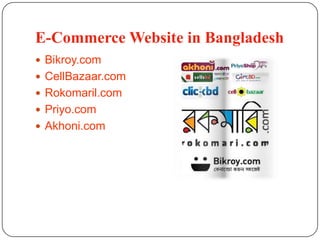
E-Commerce Website in Bangladesh
 Bikroy.com
 CellBazaar.com
 Rokomaril.com
 Priyo.com
 Akhoni.com
 High price of computer and hardware
 Very minimum number of users of web sites
 Telecommunication infrastructure is poor
 Lack of technically efficient personnel
 Small number of Credit Card users
 Fulfillment & customer relation problem
 To make ecommerce successful in our country we
need the help of all aspect of people as well as
govt. and business industry to cope up or
overcome the following limitations
 Access to computer of household should be
increased
 The cost of using internet should be affordable to
general people
 User of software should be more simple for the
easier use
 Its use should be made as easy as TV and
newspaper so that it require unsophisticated skill
E commerce in bangladesh

E commerce in bangladesh

  • 1.
  • 2.
    Electronic commerce popularlyknown as ecommerce is a type of industry where buying and selling of product is done by internet or computer networks. It includes technologies like mobile commerce, supply chain management, internet marketing, automated data collection system etc.
  • 3.
    E-commerce is dividedmainly to 4 categories  1.B to B(business to business)  2.B to C(business to consumer)  3.C to B(consumer to business)  4.C to C(consumer to consumer)
  • 4.
    Today's e-commerce wascertainly not in this manner years back. So, lets see how it was started.
  • 5.
    Year Incident 1971 Theseminal act of e-commerce 1979 Micheal Aldrin demonstrates the first online shopping system. 1981 Online shopping system was installed 1982 Started online ordering 1984 Online home shopping started & launches the electronic mall 1992 Opened a commercial sales website (WWW.books.com) selling books online with credit card launched a fully graphical, iconic, navigated bulletin board 1994 Released the Navigator browser -MOZILLA 1995 Launched Amazon.com first commercial free 24 hour internet only radio station. Dell & Cisco used internet for commercial transaction.
  • 6.
    Year Incident 1996 EstablishedEC plaza B2B market place 1999 Established Alibaba group business.com sold for US $7.5 million to e-companies 2001 Decorative items was sold by ATG stores Alibaba.com achieved profit 2003 Amazo.com posts first yearly profit. 2004 DH gate.com China first online B2B transaction 2007 Bussiness.com acquired by R.H.Donnelley for $345 million 2010 Group on reportedly rejected a $6 billion offer from GOOGLE 2012 US e-commerce reached $226 billion 2014 India e-commerce industry estimated more than 30% from previous year.
  • 9.
     Online banking Hotel booking  Airline ticket booking  Ready made garment  Oil and Gas Sector  Online Marketing  Pay Bill  Education
  • 10.
     The potentialfor ecommerce exists in virtually every economy.  Stand out in the competition against exporters in other countries.  UNCTAD and WTO have put much emphasis on the importance of E Commerce for developing countries.  Buyers and importers gain a clear advantage when the Internet gives them access to the global market.
  • 11.
     Provides consumerswith more choices.  Expands the Marketplace to national and international market.  Decrease the cost of production and distribution.  Allows consumers to interact and exchange ideas.  Enables consumers to shop or other transaction 24 hours a day.
  • 12.
    E-Commerce Website inBangladesh  Bikroy.com  CellBazaar.com  Rokomaril.com  Priyo.com  Akhoni.com
  • 13.
     High priceof computer and hardware  Very minimum number of users of web sites  Telecommunication infrastructure is poor  Lack of technically efficient personnel  Small number of Credit Card users  Fulfillment & customer relation problem
  • 14.
     To makeecommerce successful in our country we need the help of all aspect of people as well as govt. and business industry to cope up or overcome the following limitations  Access to computer of household should be increased  The cost of using internet should be affordable to general people  User of software should be more simple for the easier use  Its use should be made as easy as TV and newspaper so that it require unsophisticated skill