WELCOME
LEARNING DISABILITY
It refers to a mixed group of disorders
manifested by significant difficulties in
the acquisition and use of listening,
speaking, writing, reasoning or
mathematical abilities.
TYPES OF LEARNING DISABILITIES
 Dyslexia
 Dysgraphia
 Dyscalculia
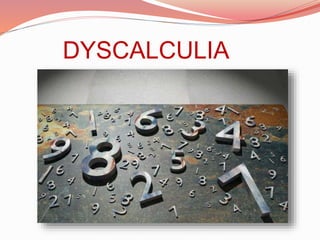
DYSCALCULIA
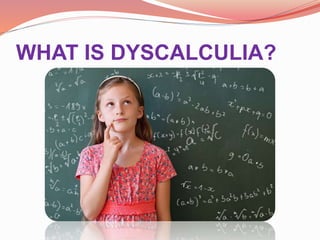
WHAT IS DYSCALCULIA?
ETYMOLOGY
 Dyscalculia Comes from Greek and Latin
 “Dys” means “badly”.
 “Calculia”- from the Latin word
“Calculare” , means “to count”.
 So that Dyscalculia means:
“ Counting badly ”.
DEFINITION
The department for education
defined it as:
“ A condition that affects the ability
to acquire arithmetic skills ” .
MORE ABOUT DYSCALCULIA
 Difficulty in learning or comprehending arithmetic.
 Difficulty with calculations.
 Difficulty in understanding numbers.
 It is generally seen as a specific developmental
disorder.
1 in 20 school aged children will have dyscalculia.
Estimate of prevalence of range between 3 and 6% of
population.
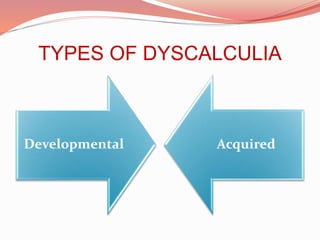
TYPES OF DYSCALCULIA
Developmental Acquired
SYMPTOMS
Difficulty in:
 classifying mathematical signs.
 Reading a clock and telling time.
 Calculating basic accounts like bills.
 Learning multiplication tables.
 Using calculators.
 Learning and remembering mathematical rules and formulas.
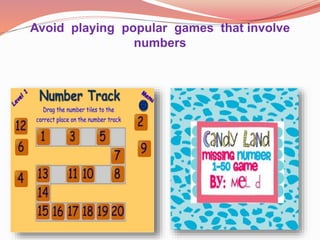
 Playing games that involve numbers.
 Reading analog clocks / Telling the time.
 Conceptualizing time and judging the passing of time.
 Judging distance.
 Handling money.
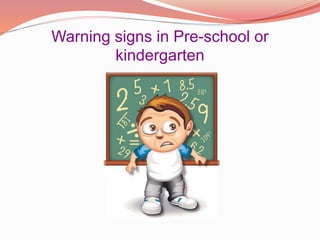
Warning signs in Pre-school or
kindergarten
Trouble in learning to count
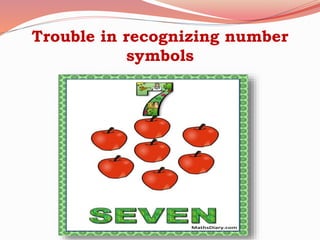
Trouble in recognizing number
symbols
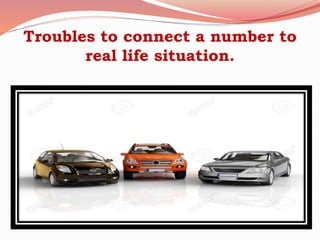
Troubles to connect a number to
real life situation.
Avoid playing popular games that involve
numbers
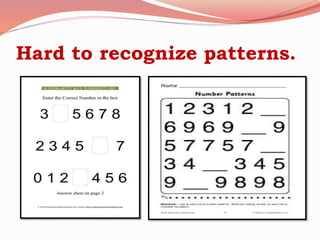
Hard to recognize patterns.
WARNING SIGNS IN MIDDLE SCHOOL
Trouble recognizing numbers
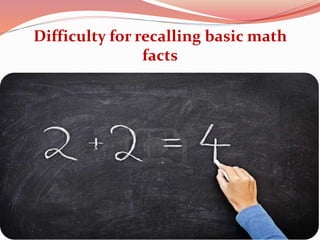
Difficulty for recalling basic math
facts
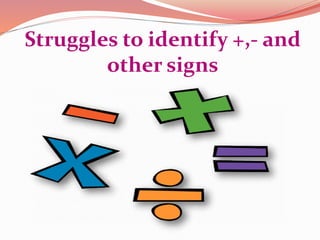
Struggles to identify +,- and
other signs
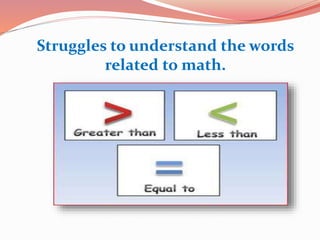
Struggles to understand the words
related to math.
Difficulty for remembering phone
number
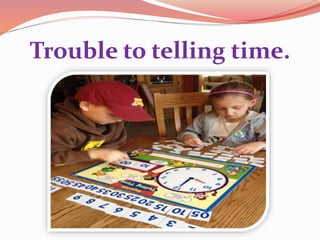
Trouble to telling time.
WARNING SIGNS IN HIGH SCHOOL
Struggles to apply math concepts
in daily life
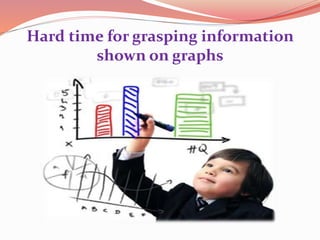
Hard time for grasping information
shown on graphs
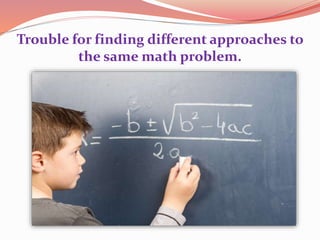
Trouble for finding different approaches to
the same math problem.
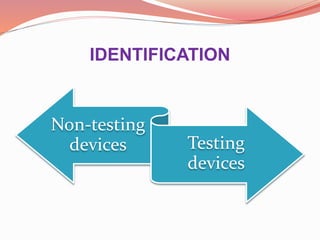
IDENTIFICATION
Non-testing
devices Testing
devices
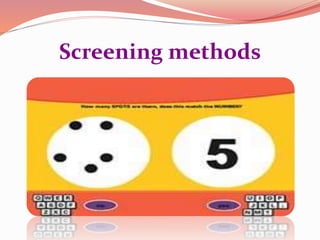
Screening methods
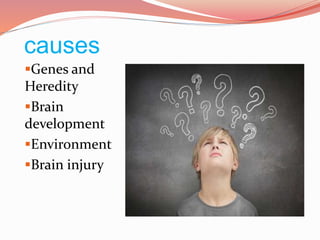
causes
Genes and
Heredity
Brain
development
Environment
Brain injury
What can be done at home for
dyscalculia?
Learn as much as you can.
Play math games.
Create a home work station.
Cozy up with the calculator.
Boost confidence.
Help your child keep track of time.
Be up beat.
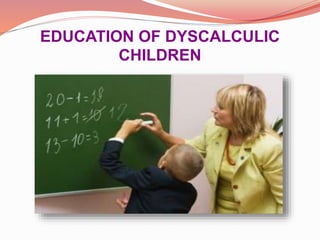
EDUCATION OF DYSCALCULIC
CHILDREN
Role of a teacher
 Every day examples.
 Repeated reinforcement.
 Encourage in their work.
 Encourage to ask questions.
 Teach multisensory study skills.
 Use concrete-pictorial-abstract approach.
 Opportunity to drill on skills.
 Use memory tricks.

 Use concrete pictorial-abstract approach.
Dyscalculia

Dyscalculia