The Counselor:
Person and
Professional
MAP108 – Psychological Counseling and Psychotherapy
“One of the important instruments you
have to work with as a counselor is
yourself as a person” (Corey, 2017, p. 18).
Counselor as a Therapeutic
Person
• Authenticity is an important characteristic in the therapeutic
relationship.
• Who the psychotherapist is directly relates to his/her ability to
establish and maintain effective therapy relationships with clients.
• Determinants of Therapeutic Outcome
• The alliance
• The relationship
• Personal and interpersonal skills of the therapist
• Client agency
• Extra-therapeutic factors
Counselor as a Therapeutic
Person
• Authenticity is an important characteristic in the therapeutic
relationship.
• Who the psychotherapist is directly relates to his/her ability to
establish and maintain effective therapy relationships with clients.
• Determinants of Therapeutic Outcome:
• The alliance
• The relationship
• Personal and interpersonal skills of the therapist
• Client agency
• Extra-therapeutic factors
The Counselor
MUST NOT…
• Be emotionally distressed
• Be coping vicariously
• Lonely and isolated
• Controlling
• Grandiose and Narcissistic
• Have unresolved anger
MUST…
• Be curious and inquisitive
• Be able to listen
• Find comfort with conversation
• Have empathy and understanding
• Be emotionally insightful
• Be Introspective
• Have the capacity for self-denial
• Be tolerant of intimacy
• Be comfortable with power
• Have the ability to laugh
• Have an intentional “alonetime”
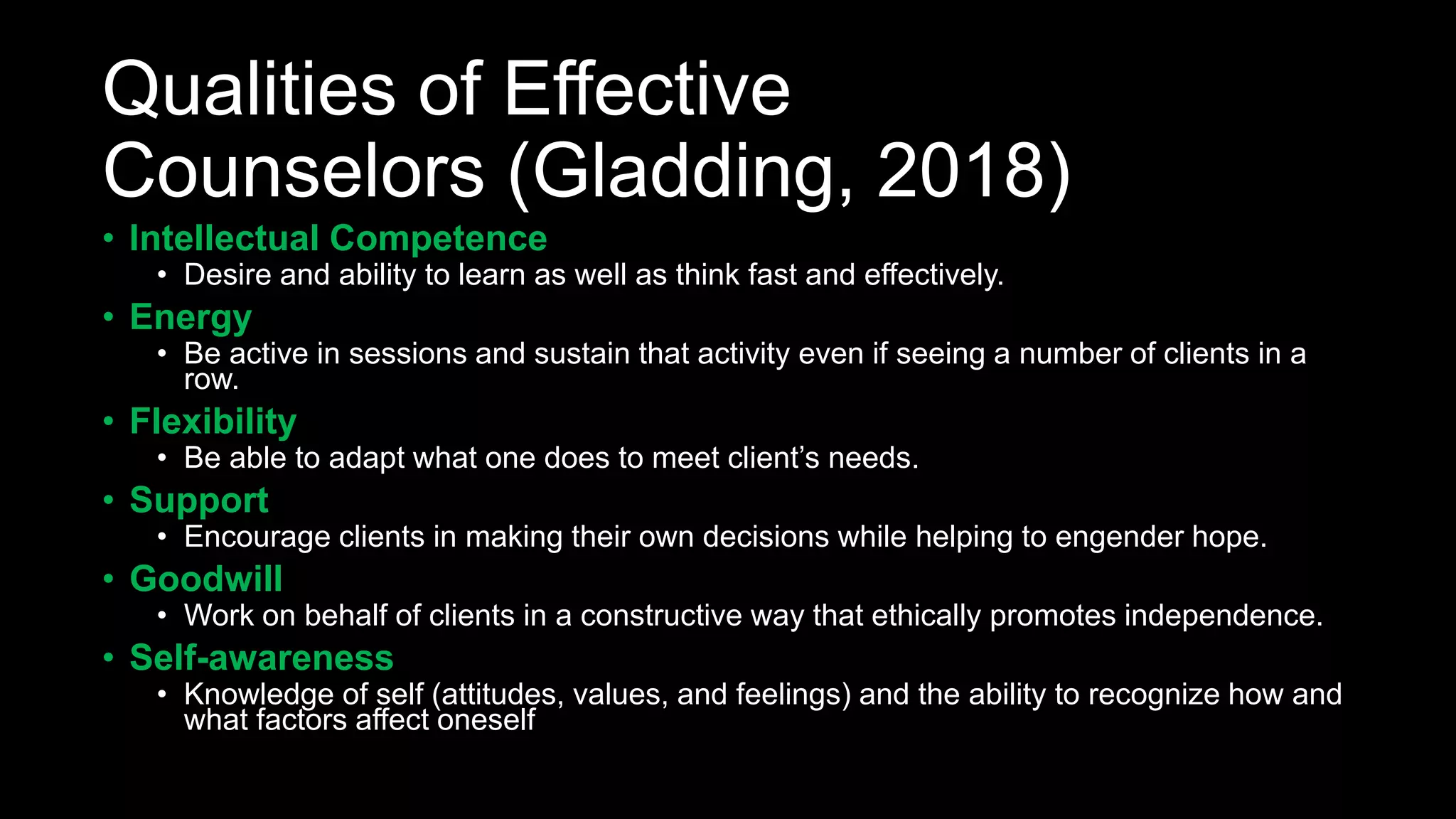
Qualities of Effective
Counselors (Gladding, 2018)
• Intellectual Competence
• Desire and ability to learn as well as think fast and effectively.
• Energy
• Be active in sessions and sustain that activity even if seeing a number of clients in a
row.
• Flexibility
• Be able to adapt what one does to meet client’s needs.
• Support
• Encourage clients in making their own decisions while helping to engender hope.
• Goodwill
• Work on behalf of clients in a constructive way that ethically promotes independence.
• Self-awareness
• Knowledge of self (attitudes, values, and feelings) and the ability to recognize how and
what factors affect oneself
Personal Therapy for the
Counselor
• Benefits to Therapist’s Professional Work:
• It offers a model of therapeutic practice in which the trainee experiences
the work of an experienced therapist and learn what is helpful or not.
• Enhance the therapist’s interpersonal skills.
• Contributes to the therapist’s ability to deal with the ongoing stresses
associated with clinical work
• Help prevent potential countertransference in the future.
• Awareness of inner conflicts to acknowledge how it may affect us
in practice.
Counselor’s Values and the
Therapeutic Process: Values in
Counseling• Our values are the core beliefs influencing how we act personally and
professionally.
• Guard ourselves against the tendency to use our power to influence
clients in accepting our values.
• The goal of counseling is to assist individuals in finding answers
that are congruent with their own values.
• We must provide a safe and inviting environment with which the
clients can explore congruence between their values and behavior.
• We must have the ability to work with a range of clients with diverse
worldviews and values.
Counselor’s Values and the
Therapeutic Process: Values in
Therapeutic Goals• The general goals of counselor must be congruent with the
personal goals of the client.
• The client and counselor need to explore what they hope to
obtain from the working relationship, whether they can work with
one another, and whether the goals are compatible.
• Initial interview can be used most productively to focus on
client’s goals or the lack thereof.
• Bracketing – managing personal values in order to not
contaminate the counseling process
Becoming a Multicultural
Counselor
• Culture – the values and behaviors
• It is an ethical obligation to develop sensitivity to cultural
differences.
• Counselors need to become aware of how clients fron diverse
backgrounds may perceive them as well as their perception of
the value of formal helping.
Becoming a Multicultural
Counselor
• Everyone has biases. It takes effort and vigilance to monitor
these biases
• A major part of becoming a diversity-competent counselor
involves challenging the idea that the values we hold are
automatically true for others.
Becoming a Multicultural
Counselor
• Everyone has biases. It takes effort and vigilance to monitor these
biases
• A major part of becoming a diversity-competent counselor involves
challenging the idea that the values we hold are automatically true for
others.
• It is critical to take into account the worldview and background of
every client.
• Different theories have different features to appeal to distinct cultural
groups.
• Effective practice involves an open stance from the practitioner,
flexibility, and willingness to modify strategies.
Dimensions of Competency in
Multicultural Counseling
Beliefs and Attitudes
• Cultural self-awareness and
sensitivity is essential
• Examine and understand the
world from the vantage point of
clients.
• Realize that traditional theories
and techniques may not be
appropriate for all clients or
problems.
• Monitor functioning through
consultation, supervision, and
further training/education.
Knowledge
• Detect own racist attitudes,
beliefs, and feelings.
• Do not impose values and
expectations.
• Understand that external
sociopolitical forces influences
all.
• Awareness of the institutional
barriers preventing minorities in
utilizing mental health services.
• Knowledge about historical
background, traditions, and
values.
• Knowledge of community
characteristics and resources.
Skills and Intervention Strategies
• Use methods and strategies
and define goals consistent with
the life experiences and cultural
values of clients.
• Modify and adapt to
accommodate for cultural
differences
• Recognition that counseling
techniques may be culture-
bound.
Issues Faced by Beginning
Therapists
• A certain level of anxiety demonstrates awareness of uncertainties.
• Be open to discuss self-doubts with a supervisor and peer.
Dealing with Anxiety
• Being ourselves in therapy and appropriately disclosing our reactions increases our authenticity.
• Consider what, when, and how much to reveal.
• The most productive form of self-disclosure is going on between the counselor and the client
within the session.
Being Yourself and Self-Disclosure
• You will make mistakes regardless of being a beginner or a seasoned one.
Avoiding Perfectionism
Issues Faced by Beginning
Therapists
• It takes honesty to admit that you cannot work successfully with every client.
• Learn when and how to make a referral for clients.
Being Honest About Your Limitations
• Acknowledge and explore with clients the meaning of silence when it occurs
Understanding Silence
• Prepare them for the process.
Dealing with Clients Who Lack Commitment
• Clients may seemingly “get worse: before therapeutic gains.
• Realize that the fruitful effects of the joint efforts may manifest after the conclusion of therapy.
Tolerating Ambiguity
Issues Faced by Beginning
Therapists
• Countertransference – any projections that influences the way we perceive and react to a client
• Manifested by being triggered to becoming emotionally reactive, being defensive, or losing the ability to
be present in the relationship.
• It is not appropriate to use our clients in working our reactions to them.
• We do not carry the pain of our clients.
Becoming Aware of Your Countertransference
• Both clients and counselor can enrich a relationship through humor.
• Distinguish between a humor that distracts and a humor that enriches.
Developing a Sense of Humor
• Should be addressed early in the course of counseling.
• Discuss specific matters.
Sharing Responsibility with the Client
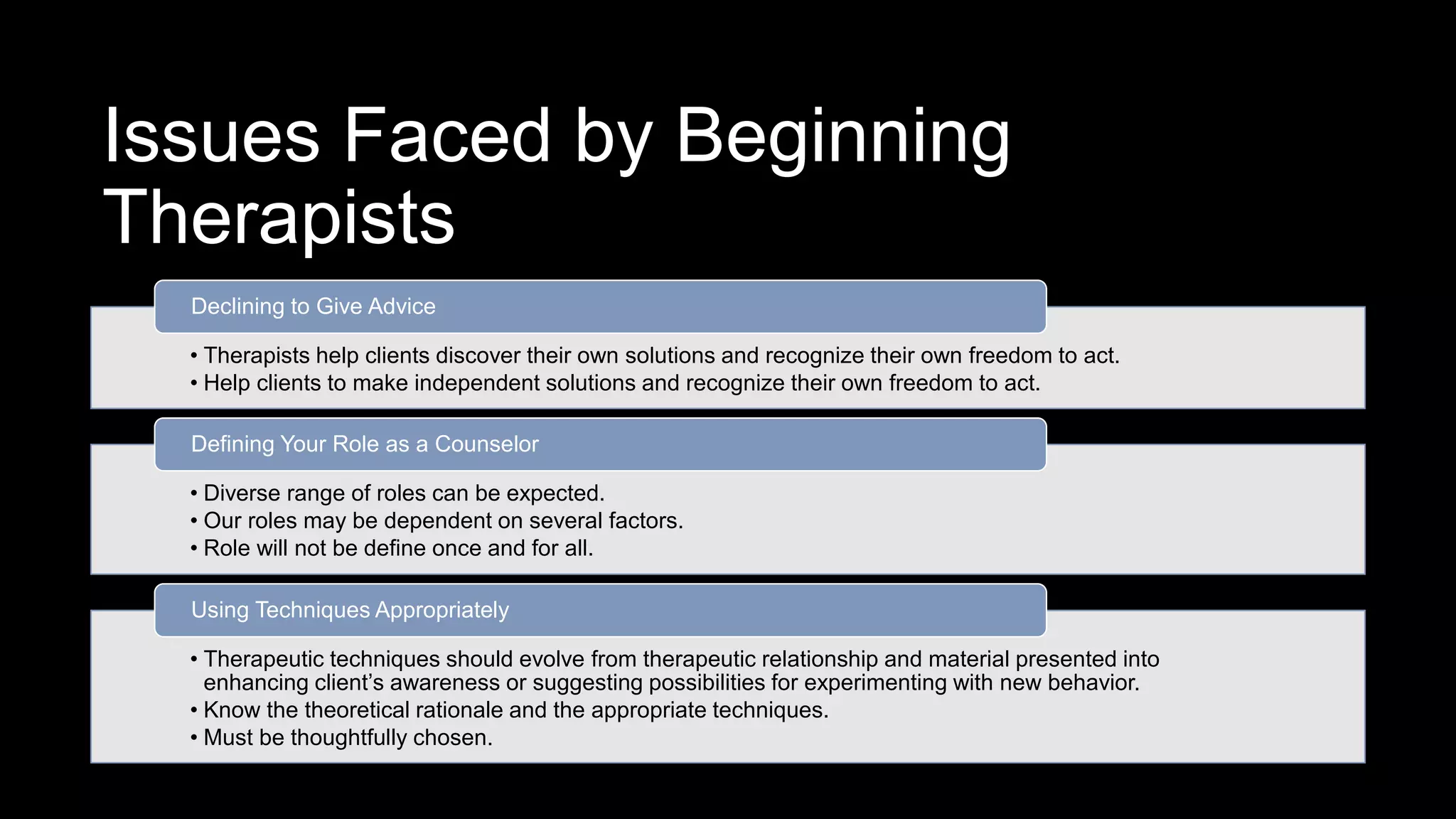
Issues Faced by Beginning
Therapists
• Therapists help clients discover their own solutions and recognize their own freedom to act.
• Help clients to make independent solutions and recognize their own freedom to act.
Declining to Give Advice
• Diverse range of roles can be expected.
• Our roles may be dependent on several factors.
• Role will not be define once and for all.
Defining Your Role as a Counselor
• Therapeutic techniques should evolve from therapeutic relationship and material presented into
enhancing client’s awareness or suggesting possibilities for experimenting with new behavior.
• Know the theoretical rationale and the appropriate techniques.
• Must be thoughtfully chosen.
Using Techniques Appropriately
Issues Faced by Beginning
Therapists
• Wide variations in approach can be very effective.
• Imitations of another’s style can inhibit our potential.
Developing your own counseling style
• Work at dealing with those factors that threaten to drain life from us and render us
helpless.
• May help prevent professional burnout.
• By being in-tune with ourselves, we experience a sense of personal power of
integrating life-experiences with professional experiences.
• If we neglect to take care of ourselves, our clients will not be getting the best of us.
• Our self-care should mirror the care we provide for others.
Maintaining your vitality as a person & professional
References
• Corey, G. (2017). Theory and practice of counseling and
psychotherapy (10th ed.). Cengage
• Gladding, S. (2018). Counseling: A comprehensive profession
(8th ed.). Pearson

Counselor: Person and Professional

  • 1.
    The Counselor: Person and Professional MAP108– Psychological Counseling and Psychotherapy
  • 2.
    “One of theimportant instruments you have to work with as a counselor is yourself as a person” (Corey, 2017, p. 18).
  • 3.
    Counselor as aTherapeutic Person • Authenticity is an important characteristic in the therapeutic relationship. • Who the psychotherapist is directly relates to his/her ability to establish and maintain effective therapy relationships with clients. • Determinants of Therapeutic Outcome • The alliance • The relationship • Personal and interpersonal skills of the therapist • Client agency • Extra-therapeutic factors
  • 4.
    Counselor as aTherapeutic Person • Authenticity is an important characteristic in the therapeutic relationship. • Who the psychotherapist is directly relates to his/her ability to establish and maintain effective therapy relationships with clients. • Determinants of Therapeutic Outcome: • The alliance • The relationship • Personal and interpersonal skills of the therapist • Client agency • Extra-therapeutic factors
  • 5.
    The Counselor MUST NOT… •Be emotionally distressed • Be coping vicariously • Lonely and isolated • Controlling • Grandiose and Narcissistic • Have unresolved anger MUST… • Be curious and inquisitive • Be able to listen • Find comfort with conversation • Have empathy and understanding • Be emotionally insightful • Be Introspective • Have the capacity for self-denial • Be tolerant of intimacy • Be comfortable with power • Have the ability to laugh • Have an intentional “alonetime”
  • 6.
    Qualities of Effective Counselors(Gladding, 2018) • Intellectual Competence • Desire and ability to learn as well as think fast and effectively. • Energy • Be active in sessions and sustain that activity even if seeing a number of clients in a row. • Flexibility • Be able to adapt what one does to meet client’s needs. • Support • Encourage clients in making their own decisions while helping to engender hope. • Goodwill • Work on behalf of clients in a constructive way that ethically promotes independence. • Self-awareness • Knowledge of self (attitudes, values, and feelings) and the ability to recognize how and what factors affect oneself
  • 7.
    Personal Therapy forthe Counselor • Benefits to Therapist’s Professional Work: • It offers a model of therapeutic practice in which the trainee experiences the work of an experienced therapist and learn what is helpful or not. • Enhance the therapist’s interpersonal skills. • Contributes to the therapist’s ability to deal with the ongoing stresses associated with clinical work • Help prevent potential countertransference in the future. • Awareness of inner conflicts to acknowledge how it may affect us in practice.
  • 8.
    Counselor’s Values andthe Therapeutic Process: Values in Counseling• Our values are the core beliefs influencing how we act personally and professionally. • Guard ourselves against the tendency to use our power to influence clients in accepting our values. • The goal of counseling is to assist individuals in finding answers that are congruent with their own values. • We must provide a safe and inviting environment with which the clients can explore congruence between their values and behavior. • We must have the ability to work with a range of clients with diverse worldviews and values.
  • 9.
    Counselor’s Values andthe Therapeutic Process: Values in Therapeutic Goals• The general goals of counselor must be congruent with the personal goals of the client. • The client and counselor need to explore what they hope to obtain from the working relationship, whether they can work with one another, and whether the goals are compatible. • Initial interview can be used most productively to focus on client’s goals or the lack thereof. • Bracketing – managing personal values in order to not contaminate the counseling process
  • 10.
    Becoming a Multicultural Counselor •Culture – the values and behaviors • It is an ethical obligation to develop sensitivity to cultural differences. • Counselors need to become aware of how clients fron diverse backgrounds may perceive them as well as their perception of the value of formal helping.
  • 11.
    Becoming a Multicultural Counselor •Everyone has biases. It takes effort and vigilance to monitor these biases • A major part of becoming a diversity-competent counselor involves challenging the idea that the values we hold are automatically true for others.
  • 12.
    Becoming a Multicultural Counselor •Everyone has biases. It takes effort and vigilance to monitor these biases • A major part of becoming a diversity-competent counselor involves challenging the idea that the values we hold are automatically true for others. • It is critical to take into account the worldview and background of every client. • Different theories have different features to appeal to distinct cultural groups. • Effective practice involves an open stance from the practitioner, flexibility, and willingness to modify strategies.
  • 13.
    Dimensions of Competencyin Multicultural Counseling Beliefs and Attitudes • Cultural self-awareness and sensitivity is essential • Examine and understand the world from the vantage point of clients. • Realize that traditional theories and techniques may not be appropriate for all clients or problems. • Monitor functioning through consultation, supervision, and further training/education. Knowledge • Detect own racist attitudes, beliefs, and feelings. • Do not impose values and expectations. • Understand that external sociopolitical forces influences all. • Awareness of the institutional barriers preventing minorities in utilizing mental health services. • Knowledge about historical background, traditions, and values. • Knowledge of community characteristics and resources. Skills and Intervention Strategies • Use methods and strategies and define goals consistent with the life experiences and cultural values of clients. • Modify and adapt to accommodate for cultural differences • Recognition that counseling techniques may be culture- bound.
  • 14.
    Issues Faced byBeginning Therapists • A certain level of anxiety demonstrates awareness of uncertainties. • Be open to discuss self-doubts with a supervisor and peer. Dealing with Anxiety • Being ourselves in therapy and appropriately disclosing our reactions increases our authenticity. • Consider what, when, and how much to reveal. • The most productive form of self-disclosure is going on between the counselor and the client within the session. Being Yourself and Self-Disclosure • You will make mistakes regardless of being a beginner or a seasoned one. Avoiding Perfectionism
  • 15.
    Issues Faced byBeginning Therapists • It takes honesty to admit that you cannot work successfully with every client. • Learn when and how to make a referral for clients. Being Honest About Your Limitations • Acknowledge and explore with clients the meaning of silence when it occurs Understanding Silence • Prepare them for the process. Dealing with Clients Who Lack Commitment • Clients may seemingly “get worse: before therapeutic gains. • Realize that the fruitful effects of the joint efforts may manifest after the conclusion of therapy. Tolerating Ambiguity
  • 16.
    Issues Faced byBeginning Therapists • Countertransference – any projections that influences the way we perceive and react to a client • Manifested by being triggered to becoming emotionally reactive, being defensive, or losing the ability to be present in the relationship. • It is not appropriate to use our clients in working our reactions to them. • We do not carry the pain of our clients. Becoming Aware of Your Countertransference • Both clients and counselor can enrich a relationship through humor. • Distinguish between a humor that distracts and a humor that enriches. Developing a Sense of Humor • Should be addressed early in the course of counseling. • Discuss specific matters. Sharing Responsibility with the Client
  • 17.
    Issues Faced byBeginning Therapists • Therapists help clients discover their own solutions and recognize their own freedom to act. • Help clients to make independent solutions and recognize their own freedom to act. Declining to Give Advice • Diverse range of roles can be expected. • Our roles may be dependent on several factors. • Role will not be define once and for all. Defining Your Role as a Counselor • Therapeutic techniques should evolve from therapeutic relationship and material presented into enhancing client’s awareness or suggesting possibilities for experimenting with new behavior. • Know the theoretical rationale and the appropriate techniques. • Must be thoughtfully chosen. Using Techniques Appropriately
  • 18.
    Issues Faced byBeginning Therapists • Wide variations in approach can be very effective. • Imitations of another’s style can inhibit our potential. Developing your own counseling style • Work at dealing with those factors that threaten to drain life from us and render us helpless. • May help prevent professional burnout. • By being in-tune with ourselves, we experience a sense of personal power of integrating life-experiences with professional experiences. • If we neglect to take care of ourselves, our clients will not be getting the best of us. • Our self-care should mirror the care we provide for others. Maintaining your vitality as a person & professional
  • 19.
    References • Corey, G.(2017). Theory and practice of counseling and psychotherapy (10th ed.). Cengage • Gladding, S. (2018). Counseling: A comprehensive profession (8th ed.). Pearson