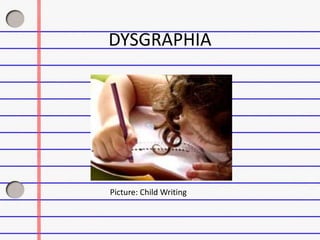
DYSGRAPHIA


Picture: Child Writing
WHAT IS DYSGRAPHIA?


• A learning disability that effects writing
  which requires a complex set of motor
      and information processing skills
WHAT IS DYSGRAPHIA?


 • Dysgraphia makes the act of writing
               difficult.

   • Leads to problems with spelling,
handwriting, and getting thoughts down on
                  paper.
WHAT ARE WARNING SIGNS OF
      DYSGRAPHIA?
Students with Dysgraphia may exhibit the
following:
  • Illegible handwriting
  • Saying words out loud while writing
  • Trouble forming letter shapes
  • Trouble keeping track of thoughts already
    written down
  • Difficulty with syntax structure and
    grammar
STRATAGIES TO HELP
• Accommodations: providing alternatives to
  written expression

• Modifications: changing expectations or tasks to
  minimize or avoid the area of weakness

• Remediation: providing instruction for
  improving handwriting and writing skills
ACCOMODATIONS
• Use of word processing or computer software

• Speech recognition software

• Increase amount of time a student has to copy
  work and complete tasks
MODIFICATIONS
• Eliminate “neatness” on grading rubric

• Develop cooperative writing projects that
  encourage students to work together and
  complete different tasks

• Offer alternative projects to a written report
  Ex: oral presentations
REMIDATIONS
• Provide students with raised line paper

• Allow students to use writing utensil of their
  choice and place a “griper” for more stability

• Occupational Therapy sessions to enhance
  motor skills
EXAMPLE LESSONS
• Shaving Cream Spelling
    • Spread shaving cream on students’ desks
    • Ask students to say the word, spell the
       word, then say it again
    • Instruct students to write the word in the
       shaving cream on their desk

     • Can be adapted for math facts
EXAMPLE LESSONS
• Bean Math Sentences
  • Give each child x number of beans (ex: 6)
  • Have them shake the beans (you can use a
    can to shake them in)
  • Instruct students to spill the beans
  • Say and record the number sentence.

• Example: If they shake four red and two white,
  the number sentence is 4 + 2 = 6.
UDL CONNECTION
• UDL encourages choice and autonomy in terms
  of work
     • Provide students with various assignment
       options

• Allow students to set their own goals and assess
  reflect on the progress they have made with teir
  work

Dysgraphia

  • 1.
  • 2.
    WHAT IS DYSGRAPHIA? •A learning disability that effects writing which requires a complex set of motor and information processing skills
  • 3.
    WHAT IS DYSGRAPHIA? • Dysgraphia makes the act of writing difficult. • Leads to problems with spelling, handwriting, and getting thoughts down on paper.
  • 4.
    WHAT ARE WARNINGSIGNS OF DYSGRAPHIA? Students with Dysgraphia may exhibit the following: • Illegible handwriting • Saying words out loud while writing • Trouble forming letter shapes • Trouble keeping track of thoughts already written down • Difficulty with syntax structure and grammar
  • 5.
    STRATAGIES TO HELP •Accommodations: providing alternatives to written expression • Modifications: changing expectations or tasks to minimize or avoid the area of weakness • Remediation: providing instruction for improving handwriting and writing skills
  • 6.
    ACCOMODATIONS • Use ofword processing or computer software • Speech recognition software • Increase amount of time a student has to copy work and complete tasks
  • 7.
    MODIFICATIONS • Eliminate “neatness”on grading rubric • Develop cooperative writing projects that encourage students to work together and complete different tasks • Offer alternative projects to a written report Ex: oral presentations
  • 8.
    REMIDATIONS • Provide studentswith raised line paper • Allow students to use writing utensil of their choice and place a “griper” for more stability • Occupational Therapy sessions to enhance motor skills
  • 9.
    EXAMPLE LESSONS • ShavingCream Spelling • Spread shaving cream on students’ desks • Ask students to say the word, spell the word, then say it again • Instruct students to write the word in the shaving cream on their desk • Can be adapted for math facts
  • 10.
    EXAMPLE LESSONS • BeanMath Sentences • Give each child x number of beans (ex: 6) • Have them shake the beans (you can use a can to shake them in) • Instruct students to spill the beans • Say and record the number sentence. • Example: If they shake four red and two white, the number sentence is 4 + 2 = 6.
  • 11.
    UDL CONNECTION • UDLencourages choice and autonomy in terms of work • Provide students with various assignment options • Allow students to set their own goals and assess reflect on the progress they have made with teir work