Created By : Howard Ong
LEARNING
DISABILITY
Dyslexia is a lifelong condition that a child will not out grow.
Dyslexia is not a vision problem, that is common misbelief
for other people that is a vision problem.
Mostly affects reading and may be referred to as
a “reading disorder”. Can also affect writing
spelling and speaking. Dyslexia can impact social
skills, listening comprehension, time
management memory and navigation or sense of
direction.
DYSLEXIA
 Reads and rereads with
little comprehension
 Difficulty spelling
 Spells phonetically and
inconsistently
 Difficulties learning and
communicating
 Handwriting struggles
Characteristics
Slow reading
Difficulty with
comprehension
Messy handwriting
Avoids reading out
loud
Difficulty spelling
What are the signs of dyslexia
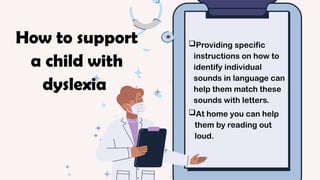
Providing specific
instructions on how to
identify individual
sounds in language can
help them match these
sounds with letters.
At home you can help
them by reading out
loud.
How to support
a child with
dyslexia
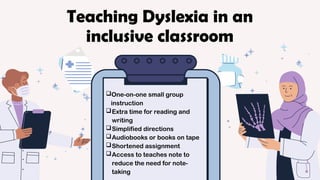
One-on-one small group
instruction
Extra time for reading and
writing
Simplified directions
Audiobooks or books on tape
Shortened assignment
Access to teaches note to
reduce the need for note-
taking
Teaching Dyslexia in an
inclusive classroom
Dysgraphia is a neurological condition in
which someone has difficulty turning their
thoughts into written language for their age
and ability to think, despite exposure to
adequate instruction and education.
Dysgraphia generally appears when children
are first learning to write. This is called
developmental dysgraphia. People can also
develop dysgraphia suddenly after some type of
head or brain trauma. This is called acquired
dysgraphia.
Dysgraphia is considered a “specific learning
disorder” — more specifically, a “specific learning
disorder in written expression. Dysgraphia has no
medication treatment. Instead, educational
interventions can teach effective, new ways to
write.
Dysgraphia is common in
children with a Autism Spectrum
Disorder (ASD) and/or Attention
Deficit Hyperactivity Disorder
(ADHD).
DYSGRAPHIA
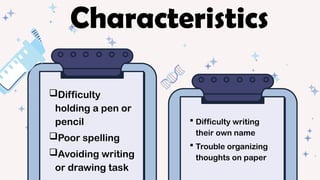
 Difficulty writing
their own name
 Trouble organizing
thoughts on paper
Difficulty
holding a pen or
pencil
Poor spelling
Avoiding writing
or drawing task
Characteristics
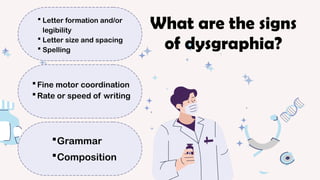
 Letter formation and/or
legibility
 Letter size and spacing
 Spelling
 Fine motor coordination
 Rate or speed of writing
Grammar
Composition
What are the signs
of dysgraphia?
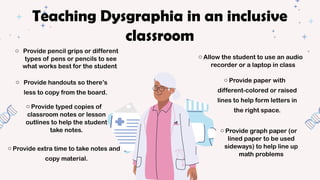
o Provide pencil grips or different
types of pens or pencils to see
what works best for the student
o Allow the student to use an audio
recorder or a laptop in class
o Provide extra time to take notes and
copy material.
o Provide typed copies of
classroom notes or lesson
outlines to help the student
take notes.
o Provide handouts so there’s
less to copy from the board.
o Provide graph paper (or
lined paper to be used
sideways) to help line up
math problems
o Provide paper with
different-colored or raised
lines to help form letters in
the right space.
Teaching Dysgraphia in an inclusive
classroom
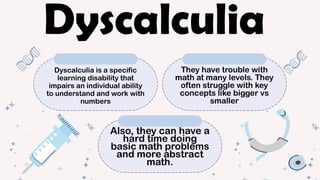
Dyscalculia is a specific
learning disability that
impairs an individual ability
to understand and work with
numbers
They have trouble with
math at many levels. They
often struggle with key
concepts like bigger vs
smaller
Also, they can have a
hard time doing
basic math problems
and more abstract
math.
Dyscalculia
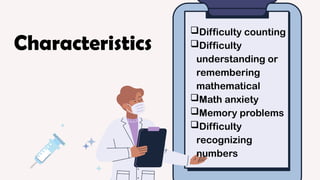
Difficulty counting
Difficulty
understanding or
remembering
mathematical
Math anxiety
Memory problems
Difficulty
recognizing
numbers
Characteristics
 Struggle with mental
math
 Problem with counting
 Trouble relating numbers to object,
like connecting the numbers “two”
indicates two objects or people.
 Difficulty spotting patterns, such as
arranging from the smallest to the
largest or far and close space
orientations
What are the
signs of
dyscalculia
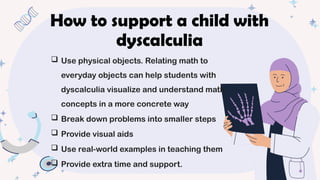
 Use physical objects. Relating math to
everyday objects can help students with
dyscalculia visualize and understand math
concepts in a more concrete way
 Break down problems into smaller steps
 Provide visual aids
 Use real-world examples in teaching them
 Provide extra time and support.
How to support a child with
dyscalculia
 Give a rubric that describes
the elements of the
assignment.
 Give the student a list of the
math formulas, math facts, or
tables.
 Create separate worksheets
for word problems and number
problems.
 Break down worksheets into
sections.
 Give more space to write
problems and solutions.
 Highlight or circle key words and
numbers on word problems.
 Give step-by-step instructions and
have the student repeat them.
 Provide checklists for common
multi-step procedures.
 Break down large assignments into
smaller, more manageable parts.
 Give extended time on lengthy
assignments or projects.
Teaching Dyscalculia in an
inclusive classroom
Thank you for your
attention

LEARNING-DISABILITY... Dyslexia, Dyscalculia, Dysgraphia

  • 1.
    Created By :Howard Ong LEARNING DISABILITY
  • 2.
    Dyslexia is alifelong condition that a child will not out grow. Dyslexia is not a vision problem, that is common misbelief for other people that is a vision problem. Mostly affects reading and may be referred to as a “reading disorder”. Can also affect writing spelling and speaking. Dyslexia can impact social skills, listening comprehension, time management memory and navigation or sense of direction. DYSLEXIA
  • 3.
     Reads andrereads with little comprehension  Difficulty spelling  Spells phonetically and inconsistently  Difficulties learning and communicating  Handwriting struggles Characteristics
  • 4.
    Slow reading Difficulty with comprehension Messyhandwriting Avoids reading out loud Difficulty spelling What are the signs of dyslexia
  • 5.
    Providing specific instructions onhow to identify individual sounds in language can help them match these sounds with letters. At home you can help them by reading out loud. How to support a child with dyslexia
  • 6.
    One-on-one small group instruction Extratime for reading and writing Simplified directions Audiobooks or books on tape Shortened assignment Access to teaches note to reduce the need for note- taking Teaching Dyslexia in an inclusive classroom
  • 8.
    Dysgraphia is aneurological condition in which someone has difficulty turning their thoughts into written language for their age and ability to think, despite exposure to adequate instruction and education. Dysgraphia generally appears when children are first learning to write. This is called developmental dysgraphia. People can also develop dysgraphia suddenly after some type of head or brain trauma. This is called acquired dysgraphia. Dysgraphia is considered a “specific learning disorder” — more specifically, a “specific learning disorder in written expression. Dysgraphia has no medication treatment. Instead, educational interventions can teach effective, new ways to write. Dysgraphia is common in children with a Autism Spectrum Disorder (ASD) and/or Attention Deficit Hyperactivity Disorder (ADHD). DYSGRAPHIA
  • 9.
     Difficulty writing theirown name  Trouble organizing thoughts on paper Difficulty holding a pen or pencil Poor spelling Avoiding writing or drawing task Characteristics
  • 10.
     Letter formationand/or legibility  Letter size and spacing  Spelling  Fine motor coordination  Rate or speed of writing Grammar Composition What are the signs of dysgraphia?
  • 11.
    o Provide pencilgrips or different types of pens or pencils to see what works best for the student o Allow the student to use an audio recorder or a laptop in class o Provide extra time to take notes and copy material. o Provide typed copies of classroom notes or lesson outlines to help the student take notes. o Provide handouts so there’s less to copy from the board. o Provide graph paper (or lined paper to be used sideways) to help line up math problems o Provide paper with different-colored or raised lines to help form letters in the right space. Teaching Dysgraphia in an inclusive classroom
  • 13.
    Dyscalculia is aspecific learning disability that impairs an individual ability to understand and work with numbers They have trouble with math at many levels. They often struggle with key concepts like bigger vs smaller Also, they can have a hard time doing basic math problems and more abstract math. Dyscalculia
  • 14.
    Difficulty counting Difficulty understanding or remembering mathematical Mathanxiety Memory problems Difficulty recognizing numbers Characteristics
  • 15.
     Struggle withmental math  Problem with counting  Trouble relating numbers to object, like connecting the numbers “two” indicates two objects or people.  Difficulty spotting patterns, such as arranging from the smallest to the largest or far and close space orientations What are the signs of dyscalculia
  • 16.
     Use physicalobjects. Relating math to everyday objects can help students with dyscalculia visualize and understand math concepts in a more concrete way  Break down problems into smaller steps  Provide visual aids  Use real-world examples in teaching them  Provide extra time and support. How to support a child with dyscalculia
  • 17.
     Give arubric that describes the elements of the assignment.  Give the student a list of the math formulas, math facts, or tables.  Create separate worksheets for word problems and number problems.  Break down worksheets into sections.  Give more space to write problems and solutions.  Highlight or circle key words and numbers on word problems.  Give step-by-step instructions and have the student repeat them.  Provide checklists for common multi-step procedures.  Break down large assignments into smaller, more manageable parts.  Give extended time on lengthy assignments or projects. Teaching Dyscalculia in an inclusive classroom
  • 19.
    Thank you foryour attention