Paraphilic
Disorders
MAP106 - Advanced Abnormal Psychology
What are
Paraphilias?
● These are sexual stimuli or
acts that are deviations
from normal sexual
behaviors, but are necessary
for some to experience
arousal and orgasm, to
which the client’s sexuality
appears to be restricted with
● It can range from nearly
normal behavior to behavior
that is destructive or hurtful
only to oneself or to
another.
● Paraphilia is clinically
significant if the person has
acted on these fantasies or
if it has caused marked
distress or
interpersonal/job-related
difficulties
What are
Paraphilias?
● If the client has not acted out
on their fantasies, we shall
omit a diagnosis of a
paraphilic disorder.
● The fantasies and their
behavioral manifestations
extend beyond the sexual
sphere to pervade people’s
lives.
● It ranges from mild (men
wearing women’s underwear,
consensual blindfolding, and
role playing) to severe
(sexually abusing children or
sadistic beating/cutting), and
clinicians must determine the
level of distress of harm that
warrants a diagnosis
DSM-5 Modifications
The DSM now made a clear distinction between
paraphilic interests and paraphilic disorders in order
to avoid pathologizing sexual preferences that are
not problematic. However, criticisms are due to
perceived lack of clarity underlying the categorization
of paraphilic disorders, unclear distinctions between
paraphilias and paraphilic disorders, and the use of
vague description of “recurrent and intense” in
describing the symptoms
Paraphilic
Disorders:
Courtship
Disorders
(abnormal activities
that are reminiscent
of courtship)
VOYEURISTIC DISORDER
➢ Recurrent and intense arousal from
observing an unsuspected person who is
naked, in the process of disrobing, or
engaging in sexual activity, as manifested
by fantasies, urges, or behaviors
EXHIBITIONISTIC DISORDER
➢ Recurrent and intense arousal from
exposing one’s genitals to an
unsuspecting person, as manifested by
fantasies, urges, or behaviors
FROTTEURISTIC DISORDER
➢ Recurrent and intense arousal from
touching or rubbing against a
nonconsenting person, as manifested by
fantasies, urges or behaviors
Paraphilic
Disorders:
Algolagnic
Disorders
(involves pain to
oneself or others)
SEXUAL MASOCHISM DISORDER
➢ Recurrent and intense arousal from the
act of being humiliated, being made to
suffer,, as manifested by fantasies, urges,
or behaviors
SEXUAL SADISM DISORDER
➢ Recurrent and intense arousal from the
physical or psychological suffering of
another person, as manifested by
fantasies, urges, or behaviors
Paraphilic
Disorders:
Anomalous
Activity/Target
Preferences
PEDOPHILIC DISORDER
➢ Recurrent and intense arousal involving sexual
activity with prepubescent children (13 or
younger), as manifested by fantasies, urges, or
behaviors
➢ The individual should be at least 16 years old and
at least 5 years older than the child or children
FETISHISTIC DISORDER
➢ Recurrent and intense arousal from the use of
nonliving objects or a highly specific focus on
nongenital body parts, as manifested by
fantasies, urges, or behaviors
➢ These objects are not limited to articles of
clothing in cross-dressing or devices that is
designed for tactile genital stimulation
TRANSVESTIC DISORDER
➢ Recurrent and intense arousal from
cross-dressing, as manifested by fantasies, urges
or behaviors
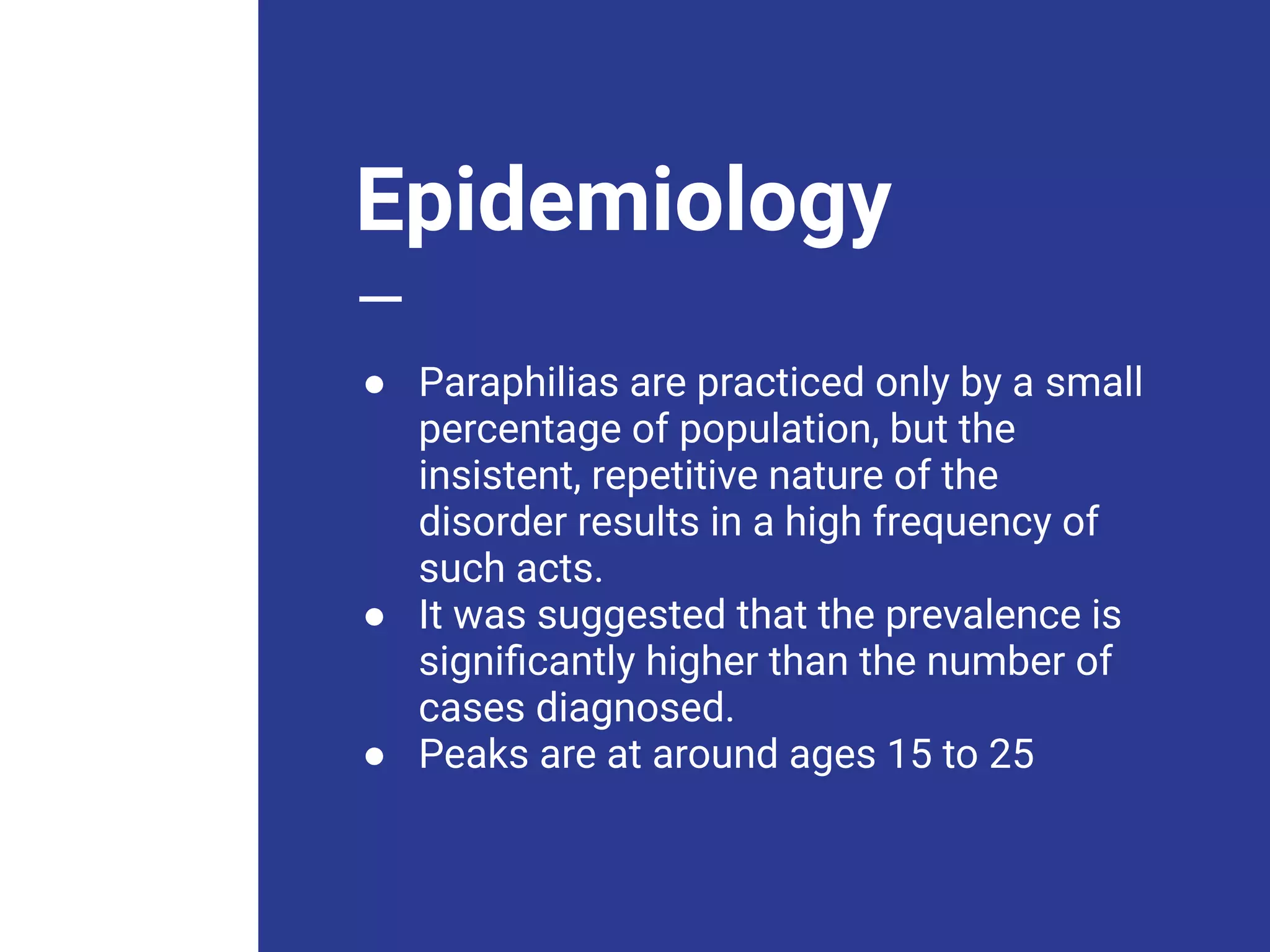
Epidemiology
● Paraphilias are practiced only by a small
percentage of population, but the
insistent, repetitive nature of the
disorder results in a high frequency of
such acts.
● It was suggested that the prevalence is
significantly higher than the number of
cases diagnosed.
● Peaks are at around ages 15 to 25
Epidemiology
● Legally identified cases:
○ Pedophilia is most common
○ Exhibitionists among children
○ Voyeurism may be apprehended, but the risk is
not great
○ Sadism comes with rape, brutality, and lust
murder
○ Excretory paraphilic disorders are scarcely
reported due to their consensual nature
○ Fetishists rarely become entangled with the
legal system
○ Transvestites are occassionally arrested
● Fetishism almost occur among men.
● Paraphilias seem to be largely male conditions
● DSM-5 suggests that diagnosis of paraphilias be
reserved for ages 18 and above
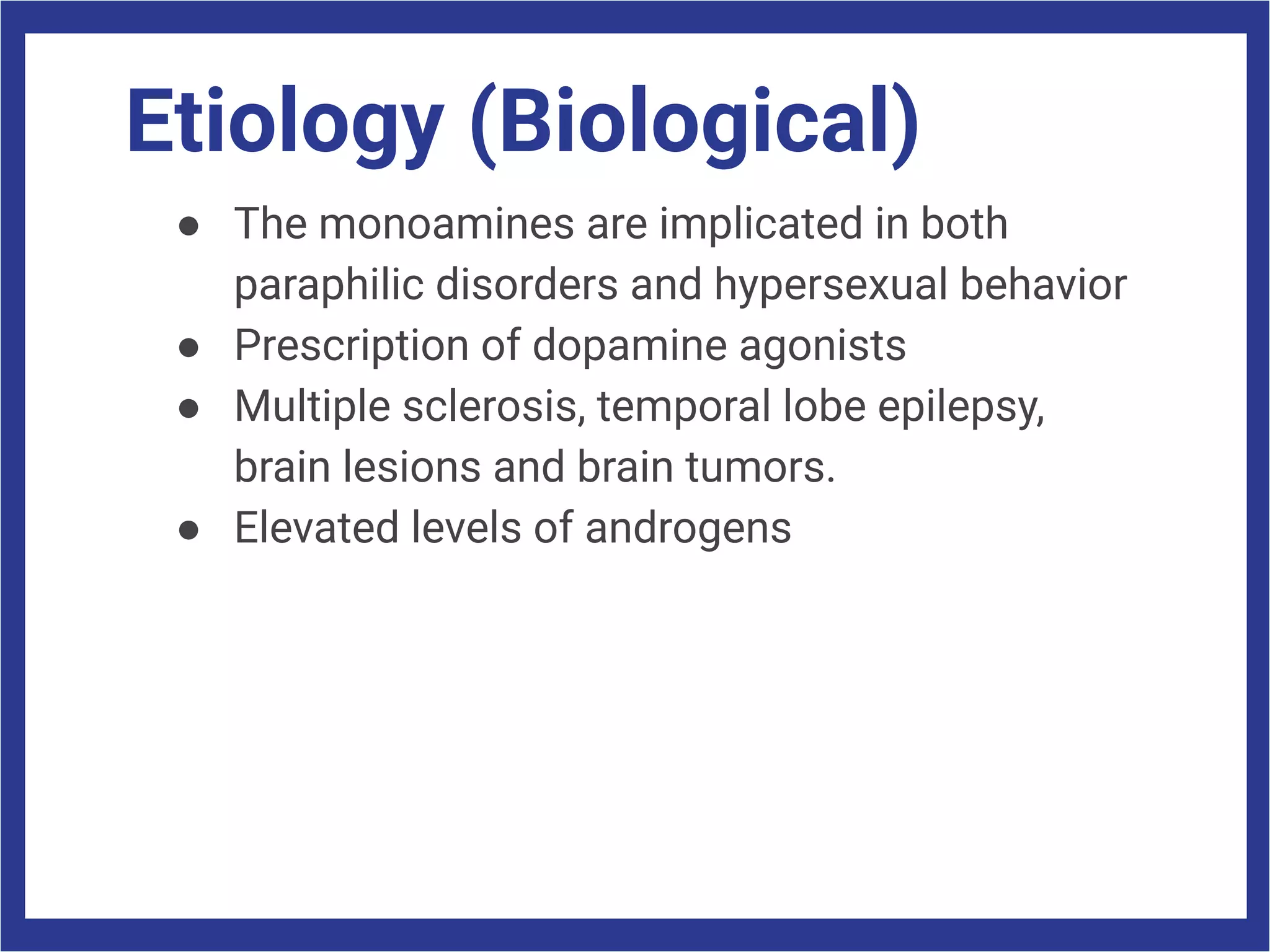
Etiology (Biological)
● The monoamines are implicated in both
paraphilic disorders and hypersexual behavior
● Prescription of dopamine agonists
● Multiple sclerosis, temporal lobe epilepsy,
brain lesions and brain tumors.
● Elevated levels of androgens
Etiology (Environmental
& Psychosocial)
● Classical conditioning due to the
simultaneous arousal to the presence of an
object
● Operant conditioning by means of evasion
from punishment
● Psychosocial history and comorbid problems
● Substance-abuse problems
● Early sexual problems
● Psychological difficulties and dissatisfaction
with life
Etiology (Environmental
& Psychosocial)
● Classical conditioning due to the
simultaneous arousal to the presence of an
object
● Operant conditioning by means of evasion
from punishment
● Psychosocial history and comorbid problems
● Substance-abuse problems
● Early sexual problems
● Psychological difficulties and dissatisfaction
with life
Treatment
● Individuals are reluctant to seek treatment:
○ They do not believe it is problematic
○ Embarrassment about unusual sexual activities
○ Their sexual activities are illegal
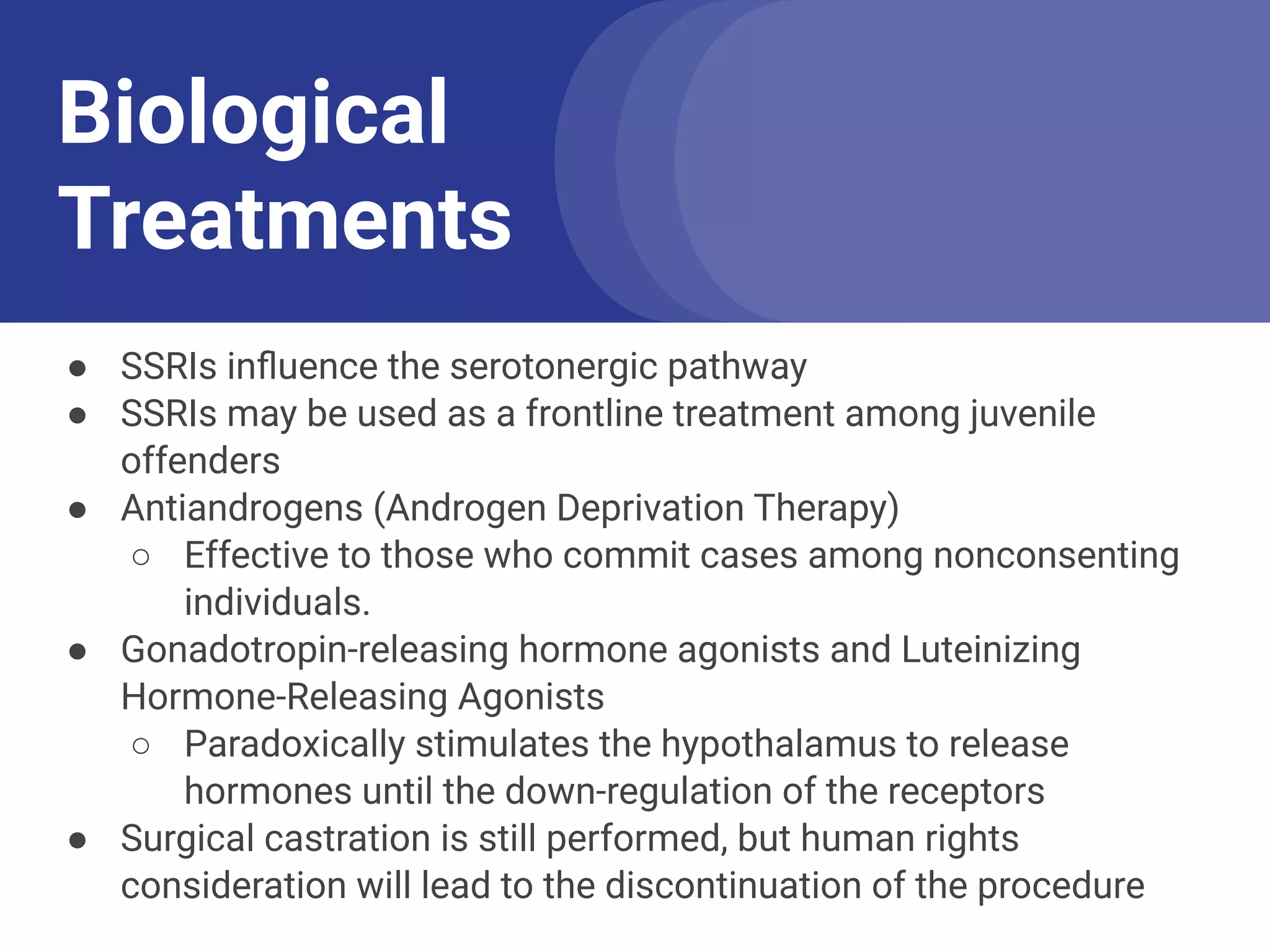
Biological
Treatments
● SSRIs influence the serotonergic pathway
● SSRIs may be used as a frontline treatment among juvenile
offenders
● Antiandrogens (Androgen Deprivation Therapy)
○ Effective to those who commit cases among nonconsenting
individuals.
● Gonadotropin-releasing hormone agonists and Luteinizing
Hormone-Releasing Agonists
○ Paradoxically stimulates the hypothalamus to release
hormones until the down-regulation of the receptors
● Surgical castration is still performed, but human rights
consideration will lead to the discontinuation of the procedure
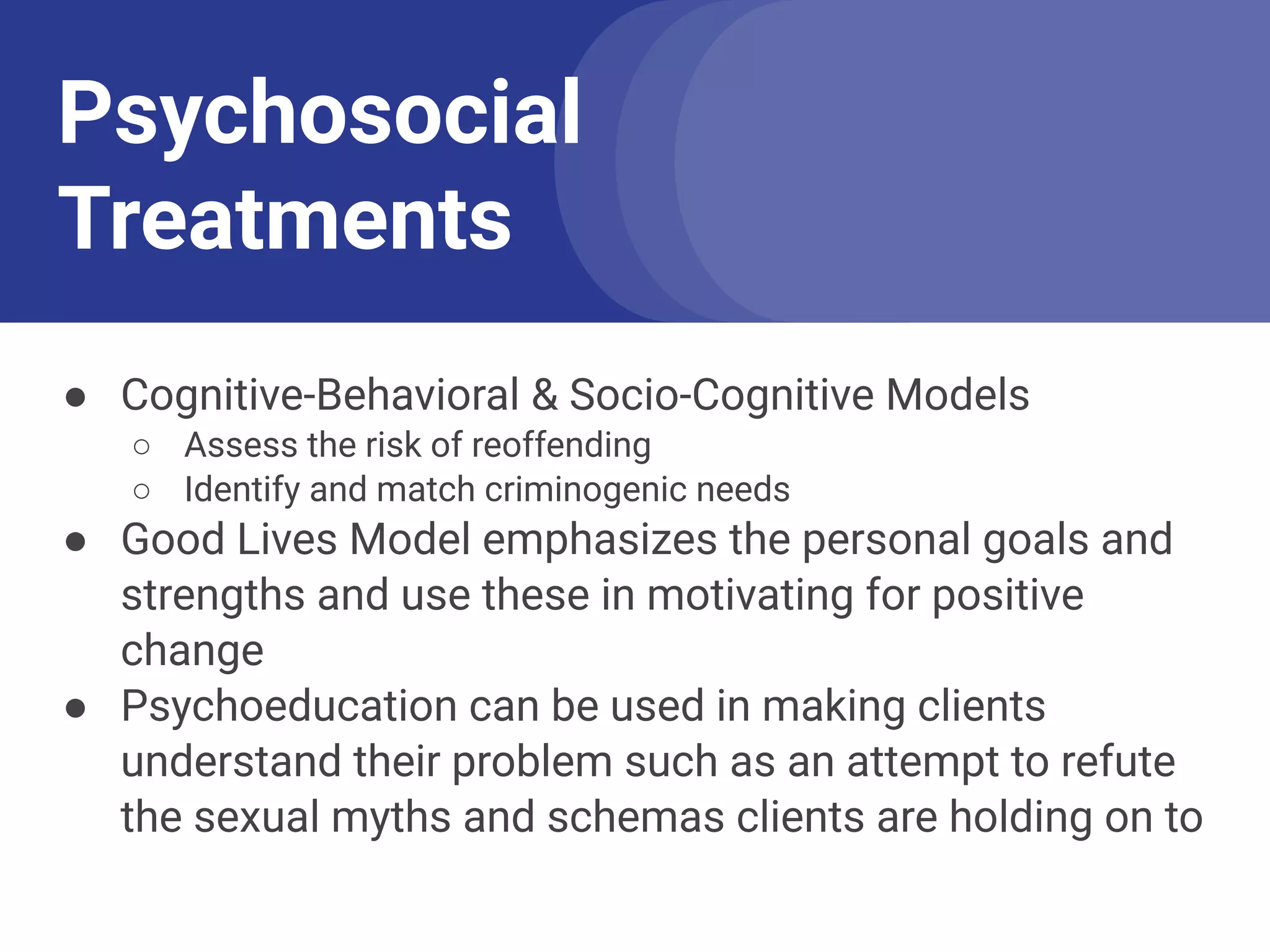
Psychosocial
Treatments
● Cognitive-Behavioral & Socio-Cognitive Models
○ Assess the risk of reoffending
○ Identify and match criminogenic needs
● Good Lives Model emphasizes the personal goals and
strengths and use these in motivating for positive
change
● Psychoeducation can be used in making clients
understand their problem such as an attempt to refute
the sexual myths and schemas clients are holding on to

Paraphilias

  • 1.
  • 2.
    What are Paraphilias? ● Theseare sexual stimuli or acts that are deviations from normal sexual behaviors, but are necessary for some to experience arousal and orgasm, to which the client’s sexuality appears to be restricted with ● It can range from nearly normal behavior to behavior that is destructive or hurtful only to oneself or to another. ● Paraphilia is clinically significant if the person has acted on these fantasies or if it has caused marked distress or interpersonal/job-related difficulties
  • 3.
    What are Paraphilias? ● Ifthe client has not acted out on their fantasies, we shall omit a diagnosis of a paraphilic disorder. ● The fantasies and their behavioral manifestations extend beyond the sexual sphere to pervade people’s lives. ● It ranges from mild (men wearing women’s underwear, consensual blindfolding, and role playing) to severe (sexually abusing children or sadistic beating/cutting), and clinicians must determine the level of distress of harm that warrants a diagnosis
  • 4.
    DSM-5 Modifications The DSMnow made a clear distinction between paraphilic interests and paraphilic disorders in order to avoid pathologizing sexual preferences that are not problematic. However, criticisms are due to perceived lack of clarity underlying the categorization of paraphilic disorders, unclear distinctions between paraphilias and paraphilic disorders, and the use of vague description of “recurrent and intense” in describing the symptoms
  • 5.
    Paraphilic Disorders: Courtship Disorders (abnormal activities that arereminiscent of courtship) VOYEURISTIC DISORDER ➢ Recurrent and intense arousal from observing an unsuspected person who is naked, in the process of disrobing, or engaging in sexual activity, as manifested by fantasies, urges, or behaviors EXHIBITIONISTIC DISORDER ➢ Recurrent and intense arousal from exposing one’s genitals to an unsuspecting person, as manifested by fantasies, urges, or behaviors FROTTEURISTIC DISORDER ➢ Recurrent and intense arousal from touching or rubbing against a nonconsenting person, as manifested by fantasies, urges or behaviors
  • 6.
    Paraphilic Disorders: Algolagnic Disorders (involves pain to oneselfor others) SEXUAL MASOCHISM DISORDER ➢ Recurrent and intense arousal from the act of being humiliated, being made to suffer,, as manifested by fantasies, urges, or behaviors SEXUAL SADISM DISORDER ➢ Recurrent and intense arousal from the physical or psychological suffering of another person, as manifested by fantasies, urges, or behaviors
  • 7.
    Paraphilic Disorders: Anomalous Activity/Target Preferences PEDOPHILIC DISORDER ➢ Recurrentand intense arousal involving sexual activity with prepubescent children (13 or younger), as manifested by fantasies, urges, or behaviors ➢ The individual should be at least 16 years old and at least 5 years older than the child or children FETISHISTIC DISORDER ➢ Recurrent and intense arousal from the use of nonliving objects or a highly specific focus on nongenital body parts, as manifested by fantasies, urges, or behaviors ➢ These objects are not limited to articles of clothing in cross-dressing or devices that is designed for tactile genital stimulation TRANSVESTIC DISORDER ➢ Recurrent and intense arousal from cross-dressing, as manifested by fantasies, urges or behaviors
  • 8.
    Epidemiology ● Paraphilias arepracticed only by a small percentage of population, but the insistent, repetitive nature of the disorder results in a high frequency of such acts. ● It was suggested that the prevalence is significantly higher than the number of cases diagnosed. ● Peaks are at around ages 15 to 25
  • 9.
    Epidemiology ● Legally identifiedcases: ○ Pedophilia is most common ○ Exhibitionists among children ○ Voyeurism may be apprehended, but the risk is not great ○ Sadism comes with rape, brutality, and lust murder ○ Excretory paraphilic disorders are scarcely reported due to their consensual nature ○ Fetishists rarely become entangled with the legal system ○ Transvestites are occassionally arrested ● Fetishism almost occur among men. ● Paraphilias seem to be largely male conditions ● DSM-5 suggests that diagnosis of paraphilias be reserved for ages 18 and above
  • 10.
    Etiology (Biological) ● Themonoamines are implicated in both paraphilic disorders and hypersexual behavior ● Prescription of dopamine agonists ● Multiple sclerosis, temporal lobe epilepsy, brain lesions and brain tumors. ● Elevated levels of androgens
  • 11.
    Etiology (Environmental & Psychosocial) ●Classical conditioning due to the simultaneous arousal to the presence of an object ● Operant conditioning by means of evasion from punishment ● Psychosocial history and comorbid problems ● Substance-abuse problems ● Early sexual problems ● Psychological difficulties and dissatisfaction with life
  • 12.
    Etiology (Environmental & Psychosocial) ●Classical conditioning due to the simultaneous arousal to the presence of an object ● Operant conditioning by means of evasion from punishment ● Psychosocial history and comorbid problems ● Substance-abuse problems ● Early sexual problems ● Psychological difficulties and dissatisfaction with life
  • 13.
    Treatment ● Individuals arereluctant to seek treatment: ○ They do not believe it is problematic ○ Embarrassment about unusual sexual activities ○ Their sexual activities are illegal
  • 14.
    Biological Treatments ● SSRIs influencethe serotonergic pathway ● SSRIs may be used as a frontline treatment among juvenile offenders ● Antiandrogens (Androgen Deprivation Therapy) ○ Effective to those who commit cases among nonconsenting individuals. ● Gonadotropin-releasing hormone agonists and Luteinizing Hormone-Releasing Agonists ○ Paradoxically stimulates the hypothalamus to release hormones until the down-regulation of the receptors ● Surgical castration is still performed, but human rights consideration will lead to the discontinuation of the procedure
  • 15.
    Psychosocial Treatments ● Cognitive-Behavioral &Socio-Cognitive Models ○ Assess the risk of reoffending ○ Identify and match criminogenic needs ● Good Lives Model emphasizes the personal goals and strengths and use these in motivating for positive change ● Psychoeducation can be used in making clients understand their problem such as an attempt to refute the sexual myths and schemas clients are holding on to