DIFFERENCE BETWEEN Z- TRANSFORM ,
FOURIER SERIES AND FOURIER TRANSFORM
Naresh Biloniya
2015KUEC2018
Department of Electronics and Communication Engineering
Indian Institute of Information Technology Kota
Naresh (IIITK) IIITK 1 / 12
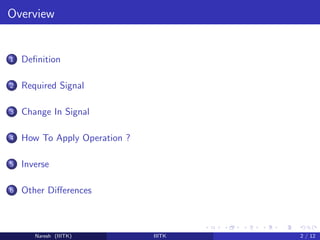
Overview
1 Definition
2 Required Signal
3 Change In Signal
4 How To Apply Operation ?
5 Inverse
6 Other Differences
Naresh (IIITK) IIITK 2 / 12
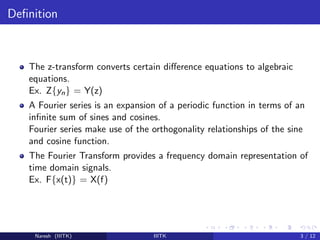
Definition
The z-transform converts certain difference equations to algebraic
equations.
Ex. Z{yn} = Y(z)
A Fourier series is an expansion of a periodic function in terms of an
infinite sum of sines and cosines.
Fourier series make use of the orthogonality relationships of the sine
and cosine function.
The Fourier Transform provides a frequency domain representation of
time domain signals.
Ex. F{x(t)} = X(f)
Naresh (IIITK) IIITK 3 / 12
Required Signal
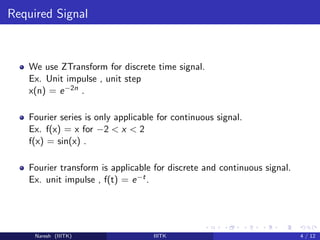
We use ZTransform for discrete time signal.
Ex. Unit impulse , unit step
x(n) = e−2n .
Fourier series is only applicable for continuous signal.
Ex. f(x) = x for −2 < x < 2
f(x) = sin(x) .
Fourier transform is applicable for discrete and continuous signal.
Ex. unit impulse , f(t) = e−t.
Naresh (IIITK) IIITK 4 / 12
Change In Signal
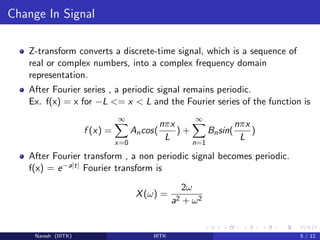
Z-transform converts a discrete-time signal, which is a sequence of
real or complex numbers, into a complex frequency domain
representation.
After Fourier series , a periodic signal remains periodic.
Ex. f(x) = x for −L <= x < L and the Fourier series of the function is
f (x) =
∞
x=0
Ancos(
nπx
L
) +
∞
n=1
Bnsin(
nπx
L
)
After Fourier transform , a non periodic signal becomes periodic.
f(x) = e−a|t| Fourier transform is
X(ω) =
2ω
a2 + ω2
Naresh (IIITK) IIITK 5 / 12
How To Apply Operation ?
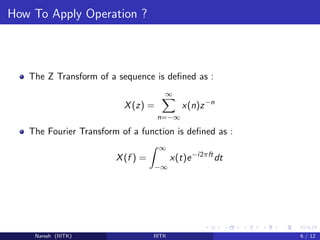
The Z Transform of a sequence is defined as :
X(z) =
∞
n=−∞
x(n)z−n
The Fourier Transform of a function is defined as :
X(f ) =
∞
−∞
x(t)e−i2πft
dt
Naresh (IIITK) IIITK 6 / 12
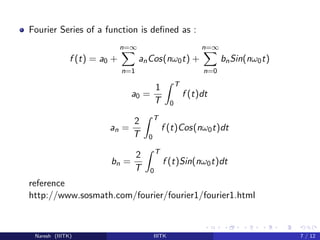
Fourier Series of a function is defined as :
f (t) = a0 +
n=∞
n=1
anCos(nω0t) +
n=∞
n=0
bnSin(nω0t)
a0 =
1
T
T
0
f (t)dt
an =
2
T
T
0
f (t)Cos(nω0t)dt
bn =
2
T
T
0
f (t)Sin(nω0t)dt
reference
http://www.sosmath.com/fourier/fourier1/fourier1.html
Naresh (IIITK) IIITK 7 / 12
Inverse
The inverse Z - Transform of a function can be found by following
methods :
1. Direct division method
2. Partial fraction expansion method
3. Difference equation approach
4. MATLAB approach
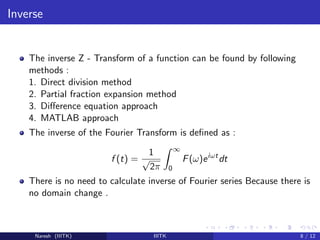
The inverse of the Fourier Transform is defined as :
f (t) =
1
√
2π
∞
0
F(ω)eiωt
dt
There is no need to calculate inverse of Fourier series Because there is
no domain change .
Naresh (IIITK) IIITK 8 / 12
Other Differences
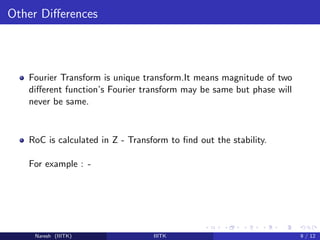
Fourier Transform is unique transform.It means magnitude of two
different function’s Fourier transform may be same but phase will
never be same.
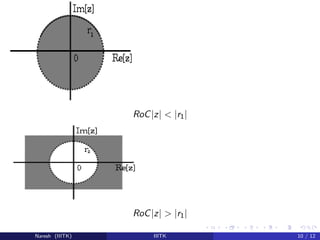
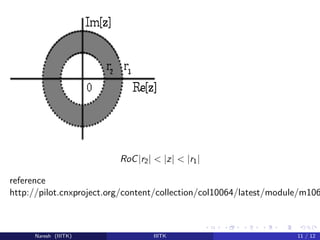
RoC is calculated in Z - Transform to find out the stability.
For example : -
Naresh (IIITK) IIITK 9 / 12
RoC|z| < |r1|
RoC|z| > |r1|
Naresh (IIITK) IIITK 10 / 12
RoC|r2| < |z| < |r1|
reference
http://pilot.cnxproject.org/content/collection/col10064/latest/module/m106
Naresh (IIITK) IIITK 11 / 12
Thank you!
Questions and Suggestions
Nareshbiloniya123@gmail.com
Naresh (IIITK) IIITK 12 / 12

DSP, Differences between Fourier series ,Fourier Transform and Z transform

  • 1.
    DIFFERENCE BETWEEN Z-TRANSFORM , FOURIER SERIES AND FOURIER TRANSFORM Naresh Biloniya 2015KUEC2018 Department of Electronics and Communication Engineering Indian Institute of Information Technology Kota Naresh (IIITK) IIITK 1 / 12
  • 2.
    Overview 1 Definition 2 RequiredSignal 3 Change In Signal 4 How To Apply Operation ? 5 Inverse 6 Other Differences Naresh (IIITK) IIITK 2 / 12
  • 3.
    Definition The z-transform convertscertain difference equations to algebraic equations. Ex. Z{yn} = Y(z) A Fourier series is an expansion of a periodic function in terms of an infinite sum of sines and cosines. Fourier series make use of the orthogonality relationships of the sine and cosine function. The Fourier Transform provides a frequency domain representation of time domain signals. Ex. F{x(t)} = X(f) Naresh (IIITK) IIITK 3 / 12
  • 4.
    Required Signal We useZTransform for discrete time signal. Ex. Unit impulse , unit step x(n) = e−2n . Fourier series is only applicable for continuous signal. Ex. f(x) = x for −2 < x < 2 f(x) = sin(x) . Fourier transform is applicable for discrete and continuous signal. Ex. unit impulse , f(t) = e−t. Naresh (IIITK) IIITK 4 / 12
  • 5.
    Change In Signal Z-transformconverts a discrete-time signal, which is a sequence of real or complex numbers, into a complex frequency domain representation. After Fourier series , a periodic signal remains periodic. Ex. f(x) = x for −L <= x < L and the Fourier series of the function is f (x) = ∞ x=0 Ancos( nπx L ) + ∞ n=1 Bnsin( nπx L ) After Fourier transform , a non periodic signal becomes periodic. f(x) = e−a|t| Fourier transform is X(ω) = 2ω a2 + ω2 Naresh (IIITK) IIITK 5 / 12
  • 6.
    How To ApplyOperation ? The Z Transform of a sequence is defined as : X(z) = ∞ n=−∞ x(n)z−n The Fourier Transform of a function is defined as : X(f ) = ∞ −∞ x(t)e−i2πft dt Naresh (IIITK) IIITK 6 / 12
  • 7.
    Fourier Series ofa function is defined as : f (t) = a0 + n=∞ n=1 anCos(nω0t) + n=∞ n=0 bnSin(nω0t) a0 = 1 T T 0 f (t)dt an = 2 T T 0 f (t)Cos(nω0t)dt bn = 2 T T 0 f (t)Sin(nω0t)dt reference http://www.sosmath.com/fourier/fourier1/fourier1.html Naresh (IIITK) IIITK 7 / 12
  • 8.
    Inverse The inverse Z- Transform of a function can be found by following methods : 1. Direct division method 2. Partial fraction expansion method 3. Difference equation approach 4. MATLAB approach The inverse of the Fourier Transform is defined as : f (t) = 1 √ 2π ∞ 0 F(ω)eiωt dt There is no need to calculate inverse of Fourier series Because there is no domain change . Naresh (IIITK) IIITK 8 / 12
  • 9.
    Other Differences Fourier Transformis unique transform.It means magnitude of two different function’s Fourier transform may be same but phase will never be same. RoC is calculated in Z - Transform to find out the stability. For example : - Naresh (IIITK) IIITK 9 / 12
  • 10.
    RoC|z| < |r1| RoC|z|> |r1| Naresh (IIITK) IIITK 10 / 12
  • 11.
    RoC|r2| < |z|< |r1| reference http://pilot.cnxproject.org/content/collection/col10064/latest/module/m106 Naresh (IIITK) IIITK 11 / 12
  • 12.
    Thank you! Questions andSuggestions Nareshbiloniya123@gmail.com Naresh (IIITK) IIITK 12 / 12