1
Presented By :
Suraj Kumar Saini (2015KUEC2015)
Naresh Biloniya (2015KUEC2018)
Indian Institute of information Technology
Kota
Table of
Content
 Introduction
 What is Heterogeneous Network (HetNet) ?
 Components of HetNet
 Issues regarding capacity, coverage and interference
 Solutions for the above issues
 Conclusion
3
Introduction
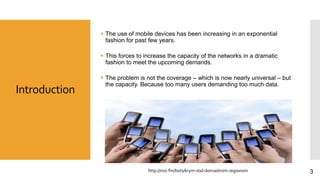
 The use of mobile devices has been increasing in an exponential
fashion for past few years.
 This forces to increase the capacity of the networks in a dramatic
fashion to meet the upcoming demands.
 The problem is not the coverage – which is now nearly universal – but
the capacity. Because too many users demanding too much data.
3http://nsn.fm/hots/krym-stal-domashnim-regionom
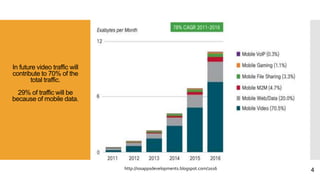
In future video traffic will
contribute to 70% of the
total traffic.
29% of traffic will be
because of mobile data.
http://iosappsdevelopments.blogspot.com/2016 4
Cellular
networks
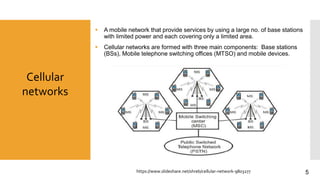
 A mobile network that provide services by using a large no. of base stations
with limited power and each covering only a limited area.
 Cellular networks are formed with three main components: Base stations
(BSs), Mobile telephone switching offices (MTSO) and mobile devices.
https://www.slideshare.net/shreb/cellular-network-9803277 5
What is HetNet ?
 Heterogeneous is the characteristic of containing dissimilar constituents.
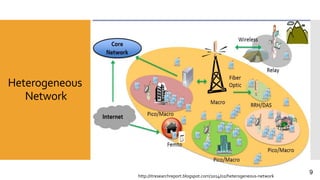
 Heterogeneous Network (HetNet) : A network that consists of a mix of high
power macro cells and low-power nodes, e.g. Pico, Femto cells.
 Mobile experts define a HetNet as a network with complex interoperation
between macrocell, small cell, and in some cases WiFi network elements
 All of them eventually come together to form a larger network as a whole.
6
Multi-Tier
Networks
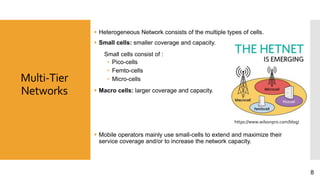
 Heterogeneous Network consists of the multiple types of cells.
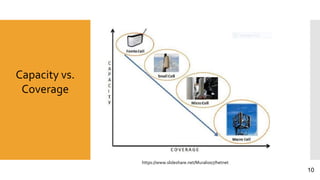
 Small cells: smaller coverage and capacity.
Small cells consist of :
• Pico-cells
• Femto-cells
• Micro-cells
 Macro cells: larger coverage and capacity.
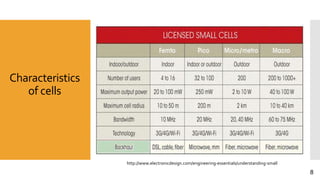
 Mobile operators mainly use small-cells to extend and maximize their
service coverage and/or to increase the network capacity.
https://www.wilsonpro.com/blog/
8
Characteristics
of cells
http://www.electronicdesign.com/engineering-essentials/understanding-small
8
Heterogeneous
Network
http://itresearchreport.blogspot.com/2014/02/heterogeneous-network
9
Capacity vs.
Coverage
https://www.slideshare.net/Murali007/hetnet
10
Inter cell
Interference
(ICI)
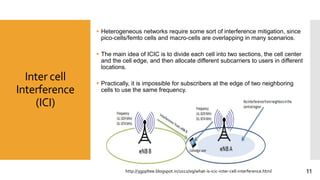
 Heterogeneous networks require some sort of interference mitigation, since
pico-cells/femto cells and macro-cells are overlapping in many scenarios.
 The main idea of ICIC is to divide each cell into two sections, the cell center
and the cell edge, and then allocate different subcarriers to users in different
locations.
 Practically, it is impossible for subscribers at the edge of two neighboring
cells to use the same frequency.
http://3gppltee.blogspot.in/2012/09/what-is-icic-inter-cell-interference.html 11
Inter cell
Interference
Coordination
(ICIC)
Techniques
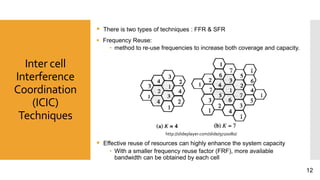
 There is two types of techniques : FFR & SFR
 Frequency Reuse:
• method to re-use frequencies to increase both coverage and capacity.
 Effective reuse of resources can highly enhance the system capacity
• With a smaller frequency reuse factor (FRF), more available
bandwidth can be obtained by each cell
http://slideplayer.com/slide/9720080/
12
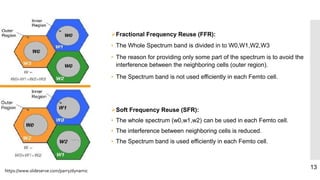
Fractional Frequency Reuse (FFR):
• The Whole Spectrum band is divided in to W0,W1,W2,W3
• The reason for providing only some part of the spectrum is to avoid the
interference between the neighboring cells (outer region).
• The Spectrum band is not used efficiently in each Femto cell.
Soft Frequency Reuse (SFR):
• The whole spectrum (w0,w1,w2) can be used in each Femto cell.
• The interference between neighboring cells is reduced.
• The Spectrum band is used efficiently in each Femto cell.
https://www.slideserve.com/parry/dynamic
13
Outdoor
Macro-Pico
Deployment
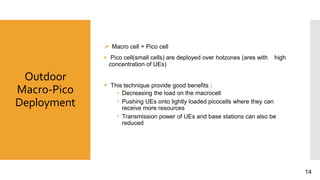
 Macro cell + Pico cell
 Pico cell(small cells) are deployed over hotzones (ares with high
concentration of UEs)
 This technique provide good benefits :
• Decreasing the load on the macrocell
• Pushing UEs onto lightly loaded picocells where they can
receive more resources
• Transmission power of UEs and base stations can also be
reduced
14
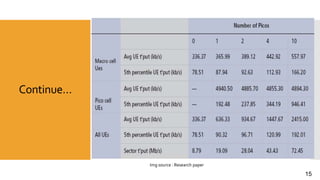
Continue…
Img source : Research paper
15
Conclusion
 In this article some facts regarding internet data use are lighted up.
 The article put special emphasis on to increase capacity, coverage
and interference reduction.
 To increase the capacity and coverage of network an approach of
multi-tier cellular network is developed.
 In order to establish the macro, pico and femto cell, interference
creates problem so some techniques are developed for this.
16
References
 M. Dohler et al., “Is the PHY Layer Dead?,” IEEE Commun. Mag., Apr. 2011.
 V. Chandrasekhar, J. G. Andrews, and A. Gatherer, “Femtocell Networks: A
Survey,” IEEE Commun. Mag., Sept. 2008.
 F. Baccelli and B. Blaszczyszyn, Stochastic Geometry and Wireless Networks,
Foundations and Trends in Networking, 2009.
 H. Dhillon et al., “Modeling and Analysis of K-Tier Downlink Heterogeneous
Cellular Networks,” to appear, IEEE JSAC, Mar. 2011,
http://arxiv.org/abs/1103.2177 .
 A. Ghosh et al., “LTE-Advanced: Next-Generation Wireless broadband
Technology,” IEEE Wireless Commun., vol. 17, no. 3, June 2010, pp. 10–22.
17
References
Image Courtesy:
 Slide 5,7:
http://iosappsdevelopments.blogspot.com/2014/
http://itresearchreport.blogspot.com/2014/02/heterogeneous-network
 Slide 8,9:
https://www.wilsonpro.com/blog/
http://www.electronicdesign.com/engineering-essentials/understanding-small
 Slide 10,11:
https://www.slideshare.net/Murali007/hetnet
http://3gppltee.blogspot.in/2012/09/what-is-icic-inter-cell-interference.html
 Slide 12,14:
http://ieeexplore.ieee.org/document/6211486/
https://www.slideshare.net/dev464898/ppt-het-net
18
ThankYou
19

Heterogeneous Cellular Network (HetNet)

  • 1.
    1 Presented By : SurajKumar Saini (2015KUEC2015) Naresh Biloniya (2015KUEC2018) Indian Institute of information Technology Kota
  • 2.
    Table of Content  Introduction What is Heterogeneous Network (HetNet) ?  Components of HetNet  Issues regarding capacity, coverage and interference  Solutions for the above issues  Conclusion 3
  • 3.
    Introduction  The useof mobile devices has been increasing in an exponential fashion for past few years.  This forces to increase the capacity of the networks in a dramatic fashion to meet the upcoming demands.  The problem is not the coverage – which is now nearly universal – but the capacity. Because too many users demanding too much data. 3http://nsn.fm/hots/krym-stal-domashnim-regionom
  • 4.
    In future videotraffic will contribute to 70% of the total traffic. 29% of traffic will be because of mobile data. http://iosappsdevelopments.blogspot.com/2016 4
  • 5.
    Cellular networks  A mobilenetwork that provide services by using a large no. of base stations with limited power and each covering only a limited area.  Cellular networks are formed with three main components: Base stations (BSs), Mobile telephone switching offices (MTSO) and mobile devices. https://www.slideshare.net/shreb/cellular-network-9803277 5
  • 6.
    What is HetNet?  Heterogeneous is the characteristic of containing dissimilar constituents.  Heterogeneous Network (HetNet) : A network that consists of a mix of high power macro cells and low-power nodes, e.g. Pico, Femto cells.  Mobile experts define a HetNet as a network with complex interoperation between macrocell, small cell, and in some cases WiFi network elements  All of them eventually come together to form a larger network as a whole. 6
  • 7.
    Multi-Tier Networks  Heterogeneous Networkconsists of the multiple types of cells.  Small cells: smaller coverage and capacity. Small cells consist of : • Pico-cells • Femto-cells • Micro-cells  Macro cells: larger coverage and capacity.  Mobile operators mainly use small-cells to extend and maximize their service coverage and/or to increase the network capacity. https://www.wilsonpro.com/blog/ 8
  • 8.
  • 9.
  • 10.
  • 11.
    Inter cell Interference (ICI)  Heterogeneousnetworks require some sort of interference mitigation, since pico-cells/femto cells and macro-cells are overlapping in many scenarios.  The main idea of ICIC is to divide each cell into two sections, the cell center and the cell edge, and then allocate different subcarriers to users in different locations.  Practically, it is impossible for subscribers at the edge of two neighboring cells to use the same frequency. http://3gppltee.blogspot.in/2012/09/what-is-icic-inter-cell-interference.html 11
  • 12.
    Inter cell Interference Coordination (ICIC) Techniques  Thereis two types of techniques : FFR & SFR  Frequency Reuse: • method to re-use frequencies to increase both coverage and capacity.  Effective reuse of resources can highly enhance the system capacity • With a smaller frequency reuse factor (FRF), more available bandwidth can be obtained by each cell http://slideplayer.com/slide/9720080/ 12
  • 13.
    Fractional Frequency Reuse(FFR): • The Whole Spectrum band is divided in to W0,W1,W2,W3 • The reason for providing only some part of the spectrum is to avoid the interference between the neighboring cells (outer region). • The Spectrum band is not used efficiently in each Femto cell. Soft Frequency Reuse (SFR): • The whole spectrum (w0,w1,w2) can be used in each Femto cell. • The interference between neighboring cells is reduced. • The Spectrum band is used efficiently in each Femto cell. https://www.slideserve.com/parry/dynamic 13
  • 14.
    Outdoor Macro-Pico Deployment  Macro cell+ Pico cell  Pico cell(small cells) are deployed over hotzones (ares with high concentration of UEs)  This technique provide good benefits : • Decreasing the load on the macrocell • Pushing UEs onto lightly loaded picocells where they can receive more resources • Transmission power of UEs and base stations can also be reduced 14
  • 15.
    Continue… Img source :Research paper 15
  • 16.
    Conclusion  In thisarticle some facts regarding internet data use are lighted up.  The article put special emphasis on to increase capacity, coverage and interference reduction.  To increase the capacity and coverage of network an approach of multi-tier cellular network is developed.  In order to establish the macro, pico and femto cell, interference creates problem so some techniques are developed for this. 16
  • 17.
    References  M. Dohleret al., “Is the PHY Layer Dead?,” IEEE Commun. Mag., Apr. 2011.  V. Chandrasekhar, J. G. Andrews, and A. Gatherer, “Femtocell Networks: A Survey,” IEEE Commun. Mag., Sept. 2008.  F. Baccelli and B. Blaszczyszyn, Stochastic Geometry and Wireless Networks, Foundations and Trends in Networking, 2009.  H. Dhillon et al., “Modeling and Analysis of K-Tier Downlink Heterogeneous Cellular Networks,” to appear, IEEE JSAC, Mar. 2011, http://arxiv.org/abs/1103.2177 .  A. Ghosh et al., “LTE-Advanced: Next-Generation Wireless broadband Technology,” IEEE Wireless Commun., vol. 17, no. 3, June 2010, pp. 10–22. 17
  • 18.
    References Image Courtesy:  Slide5,7: http://iosappsdevelopments.blogspot.com/2014/ http://itresearchreport.blogspot.com/2014/02/heterogeneous-network  Slide 8,9: https://www.wilsonpro.com/blog/ http://www.electronicdesign.com/engineering-essentials/understanding-small  Slide 10,11: https://www.slideshare.net/Murali007/hetnet http://3gppltee.blogspot.in/2012/09/what-is-icic-inter-cell-interference.html  Slide 12,14: http://ieeexplore.ieee.org/document/6211486/ https://www.slideshare.net/dev464898/ppt-het-net 18
  • 19.