Lecture Notes for
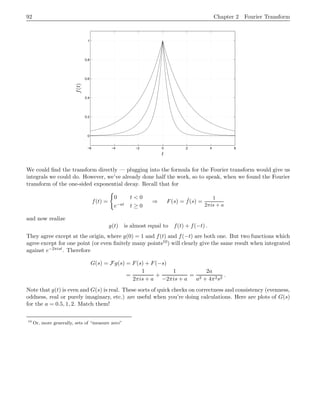
The Fourier Transform and its Applications
Prof. Brad Osgood
Stanford University
https://see.stanford.edu/materials/lsoftaee261/book-fall-07.pdf
http://www.coursehero.org/lecture/fourier-series-0
https://www.youtube.com/view_play_list?p=B24BC7956EE040CD
https://see.stanford.edu/Course/EE261
Chapter 2
Fourier Transform
2.1 A First Look at the Fourier Transform
We’re about to make the transition from Fourier series to the Fourier transform. “Transition” is the
appropriate word, for in the approach we’ll take the Fourier transform emerges as we pass from periodic
to nonperiodic functions. To make the trip we’ll view a nonperiodic function (which can be just about
anything) as a limiting case of a periodic function as the period becomes longer and longer. Actually, this
process doesn’t immediately produce the desired result. It takes a little extra tinkering to coax the Fourier
transform out of the Fourier series, but it’s an interesting approach.1
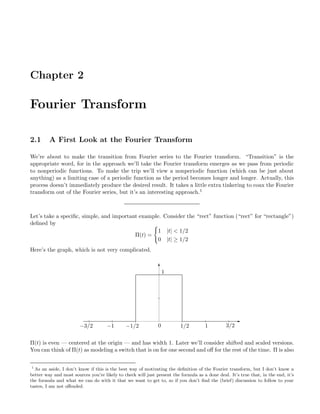
Let’s take a specific, simple, and important example. Consider the “rect” function (“rect” for “rectangle”)
defined by
Π(t) =
(
1 |t| < 1/2
0 |t| ≥ 1/2
Here’s the graph, which is not very complicated.
0
1
1
1/2 3/2
−1 −1/2
−3/2
Π(t) is even — centered at the origin — and has width 1. Later we’ll consider shifted and scaled versions.
You can think of Π(t) as modeling a switch that is on for one second and off for the rest of the time. Π is also
1
As an aside, I don’t know if this is the best way of motivating the definition of the Fourier transform, but I don’t know a
better way and most sources you’re likely to check will just present the formula as a done deal. It’s true that, in the end, it’s
the formula and what we can do with it that we want to get to, so if you don’t find the (brief) discussion to follow to your
tastes, I am not offended.
66 Chapter 2 Fourier Transform
called, variously, the top hat function (because of its graph), the indicator function, or the characteristic
function for the interval (−1/2, 1/2).
While we have defined Π(±1/2) = 0, other common conventions are either to have Π(±1/2) = 1 or
Π(±1/2) = 1/2. And some people don’t define Π at ±1/2 at all, leaving two holes in the domain. I don’t
want to get dragged into this dispute. It almost never matters, though for some purposes the choice
Π(±1/2) = 1/2 makes the most sense. We’ll deal with this on an exceptional basis if and when it comes
up.
Π(t) is not periodic. It doesn’t have a Fourier series. In problems you experimented a little with periodiza-
tions, and I want to do that with Π but for a specific purpose. As a periodic version of Π(t) we repeat
the nonzero part of the function at regular intervals, separated by (long) intervals where the function is
zero. We can think of such a function arising when we flip a switch on for a second at a time, and do so
repeatedly, and we keep it off for a long time in between the times it’s on. (One often hears the term duty
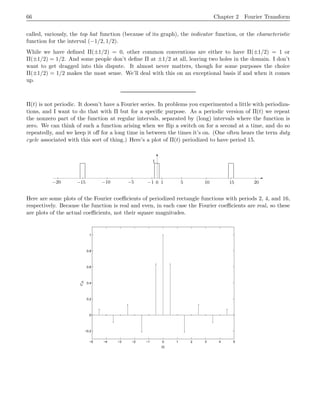
cycle associated with this sort of thing.) Here’s a plot of Π(t) periodized to have period 15.
0 1
1
5 10 15 20
−1
−5
−10
−15
−20
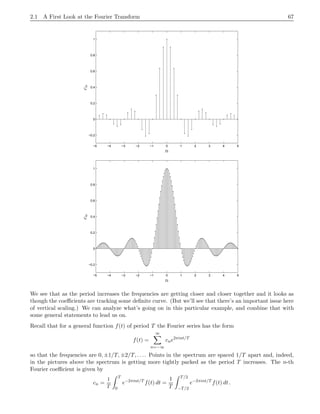
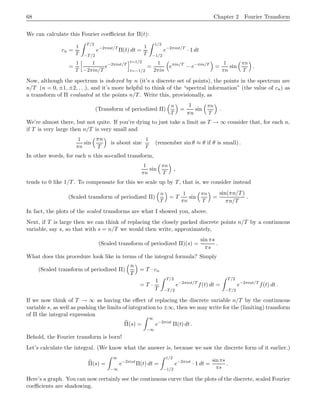
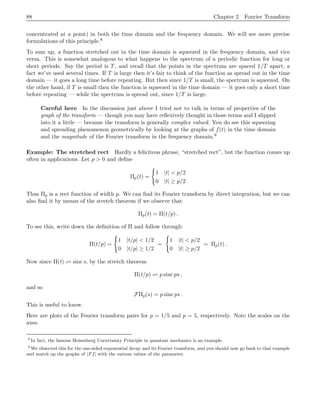
Here are some plots of the Fourier coefficients of periodized rectangle functions with periods 2, 4, and 16,
respectively. Because the function is real and even, in each case the Fourier coefficients are real, so these
are plots of the actual coefficients, not their square magnitudes.
−5 −4 −3 −2 −1 0 1 2 3 4 5
−0.2
0
0.2
0.4
0.6
0.8
1
n
c
n
2.1 A First Look at the Fourier Transform 67
−5 −4 −3 −2 −1 0 1 2 3 4 5
−0.2
0
0.2
0.4
0.6
0.8
1
n
c
n
−5 −4 −3 −2 −1 0 1 2 3 4 5
−0.2
0
0.2
0.4
0.6
0.8
1
n
c
n
We see that as the period increases the frequencies are getting closer and closer together and it looks as
though the coefficients are tracking some definite curve. (But we’ll see that there’s an important issue here
of vertical scaling.) We can analyze what’s going on in this particular example, and combine that with
some general statements to lead us on.
Recall that for a general function f(t) of period T the Fourier series has the form
f(t) =
∞
X
n=−∞
cne2πint/T
so that the frequencies are 0, ±1/T, ±2/T, . . .. Points in the spectrum are spaced 1/T apart and, indeed,
in the pictures above the spectrum is getting more tightly packed as the period T increases. The n-th
Fourier coefficient is given by
cn =
1
T
Z T
0
e−2πint/T
f(t) dt =
1
T
Z T/2
−T/2
e−2πint/T
f(t) dt .
68 Chapter 2 Fourier Transform
We can calculate this Fourier coefficient for Π(t):
cn =
1
T
Z T/2
−T/2
e−2πint/T
Π(t) dt =
1
T
Z 1/2
−1/2
e−2πint/T
· 1 dt
=
1
T
h 1
−2πin/T
e−2πint/T
it=1/2
t=−1/2
=
1
2πin

eπin/T
− e−πin/T

=
1
πn
sin
πn
T

.
Now, although the spectrum is indexed by n (it’s a discrete set of points), the points in the spectrum are
n/T (n = 0, ±1, ±2, . . .), and it’s more helpful to think of the “spectral information” (the value of cn) as
a transform of Π evaluated at the points n/T. Write this, provisionally, as
(Transform of periodized Π)
 n
T

=
1
πn
sin
πn
T

.
We’re almost there, but not quite. If you’re dying to just take a limit as T → ∞ consider that, for each n,
if T is very large then n/T is very small and
1
πn
sin
πn
T

is about size
1
T
(remember sin θ ≈ θ if θ is small).
In other words, for each n this so-called transform,
1
πn
sin
πn
T

,
tends to 0 like 1/T. To compensate for this we scale up by T, that is, we consider instead
(Scaled transform of periodized Π)
 n
T

= T
1
πn
sin
πn
T

=
sin(πn/T)
πn/T
.
In fact, the plots of the scaled transforms are what I showed you, above.
Next, if T is large then we can think of replacing the closely packed discrete points n/T by a continuous
variable, say s, so that with s = n/T we would then write, approximately,
(Scaled transform of periodized Π)(s) =
sin πs
πs
.
What does this procedure look like in terms of the integral formula? Simply
(Scaled transform of periodized Π)
 n
T

= T · cn
= T ·
1
T
Z T/2
−T/2
e−2πint/T
f(t) dt =
Z T/2
−T/2
e−2πint/T
f(t) dt .
If we now think of T → ∞ as having the effect of replacing the discrete variable n/T by the continuous
variable s, as well as pushing the limits of integration to ±∞, then we may write for the (limiting) transform
of Π the integral expression
b
Π(s) =
Z ∞
−∞
e−2πist
Π(t) dt .
Behold, the Fourier transform is born!
Let’s calculate the integral. (We know what the answer is, because we saw the discrete form of it earlier.)
b
Π(s) =
Z ∞
−∞
e−2πist
Π(t) dt =
Z 1/2
−1/2
e−2πist
· 1 dt =
sinπs
πs
.
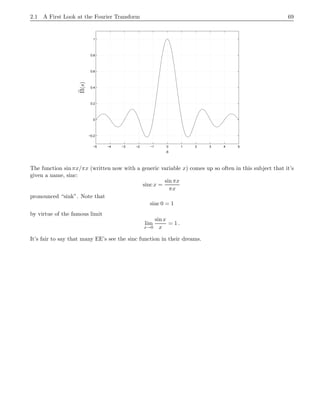
Here’s a graph. You can now certainly see the continuous curve that the plots of the discrete, scaled Fourier
coefficients are shadowing.
2.1 A First Look at the Fourier Transform 69
−5 −4 −3 −2 −1 0 1 2 3 4 5
−0.2
0
0.2
0.4
0.6
0.8
1
s
b
Π(s)
The function sin πx/πx (written now with a generic variable x) comes up so often in this subject that it’s
given a name, sinc:
sinc x =
sin πx
πx
pronounced “sink”. Note that
sinc 0 = 1
by virtue of the famous limit
lim
x→0
sin x
x
= 1 .
It’s fair to say that many EE’s see the sinc function in their dreams.
70 Chapter 2 Fourier Transform
How general is this? We would be led to the same idea — scale the Fourier coefficients by T — if we
had started off periodizing just about any function with the intention of letting T → ∞. Suppose f(t) is
zero outside of |t| ≤ 1/2. (Any interval will do, we just want to suppose a function is zero outside some
interval so we can periodize.) We periodize f(t) to have period T and compute the Fourier coefficients:
cn =
1
T
Z T/2
−T/2
e−2πint/T
f(t) dt =
1
T
Z 1/2
−1/2
e−2πint/T
f(t) dt .
2.1 A First Look at the Fourier Transform 71
How big is this? We can estimate
|cn| =
1
T
Z 1/2
−1/2
e−2πint/T
f(t) dt
≤
1
T
Z 1/2
−1/2
|e−2πint/T
| |f(t)| dt =
1
T
Z 1/2
−1/2
|f(t)| dt =
A
T
,
where
A =
Z 1/2
−1/2
|f(t)| dt ,
which is some fixed number independent of n and T. Again we see that cn tends to 0 like 1/T, and so again
we scale back up by T and consider
(Scaled transform of periodized f)
 n
T

= Tcn =
Z T/2
−T/2
e−2πint/T
f(t) dt .
In the limit as T → ∞ we replace n/T by s and consider
ˆ
f(s) =
Z ∞
−∞
e−2πist
f(t) dt .
We’re back to the same integral formula.
Fourier transform defined There you have it. We now define the Fourier transform of a function f(t)
to be
ˆ
f(s) =
Z ∞
−∞
e−2πist
f(t) dt .
For now, just take this as a formal definition; we’ll discuss later when such an integral exists. We assume
that f(t) is defined for all real numbers t. For any s ∈ R, integrating f(t) against e−2πist with respect to t
produces a complex valued function of s, that is, the Fourier transform ˆ
f(s) is a complex-valued function
of s ∈ R. If t has dimension time then to make st dimensionless in the exponential e−2πist s must have
dimension 1/time.
While the Fourier transform takes flight from the desire to find spectral information on a nonperiodic
function, the extra complications and extra richness of what results will soon make it seem like we’re in
a much different world. The definition just given is a good one because of the richness and despite the
complications. Periodic functions are great, but there’s more bang than buzz in the world to analyze.
The spectrum of a periodic function is a discrete set of frequencies, possibly an infinite set (when there’s
a corner) but always a discrete set. By contrast, the Fourier transform of a nonperiodic signal produces a
continuous spectrum, or a continuum of frequencies.
It may be that ˆ
f(s) is identically zero for |s| sufficiently large — an important class of signals called
bandlimited — or it may be that the nonzero values of ˆ
f(s) extend to ±∞, or it may be that ˆ
f(s) is zero
for just a few values of s.
The Fourier transform analyzes a signal into its frequency components. We haven’t yet considered how
the corresponding synthesis goes. How can we recover f(t) in the time domain from ˆ
f(s) in the frequency
domain?
72 Chapter 2 Fourier Transform
Recovering f(t) from ˆ
f(s) We can push the ideas on nonperiodic functions as limits of periodic func-
tions a little further and discover how we might obtain f(t) from its transform ˆ
f(s). Again suppose f(t)
is zero outside some interval and periodize it to have (large) period T. We expand f(t) in a Fourier series,
f(t) =
∞
X
n=−∞
cne2πint/T
.
The Fourier coefficients can be written via the Fourier transform of f evaluated at the points sn = n/T.
cn =
1
T
Z T/2
−T/2
e−2πint/T
f(t) dt =
1
T
Z ∞
−∞
e−2πint/T
f(t) dt
(we can extend the limits to ±∞ since f(t) is zero outside of [−T/2, T/2])
=
1
T
ˆ
f
 n
T

=
1
T
ˆ
f(sn) .
Plug this into the expression for f(t):
f(t) =
∞
X
n=−∞
1
T
ˆ
f(sn)e2πisnt
.
Now, the points sn = n/T are spaced 1/T apart, so we can think of 1/T as, say ∆s, and the sum above as
a Riemann sum approximating an integral
∞
X
n=−∞
1
T
ˆ
f(sn)e2πisnt
=
∞
X
n=−∞
ˆ
f(sn)e2πisnt
∆s ≈
Z ∞
−∞
ˆ
f(s)e2πist
ds .
The limits on the integral go from −∞ to ∞ because the sum, and the points sn, go from −∞ to ∞. Thus
as the period T → ∞ we would expect to have
f(t) =
Z ∞
−∞
ˆ
f(s)e2πist
ds
and we have recovered f(t) from ˆ
f(s). We have found the inverse Fourier transform and Fourier inversion.
The inverse Fourier transform defined, and Fourier inversion, too The integral we’ve just come
up with can stand on its own as a “transform”, and so we define the inverse Fourier transform of a function
g(s) to be
ǧ(t) =
Z ∞
−∞
e2πist
g(s) ds (upside down hat — cute) .
Again, we’re treating this formally for the moment, withholding a discussion of conditions under which the
integral makes sense. In the same spirit, we’ve also produced the Fourier inversion theorem. That is
f(t) =
Z ∞
−∞
e2πist ˆ
f(s) ds .
Written very compactly,
( ˆ
f)ˇ
= f .
The inverse Fourier transform looks just like the Fourier transform except for the minus sign. Later we’ll
say more about the remarkable symmetry between the Fourier transform and its inverse.
By the way, we could have gone through the whole argument, above, starting with ˆ
f as the basic function
instead of f. If we did that we’d be led to the complementary result on Fourier inversion,
(ǧ)ˆ
= g .
2.1 A First Look at the Fourier Transform 73
A quick summary Let’s summarize what we’ve done here, partly as a guide to what we’d like to do
next. There’s so much involved, all of importance, that it’s hard to avoid saying everything at once. Realize
that it will take some time before everything is in place.
• The Fourier transform of the signal f(t) is
ˆ
f(s) =
Z ∞
−∞
f(t)e−2πist
dt .
This is a complex-valued function of s.
One value is easy to compute, and worth pointing out, namely for s = 0 we have
ˆ
f(0) =
Z ∞
−∞
f(t) dt .
In calculus terms this is the area under the graph of f(t). If f(t) is real, as it most often is, then
ˆ
f(0) is real even though other values of the Fourier transform may be complex.
• The domain of the Fourier transform is the set of real numbers s. One says that ˆ
f is defined on
the frequency domain, and that the original signal f(t) is defined on the time domain (or the spatial
domain, depending on the context). For a (nonperiodic) signal defined on the whole real line we
generally do not have a discrete set of frequencies, as in the periodic case, but rather a continuum
of frequencies.2 (We still do call them “frequencies”, however.) The set of all frequencies is the
spectrum of f(t).
◦ Not all frequencies need occur, i.e., ˆ
f(s) might be zero for some values of s. Furthermore, it
might be that there aren’t any frequencies outside of a certain range, i.e.,
ˆ
f(s) = 0 for |s| large.
These are called bandlimited signals and they are an important special class of signals. They
come up in sampling theory.
• The inverse Fourier transform is defined by
ǧ(t) =
Z ∞
−∞
e2πist
g(s) ds .
Taken together, the Fourier transform and its inverse provide a way of passing between two (equiva-
lent) representations of a signal via the Fourier inversion theorem:
( ˆ
f)ˇ
= f , (ǧ)ˆ
= g .
We note one consequence of Fourier inversion, that
f(0) =
Z ∞
−∞
ˆ
f(s) ds .
There is no quick calculus interpretation of this result. The right hand side is an integral of a
complex-valued function (generally), and result is real (if f(0) is real).
2
A periodic function does have a Fourier transform, but it’s a sum of δ functions. We’ll have to do that, too, and it will take
some effort.
74 Chapter 2 Fourier Transform
Now remember that ˆ
f(s) is a transformed, complex-valued function, and while it may be “equivalent”
to f(t) it has very different properties. Is it really true that when ˆ
f(s) exists we can just plug it into
the formula for the inverse Fourier transform — which is also an improper integral that looks the
same as the forward transform except for the minus sign — and really get back f(t)? Really? That’s
worth wondering about.
• The square magnitude | ˆ
f(s)|2 is called the power spectrum (especially in connection with its use in
communications) or the spectral power density (especially in connection with its use in optics) or the
energy spectrum (especially in every other connection).
An important relation between the energy of the signal in the time domain and the energy spectrum
in the frequency domain is given by Parseval’s identity for Fourier transforms:
Z ∞
−∞
|f(t)|2
dt =
Z ∞
−∞
| ˆ
f(s)|2
ds .
This is also a future attraction.
A warning on notations: None is perfect, all are in use Depending on the operation to be
performed, or on the context, it’s often useful to have alternate notations for the Fourier transform. But
here’s a warning, which is the start of a complaint, which is the prelude to a full blown rant. Diddling with
notation seems to be an unavoidable hassle in this subject. Flipping back and forth between a transform
and its inverse, naming the variables in the different domains (even writing or not writing the variables),
changing plus signs to minus signs, taking complex conjugates, these are all routine day-to-day operations
and they can cause endless muddles if you are not careful, and sometimes even if you are careful. You will
believe me when we have some examples, and you will hear me complain about it frequently.
Here’s one example of a common convention:
If the function is called f then one often uses the corresponding capital letter, F, to denote the
Fourier transform. So one sees a and A, z and Z, and everything in between. Note, however,
that one typically uses different names for the variable for the two functions, as in f(x) (or
f(t)) and F(s). This ‘capital letter notation’ is very common in engineering but often confuses
people when ‘duality’ is invoked, to be explained below.
And then there’s this:
Since taking the Fourier transform is an operation that is applied to a function to produce a new
function, it’s also sometimes convenient to indicate this by a kind of “operational” notation.
For example, it’s common to write Ff(s) for ˆ
f(s), and so, to repeat the full definition
Ff(s) =
Z ∞
−∞
e−2πist
f(t) dt .
This is often the most unambiguous notation. Similarly, the operation of taking the inverse
Fourier transform is then denoted by F−1, and so
F−1
g(t) =
Z ∞
−∞
e2πist
g(s) ds .
We will use the notation Ff more often than not. It, too, is far from ideal, the problem being with keeping
variables straight — you’ll see.
2.2 Getting to Know Your Fourier Transform 75
Finally, a function and its Fourier transform are said to constitute a “Fourier pair”, ; this is concept of
‘duality’ to be explained more precisely later. There have been various notations devised to indicate this
sibling relationship. One is
f(t) 
 F(s)
Bracewell advocated the use of
F(s) ⊃ f(t)
and Gray and Goodman also use it. I hate it, personally.
A warning on definitions Our definition of the Fourier transform is a standard one, but it’s not the
only one. The question is where to put the 2π: in the exponential, as we have done; or perhaps as a factor
out front; or perhaps left out completely. There’s also a question of which is the Fourier transform and
which is the inverse, i.e., which gets the minus sign in the exponential. All of the various conventions are in
day-to-day use in the professions, and I only mention this now because when you’re talking with a friend
over drinks about the Fourier transform, be sure you both know which conventions are being followed. I’d
hate to see that kind of misunderstanding get in the way of a beautiful friendship.
Following the helpful summary provided by T. W. Körner in his book Fourier Analysis, I will summarize
the many irritating variations. To be general, let’s write
Ff(s) =
1
A
Z ∞
−∞
eiBst
f(t) dt .
The choices that are found in practice are
A =
√
2π B = ±1
A = 1 B = ±2π
A = 1 B = ±1
The definition we’ve chosen has A = 1 and B = −2π.
Happy hunting and good luck.
2.2 Getting to Know Your Fourier Transform
In one way, at least, our study of the Fourier transform will run the same course as your study of calculus.
When you learned calculus it was necessary to learn the derivative and integral formulas for specific
functions and types of functions (powers, exponentials, trig functions), and also to learn the general
principles and rules of differentiation and integration that allow you to work with combinations of functions
(product rule, chain rule, inverse functions). It will be the same thing for us now. We’ll need to have a
storehouse of specific functions and their transforms that we can call on, and we’ll need to develop general
principles and results on how the Fourier transform operates.
2.2.1 Examples
We’ve already seen the example
b
Π = sinc orFΠ(s) = sinc s
using the F notation. Let’s do a few more examples.
76 Chapter 2 Fourier Transform
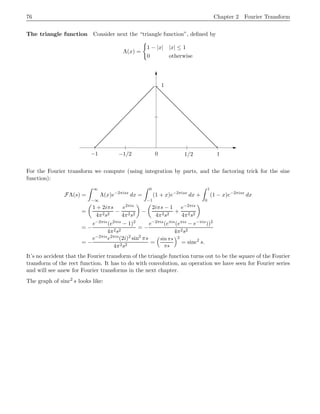
The triangle function Consider next the “triangle function”, defined by
Λ(x) =
(
1 − |x| |x| ≤ 1
0 otherwise
0 1
1
−1 1/2
−1/2
For the Fourier transform we compute (using integration by parts, and the factoring trick for the sine
function):
FΛ(s) =
Z ∞
−∞
Λ(x)e−2πisx
dx =
Z 0
−1
(1 + x)e−2πisx
dx +
Z 1
0
(1 − x)e−2πisx
dx
=

1 + 2iπs
4π2s2
−
e2πis
4π2s2

−

2iπs − 1
4π2s2
+
e−2πis
4π2s2

= −
e−2πis
(e2πis
− 1)2
4π2s2
= −
e−2πis
(eπis
(eπis
− e−πis
))2
4π2s2
= −
e−2πis
e2πis
(2i)2
sin2
πs
4π2s2
=

sin πs
πs
2
= sinc2
s.
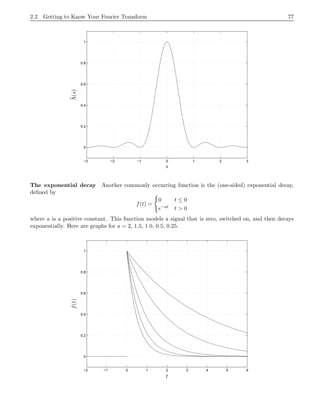
It’s no accident that the Fourier transform of the triangle function turns out to be the square of the Fourier
transform of the rect function. It has to do with convolution, an operation we have seen for Fourier series
and will see anew for Fourier transforms in the next chapter.
The graph of sinc2
s looks like:
2.2 Getting to Know Your Fourier Transform 77
−3 −2 −1 0 1 2 3
0
0.2
0.4
0.6
0.8
1
s
b
Λ(s)
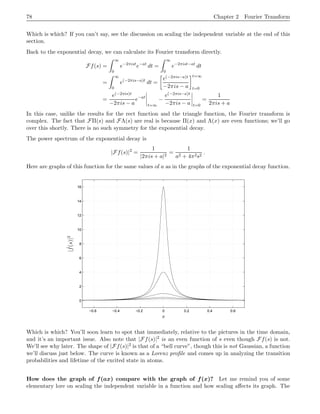
The exponential decay Another commonly occurring function is the (one-sided) exponential decay,
defined by
f(t) =
(
0 t ≤ 0
e−at
t  0
where a is a positive constant. This function models a signal that is zero, switched on, and then decays
exponentially. Here are graphs for a = 2, 1.5, 1.0, 0.5, 0.25.
−2 −1 0 1 2 3 4 5 6
0
0.2
0.4
0.6
0.8
1
t
f
(t)
78 Chapter 2 Fourier Transform
Which is which? If you can’t say, see the discussion on scaling the independent variable at the end of this
section.
Back to the exponential decay, we can calculate its Fourier transform directly.
Ff(s) =
Z ∞
0
e−2πist
e−at
dt =
Z ∞
0
e−2πist−at
dt
=
Z ∞
0
e(−2πis−a)t
dt =

e(−2πis−a)t
−2πis − a
t=∞
t=0
=
e(−2πis)t
−2πis − a
e−at
t=∞
−
e(−2πis−a)t
−2πis − a
t=0
=
1
2πis + a
In this case, unlike the results for the rect function and the triangle function, the Fourier transform is
complex. The fact that FΠ(s) and FΛ(s) are real is because Π(x) and Λ(x) are even functions; we’ll go
over this shortly. There is no such symmetry for the exponential decay.
The power spectrum of the exponential decay is
|Ff(s)|2
=
1
|2πis + a|2
=
1
a2 + 4π2s2
.
Here are graphs of this function for the same values of a as in the graphs of the exponential decay function.
−0.6 −0.4 −0.2 0 0.2 0.4 0.6
0
2
4
6
8
10
12
14
16
s
|
ˆ
f
(s)|
2
Which is which? You’ll soon learn to spot that immediately, relative to the pictures in the time domain,
and it’s an important issue. Also note that |Ff(s)|2
is an even function of s even though Ff(s) is not.
We’ll see why later. The shape of |Ff(s)|2 is that of a “bell curve”, though this is not Gaussian, a function
we’ll discuss just below. The curve is known as a Lorenz profile and comes up in analyzing the transition
probabilities and lifetime of the excited state in atoms.
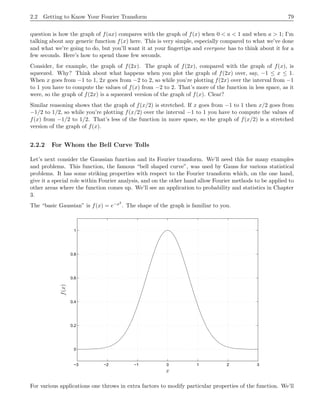
How does the graph of f(ax) compare with the graph of f(x)? Let me remind you of some
elementary lore on scaling the independent variable in a function and how scaling affects its graph. The

Chapter 2 fourier transform

  • 1.
    Lecture Notes for TheFourier Transform and its Applications Prof. Brad Osgood Stanford University https://see.stanford.edu/materials/lsoftaee261/book-fall-07.pdf http://www.coursehero.org/lecture/fourier-series-0 https://www.youtube.com/view_play_list?p=B24BC7956EE040CD https://see.stanford.edu/Course/EE261
  • 2.
    Chapter 2 Fourier Transform 2.1A First Look at the Fourier Transform We’re about to make the transition from Fourier series to the Fourier transform. “Transition” is the appropriate word, for in the approach we’ll take the Fourier transform emerges as we pass from periodic to nonperiodic functions. To make the trip we’ll view a nonperiodic function (which can be just about anything) as a limiting case of a periodic function as the period becomes longer and longer. Actually, this process doesn’t immediately produce the desired result. It takes a little extra tinkering to coax the Fourier transform out of the Fourier series, but it’s an interesting approach.1 Let’s take a specific, simple, and important example. Consider the “rect” function (“rect” for “rectangle”) defined by Π(t) = ( 1 |t| < 1/2 0 |t| ≥ 1/2 Here’s the graph, which is not very complicated. 0 1 1 1/2 3/2 −1 −1/2 −3/2 Π(t) is even — centered at the origin — and has width 1. Later we’ll consider shifted and scaled versions. You can think of Π(t) as modeling a switch that is on for one second and off for the rest of the time. Π is also 1 As an aside, I don’t know if this is the best way of motivating the definition of the Fourier transform, but I don’t know a better way and most sources you’re likely to check will just present the formula as a done deal. It’s true that, in the end, it’s the formula and what we can do with it that we want to get to, so if you don’t find the (brief) discussion to follow to your tastes, I am not offended.
  • 3.
    66 Chapter 2Fourier Transform called, variously, the top hat function (because of its graph), the indicator function, or the characteristic function for the interval (−1/2, 1/2). While we have defined Π(±1/2) = 0, other common conventions are either to have Π(±1/2) = 1 or Π(±1/2) = 1/2. And some people don’t define Π at ±1/2 at all, leaving two holes in the domain. I don’t want to get dragged into this dispute. It almost never matters, though for some purposes the choice Π(±1/2) = 1/2 makes the most sense. We’ll deal with this on an exceptional basis if and when it comes up. Π(t) is not periodic. It doesn’t have a Fourier series. In problems you experimented a little with periodiza- tions, and I want to do that with Π but for a specific purpose. As a periodic version of Π(t) we repeat the nonzero part of the function at regular intervals, separated by (long) intervals where the function is zero. We can think of such a function arising when we flip a switch on for a second at a time, and do so repeatedly, and we keep it off for a long time in between the times it’s on. (One often hears the term duty cycle associated with this sort of thing.) Here’s a plot of Π(t) periodized to have period 15. 0 1 1 5 10 15 20 −1 −5 −10 −15 −20 Here are some plots of the Fourier coefficients of periodized rectangle functions with periods 2, 4, and 16, respectively. Because the function is real and even, in each case the Fourier coefficients are real, so these are plots of the actual coefficients, not their square magnitudes. −5 −4 −3 −2 −1 0 1 2 3 4 5 −0.2 0 0.2 0.4 0.6 0.8 1 n c n
  • 4.
    2.1 A FirstLook at the Fourier Transform 67 −5 −4 −3 −2 −1 0 1 2 3 4 5 −0.2 0 0.2 0.4 0.6 0.8 1 n c n −5 −4 −3 −2 −1 0 1 2 3 4 5 −0.2 0 0.2 0.4 0.6 0.8 1 n c n We see that as the period increases the frequencies are getting closer and closer together and it looks as though the coefficients are tracking some definite curve. (But we’ll see that there’s an important issue here of vertical scaling.) We can analyze what’s going on in this particular example, and combine that with some general statements to lead us on. Recall that for a general function f(t) of period T the Fourier series has the form f(t) = ∞ X n=−∞ cne2πint/T so that the frequencies are 0, ±1/T, ±2/T, . . .. Points in the spectrum are spaced 1/T apart and, indeed, in the pictures above the spectrum is getting more tightly packed as the period T increases. The n-th Fourier coefficient is given by cn = 1 T Z T 0 e−2πint/T f(t) dt = 1 T Z T/2 −T/2 e−2πint/T f(t) dt .
  • 5.
    68 Chapter 2Fourier Transform We can calculate this Fourier coefficient for Π(t): cn = 1 T Z T/2 −T/2 e−2πint/T Π(t) dt = 1 T Z 1/2 −1/2 e−2πint/T · 1 dt = 1 T h 1 −2πin/T e−2πint/T it=1/2 t=−1/2 = 1 2πin eπin/T − e−πin/T = 1 πn sin πn T . Now, although the spectrum is indexed by n (it’s a discrete set of points), the points in the spectrum are n/T (n = 0, ±1, ±2, . . .), and it’s more helpful to think of the “spectral information” (the value of cn) as a transform of Π evaluated at the points n/T. Write this, provisionally, as (Transform of periodized Π) n T = 1 πn sin πn T . We’re almost there, but not quite. If you’re dying to just take a limit as T → ∞ consider that, for each n, if T is very large then n/T is very small and 1 πn sin πn T is about size 1 T (remember sin θ ≈ θ if θ is small). In other words, for each n this so-called transform, 1 πn sin πn T , tends to 0 like 1/T. To compensate for this we scale up by T, that is, we consider instead (Scaled transform of periodized Π) n T = T 1 πn sin πn T = sin(πn/T) πn/T . In fact, the plots of the scaled transforms are what I showed you, above. Next, if T is large then we can think of replacing the closely packed discrete points n/T by a continuous variable, say s, so that with s = n/T we would then write, approximately, (Scaled transform of periodized Π)(s) = sin πs πs . What does this procedure look like in terms of the integral formula? Simply (Scaled transform of periodized Π) n T = T · cn = T · 1 T Z T/2 −T/2 e−2πint/T f(t) dt = Z T/2 −T/2 e−2πint/T f(t) dt . If we now think of T → ∞ as having the effect of replacing the discrete variable n/T by the continuous variable s, as well as pushing the limits of integration to ±∞, then we may write for the (limiting) transform of Π the integral expression b Π(s) = Z ∞ −∞ e−2πist Π(t) dt . Behold, the Fourier transform is born! Let’s calculate the integral. (We know what the answer is, because we saw the discrete form of it earlier.) b Π(s) = Z ∞ −∞ e−2πist Π(t) dt = Z 1/2 −1/2 e−2πist · 1 dt = sinπs πs . Here’s a graph. You can now certainly see the continuous curve that the plots of the discrete, scaled Fourier coefficients are shadowing.
  • 6.
    2.1 A FirstLook at the Fourier Transform 69 −5 −4 −3 −2 −1 0 1 2 3 4 5 −0.2 0 0.2 0.4 0.6 0.8 1 s b Π(s) The function sin πx/πx (written now with a generic variable x) comes up so often in this subject that it’s given a name, sinc: sinc x = sin πx πx pronounced “sink”. Note that sinc 0 = 1 by virtue of the famous limit lim x→0 sin x x = 1 . It’s fair to say that many EE’s see the sinc function in their dreams.
  • 7.
    70 Chapter 2Fourier Transform How general is this? We would be led to the same idea — scale the Fourier coefficients by T — if we had started off periodizing just about any function with the intention of letting T → ∞. Suppose f(t) is zero outside of |t| ≤ 1/2. (Any interval will do, we just want to suppose a function is zero outside some interval so we can periodize.) We periodize f(t) to have period T and compute the Fourier coefficients: cn = 1 T Z T/2 −T/2 e−2πint/T f(t) dt = 1 T Z 1/2 −1/2 e−2πint/T f(t) dt .
  • 8.
    2.1 A FirstLook at the Fourier Transform 71 How big is this? We can estimate |cn| = 1 T
  • 12.
  • 16.
    ≤ 1 T Z 1/2 −1/2 |e−2πint/T | |f(t)|dt = 1 T Z 1/2 −1/2 |f(t)| dt = A T , where A = Z 1/2 −1/2 |f(t)| dt , which is some fixed number independent of n and T. Again we see that cn tends to 0 like 1/T, and so again we scale back up by T and consider (Scaled transform of periodized f) n T = Tcn = Z T/2 −T/2 e−2πint/T f(t) dt . In the limit as T → ∞ we replace n/T by s and consider ˆ f(s) = Z ∞ −∞ e−2πist f(t) dt . We’re back to the same integral formula. Fourier transform defined There you have it. We now define the Fourier transform of a function f(t) to be ˆ f(s) = Z ∞ −∞ e−2πist f(t) dt . For now, just take this as a formal definition; we’ll discuss later when such an integral exists. We assume that f(t) is defined for all real numbers t. For any s ∈ R, integrating f(t) against e−2πist with respect to t produces a complex valued function of s, that is, the Fourier transform ˆ f(s) is a complex-valued function of s ∈ R. If t has dimension time then to make st dimensionless in the exponential e−2πist s must have dimension 1/time. While the Fourier transform takes flight from the desire to find spectral information on a nonperiodic function, the extra complications and extra richness of what results will soon make it seem like we’re in a much different world. The definition just given is a good one because of the richness and despite the complications. Periodic functions are great, but there’s more bang than buzz in the world to analyze. The spectrum of a periodic function is a discrete set of frequencies, possibly an infinite set (when there’s a corner) but always a discrete set. By contrast, the Fourier transform of a nonperiodic signal produces a continuous spectrum, or a continuum of frequencies. It may be that ˆ f(s) is identically zero for |s| sufficiently large — an important class of signals called bandlimited — or it may be that the nonzero values of ˆ f(s) extend to ±∞, or it may be that ˆ f(s) is zero for just a few values of s. The Fourier transform analyzes a signal into its frequency components. We haven’t yet considered how the corresponding synthesis goes. How can we recover f(t) in the time domain from ˆ f(s) in the frequency domain?
  • 17.
    72 Chapter 2Fourier Transform Recovering f(t) from ˆ f(s) We can push the ideas on nonperiodic functions as limits of periodic func- tions a little further and discover how we might obtain f(t) from its transform ˆ f(s). Again suppose f(t) is zero outside some interval and periodize it to have (large) period T. We expand f(t) in a Fourier series, f(t) = ∞ X n=−∞ cne2πint/T . The Fourier coefficients can be written via the Fourier transform of f evaluated at the points sn = n/T. cn = 1 T Z T/2 −T/2 e−2πint/T f(t) dt = 1 T Z ∞ −∞ e−2πint/T f(t) dt (we can extend the limits to ±∞ since f(t) is zero outside of [−T/2, T/2]) = 1 T ˆ f n T = 1 T ˆ f(sn) . Plug this into the expression for f(t): f(t) = ∞ X n=−∞ 1 T ˆ f(sn)e2πisnt . Now, the points sn = n/T are spaced 1/T apart, so we can think of 1/T as, say ∆s, and the sum above as a Riemann sum approximating an integral ∞ X n=−∞ 1 T ˆ f(sn)e2πisnt = ∞ X n=−∞ ˆ f(sn)e2πisnt ∆s ≈ Z ∞ −∞ ˆ f(s)e2πist ds . The limits on the integral go from −∞ to ∞ because the sum, and the points sn, go from −∞ to ∞. Thus as the period T → ∞ we would expect to have f(t) = Z ∞ −∞ ˆ f(s)e2πist ds and we have recovered f(t) from ˆ f(s). We have found the inverse Fourier transform and Fourier inversion. The inverse Fourier transform defined, and Fourier inversion, too The integral we’ve just come up with can stand on its own as a “transform”, and so we define the inverse Fourier transform of a function g(s) to be ǧ(t) = Z ∞ −∞ e2πist g(s) ds (upside down hat — cute) . Again, we’re treating this formally for the moment, withholding a discussion of conditions under which the integral makes sense. In the same spirit, we’ve also produced the Fourier inversion theorem. That is f(t) = Z ∞ −∞ e2πist ˆ f(s) ds . Written very compactly, ( ˆ f)ˇ = f . The inverse Fourier transform looks just like the Fourier transform except for the minus sign. Later we’ll say more about the remarkable symmetry between the Fourier transform and its inverse. By the way, we could have gone through the whole argument, above, starting with ˆ f as the basic function instead of f. If we did that we’d be led to the complementary result on Fourier inversion, (ǧ)ˆ = g .
  • 18.
    2.1 A FirstLook at the Fourier Transform 73 A quick summary Let’s summarize what we’ve done here, partly as a guide to what we’d like to do next. There’s so much involved, all of importance, that it’s hard to avoid saying everything at once. Realize that it will take some time before everything is in place. • The Fourier transform of the signal f(t) is ˆ f(s) = Z ∞ −∞ f(t)e−2πist dt . This is a complex-valued function of s. One value is easy to compute, and worth pointing out, namely for s = 0 we have ˆ f(0) = Z ∞ −∞ f(t) dt . In calculus terms this is the area under the graph of f(t). If f(t) is real, as it most often is, then ˆ f(0) is real even though other values of the Fourier transform may be complex. • The domain of the Fourier transform is the set of real numbers s. One says that ˆ f is defined on the frequency domain, and that the original signal f(t) is defined on the time domain (or the spatial domain, depending on the context). For a (nonperiodic) signal defined on the whole real line we generally do not have a discrete set of frequencies, as in the periodic case, but rather a continuum of frequencies.2 (We still do call them “frequencies”, however.) The set of all frequencies is the spectrum of f(t). ◦ Not all frequencies need occur, i.e., ˆ f(s) might be zero for some values of s. Furthermore, it might be that there aren’t any frequencies outside of a certain range, i.e., ˆ f(s) = 0 for |s| large. These are called bandlimited signals and they are an important special class of signals. They come up in sampling theory. • The inverse Fourier transform is defined by ǧ(t) = Z ∞ −∞ e2πist g(s) ds . Taken together, the Fourier transform and its inverse provide a way of passing between two (equiva- lent) representations of a signal via the Fourier inversion theorem: ( ˆ f)ˇ = f , (ǧ)ˆ = g . We note one consequence of Fourier inversion, that f(0) = Z ∞ −∞ ˆ f(s) ds . There is no quick calculus interpretation of this result. The right hand side is an integral of a complex-valued function (generally), and result is real (if f(0) is real). 2 A periodic function does have a Fourier transform, but it’s a sum of δ functions. We’ll have to do that, too, and it will take some effort.
  • 19.
    74 Chapter 2Fourier Transform Now remember that ˆ f(s) is a transformed, complex-valued function, and while it may be “equivalent” to f(t) it has very different properties. Is it really true that when ˆ f(s) exists we can just plug it into the formula for the inverse Fourier transform — which is also an improper integral that looks the same as the forward transform except for the minus sign — and really get back f(t)? Really? That’s worth wondering about. • The square magnitude | ˆ f(s)|2 is called the power spectrum (especially in connection with its use in communications) or the spectral power density (especially in connection with its use in optics) or the energy spectrum (especially in every other connection). An important relation between the energy of the signal in the time domain and the energy spectrum in the frequency domain is given by Parseval’s identity for Fourier transforms: Z ∞ −∞ |f(t)|2 dt = Z ∞ −∞ | ˆ f(s)|2 ds . This is also a future attraction. A warning on notations: None is perfect, all are in use Depending on the operation to be performed, or on the context, it’s often useful to have alternate notations for the Fourier transform. But here’s a warning, which is the start of a complaint, which is the prelude to a full blown rant. Diddling with notation seems to be an unavoidable hassle in this subject. Flipping back and forth between a transform and its inverse, naming the variables in the different domains (even writing or not writing the variables), changing plus signs to minus signs, taking complex conjugates, these are all routine day-to-day operations and they can cause endless muddles if you are not careful, and sometimes even if you are careful. You will believe me when we have some examples, and you will hear me complain about it frequently. Here’s one example of a common convention: If the function is called f then one often uses the corresponding capital letter, F, to denote the Fourier transform. So one sees a and A, z and Z, and everything in between. Note, however, that one typically uses different names for the variable for the two functions, as in f(x) (or f(t)) and F(s). This ‘capital letter notation’ is very common in engineering but often confuses people when ‘duality’ is invoked, to be explained below. And then there’s this: Since taking the Fourier transform is an operation that is applied to a function to produce a new function, it’s also sometimes convenient to indicate this by a kind of “operational” notation. For example, it’s common to write Ff(s) for ˆ f(s), and so, to repeat the full definition Ff(s) = Z ∞ −∞ e−2πist f(t) dt . This is often the most unambiguous notation. Similarly, the operation of taking the inverse Fourier transform is then denoted by F−1, and so F−1 g(t) = Z ∞ −∞ e2πist g(s) ds . We will use the notation Ff more often than not. It, too, is far from ideal, the problem being with keeping variables straight — you’ll see.
  • 20.
    2.2 Getting toKnow Your Fourier Transform 75 Finally, a function and its Fourier transform are said to constitute a “Fourier pair”, ; this is concept of ‘duality’ to be explained more precisely later. There have been various notations devised to indicate this sibling relationship. One is f(t) F(s) Bracewell advocated the use of F(s) ⊃ f(t) and Gray and Goodman also use it. I hate it, personally. A warning on definitions Our definition of the Fourier transform is a standard one, but it’s not the only one. The question is where to put the 2π: in the exponential, as we have done; or perhaps as a factor out front; or perhaps left out completely. There’s also a question of which is the Fourier transform and which is the inverse, i.e., which gets the minus sign in the exponential. All of the various conventions are in day-to-day use in the professions, and I only mention this now because when you’re talking with a friend over drinks about the Fourier transform, be sure you both know which conventions are being followed. I’d hate to see that kind of misunderstanding get in the way of a beautiful friendship. Following the helpful summary provided by T. W. Körner in his book Fourier Analysis, I will summarize the many irritating variations. To be general, let’s write Ff(s) = 1 A Z ∞ −∞ eiBst f(t) dt . The choices that are found in practice are A = √ 2π B = ±1 A = 1 B = ±2π A = 1 B = ±1 The definition we’ve chosen has A = 1 and B = −2π. Happy hunting and good luck. 2.2 Getting to Know Your Fourier Transform In one way, at least, our study of the Fourier transform will run the same course as your study of calculus. When you learned calculus it was necessary to learn the derivative and integral formulas for specific functions and types of functions (powers, exponentials, trig functions), and also to learn the general principles and rules of differentiation and integration that allow you to work with combinations of functions (product rule, chain rule, inverse functions). It will be the same thing for us now. We’ll need to have a storehouse of specific functions and their transforms that we can call on, and we’ll need to develop general principles and results on how the Fourier transform operates. 2.2.1 Examples We’ve already seen the example b Π = sinc orFΠ(s) = sinc s using the F notation. Let’s do a few more examples.
  • 21.
    76 Chapter 2Fourier Transform The triangle function Consider next the “triangle function”, defined by Λ(x) = ( 1 − |x| |x| ≤ 1 0 otherwise 0 1 1 −1 1/2 −1/2 For the Fourier transform we compute (using integration by parts, and the factoring trick for the sine function): FΛ(s) = Z ∞ −∞ Λ(x)e−2πisx dx = Z 0 −1 (1 + x)e−2πisx dx + Z 1 0 (1 − x)e−2πisx dx = 1 + 2iπs 4π2s2 − e2πis 4π2s2 − 2iπs − 1 4π2s2 + e−2πis 4π2s2 = − e−2πis (e2πis − 1)2 4π2s2 = − e−2πis (eπis (eπis − e−πis ))2 4π2s2 = − e−2πis e2πis (2i)2 sin2 πs 4π2s2 = sin πs πs 2 = sinc2 s. It’s no accident that the Fourier transform of the triangle function turns out to be the square of the Fourier transform of the rect function. It has to do with convolution, an operation we have seen for Fourier series and will see anew for Fourier transforms in the next chapter. The graph of sinc2 s looks like:
  • 22.
    2.2 Getting toKnow Your Fourier Transform 77 −3 −2 −1 0 1 2 3 0 0.2 0.4 0.6 0.8 1 s b Λ(s) The exponential decay Another commonly occurring function is the (one-sided) exponential decay, defined by f(t) = ( 0 t ≤ 0 e−at t 0 where a is a positive constant. This function models a signal that is zero, switched on, and then decays exponentially. Here are graphs for a = 2, 1.5, 1.0, 0.5, 0.25. −2 −1 0 1 2 3 4 5 6 0 0.2 0.4 0.6 0.8 1 t f (t)
  • 23.
    78 Chapter 2Fourier Transform Which is which? If you can’t say, see the discussion on scaling the independent variable at the end of this section. Back to the exponential decay, we can calculate its Fourier transform directly. Ff(s) = Z ∞ 0 e−2πist e−at dt = Z ∞ 0 e−2πist−at dt = Z ∞ 0 e(−2πis−a)t dt = e(−2πis−a)t −2πis − a t=∞ t=0 = e(−2πis)t −2πis − a e−at
  • 27.
  • 31.
    t=0 = 1 2πis + a Inthis case, unlike the results for the rect function and the triangle function, the Fourier transform is complex. The fact that FΠ(s) and FΛ(s) are real is because Π(x) and Λ(x) are even functions; we’ll go over this shortly. There is no such symmetry for the exponential decay. The power spectrum of the exponential decay is |Ff(s)|2 = 1 |2πis + a|2 = 1 a2 + 4π2s2 . Here are graphs of this function for the same values of a as in the graphs of the exponential decay function. −0.6 −0.4 −0.2 0 0.2 0.4 0.6 0 2 4 6 8 10 12 14 16 s | ˆ f (s)| 2 Which is which? You’ll soon learn to spot that immediately, relative to the pictures in the time domain, and it’s an important issue. Also note that |Ff(s)|2 is an even function of s even though Ff(s) is not. We’ll see why later. The shape of |Ff(s)|2 is that of a “bell curve”, though this is not Gaussian, a function we’ll discuss just below. The curve is known as a Lorenz profile and comes up in analyzing the transition probabilities and lifetime of the excited state in atoms. How does the graph of f(ax) compare with the graph of f(x)? Let me remind you of some elementary lore on scaling the independent variable in a function and how scaling affects its graph. The