Signals & Systems
Course Co ordinator: Dr. R. Sudarmani
1 Department of ECE, Avinshilingam Institute
Books
Signals & Systems (Second Edition)  Text book
by
AlanV. Oppenheim,Alan S.Willsky,
S. Hamid Nawab
2 Department of ECE
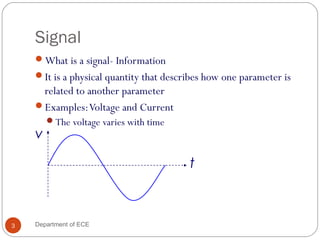
Signal
What is a signal- Information
It is a physical quantity that describes how one parameter is
related to another parameter
Examples:Voltage and Current
The voltage varies with time
t
v
3 Department of ECE
•Examples of signal include:
•Electrical signals
•Voltages and currents in a circuit
•Acoustic signals
•Acoustic pressure (sound) over time
•Mechanical signals
•Velocity of a car over time
•Video signals
•Intensity level of a pixel (camera, video) over time
4 Department of ECE
Signal
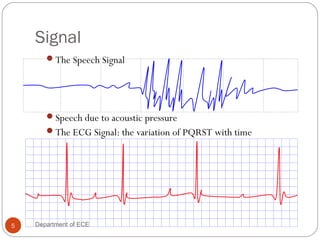
The Speech Signal
Speech due to acoustic pressure
The ECG Signal: the variation of PQRST with time
5 Department of ECE
Signal
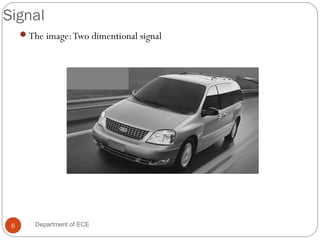
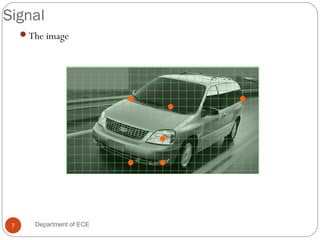
The image:Two dimentional signal
6 Department of ECE
Signal
The image
7 Department of ECE
Signal
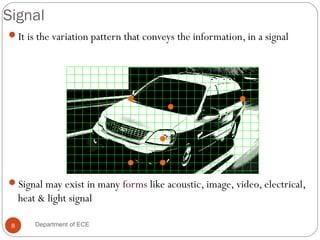
It is the variation pattern that conveys the information, in a signal
Signal may exist in many forms like acoustic, image, video, electrical,
heat & light signal
8 Department of ECE
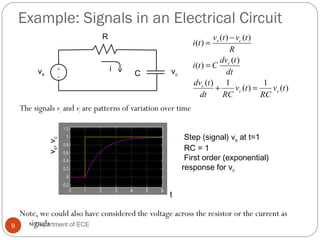
Example: Signals in an Electrical Circuit
The signals vc and vs are patterns of variation over time
Note, we could also have considered the voltage across the resistor or the current as
signals
+
-
i vcvs
R
C
)(
1
)(
1)(
)(
)(
)()(
)(
tv
RC
tv
RCdt
tdv
dt
tdv
Cti
R
tvtv
ti
sc
c
c
cs
=+
=
−
=
Step (signal) vs at t=1
RC = 1
First order (exponential)
response for vc
vs,vc
t
9 Department of ECE
Mathematical Representation
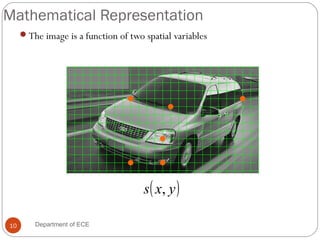
The image is a function of two spatial variables
( )yxs ,
10 Department of ECE
Mathematical Representation
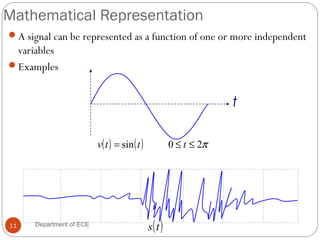
A signal can be represented as a function of one or more independent
variables
Examples
( ) ( ) π20sin ≤≤= tttv
( )ts
t
11 Department of ECE
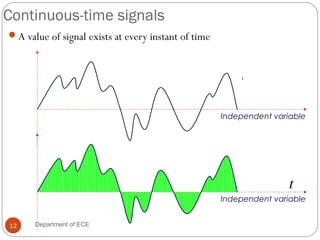
Continuous-time signals
A value of signal exists at every instant of time
t
Independent variable
t
12 Department of ECE
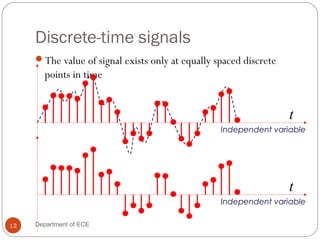
Discrete-time signals
The value of signal exists only at equally spaced discrete
points in time
Independent variable
t
t
13 Department of ECE
Notation
A continuous-time signal is represented by enclosing the
independent variable (time) in parentheses ()
A discrete-time signal is represented by enclosing the
independent variable (index) in square brackets []
( )tx
t
[ ]nx
n14 Department of ECE
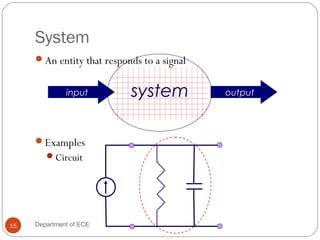
System
An entity that responds to a signal
Examples
Circuit
systeminput output
15 Department of ECE
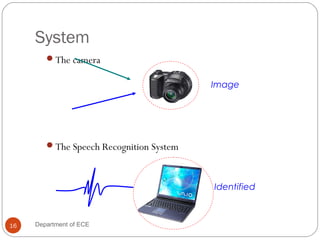
System
The camera
The Speech Recognition System
Identified
Image
16 Department of ECE
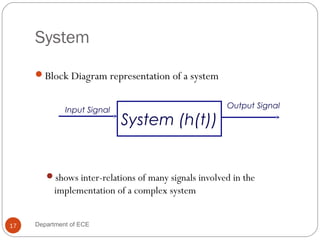
System
Block Diagram representation of a system
shows inter-relations of many signals involved in the
implementation of a complex system
System (h(t))
Input Signal
Output Signal
17 Department of ECE
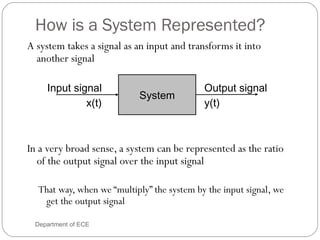
How is a System Represented?
A system takes a signal as an input and transforms it into
another signal
In a very broad sense, a system can be represented as the ratio
of the output signal over the input signal
That way, when we “multiply” the system by the input signal, we
get the output signal
System
Input signal
x(t)
Output signal
y(t)
Department of ECE
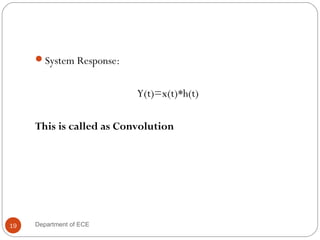
System Response:
Y(t)=x(t)*h(t)
This is called as Convolution
19 Department of ECE
Department of ECE20
ThankYou

Introduction to signals and systems

  • 1.
    Signals & Systems CourseCo ordinator: Dr. R. Sudarmani 1 Department of ECE, Avinshilingam Institute
  • 2.
    Books Signals & Systems(Second Edition)  Text book by AlanV. Oppenheim,Alan S.Willsky, S. Hamid Nawab 2 Department of ECE
  • 3.
    Signal What is asignal- Information It is a physical quantity that describes how one parameter is related to another parameter Examples:Voltage and Current The voltage varies with time t v 3 Department of ECE
  • 4.
    •Examples of signalinclude: •Electrical signals •Voltages and currents in a circuit •Acoustic signals •Acoustic pressure (sound) over time •Mechanical signals •Velocity of a car over time •Video signals •Intensity level of a pixel (camera, video) over time 4 Department of ECE
  • 5.
    Signal The Speech Signal Speechdue to acoustic pressure The ECG Signal: the variation of PQRST with time 5 Department of ECE
  • 6.
    Signal The image:Two dimentionalsignal 6 Department of ECE
  • 7.
  • 8.
    Signal It is thevariation pattern that conveys the information, in a signal Signal may exist in many forms like acoustic, image, video, electrical, heat & light signal 8 Department of ECE
  • 9.
    Example: Signals inan Electrical Circuit The signals vc and vs are patterns of variation over time Note, we could also have considered the voltage across the resistor or the current as signals + - i vcvs R C )( 1 )( 1)( )( )( )()( )( tv RC tv RCdt tdv dt tdv Cti R tvtv ti sc c c cs =+ = − = Step (signal) vs at t=1 RC = 1 First order (exponential) response for vc vs,vc t 9 Department of ECE
  • 10.
    Mathematical Representation The imageis a function of two spatial variables ( )yxs , 10 Department of ECE
  • 11.
    Mathematical Representation A signalcan be represented as a function of one or more independent variables Examples ( ) ( ) π20sin ≤≤= tttv ( )ts t 11 Department of ECE
  • 12.
    Continuous-time signals A valueof signal exists at every instant of time t Independent variable Independent variable t 12 Department of ECE
  • 13.
    Discrete-time signals The valueof signal exists only at equally spaced discrete points in time Independent variable Independent variable t t 13 Department of ECE
  • 14.
    Notation A continuous-time signalis represented by enclosing the independent variable (time) in parentheses () A discrete-time signal is represented by enclosing the independent variable (index) in square brackets [] ( )tx t [ ]nx n14 Department of ECE
  • 15.
    System An entity thatresponds to a signal Examples Circuit systeminput output 15 Department of ECE
  • 16.
    System The camera The SpeechRecognition System Identified Image 16 Department of ECE
  • 17.
    System Block Diagram representationof a system shows inter-relations of many signals involved in the implementation of a complex system System (h(t)) Input Signal Output Signal 17 Department of ECE
  • 18.
    How is aSystem Represented? A system takes a signal as an input and transforms it into another signal In a very broad sense, a system can be represented as the ratio of the output signal over the input signal That way, when we “multiply” the system by the input signal, we get the output signal System Input signal x(t) Output signal y(t) Department of ECE
  • 19.
    System Response: Y(t)=x(t)*h(t) This iscalled as Convolution 19 Department of ECE
  • 20.