7 IT 01
Digital Signal Processing
Unit III: Frequency Analysis using Z- Transform
Prof. (Dr.) Prashant V. Ingole
Professor and Head,
Dept. of Information Technology,
Prof Ram Meghe Institute of Technology and Research, Badnera.
7 IT 01 Digital Signal Processing (Winter 2021) L25
Course Outline
UNIT III: The Z- Transform
– Z-Transform
– Properties of the Region of Convergence of the z-Transform
– The Inverse Z-Transform
– Z-Transform Properties
Course Outcomes (COs)
• Analyze DT LTI Systems using Z transform
7 IT 01 Digital Signal Processing (Winter 2021) L25
Z- Transform
• We have studied that Fourier Transform play a key role in
representing and analyzing the discrete time signals and systems.
• However Fourier Transform is subjected to many constraints
Signal under analysis x(n) need to be absolutely summable.
• So we are in need of a generalized analysis tool
• Z Transform is the generalized form of Fourier Transform
• Analog Signals  Laplace Transform
• Digital Signals Z Transform
• Motivation
1. Convergence of all types of Signals
2. Convenience of notations
3. Use of powerful complex variable theory for analysis
7 IT 01 Digital Signal Processing (Winter 2021) L25
z Transform Definition
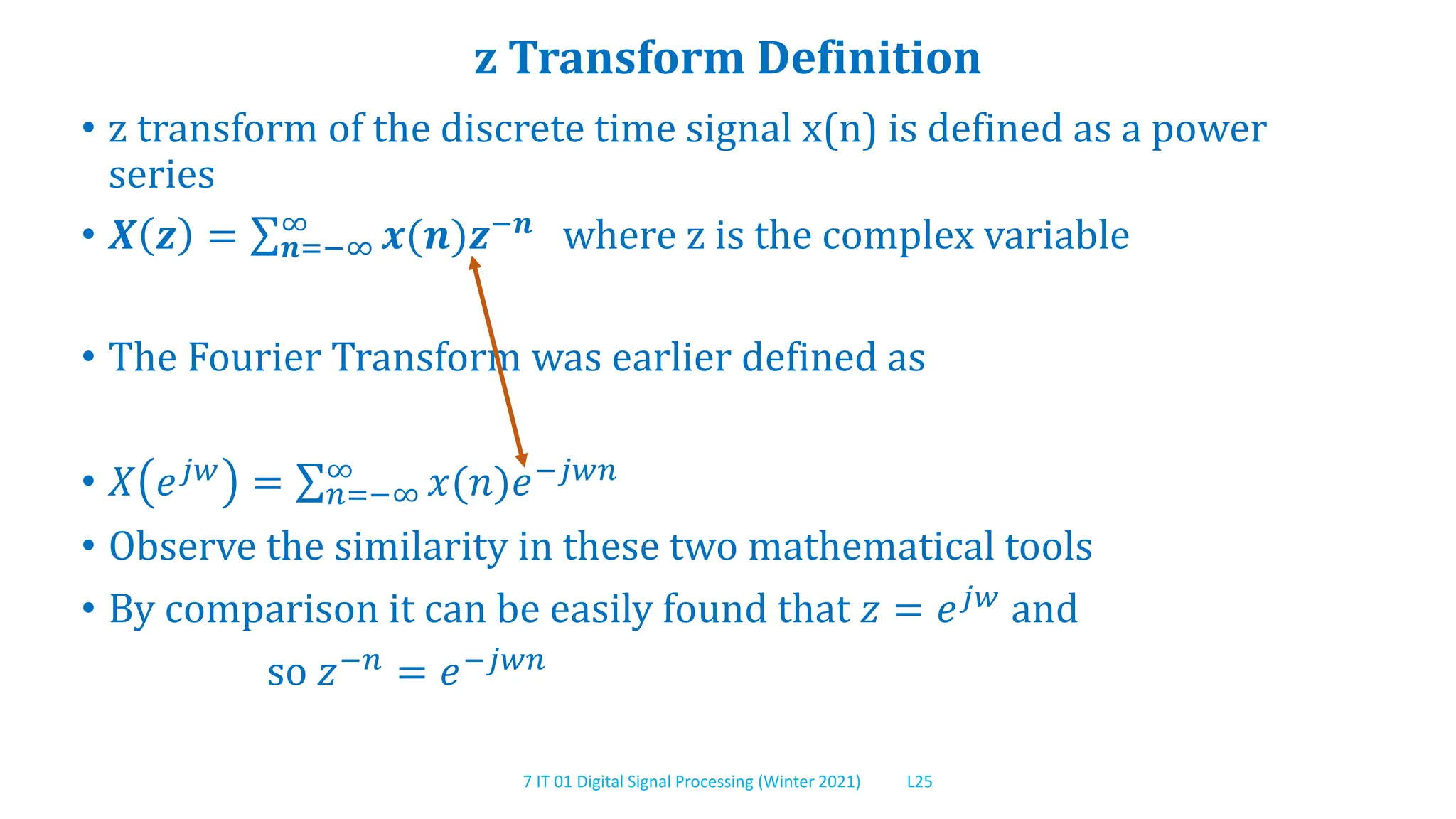
• z transform of the discrete time signal x(n) is defined as a power
series
• 𝑿 𝒛 = 𝒏=−∞
∞ 𝒙(𝒏)𝒛−𝒏 where z is the complex variable
• The Fourier Transform was earlier defined as
• 𝑋 𝑒𝑗𝑤 = 𝑛=−∞
∞ 𝑥(𝑛)𝑒−𝑗𝑤𝑛
• Observe the similarity in these two mathematical tools
• By comparison it can be easily found that 𝑧 = 𝑒𝑗𝑤 and
so 𝑧−𝑛 = 𝑒−𝑗𝑤𝑛
7 IT 01 Digital Signal Processing (Winter 2021) L25
z Transform
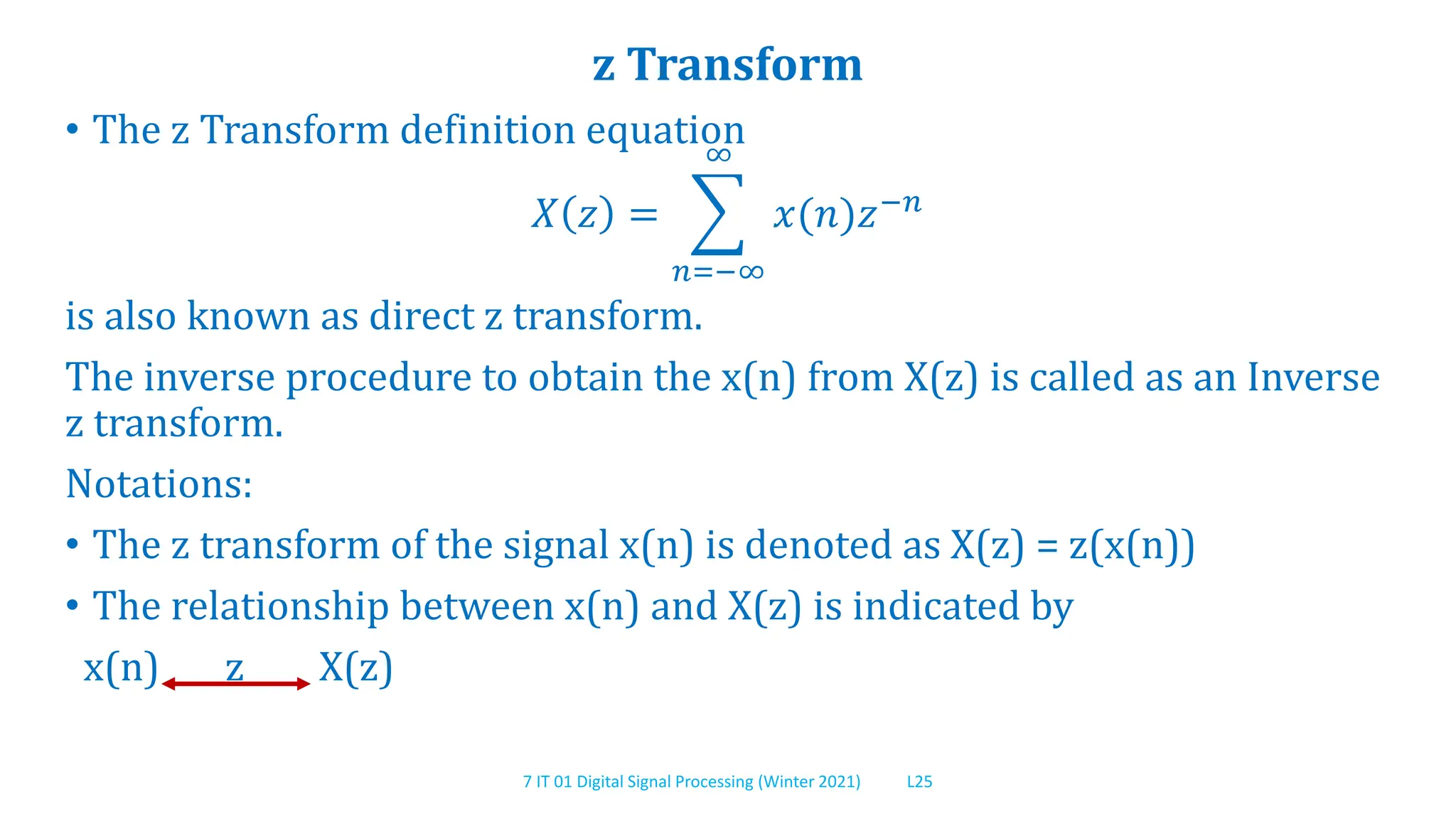
• The z Transform definition equation
𝑋 𝑧 =
𝑛=−∞
∞
𝑥(𝑛)𝑧−𝑛
is also known as direct z transform.
The inverse procedure to obtain the x(n) from X(z) is called as an Inverse
z transform.
Notations:
• The z transform of the signal x(n) is denoted as X(z) = z(x(n))
• The relationship between x(n) and X(z) is indicated by
x(n) z X(z)
7 IT 01 Digital Signal Processing (Winter 2021) L25
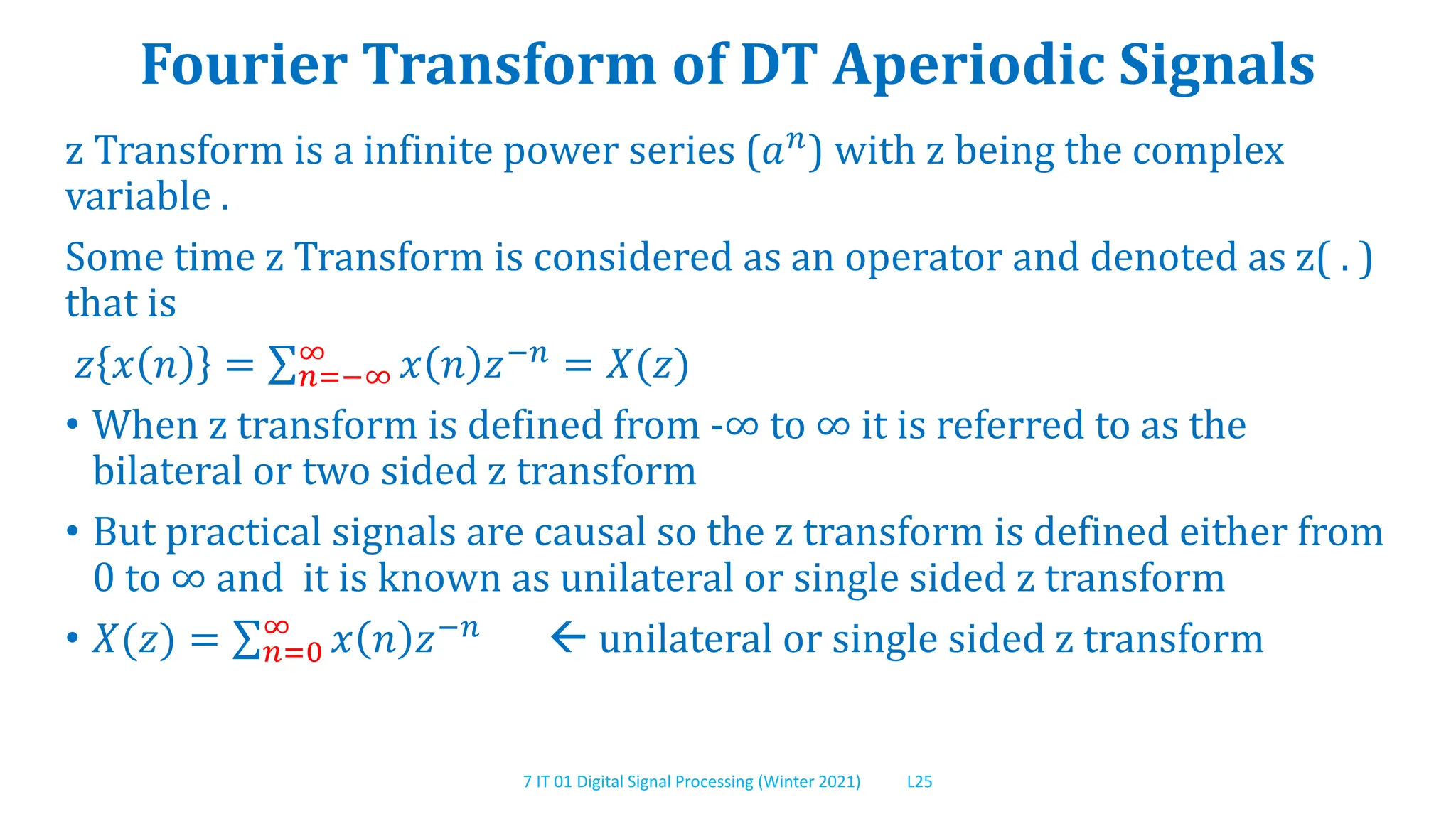
Fourier Transform of DT Aperiodic Signals
z Transform is a infinite power series (𝑎𝑛) with z being the complex
variable .
Some time z Transform is considered as an operator and denoted as z( . )
that is
𝑧 𝑥 𝑛 = 𝑛=−∞
∞ 𝑥 𝑛 𝑧−𝑛 = 𝑋(𝑧)
• When z transform is defined from -∞ to ∞ it is referred to as the
bilateral or two sided z transform
• But practical signals are causal so the z transform is defined either from
0 to ∞ and it is known as unilateral or single sided z transform
• 𝑋(𝑧) = 𝑛=0
∞
𝑥 𝑛 𝑧−𝑛  unilateral or single sided z transform
7 IT 01 Digital Signal Processing (Winter 2021) L25
z Transform
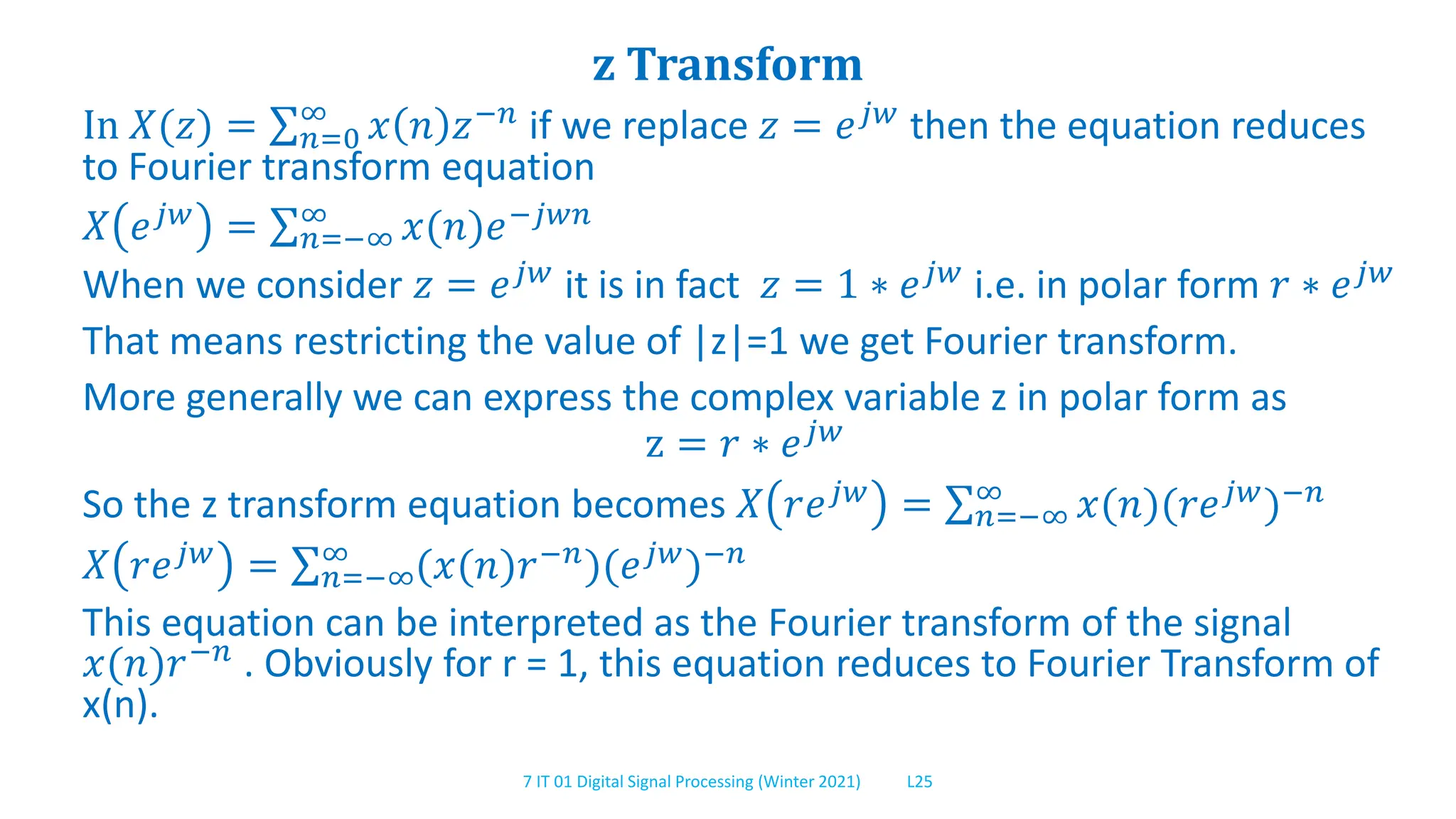
In 𝑋(𝑧) = 𝑛=0
∞
𝑥 𝑛 𝑧−𝑛
if we replace 𝑧 = 𝑒𝑗𝑤
then the equation reduces
to Fourier transform equation
𝑋 𝑒𝑗𝑤 = 𝑛=−∞
∞ 𝑥(𝑛)𝑒−𝑗𝑤𝑛
When we consider 𝑧 = 𝑒𝑗𝑤 it is in fact 𝑧 = 1 ∗ 𝑒𝑗𝑤 i.e. in polar form 𝑟 ∗ 𝑒𝑗𝑤
That means restricting the value of |z|=1 we get Fourier transform.
More generally we can express the complex variable z in polar form as
z = 𝑟 ∗ 𝑒𝑗𝑤
So the z transform equation becomes 𝑋 𝑟𝑒𝑗𝑤
= 𝑛=−∞
∞
𝑥(𝑛)(𝑟𝑒𝑗𝑤
)−𝑛
𝑋 𝑟𝑒𝑗𝑤 = 𝑛=−∞
∞ (𝑥(𝑛)𝑟−𝑛)(𝑒𝑗𝑤)−𝑛
This equation can be interpreted as the Fourier transform of the signal
𝑥(𝑛)𝑟−𝑛 . Obviously for r = 1, this equation reduces to Fourier Transform of
x(n).
7 IT 01 Digital Signal Processing (Winter 2021) L25
Polar Representation of Z Transform and Unit Circle
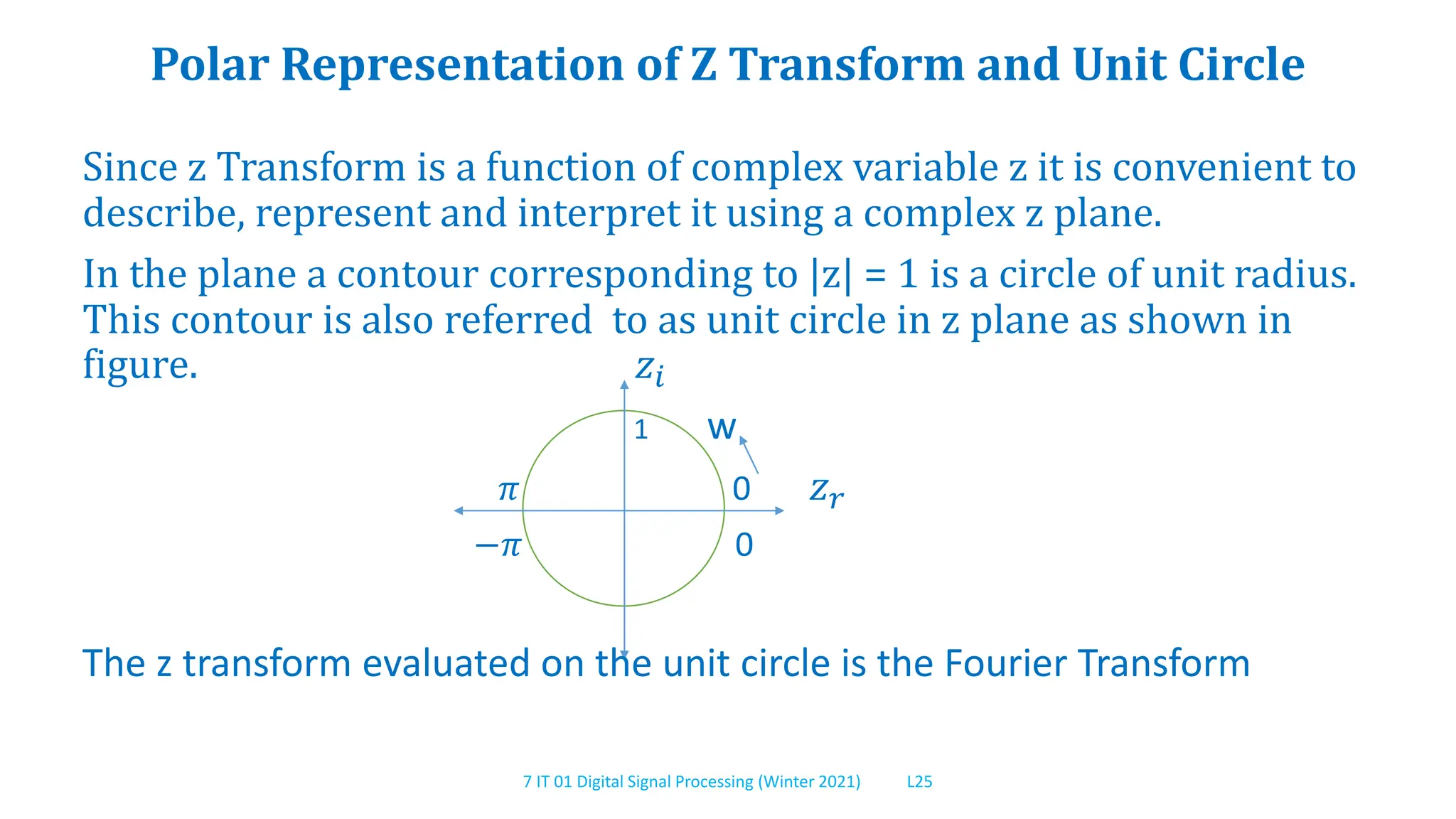
Since z Transform is a function of complex variable z it is convenient to
describe, represent and interpret it using a complex z plane.
In the plane a contour corresponding to |z| = 1 is a circle of unit radius.
This contour is also referred to as unit circle in z plane as shown in
figure. 𝑧𝑖
1 w
𝜋 0 𝑧𝑟
−𝜋 0
The z transform evaluated on the unit circle is the Fourier Transform
7 IT 01 Digital Signal Processing (Winter 2021) L25
Periodicity in z Transform
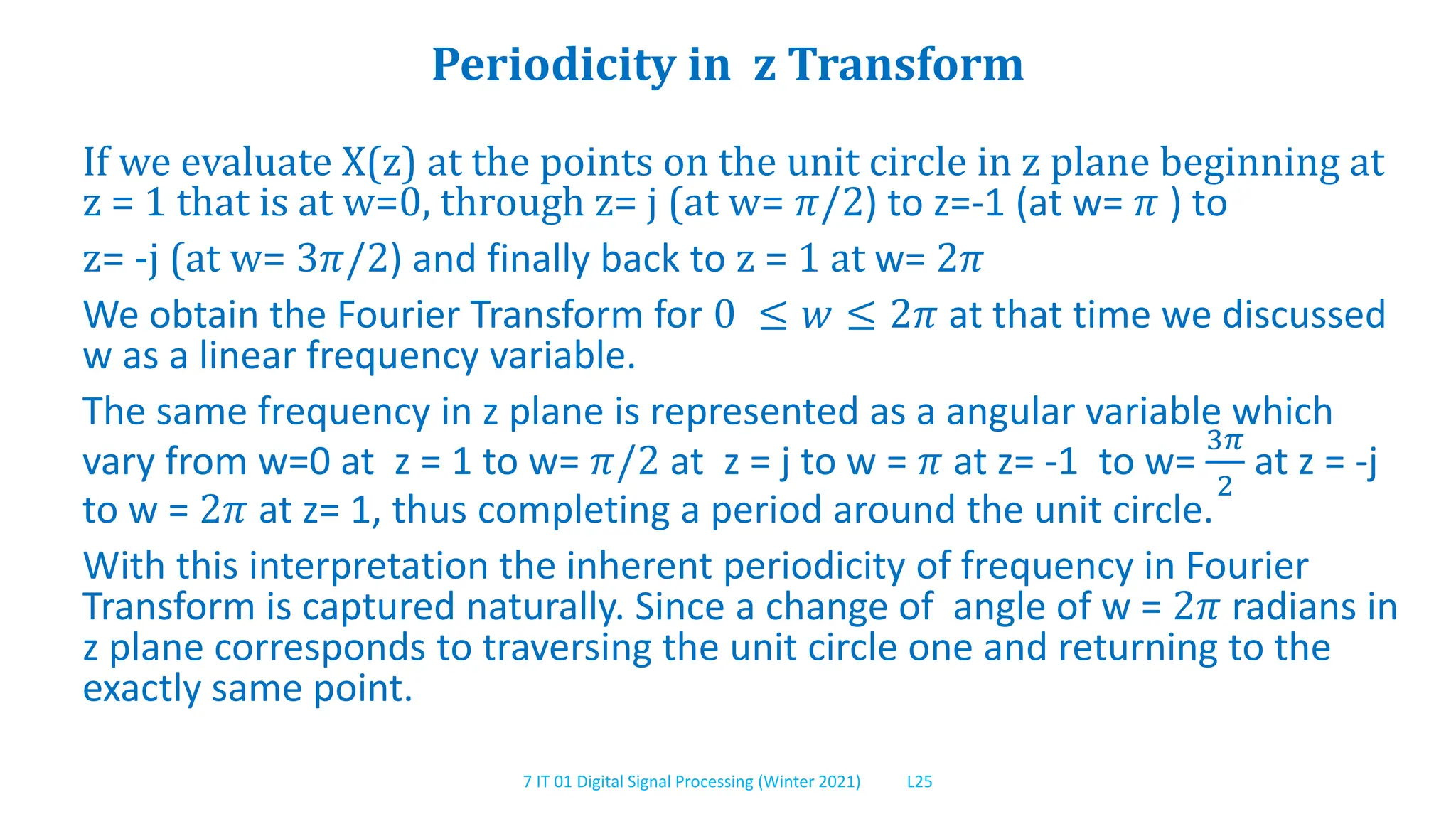
If we evaluate X(z) at the points on the unit circle in z plane beginning at
z = 1 that is at w=0, through z= j (at w= 𝜋/2) to z=-1 (at w= 𝜋 ) to
z= -j (at w= 3𝜋/2) and finally back to z = 1 at w= 2𝜋
We obtain the Fourier Transform for 0 ≤ 𝑤 ≤ 2𝜋 at that time we discussed
w as a linear frequency variable.
The same frequency in z plane is represented as a angular variable which
vary from w=0 at z = 1 to w= 𝜋/2 at z = j to w = 𝜋 at z= -1 to w=
3𝜋
2
at z = -j
to w = 2𝜋 at z= 1, thus completing a period around the unit circle.
With this interpretation the inherent periodicity of frequency in Fourier
Transform is captured naturally. Since a change of angle of w = 2𝜋 radians in
z plane corresponds to traversing the unit circle one and returning to the
exactly same point.
7 IT 01 Digital Signal Processing (Winter 2021) L25
Region of Convergence in z Transform
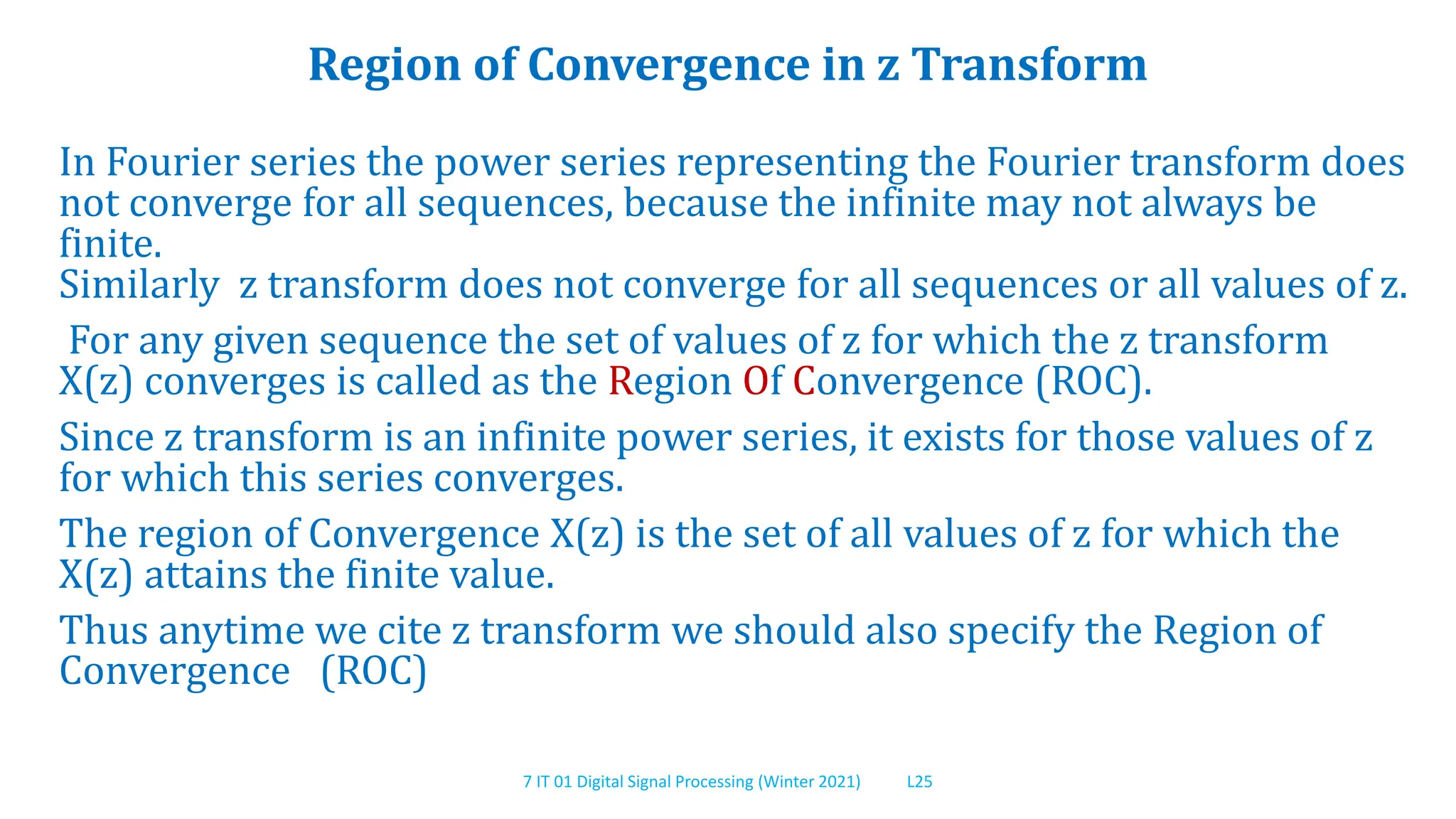
In Fourier series the power series representing the Fourier transform does
not converge for all sequences, because the infinite may not always be
finite.
Similarly z transform does not converge for all sequences or all values of z.
For any given sequence the set of values of z for which the z transform
X(z) converges is called as the Region Of Convergence (ROC).
Since z transform is an infinite power series, it exists for those values of z
for which this series converges.
The region of Convergence X(z) is the set of all values of z for which the
X(z) attains the finite value.
Thus anytime we cite z transform we should also specify the Region of
Convergence (ROC)
7 IT 01 Digital Signal Processing (Winter 2021) L25
z –Transform Evaluation
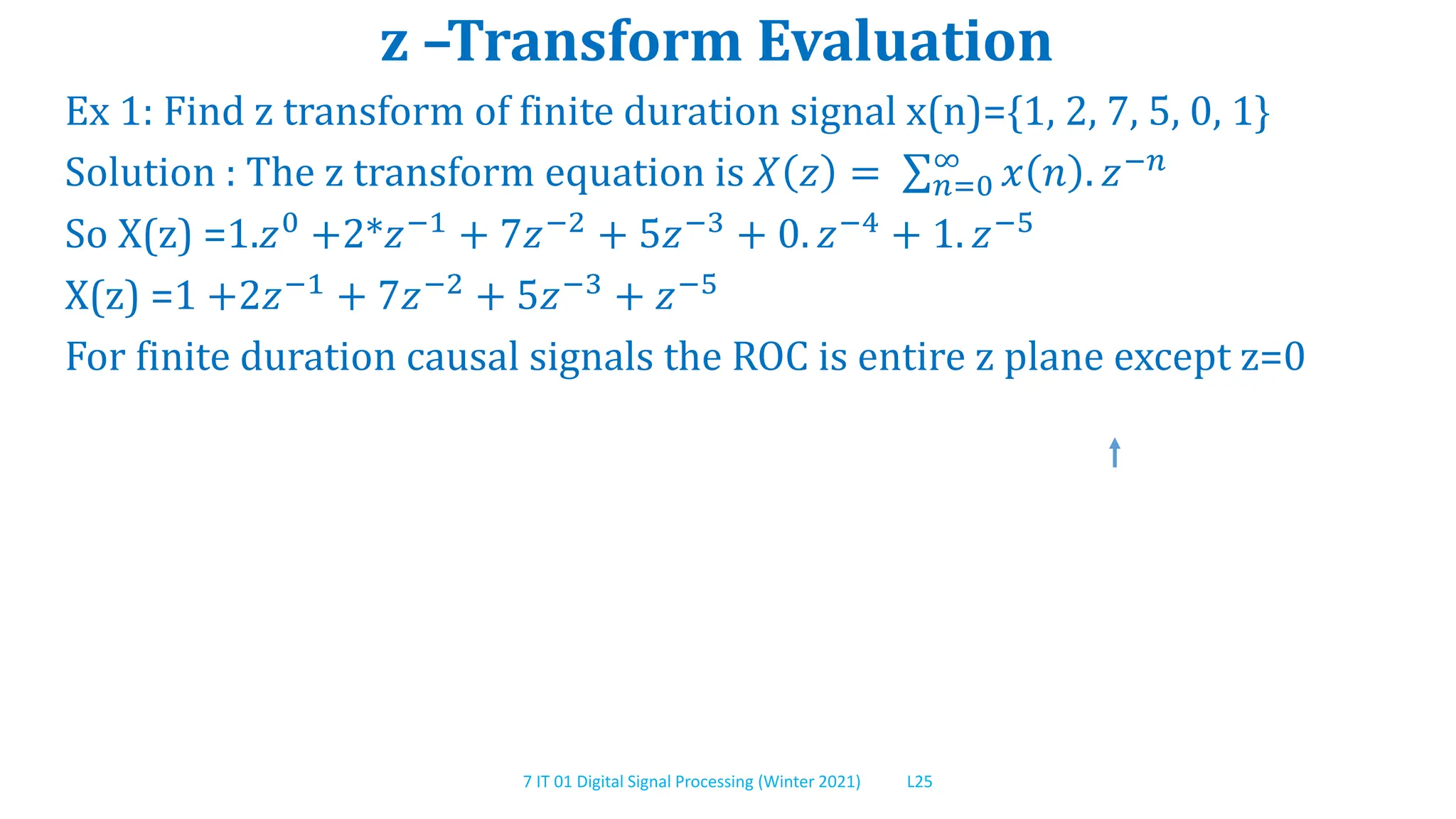
Ex 1: Find z transform of finite duration signal x(n)={1, 2, 7, 5, 0, 1}
Solution : The z transform equation is 𝑋 𝑧 = 𝑛=0
∞
𝑥 𝑛 . 𝑧−𝑛
So X(z) =1.𝑧0 +2*𝑧−1 + 7𝑧−2 + 5𝑧−3 + 0. 𝑧−4 + 1. 𝑧−5
X(z) =1 +2𝑧−1 + 7𝑧−2 + 5𝑧−3 + 𝑧−5
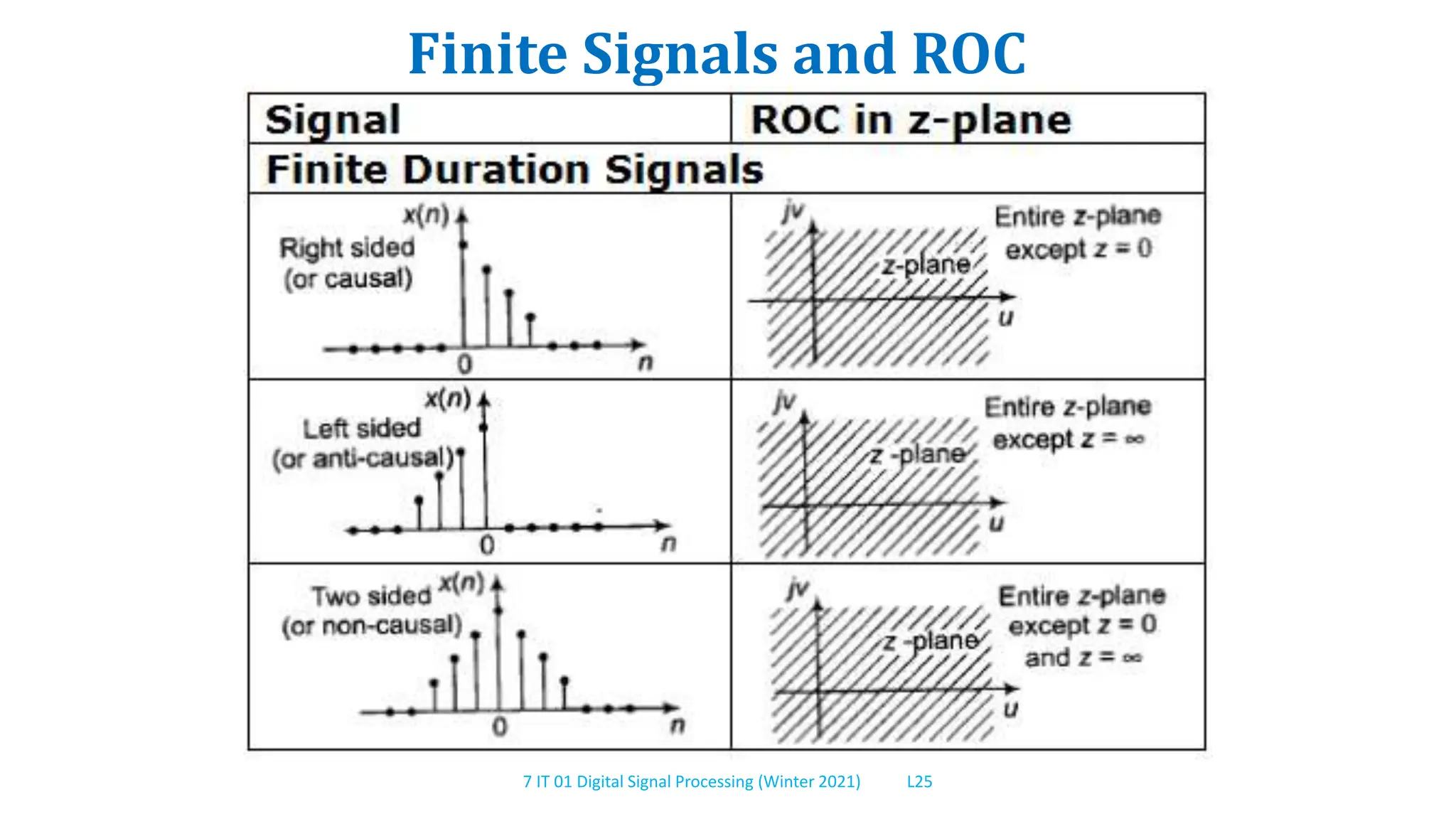
For finite duration causal signals the ROC is entire z plane except z=0
7 IT 01 Digital Signal Processing (Winter 2021) L25
z –Transform Evaluation
Ex 1: Find z transform of finite duration signal x(n)={1, 2, 7, 5, 0, 1}
Solution : The z transform equation is 𝑋 𝑧 = 𝑛=0
∞
𝑥 𝑛 . 𝑧−𝑛
So X(z) =1.𝑧0 +2*𝑧−1 + 7𝑧−2 + 5𝑧−3 + 0. 𝑧−4 + 1. 𝑧−5
X(z) =1 +2𝑧−1 + 7𝑧−2 + 5𝑧−3 + 𝑧−5
For finite duration causal signals the ROC is entire z plane except z=0
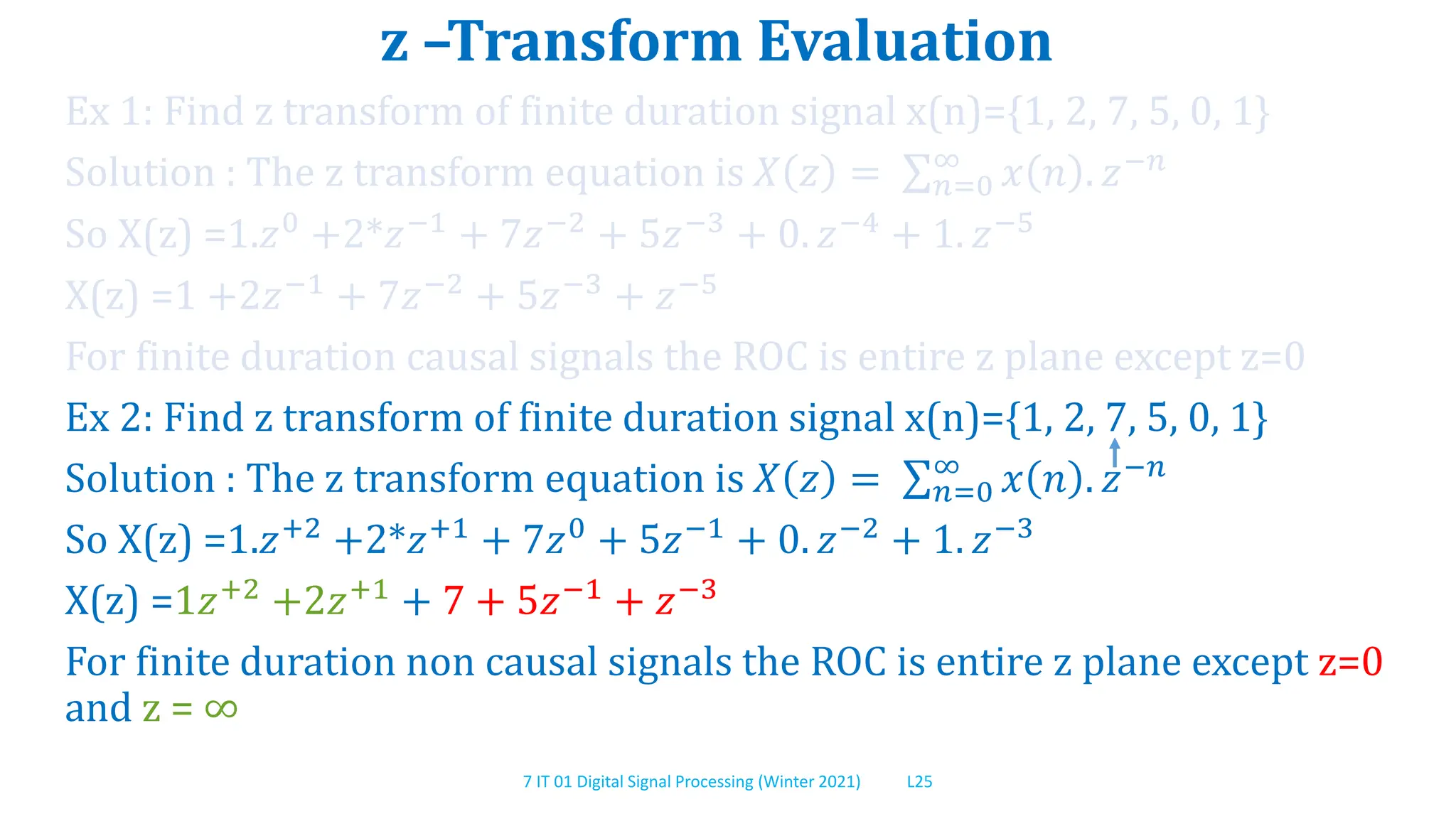
Ex 2: Find z transform of finite duration signal x(n)={1, 2, 7, 5, 0, 1}
Solution : The z transform equation is 𝑋 𝑧 = 𝑛=0
∞
𝑥 𝑛 . 𝑧−𝑛
So X(z) =1.𝑧+2 +2*𝑧+1 + 7𝑧0 + 5𝑧−1 + 0. 𝑧−2 + 1. 𝑧−3
X(z) =1𝑧+2
+2𝑧+1
+ 7 + 5𝑧−1
+ 𝑧−3
For finite duration non causal signals the ROC is entire z plane except z=0
and z = ∞
7 IT 01 Digital Signal Processing (Winter 2021) L25
z Transform Problems
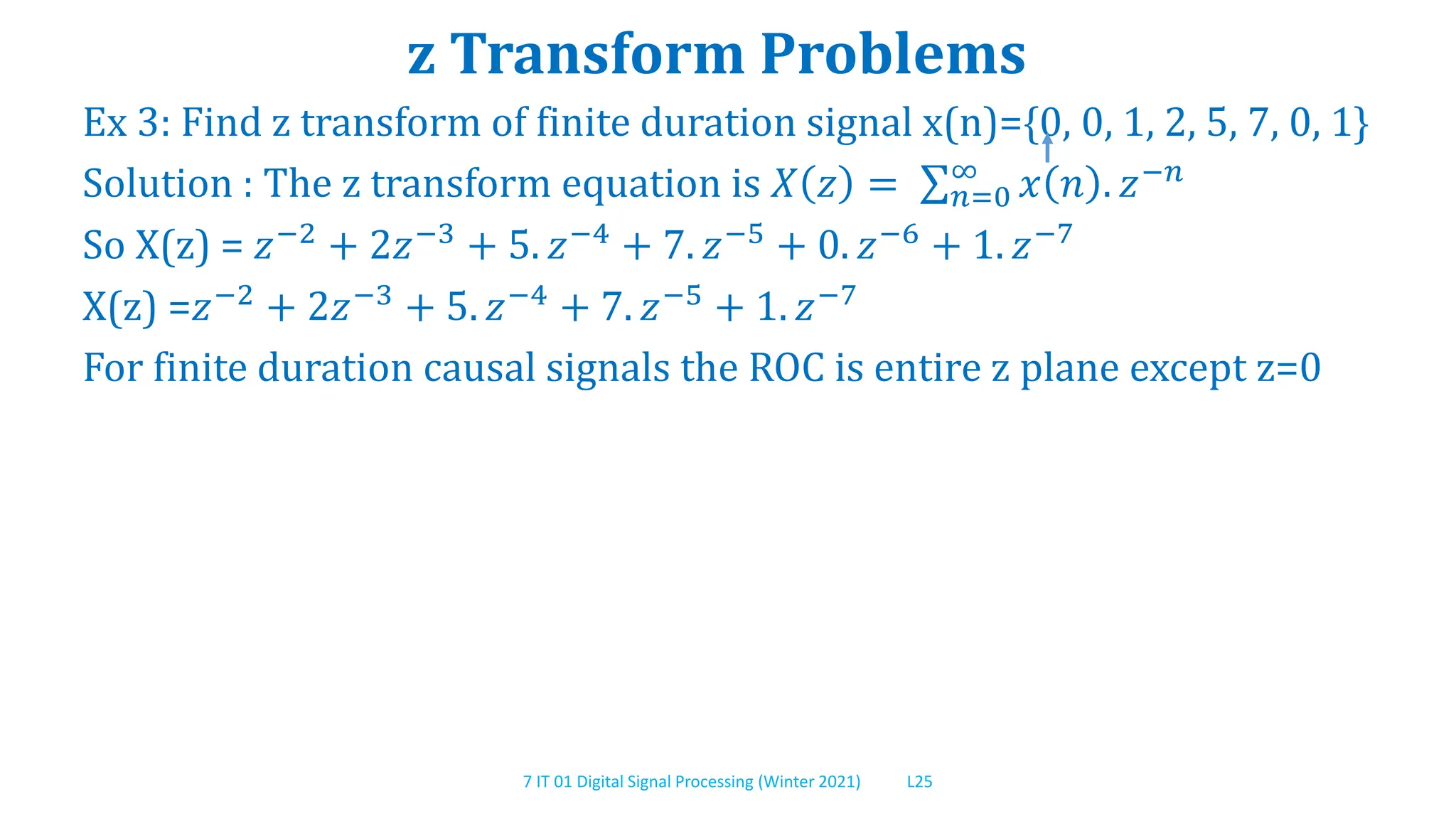
Ex 3: Find z transform of finite duration signal x(n)={0, 0, 1, 2, 5, 7, 0, 1}
Solution : The z transform equation is 𝑋 𝑧 = 𝑛=0
∞
𝑥 𝑛 . 𝑧−𝑛
So X(z) = 𝑧−2 + 2𝑧−3 + 5. 𝑧−4 + 7. 𝑧−5 + 0. 𝑧−6 + 1. 𝑧−7
X(z) =𝑧−2 + 2𝑧−3 + 5. 𝑧−4 + 7. 𝑧−5 + 1. 𝑧−7
For finite duration causal signals the ROC is entire z plane except z=0
7 IT 01 Digital Signal Processing (Winter 2021) L25
z Transform Problems
Ex 3: Find z transform of finite duration signal x(n)={0, 0, 1, 2, 5, 7, 0, 1}
Solution : The z transform equation is 𝑋 𝑧 = 𝑛=0
∞
𝑥 𝑛 . 𝑧−𝑛
So X(z) = 𝑧−2 + 2𝑧−3 + 5. 𝑧−4 + 7. 𝑧−5 + 0. 𝑧−6 + 1. 𝑧−7
X(z) =𝑧−2 + 2𝑧−3 + 5. 𝑧−4 + 7. 𝑧−5 + 1. 𝑧−7
For finite duration causal signals the ROC is entire z plane except z=0
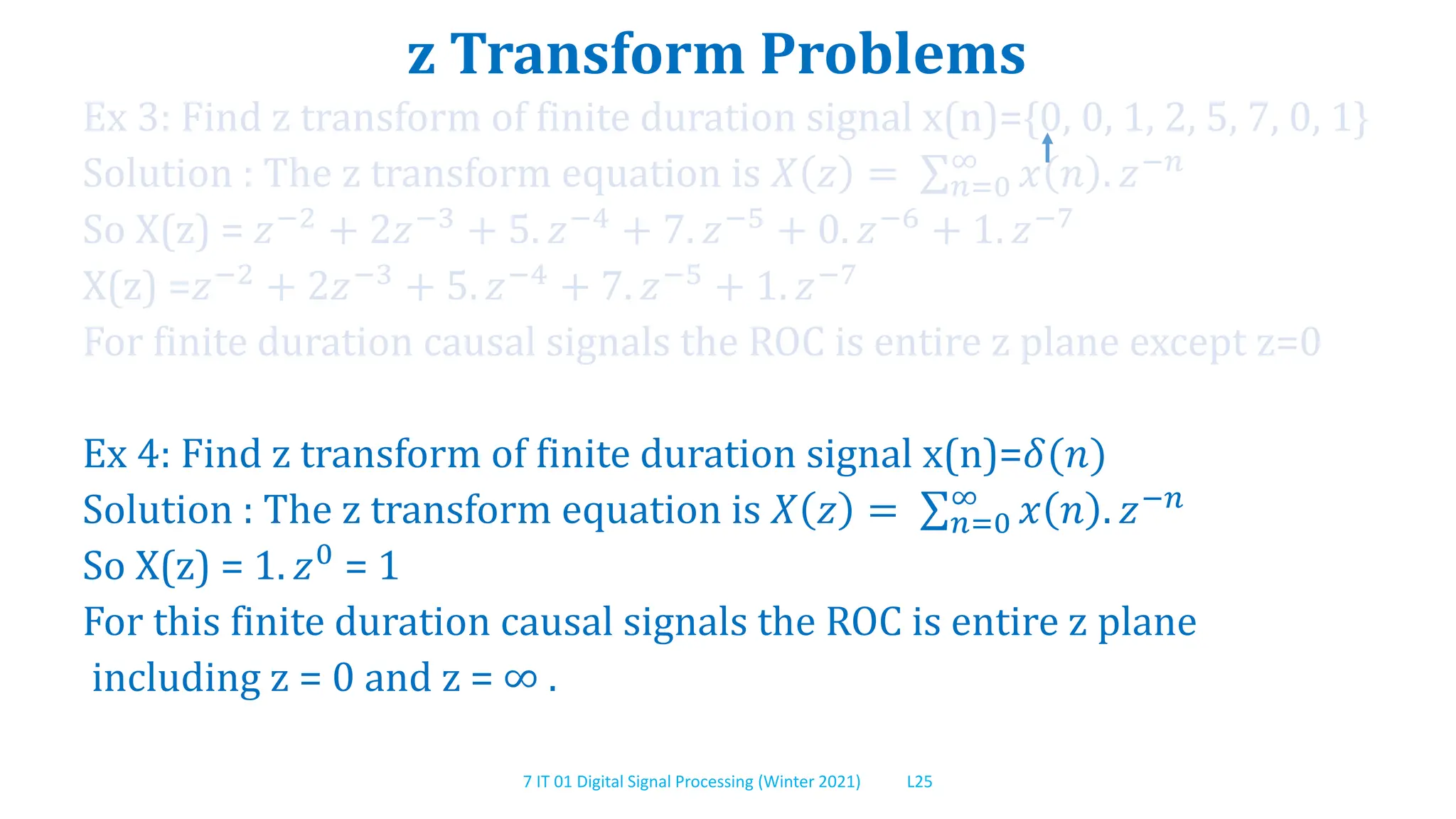
Ex 4: Find z transform of finite duration signal x(n)=𝛿(𝑛)
Solution : The z transform equation is 𝑋 𝑧 = 𝑛=0
∞
𝑥 𝑛 . 𝑧−𝑛
So X(z) = 1. 𝑧0 = 1
For this finite duration causal signals the ROC is entire z plane
including z = 0 and z = ∞ .
7 IT 01 Digital Signal Processing (Winter 2021) L25
z Transform Problems
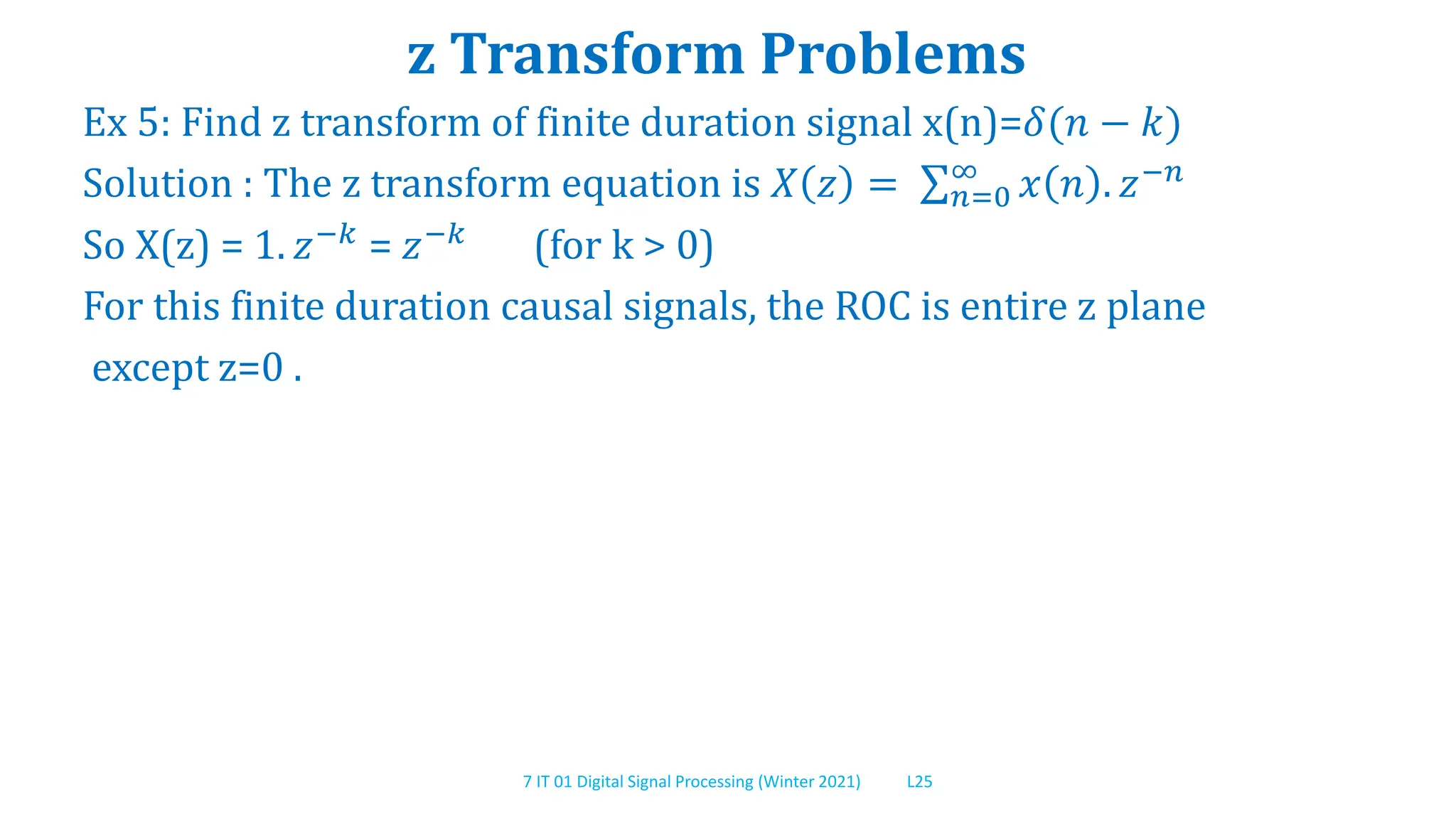
Ex 5: Find z transform of finite duration signal x(n)=𝛿(𝑛 − 𝑘)
Solution : The z transform equation is 𝑋 𝑧 = 𝑛=0
∞
𝑥 𝑛 . 𝑧−𝑛
So X(z) = 1. 𝑧−𝑘
= 𝑧−𝑘
(for k > 0)
For this finite duration causal signals, the ROC is entire z plane
except z=0 .
7 IT 01 Digital Signal Processing (Winter 2021) L25
z Transform Problems
Ex 5: Find z transform of finite duration signal x(n)=𝛿(𝑛 − 𝑘)
Solution : The z transform equation is 𝑋 𝑧 = 𝑛=0
∞
𝑥 𝑛 . 𝑧−𝑛
So X(z) = 1. 𝑧−𝑘 = 𝑧−𝑘 (for k > 0)
For this finite duration causal signals, the ROC is entire z plane
except z=0 .
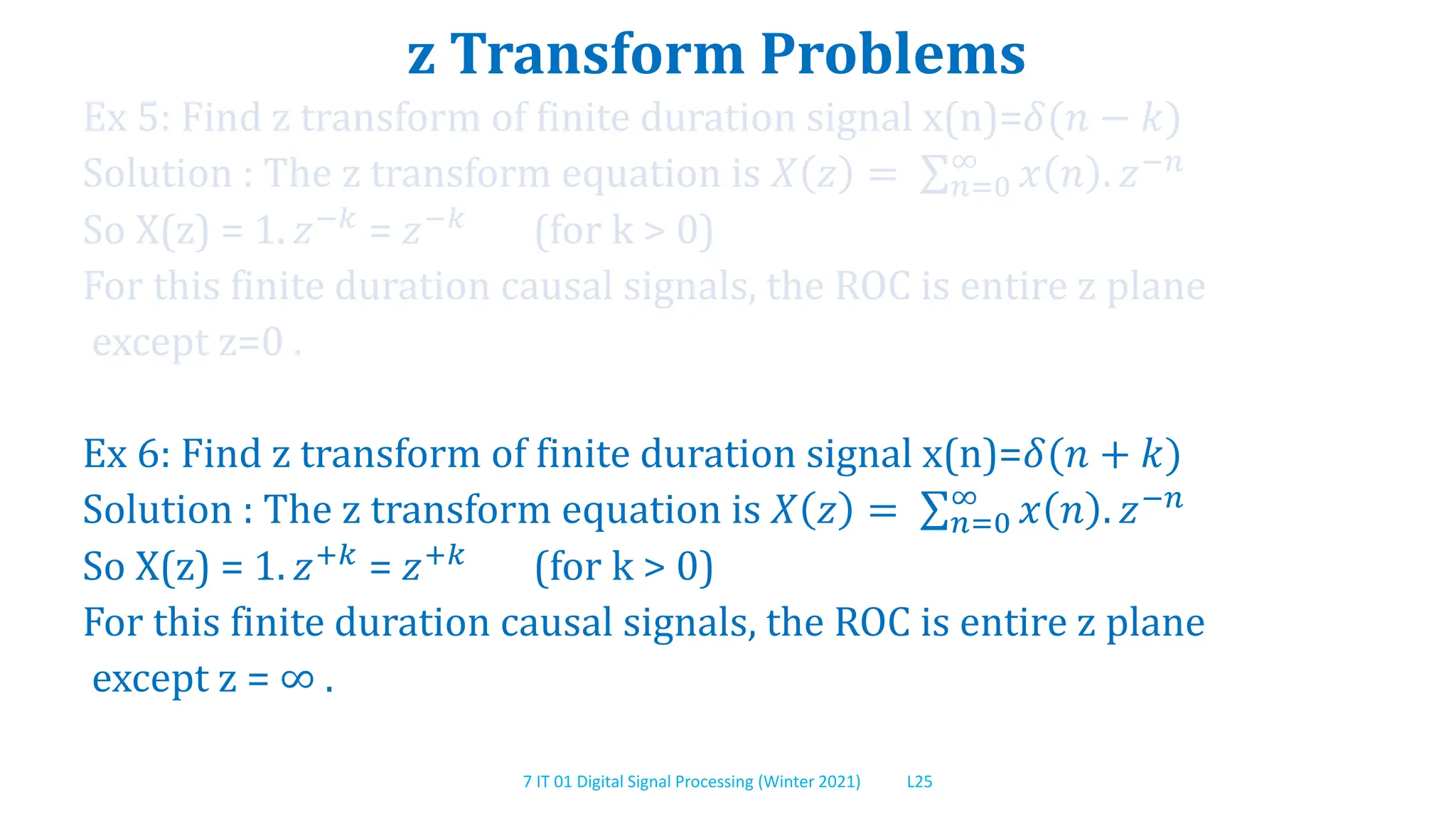
Ex 6: Find z transform of finite duration signal x(n)=𝛿(𝑛 + 𝑘)
Solution : The z transform equation is 𝑋 𝑧 = 𝑛=0
∞
𝑥 𝑛 . 𝑧−𝑛
So X(z) = 1. 𝑧+𝑘 = 𝑧+𝑘 (for k > 0)
For this finite duration causal signals, the ROC is entire z plane
except z = ∞ .
7 IT 01 Digital Signal Processing (Winter 2021) L25
Finite Signals and ROC
7 IT 01 Digital Signal Processing (Winter 2021) L25
Convergence of z Transform
If 𝑧 = 𝑒𝑗𝑤 then ROC is unit circle (r = 1)
So | z | = 1
But let us suppose 𝑧 = 𝑟. 𝑒𝑗𝑤
if we replace it in the definition of the z transform
The z transform equation becomes 𝑋 𝑟𝑒𝑗𝑤 = 𝑛=−∞
∞ 𝑥(𝑛)(𝑟𝑒𝑗𝑤)−𝑛
𝑋 𝑟𝑒𝑗𝑤 = 𝑛=−∞
∞ (𝑥(𝑛)𝑟−𝑛)(𝑒𝑗𝑤)−𝑛
Uniform convergence of the Fourier transform requires that the sequence be
absolutely summable. So applying this condition to the above equation we
get the condition as:
𝑛=−∞
∞
𝑥 𝑛 𝑟−𝑛
< ∞
For absolute convergence of the z transform.
7 IT 01 Digital Signal Processing (Winter 2021) L25
Convergence of z Transform
This condition indicates that because of the multiplication of the
sequence by the real exponential sequence 𝑟−𝑛, it is possible for the z
transform to converge even if the Fourier Transform does not converge.
Ex: Find Fourier Transform of signal x(n) = u(n)  Answer is FT does not exist
Reason is signal u(n) is not absolutely summable.
Ex: Find z transform of signal x(n) = u(n)
Solution: x(n) = u(n) is not absolutely summable so its FT cannot be found.
However while finding z transform as per the definition we find FT of
𝑥 𝑛 𝑟−𝑛
. An this multiplication is absolutely summable for r > 1.
This means z transform of the unit step exists with ROC |z| > 1 i.e. ROC is
exterior of the unit circle in z Plane
7 IT 01 Digital Signal Processing (Winter 2021) L25
Convergence of z Transform
Convergence of the power series in definition of z transform depend only on |z|.
Since |X(z)| < ∞ if 𝑛=0
∞
|𝑥 𝑛 |. |𝑧|−𝑛 < ∞
Thus if some value of 𝑧 = 𝑧1 is in the ROC, then all values of z defined by a circle
with radius z = |𝑧1|will also be in the ROC.
In ROC of X(z), |X(z)| < ∞
But as per the definition of z transform
|𝑋 𝑧 | = | 𝑛=−∞
∞
𝑥 𝑛 𝑟−𝑛
. 𝑒−𝑗𝑤𝑛
|
|𝑋 𝑧 | < 𝑛=−∞
∞ |𝑥 𝑛 𝑟−𝑛|. |𝑒−𝑗𝑤𝑛|
|𝑋 𝑧 | < 𝑛=−∞
∞
|𝑥 𝑛 𝑟−𝑛
|
Hence |𝑋 𝑧 | is finite if sequence 𝑥 𝑛 𝑟−𝑛
is absolutely summable.
The problem of finding ROC for finding X(z) is equivalent to determining the range
of values for r for which 𝒙 𝒏 . 𝒓−𝒏
is absolutely summable.
7 IT 01 Digital Signal Processing (Winter 2021) L25
Convergence of z Transform
Corrolary
|𝑋 𝑧 | < 𝑛=−∞
−1
𝑥 𝑛 𝑟−𝑛
+ 𝑛=0
∞
𝑥 𝑛 𝑟−𝑛
|𝑋 𝑧 | < 𝑛=1
∞
𝑥 −𝑛 𝑟𝑛
+ 𝑛=0
∞
𝑥 𝑛 /𝑟𝑛
1) Non Causal component, 2) Causal component
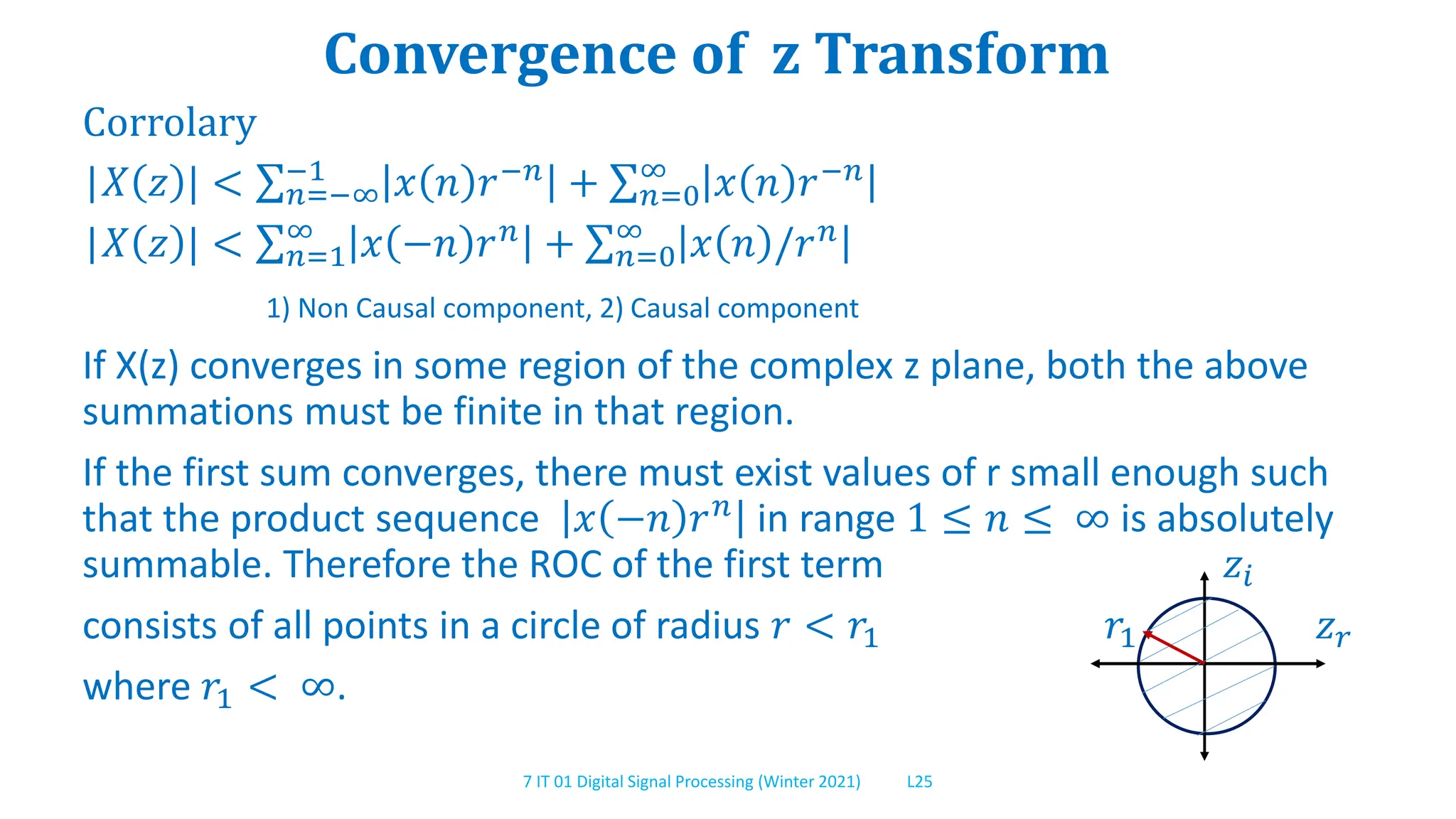
If X(z) converges in some region of the complex z plane, both the above
summations must be finite in that region.
If the first sum converges, there must exist values of r small enough such
that the product sequence 𝑥 −𝑛 𝑟𝑛
in range 1 ≤ 𝑛 ≤ ∞ is absolutely
summable. Therefore the ROC of the first term 𝑧𝑖
consists of all points in a circle of radius 𝑟 < 𝑟1 𝑟1 𝑧𝑟
where 𝑟1 < ∞.
7 IT 01 Digital Signal Processing (Winter 2021) L25
Convergence of z Transform
Corrolary
|𝑋 𝑧 | < 𝑛=−∞
−1
𝑥 𝑛 𝑟−𝑛
+ 𝑛=0
∞
𝑥 𝑛 𝑟−𝑛
|𝑋 𝑧 | < 𝑛=1
∞
𝑥 −𝑛 𝑟𝑛 + 𝑛=0
∞
𝑥 𝑛 /𝑟𝑛
1) Non Causal component, 2) Causal component
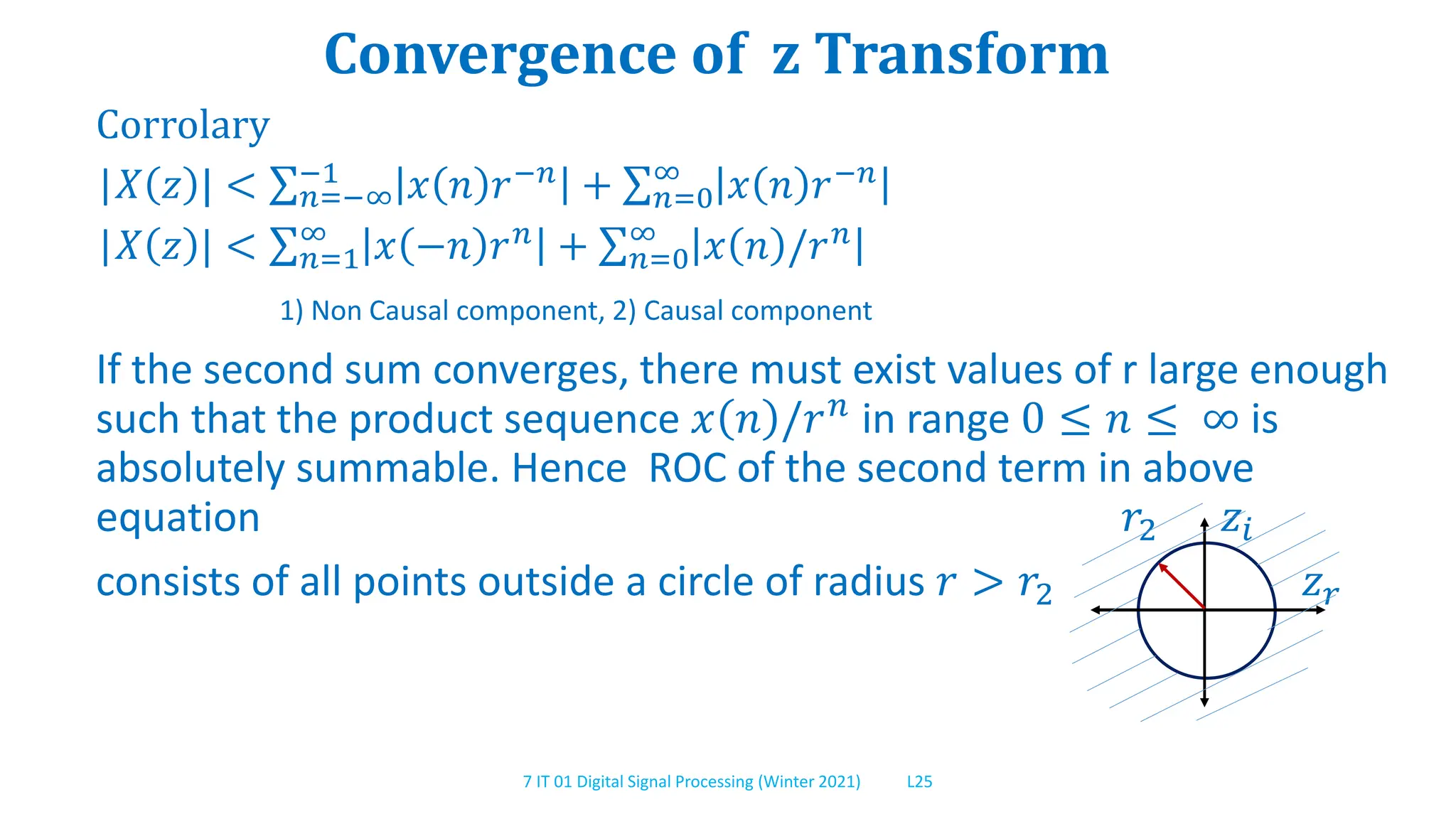
If the second sum converges, there must exist values of r large enough
such that the product sequence 𝑥 𝑛 /𝑟𝑛
in range 0 ≤ 𝑛 ≤ ∞ is
absolutely summable. Hence ROC of the second term in above
equation 𝑟2 𝑧𝑖
consists of all points outside a circle of radius 𝑟 > 𝑟2 𝑧𝑟
7 IT 01 Digital Signal Processing (Winter 2021) L25
Convergence of z Transform
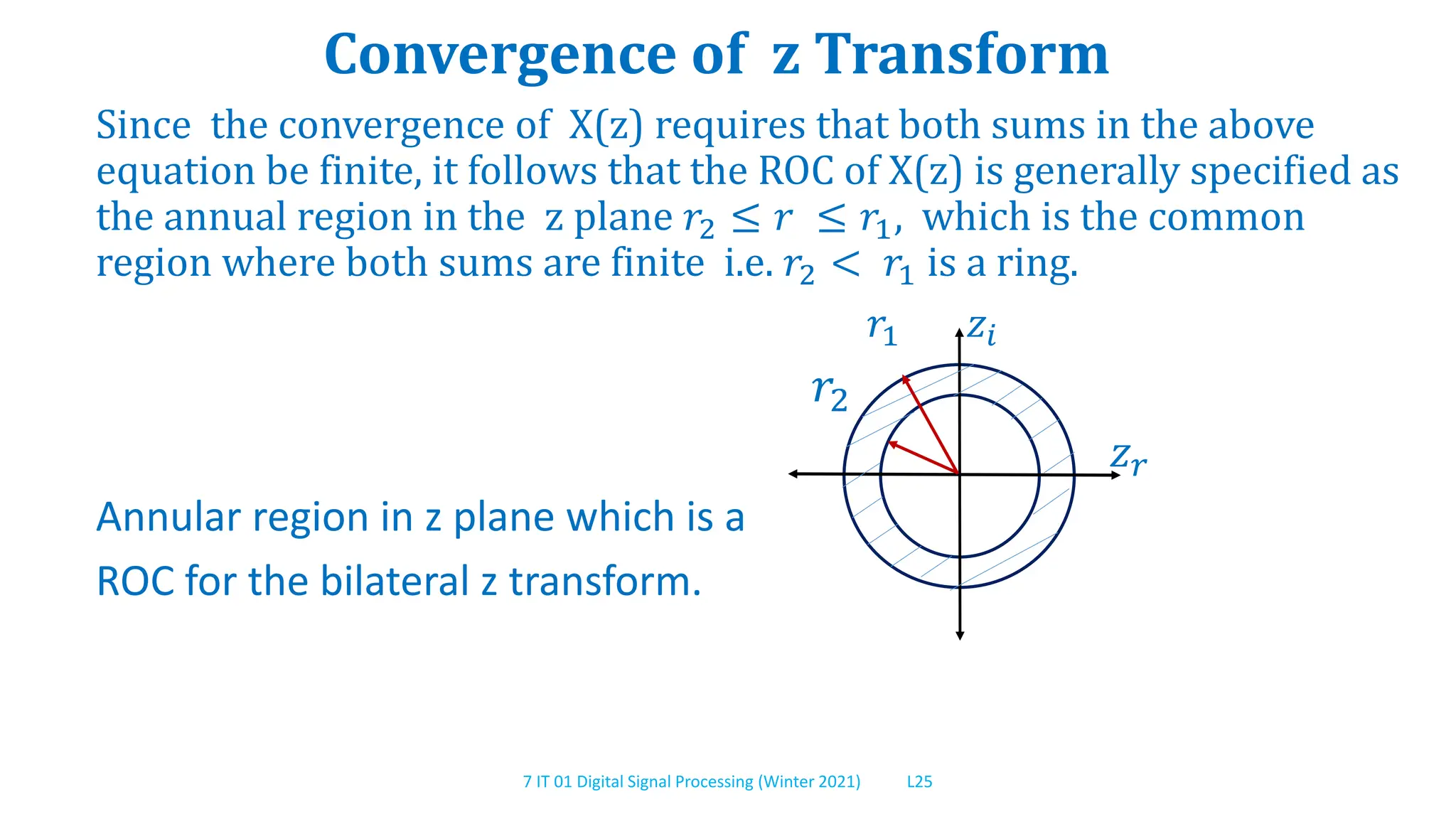
Since the convergence of X(z) requires that both sums in the above
equation be finite, it follows that the ROC of X(z) is generally specified as
the annual region in the z plane 𝑟2 ≤ 𝑟 ≤ 𝑟1, which is the common
region where both sums are finite i.e. 𝑟2 < 𝑟1 is a ring.
𝑟1 𝑧𝑖
𝑟2
𝑧𝑟
Annular region in z plane which is a
ROC for the bilateral z transform.
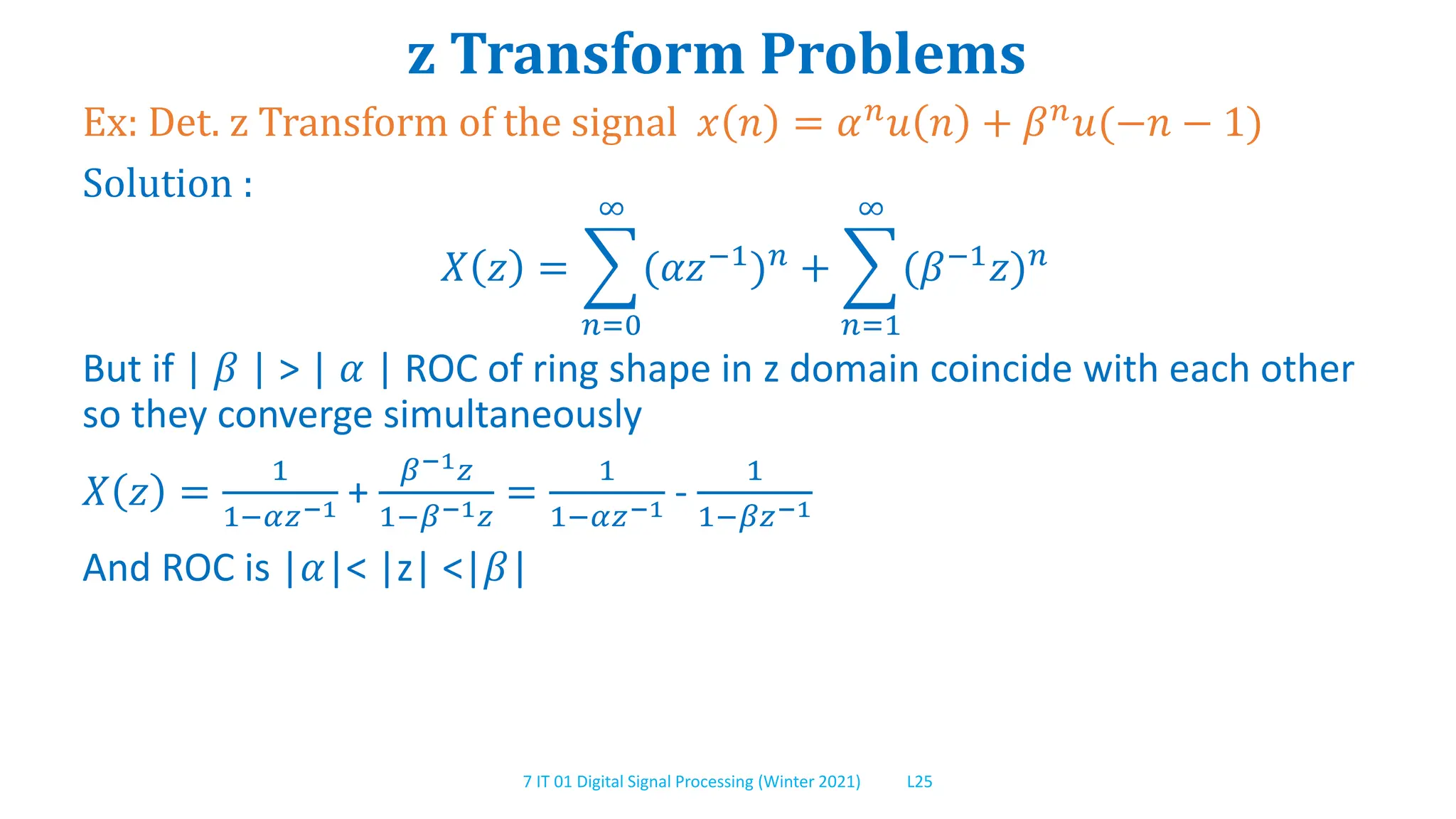
7 IT 01 Digital Signal Processing (Winter 2021) L25
z Transform Problems
Ex: Determine z Transform of the signal 𝑥 𝑛 =
1
2
𝑛
𝑢(𝑛)
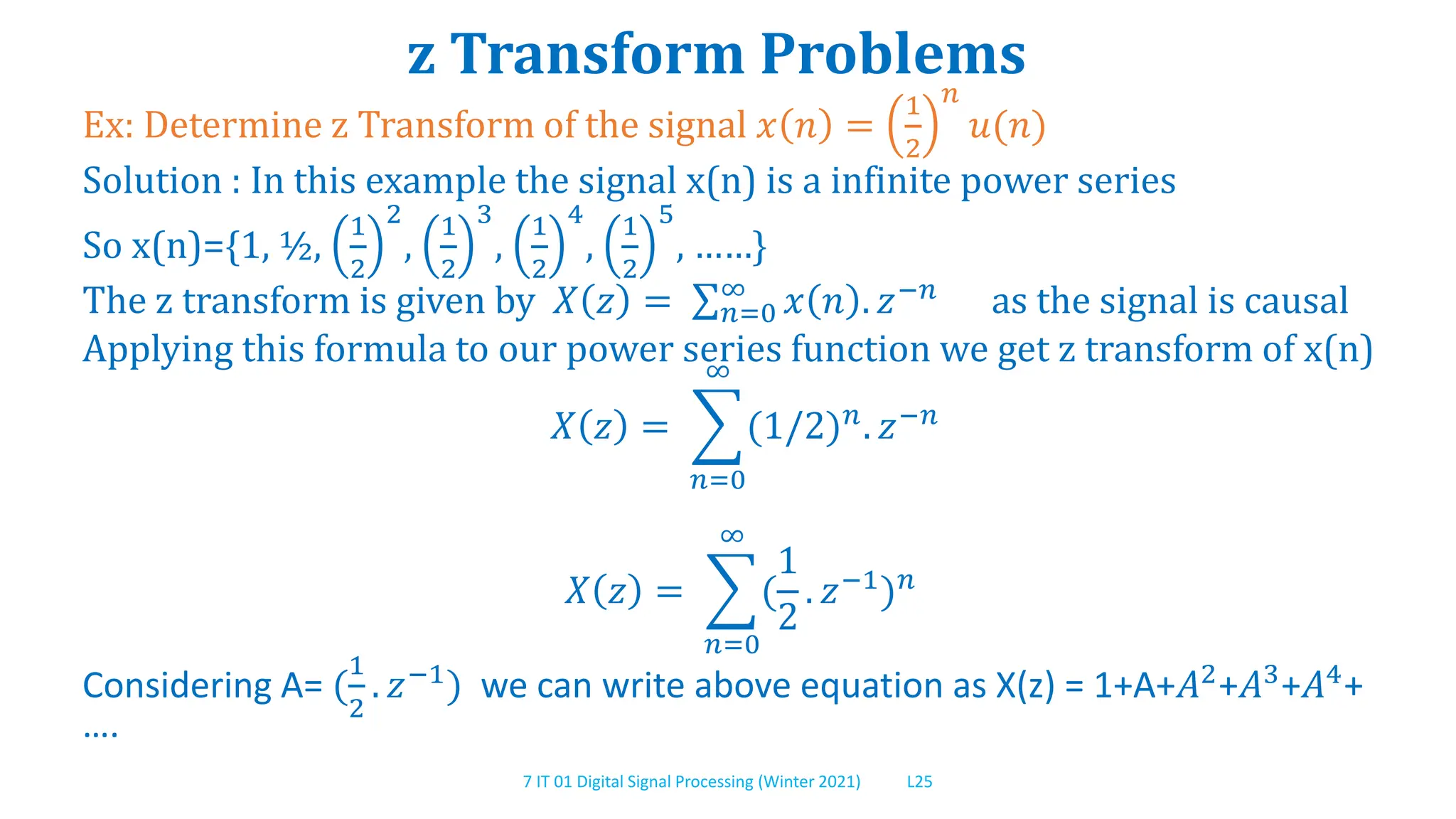
Solution : In this example the signal x(n) is a infinite power series
So x(n)={1, ½,
1
2
2
,
1
2
3
,
1
2
4
,
1
2
5
, ……}
The z transform is given by 𝑋 𝑧 = 𝑛=0
∞
𝑥 𝑛 . 𝑧−𝑛
as the signal is causal
Applying this formula to our power series function we get z transform of x(n)
𝑋 𝑧 =
𝑛=0
∞
(1/2)𝑛
. 𝑧−𝑛
𝑋 𝑧 =
𝑛=0
∞
(
1
2
. 𝑧−1
)𝑛
Considering A= (
1
2
. 𝑧−1
) we can write above equation as X(z) = 1+A+𝐴2
+𝐴3
+𝐴4
+
….
7 IT 01 Digital Signal Processing (Winter 2021) L25
z Transform Problems
Ex: Determine z Transform of the signal 𝑥 𝑛 =
1
2
𝑛
𝑢(𝑛)
Continued : Considering A= (
1
2
. 𝑧−1) ; then X(z) = 1+A+𝐴2+𝐴3+𝐴4+ ….
The infinite power series can be represented by IGSS as 𝑋(𝑧) =
1
1−𝐴
Putting value of A in the above equation we get 𝑋(𝑧) =
1
1−
1
2
.𝑧−1
As per IGSS formula A < 1 so
1
2
. 𝑧−1 < 1 that means z >
1
2
This means the ROC is exterior of the circle with radius
1
2
𝑧𝑖
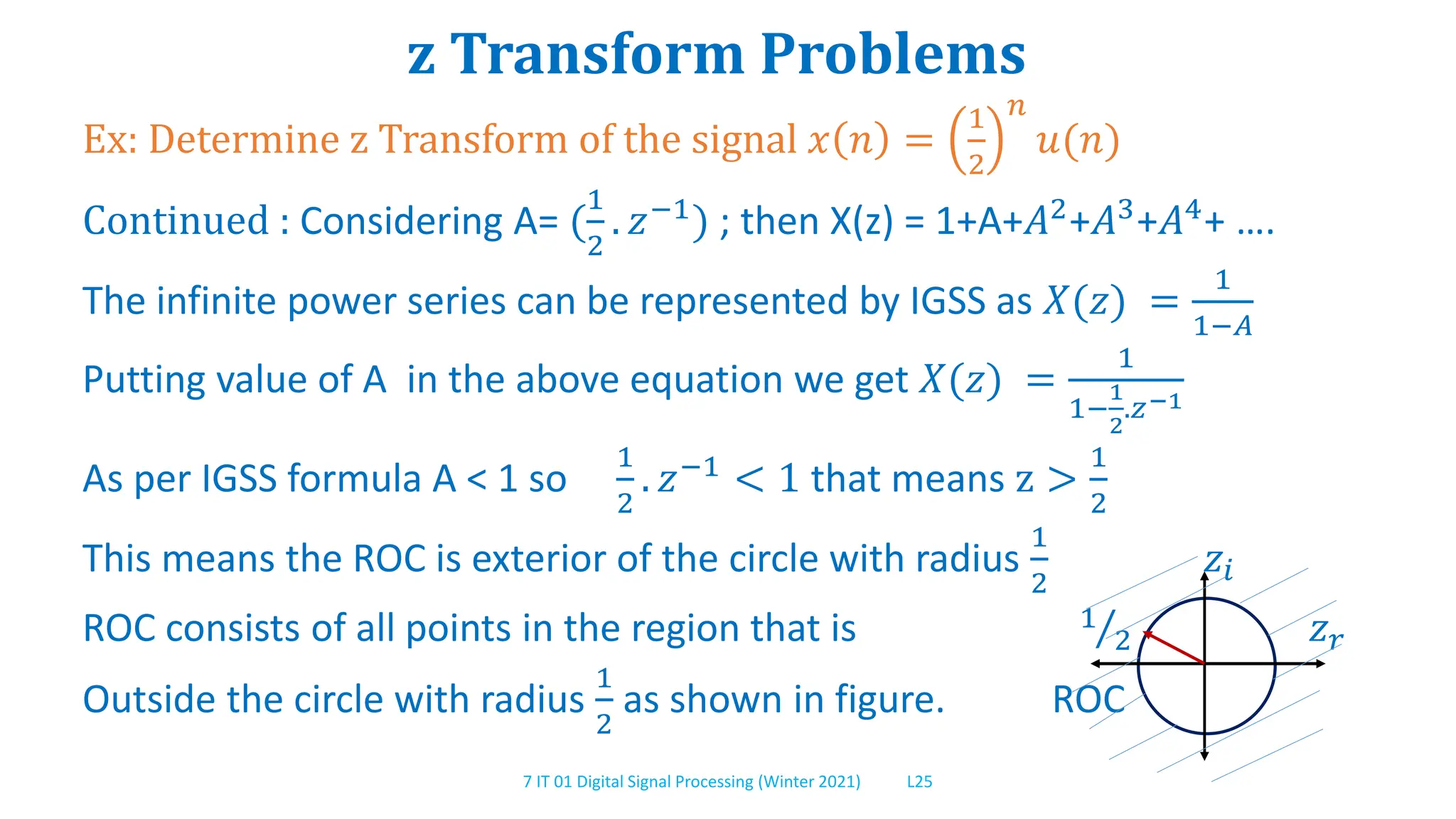
ROC consists of all points in the region that is 1
2 𝑧𝑟
Outside the circle with radius
1
2
as shown in figure. ROC
7 IT 01 Digital Signal Processing (Winter 2021) L25
z Transform Problems
Ex: Determine z Transform of the signal 𝑥 𝑛 = 𝛼𝑛
𝑢(𝑛)
Solution : In this example the signal x(n) is a infinite power series
So x(n)={1, , 𝛼 2
, 𝛼 3
, 𝛼 4
, 𝛼 5
, ……}
The z transform is given by 𝑋 𝑧 = 𝑛=0
∞
𝑥 𝑛 . 𝑧−𝑛
as the signal is causal
Applying this formula to our power series function we get z transform of x(n)
𝑋 𝑧 =
𝑛=0
∞
(𝛼)𝑛. 𝑧−𝑛
𝑋 𝑧 =
𝑛=0
∞
(𝛼. 𝑧−1
)𝑛
Considering A= (𝛼. 𝑧−1) we can write above equation X(z) = 1+A+𝐴2+𝐴3+𝐴4+ ….
7 IT 01 Digital Signal Processing (Winter 2021) L25
z Transform Problems
Ex: Determine z Transform of the signal 𝑥 𝑛 = 𝛼 𝑛
𝑢(𝑛)
Continued : Considering A= (𝛼. 𝑧−1
) ; then X(z) = 1+A+𝐴2
+𝐴3
+𝐴4
+ ….
The infinite power series can be represented by IGSS as 𝑋(𝑧) =
1
1−𝐴
Putting value of A in the above equation we get 𝑿(𝒛) =
𝟏
𝟏−𝜶𝒛−𝟏
As per IGSS formula A < 1 so 𝛼. 𝑧−1 < 1 that means z > 𝛼
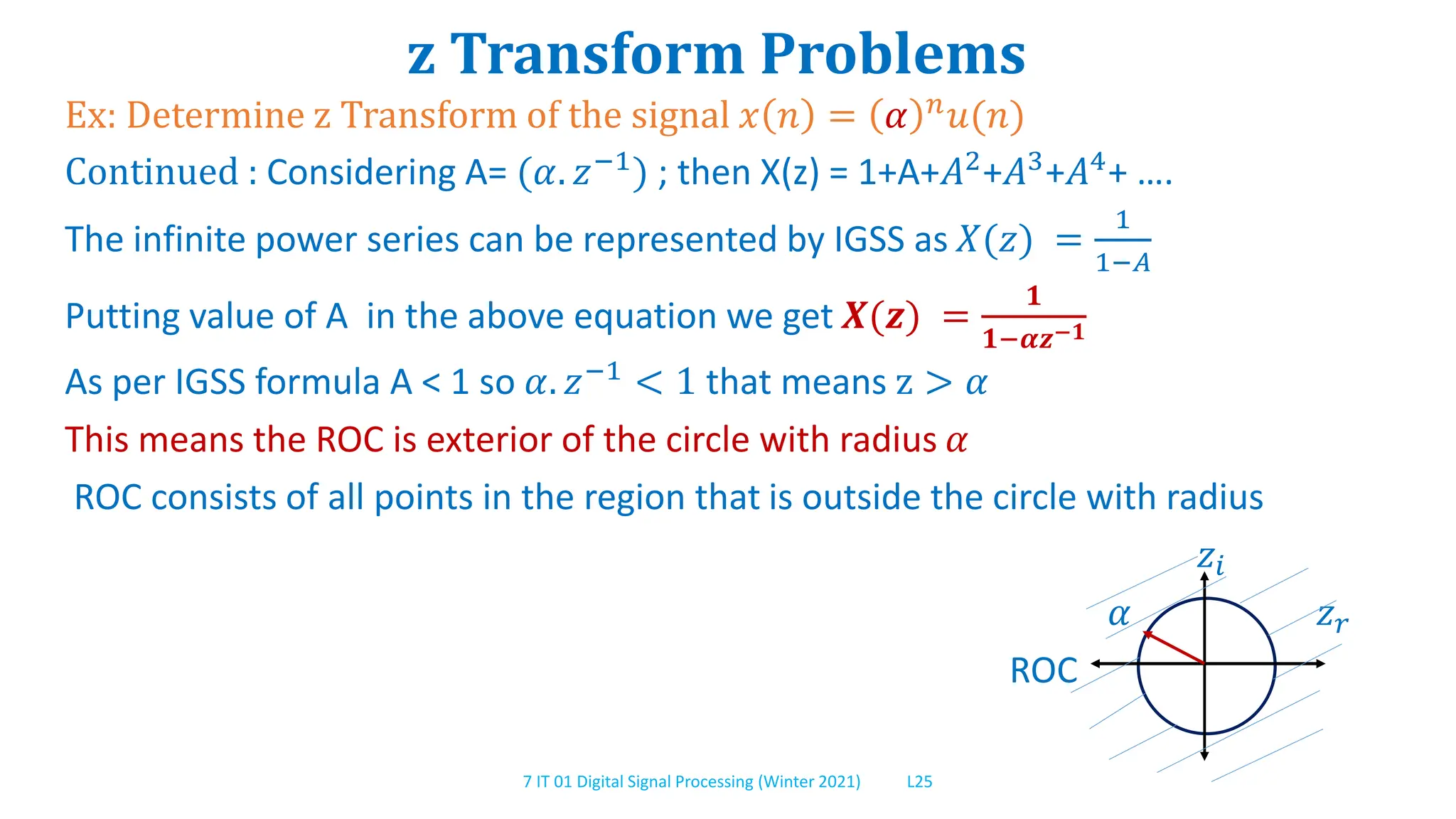
This means the ROC is exterior of the circle with radius 𝛼
ROC consists of all points in the region that is outside the circle with radius
𝑧𝑖
𝛼 𝑧𝑟
ROC
7 IT 01 Digital Signal Processing (Winter 2021) L25
z Transform Problems
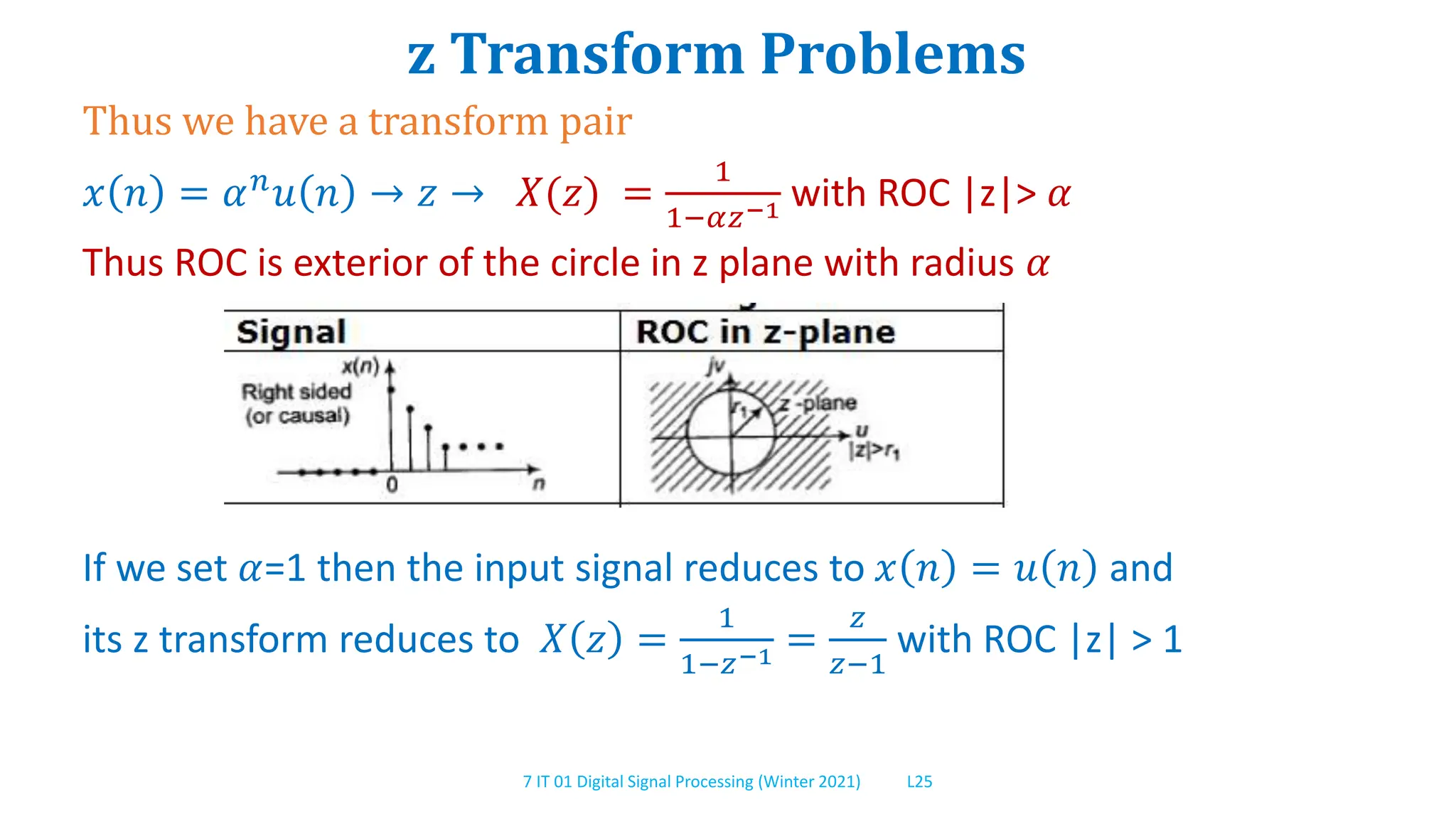
Thus we have a transform pair
𝑥 𝑛 = 𝛼𝑛𝑢 𝑛 → 𝑧 → 𝑋(𝑧) =
1
1−𝛼𝑧−1 with ROC |z|> 𝛼
Thus ROC is exterior of the circle in z plane with radius 𝛼
If we set 𝛼=1 then the input signal reduces to 𝑥 𝑛 = 𝑢 𝑛 and
its z transform reduces to 𝑋 𝑧 =
1
1−𝑧−1 =
𝑧
𝑧−1
with ROC |z| > 1
7 IT 01 Digital Signal Processing (Winter 2021) L25
z Transform Problems
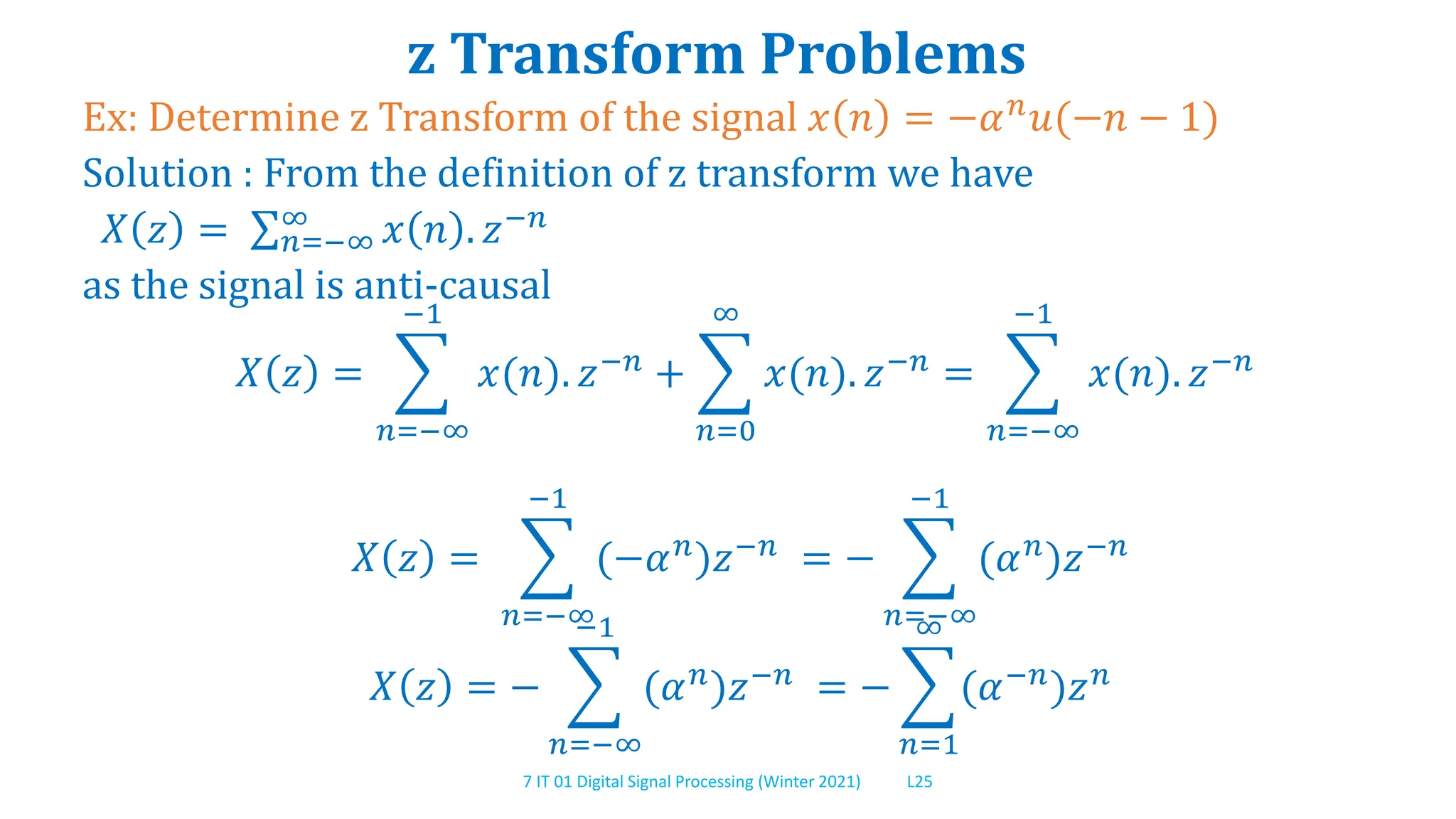
Ex: Determine z Transform of the signal 𝑥 𝑛 = −𝛼𝑛𝑢(−𝑛 − 1)
Solution : From the definition of z transform we have
𝑋 𝑧 = 𝑛=−∞
∞ 𝑥 𝑛 . 𝑧−𝑛
as the signal is anti-causal
𝑋 𝑧 =
𝑛=−∞
−1
𝑥(𝑛). 𝑧−𝑛 +
𝑛=0
∞
𝑥(𝑛). 𝑧−𝑛 =
𝑛=−∞
−1
𝑥(𝑛). 𝑧−𝑛
𝑋 𝑧 =
𝑛=−∞
−1
(−𝛼𝑛)𝑧−𝑛 = −
𝑛=−∞
−1
(𝛼𝑛)𝑧−𝑛
𝑋 𝑧 = −
𝑛=−∞
−1
(𝛼𝑛)𝑧−𝑛 = −
𝑛=1
∞
(𝛼−𝑛)𝑧𝑛
7 IT 01 Digital Signal Processing (Winter 2021) L25
z Transform Problems
𝑋 𝑧 = −
𝑛=−∞
−1
(𝛼𝑛
)𝑧−𝑛
= −
𝑛=1
∞
(𝛼−𝑛
)𝑧𝑛
𝑋 𝑧 = −
𝑛=1
∞
(𝛼−1
𝑧)𝑛
Let A= 𝛼−1𝑧, then as per IGSS formula we have 𝑋 𝑧 = −
𝐴
1−𝐴
= −
𝛼−1𝑧
1−𝛼−1𝑧
𝑋 𝑧 =
1
1 − 𝛼𝑧−1
With A < 1 that is 𝛼−1
𝑧 < 1 that means z < 𝛼
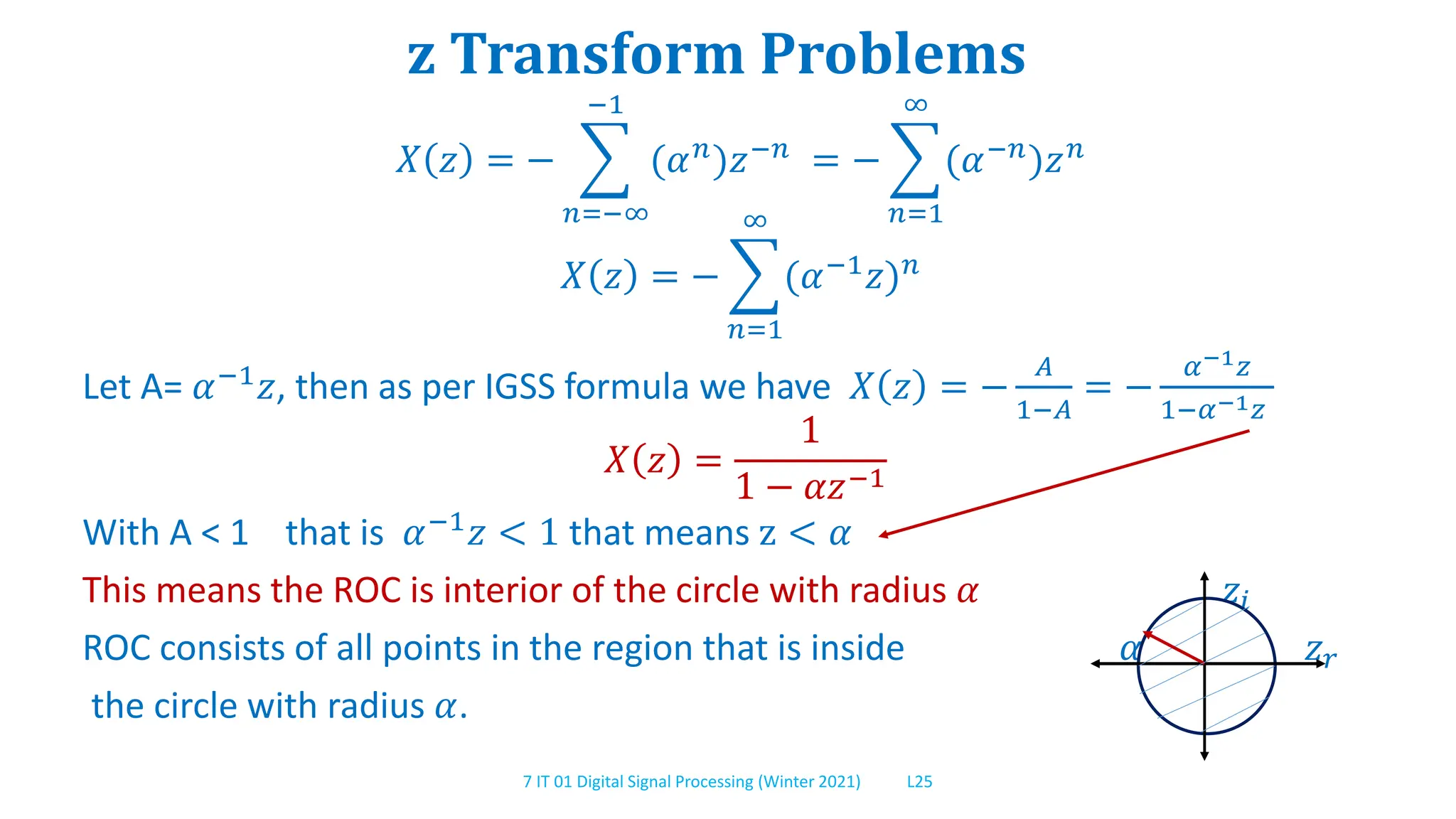
This means the ROC is interior of the circle with radius 𝛼 𝑧𝑖
ROC consists of all points in the region that is inside 𝛼 𝑧𝑟
the circle with radius 𝛼.
7 IT 01 Digital Signal Processing (Winter 2021) L25
z Transform Problems
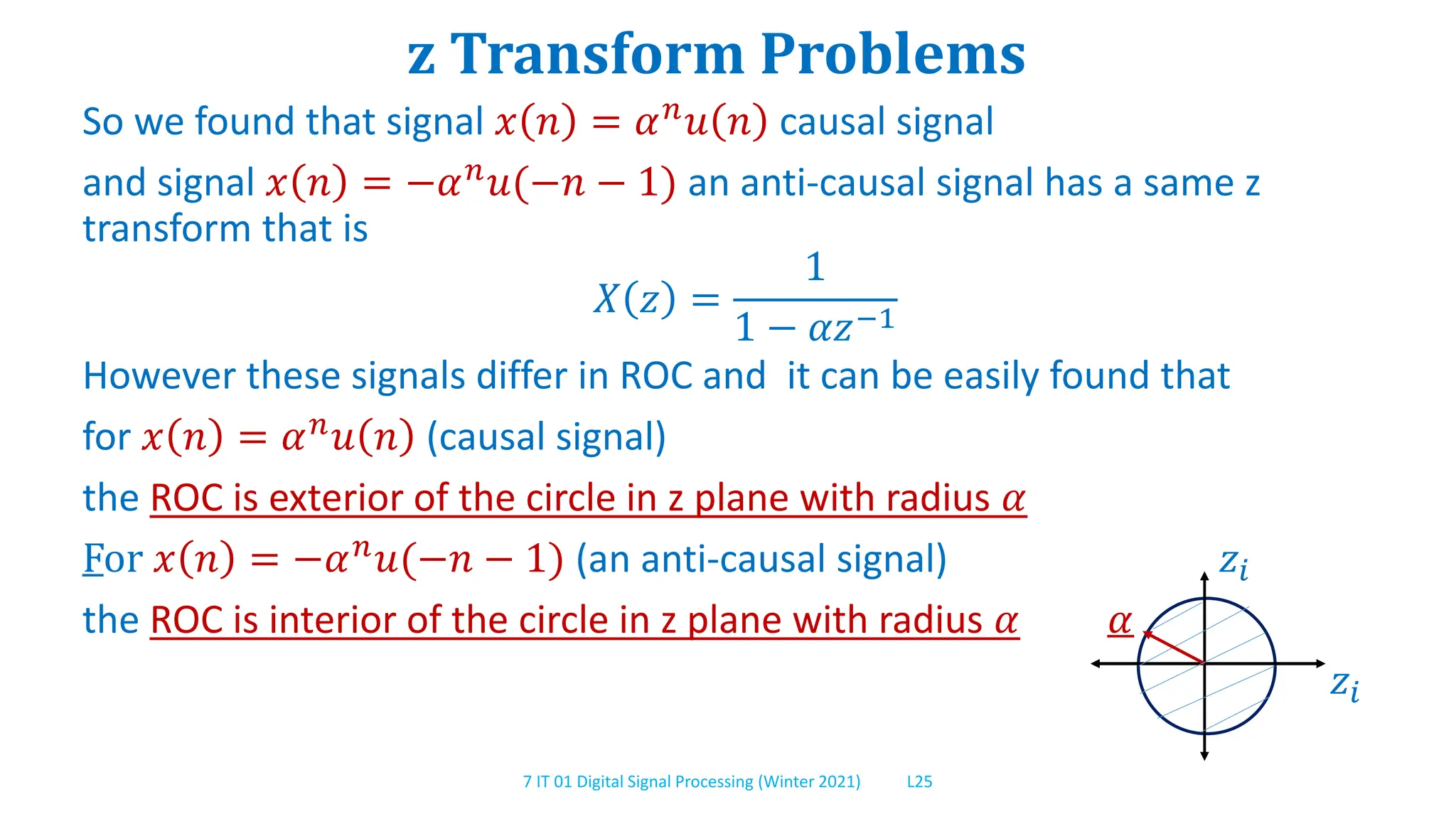
So we found that signal 𝑥 𝑛 = 𝛼𝑛
𝑢 𝑛 causal signal
and signal 𝑥 𝑛 = −𝛼𝑛𝑢(−𝑛 − 1) an anti-causal signal has a same z
transform that is
𝑋 𝑧 =
1
1 − 𝛼𝑧−1
However these signals differ in ROC and it can be easily found that
for 𝑥 𝑛 = 𝛼𝑛𝑢 𝑛 (causal signal)
the ROC is exterior of the circle in z plane with radius 𝛼
For 𝑥 𝑛 = −𝛼𝑛𝑢(−𝑛 − 1) (an anti-causal signal) 𝑧𝑖
the ROC is interior of the circle in z plane with radius 𝛼 𝛼
𝑧𝑖
7 IT 01 Digital Signal Processing (Winter 2021) L25
z Transform Problems
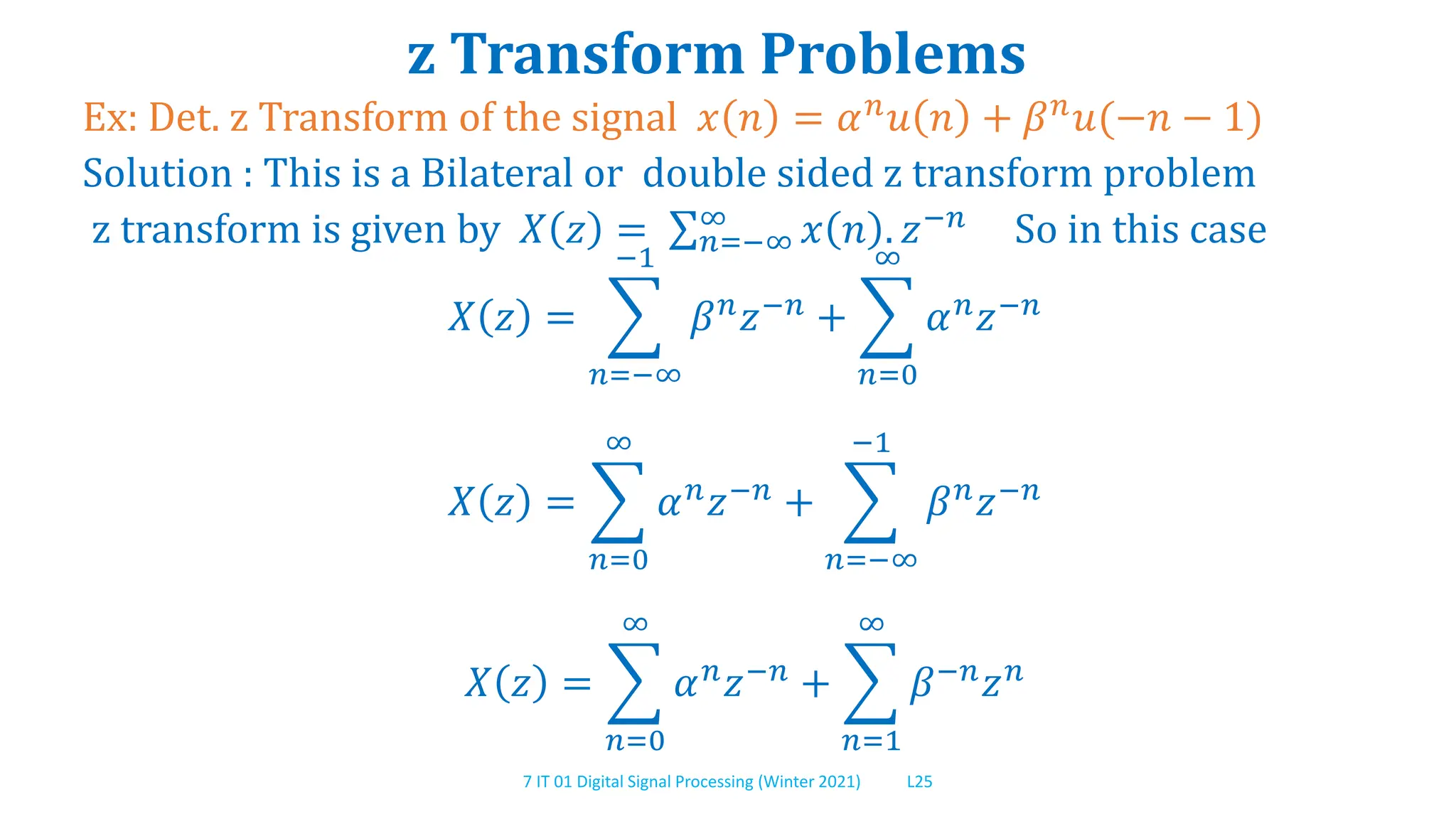
Ex: Det. z Transform of the signal 𝑥 𝑛 = 𝛼𝑛𝑢 𝑛 + 𝛽𝑛𝑢(−𝑛 − 1)
Solution : This is a Bilateral or double sided z transform problem
z transform is given by 𝑋 𝑧 = 𝑛=−∞
∞ 𝑥 𝑛 . 𝑧−𝑛 So in this case
𝑋 𝑧 =
𝑛=−∞
−1
𝛽𝑛𝑧−𝑛 +
𝑛=0
∞
𝛼𝑛𝑧−𝑛
𝑋 𝑧 =
𝑛=0
∞
𝛼𝑛𝑧−𝑛 +
𝑛=−∞
−1
𝛽𝑛𝑧−𝑛
𝑋 𝑧 =
𝑛=0
∞
𝛼𝑛𝑧−𝑛 +
𝑛=1
∞
𝛽−𝑛𝑧𝑛
7 IT 01 Digital Signal Processing (Winter 2021) L25
z Transform Problems
Ex: Det. z Transform of the signal 𝑥 𝑛 = 𝛼𝑛
𝑢 𝑛 + 𝛽𝑛
𝑢(−𝑛 − 1)
Solution :
𝑋 𝑧 =
𝑛=0
∞
(𝛼𝑧−1
)𝑛
+
𝑛=1
∞
(𝛽−1
𝑧)𝑛
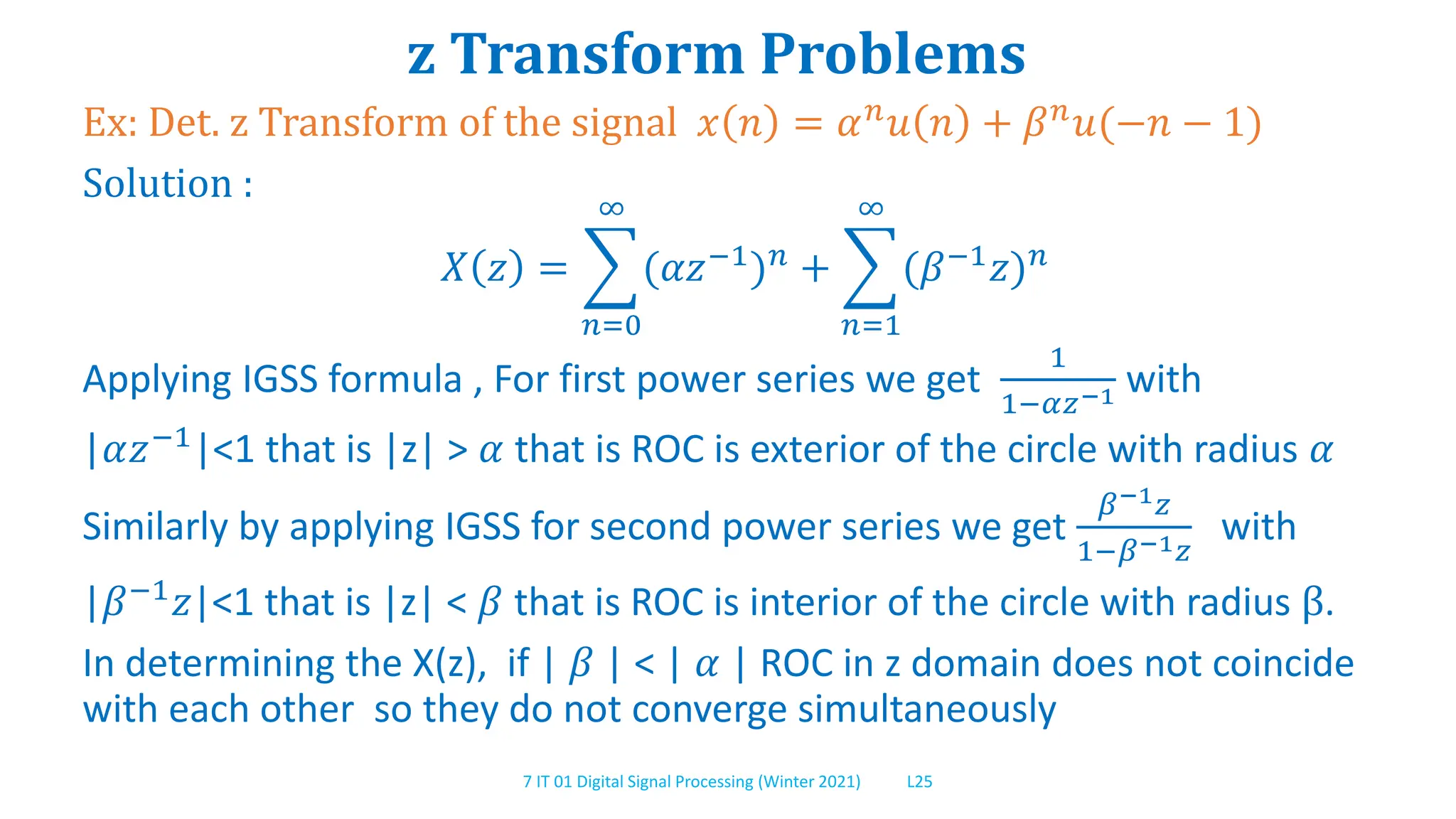
Applying IGSS formula , For first power series we get
1
1−𝛼𝑧−1 with
|𝛼𝑧−1
|<1 that is |z| > 𝛼 that is ROC is exterior of the circle with radius 𝛼
Similarly by applying IGSS for second power series we get
𝛽−1𝑧
1−𝛽−1𝑧
with
|𝛽−1𝑧|<1 that is |z| < 𝛽 that is ROC is interior of the circle with radius β.
In determining the X(z), if | 𝛽 | < | 𝛼 | ROC in z domain does not coincide
with each other so they do not converge simultaneously
7 IT 01 Digital Signal Processing (Winter 2021) L25
z Transform Problems
Ex: Det. z Transform of the signal 𝑥 𝑛 = 𝛼𝑛
𝑢 𝑛 + 𝛽𝑛
𝑢(−𝑛 − 1)
Solution :
𝑋 𝑧 =
𝑛=0
∞
(𝛼𝑧−1
)𝑛
+
𝑛=1
∞
(𝛽−1
𝑧)𝑛
But if | 𝛽 | > | 𝛼 | ROC of ring shape in z domain coincide with each other
so they converge simultaneously
𝑋 𝑧 =
1
1−𝛼𝑧−1 +
𝛽−1𝑧
1−𝛽−1𝑧
=
1
1−𝛼𝑧−1 -
1
1−𝛽𝑧−1
And ROC is |𝛼|< |z| <|𝛽|
7 IT 01 Digital Signal Processing (Winter 2021) L25
Infinite Signals and ROC
7 IT 01 Digital Signal Processing (Winter 2021) L25
Properties of z Transform
The z transform is a very powerful tool and this is exhibited by it’s powerful
set of properties.
Note : when we combine several z transforms, the ROC of the overall
transform is at least the intersection of their ROCs.
Properties:
1. Linearity
2. Time Shifting
3. Scaling in z domain
4. Time Reversal
5. Differentiation in z domain
6. Convolution of two sequences
7 IT 01 Digital Signal Processing (Winter 2021) L25
Linearity Property
1. Linearity:
If 𝑥1 𝑛 ← 𝑧 → 𝑋1(𝑧) and 𝑥2 𝑛 ← 𝑧 → 𝑋2(𝑧)
Then 𝑥 𝑛 = 𝑎1𝑥1 𝑛 + 𝑎2𝑥2 𝑛 ← 𝑧 → 𝑋 𝑧 = 𝑎1𝑋1 𝑧 + 𝑎2𝑋2 𝑧
Proof: 𝑧 𝑥 𝑛 = 𝑋 𝑧 = 𝑘=−∞
∞
𝑥(𝑘)𝑧−𝑘
For 𝑥 𝑘 = 𝑎1𝑥1 𝑘 + 𝑎2𝑥2 𝑘
𝑋 𝑧 = 𝑘=−∞
∞
(𝑎1𝑥1 𝑘 + 𝑎2𝑥2(𝑘))𝑧−𝑘
= 𝑘=−∞
∞
𝑎1𝑥1 𝑘 𝑧−𝑘 + 𝑎2𝑥2(𝑘)𝑧−𝑘
= 𝑎1 𝑘=−∞
∞
𝑥1 𝑘 𝑧−𝑘
+ 𝑎2 𝑘=−∞
∞
𝑥2(𝑘)𝑧−𝑘
Thus
𝑋1 𝑧 𝑋2 𝑧
𝑋 𝑧 = 𝑎1𝑋1 𝑧 + 𝑎2𝑋2 𝑧
Thus the signal can be expressed first in composite form and then its
z transform can be found.
7 IT 01 Digital Signal Processing (Winter 2021) L25
Problems on Linearity Property
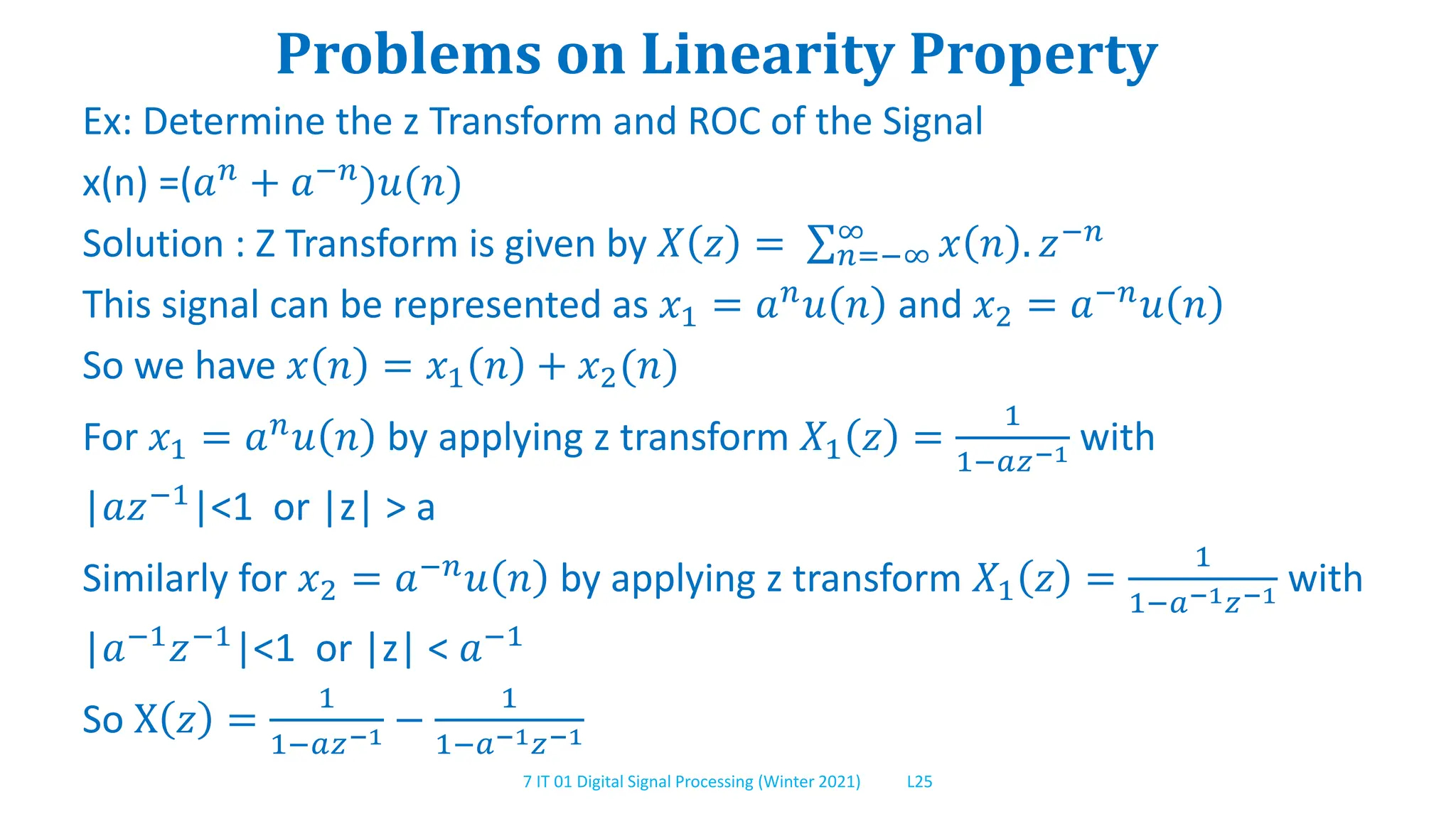
Ex: Determine the z Transform and ROC of the Signal
x(n) =(𝑎𝑛 + 𝑎−𝑛)𝑢(𝑛)
Solution : Z Transform is given by 𝑋 𝑧 = 𝑛=−∞
∞
𝑥 𝑛 . 𝑧−𝑛
This signal can be represented as 𝑥1 = 𝑎𝑛𝑢 𝑛 and 𝑥2 = 𝑎−𝑛𝑢 𝑛
So we have 𝑥 𝑛 = 𝑥1 𝑛 + 𝑥2(𝑛)
For 𝑥1 = 𝑎𝑛𝑢 𝑛 by applying z transform 𝑋1 𝑧 =
1
1−𝑎𝑧−1 with
|𝑎𝑧−1|<1 or |z| > a
Similarly for 𝑥2 = 𝑎−𝑛
𝑢 𝑛 by applying z transform 𝑋1 𝑧 =
1
1−𝑎−1𝑧−1 with
|𝑎−1𝑧−1|<1 or |z| < 𝑎−1
So X 𝑧 =
1
1−𝑎𝑧−1 −
1
1−𝑎−1𝑧−1
7 IT 01 Digital Signal Processing (Winter 2021) L25
Problems on Linearity Property
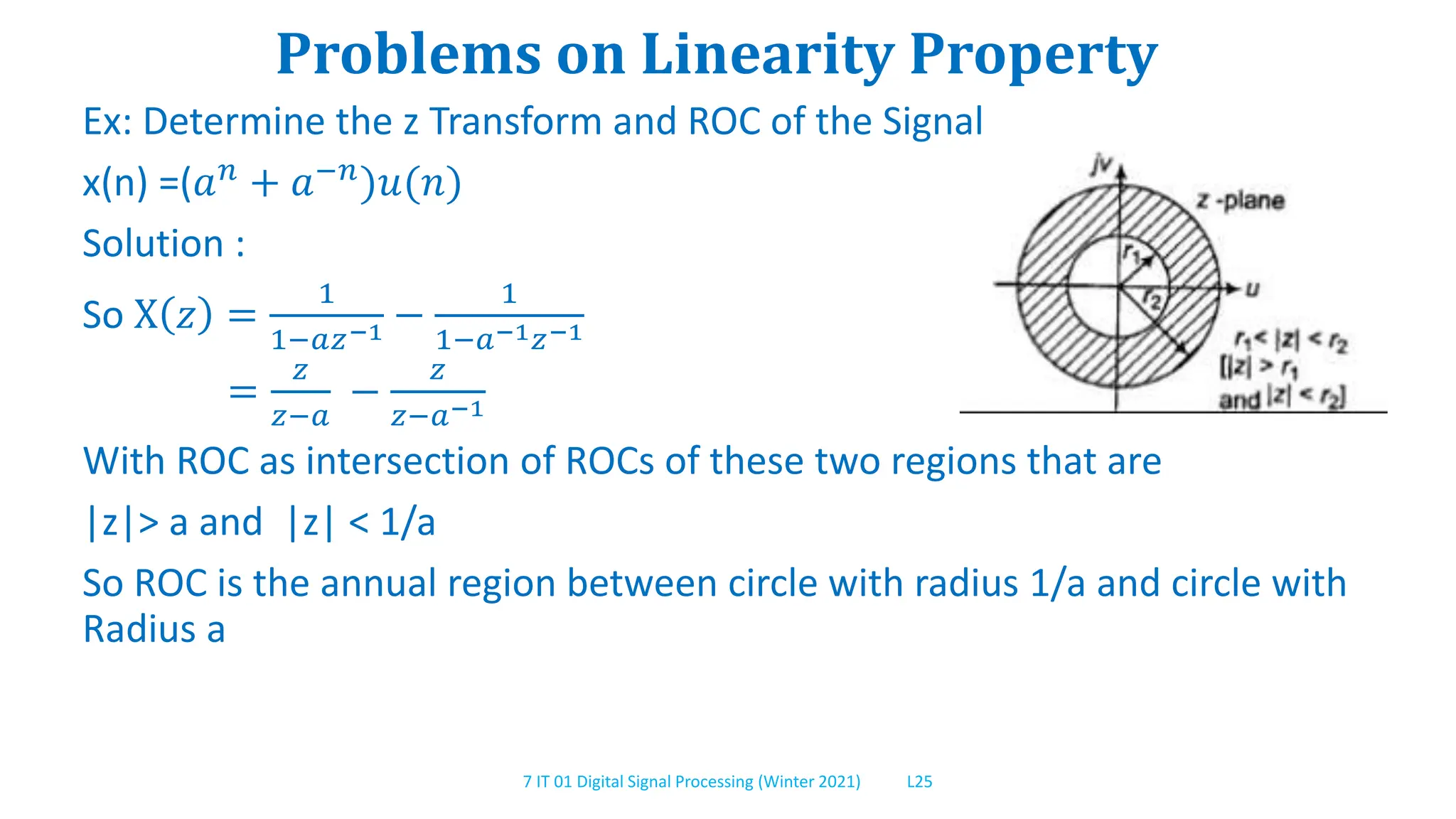
Ex: Determine the z Transform and ROC of the Signal
x(n) =(𝑎𝑛 + 𝑎−𝑛)𝑢(𝑛)
Solution :
So X 𝑧 =
1
1−𝑎𝑧−1 −
1
1−𝑎−1𝑧−1
=
𝑧
𝑧−𝑎
−
𝑧
𝑧−𝑎−1
With ROC as intersection of ROCs of these two regions that are
|z|> a and |z| < 1/a
So ROC is the annual region between circle with radius 1/a and circle with
Radius a
7 IT 01 Digital Signal Processing (Winter 2021) L25
Problems on Linearity Property
EX: Determine the z transform of signal 𝑥(𝑛) = (cos 𝑤0𝑛)u(n)
Solution : Given signal is 𝑥(𝑛) = (cos 𝑤0𝑛)u(n)
This signal can be decomposed by using Eular’s Identity as
cos 𝑤0𝑛 =
𝑒𝑗𝑤0𝑛 + 𝑒−𝑗𝑤0𝑛
2
So 𝑥(𝑛) = (
𝑒𝑗𝑤0𝑛+𝑒−𝑗𝑤0𝑛
2
)u(n)
Thus the decomposed signal is represented as
𝑥 𝑛 =
𝑒𝑗𝑤0𝑛
2
u n +
𝑒−𝑗𝑤0𝑛
2
u n
𝑋 𝑧 =
1
2
[𝑧(𝑒𝑗𝑤0𝑛)+𝑧(𝑒−𝑗𝑤0𝑛)]
We can write 𝑥1(𝑛) = 𝑒𝑗𝑤0𝑛𝑢(𝑛) and 𝑥2(𝑛) = 𝑒−𝑗𝑤0𝑛𝑢(𝑛)
7 IT 01 Digital Signal Processing (Winter 2021) L25
Problems on Linearity Property
𝑿 𝒛 =
𝟏
𝟐
[𝒛(𝒆𝒋𝒘𝟎𝒏)+𝒛(𝒆−𝒋𝒘𝟎𝒏)]
We can write 𝑥1 = 𝑒𝑗𝑤0𝑛𝑢(𝑛) and 𝑥2 = 𝑒−𝑗𝑤0𝑛𝑢(𝑛)
Let us say 𝛼 = 𝑒𝑗𝑤0 so 𝛼 = 𝑒𝑗𝑤0 = 1
𝑋1 𝑧 = 𝑧{ 𝑒𝑗𝑤0𝑛 𝑢 𝑛 } = 𝑛=0
∞
𝑒𝑗𝑤0𝑛 𝑧−𝑛
𝑋1 𝑧 = 𝑛=0
∞
(𝑒𝑗𝑤0𝑧−1)𝑛 =
1
1−(𝑒𝑗𝑤0𝑧−1)
where |𝑒𝑗𝑤0𝑧−1| < 1
As 𝑒𝑗𝑤0 = 1 , ROC is |z|> 1
Now let us say 𝛼 = 𝑒−𝑗𝑤0 so 𝛼 = 𝑒−𝑗𝑤0 = 1
𝑋2 𝑧 = 𝑧{ 𝑒−𝑗𝑤0𝑛 𝑢 𝑛 } = 𝑛=0
∞
𝑒−𝑗𝑤0𝑛 𝑧−𝑛
𝑋2 𝑧 = 𝑛=0
∞
(𝑒−𝑗𝑤0𝑧−1
)𝑛
=
1
1−(𝑒−𝑗𝑤0𝑧−1)
where |𝑒−𝑗𝑤0𝑧−1
| < 1
As 𝑒𝑗𝑤0 = 1 , ROC is |z|> 1
7 IT 01 Digital Signal Processing (Winter 2021) L25
Problems on Linearity Property
𝑿 𝒛 =
𝟏
𝟐
[𝒛(𝒆𝒋𝒘𝟎𝒏)+𝒛(𝒆𝒋𝒘𝟎𝒏)]
𝑋 𝑧 =
1
2
{
1
1−(𝑒𝑗𝑤0𝑧−1)
+
1
1−(𝑒−𝑗𝑤0𝑧−1)
}
Where ROC in both cases is |z|> 1
𝑋 𝑧 =
1
2
{
1−(𝑒−𝑗𝑤0𝑧−1+1−(𝑒𝑗𝑤0𝑧−1)
1−𝑒𝑗𝑤0𝑧−1 ∗(1−𝑒−𝑗𝑤0𝑧−1)
}
𝑋 𝑧 =
1
2
{
2−𝑒−𝑗𝑤0𝑧−1−𝑒𝑗𝑤0𝑧−1
1−𝑒𝑗𝑤0𝑧−1 ∗(1−𝑒−𝑗𝑤0𝑧−1)
}
Solving Numerator = 2 − 𝑒−𝑗𝑤0𝑧−1 − 𝑒𝑗𝑤0𝑧−1
= 2 −
2(𝑒𝑗𝑤0+𝑒−𝑗𝑤0) 𝑧−1
2
= 2 − 2 𝑐𝑜𝑠𝑤0𝑧−1
7 IT 01 Digital Signal Processing (Winter 2021) L25
Problems on Linearity Property
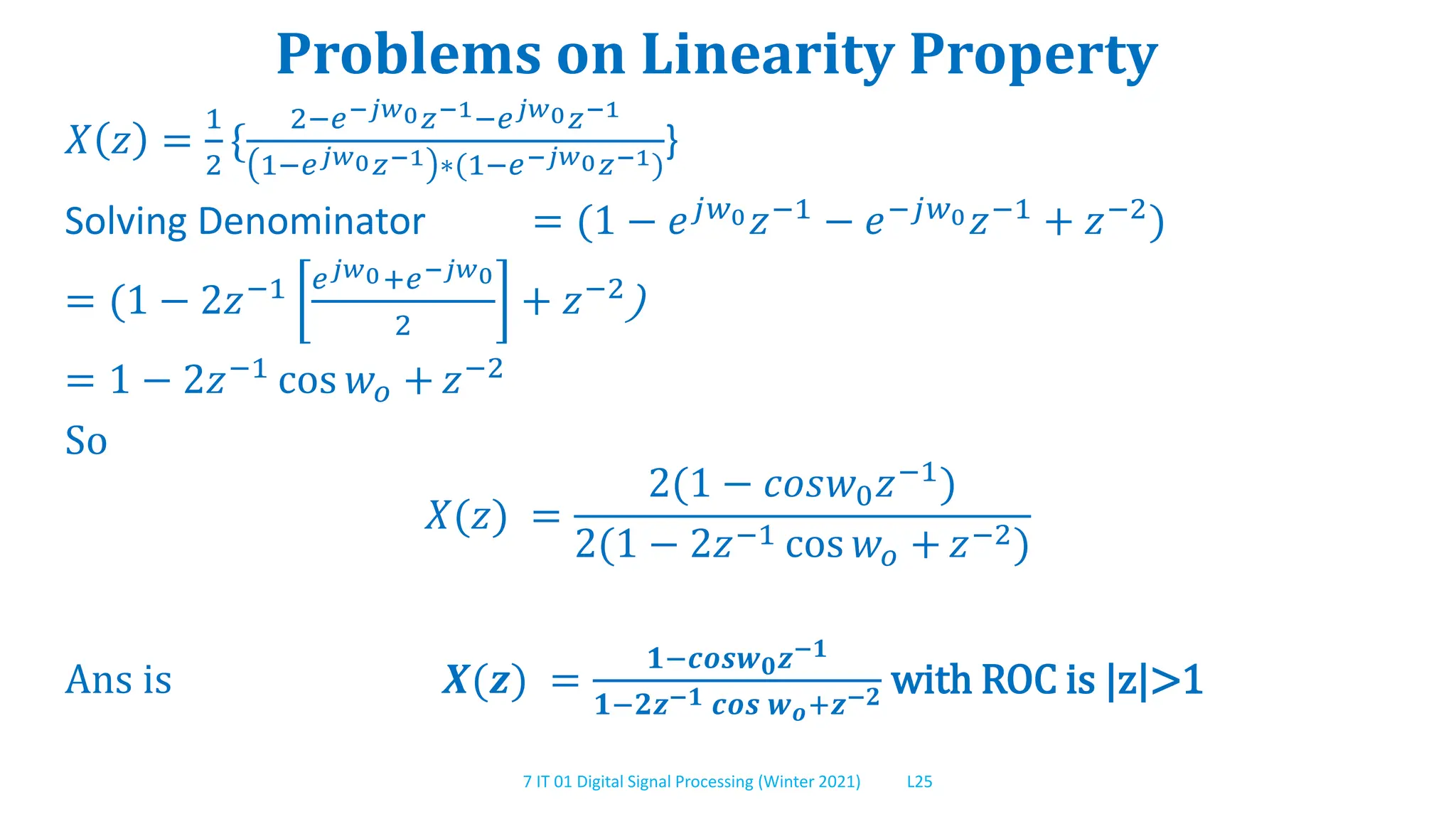
𝑋 𝑧 =
1
2
{
2−𝑒−𝑗𝑤0𝑧−1−𝑒𝑗𝑤0𝑧−1
1−𝑒𝑗𝑤0𝑧−1 ∗(1−𝑒−𝑗𝑤0𝑧−1)
}
Solving Denominator = (1 − 𝑒𝑗𝑤0𝑧−1 − 𝑒−𝑗𝑤0𝑧−1 + 𝑧−2)
= (1 − 2𝑧−1 𝑒𝑗𝑤0+𝑒−𝑗𝑤0
2
+ 𝑧−2)
= 1 − 2𝑧−1 cos 𝑤𝑜 + 𝑧−2
So
𝑋(𝑧) =
2(1 − 𝑐𝑜𝑠𝑤0𝑧−1)
2(1 − 2𝑧−1 cos 𝑤𝑜 + 𝑧−2)
Ans is 𝑿(𝒛) =
𝟏−𝒄𝒐𝒔𝒘𝟎𝒛−𝟏
𝟏−𝟐𝒛−𝟏 𝒄𝒐𝒔 𝒘𝒐+𝒛−𝟐 with ROC is |z|>1
7 IT 01 Digital Signal Processing (Winter 2021) L25
Problems on Linearity Property
EX: Determine the z transform of signal 𝑥(𝑛) = (sin 𝑤0𝑛)u(n)
Solution : Given signal is 𝑥(𝑛) = (𝑠𝑖𝑛 𝑤0𝑛)u(n)
This signal can be decomposed by using Eular’s Identity as
sin 𝑤0𝑛 =
𝑒𝑗𝑤0𝑛 − 𝑒−𝑗𝑤0𝑛
2𝑗
So 𝑥(𝑛) = (
𝑒𝑗𝑤0𝑛−𝑒−𝑗𝑤0𝑛
2𝑗
)u(n)
Thus the decomposed signal is represented as
𝑥 𝑛 =
𝑒𝑗𝑤0𝑛
2𝑗
u n −
𝑒−𝑗𝑤0𝑛
2𝑗
u n
𝑋 𝑧 =
1
2𝑗
[𝑧(𝑒𝑗𝑤0𝑛)-𝑧(𝑒−𝑗𝑤0𝑛)]
We can write 𝑥1 = 𝑒𝑗𝑤0𝑛
𝑢(𝑛) and 𝑥2 = 𝑒−𝑗𝑤0𝑛
𝑢(𝑛)
7 IT 01 Digital Signal Processing (Winter 2021) L25
Problems on Linearity Property
𝑿 𝒛 =
𝟏
𝟐𝒋
[𝒛(𝒆𝒋𝒘𝟎𝒏)-𝒛(𝒆−𝒋𝒘𝟎𝒏)]
We can write 𝑥1 = 𝑒𝑗𝑤0𝑛𝑢(𝑛) and 𝑥2 = 𝑒−𝑗𝑤0𝑛𝑢(𝑛)
Let us say 𝛼 = 𝑒𝑗𝑤0 so 𝛼 = 𝑒𝑗𝑤0 = 1
𝑋1 𝑧 = 𝑧{ 𝑒𝑗𝑤0𝑛 𝑢 𝑛 } = 𝑛=0
∞
𝑒𝑗𝑤0𝑛 𝑧−𝑛
𝑋1 𝑧 = 𝑛=0
∞
(𝑒𝑗𝑤0𝑧−1
)𝑛
=
1
1−(𝑒𝑗𝑤0𝑧−1)
where |𝑒𝑗𝑤0𝑧−1
| < 1
As 𝑒𝑗𝑤0 = 1 , ROC is |z|> 1
Now let us say 𝛼 = 𝑒−𝑗𝑤0 so 𝛼 = 𝑒−𝑗𝑤0 = 1
𝑋1 𝑧 = 𝑧{ 𝑒−𝑗𝑤0𝑛 𝑢 𝑛 } = 𝑛=0
∞
𝑒−𝑗𝑤0𝑛 𝑧−𝑛
𝑋1 𝑧 = 𝑛=0
∞
(𝑒−𝑗𝑤0𝑧−1)𝑛 =
1
1−(𝑒−𝑗𝑤0𝑧−1)
where |𝑒−𝑗𝑤0𝑧−1| < 1
As 𝑒𝑗𝑤0 = 1 , ROC is |z|> 1
7 IT 01 Digital Signal Processing (Winter 2021) L25
Problems on Linearity Property
𝑿 𝒛 =
𝟏
𝟐𝒋
[𝒛(𝒆𝒋𝒘𝟎𝒏)-𝒛(𝒆−𝒋𝒘𝟎𝒏)]
𝑋 𝑧 =
1
2𝑗
{
1
1−(𝑒𝑗𝑤0𝑧−1)
−
1
1−(𝑒−𝑗𝑤0𝑧−1)
}
Where ROC in both cases is |z|> 1
𝑋 𝑧 =
1
2𝑗
{
1−𝑒−𝑗𝑤0𝑧−1−1+𝑒𝑗𝑤0𝑧−1)
1−𝑒𝑗𝑤0𝑧−1 ∗(1−𝑒−𝑗𝑤0𝑧−1)
}
𝑋 𝑧 =
1
2𝑗
{
−𝑒−𝑗𝑤0𝑧−1+𝑒𝑗𝑤0𝑧−1
1−𝑒𝑗𝑤0𝑧−1 ∗(1−𝑒−𝑗𝑤0𝑧−1)
}
Solving Numerator = 𝑒−𝑗𝑤0𝑧−1 − 𝑒𝑗𝑤0𝑧−1
=
(𝑒𝑗𝑤0−𝑒−𝑗𝑤0) 𝑧−1
2𝑗
= sin 𝑤0 𝑧−1
7 IT 01 Digital Signal Processing (Winter 2021) L25
Problems on Linearity Property
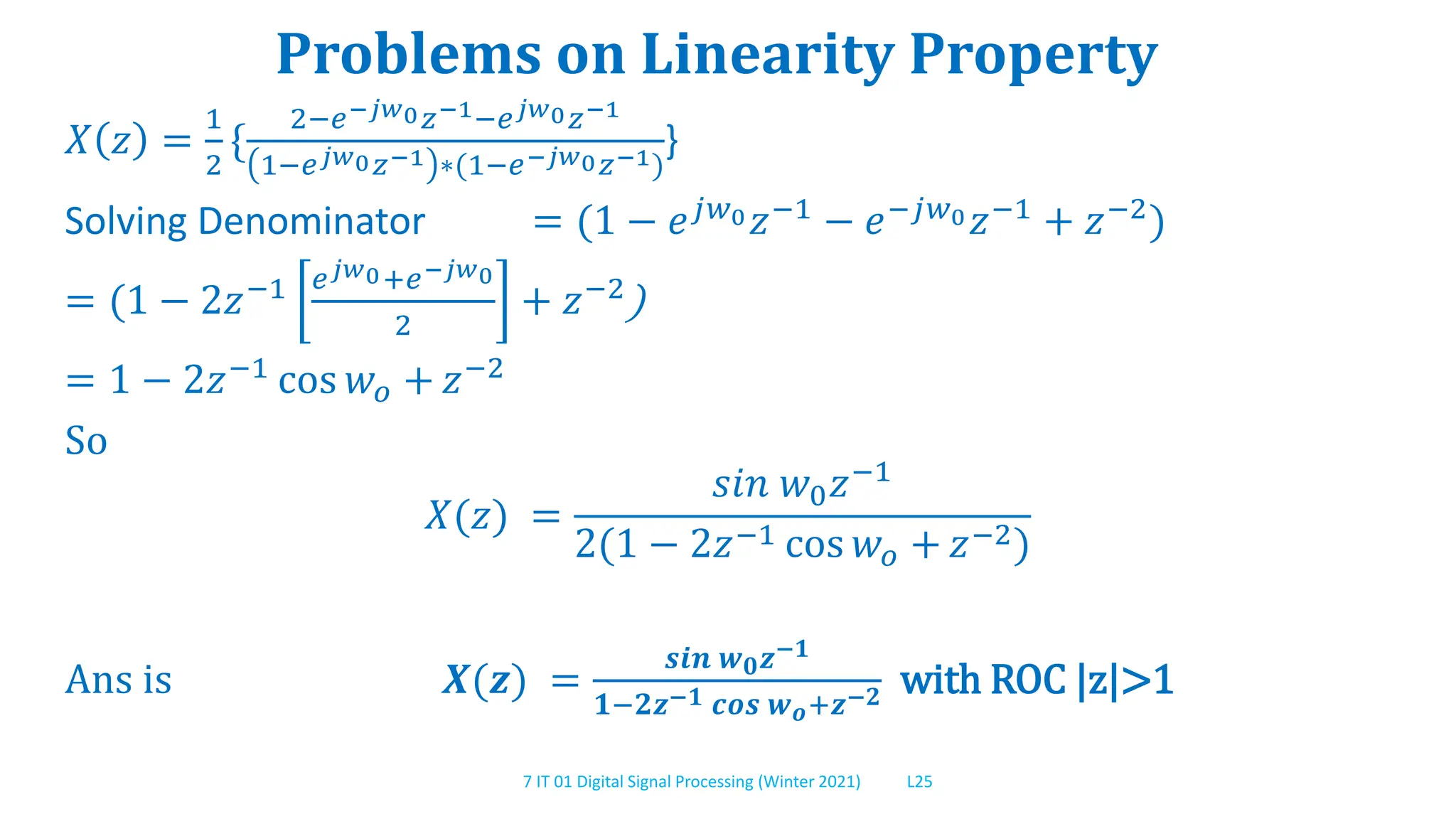
𝑋 𝑧 =
1
2
{
2−𝑒−𝑗𝑤0𝑧−1−𝑒𝑗𝑤0𝑧−1
1−𝑒𝑗𝑤0𝑧−1 ∗(1−𝑒−𝑗𝑤0𝑧−1)
}
Solving Denominator = (1 − 𝑒𝑗𝑤0𝑧−1 − 𝑒−𝑗𝑤0𝑧−1 + 𝑧−2)
= (1 − 2𝑧−1 𝑒𝑗𝑤0+𝑒−𝑗𝑤0
2
+ 𝑧−2)
= 1 − 2𝑧−1 cos 𝑤𝑜 + 𝑧−2
So
𝑋(𝑧) =
𝑠𝑖𝑛 𝑤0𝑧−1
2(1 − 2𝑧−1 cos 𝑤𝑜 + 𝑧−2)
Ans is 𝑿(𝒛) =
𝒔𝒊𝒏 𝒘𝟎𝒛−𝟏
𝟏−𝟐𝒛−𝟏 𝒄𝒐𝒔 𝒘𝒐+𝒛−𝟐 with ROC |z|>1
7 IT 01 Digital Signal Processing (Winter 2021) L25
Problems on Linearity Property
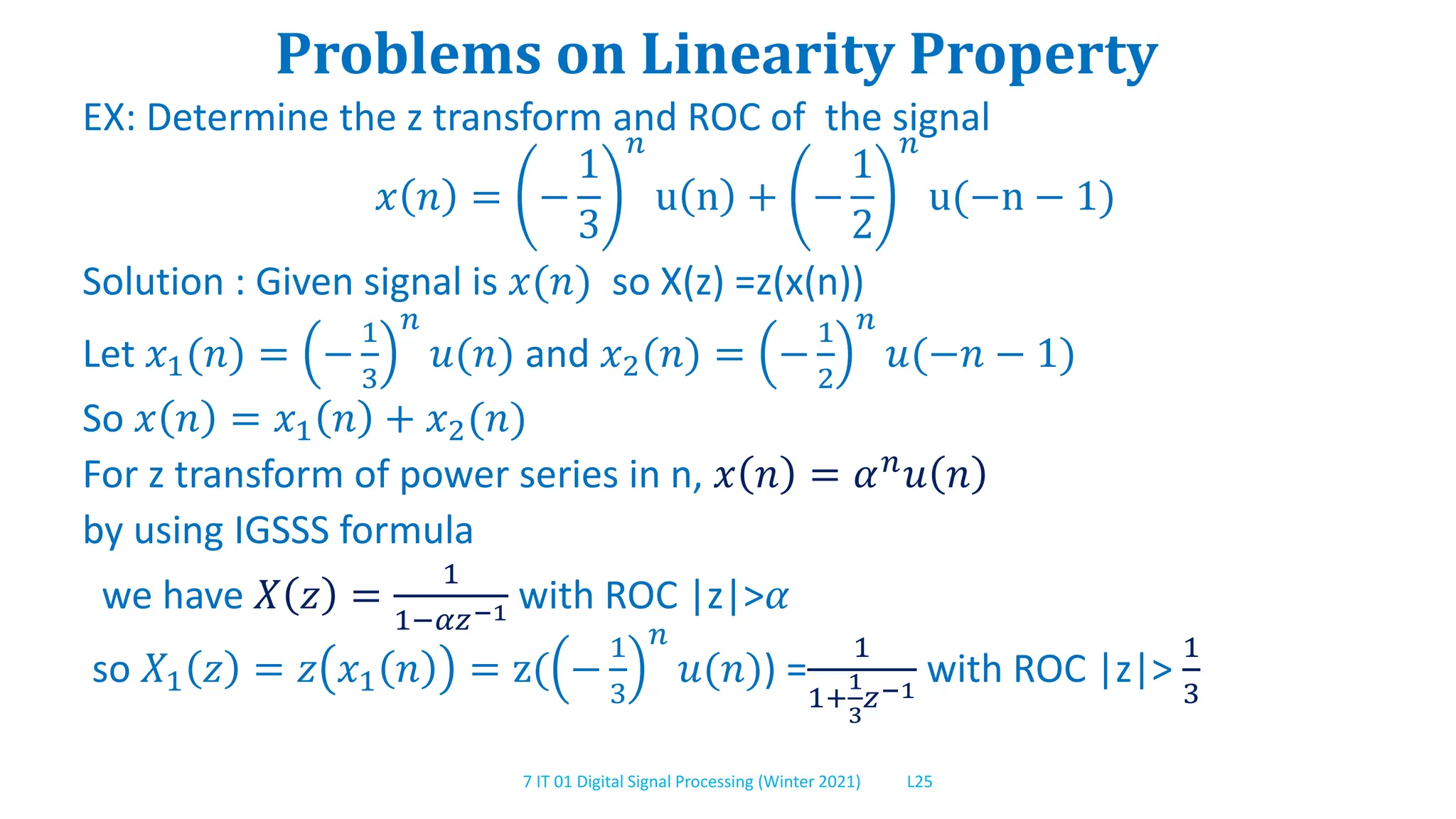
EX: Determine the z transform and ROC of the signal
𝑥 𝑛 = −
1
3
𝑛
u n + −
1
2
𝑛
u(−n − 1)
Solution : Given signal is 𝑥(𝑛) so X(z) =z(x(n))
Let 𝑥1(𝑛) = −
1
3
𝑛
𝑢(𝑛) and 𝑥2(𝑛) = −
1
2
𝑛
𝑢(−𝑛 − 1)
So 𝑥 𝑛 = 𝑥1 𝑛 + 𝑥2(𝑛)
For z transform of power series in n, 𝑥 𝑛 = 𝛼𝑛𝑢 𝑛
by using IGSSS formula
we have 𝑋 𝑧 =
1
1−𝛼𝑧−1 with ROC |z|>𝛼
so 𝑋1 𝑧 = 𝑧 𝑥1 𝑛 = z( −
1
3
𝑛
𝑢(𝑛)) =
1
1+
1
3
𝑧−1
with ROC |z|>
1
3
7 IT 01 Digital Signal Processing (Winter 2021) L25
Problems on Linearity Property
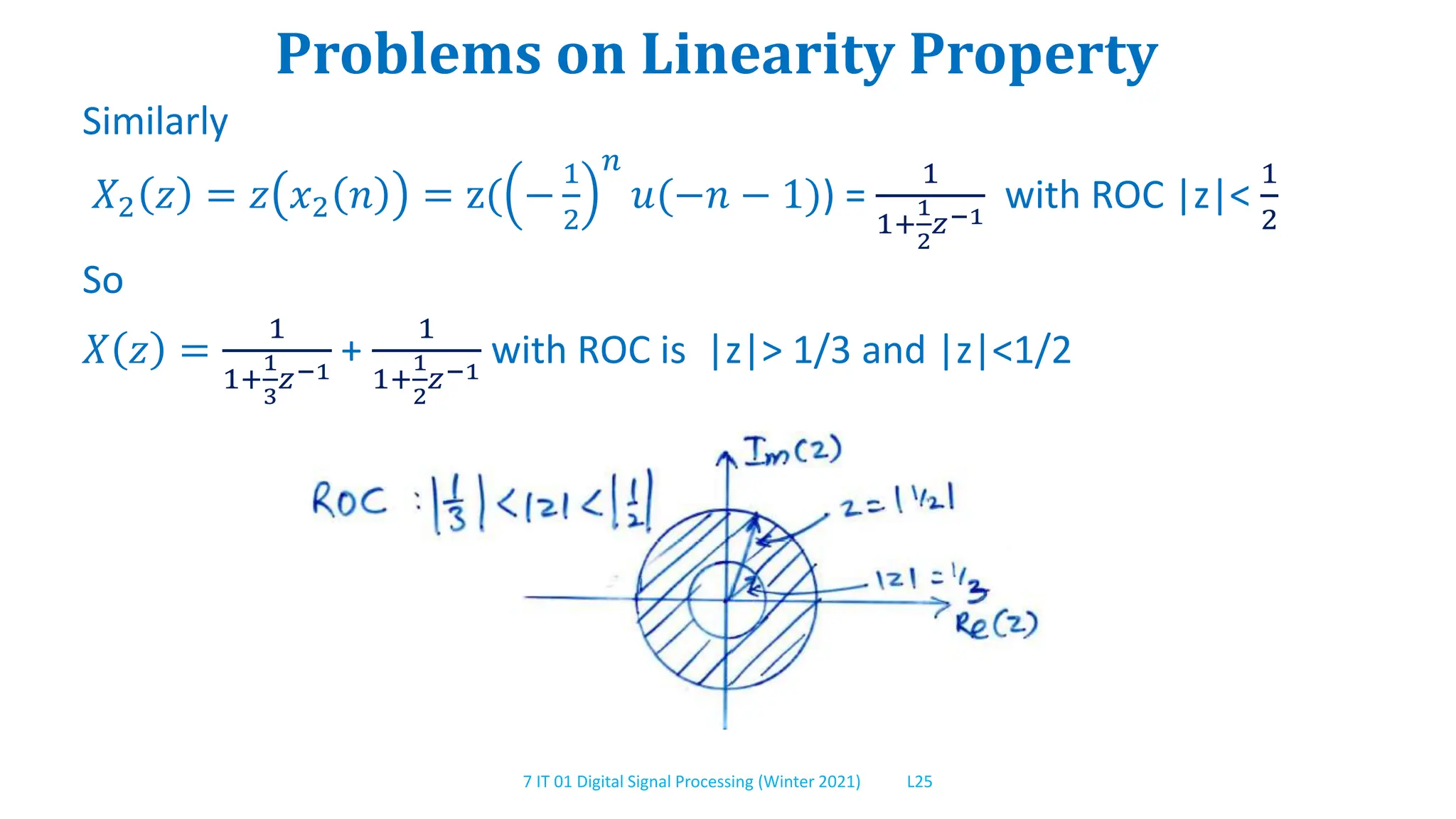
Similarly
𝑋2 𝑧 = 𝑧 𝑥2 𝑛 = z( −
1
2
𝑛
𝑢(−𝑛 − 1)) =
1
1+
1
2
𝑧−1
with ROC |z|<
1
2
So
𝑋 𝑧 =
1
1+
1
3
𝑧−1
+
1
1+
1
2
𝑧−1
with ROC is |z|> 1/3 and |z|<1/2
7 IT 01 Digital Signal Processing (Winter 2021) L25
Properties of z Transform
The z transform is a very powerful tool and this is exhibited by it’s powerful
set of properties.
Note : when we combine several z transforms, the ROC of the overall
transform is at least the intersection of their ROCs.
Properties:
1. Linearity
2. Time Shifting
3. Scaling in z domain
4. Time Reversal
5. Differentiation in z domain
6. Convolution of two sequences
7 IT 01 Digital Signal Processing (Winter 2021) L25
Time Shifting Property
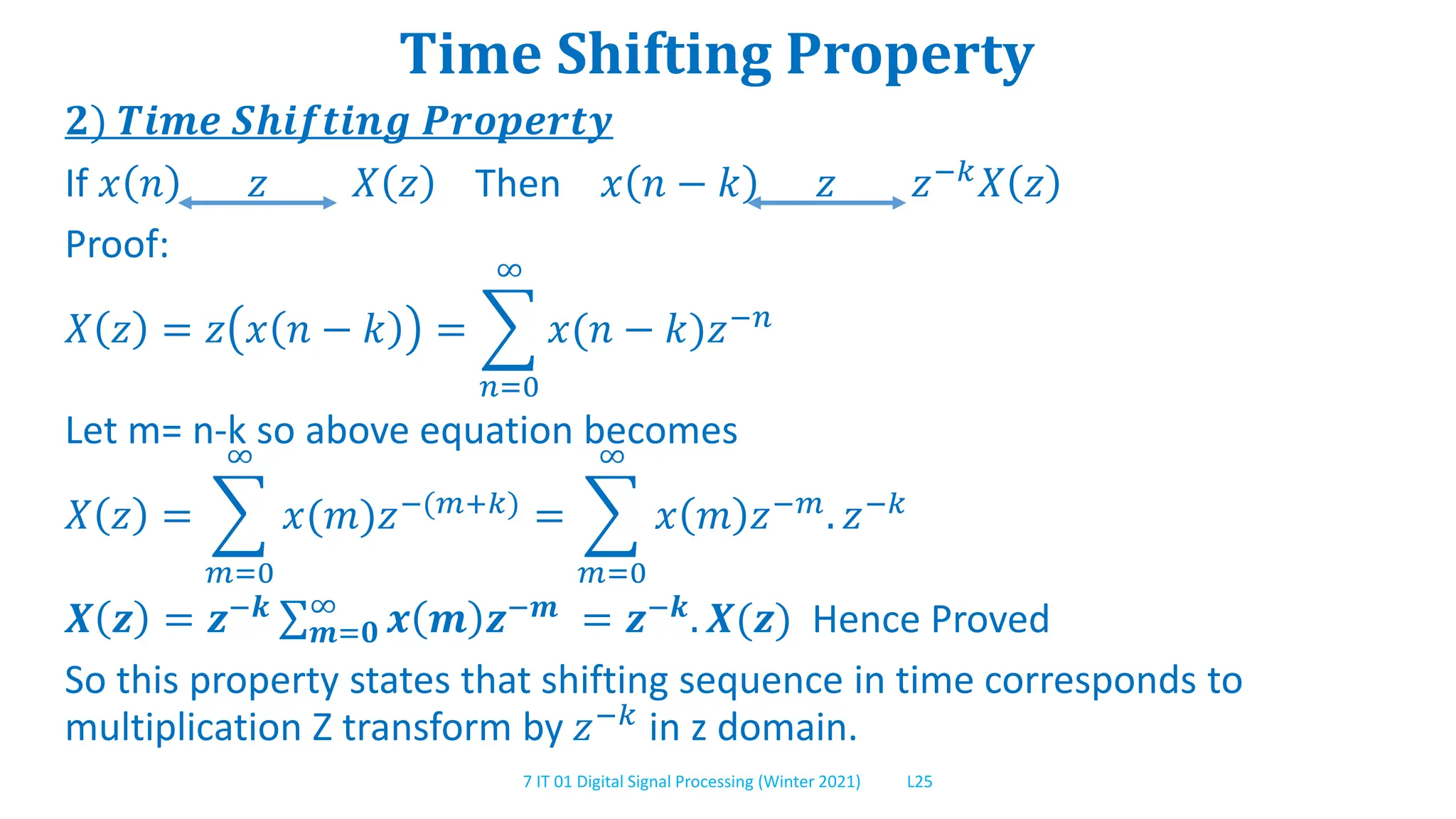
𝟐) 𝑻𝒊𝒎𝒆 𝑺𝒉𝒊𝒇𝒕𝒊𝒏𝒈 𝑷𝒓𝒐𝒑𝒆𝒓𝒕𝒚
If 𝑥 𝑛 𝑧 𝑋 𝑧 Then 𝑥 𝑛 − 𝑘 𝑧 𝑧−𝑘𝑋 𝑧
Proof:
𝑋 𝑧 = 𝑧 𝑥 𝑛 − 𝑘 =
𝑛=0
∞
𝑥(𝑛 − 𝑘)𝑧−𝑛
Let m= n-k so above equation becomes
𝑋 𝑧 =
𝑚=0
∞
𝑥(𝑚)𝑧−(𝑚+𝑘) =
𝑚=0
∞
𝑥 𝑚 𝑧−𝑚. 𝑧−𝑘
𝑿 𝒛 = 𝒛−𝒌
𝒎=𝟎
∞
𝒙 𝒎 𝒛−𝒎
= 𝒛−𝒌
. 𝑿(𝒛) Hence Proved
So this property states that shifting sequence in time corresponds to
multiplication Z transform by 𝑧−𝑘 in z domain.
7 IT 01 Digital Signal Processing (Winter 2021) L25
Problems on Time Shifting Property
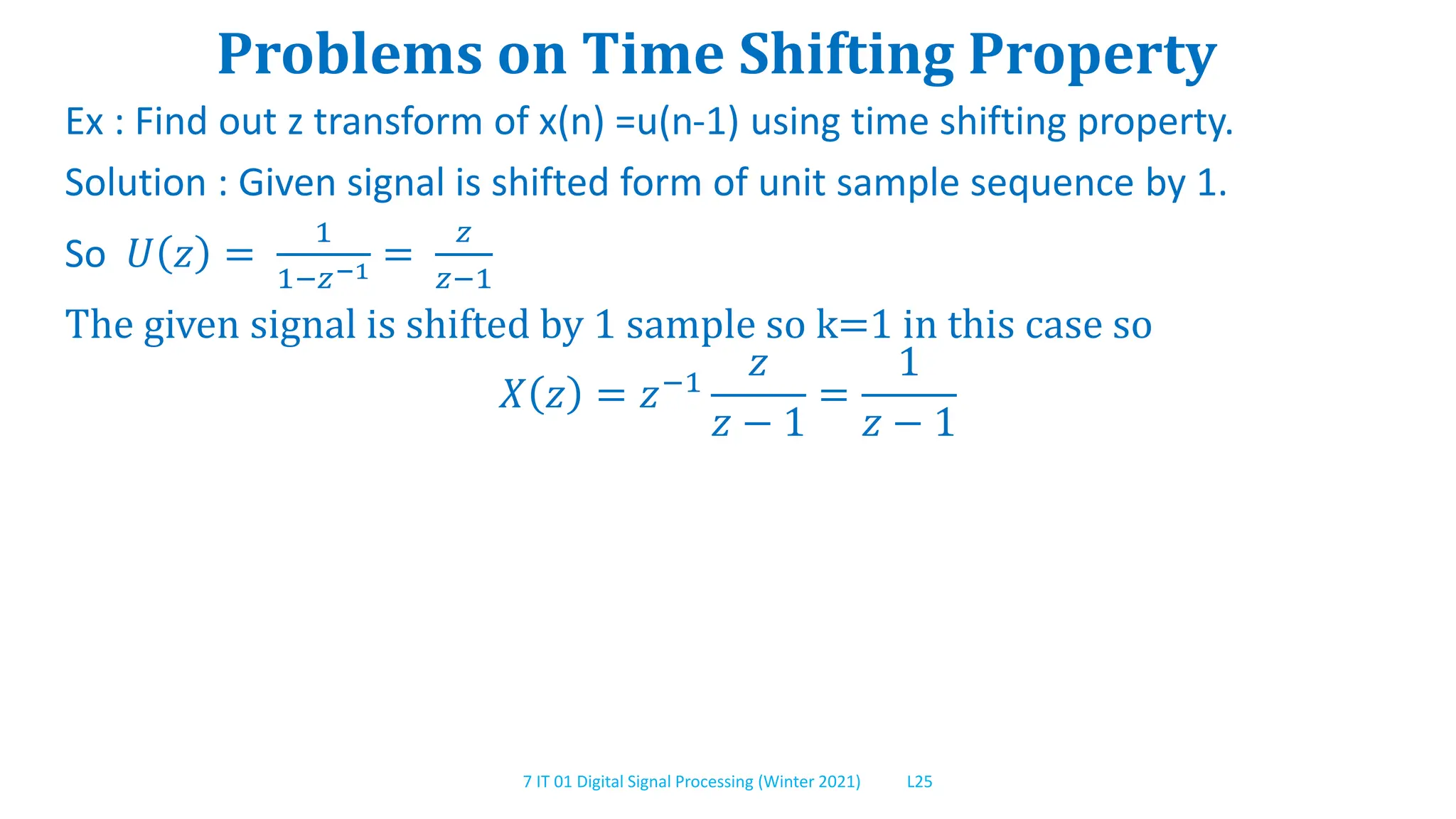
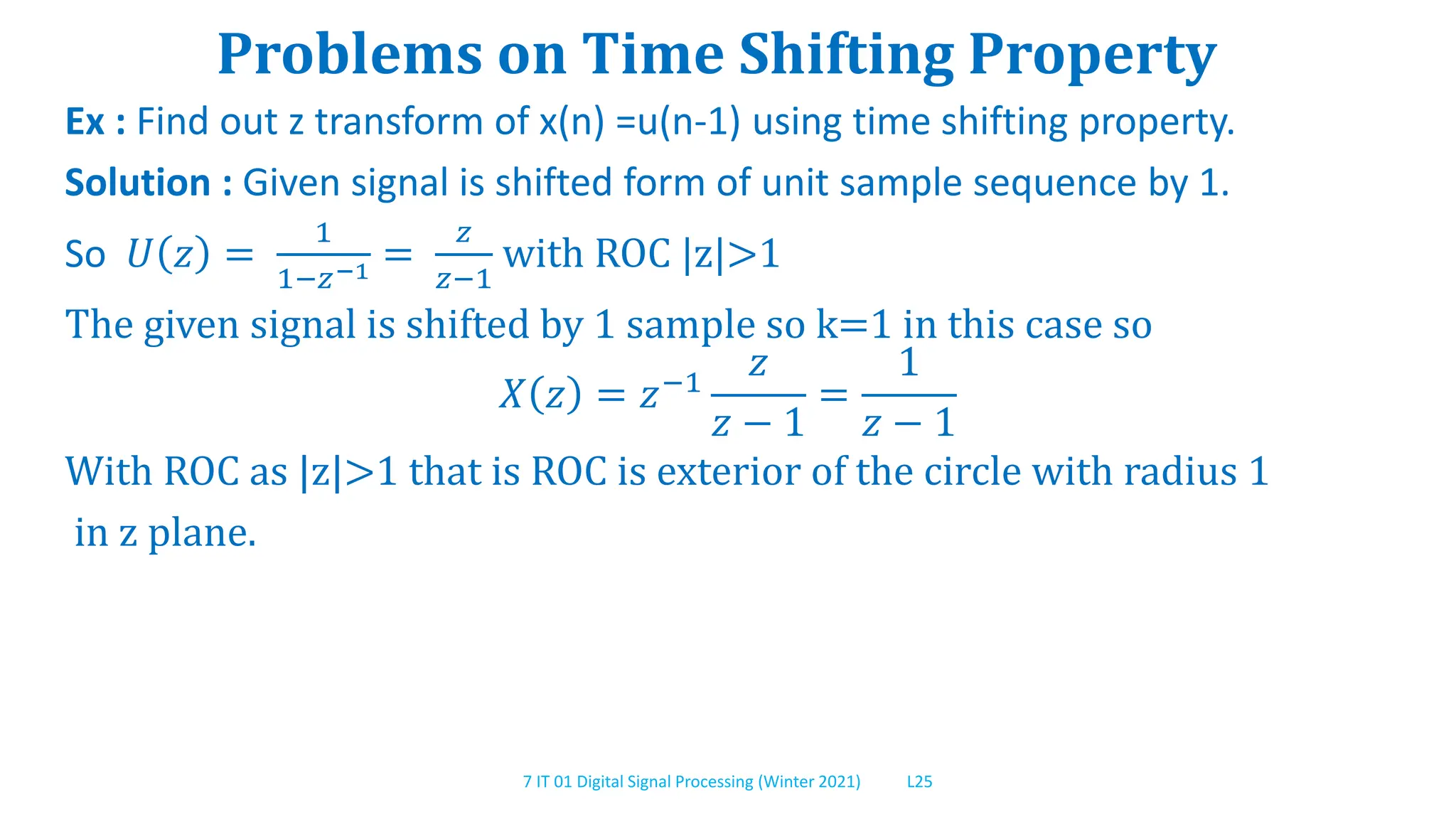
Ex : Find out z transform of x(n) =u(n-1) using time shifting property.
Solution : Given signal is shifted form of unit sample sequence by 1.
So 𝑈 𝑧 =
1
1−𝑧−1 =
𝑧
𝑧−1
The given signal is shifted by 1 sample so k=1 in this case so
𝑋 𝑧 = 𝑧−1
𝑧
𝑧 − 1
=
1
𝑧 − 1
7 IT 01 Digital Signal Processing (Winter 2021) L25
Problems on Time Shifting Property
Ex : Find out z transform of x(n) =u(n-1) using time shifting property.
Solution : Given signal is shifted form of unit sample sequence by 1.
So 𝑈 𝑧 =
1
1−𝑧−1 =
𝑧
𝑧−1
with ROC |z|>1
The given signal is shifted by 1 sample so k=1 in this case so
𝑋 𝑧 = 𝑧−1
𝑧
𝑧 − 1
=
1
𝑧 − 1
With ROC as |z|>1 that is ROC is exterior of the circle with radius 1
in z plane.
7 IT 01 Digital Signal Processing (Winter 2021) L25
Problems on Time Shifting Property
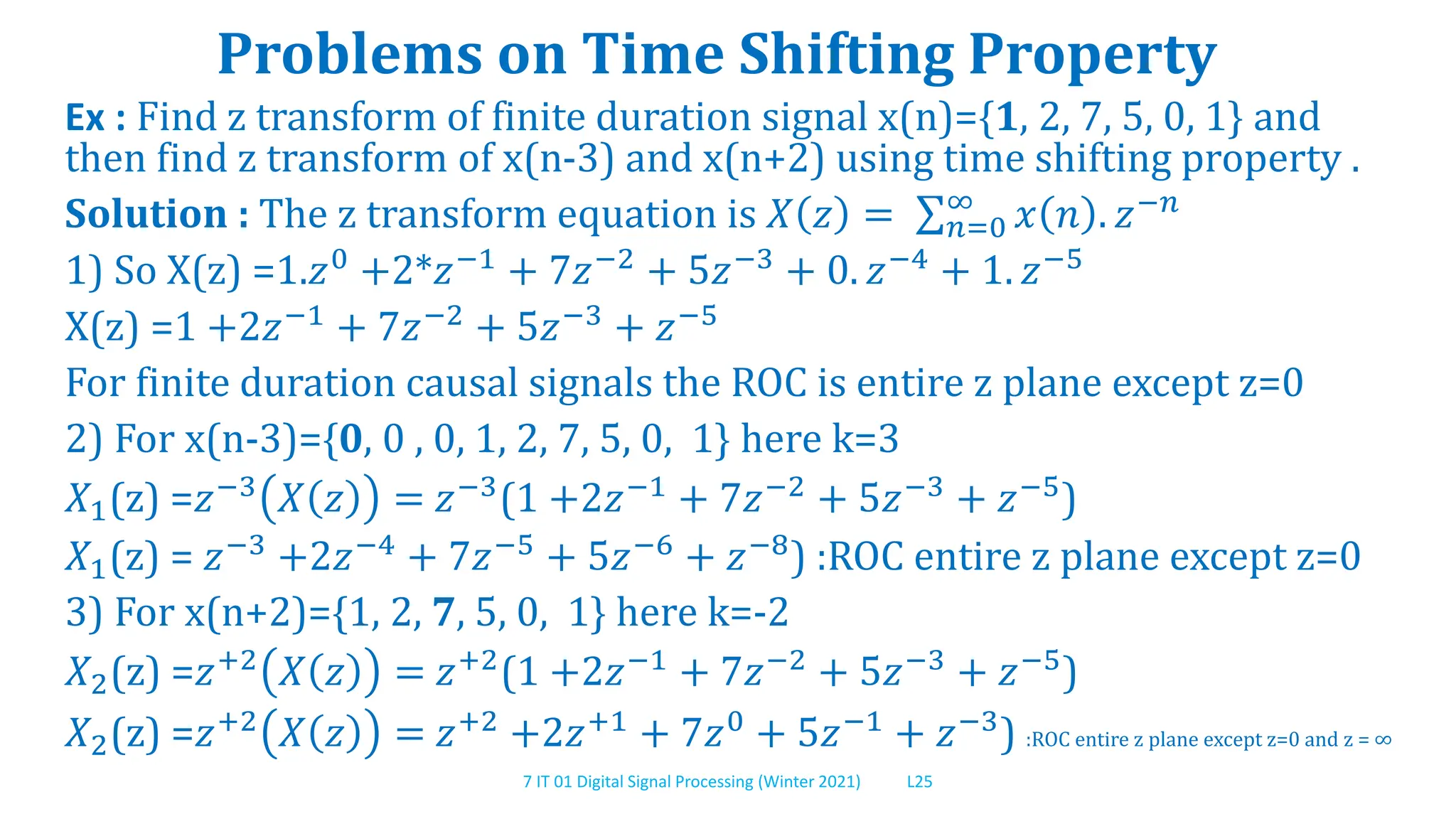
Ex : Find z transform of finite duration signal x(n)={1, 2, 7, 5, 0, 1} and
then find z transform of x(n-3) and x(n+2) using time shifting property .
Solution : The z transform equation is 𝑋 𝑧 = 𝑛=0
∞
𝑥 𝑛 . 𝑧−𝑛
1) So X(z) =1.𝑧0
+2*𝑧−1
+ 7𝑧−2
+ 5𝑧−3
+ 0. 𝑧−4
+ 1. 𝑧−5
X(z) =1 +2𝑧−1 + 7𝑧−2 + 5𝑧−3 + 𝑧−5
For finite duration causal signals the ROC is entire z plane except z=0
2) For x(n-3)={0, 0 , 0, 1, 2, 7, 5, 0, 1} here k=3
𝑋1(z) =𝑧−3 𝑋 𝑧 = 𝑧−3(1 +2𝑧−1 + 7𝑧−2 + 5𝑧−3 + 𝑧−5)
𝑋1(z) = 𝑧−3 +2𝑧−4 + 7𝑧−5 + 5𝑧−6 + 𝑧−8) :ROC entire z plane except z=0
3) For x(n+2)={1, 2, 7, 5, 0, 1} here k=-2
𝑋2(z) =𝑧+2 𝑋 𝑧 = 𝑧+2(1 +2𝑧−1 + 7𝑧−2 + 5𝑧−3 + 𝑧−5)
𝑋2(z) =𝑧+2 𝑋 𝑧 = 𝑧+2 +2𝑧+1 + 7𝑧0 + 5𝑧−1 + 𝑧−3) :ROC entire z plane except z=0 and z = ∞
7 IT 01 Digital Signal Processing (Winter 2021) L25
Properties of z Transform
The z transform is a very powerful tool and this is exhibited by it’s powerful
set of properties.
Note : when we combine several z transforms, the ROC of the overall
transform is at least the intersection of their ROCs.
Properties:
1. Linearity
2. Time Shifting
3. Scaling in z domain
4. Time Reversal
5. Differentiation in z domain
6. Convolution of two sequences
7 IT 01 Digital Signal Processing (Winter 2021) L25
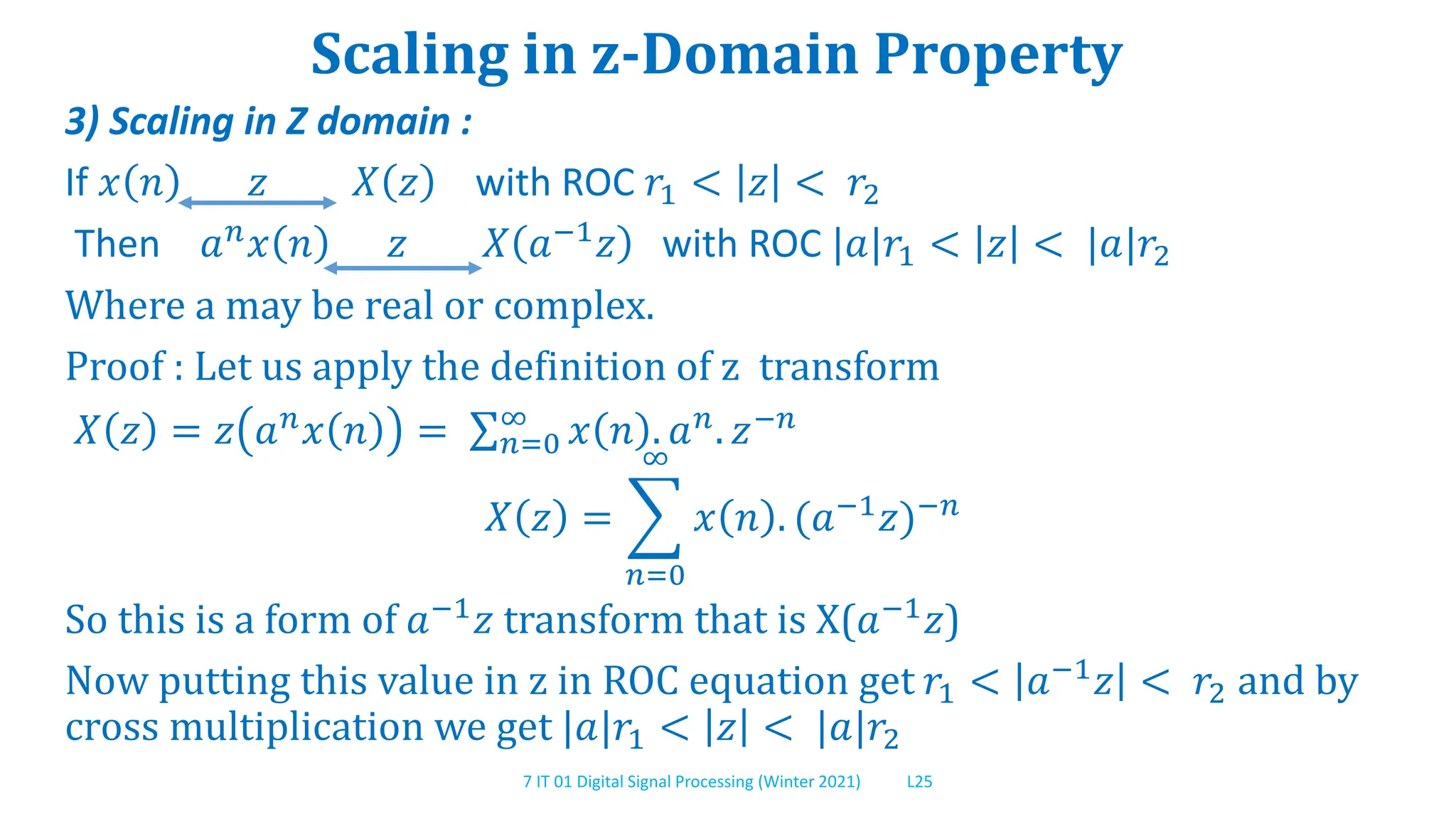
Scaling in z-Domain Property
3) Scaling in Z domain :
If 𝑥 𝑛 𝑧 𝑋 𝑧 with ROC 𝑟1 < 𝑧 < 𝑟2
Then 𝑎𝑛𝑥 𝑛 𝑧 𝑋 𝑎−1𝑧 with ROC |𝑎|𝑟1 < 𝑧 < |𝑎|𝑟2
Where a may be real or complex.
Proof : Let us apply the definition of z transform
𝑋 𝑧 = 𝑧 𝑎𝑛𝑥 𝑛 = 𝑛=0
∞
𝑥 𝑛 . 𝑎𝑛. 𝑧−𝑛
𝑋 𝑧 =
𝑛=0
∞
𝑥 𝑛 . (𝑎−1
𝑧)−𝑛
So this is a form of 𝑎−1𝑧 transform that is X(𝑎−1𝑧)
Now putting this value in z in ROC equation get 𝑟1 < 𝑎−1𝑧 < 𝑟2 and by
cross multiplication we get |𝑎|𝑟1 < 𝑧 < |𝑎|𝑟2
7 IT 01 Digital Signal Processing (Winter 2021) L25
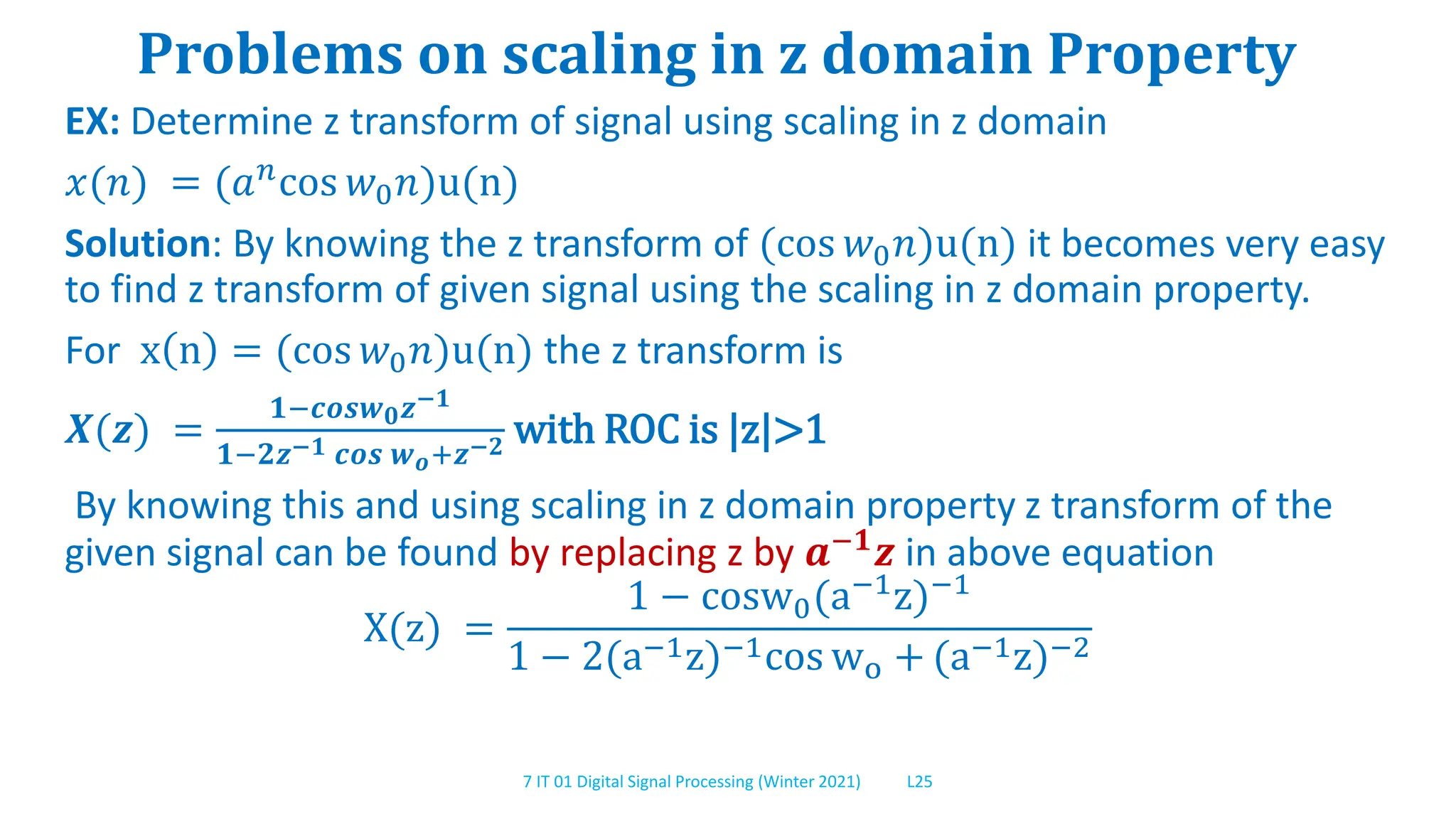
Problems on scaling in z domain Property
EX: Determine z transform of signal using scaling in z domain
𝑥(𝑛) = (𝑎𝑛cos 𝑤0𝑛)u(n)
Solution: By knowing the z transform of (cos 𝑤0𝑛)u(n) it becomes very easy
to find z transform of given signal using the scaling in z domain property.
For x n = (cos 𝑤0𝑛)u(n) the z transform is
𝑿(𝒛) =
𝟏−𝒄𝒐𝒔𝒘𝟎𝒛−𝟏
𝟏−𝟐𝒛−𝟏 𝒄𝒐𝒔 𝒘𝒐+𝒛−𝟐 with ROC is |z|>1
By knowing this and using scaling in z domain property z transform of the
given signal can be found by replacing z by 𝒂−𝟏𝒛 in above equation
X(z) =
1 − cosw0(a−1
z)−1
1 − 2(a−1z)−1cos wo + (a−1z)−2
7 IT 01 Digital Signal Processing (Winter 2021) L25
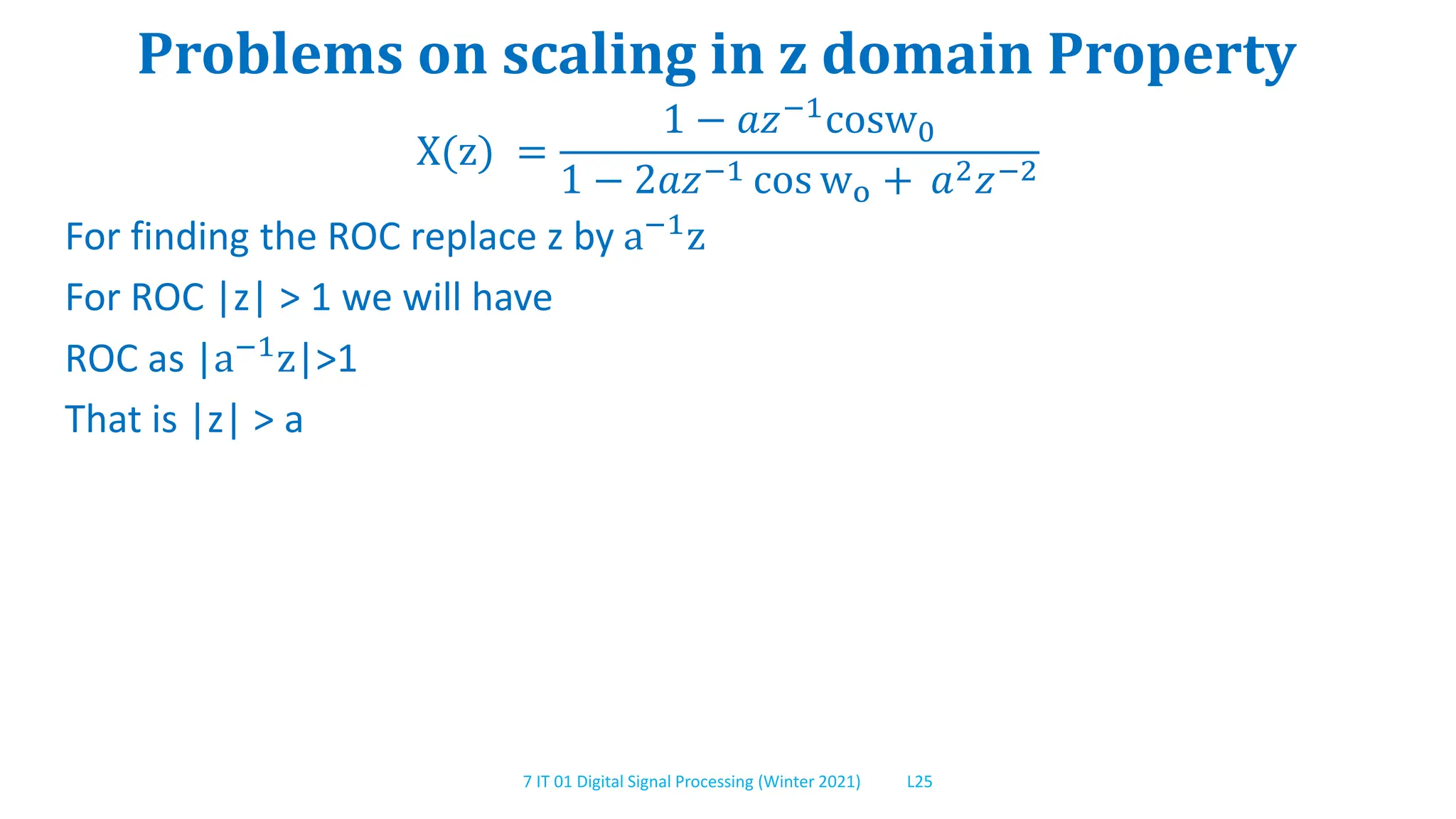
Problems on scaling in z domain Property
X(z) =
1 − 𝑎𝑧−1cosw0
1 − 2𝑎𝑧−1 cos wo + 𝑎2𝑧−2
For finding the ROC replace z by a−1z
For ROC |z| > 1 we will have
ROC as |a−1z|>1
That is |z| > a
7 IT 01 Digital Signal Processing (Winter 2021) L25
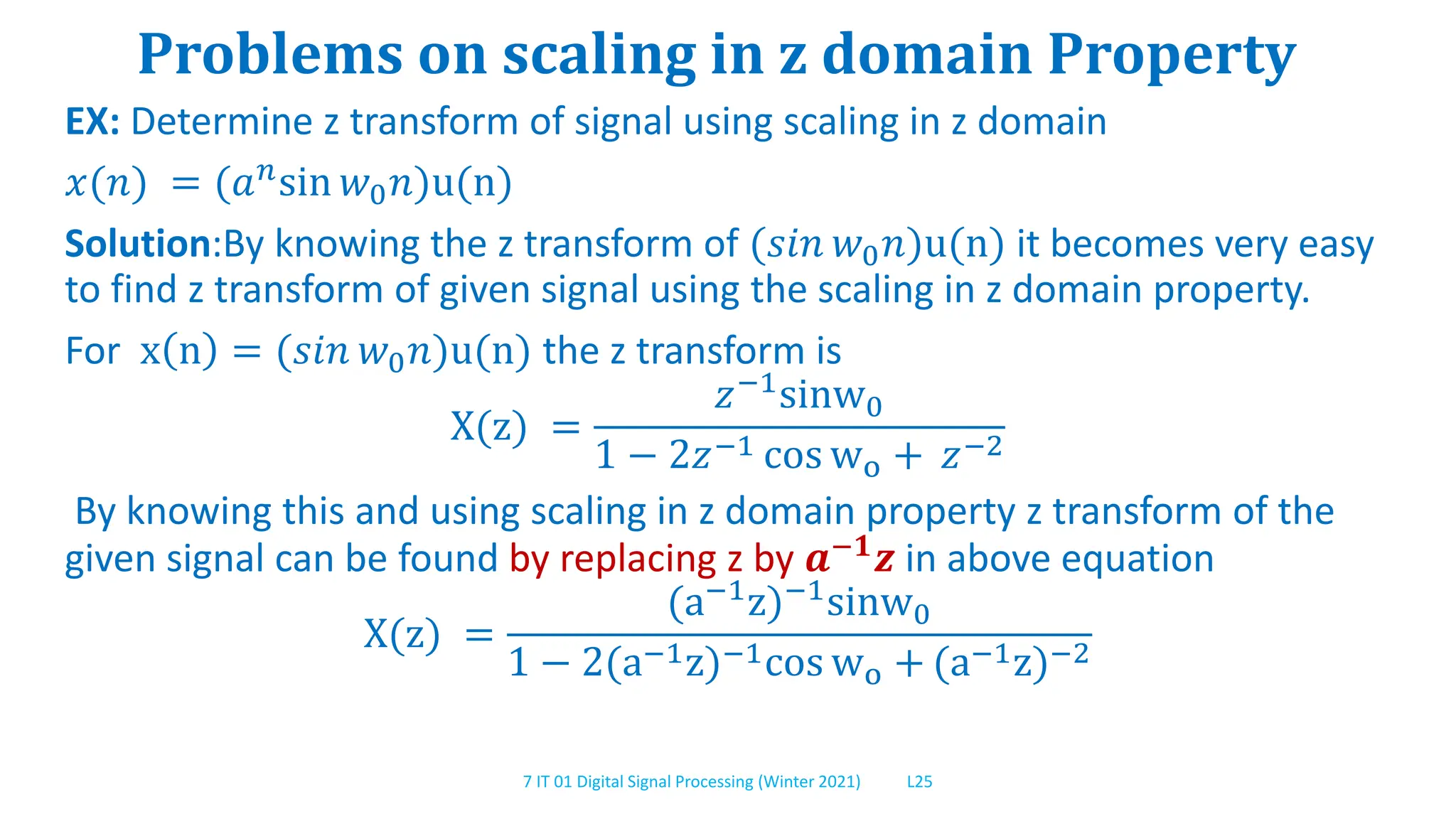
Problems on scaling in z domain Property
EX: Determine z transform of signal using scaling in z domain
𝑥(𝑛) = (𝑎𝑛sin 𝑤0𝑛)u(n)
Solution:By knowing the z transform of (𝑠𝑖𝑛 𝑤0𝑛)u(n) it becomes very easy
to find z transform of given signal using the scaling in z domain property.
For x n = (𝑠𝑖𝑛 𝑤0𝑛)u(n) the z transform is
X(z) =
𝑧−1sinw0
1 − 2𝑧−1 cos wo + 𝑧−2
By knowing this and using scaling in z domain property z transform of the
given signal can be found by replacing z by 𝒂−𝟏𝒛 in above equation
X(z) =
(a−1z)−1sinw0
1 − 2(a−1z)−1cos wo + (a−1z)−2
7 IT 01 Digital Signal Processing (Winter 2021) L25
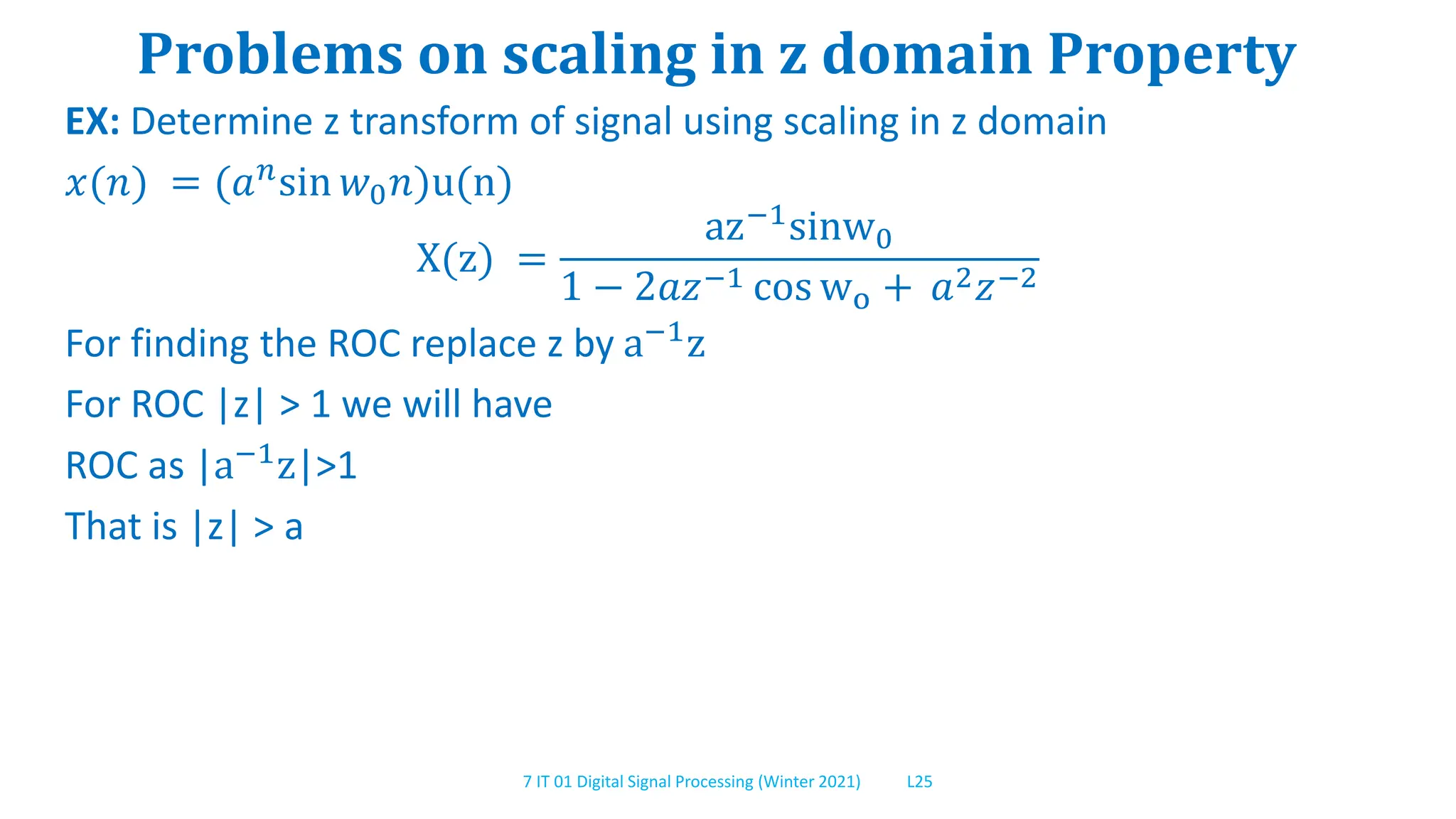
Problems on scaling in z domain Property
EX: Determine z transform of signal using scaling in z domain
𝑥(𝑛) = (𝑎𝑛sin 𝑤0𝑛)u(n)
X(z) =
az−1sinw0
1 − 2𝑎𝑧−1 cos wo + 𝑎2𝑧−2
For finding the ROC replace z by a−1
z
For ROC |z| > 1 we will have
ROC as |a−1z|>1
That is |z| > a
7 IT 01 Digital Signal Processing (Winter 2021) L25
Properties of z Transform
The z transform is a very powerful tool and this is exhibited by it’s powerful
set of properties.
Note : when we combine several z transforms, the ROC of the overall
transform is at least the intersection of their ROCs.
Properties:
1. Linearity
2. Time Shifting
3. Scaling in z domain
4. Time Reversal
5. Differentiation in z domain
6. Convolution of two sequences
7 IT 01 Digital Signal Processing (Winter 2021) L25
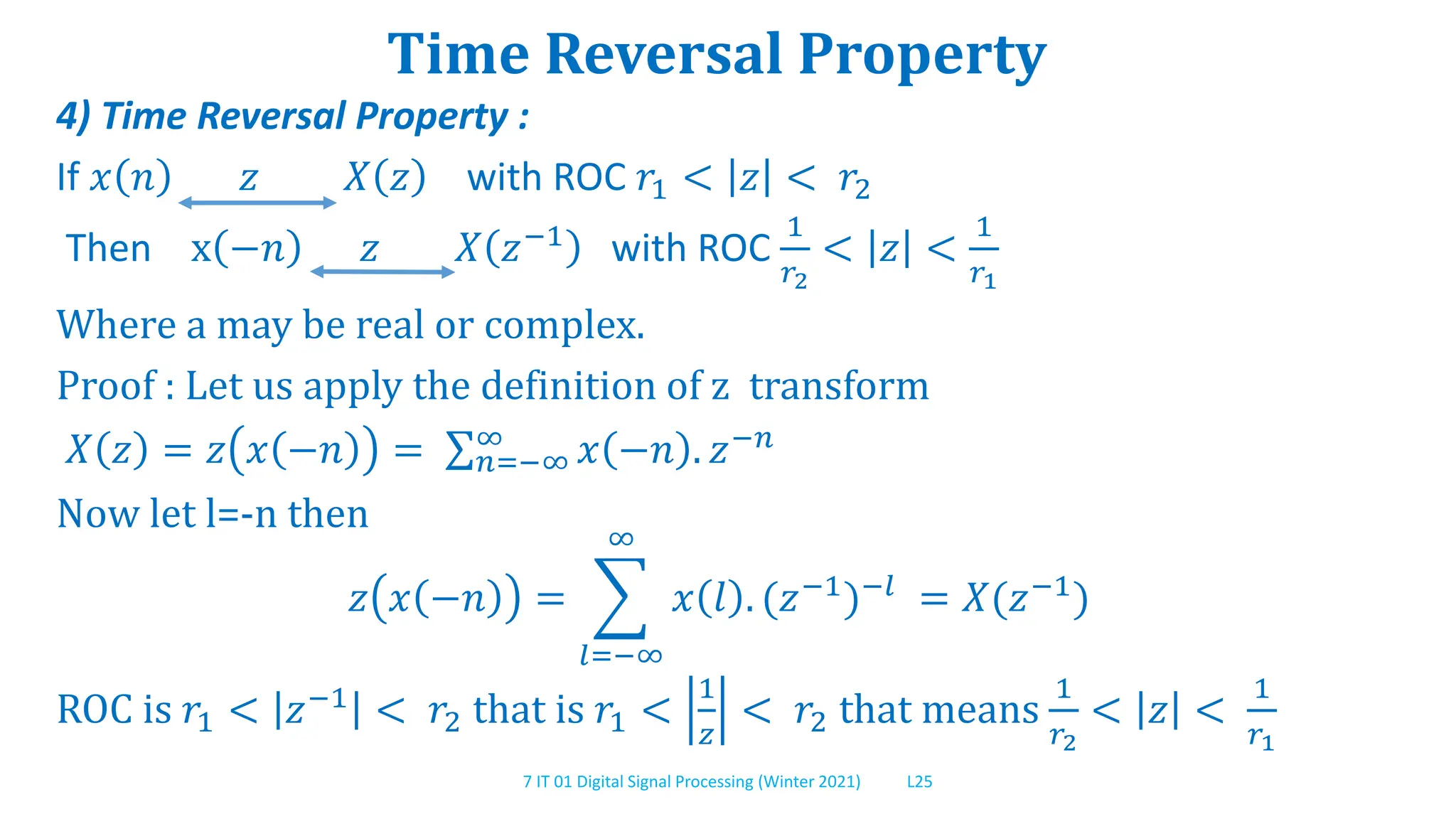
Time Reversal Property
4) Time Reversal Property :
If 𝑥 𝑛 𝑧 𝑋 𝑧 with ROC 𝑟1 < 𝑧 < 𝑟2
Then x −𝑛 𝑧 𝑋 𝑧−1
with ROC
1
𝑟2
< 𝑧 <
1
𝑟1
Where a may be real or complex.
Proof : Let us apply the definition of z transform
𝑋 𝑧 = 𝑧 𝑥 −𝑛 = 𝑛=−∞
∞ 𝑥 −𝑛 . 𝑧−𝑛
Now let l=-n then
𝑧 𝑥 −𝑛 =
𝑙=−∞
∞
𝑥 𝑙 . (𝑧−1
)−𝑙
= 𝑋(𝑧−1
)
ROC is 𝑟1 < 𝑧−1 < 𝑟2 that is 𝑟1 <
1
𝑧
< 𝑟2 that means
1
𝑟2
< 𝑧 <
1
𝑟1
7 IT 01 Digital Signal Processing (Winter 2021) L25
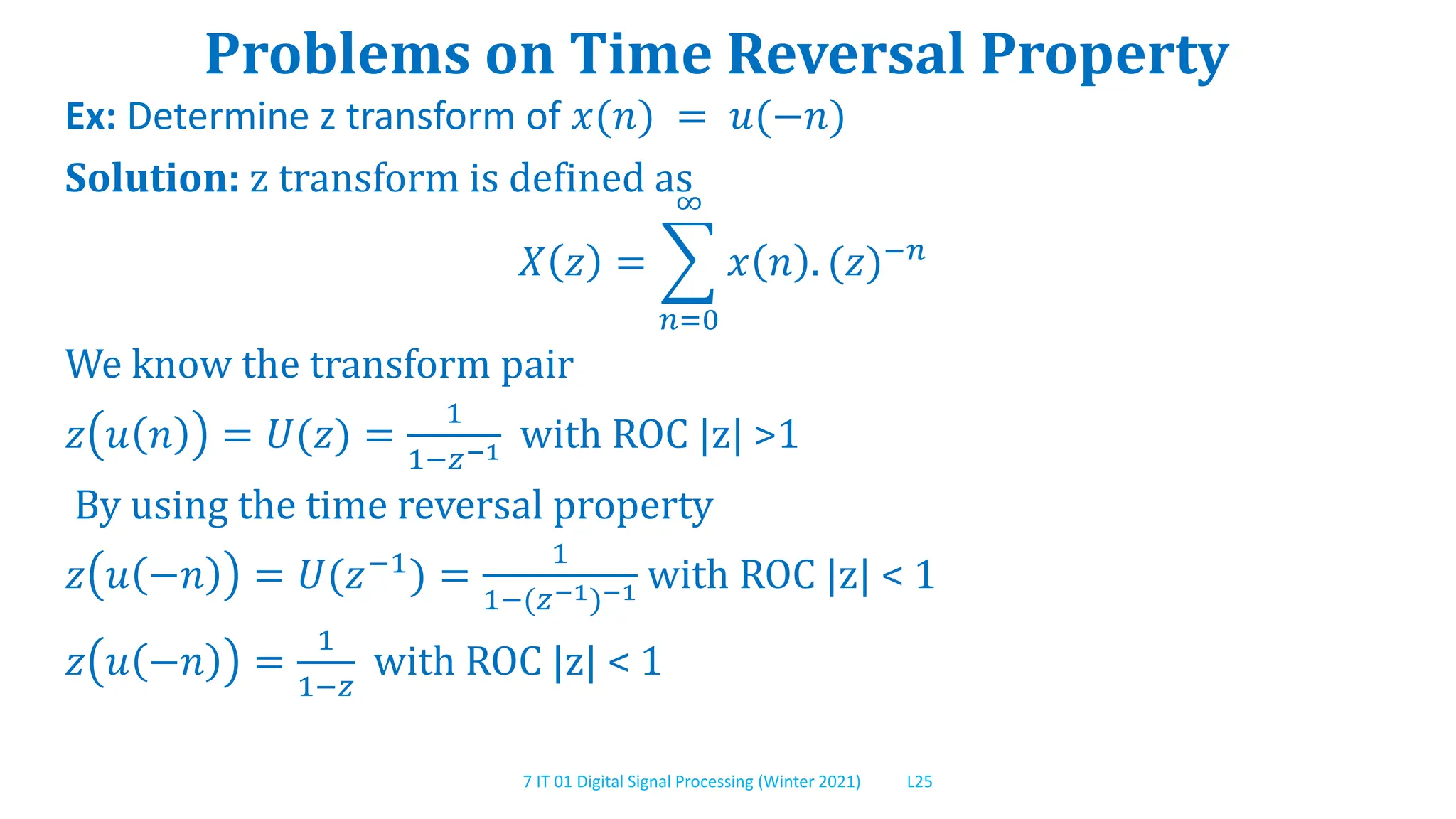
Problems on Time Reversal Property
Ex: Determine z transform of 𝑥(𝑛) = 𝑢(−𝑛)
Solution: z transform is defined as
𝑋 𝑧 =
𝑛=0
∞
𝑥 𝑛 . (𝑧)−𝑛
We know the transform pair
𝑧 𝑢 𝑛 = 𝑈(𝑧) =
1
1−𝑧−1 with ROC |z| >1
By using the time reversal property
𝑧 𝑢 −𝑛 = 𝑈(𝑧−1
) =
1
1−(𝑧−1)−1 with ROC |z| < 1
𝑧 𝑢 −𝑛 =
1
1−𝑧
with ROC |z| < 1
7 IT 01 Digital Signal Processing (Winter 2021) L25
Properties of z Transform
The z transform is a very powerful tool and this is exhibited by it’s powerful
set of properties.
Note : when we combine several z transforms, the ROC of the overall
transform is at least the intersection of their ROCs.
Properties:
1. Linearity
2. Time Shifting
3. Scaling in z domain
4. Time Reversal
5. Differentiation in z domain
6. Convolution of two sequences
7 IT 01 Digital Signal Processing (Winter 2021) L25
Differentiation in z Domain Property
5) Differentiation in z Domain Property :
If 𝑥 𝑛) 𝑧 𝑋 𝑧
Then n x 𝑛 𝑧 − 𝑧
𝑑𝑋(𝑧)
𝑑𝑧
with same ROC
Proof : For signal 𝑥 𝑛 𝑧 𝑋 𝑧
Using the definition of z transform
𝑋 𝑧 = 𝑧 𝑥 𝑛 = 𝑛=0
∞
𝑥 𝑛 . 𝑧−𝑛
Taking differentiation of both sides
𝑑𝑋 𝑧
𝑑𝑧
=
𝑛=0
∞
𝑥 𝑛 .
𝑑
𝑑𝑧
𝑧−𝑛
𝑑𝑋 𝑧
𝑑𝑧
=
𝑛=0
∞
𝑥 𝑛 . (−𝑛. 𝑧−𝑛−1)
7 IT 01 Digital Signal Processing (Winter 2021) L25
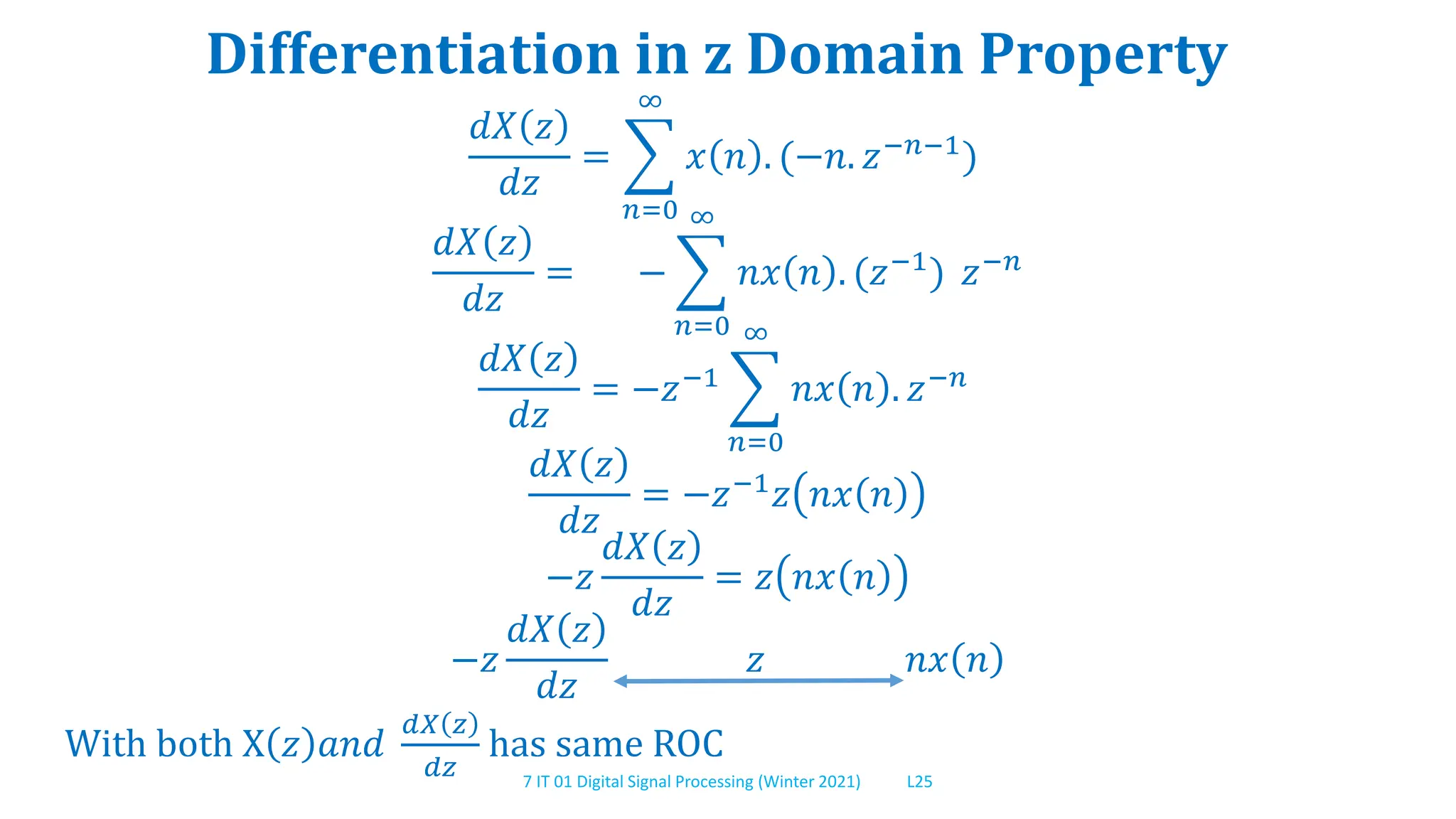
Differentiation in z Domain Property
𝑑𝑋 𝑧
𝑑𝑧
=
𝑛=0
∞
𝑥 𝑛 . (−𝑛. 𝑧−𝑛−1
)
𝑑𝑋 𝑧
𝑑𝑧
= −
𝑛=0
∞
𝑛𝑥 𝑛 . (𝑧−1
) 𝑧−𝑛
𝑑𝑋 𝑧
𝑑𝑧
= −𝑧−1
𝑛=0
∞
𝑛𝑥 𝑛 . 𝑧−𝑛
𝑑𝑋 𝑧
𝑑𝑧
= −𝑧−1
𝑧 𝑛𝑥 𝑛
−𝑧
𝑑𝑋 𝑧
𝑑𝑧
= 𝑧 𝑛𝑥 𝑛
−𝑧
𝑑𝑋 𝑧
𝑑𝑧
𝑧 𝑛𝑥 𝑛
With both X 𝑧 𝑎𝑛𝑑
𝑑𝑋 𝑧
𝑑𝑧
has same ROC
7 IT 01 Digital Signal Processing (Winter 2021) L25
Problems on Diff. in z Domain Property
EX : Determine the z transform of the given signal 𝑥 𝑛 = 𝑛𝑎𝑛
𝑢(𝑛)
Solution : In this case we can write 𝑥 𝑛 = 𝑛 [𝑎𝑛𝑢 𝑛 ]
let 𝑥1 𝑛 = 𝑎𝑛𝑢(𝑛)
So 𝑥 𝑛 = 𝑛𝑥1(𝑛)
𝑋1 𝑧 =
1
1−𝑎𝑧−1 with ROC |z| > a
By using differentiation in z domain property z transform of 𝑛𝑥(𝑛) is
−𝑧
𝑑𝑋 𝑧
𝑑𝑧
so in this case 𝑧 𝑥 𝑛 = −𝑧
𝑑
𝑑𝑧
(
1
1−𝑎𝑧−1)
Using differentiation formula
𝑑
𝑑𝑧
𝑢
𝑣
=
𝑢.𝑑𝑣−𝑣.𝑑𝑢
𝑣2
We get X 𝑧 =
𝑎𝑧−1
(1−𝑎𝑧−1)2 with ROC |z| > a
7 IT 01 Digital Signal Processing (Winter 2021) L25
Problems on Diff. in z Domain Property
EX : Determine the z transform of the given signal 𝑥 𝑛 = 𝑛𝑎𝑛
𝑢(𝑛)
So : In this case we can write 𝑥 𝑛 = 𝑛 [𝑎𝑛𝑢 𝑛 ]let 𝑥1 𝑛 = 𝑎𝑛
𝑢(𝑛) , So 𝑥 𝑛 = 𝑛𝑥1(𝑛)
𝑋1 𝑧 =
1
1−𝑎𝑧−1 with ROC |z| > a
By using differentiation in z domain property z transform of 𝑛𝑥(𝑛) is
−𝑧
𝑑𝑋 𝑧
𝑑𝑧
so in this case 𝑧 𝑥 𝑛 = −𝑧
𝑑
𝑑𝑧
(
1
1−𝑎𝑧−1)
Using differentiation formula
𝑑
𝑑𝑧
𝑢
𝑣
=
𝑢.𝑑𝑣−𝑣.𝑑𝑢
𝑣2
We get X 𝑧 =
𝑎𝑧−1
(1−𝑎𝑧−1)2 with ROC |z| > a
If we consider a=1 we get a ramp signal 𝑥 𝑛 = 𝑛𝑢(𝑛)
So its z transform is X 𝑧 =
𝑧−1
(1−𝑧−1)2 with ROC |z| > 1
7 IT 01 Digital Signal Processing (Winter 2021) L25
Properties of z Transform
The z transform is a very powerful tool and this is exhibited by it’s powerful
set of properties.
Note : when we combine several z transforms, the ROC of the overall
transform is at least the intersection of their ROCs.
Properties:
1. Linearity
2. Time Shifting
3. Scaling in z domain
4. Time Reversal
5. Differentiation in z domain
6. Convolution of two sequences
7 IT 01 Digital Signal Processing (Winter 2021) L25
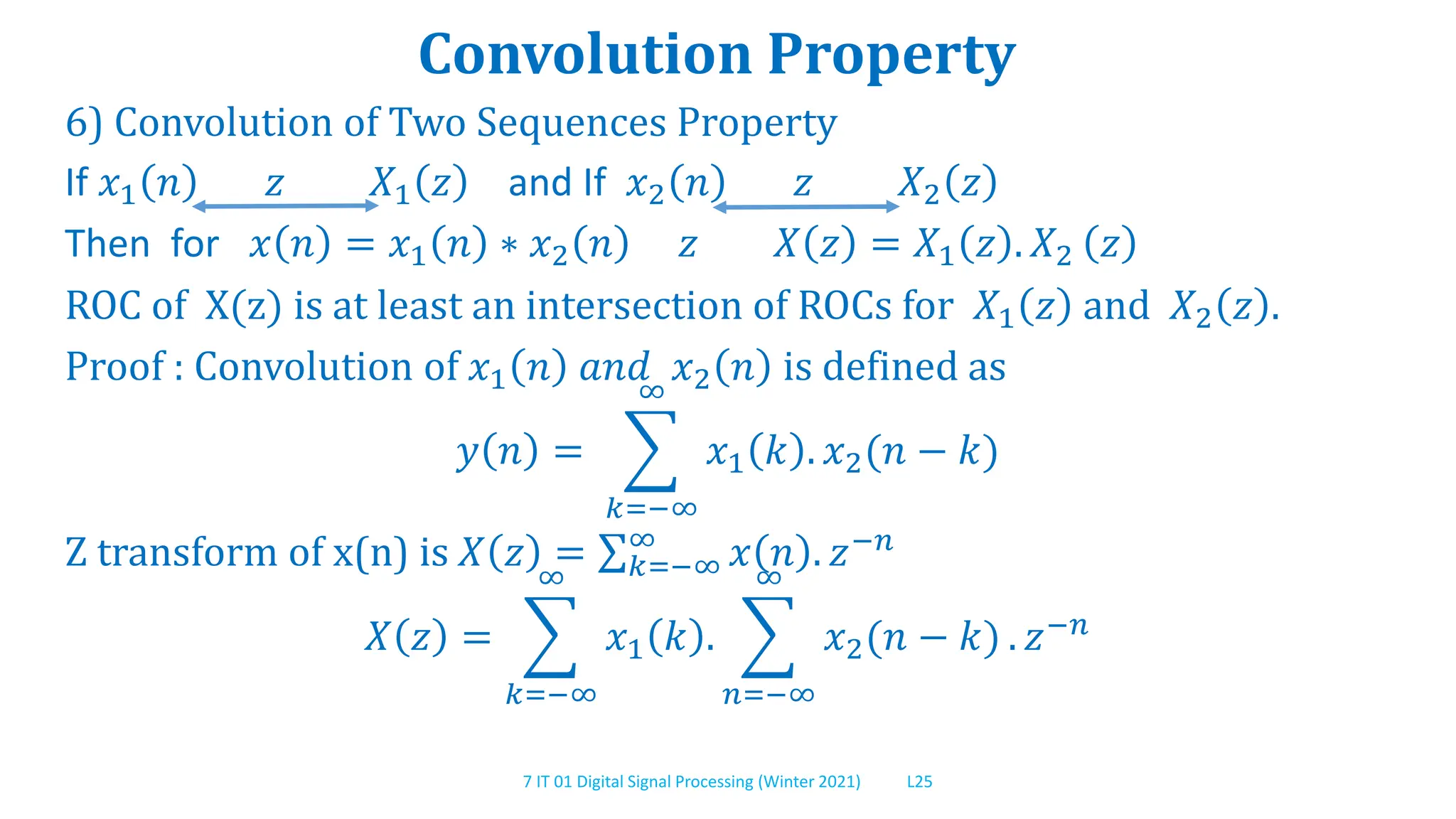
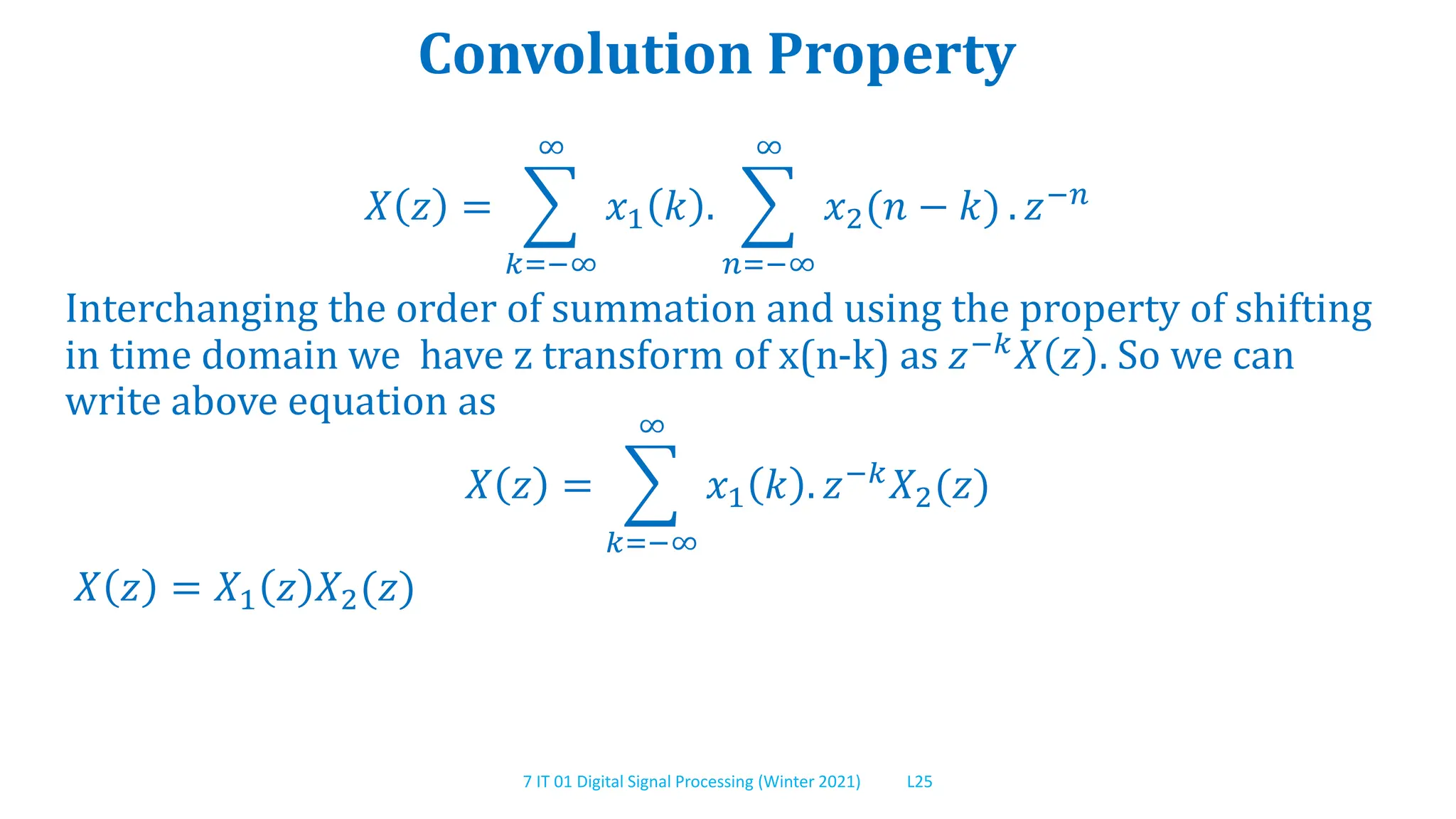
Convolution Property
6) Convolution of Two Sequences Property
If 𝑥1 𝑛 𝑧 𝑋1 𝑧 and If 𝑥2 𝑛 𝑧 𝑋2 𝑧
Then for 𝑥 𝑛 = 𝑥1 𝑛 ∗ 𝑥2 𝑛 𝑧 𝑋 𝑧 = 𝑋1 𝑧 . 𝑋2 𝑧
ROC of X(z) is at least an intersection of ROCs for 𝑋1 𝑧 and 𝑋2 𝑧 .
Proof : Convolution of 𝑥1 𝑛 𝑎𝑛𝑑 𝑥2 𝑛 is defined as
𝑦 𝑛 =
𝑘=−∞
∞
𝑥1 𝑘 . 𝑥2(𝑛 − 𝑘)
Z transform of x(n) is 𝑋 𝑧 = 𝑘=−∞
∞
𝑥 𝑛 . 𝑧−𝑛
𝑋 𝑧 =
𝑘=−∞
∞
𝑥1 𝑘 .
𝑛=−∞
∞
𝑥2(𝑛 − 𝑘) . 𝑧−𝑛
7 IT 01 Digital Signal Processing (Winter 2021) L25
Convolution Property
𝑋 𝑧 =
𝑘=−∞
∞
𝑥1 𝑘 .
𝑛=−∞
∞
𝑥2(𝑛 − 𝑘) . 𝑧−𝑛
Interchanging the order of summation and using the property of shifting
in time domain we have z transform of x(n-k) as 𝑧−𝑘
𝑋 𝑧 . So we can
write above equation as
𝑋 𝑧 =
𝑘=−∞
∞
𝑥1 𝑘 . 𝑧−𝑘𝑋2(𝑧)
𝑋 𝑧 = 𝑋1 𝑧 𝑋2(𝑧)
7 IT 01 Digital Signal Processing (Winter 2021) L25
Convolution Property
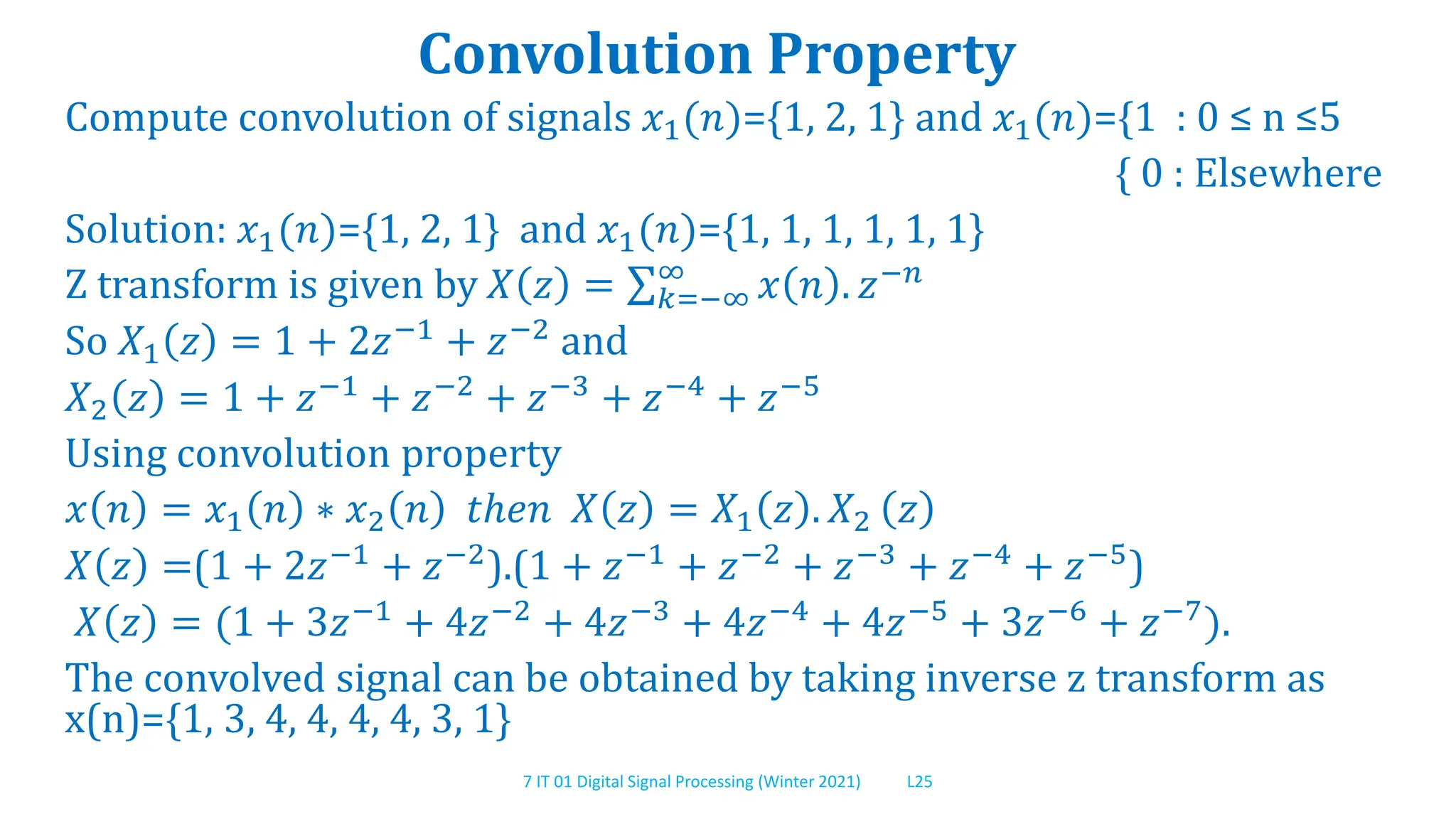
Compute convolution of signals 𝑥1(𝑛)={1, 2, 1} and 𝑥1(𝑛)={1 : 0 ≤ n ≤5
{ 0 : Elsewhere
Solution: 𝑥1(𝑛)={1, 2, 1} and 𝑥1(𝑛)={1, 1, 1, 1, 1, 1}
Z transform is given by 𝑋 𝑧 = 𝑘=−∞
∞
𝑥 𝑛 . 𝑧−𝑛
So 𝑋1 𝑧 = 1 + 2𝑧−1
+ 𝑧−2
and
𝑋2 𝑧 = 1 + 𝑧−1 + 𝑧−2 + 𝑧−3 + 𝑧−4 + 𝑧−5
Using convolution property
𝑥 𝑛 = 𝑥1 𝑛 ∗ 𝑥2 𝑛 𝑡ℎ𝑒𝑛 𝑋 𝑧 = 𝑋1 𝑧 . 𝑋2 𝑧
𝑋 𝑧 =(1 + 2𝑧−1 + 𝑧−2).(1 + 𝑧−1 + 𝑧−2 + 𝑧−3 + 𝑧−4 + 𝑧−5)
𝑋 𝑧 = (1 + 3𝑧−1
+ 4𝑧−2
+ 4𝑧−3
+ 4𝑧−4
+ 4𝑧−5
+ 3𝑧−6
+ 𝑧−7
).
The convolved signal can be obtained by taking inverse z transform as
x(n)={1, 3, 4, 4, 4, 4, 3, 1}
7 IT 01 Digital Signal Processing (Winter 2021) L25
Convolution Property
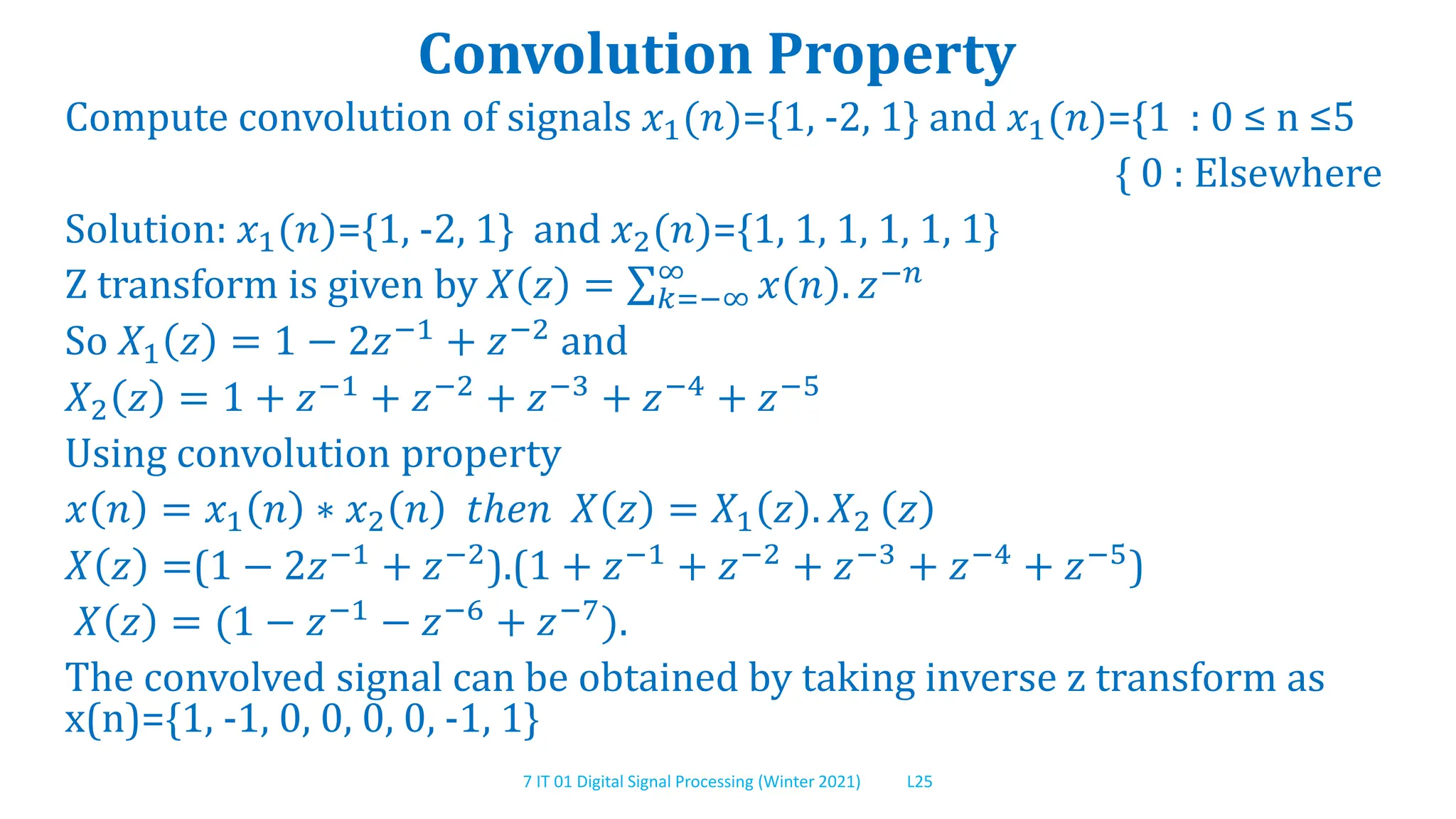
Compute convolution of signals 𝑥1(𝑛)={1, -2, 1} and 𝑥1(𝑛)={1 : 0 ≤ n ≤5
{ 0 : Elsewhere
Solution: 𝑥1(𝑛)={1, -2, 1} and 𝑥2(𝑛)={1, 1, 1, 1, 1, 1}
Z transform is given by 𝑋 𝑧 = 𝑘=−∞
∞
𝑥 𝑛 . 𝑧−𝑛
So 𝑋1 𝑧 = 1 − 2𝑧−1
+ 𝑧−2
and
𝑋2 𝑧 = 1 + 𝑧−1 + 𝑧−2 + 𝑧−3 + 𝑧−4 + 𝑧−5
Using convolution property
𝑥 𝑛 = 𝑥1 𝑛 ∗ 𝑥2 𝑛 𝑡ℎ𝑒𝑛 𝑋 𝑧 = 𝑋1 𝑧 . 𝑋2 𝑧
𝑋 𝑧 =(1 − 2𝑧−1 + 𝑧−2).(1 + 𝑧−1 + 𝑧−2 + 𝑧−3 + 𝑧−4 + 𝑧−5)
𝑋 𝑧 = (1 − 𝑧−1
− 𝑧−6
+ 𝑧−7
).
The convolved signal can be obtained by taking inverse z transform as
x(n)={1, -1, 0, 0, 0, 0, -1, 1}
7 IT 01 Digital Signal Processing (Winter 2021) L25
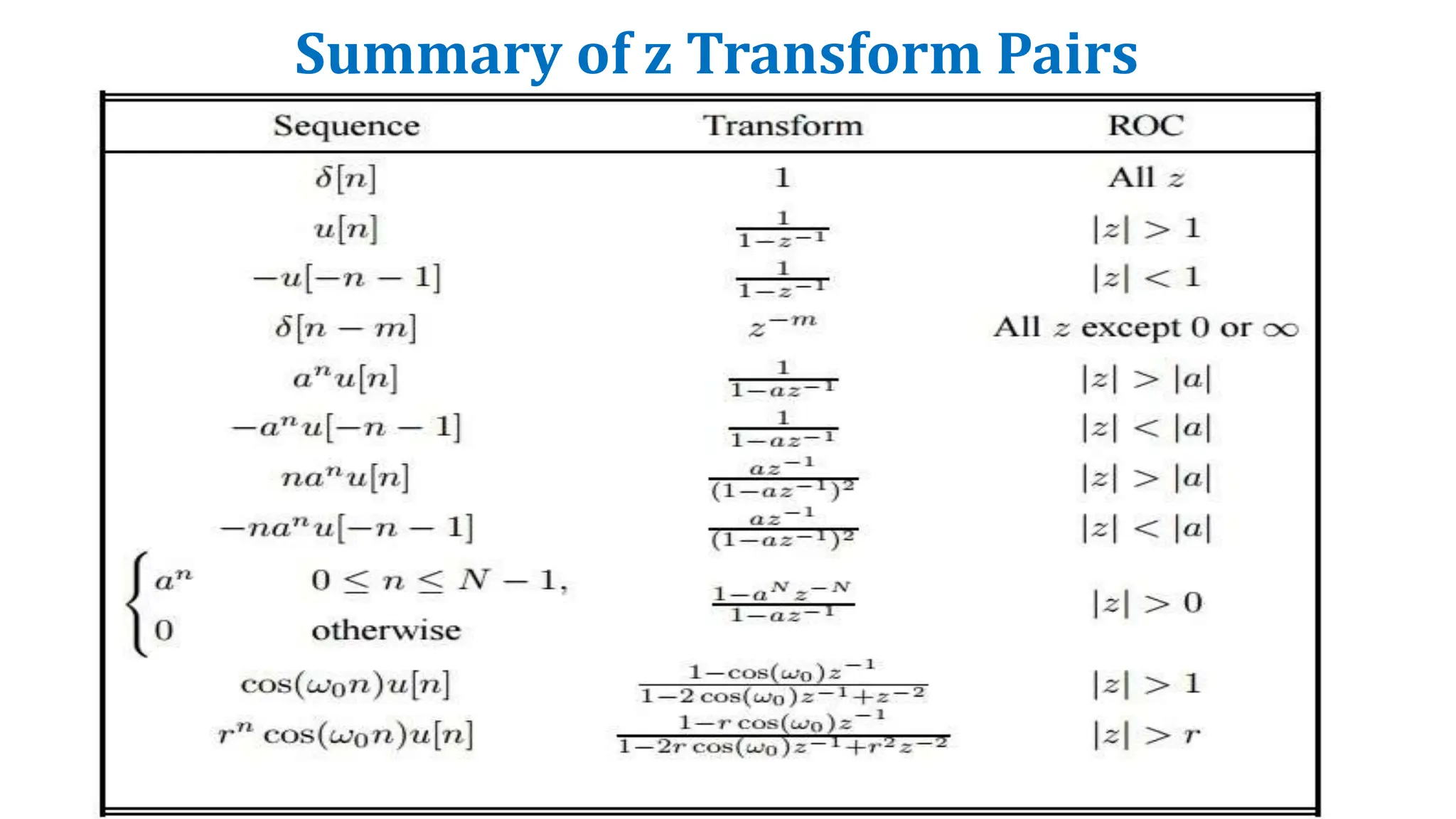
Summary of z Transform Pairs
7 IT 01 Digital Signal Processing (Winter 2021) L25
Inverse z Transform
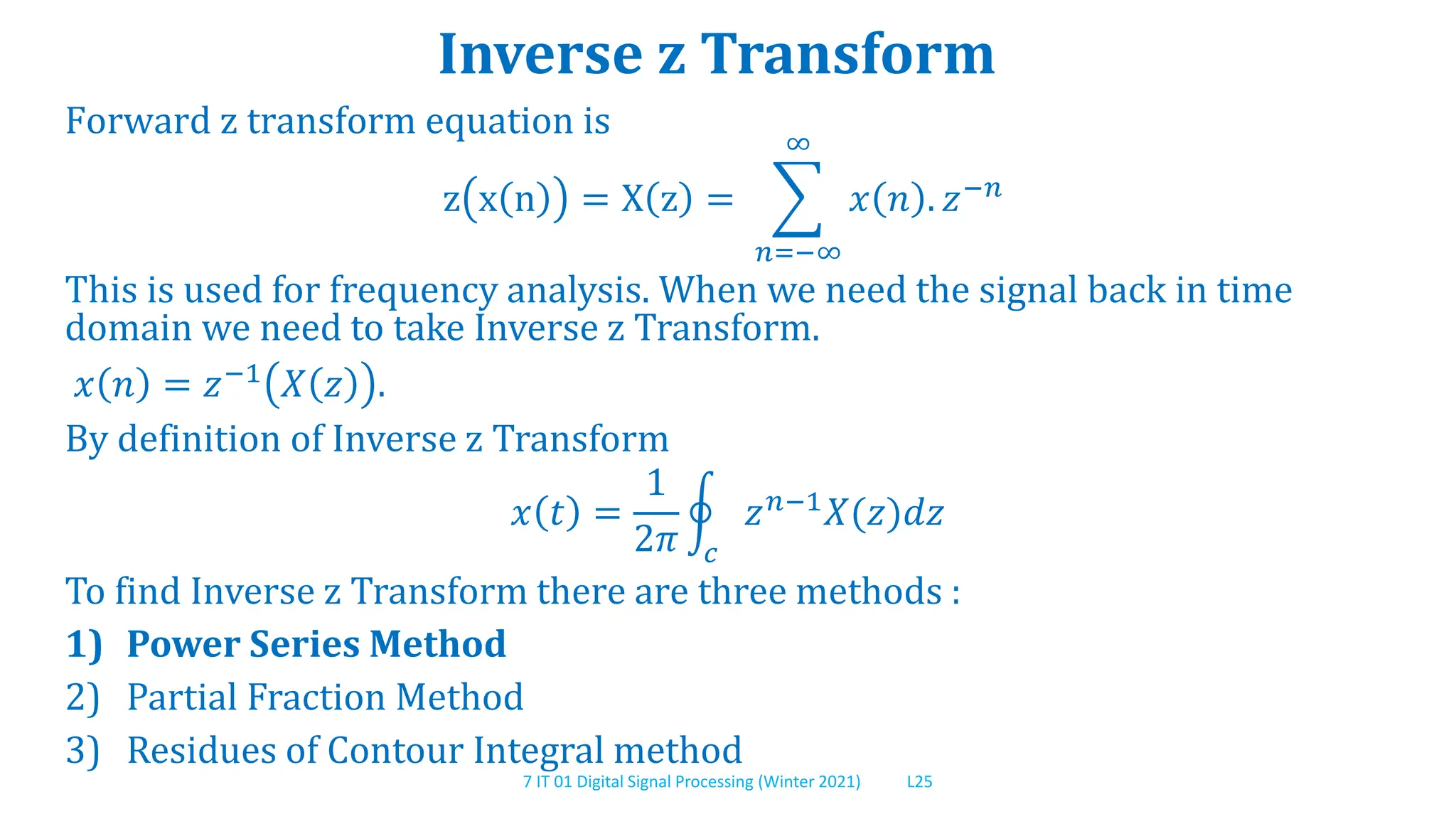
Forward z transform equation is
z x n = X z =
𝑛=−∞
∞
𝑥 𝑛 . 𝑧−𝑛
This is used for frequency analysis. When we need the signal back in time
domain we need to take Inverse z Transform.
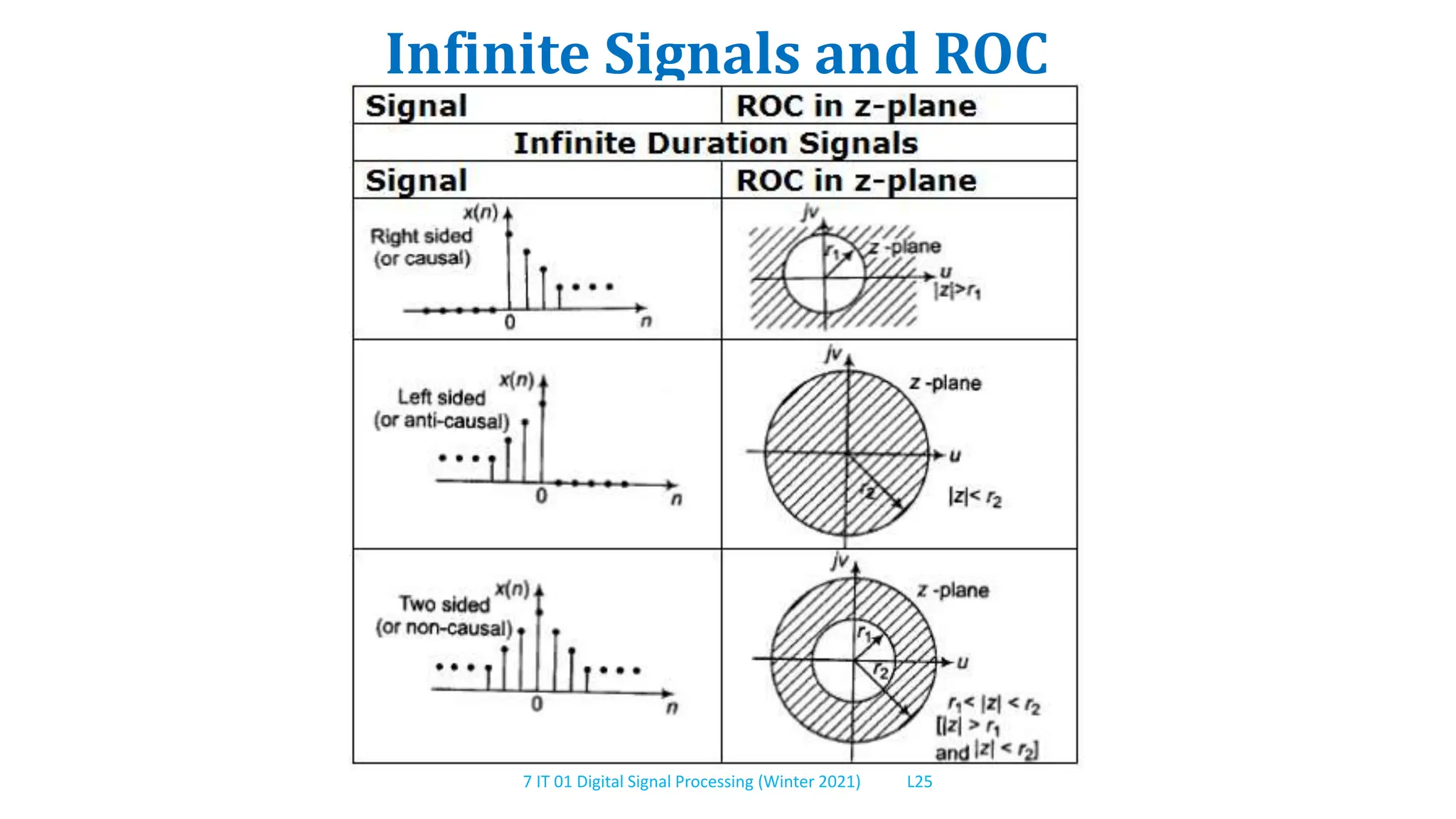
𝑥 𝑛 = 𝑧−1
𝑋 𝑧 .
By definition of Inverse z Transform
𝑥 𝑡 =
1
2𝜋 𝑐
𝑧𝑛−1𝑋(𝑧)𝑑𝑧
To find Inverse z Transform there are three methods :
1) Power Series Method
2) Partial Fraction Method
3) Residues of Contour Integral method
7 IT 01 Digital Signal Processing (Winter 2021) L25
Inverse z Transform
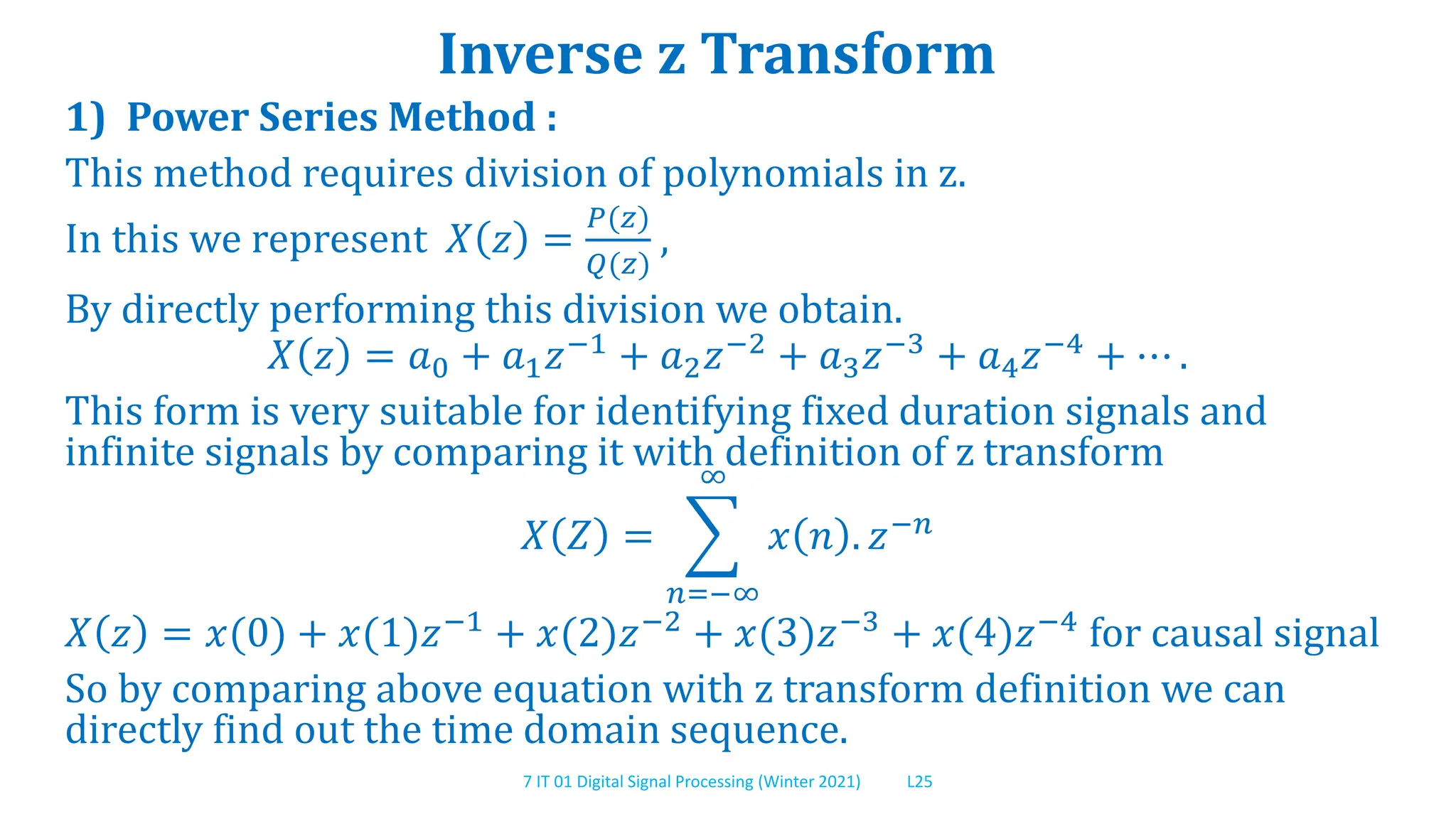
1) Power Series Method :
This method requires division of polynomials in z.
In this we represent 𝑋 𝑧 =
𝑃(𝑧)
𝑄(𝑧)
,
By directly performing this division we obtain.
𝑋 𝑧 = 𝑎0 + 𝑎1𝑧−1
+ 𝑎2𝑧−2
+ 𝑎3𝑧−3
+ 𝑎4𝑧−4
+ ⋯ .
This form is very suitable for identifying fixed duration signals and
infinite signals by comparing it with definition of z transform
𝑋 𝑍 =
𝑛=−∞
∞
𝑥 𝑛 . 𝑧−𝑛
𝑋 𝑧 = 𝑥(0) + 𝑥(1)𝑧−1 + 𝑥(2)𝑧−2 + 𝑥(3)𝑧−3 + 𝑥(4)𝑧−4 for causal signal
So by comparing above equation with z transform definition we can
directly find out the time domain sequence.
7 IT 01 Digital Signal Processing (Winter 2021) L25
Inverse z Transform
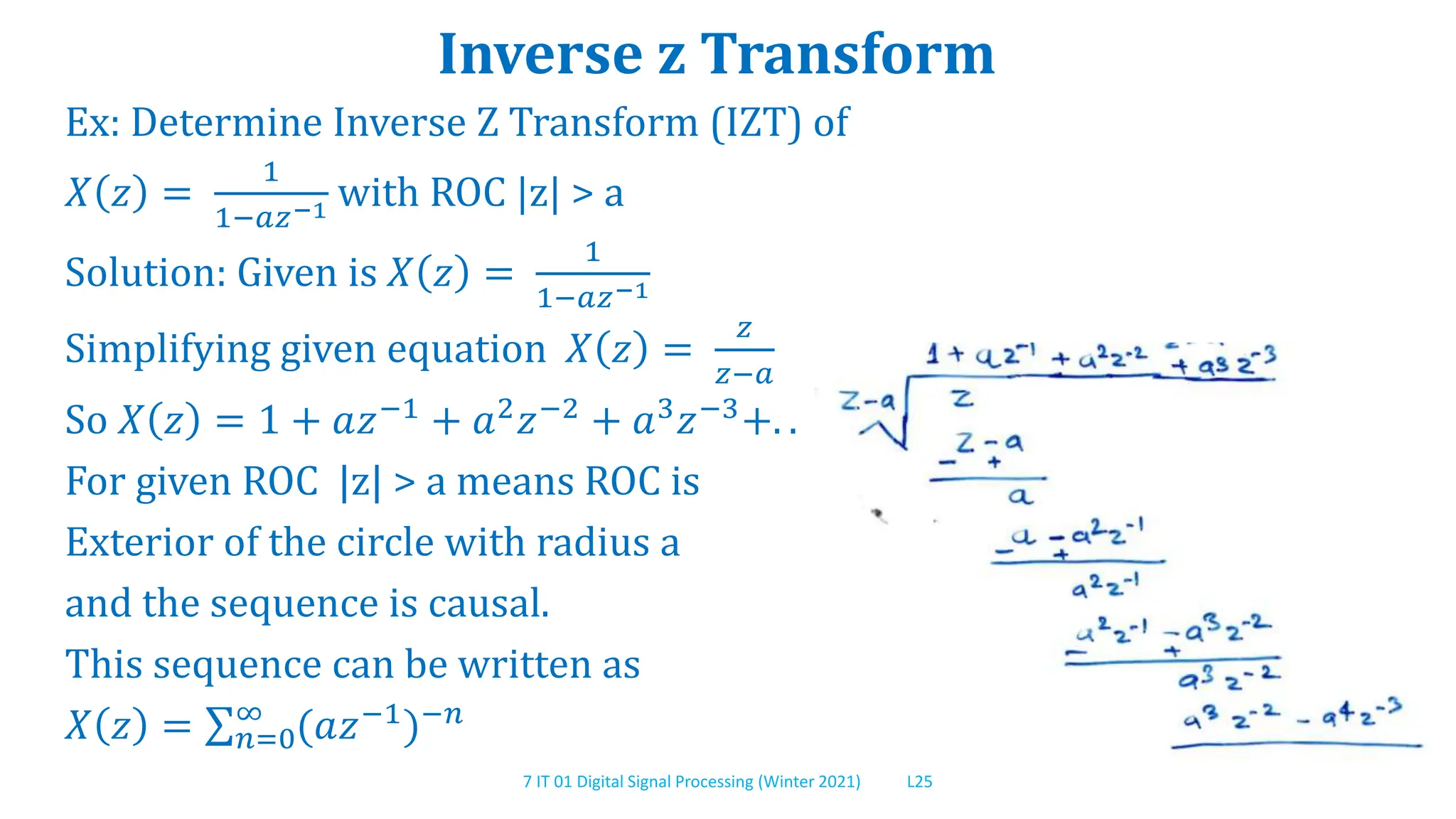
Ex: Determine Inverse Z Transform (IZT) of
𝑋 𝑧 =
1
1−𝑎𝑧−1 with ROC |z| > a
Solution: Given is 𝑋 𝑧 =
1
1−𝑎𝑧−1
Simplifying given equation 𝑋 𝑧 =
𝑧
𝑧−𝑎
So 𝑋 𝑧 = 1 + 𝑎𝑧−1 + 𝑎2𝑧−2 + 𝑎3𝑧−3+. .
For given ROC |z| > a means ROC is
Exterior of the circle with radius a
and the sequence is causal.
This sequence can be written as
𝑋 𝑧 = 𝑛=0
∞
(𝑎𝑧−1)−𝑛
7 IT 01 Digital Signal Processing (Winter 2021) L25
Inverse z Transform
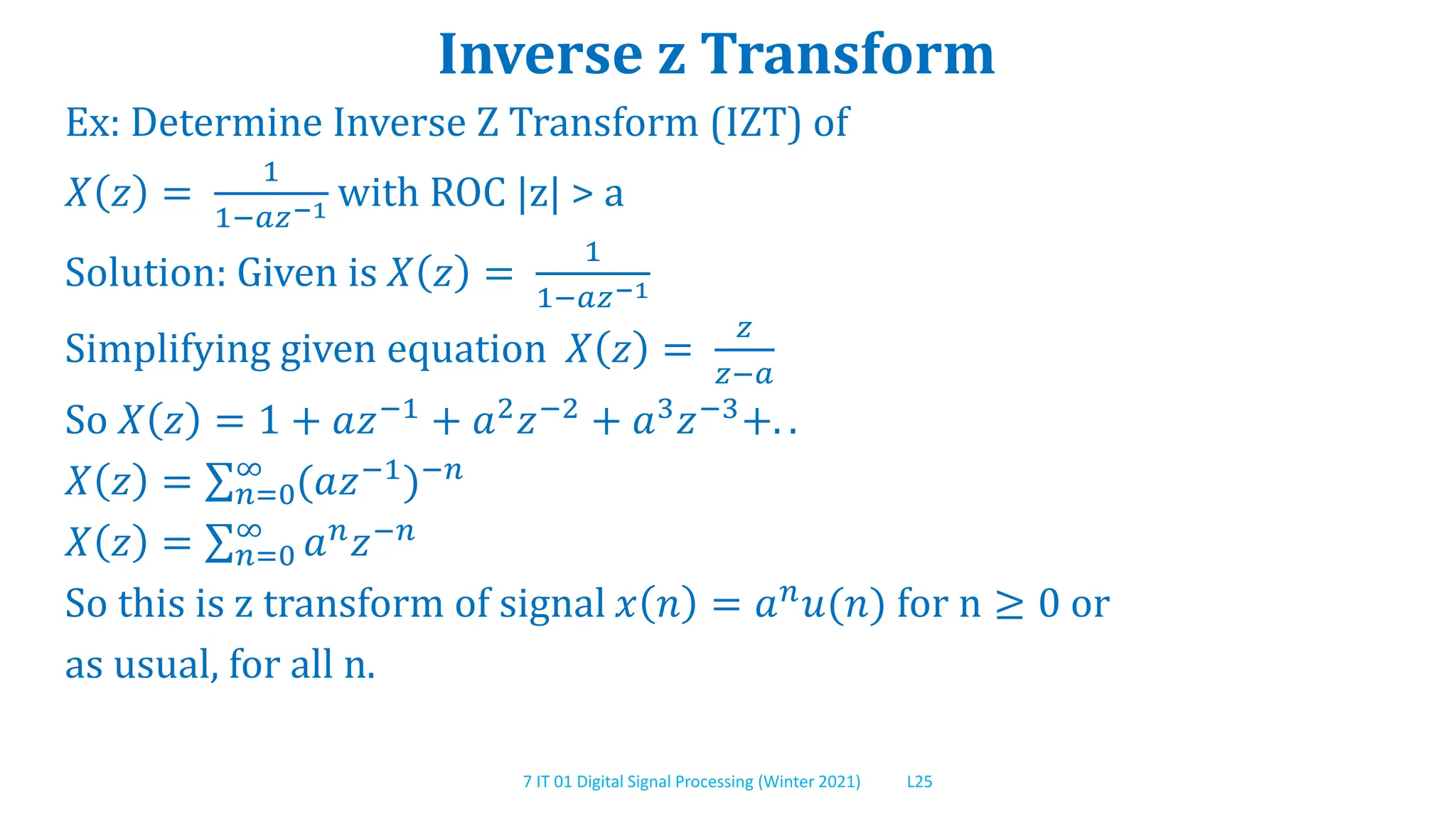
Ex: Determine Inverse Z Transform (IZT) of
𝑋 𝑧 =
1
1−𝑎𝑧−1 with ROC |z| > a
Solution: Given is 𝑋 𝑧 =
1
1−𝑎𝑧−1
Simplifying given equation 𝑋 𝑧 =
𝑧
𝑧−𝑎
So 𝑋 𝑧 = 1 + 𝑎𝑧−1 + 𝑎2𝑧−2 + 𝑎3𝑧−3+. .
𝑋 𝑧 = 𝑛=0
∞
(𝑎𝑧−1
)−𝑛
𝑋 𝑧 = 𝑛=0
∞
𝑎𝑛𝑧−𝑛
So this is z transform of signal 𝑥 𝑛 = 𝑎𝑛𝑢(𝑛) for n ≥ 0 or
as usual, for all n.
7 IT 01 Digital Signal Processing (Winter 2021) L25
Inverse z Transform
Ex: Determine Inverse Z Transform (IZT) of
𝑋 𝑧 =
1
1−𝑎𝑧−1 with ROC |z| < a
Solution: Given is 𝑋 𝑧 =
1
1−𝑎𝑧−1
Simplifying given equation 𝑋 𝑧 =
𝑧
𝑧−𝑎
If ROC is given as the |z| < a
Then write 𝑋 𝑧 =
𝑧
−𝑎+𝑧
and perform
Division
So 𝑋 𝑧 = −𝑎−1
𝑧1
− 𝑎−2
𝑧2
+ 𝑎−3
𝑧3
+. .
For given ROC |z| < a means ROC is
interior of the circle with radius a
and the sequence is anticausal.
This sequence can be written as
𝑋 𝑧 = 𝑛=0
∞
(𝑎−1
𝑧)−𝑛
7 IT 01 Digital Signal Processing (Winter 2021) L25
Inverse z Transform
Ex: Determine Inverse Z Transform (IZT) of
𝑋 𝑧 =
1
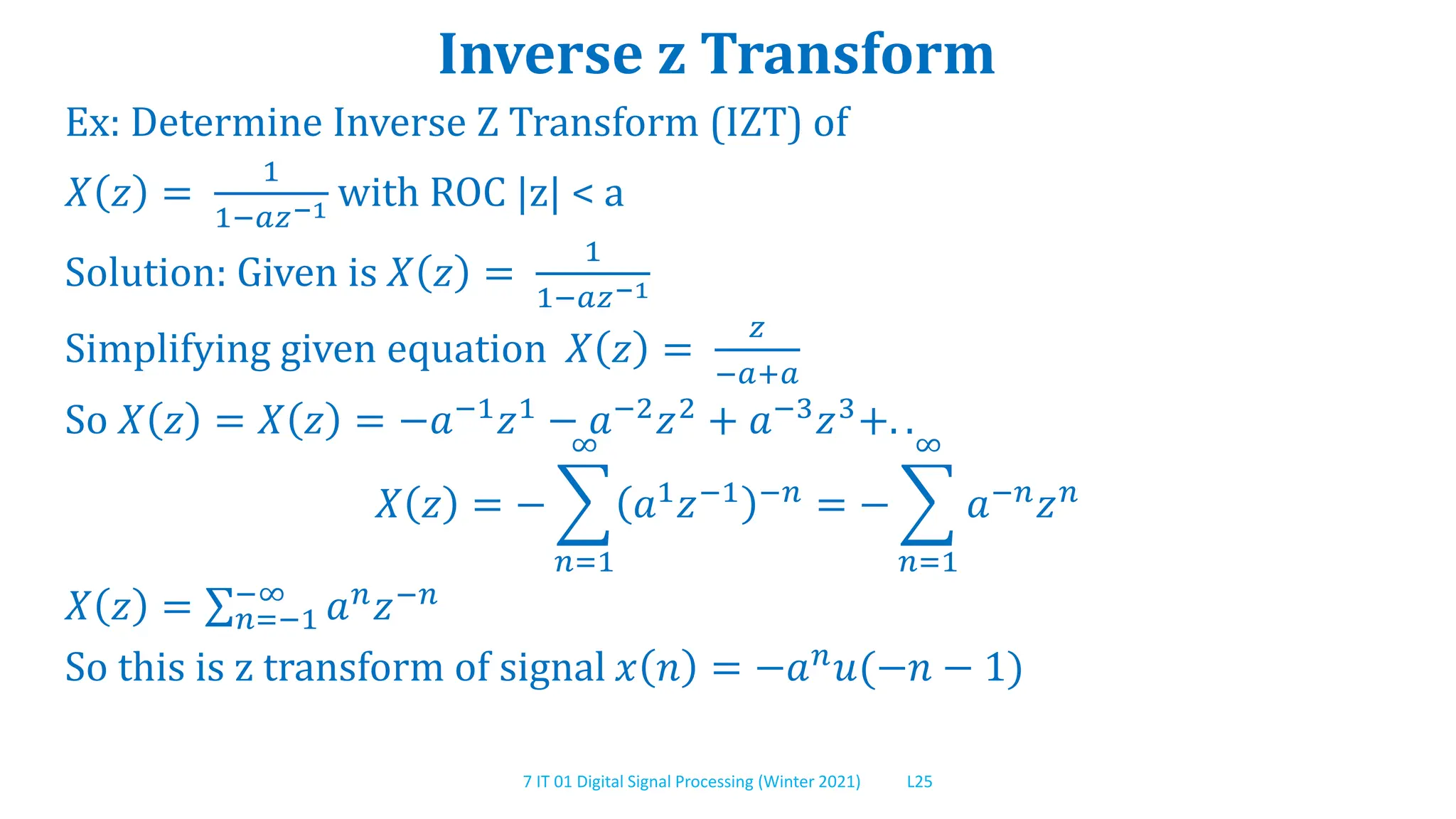
1−𝑎𝑧−1 with ROC |z| < a
Solution: Given is 𝑋 𝑧 =
1
1−𝑎𝑧−1
Simplifying given equation 𝑋 𝑧 =
𝑧
−𝑎+𝑎
So 𝑋 𝑧 = 𝑋 𝑧 = −𝑎−1𝑧1 − 𝑎−2𝑧2 + 𝑎−3𝑧3+. .
𝑋 𝑧 = −
𝑛=1
∞
𝑎1𝑧−1 −𝑛 = −
𝑛=1
∞
𝑎−𝑛𝑧𝑛
𝑋 𝑧 = 𝑛=−1
−∞
𝑎𝑛𝑧−𝑛
So this is z transform of signal 𝑥 𝑛 = −𝑎𝑛
𝑢(−𝑛 − 1)
7 IT 01 Digital Signal Processing (Winter 2021) L25
Inverse z Transform
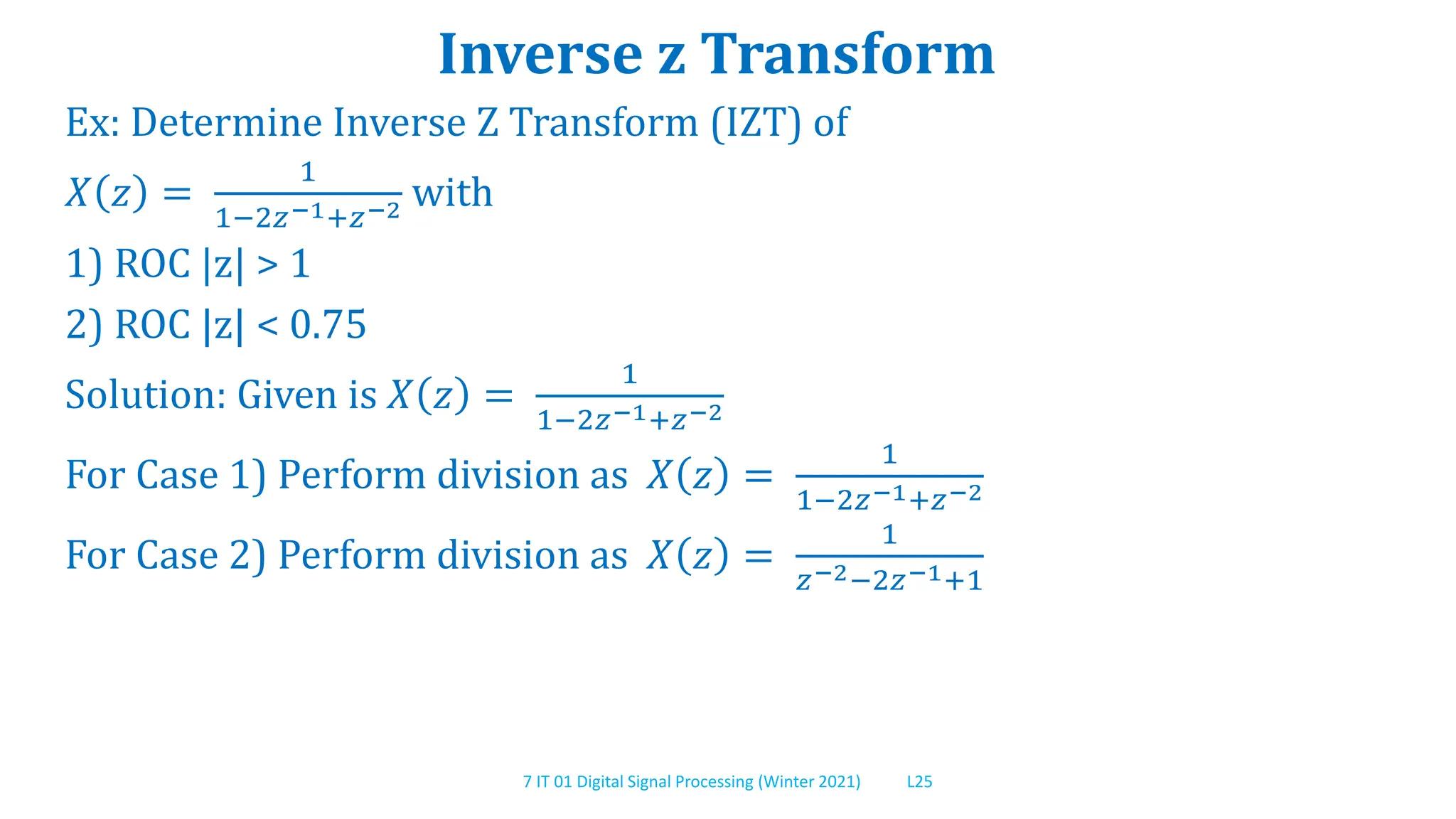
Ex: Determine Inverse Z Transform (IZT) of
𝑋 𝑧 =
1
1−2𝑧−1+𝑧−2 with
1) ROC |z| > 1
2) ROC |z| < 0.75
Solution: Given is 𝑋 𝑧 =
1
1−2𝑧−1+𝑧−2
For Case 1) Perform division as 𝑋 𝑧 =
1
1−2𝑧−1+𝑧−2
For Case 2) Perform division as 𝑋 𝑧 =
1
𝑧−2−2𝑧−1+1
7 IT 01 Digital Signal Processing (Winter 2021) L25
Inverse z Transform
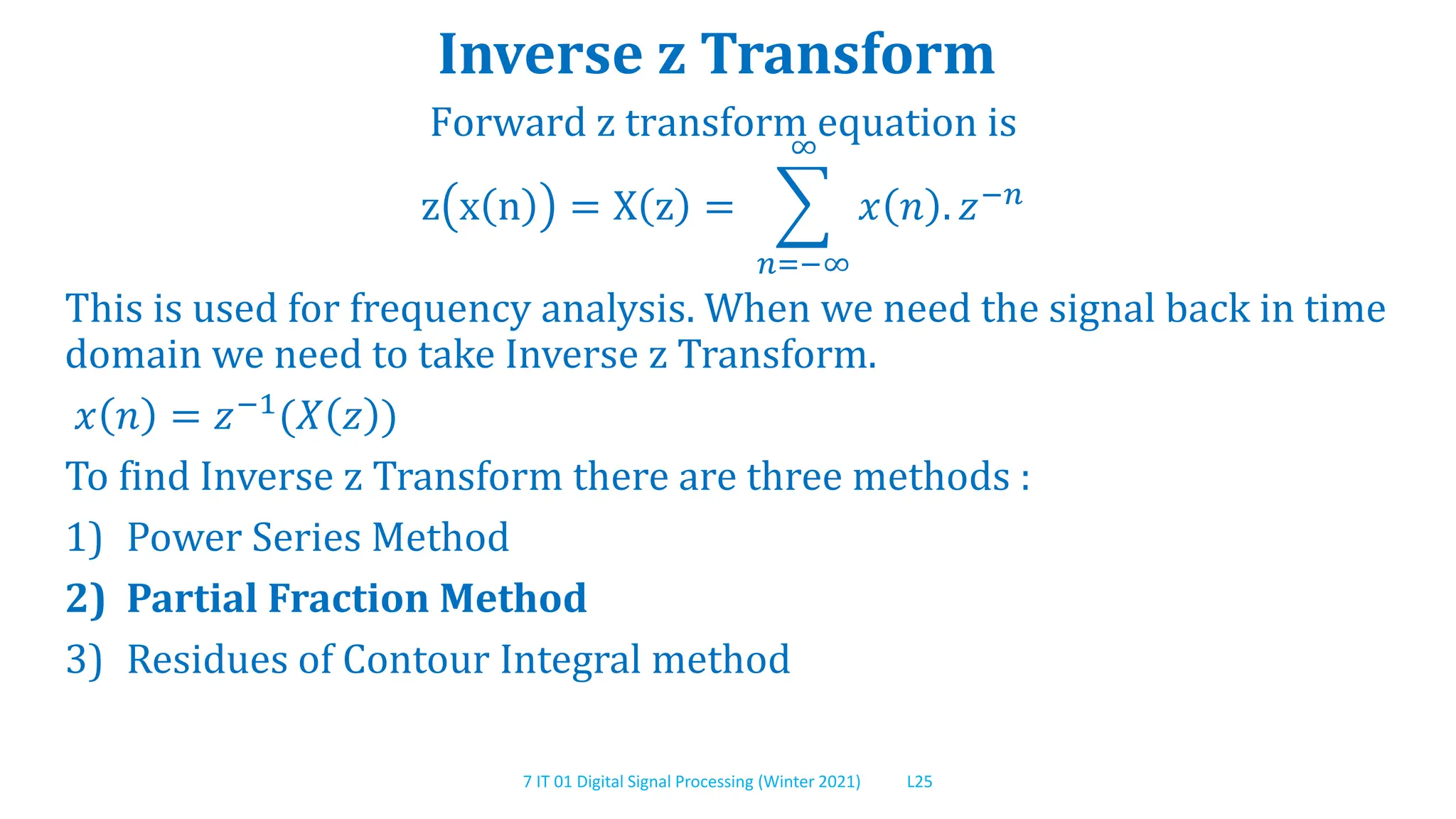
Forward z transform equation is
z x n = X z =
𝑛=−∞
∞
𝑥 𝑛 . 𝑧−𝑛
This is used for frequency analysis. When we need the signal back in time
domain we need to take Inverse z Transform.
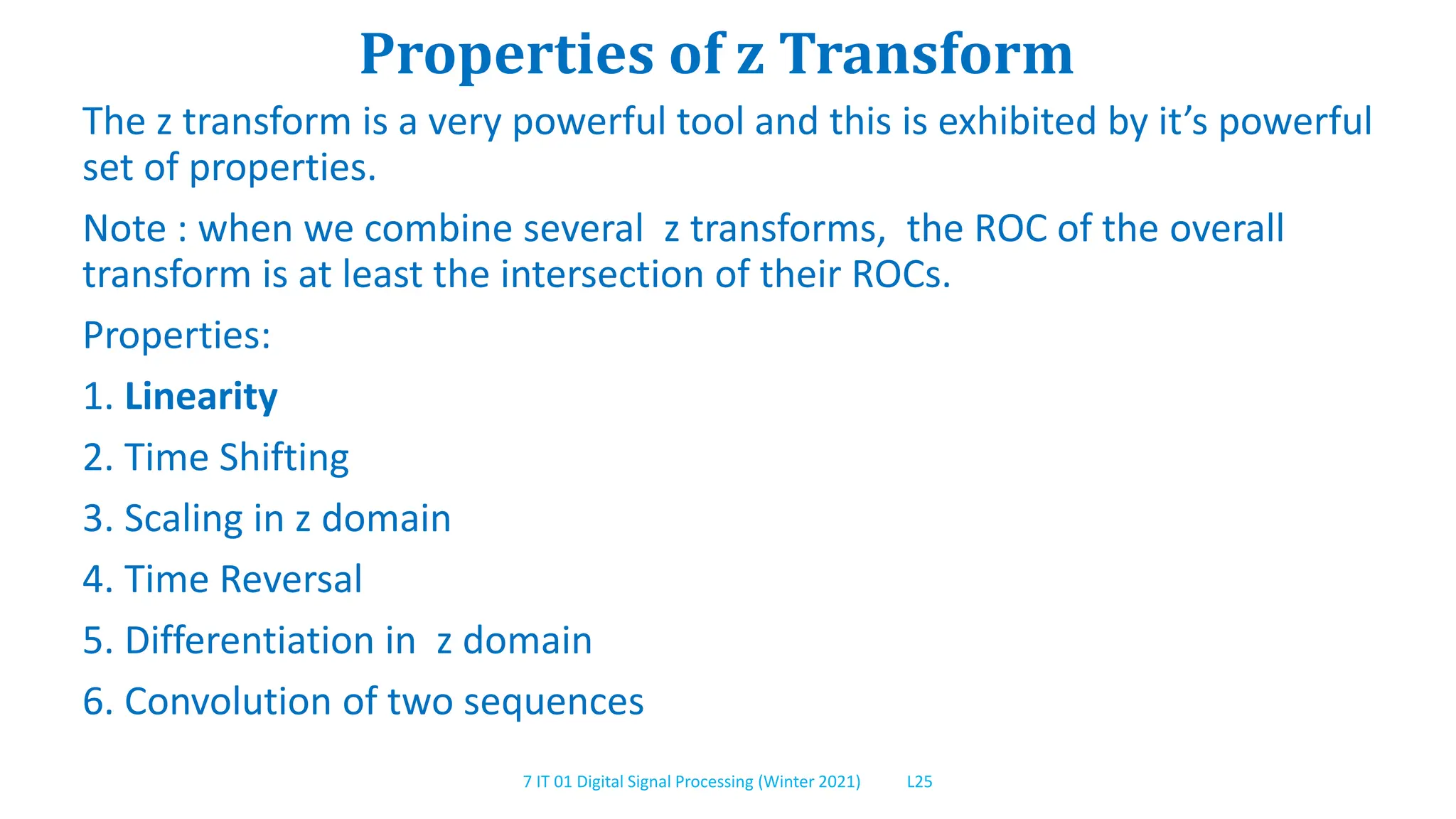
𝑥 𝑛 = 𝑧−1(𝑋 𝑧 )
To find Inverse z Transform there are three methods :
1) Power Series Method
2) Partial Fraction Method
3) Residues of Contour Integral method
7 IT 01 Digital Signal Processing (Winter 2021) L25
Inverse z Transform
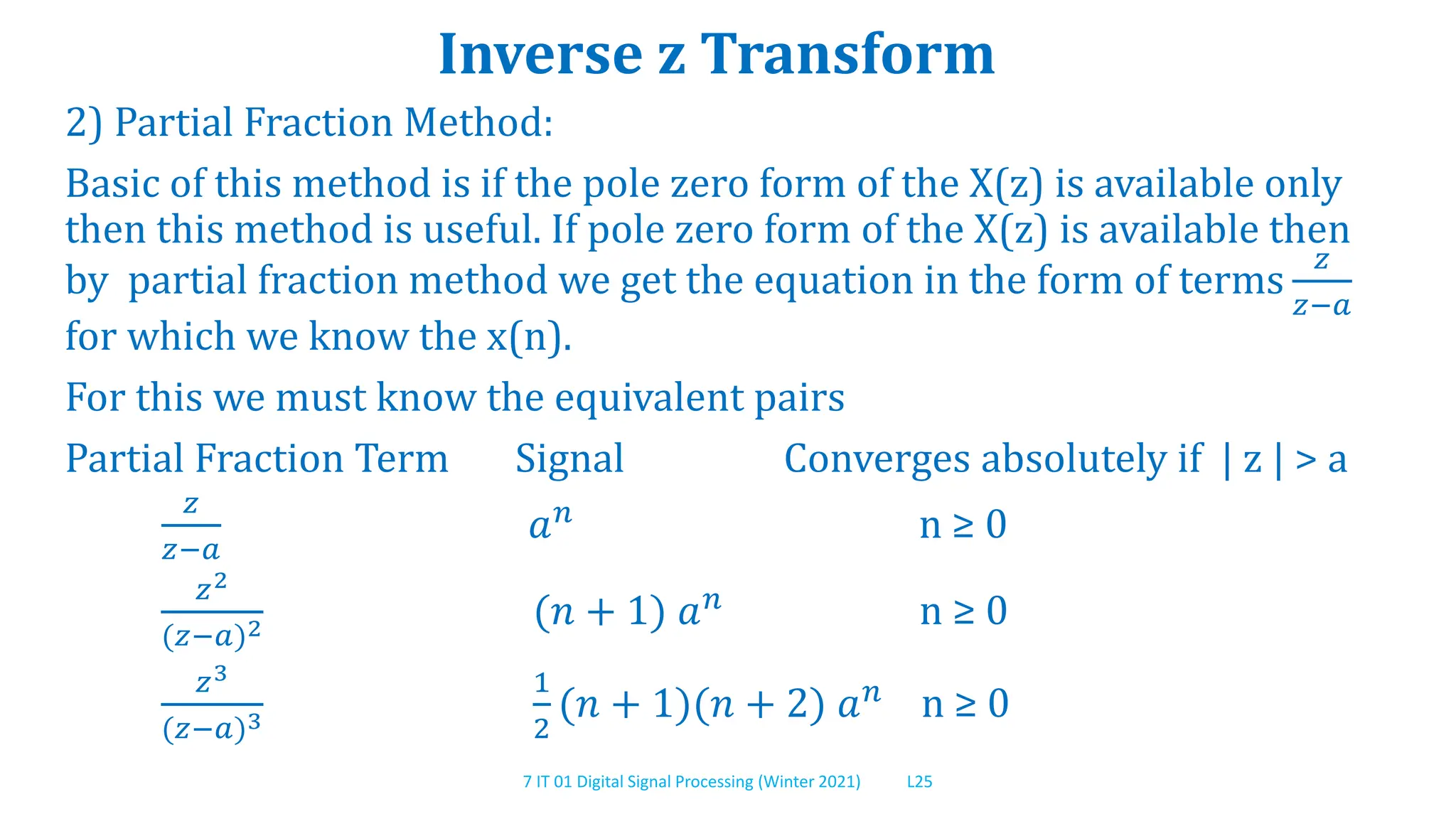
2) Partial Fraction Method:
Basic of this method is if the pole zero form of the X(z) is available only
then this method is useful. If pole zero form of the X(z) is available then
by partial fraction method we get the equation in the form of terms
𝑧
𝑧−𝑎
for which we know the x(n).
For this we must know the equivalent pairs
Partial Fraction Term Signal Converges absolutely if | z | > a
𝑧
𝑧−𝑎
𝑎𝑛
n ≥ 0
𝑧2
(𝑧−𝑎)2 (𝑛 + 1) 𝑎𝑛 n ≥ 0
𝑧3
(𝑧−𝑎)3
1
2
(𝑛 + 1)(𝑛 + 2) 𝑎𝑛
n ≥ 0
7 IT 01 Digital Signal Processing (Winter 2021) L25
Inverse z Transform
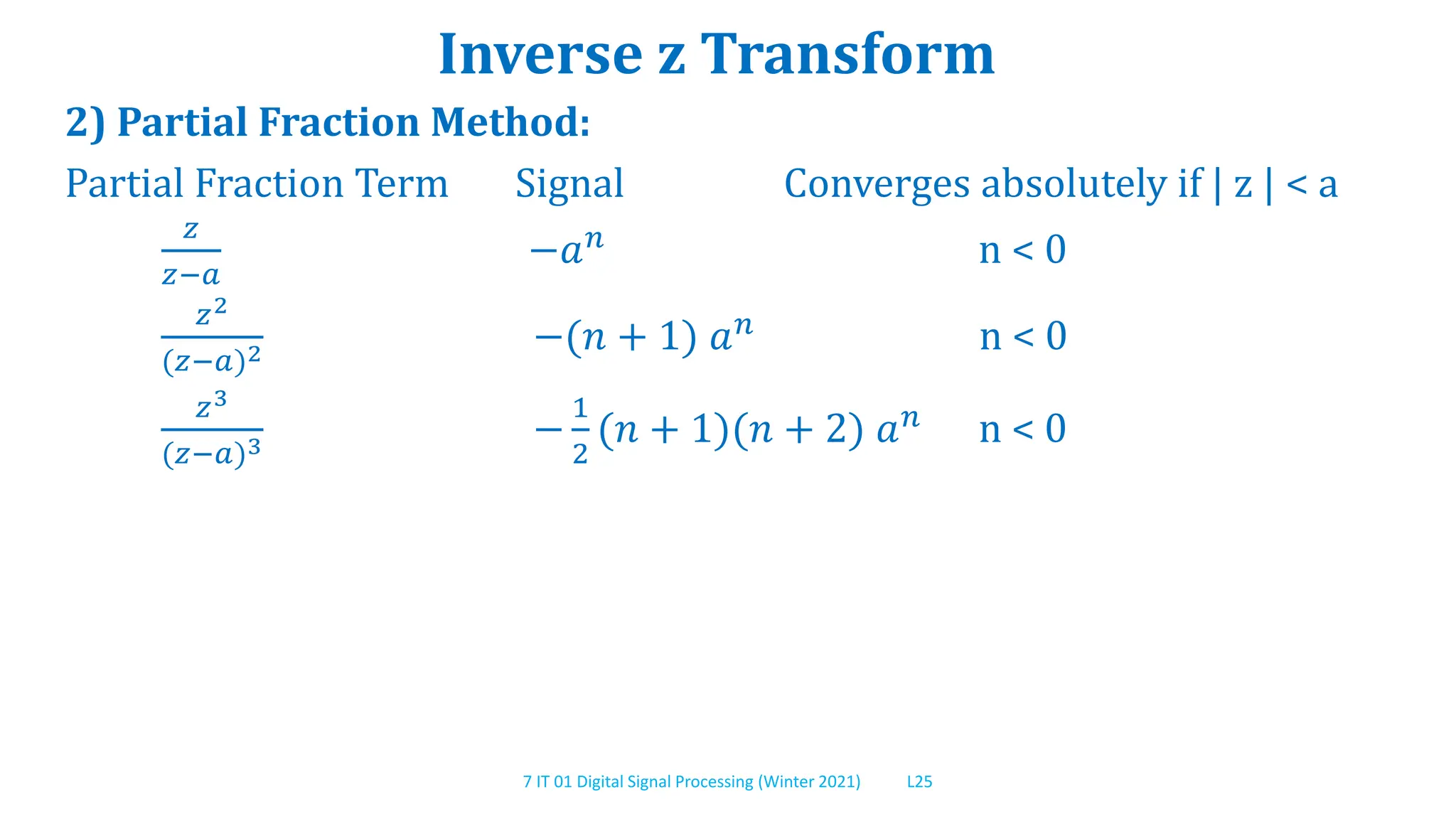
2) Partial Fraction Method:
Partial Fraction Term Signal Converges absolutely if | z | < a
𝑧
𝑧−𝑎
−𝑎𝑛 n < 0
𝑧2
(𝑧−𝑎)2 −(𝑛 + 1) 𝑎𝑛
n < 0
𝑧3
(𝑧−𝑎)3 −
1
2
(𝑛 + 1)(𝑛 + 2) 𝑎𝑛 n < 0
7 IT 01 Digital Signal Processing (Winter 2021) L25
Inverse z Transform
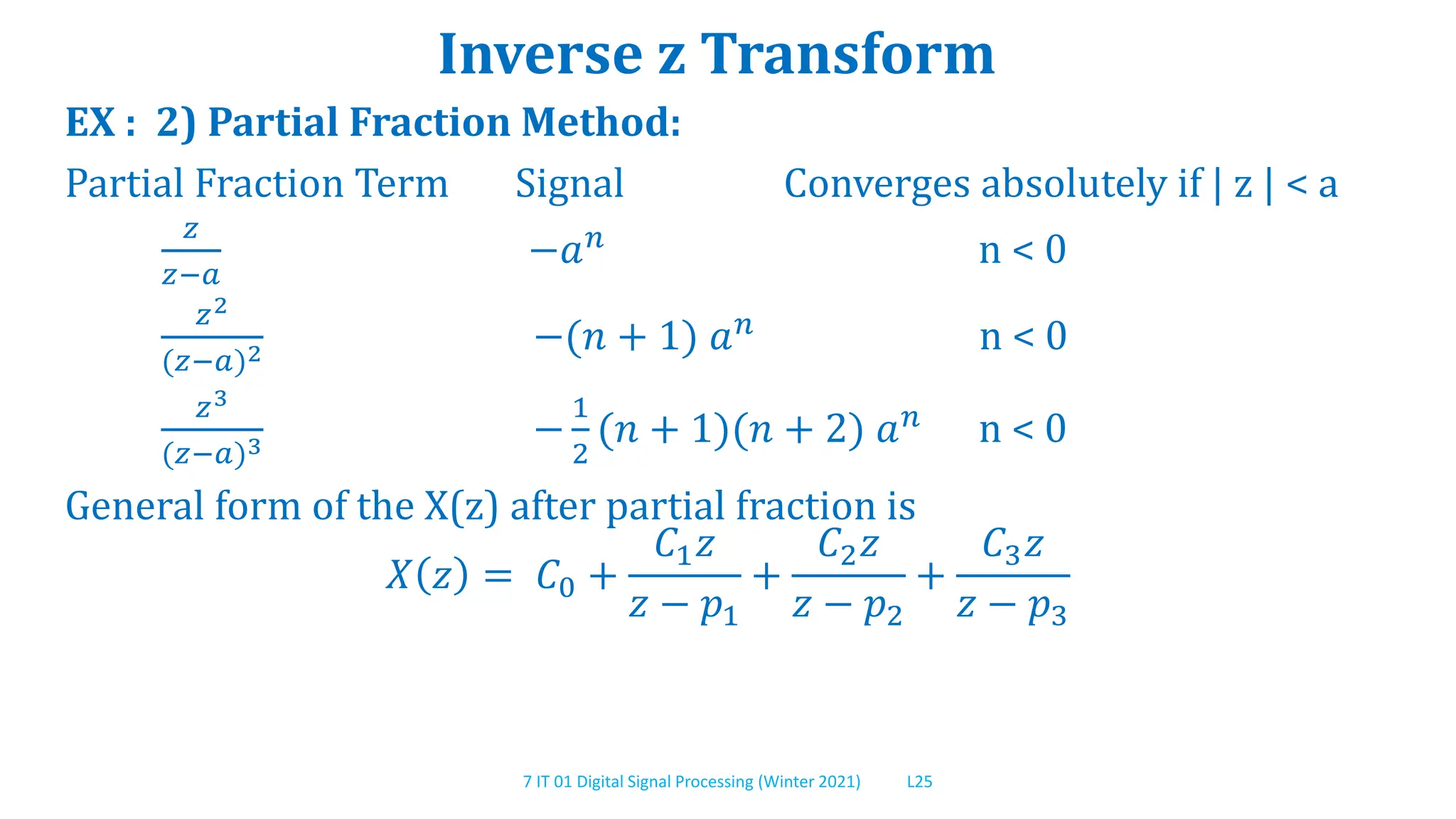
EX : 2) Partial Fraction Method:
Partial Fraction Term Signal Converges absolutely if | z | < a
𝑧
𝑧−𝑎
−𝑎𝑛 n < 0
𝑧2
(𝑧−𝑎)2 −(𝑛 + 1) 𝑎𝑛
n < 0
𝑧3
(𝑧−𝑎)3 −
1
2
(𝑛 + 1)(𝑛 + 2) 𝑎𝑛 n < 0
General form of the X(z) after partial fraction is
𝑋 𝑧 = 𝐶0 +
𝐶1𝑧
𝑧 − 𝑝1
+
𝐶2𝑧
𝑧 − 𝑝2
+
𝐶3𝑧
𝑧 − 𝑝3
7 IT 01 Digital Signal Processing (Winter 2021) L25
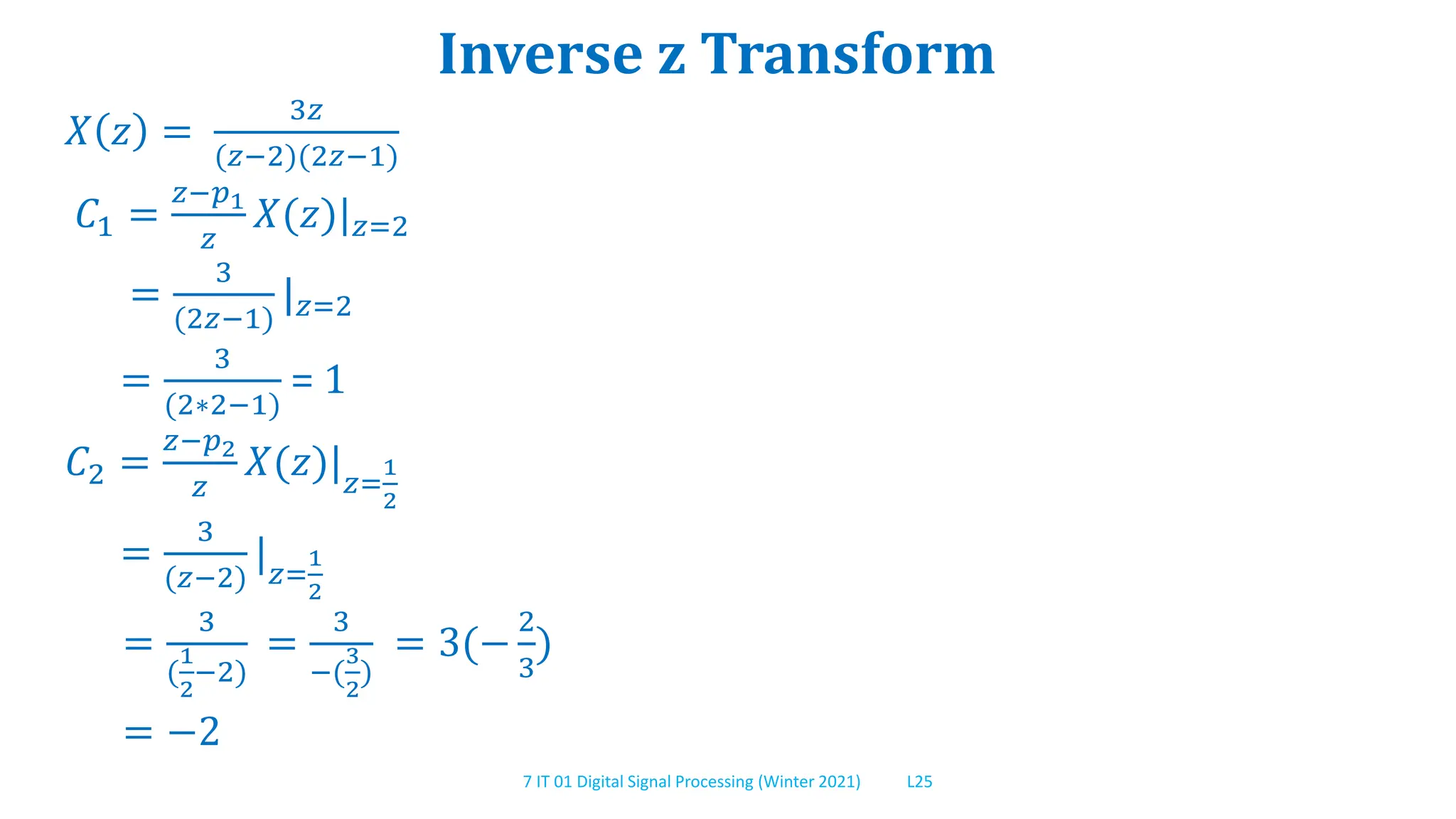
Inverse z Transform
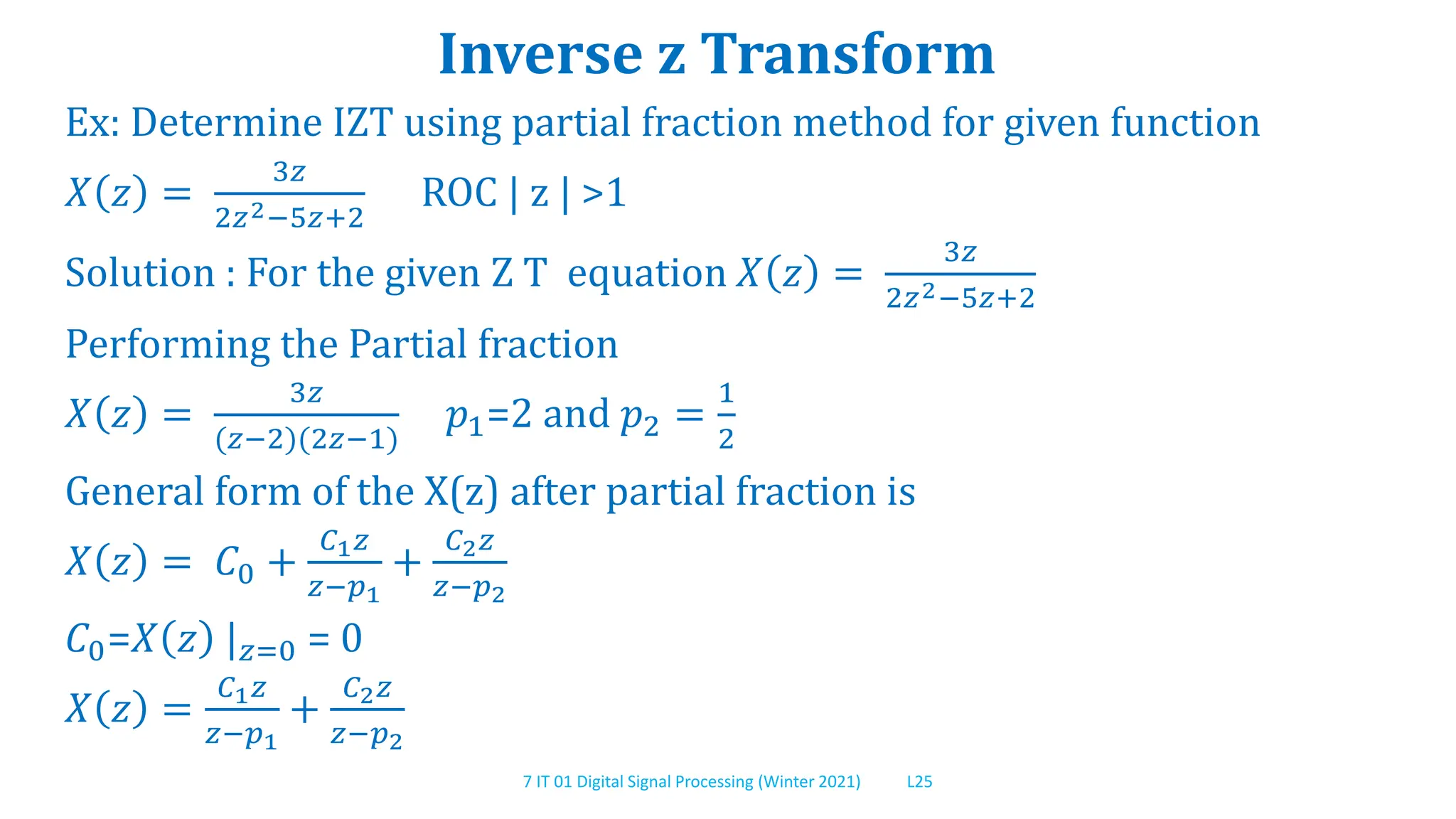
Ex: Determine IZT using partial fraction method for given function
𝑋 𝑧 =
3𝑧
2𝑧2−5𝑧+2
ROC | z | >1
Solution : For the given Z T equation 𝑋 𝑧 =
3𝑧
2𝑧2−5𝑧+2
Performing the Partial fraction
𝑋 𝑧 =
3𝑧
(𝑧−2)(2𝑧−1)
𝑝1=2 and 𝑝2 =
1
2
General form of the X(z) after partial fraction is
𝑋 𝑧 = 𝐶0 +
𝐶1𝑧
𝑧−𝑝1
+
𝐶2𝑧
𝑧−𝑝2
𝐶0=𝑋 𝑧 |𝑧=0 = 0
𝑋 𝑧 =
𝐶1𝑧
𝑧−𝑝1
+
𝐶2𝑧
𝑧−𝑝2
7 IT 01 Digital Signal Processing (Winter 2021) L25
Inverse z Transform
𝑋 𝑧 =
3𝑧
(𝑧−2)(2𝑧−1)
𝐶1 =
𝑧−𝑝1
𝑧
𝑋(𝑧)|𝑧=2
=
3
(2𝑧−1)
|𝑧=2
=
3
(2∗2−1)
= 1
𝐶2 =
𝑧−𝑝2
𝑧
𝑋(𝑧)|𝑧=
1
2
=
3
(𝑧−2)
|𝑧=
1
2
=
3
(
1
2
−2)
=
3
−(
3
2
)
= 3(−
2
3
)
= −2
7 IT 01 Digital Signal Processing (Winter 2021) L25
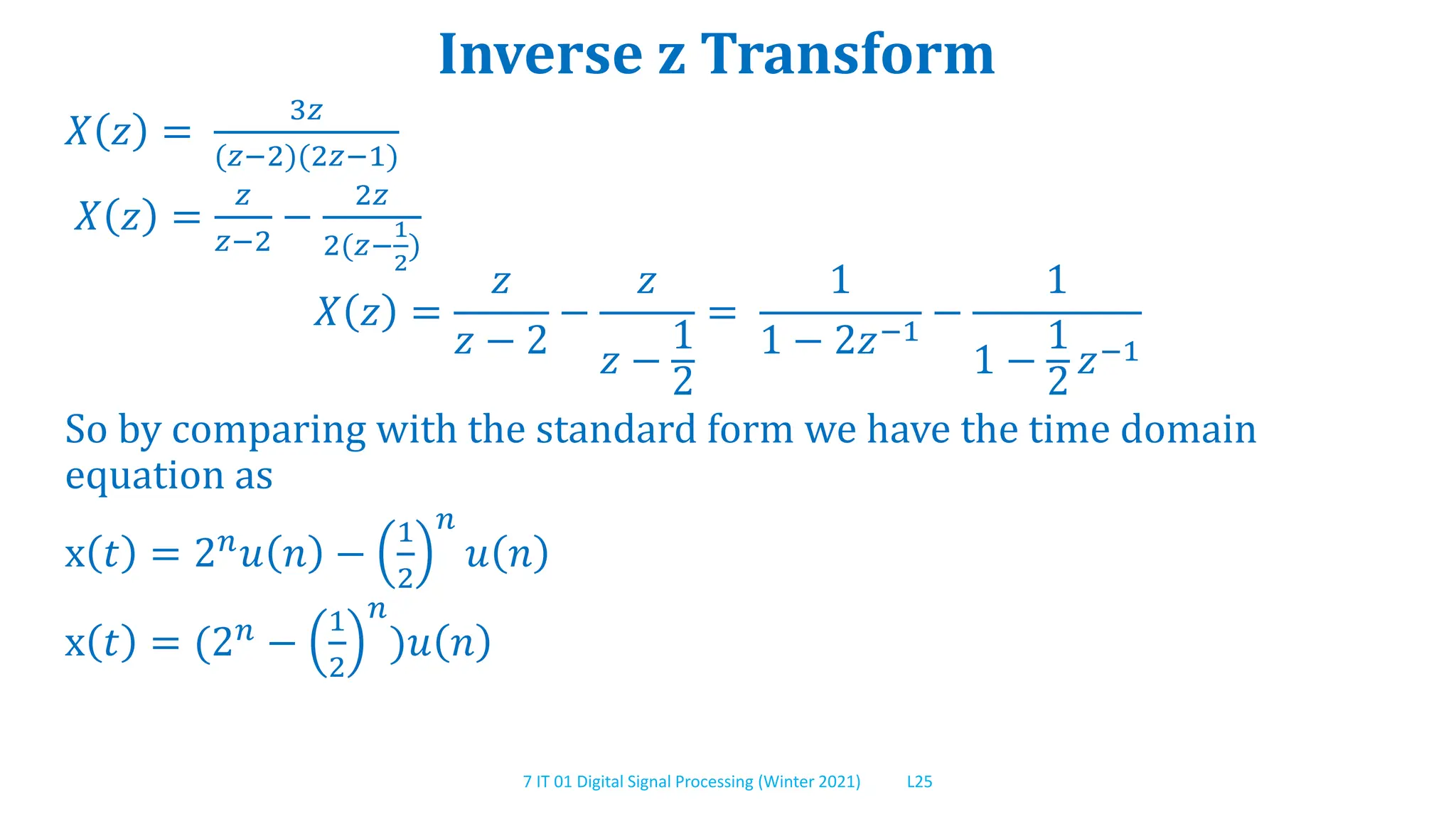
Inverse z Transform
𝑋 𝑧 =
3𝑧
(𝑧−2)(2𝑧−1)
𝑋 𝑧 =
𝑧
𝑧−2
−
2𝑧
2(𝑧−
1
2
)
𝑋 𝑧 =
𝑧
𝑧 − 2
−
𝑧
𝑧 −
1
2
=
1
1 − 2𝑧−1
−
1
1 −
1
2
𝑧−1
So by comparing with the standard form we have the time domain
equation as
x 𝑡 = 2𝑛𝑢 𝑛 −
1
2
𝑛
𝑢 𝑛
x 𝑡 = (2𝑛 −
1
2
𝑛
)𝑢 𝑛
7 IT 01 Digital Signal Processing (Winter 2021) L25
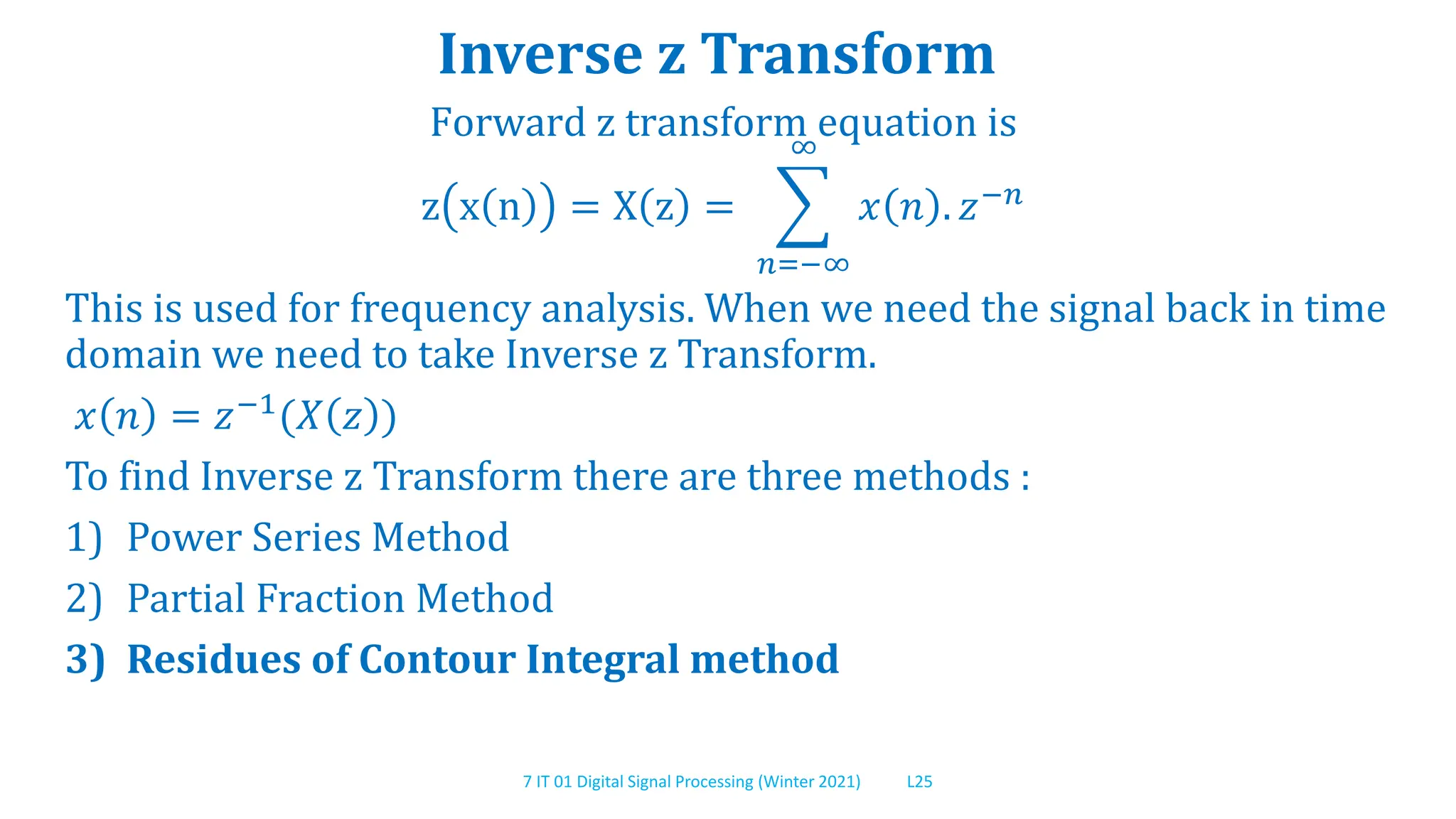
Inverse z Transform
Forward z transform equation is
z x n = X z =
𝑛=−∞
∞
𝑥 𝑛 . 𝑧−𝑛
This is used for frequency analysis. When we need the signal back in time
domain we need to take Inverse z Transform.
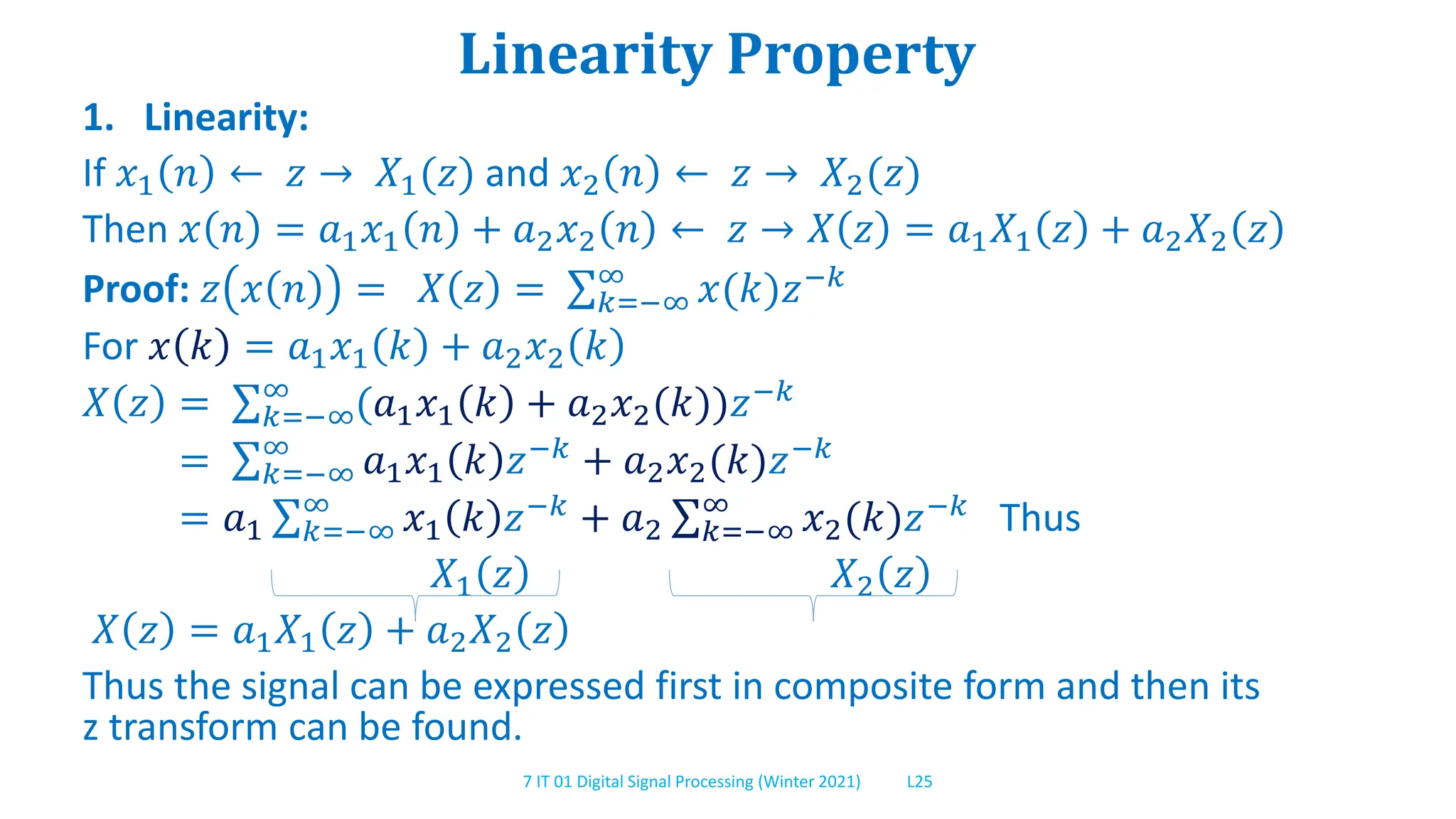
𝑥 𝑛 = 𝑧−1(𝑋 𝑧 )
To find Inverse z Transform there are three methods :
1) Power Series Method
2) Partial Fraction Method
3) Residues of Contour Integral method
7 IT 01 Digital Signal Processing (Winter 2021) L25
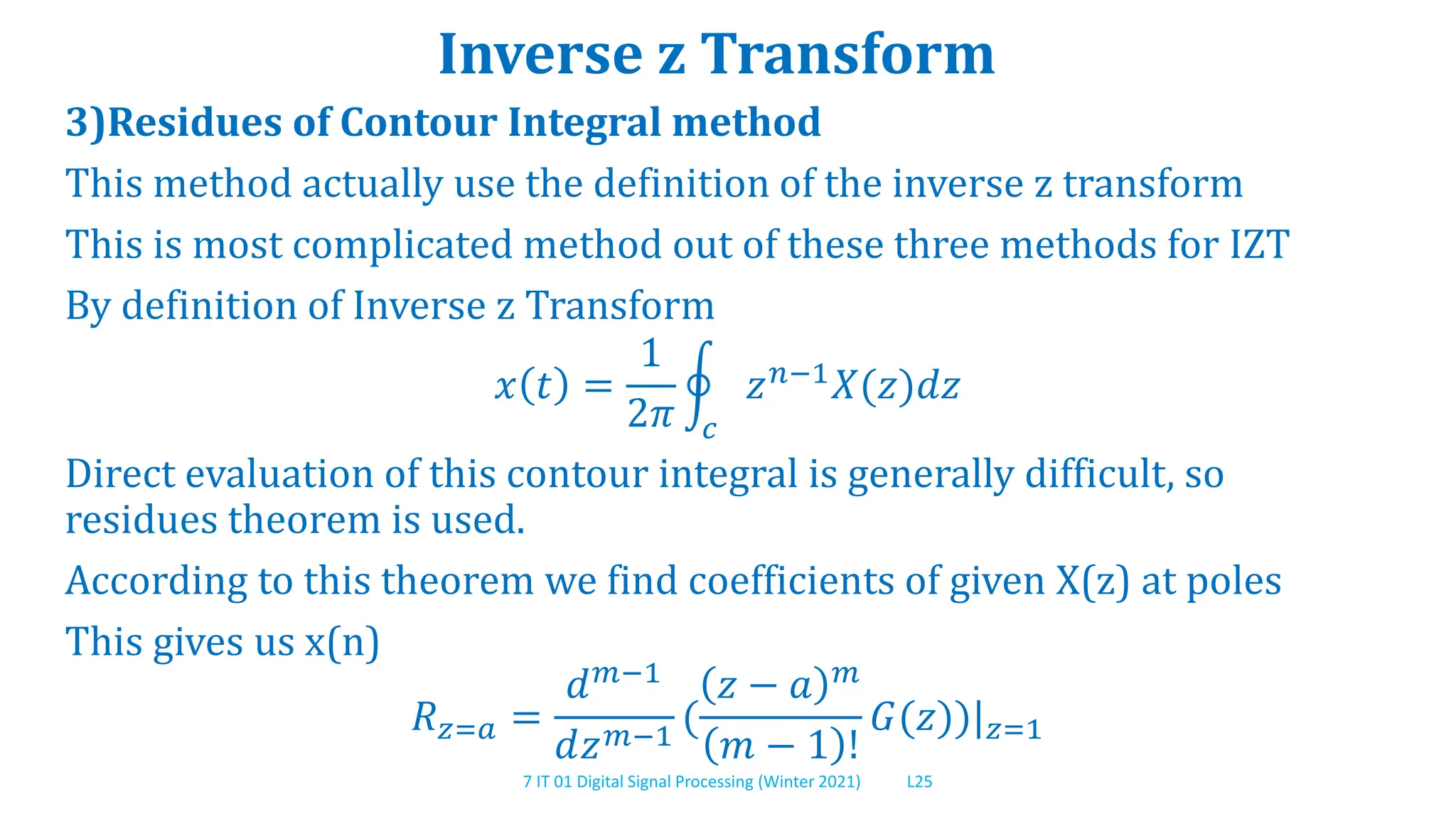
Inverse z Transform
3)Residues of Contour Integral method
This method actually use the definition of the inverse z transform
This is most complicated method out of these three methods for IZT
By definition of Inverse z Transform
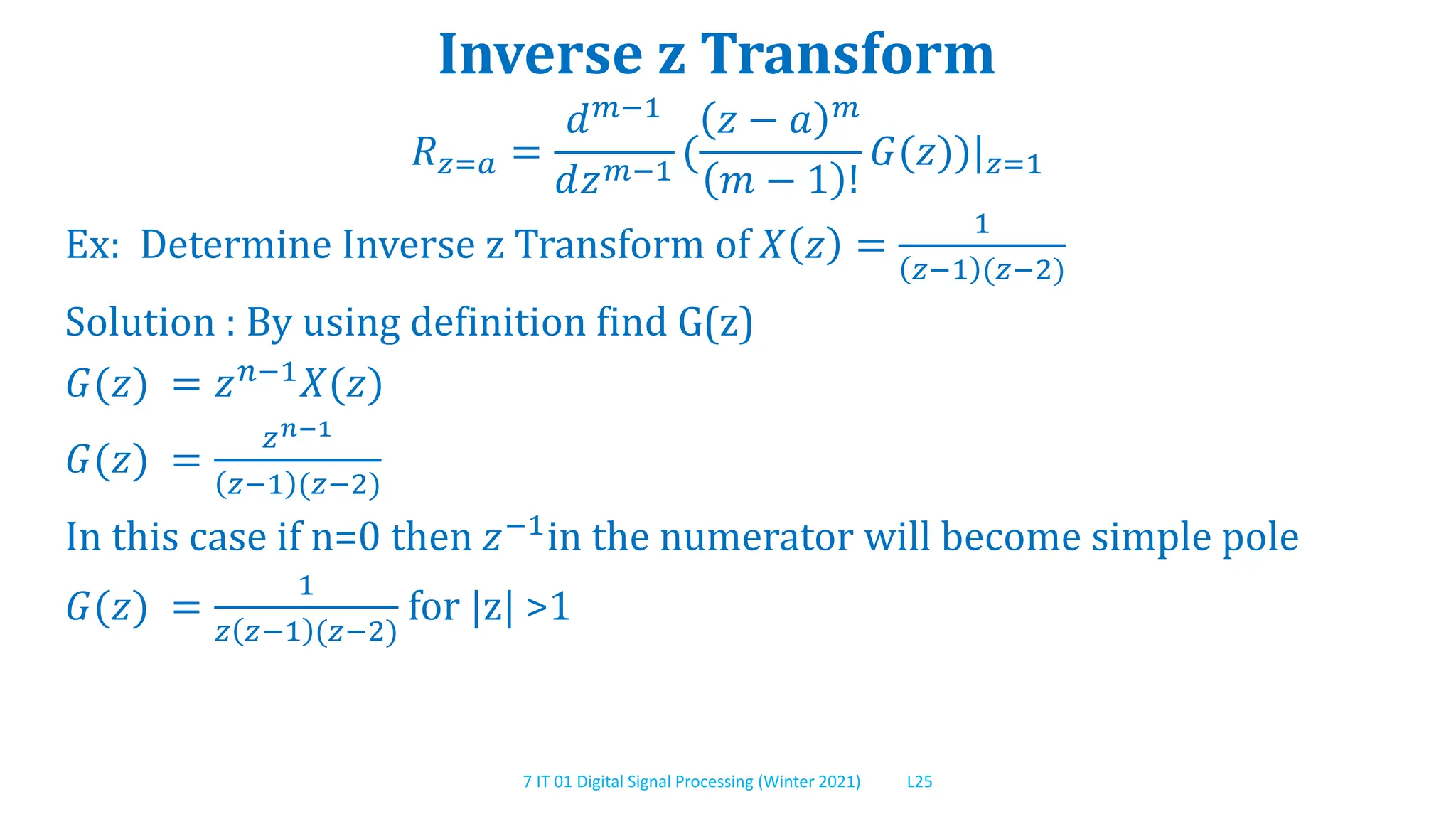
𝑥 𝑡 =
1
2𝜋 𝑐
𝑧𝑛−1𝑋(𝑧)𝑑𝑧
Direct evaluation of this contour integral is generally difficult, so
residues theorem is used.
According to this theorem we find coefficients of given X(z) at poles
This gives us x(n)
𝑅𝑧=𝑎 =
𝑑𝑚−1
𝑑𝑧𝑚−1
(
𝑧 − 𝑎 𝑚
𝑚 − 1 !
𝐺(𝑧))|𝑧=1
7 IT 01 Digital Signal Processing (Winter 2021) L25
Inverse z Transform
𝑅𝑧=𝑎 =
𝑑𝑚−1
𝑑𝑧𝑚−1
(
𝑧 − 𝑎 𝑚
𝑚 − 1 !
𝐺(𝑧))|𝑧=1
Ex: Determine Inverse z Transform of 𝑋 𝑧 =
1
𝑧−1 (𝑧−2)
Solution : By using definition find G(z)
𝐺(𝑧) = 𝑧𝑛−1𝑋(𝑧)
𝐺(𝑧) =
𝑧𝑛−1
𝑧−1 (𝑧−2)
In this case if n=0 then 𝑧−1
in the numerator will become simple pole
𝐺(𝑧) =
1
𝑧 𝑧−1 (𝑧−2)
for |z| >1
7 IT 01 Digital Signal Processing (Winter 2021) L25
Inverse z Transform
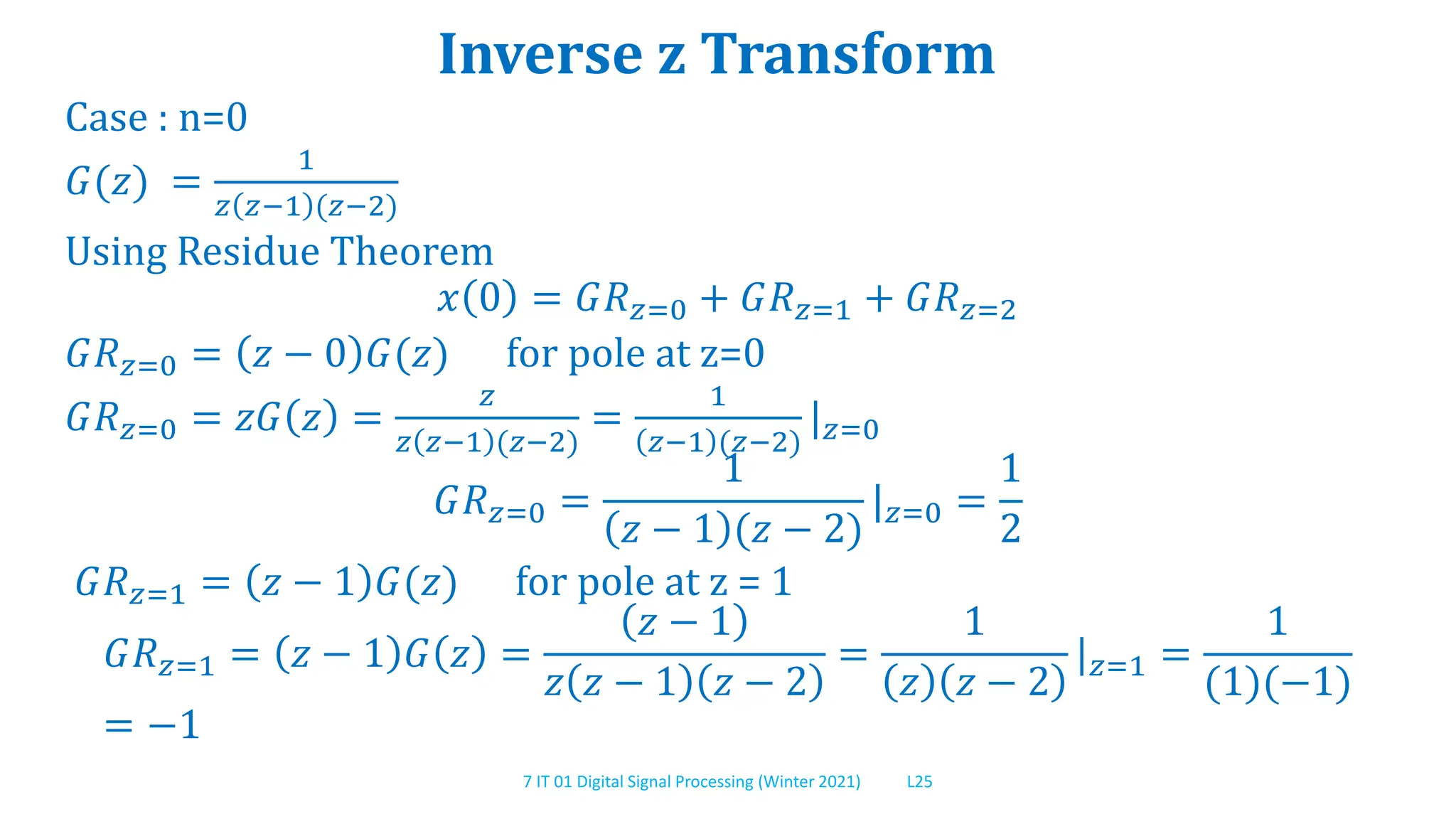
Case : n=0
𝐺(𝑧) =
1
𝑧 𝑧−1 (𝑧−2)
Using Residue Theorem
𝑥 0 = 𝐺𝑅𝑧=0 + 𝐺𝑅𝑧=1 + 𝐺𝑅𝑧=2
𝐺𝑅𝑧=0 = 𝑧 − 0 𝐺(𝑧) for pole at z=0
𝐺𝑅𝑧=0 = 𝑧𝐺 𝑧 =
𝑧
𝑧 𝑧−1 (𝑧−2)
=
1
𝑧−1 (𝑧−2)
|𝑧=0
𝐺𝑅𝑧=0 =
1
𝑧 − 1 (𝑧 − 2)
|𝑧=0 =
1
2
𝐺𝑅𝑧=1 = 𝑧 − 1 𝐺(𝑧) for pole at z = 1
𝐺𝑅𝑧=1 = 𝑧 − 1 𝐺 𝑧 =
𝑧 − 1
𝑧 𝑧 − 1 𝑧 − 2
=
1
𝑧 𝑧 − 2
|𝑧=1 =
1
(1)(−1)
= −1
7 IT 01 Digital Signal Processing (Winter 2021) L25
Inverse z Transform
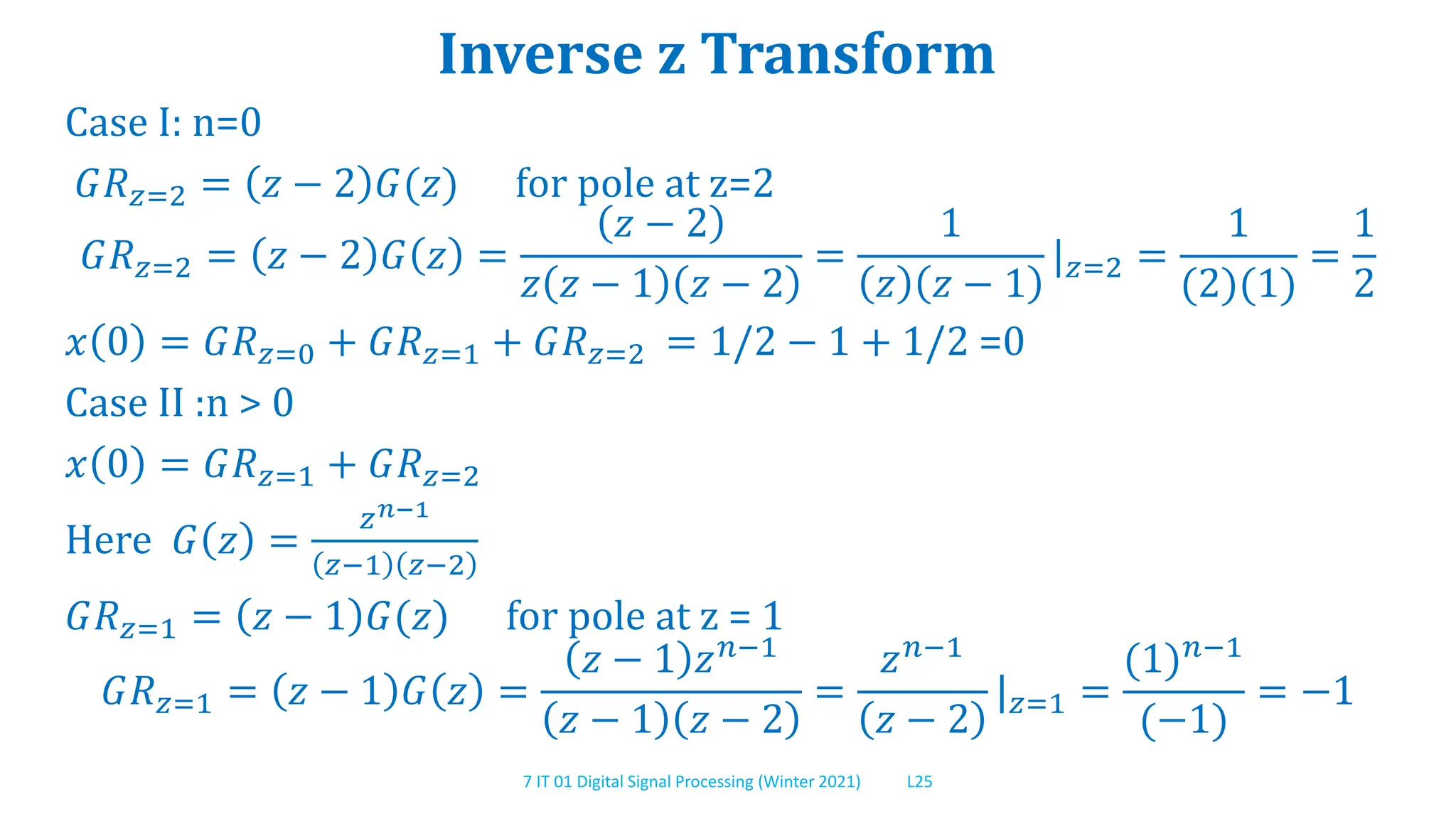
Case I: n=0
𝐺𝑅𝑧=2 = 𝑧 − 2 𝐺(𝑧) for pole at z=2
𝐺𝑅𝑧=2 = 𝑧 − 2 𝐺 𝑧 =
𝑧 − 2
𝑧 𝑧 − 1 𝑧 − 2
=
1
𝑧 𝑧 − 1
|𝑧=2 =
1
(2)(1)
=
1
2
𝑥 0 = 𝐺𝑅𝑧=0 + 𝐺𝑅𝑧=1 + 𝐺𝑅𝑧=2 = 1/2 − 1 + 1/2 =0
Case II :n > 0
𝑥 0 = 𝐺𝑅𝑧=1 + 𝐺𝑅𝑧=2
Here 𝐺 𝑧 =
𝑧𝑛−1
𝑧−1 𝑧−2
𝐺𝑅𝑧=1 = 𝑧 − 1 𝐺(𝑧) for pole at z = 1
𝐺𝑅𝑧=1 = 𝑧 − 1 𝐺 𝑧 =
𝑧 − 1 𝑧𝑛−1
𝑧 − 1 𝑧 − 2
=
𝑧𝑛−1
𝑧 − 2
|𝑧=1 =
(1)𝑛−1
(−1)
= −1
7 IT 01 Digital Signal Processing (Winter 2021) L25
Inverse z Transform
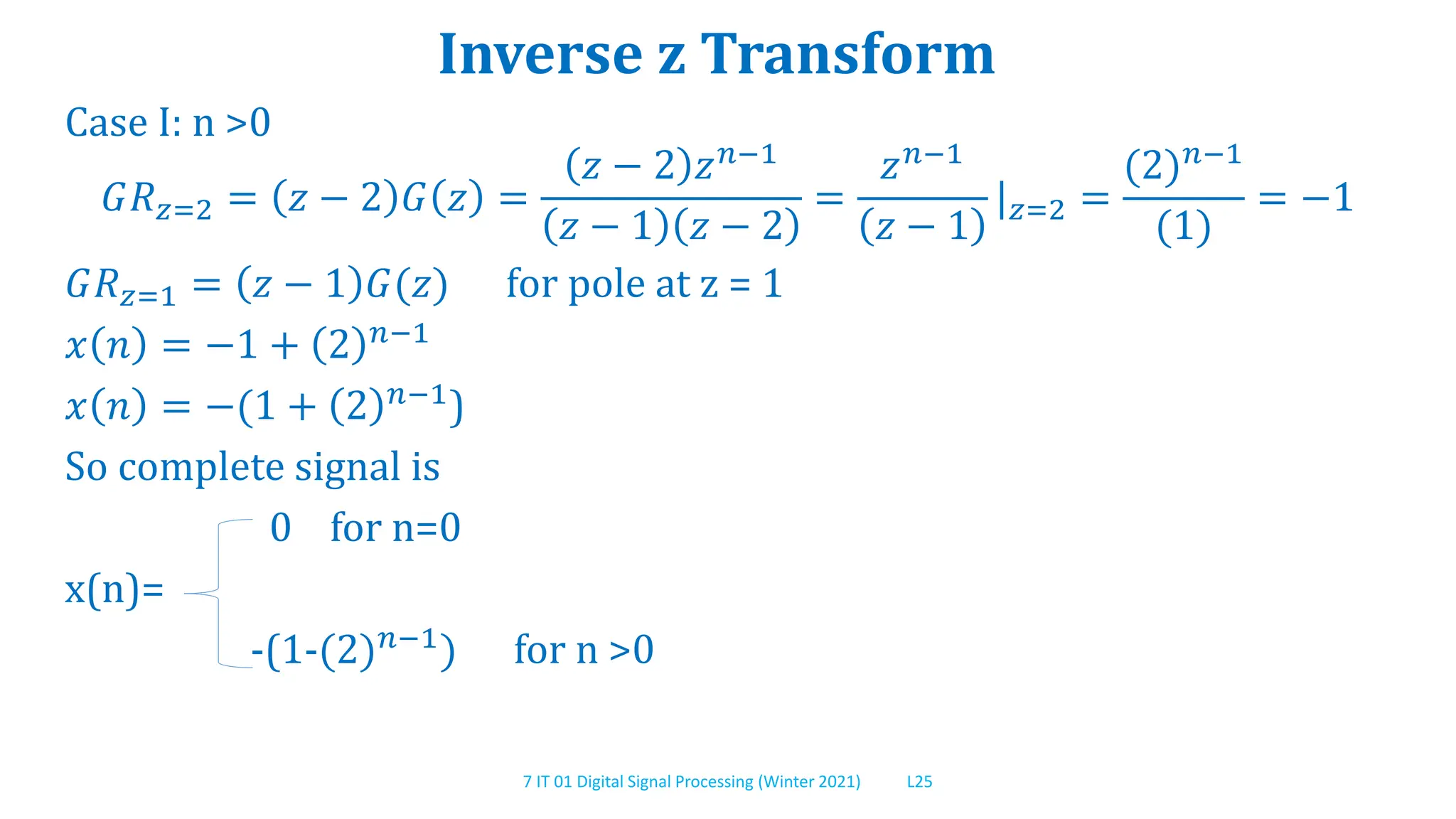
Case I: n >0
𝐺𝑅𝑧=2 = 𝑧 − 2 𝐺 𝑧 =
𝑧 − 2 𝑧𝑛−1
𝑧 − 1 𝑧 − 2
=
𝑧𝑛−1
𝑧 − 1
|𝑧=2 =
(2)𝑛−1
(1)
= −1
𝐺𝑅𝑧=1 = 𝑧 − 1 𝐺(𝑧) for pole at z = 1
𝑥 𝑛 = −1 + 2 𝑛−1
𝑥 𝑛 = −(1 + 2 𝑛−1)
So complete signal is
0 for n=0
x(n)=
-(1-(2)𝑛−1
) for n >0
THANK YOU !
7 IT 01 Digital Signal Processing (Winter 2021) L25

Frequency Analysis using Z Transform.pptx

  • 1.
    7 IT 01 DigitalSignal Processing Unit III: Frequency Analysis using Z- Transform Prof. (Dr.) Prashant V. Ingole Professor and Head, Dept. of Information Technology, Prof Ram Meghe Institute of Technology and Research, Badnera. 7 IT 01 Digital Signal Processing (Winter 2021) L25
  • 2.
    7 IT 01Digital Signal Processing (Winter 2021) L25 Course Outline UNIT III: The Z- Transform – Z-Transform – Properties of the Region of Convergence of the z-Transform – The Inverse Z-Transform – Z-Transform Properties Course Outcomes (COs) • Analyze DT LTI Systems using Z transform
  • 3.
    7 IT 01Digital Signal Processing (Winter 2021) L25 Z- Transform • We have studied that Fourier Transform play a key role in representing and analyzing the discrete time signals and systems. • However Fourier Transform is subjected to many constraints Signal under analysis x(n) need to be absolutely summable. • So we are in need of a generalized analysis tool • Z Transform is the generalized form of Fourier Transform • Analog Signals  Laplace Transform • Digital Signals Z Transform • Motivation 1. Convergence of all types of Signals 2. Convenience of notations 3. Use of powerful complex variable theory for analysis
  • 4.
    7 IT 01Digital Signal Processing (Winter 2021) L25 z Transform Definition • z transform of the discrete time signal x(n) is defined as a power series • 𝑿 𝒛 = 𝒏=−∞ ∞ 𝒙(𝒏)𝒛−𝒏 where z is the complex variable • The Fourier Transform was earlier defined as • 𝑋 𝑒𝑗𝑤 = 𝑛=−∞ ∞ 𝑥(𝑛)𝑒−𝑗𝑤𝑛 • Observe the similarity in these two mathematical tools • By comparison it can be easily found that 𝑧 = 𝑒𝑗𝑤 and so 𝑧−𝑛 = 𝑒−𝑗𝑤𝑛
  • 5.
    7 IT 01Digital Signal Processing (Winter 2021) L25 z Transform • The z Transform definition equation 𝑋 𝑧 = 𝑛=−∞ ∞ 𝑥(𝑛)𝑧−𝑛 is also known as direct z transform. The inverse procedure to obtain the x(n) from X(z) is called as an Inverse z transform. Notations: • The z transform of the signal x(n) is denoted as X(z) = z(x(n)) • The relationship between x(n) and X(z) is indicated by x(n) z X(z)
  • 6.
    7 IT 01Digital Signal Processing (Winter 2021) L25 Fourier Transform of DT Aperiodic Signals z Transform is a infinite power series (𝑎𝑛) with z being the complex variable . Some time z Transform is considered as an operator and denoted as z( . ) that is 𝑧 𝑥 𝑛 = 𝑛=−∞ ∞ 𝑥 𝑛 𝑧−𝑛 = 𝑋(𝑧) • When z transform is defined from -∞ to ∞ it is referred to as the bilateral or two sided z transform • But practical signals are causal so the z transform is defined either from 0 to ∞ and it is known as unilateral or single sided z transform • 𝑋(𝑧) = 𝑛=0 ∞ 𝑥 𝑛 𝑧−𝑛  unilateral or single sided z transform
  • 7.
    7 IT 01Digital Signal Processing (Winter 2021) L25 z Transform In 𝑋(𝑧) = 𝑛=0 ∞ 𝑥 𝑛 𝑧−𝑛 if we replace 𝑧 = 𝑒𝑗𝑤 then the equation reduces to Fourier transform equation 𝑋 𝑒𝑗𝑤 = 𝑛=−∞ ∞ 𝑥(𝑛)𝑒−𝑗𝑤𝑛 When we consider 𝑧 = 𝑒𝑗𝑤 it is in fact 𝑧 = 1 ∗ 𝑒𝑗𝑤 i.e. in polar form 𝑟 ∗ 𝑒𝑗𝑤 That means restricting the value of |z|=1 we get Fourier transform. More generally we can express the complex variable z in polar form as z = 𝑟 ∗ 𝑒𝑗𝑤 So the z transform equation becomes 𝑋 𝑟𝑒𝑗𝑤 = 𝑛=−∞ ∞ 𝑥(𝑛)(𝑟𝑒𝑗𝑤 )−𝑛 𝑋 𝑟𝑒𝑗𝑤 = 𝑛=−∞ ∞ (𝑥(𝑛)𝑟−𝑛)(𝑒𝑗𝑤)−𝑛 This equation can be interpreted as the Fourier transform of the signal 𝑥(𝑛)𝑟−𝑛 . Obviously for r = 1, this equation reduces to Fourier Transform of x(n).
  • 8.
    7 IT 01Digital Signal Processing (Winter 2021) L25 Polar Representation of Z Transform and Unit Circle Since z Transform is a function of complex variable z it is convenient to describe, represent and interpret it using a complex z plane. In the plane a contour corresponding to |z| = 1 is a circle of unit radius. This contour is also referred to as unit circle in z plane as shown in figure. 𝑧𝑖 1 w 𝜋 0 𝑧𝑟 −𝜋 0 The z transform evaluated on the unit circle is the Fourier Transform
  • 9.
    7 IT 01Digital Signal Processing (Winter 2021) L25 Periodicity in z Transform If we evaluate X(z) at the points on the unit circle in z plane beginning at z = 1 that is at w=0, through z= j (at w= 𝜋/2) to z=-1 (at w= 𝜋 ) to z= -j (at w= 3𝜋/2) and finally back to z = 1 at w= 2𝜋 We obtain the Fourier Transform for 0 ≤ 𝑤 ≤ 2𝜋 at that time we discussed w as a linear frequency variable. The same frequency in z plane is represented as a angular variable which vary from w=0 at z = 1 to w= 𝜋/2 at z = j to w = 𝜋 at z= -1 to w= 3𝜋 2 at z = -j to w = 2𝜋 at z= 1, thus completing a period around the unit circle. With this interpretation the inherent periodicity of frequency in Fourier Transform is captured naturally. Since a change of angle of w = 2𝜋 radians in z plane corresponds to traversing the unit circle one and returning to the exactly same point.
  • 10.
    7 IT 01Digital Signal Processing (Winter 2021) L25 Region of Convergence in z Transform In Fourier series the power series representing the Fourier transform does not converge for all sequences, because the infinite may not always be finite. Similarly z transform does not converge for all sequences or all values of z. For any given sequence the set of values of z for which the z transform X(z) converges is called as the Region Of Convergence (ROC). Since z transform is an infinite power series, it exists for those values of z for which this series converges. The region of Convergence X(z) is the set of all values of z for which the X(z) attains the finite value. Thus anytime we cite z transform we should also specify the Region of Convergence (ROC)
  • 11.
    7 IT 01Digital Signal Processing (Winter 2021) L25 z –Transform Evaluation Ex 1: Find z transform of finite duration signal x(n)={1, 2, 7, 5, 0, 1} Solution : The z transform equation is 𝑋 𝑧 = 𝑛=0 ∞ 𝑥 𝑛 . 𝑧−𝑛 So X(z) =1.𝑧0 +2*𝑧−1 + 7𝑧−2 + 5𝑧−3 + 0. 𝑧−4 + 1. 𝑧−5 X(z) =1 +2𝑧−1 + 7𝑧−2 + 5𝑧−3 + 𝑧−5 For finite duration causal signals the ROC is entire z plane except z=0
  • 12.
    7 IT 01Digital Signal Processing (Winter 2021) L25 z –Transform Evaluation Ex 1: Find z transform of finite duration signal x(n)={1, 2, 7, 5, 0, 1} Solution : The z transform equation is 𝑋 𝑧 = 𝑛=0 ∞ 𝑥 𝑛 . 𝑧−𝑛 So X(z) =1.𝑧0 +2*𝑧−1 + 7𝑧−2 + 5𝑧−3 + 0. 𝑧−4 + 1. 𝑧−5 X(z) =1 +2𝑧−1 + 7𝑧−2 + 5𝑧−3 + 𝑧−5 For finite duration causal signals the ROC is entire z plane except z=0 Ex 2: Find z transform of finite duration signal x(n)={1, 2, 7, 5, 0, 1} Solution : The z transform equation is 𝑋 𝑧 = 𝑛=0 ∞ 𝑥 𝑛 . 𝑧−𝑛 So X(z) =1.𝑧+2 +2*𝑧+1 + 7𝑧0 + 5𝑧−1 + 0. 𝑧−2 + 1. 𝑧−3 X(z) =1𝑧+2 +2𝑧+1 + 7 + 5𝑧−1 + 𝑧−3 For finite duration non causal signals the ROC is entire z plane except z=0 and z = ∞
  • 13.
    7 IT 01Digital Signal Processing (Winter 2021) L25 z Transform Problems Ex 3: Find z transform of finite duration signal x(n)={0, 0, 1, 2, 5, 7, 0, 1} Solution : The z transform equation is 𝑋 𝑧 = 𝑛=0 ∞ 𝑥 𝑛 . 𝑧−𝑛 So X(z) = 𝑧−2 + 2𝑧−3 + 5. 𝑧−4 + 7. 𝑧−5 + 0. 𝑧−6 + 1. 𝑧−7 X(z) =𝑧−2 + 2𝑧−3 + 5. 𝑧−4 + 7. 𝑧−5 + 1. 𝑧−7 For finite duration causal signals the ROC is entire z plane except z=0
  • 14.
    7 IT 01Digital Signal Processing (Winter 2021) L25 z Transform Problems Ex 3: Find z transform of finite duration signal x(n)={0, 0, 1, 2, 5, 7, 0, 1} Solution : The z transform equation is 𝑋 𝑧 = 𝑛=0 ∞ 𝑥 𝑛 . 𝑧−𝑛 So X(z) = 𝑧−2 + 2𝑧−3 + 5. 𝑧−4 + 7. 𝑧−5 + 0. 𝑧−6 + 1. 𝑧−7 X(z) =𝑧−2 + 2𝑧−3 + 5. 𝑧−4 + 7. 𝑧−5 + 1. 𝑧−7 For finite duration causal signals the ROC is entire z plane except z=0 Ex 4: Find z transform of finite duration signal x(n)=𝛿(𝑛) Solution : The z transform equation is 𝑋 𝑧 = 𝑛=0 ∞ 𝑥 𝑛 . 𝑧−𝑛 So X(z) = 1. 𝑧0 = 1 For this finite duration causal signals the ROC is entire z plane including z = 0 and z = ∞ .
  • 15.
    7 IT 01Digital Signal Processing (Winter 2021) L25 z Transform Problems Ex 5: Find z transform of finite duration signal x(n)=𝛿(𝑛 − 𝑘) Solution : The z transform equation is 𝑋 𝑧 = 𝑛=0 ∞ 𝑥 𝑛 . 𝑧−𝑛 So X(z) = 1. 𝑧−𝑘 = 𝑧−𝑘 (for k > 0) For this finite duration causal signals, the ROC is entire z plane except z=0 .
  • 16.
    7 IT 01Digital Signal Processing (Winter 2021) L25 z Transform Problems Ex 5: Find z transform of finite duration signal x(n)=𝛿(𝑛 − 𝑘) Solution : The z transform equation is 𝑋 𝑧 = 𝑛=0 ∞ 𝑥 𝑛 . 𝑧−𝑛 So X(z) = 1. 𝑧−𝑘 = 𝑧−𝑘 (for k > 0) For this finite duration causal signals, the ROC is entire z plane except z=0 . Ex 6: Find z transform of finite duration signal x(n)=𝛿(𝑛 + 𝑘) Solution : The z transform equation is 𝑋 𝑧 = 𝑛=0 ∞ 𝑥 𝑛 . 𝑧−𝑛 So X(z) = 1. 𝑧+𝑘 = 𝑧+𝑘 (for k > 0) For this finite duration causal signals, the ROC is entire z plane except z = ∞ .
  • 17.
    7 IT 01Digital Signal Processing (Winter 2021) L25 Finite Signals and ROC
  • 18.
    7 IT 01Digital Signal Processing (Winter 2021) L25 Convergence of z Transform If 𝑧 = 𝑒𝑗𝑤 then ROC is unit circle (r = 1) So | z | = 1 But let us suppose 𝑧 = 𝑟. 𝑒𝑗𝑤 if we replace it in the definition of the z transform The z transform equation becomes 𝑋 𝑟𝑒𝑗𝑤 = 𝑛=−∞ ∞ 𝑥(𝑛)(𝑟𝑒𝑗𝑤)−𝑛 𝑋 𝑟𝑒𝑗𝑤 = 𝑛=−∞ ∞ (𝑥(𝑛)𝑟−𝑛)(𝑒𝑗𝑤)−𝑛 Uniform convergence of the Fourier transform requires that the sequence be absolutely summable. So applying this condition to the above equation we get the condition as: 𝑛=−∞ ∞ 𝑥 𝑛 𝑟−𝑛 < ∞ For absolute convergence of the z transform.
  • 19.
    7 IT 01Digital Signal Processing (Winter 2021) L25 Convergence of z Transform This condition indicates that because of the multiplication of the sequence by the real exponential sequence 𝑟−𝑛, it is possible for the z transform to converge even if the Fourier Transform does not converge. Ex: Find Fourier Transform of signal x(n) = u(n)  Answer is FT does not exist Reason is signal u(n) is not absolutely summable. Ex: Find z transform of signal x(n) = u(n) Solution: x(n) = u(n) is not absolutely summable so its FT cannot be found. However while finding z transform as per the definition we find FT of 𝑥 𝑛 𝑟−𝑛 . An this multiplication is absolutely summable for r > 1. This means z transform of the unit step exists with ROC |z| > 1 i.e. ROC is exterior of the unit circle in z Plane
  • 20.
    7 IT 01Digital Signal Processing (Winter 2021) L25 Convergence of z Transform Convergence of the power series in definition of z transform depend only on |z|. Since |X(z)| < ∞ if 𝑛=0 ∞ |𝑥 𝑛 |. |𝑧|−𝑛 < ∞ Thus if some value of 𝑧 = 𝑧1 is in the ROC, then all values of z defined by a circle with radius z = |𝑧1|will also be in the ROC. In ROC of X(z), |X(z)| < ∞ But as per the definition of z transform |𝑋 𝑧 | = | 𝑛=−∞ ∞ 𝑥 𝑛 𝑟−𝑛 . 𝑒−𝑗𝑤𝑛 | |𝑋 𝑧 | < 𝑛=−∞ ∞ |𝑥 𝑛 𝑟−𝑛|. |𝑒−𝑗𝑤𝑛| |𝑋 𝑧 | < 𝑛=−∞ ∞ |𝑥 𝑛 𝑟−𝑛 | Hence |𝑋 𝑧 | is finite if sequence 𝑥 𝑛 𝑟−𝑛 is absolutely summable. The problem of finding ROC for finding X(z) is equivalent to determining the range of values for r for which 𝒙 𝒏 . 𝒓−𝒏 is absolutely summable.
  • 21.
    7 IT 01Digital Signal Processing (Winter 2021) L25 Convergence of z Transform Corrolary |𝑋 𝑧 | < 𝑛=−∞ −1 𝑥 𝑛 𝑟−𝑛 + 𝑛=0 ∞ 𝑥 𝑛 𝑟−𝑛 |𝑋 𝑧 | < 𝑛=1 ∞ 𝑥 −𝑛 𝑟𝑛 + 𝑛=0 ∞ 𝑥 𝑛 /𝑟𝑛 1) Non Causal component, 2) Causal component If X(z) converges in some region of the complex z plane, both the above summations must be finite in that region. If the first sum converges, there must exist values of r small enough such that the product sequence 𝑥 −𝑛 𝑟𝑛 in range 1 ≤ 𝑛 ≤ ∞ is absolutely summable. Therefore the ROC of the first term 𝑧𝑖 consists of all points in a circle of radius 𝑟 < 𝑟1 𝑟1 𝑧𝑟 where 𝑟1 < ∞.
  • 22.
    7 IT 01Digital Signal Processing (Winter 2021) L25 Convergence of z Transform Corrolary |𝑋 𝑧 | < 𝑛=−∞ −1 𝑥 𝑛 𝑟−𝑛 + 𝑛=0 ∞ 𝑥 𝑛 𝑟−𝑛 |𝑋 𝑧 | < 𝑛=1 ∞ 𝑥 −𝑛 𝑟𝑛 + 𝑛=0 ∞ 𝑥 𝑛 /𝑟𝑛 1) Non Causal component, 2) Causal component If the second sum converges, there must exist values of r large enough such that the product sequence 𝑥 𝑛 /𝑟𝑛 in range 0 ≤ 𝑛 ≤ ∞ is absolutely summable. Hence ROC of the second term in above equation 𝑟2 𝑧𝑖 consists of all points outside a circle of radius 𝑟 > 𝑟2 𝑧𝑟
  • 23.
    7 IT 01Digital Signal Processing (Winter 2021) L25 Convergence of z Transform Since the convergence of X(z) requires that both sums in the above equation be finite, it follows that the ROC of X(z) is generally specified as the annual region in the z plane 𝑟2 ≤ 𝑟 ≤ 𝑟1, which is the common region where both sums are finite i.e. 𝑟2 < 𝑟1 is a ring. 𝑟1 𝑧𝑖 𝑟2 𝑧𝑟 Annular region in z plane which is a ROC for the bilateral z transform.
  • 24.
    7 IT 01Digital Signal Processing (Winter 2021) L25 z Transform Problems Ex: Determine z Transform of the signal 𝑥 𝑛 = 1 2 𝑛 𝑢(𝑛) Solution : In this example the signal x(n) is a infinite power series So x(n)={1, ½, 1 2 2 , 1 2 3 , 1 2 4 , 1 2 5 , ……} The z transform is given by 𝑋 𝑧 = 𝑛=0 ∞ 𝑥 𝑛 . 𝑧−𝑛 as the signal is causal Applying this formula to our power series function we get z transform of x(n) 𝑋 𝑧 = 𝑛=0 ∞ (1/2)𝑛 . 𝑧−𝑛 𝑋 𝑧 = 𝑛=0 ∞ ( 1 2 . 𝑧−1 )𝑛 Considering A= ( 1 2 . 𝑧−1 ) we can write above equation as X(z) = 1+A+𝐴2 +𝐴3 +𝐴4 + ….
  • 25.
    7 IT 01Digital Signal Processing (Winter 2021) L25 z Transform Problems Ex: Determine z Transform of the signal 𝑥 𝑛 = 1 2 𝑛 𝑢(𝑛) Continued : Considering A= ( 1 2 . 𝑧−1) ; then X(z) = 1+A+𝐴2+𝐴3+𝐴4+ …. The infinite power series can be represented by IGSS as 𝑋(𝑧) = 1 1−𝐴 Putting value of A in the above equation we get 𝑋(𝑧) = 1 1− 1 2 .𝑧−1 As per IGSS formula A < 1 so 1 2 . 𝑧−1 < 1 that means z > 1 2 This means the ROC is exterior of the circle with radius 1 2 𝑧𝑖 ROC consists of all points in the region that is 1 2 𝑧𝑟 Outside the circle with radius 1 2 as shown in figure. ROC
  • 26.
    7 IT 01Digital Signal Processing (Winter 2021) L25 z Transform Problems Ex: Determine z Transform of the signal 𝑥 𝑛 = 𝛼𝑛 𝑢(𝑛) Solution : In this example the signal x(n) is a infinite power series So x(n)={1, , 𝛼 2 , 𝛼 3 , 𝛼 4 , 𝛼 5 , ……} The z transform is given by 𝑋 𝑧 = 𝑛=0 ∞ 𝑥 𝑛 . 𝑧−𝑛 as the signal is causal Applying this formula to our power series function we get z transform of x(n) 𝑋 𝑧 = 𝑛=0 ∞ (𝛼)𝑛. 𝑧−𝑛 𝑋 𝑧 = 𝑛=0 ∞ (𝛼. 𝑧−1 )𝑛 Considering A= (𝛼. 𝑧−1) we can write above equation X(z) = 1+A+𝐴2+𝐴3+𝐴4+ ….
  • 27.
    7 IT 01Digital Signal Processing (Winter 2021) L25 z Transform Problems Ex: Determine z Transform of the signal 𝑥 𝑛 = 𝛼 𝑛 𝑢(𝑛) Continued : Considering A= (𝛼. 𝑧−1 ) ; then X(z) = 1+A+𝐴2 +𝐴3 +𝐴4 + …. The infinite power series can be represented by IGSS as 𝑋(𝑧) = 1 1−𝐴 Putting value of A in the above equation we get 𝑿(𝒛) = 𝟏 𝟏−𝜶𝒛−𝟏 As per IGSS formula A < 1 so 𝛼. 𝑧−1 < 1 that means z > 𝛼 This means the ROC is exterior of the circle with radius 𝛼 ROC consists of all points in the region that is outside the circle with radius 𝑧𝑖 𝛼 𝑧𝑟 ROC
  • 28.
    7 IT 01Digital Signal Processing (Winter 2021) L25 z Transform Problems Thus we have a transform pair 𝑥 𝑛 = 𝛼𝑛𝑢 𝑛 → 𝑧 → 𝑋(𝑧) = 1 1−𝛼𝑧−1 with ROC |z|> 𝛼 Thus ROC is exterior of the circle in z plane with radius 𝛼 If we set 𝛼=1 then the input signal reduces to 𝑥 𝑛 = 𝑢 𝑛 and its z transform reduces to 𝑋 𝑧 = 1 1−𝑧−1 = 𝑧 𝑧−1 with ROC |z| > 1
  • 29.
    7 IT 01Digital Signal Processing (Winter 2021) L25 z Transform Problems Ex: Determine z Transform of the signal 𝑥 𝑛 = −𝛼𝑛𝑢(−𝑛 − 1) Solution : From the definition of z transform we have 𝑋 𝑧 = 𝑛=−∞ ∞ 𝑥 𝑛 . 𝑧−𝑛 as the signal is anti-causal 𝑋 𝑧 = 𝑛=−∞ −1 𝑥(𝑛). 𝑧−𝑛 + 𝑛=0 ∞ 𝑥(𝑛). 𝑧−𝑛 = 𝑛=−∞ −1 𝑥(𝑛). 𝑧−𝑛 𝑋 𝑧 = 𝑛=−∞ −1 (−𝛼𝑛)𝑧−𝑛 = − 𝑛=−∞ −1 (𝛼𝑛)𝑧−𝑛 𝑋 𝑧 = − 𝑛=−∞ −1 (𝛼𝑛)𝑧−𝑛 = − 𝑛=1 ∞ (𝛼−𝑛)𝑧𝑛
  • 30.
    7 IT 01Digital Signal Processing (Winter 2021) L25 z Transform Problems 𝑋 𝑧 = − 𝑛=−∞ −1 (𝛼𝑛 )𝑧−𝑛 = − 𝑛=1 ∞ (𝛼−𝑛 )𝑧𝑛 𝑋 𝑧 = − 𝑛=1 ∞ (𝛼−1 𝑧)𝑛 Let A= 𝛼−1𝑧, then as per IGSS formula we have 𝑋 𝑧 = − 𝐴 1−𝐴 = − 𝛼−1𝑧 1−𝛼−1𝑧 𝑋 𝑧 = 1 1 − 𝛼𝑧−1 With A < 1 that is 𝛼−1 𝑧 < 1 that means z < 𝛼 This means the ROC is interior of the circle with radius 𝛼 𝑧𝑖 ROC consists of all points in the region that is inside 𝛼 𝑧𝑟 the circle with radius 𝛼.
  • 31.
    7 IT 01Digital Signal Processing (Winter 2021) L25 z Transform Problems So we found that signal 𝑥 𝑛 = 𝛼𝑛 𝑢 𝑛 causal signal and signal 𝑥 𝑛 = −𝛼𝑛𝑢(−𝑛 − 1) an anti-causal signal has a same z transform that is 𝑋 𝑧 = 1 1 − 𝛼𝑧−1 However these signals differ in ROC and it can be easily found that for 𝑥 𝑛 = 𝛼𝑛𝑢 𝑛 (causal signal) the ROC is exterior of the circle in z plane with radius 𝛼 For 𝑥 𝑛 = −𝛼𝑛𝑢(−𝑛 − 1) (an anti-causal signal) 𝑧𝑖 the ROC is interior of the circle in z plane with radius 𝛼 𝛼 𝑧𝑖
  • 32.
    7 IT 01Digital Signal Processing (Winter 2021) L25 z Transform Problems Ex: Det. z Transform of the signal 𝑥 𝑛 = 𝛼𝑛𝑢 𝑛 + 𝛽𝑛𝑢(−𝑛 − 1) Solution : This is a Bilateral or double sided z transform problem z transform is given by 𝑋 𝑧 = 𝑛=−∞ ∞ 𝑥 𝑛 . 𝑧−𝑛 So in this case 𝑋 𝑧 = 𝑛=−∞ −1 𝛽𝑛𝑧−𝑛 + 𝑛=0 ∞ 𝛼𝑛𝑧−𝑛 𝑋 𝑧 = 𝑛=0 ∞ 𝛼𝑛𝑧−𝑛 + 𝑛=−∞ −1 𝛽𝑛𝑧−𝑛 𝑋 𝑧 = 𝑛=0 ∞ 𝛼𝑛𝑧−𝑛 + 𝑛=1 ∞ 𝛽−𝑛𝑧𝑛
  • 33.
    7 IT 01Digital Signal Processing (Winter 2021) L25 z Transform Problems Ex: Det. z Transform of the signal 𝑥 𝑛 = 𝛼𝑛 𝑢 𝑛 + 𝛽𝑛 𝑢(−𝑛 − 1) Solution : 𝑋 𝑧 = 𝑛=0 ∞ (𝛼𝑧−1 )𝑛 + 𝑛=1 ∞ (𝛽−1 𝑧)𝑛 Applying IGSS formula , For first power series we get 1 1−𝛼𝑧−1 with |𝛼𝑧−1 |<1 that is |z| > 𝛼 that is ROC is exterior of the circle with radius 𝛼 Similarly by applying IGSS for second power series we get 𝛽−1𝑧 1−𝛽−1𝑧 with |𝛽−1𝑧|<1 that is |z| < 𝛽 that is ROC is interior of the circle with radius β. In determining the X(z), if | 𝛽 | < | 𝛼 | ROC in z domain does not coincide with each other so they do not converge simultaneously
  • 34.
    7 IT 01Digital Signal Processing (Winter 2021) L25 z Transform Problems Ex: Det. z Transform of the signal 𝑥 𝑛 = 𝛼𝑛 𝑢 𝑛 + 𝛽𝑛 𝑢(−𝑛 − 1) Solution : 𝑋 𝑧 = 𝑛=0 ∞ (𝛼𝑧−1 )𝑛 + 𝑛=1 ∞ (𝛽−1 𝑧)𝑛 But if | 𝛽 | > | 𝛼 | ROC of ring shape in z domain coincide with each other so they converge simultaneously 𝑋 𝑧 = 1 1−𝛼𝑧−1 + 𝛽−1𝑧 1−𝛽−1𝑧 = 1 1−𝛼𝑧−1 - 1 1−𝛽𝑧−1 And ROC is |𝛼|< |z| <|𝛽|
  • 35.
    7 IT 01Digital Signal Processing (Winter 2021) L25 Infinite Signals and ROC
  • 36.
    7 IT 01Digital Signal Processing (Winter 2021) L25 Properties of z Transform The z transform is a very powerful tool and this is exhibited by it’s powerful set of properties. Note : when we combine several z transforms, the ROC of the overall transform is at least the intersection of their ROCs. Properties: 1. Linearity 2. Time Shifting 3. Scaling in z domain 4. Time Reversal 5. Differentiation in z domain 6. Convolution of two sequences
  • 37.
    7 IT 01Digital Signal Processing (Winter 2021) L25 Linearity Property 1. Linearity: If 𝑥1 𝑛 ← 𝑧 → 𝑋1(𝑧) and 𝑥2 𝑛 ← 𝑧 → 𝑋2(𝑧) Then 𝑥 𝑛 = 𝑎1𝑥1 𝑛 + 𝑎2𝑥2 𝑛 ← 𝑧 → 𝑋 𝑧 = 𝑎1𝑋1 𝑧 + 𝑎2𝑋2 𝑧 Proof: 𝑧 𝑥 𝑛 = 𝑋 𝑧 = 𝑘=−∞ ∞ 𝑥(𝑘)𝑧−𝑘 For 𝑥 𝑘 = 𝑎1𝑥1 𝑘 + 𝑎2𝑥2 𝑘 𝑋 𝑧 = 𝑘=−∞ ∞ (𝑎1𝑥1 𝑘 + 𝑎2𝑥2(𝑘))𝑧−𝑘 = 𝑘=−∞ ∞ 𝑎1𝑥1 𝑘 𝑧−𝑘 + 𝑎2𝑥2(𝑘)𝑧−𝑘 = 𝑎1 𝑘=−∞ ∞ 𝑥1 𝑘 𝑧−𝑘 + 𝑎2 𝑘=−∞ ∞ 𝑥2(𝑘)𝑧−𝑘 Thus 𝑋1 𝑧 𝑋2 𝑧 𝑋 𝑧 = 𝑎1𝑋1 𝑧 + 𝑎2𝑋2 𝑧 Thus the signal can be expressed first in composite form and then its z transform can be found.
  • 38.
    7 IT 01Digital Signal Processing (Winter 2021) L25 Problems on Linearity Property Ex: Determine the z Transform and ROC of the Signal x(n) =(𝑎𝑛 + 𝑎−𝑛)𝑢(𝑛) Solution : Z Transform is given by 𝑋 𝑧 = 𝑛=−∞ ∞ 𝑥 𝑛 . 𝑧−𝑛 This signal can be represented as 𝑥1 = 𝑎𝑛𝑢 𝑛 and 𝑥2 = 𝑎−𝑛𝑢 𝑛 So we have 𝑥 𝑛 = 𝑥1 𝑛 + 𝑥2(𝑛) For 𝑥1 = 𝑎𝑛𝑢 𝑛 by applying z transform 𝑋1 𝑧 = 1 1−𝑎𝑧−1 with |𝑎𝑧−1|<1 or |z| > a Similarly for 𝑥2 = 𝑎−𝑛 𝑢 𝑛 by applying z transform 𝑋1 𝑧 = 1 1−𝑎−1𝑧−1 with |𝑎−1𝑧−1|<1 or |z| < 𝑎−1 So X 𝑧 = 1 1−𝑎𝑧−1 − 1 1−𝑎−1𝑧−1
  • 39.
    7 IT 01Digital Signal Processing (Winter 2021) L25 Problems on Linearity Property Ex: Determine the z Transform and ROC of the Signal x(n) =(𝑎𝑛 + 𝑎−𝑛)𝑢(𝑛) Solution : So X 𝑧 = 1 1−𝑎𝑧−1 − 1 1−𝑎−1𝑧−1 = 𝑧 𝑧−𝑎 − 𝑧 𝑧−𝑎−1 With ROC as intersection of ROCs of these two regions that are |z|> a and |z| < 1/a So ROC is the annual region between circle with radius 1/a and circle with Radius a
  • 40.
    7 IT 01Digital Signal Processing (Winter 2021) L25 Problems on Linearity Property EX: Determine the z transform of signal 𝑥(𝑛) = (cos 𝑤0𝑛)u(n) Solution : Given signal is 𝑥(𝑛) = (cos 𝑤0𝑛)u(n) This signal can be decomposed by using Eular’s Identity as cos 𝑤0𝑛 = 𝑒𝑗𝑤0𝑛 + 𝑒−𝑗𝑤0𝑛 2 So 𝑥(𝑛) = ( 𝑒𝑗𝑤0𝑛+𝑒−𝑗𝑤0𝑛 2 )u(n) Thus the decomposed signal is represented as 𝑥 𝑛 = 𝑒𝑗𝑤0𝑛 2 u n + 𝑒−𝑗𝑤0𝑛 2 u n 𝑋 𝑧 = 1 2 [𝑧(𝑒𝑗𝑤0𝑛)+𝑧(𝑒−𝑗𝑤0𝑛)] We can write 𝑥1(𝑛) = 𝑒𝑗𝑤0𝑛𝑢(𝑛) and 𝑥2(𝑛) = 𝑒−𝑗𝑤0𝑛𝑢(𝑛)
  • 41.
    7 IT 01Digital Signal Processing (Winter 2021) L25 Problems on Linearity Property 𝑿 𝒛 = 𝟏 𝟐 [𝒛(𝒆𝒋𝒘𝟎𝒏)+𝒛(𝒆−𝒋𝒘𝟎𝒏)] We can write 𝑥1 = 𝑒𝑗𝑤0𝑛𝑢(𝑛) and 𝑥2 = 𝑒−𝑗𝑤0𝑛𝑢(𝑛) Let us say 𝛼 = 𝑒𝑗𝑤0 so 𝛼 = 𝑒𝑗𝑤0 = 1 𝑋1 𝑧 = 𝑧{ 𝑒𝑗𝑤0𝑛 𝑢 𝑛 } = 𝑛=0 ∞ 𝑒𝑗𝑤0𝑛 𝑧−𝑛 𝑋1 𝑧 = 𝑛=0 ∞ (𝑒𝑗𝑤0𝑧−1)𝑛 = 1 1−(𝑒𝑗𝑤0𝑧−1) where |𝑒𝑗𝑤0𝑧−1| < 1 As 𝑒𝑗𝑤0 = 1 , ROC is |z|> 1 Now let us say 𝛼 = 𝑒−𝑗𝑤0 so 𝛼 = 𝑒−𝑗𝑤0 = 1 𝑋2 𝑧 = 𝑧{ 𝑒−𝑗𝑤0𝑛 𝑢 𝑛 } = 𝑛=0 ∞ 𝑒−𝑗𝑤0𝑛 𝑧−𝑛 𝑋2 𝑧 = 𝑛=0 ∞ (𝑒−𝑗𝑤0𝑧−1 )𝑛 = 1 1−(𝑒−𝑗𝑤0𝑧−1) where |𝑒−𝑗𝑤0𝑧−1 | < 1 As 𝑒𝑗𝑤0 = 1 , ROC is |z|> 1
  • 42.
    7 IT 01Digital Signal Processing (Winter 2021) L25 Problems on Linearity Property 𝑿 𝒛 = 𝟏 𝟐 [𝒛(𝒆𝒋𝒘𝟎𝒏)+𝒛(𝒆𝒋𝒘𝟎𝒏)] 𝑋 𝑧 = 1 2 { 1 1−(𝑒𝑗𝑤0𝑧−1) + 1 1−(𝑒−𝑗𝑤0𝑧−1) } Where ROC in both cases is |z|> 1 𝑋 𝑧 = 1 2 { 1−(𝑒−𝑗𝑤0𝑧−1+1−(𝑒𝑗𝑤0𝑧−1) 1−𝑒𝑗𝑤0𝑧−1 ∗(1−𝑒−𝑗𝑤0𝑧−1) } 𝑋 𝑧 = 1 2 { 2−𝑒−𝑗𝑤0𝑧−1−𝑒𝑗𝑤0𝑧−1 1−𝑒𝑗𝑤0𝑧−1 ∗(1−𝑒−𝑗𝑤0𝑧−1) } Solving Numerator = 2 − 𝑒−𝑗𝑤0𝑧−1 − 𝑒𝑗𝑤0𝑧−1 = 2 − 2(𝑒𝑗𝑤0+𝑒−𝑗𝑤0) 𝑧−1 2 = 2 − 2 𝑐𝑜𝑠𝑤0𝑧−1
  • 43.
    7 IT 01Digital Signal Processing (Winter 2021) L25 Problems on Linearity Property 𝑋 𝑧 = 1 2 { 2−𝑒−𝑗𝑤0𝑧−1−𝑒𝑗𝑤0𝑧−1 1−𝑒𝑗𝑤0𝑧−1 ∗(1−𝑒−𝑗𝑤0𝑧−1) } Solving Denominator = (1 − 𝑒𝑗𝑤0𝑧−1 − 𝑒−𝑗𝑤0𝑧−1 + 𝑧−2) = (1 − 2𝑧−1 𝑒𝑗𝑤0+𝑒−𝑗𝑤0 2 + 𝑧−2) = 1 − 2𝑧−1 cos 𝑤𝑜 + 𝑧−2 So 𝑋(𝑧) = 2(1 − 𝑐𝑜𝑠𝑤0𝑧−1) 2(1 − 2𝑧−1 cos 𝑤𝑜 + 𝑧−2) Ans is 𝑿(𝒛) = 𝟏−𝒄𝒐𝒔𝒘𝟎𝒛−𝟏 𝟏−𝟐𝒛−𝟏 𝒄𝒐𝒔 𝒘𝒐+𝒛−𝟐 with ROC is |z|>1
  • 44.
    7 IT 01Digital Signal Processing (Winter 2021) L25 Problems on Linearity Property EX: Determine the z transform of signal 𝑥(𝑛) = (sin 𝑤0𝑛)u(n) Solution : Given signal is 𝑥(𝑛) = (𝑠𝑖𝑛 𝑤0𝑛)u(n) This signal can be decomposed by using Eular’s Identity as sin 𝑤0𝑛 = 𝑒𝑗𝑤0𝑛 − 𝑒−𝑗𝑤0𝑛 2𝑗 So 𝑥(𝑛) = ( 𝑒𝑗𝑤0𝑛−𝑒−𝑗𝑤0𝑛 2𝑗 )u(n) Thus the decomposed signal is represented as 𝑥 𝑛 = 𝑒𝑗𝑤0𝑛 2𝑗 u n − 𝑒−𝑗𝑤0𝑛 2𝑗 u n 𝑋 𝑧 = 1 2𝑗 [𝑧(𝑒𝑗𝑤0𝑛)-𝑧(𝑒−𝑗𝑤0𝑛)] We can write 𝑥1 = 𝑒𝑗𝑤0𝑛 𝑢(𝑛) and 𝑥2 = 𝑒−𝑗𝑤0𝑛 𝑢(𝑛)
  • 45.
    7 IT 01Digital Signal Processing (Winter 2021) L25 Problems on Linearity Property 𝑿 𝒛 = 𝟏 𝟐𝒋 [𝒛(𝒆𝒋𝒘𝟎𝒏)-𝒛(𝒆−𝒋𝒘𝟎𝒏)] We can write 𝑥1 = 𝑒𝑗𝑤0𝑛𝑢(𝑛) and 𝑥2 = 𝑒−𝑗𝑤0𝑛𝑢(𝑛) Let us say 𝛼 = 𝑒𝑗𝑤0 so 𝛼 = 𝑒𝑗𝑤0 = 1 𝑋1 𝑧 = 𝑧{ 𝑒𝑗𝑤0𝑛 𝑢 𝑛 } = 𝑛=0 ∞ 𝑒𝑗𝑤0𝑛 𝑧−𝑛 𝑋1 𝑧 = 𝑛=0 ∞ (𝑒𝑗𝑤0𝑧−1 )𝑛 = 1 1−(𝑒𝑗𝑤0𝑧−1) where |𝑒𝑗𝑤0𝑧−1 | < 1 As 𝑒𝑗𝑤0 = 1 , ROC is |z|> 1 Now let us say 𝛼 = 𝑒−𝑗𝑤0 so 𝛼 = 𝑒−𝑗𝑤0 = 1 𝑋1 𝑧 = 𝑧{ 𝑒−𝑗𝑤0𝑛 𝑢 𝑛 } = 𝑛=0 ∞ 𝑒−𝑗𝑤0𝑛 𝑧−𝑛 𝑋1 𝑧 = 𝑛=0 ∞ (𝑒−𝑗𝑤0𝑧−1)𝑛 = 1 1−(𝑒−𝑗𝑤0𝑧−1) where |𝑒−𝑗𝑤0𝑧−1| < 1 As 𝑒𝑗𝑤0 = 1 , ROC is |z|> 1
  • 46.
    7 IT 01Digital Signal Processing (Winter 2021) L25 Problems on Linearity Property 𝑿 𝒛 = 𝟏 𝟐𝒋 [𝒛(𝒆𝒋𝒘𝟎𝒏)-𝒛(𝒆−𝒋𝒘𝟎𝒏)] 𝑋 𝑧 = 1 2𝑗 { 1 1−(𝑒𝑗𝑤0𝑧−1) − 1 1−(𝑒−𝑗𝑤0𝑧−1) } Where ROC in both cases is |z|> 1 𝑋 𝑧 = 1 2𝑗 { 1−𝑒−𝑗𝑤0𝑧−1−1+𝑒𝑗𝑤0𝑧−1) 1−𝑒𝑗𝑤0𝑧−1 ∗(1−𝑒−𝑗𝑤0𝑧−1) } 𝑋 𝑧 = 1 2𝑗 { −𝑒−𝑗𝑤0𝑧−1+𝑒𝑗𝑤0𝑧−1 1−𝑒𝑗𝑤0𝑧−1 ∗(1−𝑒−𝑗𝑤0𝑧−1) } Solving Numerator = 𝑒−𝑗𝑤0𝑧−1 − 𝑒𝑗𝑤0𝑧−1 = (𝑒𝑗𝑤0−𝑒−𝑗𝑤0) 𝑧−1 2𝑗 = sin 𝑤0 𝑧−1
  • 47.
    7 IT 01Digital Signal Processing (Winter 2021) L25 Problems on Linearity Property 𝑋 𝑧 = 1 2 { 2−𝑒−𝑗𝑤0𝑧−1−𝑒𝑗𝑤0𝑧−1 1−𝑒𝑗𝑤0𝑧−1 ∗(1−𝑒−𝑗𝑤0𝑧−1) } Solving Denominator = (1 − 𝑒𝑗𝑤0𝑧−1 − 𝑒−𝑗𝑤0𝑧−1 + 𝑧−2) = (1 − 2𝑧−1 𝑒𝑗𝑤0+𝑒−𝑗𝑤0 2 + 𝑧−2) = 1 − 2𝑧−1 cos 𝑤𝑜 + 𝑧−2 So 𝑋(𝑧) = 𝑠𝑖𝑛 𝑤0𝑧−1 2(1 − 2𝑧−1 cos 𝑤𝑜 + 𝑧−2) Ans is 𝑿(𝒛) = 𝒔𝒊𝒏 𝒘𝟎𝒛−𝟏 𝟏−𝟐𝒛−𝟏 𝒄𝒐𝒔 𝒘𝒐+𝒛−𝟐 with ROC |z|>1
  • 48.
    7 IT 01Digital Signal Processing (Winter 2021) L25 Problems on Linearity Property EX: Determine the z transform and ROC of the signal 𝑥 𝑛 = − 1 3 𝑛 u n + − 1 2 𝑛 u(−n − 1) Solution : Given signal is 𝑥(𝑛) so X(z) =z(x(n)) Let 𝑥1(𝑛) = − 1 3 𝑛 𝑢(𝑛) and 𝑥2(𝑛) = − 1 2 𝑛 𝑢(−𝑛 − 1) So 𝑥 𝑛 = 𝑥1 𝑛 + 𝑥2(𝑛) For z transform of power series in n, 𝑥 𝑛 = 𝛼𝑛𝑢 𝑛 by using IGSSS formula we have 𝑋 𝑧 = 1 1−𝛼𝑧−1 with ROC |z|>𝛼 so 𝑋1 𝑧 = 𝑧 𝑥1 𝑛 = z( − 1 3 𝑛 𝑢(𝑛)) = 1 1+ 1 3 𝑧−1 with ROC |z|> 1 3
  • 49.
    7 IT 01Digital Signal Processing (Winter 2021) L25 Problems on Linearity Property Similarly 𝑋2 𝑧 = 𝑧 𝑥2 𝑛 = z( − 1 2 𝑛 𝑢(−𝑛 − 1)) = 1 1+ 1 2 𝑧−1 with ROC |z|< 1 2 So 𝑋 𝑧 = 1 1+ 1 3 𝑧−1 + 1 1+ 1 2 𝑧−1 with ROC is |z|> 1/3 and |z|<1/2
  • 50.
    7 IT 01Digital Signal Processing (Winter 2021) L25 Properties of z Transform The z transform is a very powerful tool and this is exhibited by it’s powerful set of properties. Note : when we combine several z transforms, the ROC of the overall transform is at least the intersection of their ROCs. Properties: 1. Linearity 2. Time Shifting 3. Scaling in z domain 4. Time Reversal 5. Differentiation in z domain 6. Convolution of two sequences
  • 51.
    7 IT 01Digital Signal Processing (Winter 2021) L25 Time Shifting Property 𝟐) 𝑻𝒊𝒎𝒆 𝑺𝒉𝒊𝒇𝒕𝒊𝒏𝒈 𝑷𝒓𝒐𝒑𝒆𝒓𝒕𝒚 If 𝑥 𝑛 𝑧 𝑋 𝑧 Then 𝑥 𝑛 − 𝑘 𝑧 𝑧−𝑘𝑋 𝑧 Proof: 𝑋 𝑧 = 𝑧 𝑥 𝑛 − 𝑘 = 𝑛=0 ∞ 𝑥(𝑛 − 𝑘)𝑧−𝑛 Let m= n-k so above equation becomes 𝑋 𝑧 = 𝑚=0 ∞ 𝑥(𝑚)𝑧−(𝑚+𝑘) = 𝑚=0 ∞ 𝑥 𝑚 𝑧−𝑚. 𝑧−𝑘 𝑿 𝒛 = 𝒛−𝒌 𝒎=𝟎 ∞ 𝒙 𝒎 𝒛−𝒎 = 𝒛−𝒌 . 𝑿(𝒛) Hence Proved So this property states that shifting sequence in time corresponds to multiplication Z transform by 𝑧−𝑘 in z domain.
  • 52.
    7 IT 01Digital Signal Processing (Winter 2021) L25 Problems on Time Shifting Property Ex : Find out z transform of x(n) =u(n-1) using time shifting property. Solution : Given signal is shifted form of unit sample sequence by 1. So 𝑈 𝑧 = 1 1−𝑧−1 = 𝑧 𝑧−1 The given signal is shifted by 1 sample so k=1 in this case so 𝑋 𝑧 = 𝑧−1 𝑧 𝑧 − 1 = 1 𝑧 − 1
  • 53.
    7 IT 01Digital Signal Processing (Winter 2021) L25 Problems on Time Shifting Property Ex : Find out z transform of x(n) =u(n-1) using time shifting property. Solution : Given signal is shifted form of unit sample sequence by 1. So 𝑈 𝑧 = 1 1−𝑧−1 = 𝑧 𝑧−1 with ROC |z|>1 The given signal is shifted by 1 sample so k=1 in this case so 𝑋 𝑧 = 𝑧−1 𝑧 𝑧 − 1 = 1 𝑧 − 1 With ROC as |z|>1 that is ROC is exterior of the circle with radius 1 in z plane.
  • 54.
    7 IT 01Digital Signal Processing (Winter 2021) L25 Problems on Time Shifting Property Ex : Find z transform of finite duration signal x(n)={1, 2, 7, 5, 0, 1} and then find z transform of x(n-3) and x(n+2) using time shifting property . Solution : The z transform equation is 𝑋 𝑧 = 𝑛=0 ∞ 𝑥 𝑛 . 𝑧−𝑛 1) So X(z) =1.𝑧0 +2*𝑧−1 + 7𝑧−2 + 5𝑧−3 + 0. 𝑧−4 + 1. 𝑧−5 X(z) =1 +2𝑧−1 + 7𝑧−2 + 5𝑧−3 + 𝑧−5 For finite duration causal signals the ROC is entire z plane except z=0 2) For x(n-3)={0, 0 , 0, 1, 2, 7, 5, 0, 1} here k=3 𝑋1(z) =𝑧−3 𝑋 𝑧 = 𝑧−3(1 +2𝑧−1 + 7𝑧−2 + 5𝑧−3 + 𝑧−5) 𝑋1(z) = 𝑧−3 +2𝑧−4 + 7𝑧−5 + 5𝑧−6 + 𝑧−8) :ROC entire z plane except z=0 3) For x(n+2)={1, 2, 7, 5, 0, 1} here k=-2 𝑋2(z) =𝑧+2 𝑋 𝑧 = 𝑧+2(1 +2𝑧−1 + 7𝑧−2 + 5𝑧−3 + 𝑧−5) 𝑋2(z) =𝑧+2 𝑋 𝑧 = 𝑧+2 +2𝑧+1 + 7𝑧0 + 5𝑧−1 + 𝑧−3) :ROC entire z plane except z=0 and z = ∞
  • 55.
    7 IT 01Digital Signal Processing (Winter 2021) L25 Properties of z Transform The z transform is a very powerful tool and this is exhibited by it’s powerful set of properties. Note : when we combine several z transforms, the ROC of the overall transform is at least the intersection of their ROCs. Properties: 1. Linearity 2. Time Shifting 3. Scaling in z domain 4. Time Reversal 5. Differentiation in z domain 6. Convolution of two sequences
  • 56.
    7 IT 01Digital Signal Processing (Winter 2021) L25 Scaling in z-Domain Property 3) Scaling in Z domain : If 𝑥 𝑛 𝑧 𝑋 𝑧 with ROC 𝑟1 < 𝑧 < 𝑟2 Then 𝑎𝑛𝑥 𝑛 𝑧 𝑋 𝑎−1𝑧 with ROC |𝑎|𝑟1 < 𝑧 < |𝑎|𝑟2 Where a may be real or complex. Proof : Let us apply the definition of z transform 𝑋 𝑧 = 𝑧 𝑎𝑛𝑥 𝑛 = 𝑛=0 ∞ 𝑥 𝑛 . 𝑎𝑛. 𝑧−𝑛 𝑋 𝑧 = 𝑛=0 ∞ 𝑥 𝑛 . (𝑎−1 𝑧)−𝑛 So this is a form of 𝑎−1𝑧 transform that is X(𝑎−1𝑧) Now putting this value in z in ROC equation get 𝑟1 < 𝑎−1𝑧 < 𝑟2 and by cross multiplication we get |𝑎|𝑟1 < 𝑧 < |𝑎|𝑟2
  • 57.
    7 IT 01Digital Signal Processing (Winter 2021) L25 Problems on scaling in z domain Property EX: Determine z transform of signal using scaling in z domain 𝑥(𝑛) = (𝑎𝑛cos 𝑤0𝑛)u(n) Solution: By knowing the z transform of (cos 𝑤0𝑛)u(n) it becomes very easy to find z transform of given signal using the scaling in z domain property. For x n = (cos 𝑤0𝑛)u(n) the z transform is 𝑿(𝒛) = 𝟏−𝒄𝒐𝒔𝒘𝟎𝒛−𝟏 𝟏−𝟐𝒛−𝟏 𝒄𝒐𝒔 𝒘𝒐+𝒛−𝟐 with ROC is |z|>1 By knowing this and using scaling in z domain property z transform of the given signal can be found by replacing z by 𝒂−𝟏𝒛 in above equation X(z) = 1 − cosw0(a−1 z)−1 1 − 2(a−1z)−1cos wo + (a−1z)−2
  • 58.
    7 IT 01Digital Signal Processing (Winter 2021) L25 Problems on scaling in z domain Property X(z) = 1 − 𝑎𝑧−1cosw0 1 − 2𝑎𝑧−1 cos wo + 𝑎2𝑧−2 For finding the ROC replace z by a−1z For ROC |z| > 1 we will have ROC as |a−1z|>1 That is |z| > a
  • 59.
    7 IT 01Digital Signal Processing (Winter 2021) L25 Problems on scaling in z domain Property EX: Determine z transform of signal using scaling in z domain 𝑥(𝑛) = (𝑎𝑛sin 𝑤0𝑛)u(n) Solution:By knowing the z transform of (𝑠𝑖𝑛 𝑤0𝑛)u(n) it becomes very easy to find z transform of given signal using the scaling in z domain property. For x n = (𝑠𝑖𝑛 𝑤0𝑛)u(n) the z transform is X(z) = 𝑧−1sinw0 1 − 2𝑧−1 cos wo + 𝑧−2 By knowing this and using scaling in z domain property z transform of the given signal can be found by replacing z by 𝒂−𝟏𝒛 in above equation X(z) = (a−1z)−1sinw0 1 − 2(a−1z)−1cos wo + (a−1z)−2
  • 60.
    7 IT 01Digital Signal Processing (Winter 2021) L25 Problems on scaling in z domain Property EX: Determine z transform of signal using scaling in z domain 𝑥(𝑛) = (𝑎𝑛sin 𝑤0𝑛)u(n) X(z) = az−1sinw0 1 − 2𝑎𝑧−1 cos wo + 𝑎2𝑧−2 For finding the ROC replace z by a−1 z For ROC |z| > 1 we will have ROC as |a−1z|>1 That is |z| > a
  • 61.
    7 IT 01Digital Signal Processing (Winter 2021) L25 Properties of z Transform The z transform is a very powerful tool and this is exhibited by it’s powerful set of properties. Note : when we combine several z transforms, the ROC of the overall transform is at least the intersection of their ROCs. Properties: 1. Linearity 2. Time Shifting 3. Scaling in z domain 4. Time Reversal 5. Differentiation in z domain 6. Convolution of two sequences
  • 62.
    7 IT 01Digital Signal Processing (Winter 2021) L25 Time Reversal Property 4) Time Reversal Property : If 𝑥 𝑛 𝑧 𝑋 𝑧 with ROC 𝑟1 < 𝑧 < 𝑟2 Then x −𝑛 𝑧 𝑋 𝑧−1 with ROC 1 𝑟2 < 𝑧 < 1 𝑟1 Where a may be real or complex. Proof : Let us apply the definition of z transform 𝑋 𝑧 = 𝑧 𝑥 −𝑛 = 𝑛=−∞ ∞ 𝑥 −𝑛 . 𝑧−𝑛 Now let l=-n then 𝑧 𝑥 −𝑛 = 𝑙=−∞ ∞ 𝑥 𝑙 . (𝑧−1 )−𝑙 = 𝑋(𝑧−1 ) ROC is 𝑟1 < 𝑧−1 < 𝑟2 that is 𝑟1 < 1 𝑧 < 𝑟2 that means 1 𝑟2 < 𝑧 < 1 𝑟1
  • 63.
    7 IT 01Digital Signal Processing (Winter 2021) L25 Problems on Time Reversal Property Ex: Determine z transform of 𝑥(𝑛) = 𝑢(−𝑛) Solution: z transform is defined as 𝑋 𝑧 = 𝑛=0 ∞ 𝑥 𝑛 . (𝑧)−𝑛 We know the transform pair 𝑧 𝑢 𝑛 = 𝑈(𝑧) = 1 1−𝑧−1 with ROC |z| >1 By using the time reversal property 𝑧 𝑢 −𝑛 = 𝑈(𝑧−1 ) = 1 1−(𝑧−1)−1 with ROC |z| < 1 𝑧 𝑢 −𝑛 = 1 1−𝑧 with ROC |z| < 1
  • 64.
    7 IT 01Digital Signal Processing (Winter 2021) L25 Properties of z Transform The z transform is a very powerful tool and this is exhibited by it’s powerful set of properties. Note : when we combine several z transforms, the ROC of the overall transform is at least the intersection of their ROCs. Properties: 1. Linearity 2. Time Shifting 3. Scaling in z domain 4. Time Reversal 5. Differentiation in z domain 6. Convolution of two sequences
  • 65.
    7 IT 01Digital Signal Processing (Winter 2021) L25 Differentiation in z Domain Property 5) Differentiation in z Domain Property : If 𝑥 𝑛) 𝑧 𝑋 𝑧 Then n x 𝑛 𝑧 − 𝑧 𝑑𝑋(𝑧) 𝑑𝑧 with same ROC Proof : For signal 𝑥 𝑛 𝑧 𝑋 𝑧 Using the definition of z transform 𝑋 𝑧 = 𝑧 𝑥 𝑛 = 𝑛=0 ∞ 𝑥 𝑛 . 𝑧−𝑛 Taking differentiation of both sides 𝑑𝑋 𝑧 𝑑𝑧 = 𝑛=0 ∞ 𝑥 𝑛 . 𝑑 𝑑𝑧 𝑧−𝑛 𝑑𝑋 𝑧 𝑑𝑧 = 𝑛=0 ∞ 𝑥 𝑛 . (−𝑛. 𝑧−𝑛−1)
  • 66.
    7 IT 01Digital Signal Processing (Winter 2021) L25 Differentiation in z Domain Property 𝑑𝑋 𝑧 𝑑𝑧 = 𝑛=0 ∞ 𝑥 𝑛 . (−𝑛. 𝑧−𝑛−1 ) 𝑑𝑋 𝑧 𝑑𝑧 = − 𝑛=0 ∞ 𝑛𝑥 𝑛 . (𝑧−1 ) 𝑧−𝑛 𝑑𝑋 𝑧 𝑑𝑧 = −𝑧−1 𝑛=0 ∞ 𝑛𝑥 𝑛 . 𝑧−𝑛 𝑑𝑋 𝑧 𝑑𝑧 = −𝑧−1 𝑧 𝑛𝑥 𝑛 −𝑧 𝑑𝑋 𝑧 𝑑𝑧 = 𝑧 𝑛𝑥 𝑛 −𝑧 𝑑𝑋 𝑧 𝑑𝑧 𝑧 𝑛𝑥 𝑛 With both X 𝑧 𝑎𝑛𝑑 𝑑𝑋 𝑧 𝑑𝑧 has same ROC
  • 67.
    7 IT 01Digital Signal Processing (Winter 2021) L25 Problems on Diff. in z Domain Property EX : Determine the z transform of the given signal 𝑥 𝑛 = 𝑛𝑎𝑛 𝑢(𝑛) Solution : In this case we can write 𝑥 𝑛 = 𝑛 [𝑎𝑛𝑢 𝑛 ] let 𝑥1 𝑛 = 𝑎𝑛𝑢(𝑛) So 𝑥 𝑛 = 𝑛𝑥1(𝑛) 𝑋1 𝑧 = 1 1−𝑎𝑧−1 with ROC |z| > a By using differentiation in z domain property z transform of 𝑛𝑥(𝑛) is −𝑧 𝑑𝑋 𝑧 𝑑𝑧 so in this case 𝑧 𝑥 𝑛 = −𝑧 𝑑 𝑑𝑧 ( 1 1−𝑎𝑧−1) Using differentiation formula 𝑑 𝑑𝑧 𝑢 𝑣 = 𝑢.𝑑𝑣−𝑣.𝑑𝑢 𝑣2 We get X 𝑧 = 𝑎𝑧−1 (1−𝑎𝑧−1)2 with ROC |z| > a
  • 68.
    7 IT 01Digital Signal Processing (Winter 2021) L25 Problems on Diff. in z Domain Property EX : Determine the z transform of the given signal 𝑥 𝑛 = 𝑛𝑎𝑛 𝑢(𝑛) So : In this case we can write 𝑥 𝑛 = 𝑛 [𝑎𝑛𝑢 𝑛 ]let 𝑥1 𝑛 = 𝑎𝑛 𝑢(𝑛) , So 𝑥 𝑛 = 𝑛𝑥1(𝑛) 𝑋1 𝑧 = 1 1−𝑎𝑧−1 with ROC |z| > a By using differentiation in z domain property z transform of 𝑛𝑥(𝑛) is −𝑧 𝑑𝑋 𝑧 𝑑𝑧 so in this case 𝑧 𝑥 𝑛 = −𝑧 𝑑 𝑑𝑧 ( 1 1−𝑎𝑧−1) Using differentiation formula 𝑑 𝑑𝑧 𝑢 𝑣 = 𝑢.𝑑𝑣−𝑣.𝑑𝑢 𝑣2 We get X 𝑧 = 𝑎𝑧−1 (1−𝑎𝑧−1)2 with ROC |z| > a If we consider a=1 we get a ramp signal 𝑥 𝑛 = 𝑛𝑢(𝑛) So its z transform is X 𝑧 = 𝑧−1 (1−𝑧−1)2 with ROC |z| > 1
  • 69.
    7 IT 01Digital Signal Processing (Winter 2021) L25 Properties of z Transform The z transform is a very powerful tool and this is exhibited by it’s powerful set of properties. Note : when we combine several z transforms, the ROC of the overall transform is at least the intersection of their ROCs. Properties: 1. Linearity 2. Time Shifting 3. Scaling in z domain 4. Time Reversal 5. Differentiation in z domain 6. Convolution of two sequences
  • 70.
    7 IT 01Digital Signal Processing (Winter 2021) L25 Convolution Property 6) Convolution of Two Sequences Property If 𝑥1 𝑛 𝑧 𝑋1 𝑧 and If 𝑥2 𝑛 𝑧 𝑋2 𝑧 Then for 𝑥 𝑛 = 𝑥1 𝑛 ∗ 𝑥2 𝑛 𝑧 𝑋 𝑧 = 𝑋1 𝑧 . 𝑋2 𝑧 ROC of X(z) is at least an intersection of ROCs for 𝑋1 𝑧 and 𝑋2 𝑧 . Proof : Convolution of 𝑥1 𝑛 𝑎𝑛𝑑 𝑥2 𝑛 is defined as 𝑦 𝑛 = 𝑘=−∞ ∞ 𝑥1 𝑘 . 𝑥2(𝑛 − 𝑘) Z transform of x(n) is 𝑋 𝑧 = 𝑘=−∞ ∞ 𝑥 𝑛 . 𝑧−𝑛 𝑋 𝑧 = 𝑘=−∞ ∞ 𝑥1 𝑘 . 𝑛=−∞ ∞ 𝑥2(𝑛 − 𝑘) . 𝑧−𝑛
  • 71.
    7 IT 01Digital Signal Processing (Winter 2021) L25 Convolution Property 𝑋 𝑧 = 𝑘=−∞ ∞ 𝑥1 𝑘 . 𝑛=−∞ ∞ 𝑥2(𝑛 − 𝑘) . 𝑧−𝑛 Interchanging the order of summation and using the property of shifting in time domain we have z transform of x(n-k) as 𝑧−𝑘 𝑋 𝑧 . So we can write above equation as 𝑋 𝑧 = 𝑘=−∞ ∞ 𝑥1 𝑘 . 𝑧−𝑘𝑋2(𝑧) 𝑋 𝑧 = 𝑋1 𝑧 𝑋2(𝑧)
  • 72.
    7 IT 01Digital Signal Processing (Winter 2021) L25 Convolution Property Compute convolution of signals 𝑥1(𝑛)={1, 2, 1} and 𝑥1(𝑛)={1 : 0 ≤ n ≤5 { 0 : Elsewhere Solution: 𝑥1(𝑛)={1, 2, 1} and 𝑥1(𝑛)={1, 1, 1, 1, 1, 1} Z transform is given by 𝑋 𝑧 = 𝑘=−∞ ∞ 𝑥 𝑛 . 𝑧−𝑛 So 𝑋1 𝑧 = 1 + 2𝑧−1 + 𝑧−2 and 𝑋2 𝑧 = 1 + 𝑧−1 + 𝑧−2 + 𝑧−3 + 𝑧−4 + 𝑧−5 Using convolution property 𝑥 𝑛 = 𝑥1 𝑛 ∗ 𝑥2 𝑛 𝑡ℎ𝑒𝑛 𝑋 𝑧 = 𝑋1 𝑧 . 𝑋2 𝑧 𝑋 𝑧 =(1 + 2𝑧−1 + 𝑧−2).(1 + 𝑧−1 + 𝑧−2 + 𝑧−3 + 𝑧−4 + 𝑧−5) 𝑋 𝑧 = (1 + 3𝑧−1 + 4𝑧−2 + 4𝑧−3 + 4𝑧−4 + 4𝑧−5 + 3𝑧−6 + 𝑧−7 ). The convolved signal can be obtained by taking inverse z transform as x(n)={1, 3, 4, 4, 4, 4, 3, 1}
  • 73.
    7 IT 01Digital Signal Processing (Winter 2021) L25 Convolution Property Compute convolution of signals 𝑥1(𝑛)={1, -2, 1} and 𝑥1(𝑛)={1 : 0 ≤ n ≤5 { 0 : Elsewhere Solution: 𝑥1(𝑛)={1, -2, 1} and 𝑥2(𝑛)={1, 1, 1, 1, 1, 1} Z transform is given by 𝑋 𝑧 = 𝑘=−∞ ∞ 𝑥 𝑛 . 𝑧−𝑛 So 𝑋1 𝑧 = 1 − 2𝑧−1 + 𝑧−2 and 𝑋2 𝑧 = 1 + 𝑧−1 + 𝑧−2 + 𝑧−3 + 𝑧−4 + 𝑧−5 Using convolution property 𝑥 𝑛 = 𝑥1 𝑛 ∗ 𝑥2 𝑛 𝑡ℎ𝑒𝑛 𝑋 𝑧 = 𝑋1 𝑧 . 𝑋2 𝑧 𝑋 𝑧 =(1 − 2𝑧−1 + 𝑧−2).(1 + 𝑧−1 + 𝑧−2 + 𝑧−3 + 𝑧−4 + 𝑧−5) 𝑋 𝑧 = (1 − 𝑧−1 − 𝑧−6 + 𝑧−7 ). The convolved signal can be obtained by taking inverse z transform as x(n)={1, -1, 0, 0, 0, 0, -1, 1}
  • 74.
    7 IT 01Digital Signal Processing (Winter 2021) L25 Summary of z Transform Pairs
  • 75.
    7 IT 01Digital Signal Processing (Winter 2021) L25 Inverse z Transform Forward z transform equation is z x n = X z = 𝑛=−∞ ∞ 𝑥 𝑛 . 𝑧−𝑛 This is used for frequency analysis. When we need the signal back in time domain we need to take Inverse z Transform. 𝑥 𝑛 = 𝑧−1 𝑋 𝑧 . By definition of Inverse z Transform 𝑥 𝑡 = 1 2𝜋 𝑐 𝑧𝑛−1𝑋(𝑧)𝑑𝑧 To find Inverse z Transform there are three methods : 1) Power Series Method 2) Partial Fraction Method 3) Residues of Contour Integral method
  • 76.
    7 IT 01Digital Signal Processing (Winter 2021) L25 Inverse z Transform 1) Power Series Method : This method requires division of polynomials in z. In this we represent 𝑋 𝑧 = 𝑃(𝑧) 𝑄(𝑧) , By directly performing this division we obtain. 𝑋 𝑧 = 𝑎0 + 𝑎1𝑧−1 + 𝑎2𝑧−2 + 𝑎3𝑧−3 + 𝑎4𝑧−4 + ⋯ . This form is very suitable for identifying fixed duration signals and infinite signals by comparing it with definition of z transform 𝑋 𝑍 = 𝑛=−∞ ∞ 𝑥 𝑛 . 𝑧−𝑛 𝑋 𝑧 = 𝑥(0) + 𝑥(1)𝑧−1 + 𝑥(2)𝑧−2 + 𝑥(3)𝑧−3 + 𝑥(4)𝑧−4 for causal signal So by comparing above equation with z transform definition we can directly find out the time domain sequence.
  • 77.
    7 IT 01Digital Signal Processing (Winter 2021) L25 Inverse z Transform Ex: Determine Inverse Z Transform (IZT) of 𝑋 𝑧 = 1 1−𝑎𝑧−1 with ROC |z| > a Solution: Given is 𝑋 𝑧 = 1 1−𝑎𝑧−1 Simplifying given equation 𝑋 𝑧 = 𝑧 𝑧−𝑎 So 𝑋 𝑧 = 1 + 𝑎𝑧−1 + 𝑎2𝑧−2 + 𝑎3𝑧−3+. . For given ROC |z| > a means ROC is Exterior of the circle with radius a and the sequence is causal. This sequence can be written as 𝑋 𝑧 = 𝑛=0 ∞ (𝑎𝑧−1)−𝑛
  • 78.
    7 IT 01Digital Signal Processing (Winter 2021) L25 Inverse z Transform Ex: Determine Inverse Z Transform (IZT) of 𝑋 𝑧 = 1 1−𝑎𝑧−1 with ROC |z| > a Solution: Given is 𝑋 𝑧 = 1 1−𝑎𝑧−1 Simplifying given equation 𝑋 𝑧 = 𝑧 𝑧−𝑎 So 𝑋 𝑧 = 1 + 𝑎𝑧−1 + 𝑎2𝑧−2 + 𝑎3𝑧−3+. . 𝑋 𝑧 = 𝑛=0 ∞ (𝑎𝑧−1 )−𝑛 𝑋 𝑧 = 𝑛=0 ∞ 𝑎𝑛𝑧−𝑛 So this is z transform of signal 𝑥 𝑛 = 𝑎𝑛𝑢(𝑛) for n ≥ 0 or as usual, for all n.
  • 79.
    7 IT 01Digital Signal Processing (Winter 2021) L25 Inverse z Transform Ex: Determine Inverse Z Transform (IZT) of 𝑋 𝑧 = 1 1−𝑎𝑧−1 with ROC |z| < a Solution: Given is 𝑋 𝑧 = 1 1−𝑎𝑧−1 Simplifying given equation 𝑋 𝑧 = 𝑧 𝑧−𝑎 If ROC is given as the |z| < a Then write 𝑋 𝑧 = 𝑧 −𝑎+𝑧 and perform Division So 𝑋 𝑧 = −𝑎−1 𝑧1 − 𝑎−2 𝑧2 + 𝑎−3 𝑧3 +. . For given ROC |z| < a means ROC is interior of the circle with radius a and the sequence is anticausal. This sequence can be written as 𝑋 𝑧 = 𝑛=0 ∞ (𝑎−1 𝑧)−𝑛
  • 80.
    7 IT 01Digital Signal Processing (Winter 2021) L25 Inverse z Transform Ex: Determine Inverse Z Transform (IZT) of 𝑋 𝑧 = 1 1−𝑎𝑧−1 with ROC |z| < a Solution: Given is 𝑋 𝑧 = 1 1−𝑎𝑧−1 Simplifying given equation 𝑋 𝑧 = 𝑧 −𝑎+𝑎 So 𝑋 𝑧 = 𝑋 𝑧 = −𝑎−1𝑧1 − 𝑎−2𝑧2 + 𝑎−3𝑧3+. . 𝑋 𝑧 = − 𝑛=1 ∞ 𝑎1𝑧−1 −𝑛 = − 𝑛=1 ∞ 𝑎−𝑛𝑧𝑛 𝑋 𝑧 = 𝑛=−1 −∞ 𝑎𝑛𝑧−𝑛 So this is z transform of signal 𝑥 𝑛 = −𝑎𝑛 𝑢(−𝑛 − 1)
  • 81.
    7 IT 01Digital Signal Processing (Winter 2021) L25 Inverse z Transform Ex: Determine Inverse Z Transform (IZT) of 𝑋 𝑧 = 1 1−2𝑧−1+𝑧−2 with 1) ROC |z| > 1 2) ROC |z| < 0.75 Solution: Given is 𝑋 𝑧 = 1 1−2𝑧−1+𝑧−2 For Case 1) Perform division as 𝑋 𝑧 = 1 1−2𝑧−1+𝑧−2 For Case 2) Perform division as 𝑋 𝑧 = 1 𝑧−2−2𝑧−1+1
  • 82.
    7 IT 01Digital Signal Processing (Winter 2021) L25 Inverse z Transform Forward z transform equation is z x n = X z = 𝑛=−∞ ∞ 𝑥 𝑛 . 𝑧−𝑛 This is used for frequency analysis. When we need the signal back in time domain we need to take Inverse z Transform. 𝑥 𝑛 = 𝑧−1(𝑋 𝑧 ) To find Inverse z Transform there are three methods : 1) Power Series Method 2) Partial Fraction Method 3) Residues of Contour Integral method
  • 83.
    7 IT 01Digital Signal Processing (Winter 2021) L25 Inverse z Transform 2) Partial Fraction Method: Basic of this method is if the pole zero form of the X(z) is available only then this method is useful. If pole zero form of the X(z) is available then by partial fraction method we get the equation in the form of terms 𝑧 𝑧−𝑎 for which we know the x(n). For this we must know the equivalent pairs Partial Fraction Term Signal Converges absolutely if | z | > a 𝑧 𝑧−𝑎 𝑎𝑛 n ≥ 0 𝑧2 (𝑧−𝑎)2 (𝑛 + 1) 𝑎𝑛 n ≥ 0 𝑧3 (𝑧−𝑎)3 1 2 (𝑛 + 1)(𝑛 + 2) 𝑎𝑛 n ≥ 0
  • 84.
    7 IT 01Digital Signal Processing (Winter 2021) L25 Inverse z Transform 2) Partial Fraction Method: Partial Fraction Term Signal Converges absolutely if | z | < a 𝑧 𝑧−𝑎 −𝑎𝑛 n < 0 𝑧2 (𝑧−𝑎)2 −(𝑛 + 1) 𝑎𝑛 n < 0 𝑧3 (𝑧−𝑎)3 − 1 2 (𝑛 + 1)(𝑛 + 2) 𝑎𝑛 n < 0
  • 85.
    7 IT 01Digital Signal Processing (Winter 2021) L25 Inverse z Transform EX : 2) Partial Fraction Method: Partial Fraction Term Signal Converges absolutely if | z | < a 𝑧 𝑧−𝑎 −𝑎𝑛 n < 0 𝑧2 (𝑧−𝑎)2 −(𝑛 + 1) 𝑎𝑛 n < 0 𝑧3 (𝑧−𝑎)3 − 1 2 (𝑛 + 1)(𝑛 + 2) 𝑎𝑛 n < 0 General form of the X(z) after partial fraction is 𝑋 𝑧 = 𝐶0 + 𝐶1𝑧 𝑧 − 𝑝1 + 𝐶2𝑧 𝑧 − 𝑝2 + 𝐶3𝑧 𝑧 − 𝑝3
  • 86.
    7 IT 01Digital Signal Processing (Winter 2021) L25 Inverse z Transform Ex: Determine IZT using partial fraction method for given function 𝑋 𝑧 = 3𝑧 2𝑧2−5𝑧+2 ROC | z | >1 Solution : For the given Z T equation 𝑋 𝑧 = 3𝑧 2𝑧2−5𝑧+2 Performing the Partial fraction 𝑋 𝑧 = 3𝑧 (𝑧−2)(2𝑧−1) 𝑝1=2 and 𝑝2 = 1 2 General form of the X(z) after partial fraction is 𝑋 𝑧 = 𝐶0 + 𝐶1𝑧 𝑧−𝑝1 + 𝐶2𝑧 𝑧−𝑝2 𝐶0=𝑋 𝑧 |𝑧=0 = 0 𝑋 𝑧 = 𝐶1𝑧 𝑧−𝑝1 + 𝐶2𝑧 𝑧−𝑝2
  • 87.
    7 IT 01Digital Signal Processing (Winter 2021) L25 Inverse z Transform 𝑋 𝑧 = 3𝑧 (𝑧−2)(2𝑧−1) 𝐶1 = 𝑧−𝑝1 𝑧 𝑋(𝑧)|𝑧=2 = 3 (2𝑧−1) |𝑧=2 = 3 (2∗2−1) = 1 𝐶2 = 𝑧−𝑝2 𝑧 𝑋(𝑧)|𝑧= 1 2 = 3 (𝑧−2) |𝑧= 1 2 = 3 ( 1 2 −2) = 3 −( 3 2 ) = 3(− 2 3 ) = −2
  • 88.
    7 IT 01Digital Signal Processing (Winter 2021) L25 Inverse z Transform 𝑋 𝑧 = 3𝑧 (𝑧−2)(2𝑧−1) 𝑋 𝑧 = 𝑧 𝑧−2 − 2𝑧 2(𝑧− 1 2 ) 𝑋 𝑧 = 𝑧 𝑧 − 2 − 𝑧 𝑧 − 1 2 = 1 1 − 2𝑧−1 − 1 1 − 1 2 𝑧−1 So by comparing with the standard form we have the time domain equation as x 𝑡 = 2𝑛𝑢 𝑛 − 1 2 𝑛 𝑢 𝑛 x 𝑡 = (2𝑛 − 1 2 𝑛 )𝑢 𝑛
  • 89.
    7 IT 01Digital Signal Processing (Winter 2021) L25 Inverse z Transform Forward z transform equation is z x n = X z = 𝑛=−∞ ∞ 𝑥 𝑛 . 𝑧−𝑛 This is used for frequency analysis. When we need the signal back in time domain we need to take Inverse z Transform. 𝑥 𝑛 = 𝑧−1(𝑋 𝑧 ) To find Inverse z Transform there are three methods : 1) Power Series Method 2) Partial Fraction Method 3) Residues of Contour Integral method
  • 90.
    7 IT 01Digital Signal Processing (Winter 2021) L25 Inverse z Transform 3)Residues of Contour Integral method This method actually use the definition of the inverse z transform This is most complicated method out of these three methods for IZT By definition of Inverse z Transform 𝑥 𝑡 = 1 2𝜋 𝑐 𝑧𝑛−1𝑋(𝑧)𝑑𝑧 Direct evaluation of this contour integral is generally difficult, so residues theorem is used. According to this theorem we find coefficients of given X(z) at poles This gives us x(n) 𝑅𝑧=𝑎 = 𝑑𝑚−1 𝑑𝑧𝑚−1 ( 𝑧 − 𝑎 𝑚 𝑚 − 1 ! 𝐺(𝑧))|𝑧=1
  • 91.
    7 IT 01Digital Signal Processing (Winter 2021) L25 Inverse z Transform 𝑅𝑧=𝑎 = 𝑑𝑚−1 𝑑𝑧𝑚−1 ( 𝑧 − 𝑎 𝑚 𝑚 − 1 ! 𝐺(𝑧))|𝑧=1 Ex: Determine Inverse z Transform of 𝑋 𝑧 = 1 𝑧−1 (𝑧−2) Solution : By using definition find G(z) 𝐺(𝑧) = 𝑧𝑛−1𝑋(𝑧) 𝐺(𝑧) = 𝑧𝑛−1 𝑧−1 (𝑧−2) In this case if n=0 then 𝑧−1 in the numerator will become simple pole 𝐺(𝑧) = 1 𝑧 𝑧−1 (𝑧−2) for |z| >1
  • 92.
    7 IT 01Digital Signal Processing (Winter 2021) L25 Inverse z Transform Case : n=0 𝐺(𝑧) = 1 𝑧 𝑧−1 (𝑧−2) Using Residue Theorem 𝑥 0 = 𝐺𝑅𝑧=0 + 𝐺𝑅𝑧=1 + 𝐺𝑅𝑧=2 𝐺𝑅𝑧=0 = 𝑧 − 0 𝐺(𝑧) for pole at z=0 𝐺𝑅𝑧=0 = 𝑧𝐺 𝑧 = 𝑧 𝑧 𝑧−1 (𝑧−2) = 1 𝑧−1 (𝑧−2) |𝑧=0 𝐺𝑅𝑧=0 = 1 𝑧 − 1 (𝑧 − 2) |𝑧=0 = 1 2 𝐺𝑅𝑧=1 = 𝑧 − 1 𝐺(𝑧) for pole at z = 1 𝐺𝑅𝑧=1 = 𝑧 − 1 𝐺 𝑧 = 𝑧 − 1 𝑧 𝑧 − 1 𝑧 − 2 = 1 𝑧 𝑧 − 2 |𝑧=1 = 1 (1)(−1) = −1
  • 93.
    7 IT 01Digital Signal Processing (Winter 2021) L25 Inverse z Transform Case I: n=0 𝐺𝑅𝑧=2 = 𝑧 − 2 𝐺(𝑧) for pole at z=2 𝐺𝑅𝑧=2 = 𝑧 − 2 𝐺 𝑧 = 𝑧 − 2 𝑧 𝑧 − 1 𝑧 − 2 = 1 𝑧 𝑧 − 1 |𝑧=2 = 1 (2)(1) = 1 2 𝑥 0 = 𝐺𝑅𝑧=0 + 𝐺𝑅𝑧=1 + 𝐺𝑅𝑧=2 = 1/2 − 1 + 1/2 =0 Case II :n > 0 𝑥 0 = 𝐺𝑅𝑧=1 + 𝐺𝑅𝑧=2 Here 𝐺 𝑧 = 𝑧𝑛−1 𝑧−1 𝑧−2 𝐺𝑅𝑧=1 = 𝑧 − 1 𝐺(𝑧) for pole at z = 1 𝐺𝑅𝑧=1 = 𝑧 − 1 𝐺 𝑧 = 𝑧 − 1 𝑧𝑛−1 𝑧 − 1 𝑧 − 2 = 𝑧𝑛−1 𝑧 − 2 |𝑧=1 = (1)𝑛−1 (−1) = −1
  • 94.
    7 IT 01Digital Signal Processing (Winter 2021) L25 Inverse z Transform Case I: n >0 𝐺𝑅𝑧=2 = 𝑧 − 2 𝐺 𝑧 = 𝑧 − 2 𝑧𝑛−1 𝑧 − 1 𝑧 − 2 = 𝑧𝑛−1 𝑧 − 1 |𝑧=2 = (2)𝑛−1 (1) = −1 𝐺𝑅𝑧=1 = 𝑧 − 1 𝐺(𝑧) for pole at z = 1 𝑥 𝑛 = −1 + 2 𝑛−1 𝑥 𝑛 = −(1 + 2 𝑛−1) So complete signal is 0 for n=0 x(n)= -(1-(2)𝑛−1 ) for n >0
  • 95.
    THANK YOU ! 7IT 01 Digital Signal Processing (Winter 2021) L25