Fluids Mechanics 
• Pascal Principle 
• Bernoulli’s Equation
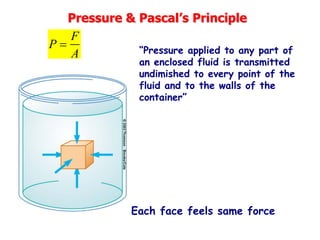
Pressure & Pascal’s Principle 
“Pressure applied to any part of an enclosed fluid is transmitted undimished to every point of the fluid and to the walls of the container” 
Each face feels same force 
P FA
Transmitting force 
An applied force F1 can be “amplified”: 
Hydraulic press 
Examples: hydraulic brakes, forklifts, car lifts, etc. 
P F1A1  F2A2F2F1A2A1
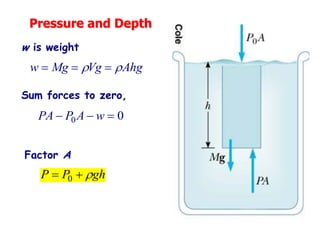
Pressure and Depth 
w is weight 
Sum forces to zero, 
Factor A 
wMgVgAhgPAP0Aw0PP0gh
Example 9.5 (skip) 
Find the pressure at 10,000 m of water. 
DATA: Atmospheric pressure = 1.015x10⁵ Pa. 
9.82x10⁷ Pa
Example 9.6 
Assume the ultimate strength of legos is 4.0x10⁴ Pa. If the density of legos is 150 kg/m3, what is 
the maximum possible height for a lego tower? 
27.2 m
Example 9.7 
Estimate the mass of the Earth’s atmosphere given that atmospheric pressure is 1.015x10⁵ Pa. Data: Rearth=6.36x10⁶ m 
5.26x10¹⁸ kg
Archimedes Principle 
Any object completely or partially submerged in a fluid is buoyed up by a force whose magnitude is equal to the weight of the fluid displaced by the object.
Example 9.8 
A helicopter lowers a probe into Lake Michigan which is suspended on a cable. The probe has a mass of 500 kg and its average density is 1400 kg/m3. What is the tension in the cable? 
1401 N
Example 9.9a 
A wooden ball of mass M and volume V floats on a swimming pool. The density of the wood is wood <H20. The buoyant force acting on the ball is: 
a) Mg upward 
b) H20gV upward 
c) (H20-wood)gV upward
Example 9.9b 
A steel ball of mass M and volume V rests on the bottom of a swimming pool. The density of the steel is steel >H20. The buoyant force acting on the ball is: 
a) Mg upward 
b) H20gV upward 
c) (steel-H20)gV upward
Example 9.10 
A small swimming pool has an area of 10 square meters. A wooden 4000-kg statue of density 500 kg/m3 is then floated on top of the pool. How far does the water rise? 
Data: Density of water = 1000 kg/m3 
40 cm
Paint Thinner Demo (SKIP) 
When I pour in the paint thinner, the cylinder will: 
a) Rise 
b) Fall
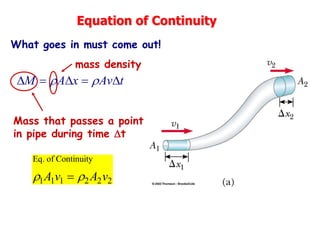
Equation of Continuity 
What goes in must come out! 
Mass that passes a point in pipe during time Dt 
mass density DMADxAvDtEq. of Continuity 1A1v12A2v2
Example 9.11 
Water flows through a 4.0 cm diameter pipe at 5 cm/s. The pipe then narrows downstream and has a diameter of of 2.0 cm. What is the velocity of the water through the smaller pipe? 
20 cm/s
Laminar or Streamline Flow 
•Fluid elements move along smooth paths 
•Friction in laminar flow is called viscosity
Turbulence 
•Fluid elements move along irregular paths 
•Sets in for high velocity gradients (small pipes)
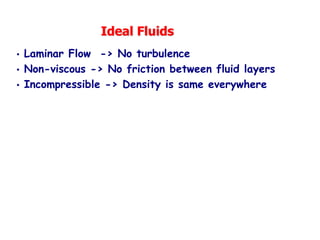
Ideal Fluids 
• Laminar Flow -> No turbulence 
• Non-viscous -> No friction between fluid layers 
• Incompressible -> Density is same everywhere
Bernoulli’s Equation 
Sum of P, KE/V and PE/V is constant 
How can we derive this? 
P 12 v2gyconstant
Bernoulli’s Equation: derivation 
Consider a volume DV of mass DM of incompressible fluid, 
DKE 12Mv22 12Mv12  12 DVv22 12 DVv12DPEMgy2Mgy1 DVgy2DVgy1WF1Dx1F2Dx2 P1A1Dx1P2A2Dx2 P1DVP2DVP1gh1 12 v12P2gh2 12 v22
Example 9.12 
A very large pipe carries water with a very slow velocity and empties into a small pipe with a high velocity. If P2 is 7000 Pa lower than P1, what is the velocity of the water in the small pipe? 
3.74 m/s 
Venturi Meter
Applications of Bernoulli’s Equation 
•Venturi meter 
•Curve balls 
•Airplanes Beach Ball & Straws Demos
Example 9.13a 
Consider an ideal incompressible fluid, choose >, < or = 1 ____ 2 
a) = 
b) < 
c) >
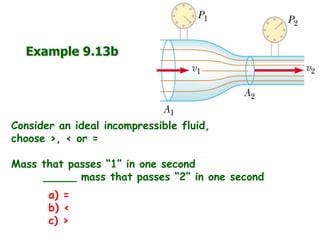
Example 9.13b 
Consider an ideal incompressible fluid, 
choose >, < or = 
Mass that passes “1” in one second _____ mass that passes “2” in one second 
a) = 
b) < 
c) >
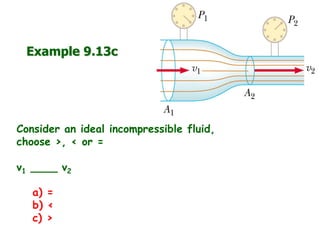
Example 9.13c 
Consider an ideal incompressible fluid, 
choose >, < or = 
v1 ____ v2 
a) = 
b) < 
c) >
Example 9.13d 
Consider an ideal incompressible fluid, choose >, < or = P1 ____ P2 
a) = 
b) < 
c) >
Example 9.14 
Water drains out of the bottom of a cooler at 3 m/s, what is the depth of the water above the valve? 
a 
b 
45.9 cm
Three Vocabulary Words 
•Viscosity 
•Diffusion 
•Osmosis
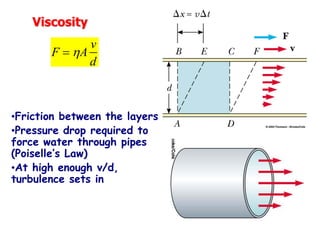
Viscosity 
•Friction between the layers 
•Pressure drop required to force water through pipes (Poiselle’s Law) 
•At high enough v/d, turbulence sets in 
FAvd
Diffusion 
•Molecules move from region of high concentration to region of low concentration 
•Fick’s Law: 
•D = diffusion coefficient 
Diffusionrate Masstime DAC2C1L    
Osmosis 
Movement of water through a boundary while denying passage to specific molecules, e.g. salts

Lecture 5 3_pascal_principle

  • 1.
    Fluids Mechanics •Pascal Principle • Bernoulli’s Equation
  • 2.
    Pressure & Pascal’sPrinciple “Pressure applied to any part of an enclosed fluid is transmitted undimished to every point of the fluid and to the walls of the container” Each face feels same force P FA
  • 3.
    Transmitting force Anapplied force F1 can be “amplified”: Hydraulic press Examples: hydraulic brakes, forklifts, car lifts, etc. P F1A1  F2A2F2F1A2A1
  • 4.
    Pressure and Depth w is weight Sum forces to zero, Factor A wMgVgAhgPAP0Aw0PP0gh
  • 5.
    Example 9.5 (skip) Find the pressure at 10,000 m of water. DATA: Atmospheric pressure = 1.015x10⁵ Pa. 9.82x10⁷ Pa
  • 6.
    Example 9.6 Assumethe ultimate strength of legos is 4.0x10⁴ Pa. If the density of legos is 150 kg/m3, what is the maximum possible height for a lego tower? 27.2 m
  • 7.
    Example 9.7 Estimatethe mass of the Earth’s atmosphere given that atmospheric pressure is 1.015x10⁵ Pa. Data: Rearth=6.36x10⁶ m 5.26x10¹⁸ kg
  • 8.
    Archimedes Principle Anyobject completely or partially submerged in a fluid is buoyed up by a force whose magnitude is equal to the weight of the fluid displaced by the object.
  • 9.
    Example 9.8 Ahelicopter lowers a probe into Lake Michigan which is suspended on a cable. The probe has a mass of 500 kg and its average density is 1400 kg/m3. What is the tension in the cable? 1401 N
  • 10.
    Example 9.9a Awooden ball of mass M and volume V floats on a swimming pool. The density of the wood is wood <H20. The buoyant force acting on the ball is: a) Mg upward b) H20gV upward c) (H20-wood)gV upward
  • 11.
    Example 9.9b Asteel ball of mass M and volume V rests on the bottom of a swimming pool. The density of the steel is steel >H20. The buoyant force acting on the ball is: a) Mg upward b) H20gV upward c) (steel-H20)gV upward
  • 12.
    Example 9.10 Asmall swimming pool has an area of 10 square meters. A wooden 4000-kg statue of density 500 kg/m3 is then floated on top of the pool. How far does the water rise? Data: Density of water = 1000 kg/m3 40 cm
  • 13.
    Paint Thinner Demo(SKIP) When I pour in the paint thinner, the cylinder will: a) Rise b) Fall
  • 14.
    Equation of Continuity What goes in must come out! Mass that passes a point in pipe during time Dt mass density DMADxAvDtEq. of Continuity 1A1v12A2v2
  • 15.
    Example 9.11 Waterflows through a 4.0 cm diameter pipe at 5 cm/s. The pipe then narrows downstream and has a diameter of of 2.0 cm. What is the velocity of the water through the smaller pipe? 20 cm/s
  • 16.
    Laminar or StreamlineFlow •Fluid elements move along smooth paths •Friction in laminar flow is called viscosity
  • 17.
    Turbulence •Fluid elementsmove along irregular paths •Sets in for high velocity gradients (small pipes)
  • 18.
    Ideal Fluids •Laminar Flow -> No turbulence • Non-viscous -> No friction between fluid layers • Incompressible -> Density is same everywhere
  • 19.
    Bernoulli’s Equation Sumof P, KE/V and PE/V is constant How can we derive this? P 12 v2gyconstant
  • 20.
    Bernoulli’s Equation: derivation Consider a volume DV of mass DM of incompressible fluid, DKE 12Mv22 12Mv12  12 DVv22 12 DVv12DPEMgy2Mgy1 DVgy2DVgy1WF1Dx1F2Dx2 P1A1Dx1P2A2Dx2 P1DVP2DVP1gh1 12 v12P2gh2 12 v22
  • 21.
    Example 9.12 Avery large pipe carries water with a very slow velocity and empties into a small pipe with a high velocity. If P2 is 7000 Pa lower than P1, what is the velocity of the water in the small pipe? 3.74 m/s Venturi Meter
  • 22.
    Applications of Bernoulli’sEquation •Venturi meter •Curve balls •Airplanes Beach Ball & Straws Demos
  • 23.
    Example 9.13a Consideran ideal incompressible fluid, choose >, < or = 1 ____ 2 a) = b) < c) >
  • 24.
    Example 9.13b Consideran ideal incompressible fluid, choose >, < or = Mass that passes “1” in one second _____ mass that passes “2” in one second a) = b) < c) >
  • 25.
    Example 9.13c Consideran ideal incompressible fluid, choose >, < or = v1 ____ v2 a) = b) < c) >
  • 26.
    Example 9.13d Consideran ideal incompressible fluid, choose >, < or = P1 ____ P2 a) = b) < c) >
  • 27.
    Example 9.14 Waterdrains out of the bottom of a cooler at 3 m/s, what is the depth of the water above the valve? a b 45.9 cm
  • 28.
    Three Vocabulary Words •Viscosity •Diffusion •Osmosis
  • 29.
    Viscosity •Friction betweenthe layers •Pressure drop required to force water through pipes (Poiselle’s Law) •At high enough v/d, turbulence sets in FAvd
  • 30.
    Diffusion •Molecules movefrom region of high concentration to region of low concentration •Fick’s Law: •D = diffusion coefficient Diffusionrate Masstime DAC2C1L    
  • 31.
    Osmosis Movement ofwater through a boundary while denying passage to specific molecules, e.g. salts