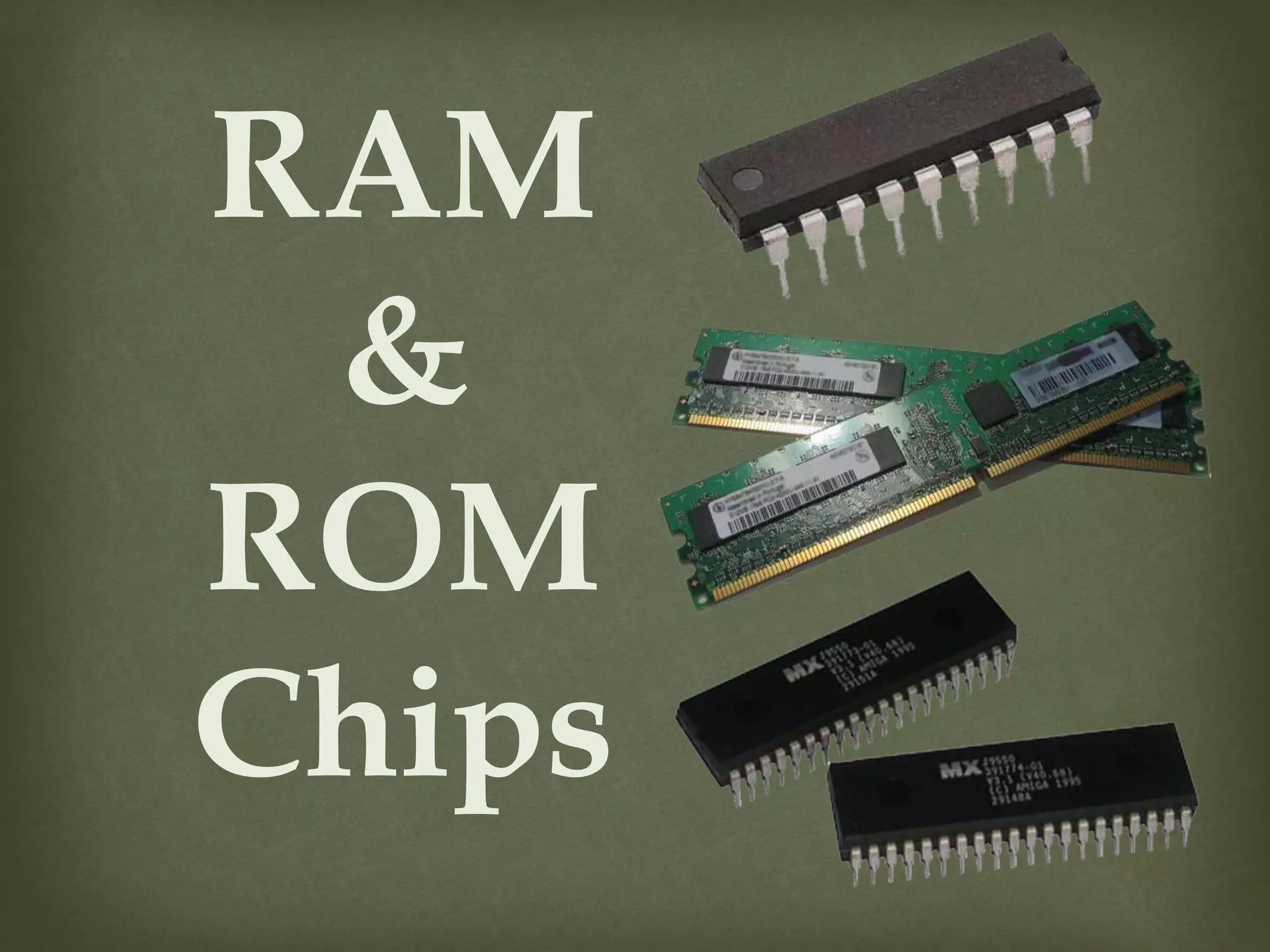
RAM
&
ROM
Chips

BY: Adeel Rasheed

Short History.
Definitions of RAM & ROM.
Difference Between RAM & ROM.
Working / Logic Gates / Design.
Advantages & Disadvantages.
Contents
 Robert Dennard:
Robert Dennard was the inventor of ram: random
access memory, the device was patented in 1968 by
Dennard.
 Jay Forrester
 An Wang
 Kenneth Olsen
 invented in 1956,
 1965 Sylvania
 1970s Fairchild, Intel, Motorola
History
Intel's 1103 was the
world's first available
dynamic RAM chip
 Random Access Memory or RAM is a form
of data storage that can be accessed
randomly at any time in any order and from
any physical location allowing quick access
and manipulation.
Read-only memory or ROM is also a form
of data storage that can not be easily altered
or reprogrammed. Stores instructions that
are not necessary for re-booting up to make
the computer operate when it is switched
off. They are hardwired.
Definitions

Difference
 RAM is volatile i.e. its
contents are lost when
the device is powered
off.
 The two main types of
RAM are static RAM
and dynamic RAM.
 It is non-volatile i.e. its
contents are retained
even when the device
is powered off.
 For Boot your PC
 The types of ROM
include PROM,
EPROM and EEPROM.

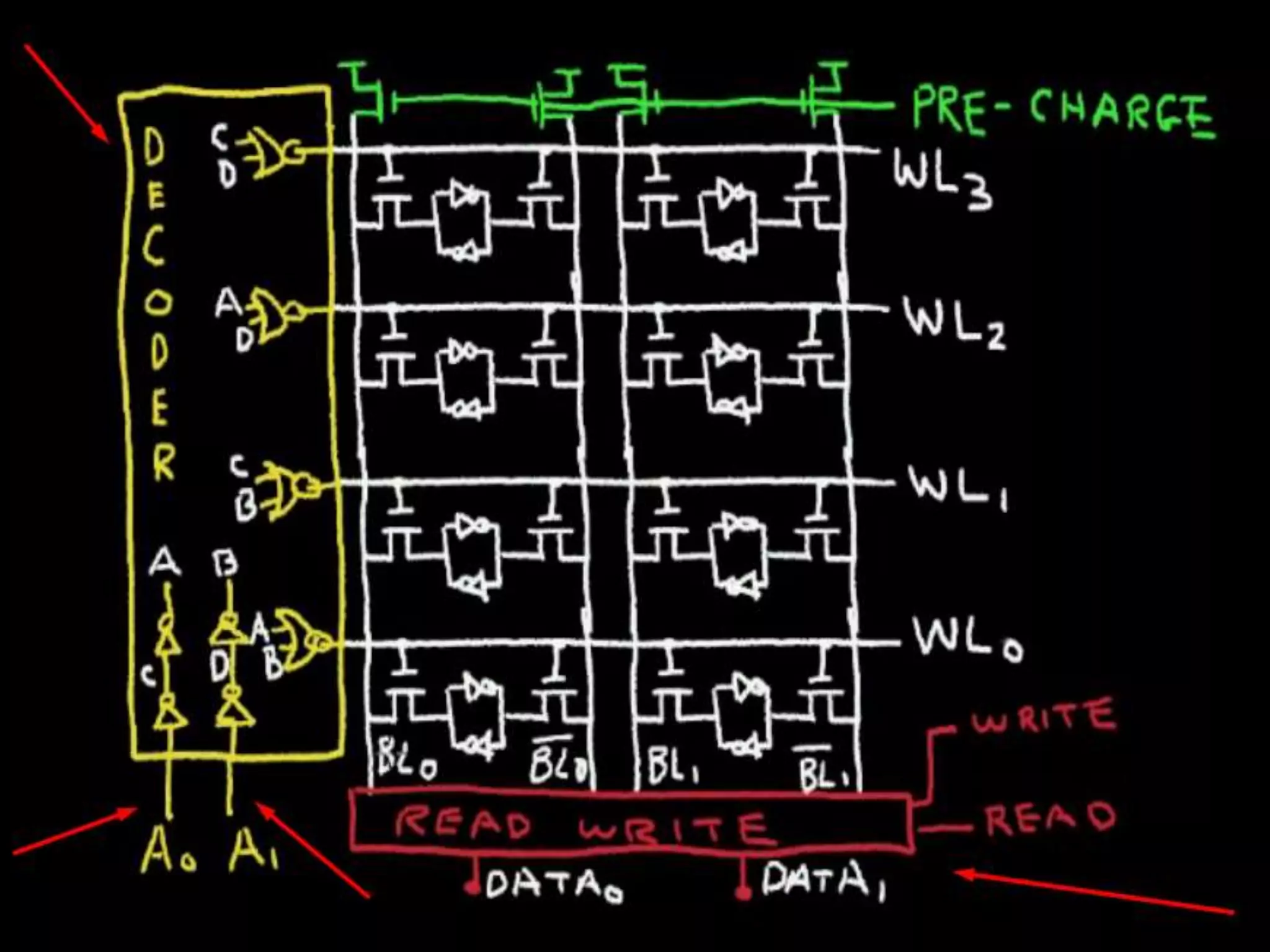
RAM Working/Gates

ROM Working/Gates
Silent: since there are no moving parts
RAM operation is completely silent.
Power-efficient: for the same reasons, RAM
uses much less power than disk drives.
 Reduce your CO2 emissions and extend
your battery life.
Advantages

Volatile: a power outage will cause
irrecoverable data loss, unless there is some
power backup system like a laptop battery.
Space-limited: RAM cost per bit is high, so
computers don’t include too much of it.
Disadvantages
RAM and ROM Chips

RAM and ROM Chips

  • 1.
  • 2.
  • 3.
     Short History. Definitions ofRAM & ROM. Difference Between RAM & ROM. Working / Logic Gates / Design. Advantages & Disadvantages. Contents
  • 4.
     Robert Dennard: RobertDennard was the inventor of ram: random access memory, the device was patented in 1968 by Dennard.  Jay Forrester  An Wang  Kenneth Olsen  invented in 1956,  1965 Sylvania  1970s Fairchild, Intel, Motorola History Intel's 1103 was the world's first available dynamic RAM chip
  • 5.
     Random AccessMemory or RAM is a form of data storage that can be accessed randomly at any time in any order and from any physical location allowing quick access and manipulation. Read-only memory or ROM is also a form of data storage that can not be easily altered or reprogrammed. Stores instructions that are not necessary for re-booting up to make the computer operate when it is switched off. They are hardwired. Definitions
  • 6.
     Difference  RAM isvolatile i.e. its contents are lost when the device is powered off.  The two main types of RAM are static RAM and dynamic RAM.  It is non-volatile i.e. its contents are retained even when the device is powered off.  For Boot your PC  The types of ROM include PROM, EPROM and EEPROM.
  • 7.
  • 10.
  • 13.
    Silent: since thereare no moving parts RAM operation is completely silent. Power-efficient: for the same reasons, RAM uses much less power than disk drives.  Reduce your CO2 emissions and extend your battery life. Advantages
  • 14.
     Volatile: a poweroutage will cause irrecoverable data loss, unless there is some power backup system like a laptop battery. Space-limited: RAM cost per bit is high, so computers don’t include too much of it. Disadvantages