Drying process for grains
Submitted by:
Pinki Chowhan
3rd Year (5th Semester)
Regd. No.
213430103420003
Roll No. 34303421027
Subject Details:
Food Process Technology-I
Code: PC-FT501
Food Technology Department
Hemnalini Memorial College of Engineering
(Affilated by MAKAUT)
Content
• Introduction
• Importance of drying
• Moisture content
• Types of drying methods
• Different dryers
• Flat bed dryer
• Mechanical tray dryer
• Solar dryer
• Conclusion
Introduction
• Dehydration is termed as removal of moisture from grain
to very low levels usually to bone dry condition.
• Drying refers to removal of moisture from grains and other
products to a predetermined level which provides a safe
level to store the grain for longer time period.
• The predetermine level of moisture removal retains the
nutritional quality of food material otherwise over drying
may deteriorate the nutritional composition of food
material.
• Drying is one of the oldest methods of food preservation.
• Drying is a thermo-physical and physio-chemical operation
by which excess moisture from a product is removed.
• Drying makes the food grains and other products suitable
for safe storage and protects them against attack of insects,
mold and other micro-organisms during storage.
Importance of drying process
• It minimizes microbial spoilage and chemical deteriorative
reactions greatly which provides safe storage facility for
long time.
• It Permits continuous supply of product thro’out the year
• Permits early harvest which reduces field damage and
shattering loss
• Permits the farmers to have better quality product
• Makes products available during off season
• The reduced weight of dried products decreases packaging,
handling and transportation costs.
• Most food products are dried for improved milling or
mixing characteristics in further processing.
• It helps in preparing different food product development.
Moisture content
• The water content of agricultural product is
given in terms of moisture content.
• It is the percentage of water content present in
product. It is designated by two methods
1. wet basis
2. dry basis
Drying methods
• Sun drying
• Conduction drying
• Convection drying
• Radiation drying
• Freeze drying
• Osmotic drying
• Fluidized bed drying
• Dielectric drying
• Thin layer drying
• Deep bed drying
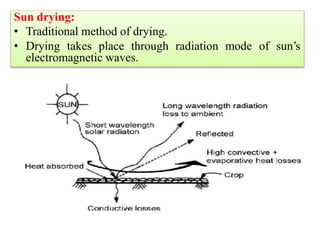
Sun drying:
• Traditional method of drying.
• Drying takes place through radiation mode of sun’s
electromagnetic waves.
Conduction or contact drying:
• Heat is transferred to wet material mainly by conduction mode
through solid surface.
• Surface temperatures may vary widely.
• Dryers can be operated under low pressure and in inert atmosphere.
• Dust and dusty material can be removed easily.
Convection drying:
• Drying agent is hot gas or hot air and supplies heat to the wet grain.
• Steam heated air, direct flue gases of agricultural waste etc. can be
used as drying agents.
• Drying temperature varies widely.
• If atmospheric humidity is high, natural air drying needs
dehumidification.
• Fuel consumption is high as compare to conduction drying for same
capacity.
• Ex: fluidized bed dryer, hot air oven dryer
Radiation drying:
• Based on absorption of radiant energy of sun and
transformation into heat energy by grain.
• Moisture movement and evaporation is caused by temperature
difference and partial pressure of water vapor b/w surrounding
air.
• Ex: sun drying
Freeze drying:
• Drying is based on the sublimation (solid to gas) of frozen
moisture from wet product placed in a drying chamber.
• Works at low pressure.
• Heat is supplied by radiation or conduction mode.
Osmotic drying:
• Moisture is removed using osmo-active substance like, 60%
aqueous solution of saccharose or 25% aqueous NaCl.
• Concentration difference generated on both sides of the semi
permeable membrane.
Fluidized bed drying:
• Products are being dried under fluidized condition.
• Fluidization occurs by drying air with sufficient high velocity
to cause suspension.
• High rate of moisture migration takes place.
• Uniform drying.
• Used for high initial moisture content and lighter material.
Dielectric drying:
• Heat is generated within the solid by placing it in fixed high
frequency current.
• Polar molecules of substance get polarized and begin to
oscillate in accordance with the frequency.
• Oscillation causes friction which generates heat within the
food stuff.
• Ex: microwave heating.
Thin layer drying
• Process in which all grains are fully exposed to
the drying air under constant drying conditions
i.e. at constant air temp. & humidity.
• Drying rate is independent of air velocity.
• Up to 20 cm thickness of grain bed is taken as
thin layer
• All commercial dryers are designed based on
thin layer drying principles.
Deep bed drying
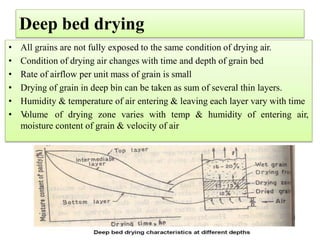
• All grains are not fully exposed to the same condition of drying air.
• Condition of drying air changes with time and depth of grain bed
• Rate of airflow per unit mass of grain is small
• Drying of grain in deep bin can be taken as sum of several thin layers.
• Humidity & temperature of air entering & leaving each layer vary with time
• V
olume of drying zone varies with temp & humidity of entering air,
moisture content of grain & velocity of air
Type of dryers
Flat bed type batch dryer
• This is a static, deep bed, batch dryer.
•Simple in design and most popular on farm.
Construction:
• It is a rectangular box type dryer.
• Size of dryer depends on area of the supporting perforated screen on
which grain is placed.
• Holding capacity- 0.25-1 tonn/batch.
•Motor capacity- 0.25-1 hp.
Operation:
• Grain is placed on supporting screen and heated air is forced through
the deep bed of grain.
• After desired moisture content observed, grain is discharged mannualy.
• Temperature of heated air should be limited upto 45oC.
• Air flow rate- 20 to 40 m3/min/1000kg of raw paddy on initial moisture
content.
Tray dryer
• In tray dryers, the food is spread out, generally quite
thinly, on trays in which the drying takes place.
• Heating may be by an air current sweeping across the
trays, or heated shelves on which the trays lie, or by
radiation from heated surfaces.
• Most tray dryers are heated by air, which also removes
the moist vapors.
• Many shallow trays are kept one above other with a gap
between.
• Tray may or may not have perforated bottoms.
• Generally used for vegetables and similar perishables.
• This is traditional method of drying of crops and
grains.
• Using the energy of the sun to remove moisture from
the product.
• Traditional sun drying
• Mechanical solar drying
Solar drying
CONCLUSION
• As shown different food products should be
stored at different moisture contents.
• If moisture content is more than the optimum
deterioration increases resulting in great loss.
• Therefore, dryers play an important role in
these days where food security is one of the
major problem.

drying process for grain.pptx

  • 1.
    Drying process forgrains Submitted by: Pinki Chowhan 3rd Year (5th Semester) Regd. No. 213430103420003 Roll No. 34303421027 Subject Details: Food Process Technology-I Code: PC-FT501 Food Technology Department Hemnalini Memorial College of Engineering (Affilated by MAKAUT)
  • 2.
    Content • Introduction • Importanceof drying • Moisture content • Types of drying methods • Different dryers • Flat bed dryer • Mechanical tray dryer • Solar dryer • Conclusion
  • 3.
    Introduction • Dehydration istermed as removal of moisture from grain to very low levels usually to bone dry condition. • Drying refers to removal of moisture from grains and other products to a predetermined level which provides a safe level to store the grain for longer time period. • The predetermine level of moisture removal retains the nutritional quality of food material otherwise over drying may deteriorate the nutritional composition of food material. • Drying is one of the oldest methods of food preservation. • Drying is a thermo-physical and physio-chemical operation by which excess moisture from a product is removed. • Drying makes the food grains and other products suitable for safe storage and protects them against attack of insects, mold and other micro-organisms during storage.
  • 4.
    Importance of dryingprocess • It minimizes microbial spoilage and chemical deteriorative reactions greatly which provides safe storage facility for long time. • It Permits continuous supply of product thro’out the year • Permits early harvest which reduces field damage and shattering loss • Permits the farmers to have better quality product • Makes products available during off season • The reduced weight of dried products decreases packaging, handling and transportation costs. • Most food products are dried for improved milling or mixing characteristics in further processing. • It helps in preparing different food product development.
  • 5.
    Moisture content • Thewater content of agricultural product is given in terms of moisture content. • It is the percentage of water content present in product. It is designated by two methods 1. wet basis 2. dry basis
  • 6.
    Drying methods • Sundrying • Conduction drying • Convection drying • Radiation drying • Freeze drying • Osmotic drying • Fluidized bed drying • Dielectric drying • Thin layer drying • Deep bed drying
  • 7.
    Sun drying: • Traditionalmethod of drying. • Drying takes place through radiation mode of sun’s electromagnetic waves.
  • 8.
    Conduction or contactdrying: • Heat is transferred to wet material mainly by conduction mode through solid surface. • Surface temperatures may vary widely. • Dryers can be operated under low pressure and in inert atmosphere. • Dust and dusty material can be removed easily. Convection drying: • Drying agent is hot gas or hot air and supplies heat to the wet grain. • Steam heated air, direct flue gases of agricultural waste etc. can be used as drying agents. • Drying temperature varies widely. • If atmospheric humidity is high, natural air drying needs dehumidification. • Fuel consumption is high as compare to conduction drying for same capacity. • Ex: fluidized bed dryer, hot air oven dryer
  • 9.
    Radiation drying: • Basedon absorption of radiant energy of sun and transformation into heat energy by grain. • Moisture movement and evaporation is caused by temperature difference and partial pressure of water vapor b/w surrounding air. • Ex: sun drying Freeze drying: • Drying is based on the sublimation (solid to gas) of frozen moisture from wet product placed in a drying chamber. • Works at low pressure. • Heat is supplied by radiation or conduction mode. Osmotic drying: • Moisture is removed using osmo-active substance like, 60% aqueous solution of saccharose or 25% aqueous NaCl. • Concentration difference generated on both sides of the semi permeable membrane.
  • 10.
    Fluidized bed drying: •Products are being dried under fluidized condition. • Fluidization occurs by drying air with sufficient high velocity to cause suspension. • High rate of moisture migration takes place. • Uniform drying. • Used for high initial moisture content and lighter material. Dielectric drying: • Heat is generated within the solid by placing it in fixed high frequency current. • Polar molecules of substance get polarized and begin to oscillate in accordance with the frequency. • Oscillation causes friction which generates heat within the food stuff. • Ex: microwave heating.
  • 11.
    Thin layer drying •Process in which all grains are fully exposed to the drying air under constant drying conditions i.e. at constant air temp. & humidity. • Drying rate is independent of air velocity. • Up to 20 cm thickness of grain bed is taken as thin layer • All commercial dryers are designed based on thin layer drying principles.
  • 12.
    Deep bed drying •All grains are not fully exposed to the same condition of drying air. • Condition of drying air changes with time and depth of grain bed • Rate of airflow per unit mass of grain is small • Drying of grain in deep bin can be taken as sum of several thin layers. • Humidity & temperature of air entering & leaving each layer vary with time • V olume of drying zone varies with temp & humidity of entering air, moisture content of grain & velocity of air
  • 13.
  • 14.
    Flat bed typebatch dryer • This is a static, deep bed, batch dryer. •Simple in design and most popular on farm. Construction: • It is a rectangular box type dryer. • Size of dryer depends on area of the supporting perforated screen on which grain is placed. • Holding capacity- 0.25-1 tonn/batch. •Motor capacity- 0.25-1 hp. Operation: • Grain is placed on supporting screen and heated air is forced through the deep bed of grain. • After desired moisture content observed, grain is discharged mannualy. • Temperature of heated air should be limited upto 45oC. • Air flow rate- 20 to 40 m3/min/1000kg of raw paddy on initial moisture content.
  • 15.
    Tray dryer • Intray dryers, the food is spread out, generally quite thinly, on trays in which the drying takes place. • Heating may be by an air current sweeping across the trays, or heated shelves on which the trays lie, or by radiation from heated surfaces. • Most tray dryers are heated by air, which also removes the moist vapors. • Many shallow trays are kept one above other with a gap between. • Tray may or may not have perforated bottoms. • Generally used for vegetables and similar perishables.
  • 16.
    • This istraditional method of drying of crops and grains. • Using the energy of the sun to remove moisture from the product. • Traditional sun drying • Mechanical solar drying Solar drying
  • 17.
    CONCLUSION • As showndifferent food products should be stored at different moisture contents. • If moisture content is more than the optimum deterioration increases resulting in great loss. • Therefore, dryers play an important role in these days where food security is one of the major problem.