1
Dryin
g
Prepared by
Ms. Mariyambibi Mandarawala
Assistant professor,
KSP,KPGU
DRYING
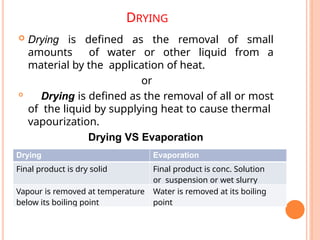
 Drying is defined as the removal of small
amounts of water or other liquid from a
material by the application of heat.
or

Drying is defined as the removal of all or most
of the liquid by supplying heat to cause thermal
vapourization.
Drying VS Evaporation
Drying Evaporation
Final product is dry solid Final product is conc. Solution
or suspension or wet slurry
Vapour is removed at temperature
below its boiling point
Water is removed at its boiling
point
APPLICATIONS OF DRYING
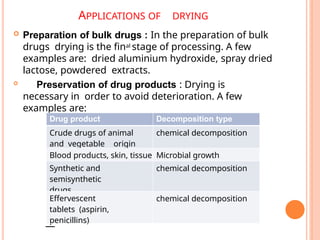
 Preparation of bulk drugs : In the preparation of bulk
drugs drying is the final stage of processing. A few
examples are: dried aluminium hydroxide, spray dried
lactose, powdered extracts.
 Preservation of drug products : Drying is
necessary in order to avoid deterioration. A few
examples are:
—
Drug product Decomposition type
Crude drugs of animal
and vegetable origin
chemical decomposition
Blood products, skin, tissue Microbial growth
Synthetic and
semisynthetic
drugs
chemical decomposition
Effervescent
tablets (aspirin,
penicillins)
chemical decomposition
 Improved characteristics : Drying produces
materials of spherical shape, uniform size, free
flowing and enhanced solubility.
Some specific areas of importance are:
(1)Granules are dried to improve the fluidity
and compression characteristics.
(2) Viscous and sticky materials are not free
flowing.
Drying modifies these characteristics.
 Improved handling : Removal of moisture makes
the material light in weight and reduces the bulk.
Thus cost of transportation will be less and storage
will be efficient. If moisture is present, size
reduction of drugs is difficult.
TERMS IN DRYING
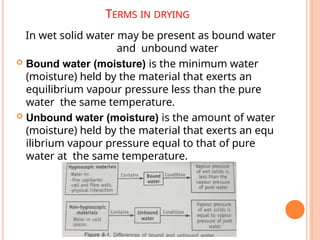
In wet solid water may be present as bound water
and unbound water
 Bound water (moisture) is the minimum water
(moisture) held by the material that exerts an
equilibrium vapour pressure less than the pure
water the same temperature.
 Unbound water (moisture) is the amount of water
(moisture) held by the material that exerts an equ
ilibrium vapour pressure equal to that of pure
water at the same temperature.
MECHANISM OF DRYING PROCESS
• Into the dryer, warm air stream is introduced to
provide the latent heat.
• This. heat is taken up by the material and the
moisture evaporates.
Drying is a three step process:
1. Heat transfer takes place from the heating
medium to the solid material.
2. Mass transfer involves the transfer of moisture to
the surface of .solids and subsequently
vapourisation from the surface in to surrounding.
3. Transfer of relased vapour away from
pharmaceutical material and out of drying
equipment.
THEORIES OF DRYING MECHANISM
Diffusion theory
 Diffusion theory the rate of flow of water iis
proportional to moisture gradient.
 According to this theory, moisture movement may
be as
follows.
1. Water diffuses through the solid to the surface
and subsequently evaporates into the
surroundings.
2. Evaporation of water occurs at an intermediate
zone, much below the solid surface, then
vapours diffuse through the solid into air.
Capillarity theory
 Capillarity theory is applicable to porous granu-
lar solids with network of inter-connected pores
and channels.
 As the drying starts, a meniscus is formed in the
capillary and exerts a force.
 This is the driving force for the movement of
water through pores towards the surface.
 The capillary force is greater in small pores
Compared to the large pores. Therefore, small pores
pull more water from the larger pores and thus large
pores get emptied first.
 This theory is applicable to hygroscopic material.
Pressure gradient theory
 Pressure gradient theory is applicable to drying of
solids
by the application of radiation.
 The radiation generates internal heat interacts with
the polarized molecules and ions of the material.
 This field aligns the molecules in order, which are
otherwise randomly oriented.
 When the field is reversed, the molecules return to
the original orientation giving up kinetic
energy( heat) inside the solid surface and liquid is
vaporised.
EQUILIBRIUM MOISTURE CONTENT (EMC)
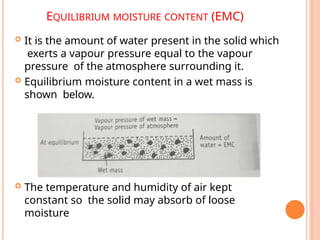
 It is the amount of water present in the solid which
exerts a vapour pressure equal to the vapour
pressure of the atmosphere surrounding it.
 Equilibrium moisture content in a wet mass is
shown below.
 The temperature and humidity of air kept
constant so the solid may absorb of loose
moisture
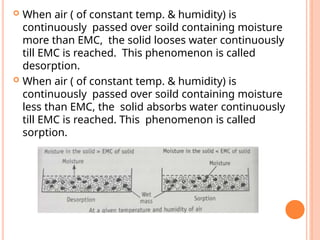
 When air ( of constant temp. & humidity) is
continuously passed over soild containing moisture
more than EMC, the solid looses water continuously
till EMC is reached. This phenomenon is called
desorption.
 When air ( of constant temp. & humidity) is
continuously passed over soild containing moisture
less than EMC, the solid absorbs water continuously
till EMC is reached. This phenomenon is called
sorption.
MEASUREMENT OF EMC
Procedure:
1. The solid samples are placed in a series of
closed chambers such as desiccators.
2. Each chamber consists of solution (desiccant),
where samples are exposed to different humidity
conditions.
3. The exposure is continued until the material
attains a constant weight
4. The difference in the final and initial weights
gives the
moisture content.
5. The moisture content is measured twice; before
keep ing the material into the storage bin and
while taking out the material.
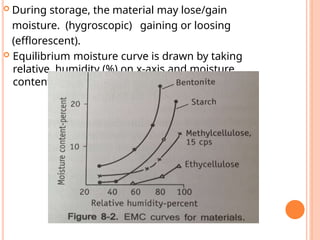
 During storage, the material may lose/gain
moisture. (hygroscopic) gaining or loosing
(efflorescent).
 Equilibrium moisture curve is drawn by taking
relative humidity (%) on x-axis and moisture
content on y-axis
APPLICATIONS OF EMC
1. The EMC curve permits the selection of
experimental conditions to be used for drying
the product.
2. Drying should be stopped when the moisture
content reaches the level of the EMC .
3. Over drying can be avoided, because overdried
product quickly regains the moisture from the
ambient conditions.
4. If the moisture content is to be reduced, the
relative humidity of the ambient air must be
reduced as a first step.
 This can be done mechanically on a large scale
using an
air-conditioning system.
 On scale dessiccators can be used.
FACTORS AFFECTING EMC
 Nature of material:
1. Nonporous insoluble solids have an EMC of
practically zero. e.g. talc and zinc oxide.
2. For fibrous or colloidal organic substances, the
EMC
values are high and variable.
For example, cotton fabric has high EMC (10
to 15 %) under normal atmospheric conditions.
3. For porous solids, the EMC values are much higher
and variable. The water may be held in fine
capillaries that have no access to the surface.
 Nature of air:
1. For air of zero humidity, EMC of all materials is zero.
2. As the temperature of air increases, the EMC of
solid decreases
TERMS IN DRYING
 Free moisture content:
It is amount ofwater that is free to evaporate from
solid
surface.
Free moisture content = total water content – EMC
 % loss on drying (LOD) =
mass of water in
sample
X 100
total mass of wet sample
 % Moisture content =
mass of water in sample X
100
mass of dry sample
DRYING RATE
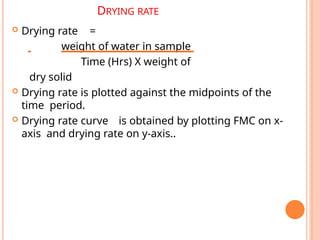
 Drying rate =
weight of water in sample
Time (Hrs) X weight of
dry solid
 Drying rate is plotted against the midpoints of the
time period.
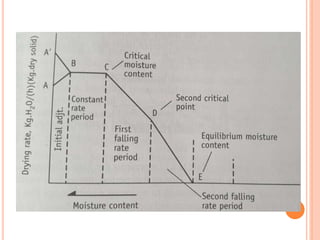
 Drying rate curve is obtained by plotting FMC on x-
axis and drying rate on y-axis..
1. Initial Adjustment
Period
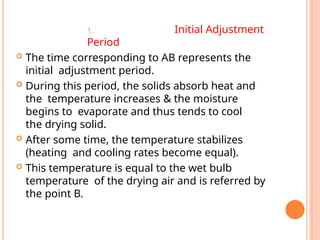
 The time corresponding to AB represents the
initial adjustment period.
 During this period, the solids absorb heat and
the temperature increases & the moisture
begins to evaporate and thus tends to cool
the drying solid.
 After some time, the temperature stabilizes
(heating and cooling rates become equal).
 This temperature is equal to the wet bulb
temperature of the drying air and is referred by
the point B.
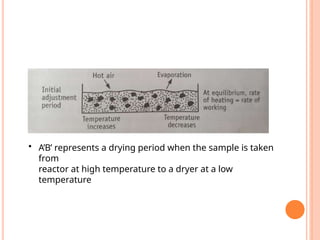
• A’B’ represents a drying period when the sample is taken
from
reactor at high temperature to a dryer at a low
temperature
2. Constant rate period
 The time corresponding to BC represents the
constant rate period .
 The temperature remains constant and rate of
drying is constant.
 The moisture evaporating from the surface is
replaced by the water diffusing fromthe interior of
the solid.
 The rate of diffusion is equal to the rate of
evaporation.
 At this stage the temperature is similar to wet
bulb temperature.
 When all other variables are kept constant, the
constant drying rate is in_dependent of the material
being dried.
 As the water is freely remove, particle size of the
solids influences the drying rate.
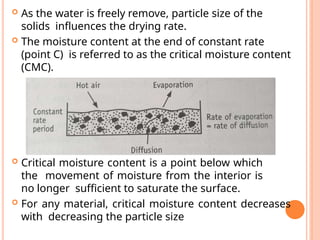
 The moisture content at the end of constant rate
(point C) is referred to as the critical moisture content
(CMC).
 Critical moisture content is a point below which
the movement of moisture from the interior is
no longer sufficient to saturate the surface.
 For any material, critical moisture content decreases
with decreasing the particle size
3. First falling period
1. The time corresponding to CD represents the
first falling rate period
2. During this period, the surface water is no longer
replaced at a rate fast enough to maintain a
continuous film on the surface.
3. Dry spots begin to appear and the rate of
drying begins to fall off.
4. For first-falling rate period, the temperature of the
solid surface is above the wet-bulb temperature.
The point D is referred to as the second critical
point.
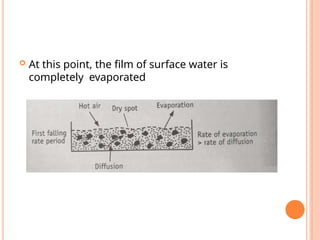
 At this point, the film of surface water is
completely evaporated
4. Second falling period
 The time corresponding to DE represents the
second Falling rate period.
 During this period, the rate of drying falls even
more rapidly than the first falling rate.

During this period, the rate of drying is dependent
on the rate of diffusion of vapour of moisture to the
surface of the solid.
 During the period, the surface temperature
approaches
the temperature of dry air. Point
 E is referred to as equilibrium moisture content.
 Beyond E, the drying rate is equal to zero. Hence
temperature and moisture content remain
constant.
 Beyond Point E continued drying is waste of
time & energy.
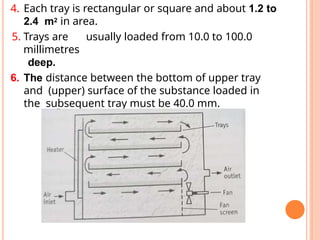
TRAY DRIER
 Principle
 Hot air is continuously circulated. Forced
convection heating takes place to remove moisture
from the solids spread in trays.
 Construction:
1. It consists of a rectangular chamber whose walls
are
insulated.
2. Trays are placed inside the heating chamber.
The number of trays may vary with the size of
the dryer.
3. laboratory size driers may contain three trays,
dryers of
industry size may contain more than 20 trays.
4. Each tray is rectangular or square and about 1.2 to
2.4 m2 in area.
5. Trays are usually loaded from 10.0 to 100.0
millimetres
deep.
6. The distance between the bottom of upper tray
and (upper) surface of the substance loaded in
the subsequent tray must be 40.0 mm.
Working:
1. Wet solid is loaded into trays. Trays are placed in
the chamber.
2. Fresh air is introduced through inlet, which
passes through the heaters and gets heated
up.
3. The hot air is circulated by means of fans at 2
to 5 m/s.
4. The water is picked up by air. As water evaporates
from the surface, the water diffuses from the
interior of the solid by capillary action.
5. Moist air is discharged through outlet.
6. Thus constant temperature and uniform airflow over
the material can be maintained for achieving
uniform drying.
 Uses
1. Sticky materials, plastic substances,. granular mass or
crystalline materials, precipitates and pastes ,Crude drugs,
chemicals, powders, granules can be dried.
 Advantages:
1. handling of materials (loading and unloading) can be done
without losses.
2. (2) Tray dryer is operated batch-wise.
(a) Each batch of material can be handled as a separate
entity.
(b)The batch sizes in the pharmaceutical industry are
relatively small (250 kg or less per batch) compared with the
chemical industry (1000 kg or more per hour).
(c)The same equipment is readily adjusted for use in
drying a wide variety of materials.
(d) Valuable products can be handled efficiently.
3. Temperature can be adjusted to meet the conditions of
Thermo sen-sitve materials.
 Disadvantages:
1. Require time and labour to load and unload.
2. Time consuming process.
3. Dusty solids cannot be dried.
Video links:
4. https://www.youtube.com/watch?v=fmrvZ1F9
x40
5. https://www.youtube.com/watch?v=TNtObZiI
8uo
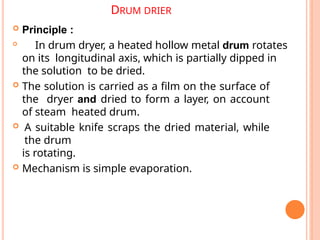
DRUM DRIER
 Principle :

In drum dryer, a heated hollow metal drum rotates
on its longitudinal axis, which is partially dipped in
the solution to be dried.
 The solution is carried as a film on the surface of
the dryer and dried to form a layer, on account
of steam heated drum.
 A suitable knife scraps the dried material, while
the drum
is rotating.
 Mechanism is simple evaporation.
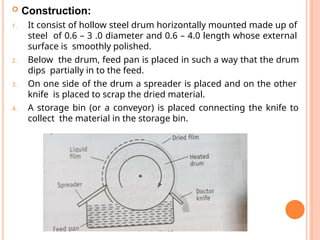
 Construction:
1. It consist of hollow steel drum horizontally mounted made up of
steel of 0.6 – 3 .0 diameter and 0.6 – 4.0 length whose external
surface is smoothly polished.
2. Below the drum, feed pan is placed in such a way that the drum
dips partially in to the feed.
3. On one side of the drum a spreader is placed and on the other
knife is placed to scrap the dried material.
4. A storage bin (or a conveyor) is placed connecting the knife to
collect the material in the storage bin.
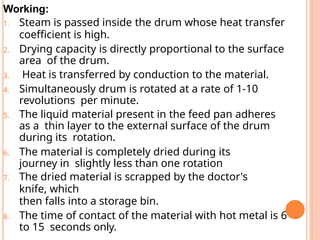
Working:
1. Steam is passed inside the drum whose heat transfer
coefficient is high.
2. Drying capacity is directly proportional to the surface
area of the drum.
3. Heat is transferred by conduction to the material.
4. Simultaneously drum is rotated at a rate of 1-10
revolutions per minute.
5. The liquid material present in the feed pan adheres
as a thin layer to the external surface of the drum
during its rotation.
6. The material is completely dried during its
journey in slightly less than one rotation
7. The dried material is scrapped by the doctor's
knife, which
then falls into a storage bin.
8. The time of contact of the material with hot metal is 6
to 15 seconds only.
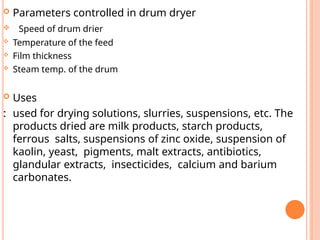
 Parameters controlled in drum dryer
 Speed of drum drier
 Temperature of the feed
 Film thickness
 Steam temp. of the drum
 Uses
: used for drying solutions, slurries, suspensions, etc. The
products dried are milk products, starch products,
ferrous salts, suspensions of zinc oxide, suspension of
kaolin, yeast, pigments, malt extracts, antibiotics,
glandular extracts, insecticides, calcium and barium
carbonates.
 Advantages:
1. In drum dryer, drying time is less, only a few
seconds. Therefore heat sensitive materials can
be dried.
2. (Drum dryer occupies less space, as it is compact
when
compared to spray dryer.
3. As a thin film of liquid is formed on the large
heating surface, mass transfer are high. & rates of
heat transfer
4. The product obtained is completely dried and is in
the final
form.
5. It is used for continuous drying/processing.
Disadvantages:
1. The initial purchase cost and the maintenance
cost of drum dryer are higher than spray
dryer.
2. Maintenance cost of a drum dryer is higher than
spray dryer.
3. Skilled operators are essential to control feed rate,
film thickness, speed of rotation and temperature.
4. it is not suitable for solutions of salts with less
solubility.
5. The heat treatment is higher than in spray drying.
The
solid product is less attractive.
Videos:
6. https://www.youtube.com/watch?v=msGOevNYVL4
SPRAY DYER
 Principle :
1. In spray dryer, the fluid to be dried is atomized
into fine droplets, on to a moving stream of hot
gas.
2. The heating medium (hot air) is in contact with the
material .
3. The temperature of the droplets is immediately
increased and fine droplets get dried instantaneously
in the form of spherical particles.
4. Drying takes place by simple evaporation rather
than boiling.
5. This process completes in a few seconds before
the droplets reach the wall of the dryer
 Construction :
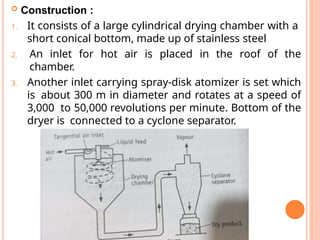
1. It consists of a large cylindrical drying chamber with a
short conical bottom, made up of stainless steel
2. An inlet for hot air is placed in the roof of the
chamber.
3. Another inlet carrying spray-disk atomizer is set which
is about 300 m in diameter and rotates at a speed of
3,000 to 50,000 revolutions per minute. Bottom of the
dryer is connected to a cyclone separator.
Working :
Drying of the material in spray dryer involves 3
stages.
(1) Atomization of the liquid.
(2) Mixing of droplets.
(3) Drying of the liquid droplets.
(4) Recovery of the dried product
Atomization of the liquid to form liquid droplets :
1. The feed is introduced through the atomizer by
using suitable pump to form fine droplets.
2. The properties of the final product depend on the
droplet.
3. Atomizer of any type; pneumatic atomizer, pressure
nozzle and spinning disc atomizer may be used.
4. The rate of feed is adjusted in such a way that the
droplets should be completely dried before reaching
the walls of the drying chamber. At the same time, the
product should not be over heated.
Drying of the liquid droplets :
1. Fine droplets are dried in the drying
chamber by supplying hot air through the
inlet.
2. The surface of the liquid drop is dried
immediately to form a tough shell.
3. The liquid inside must escape by diffusing through
the shell at a particular rate.
4. At the same time, heat transfer from outside to
inside takes place at a rate greater than liquid
diffusion rate which allows the liquid to
evaporate at a faster rate.
5. The temp. of air should be such that droplets
should be completely dried before reaching drying
chamber.
Recovery of dried product
1. Centrifugal force of atomizer drives the droplets to
follow helical path.
2. Particles are dried during their journey and finally fall
at the conical bottom.
3. All these processes are completed in a few seconds.
4. Particle size of the final product ranges from 2 to 500
µm.
5. Particle size depends on solid content in the feed,
liquid viscosity, feed rate and disc speed.
Uses :
 Spray dryers are used compulsorily when
(1)the product is a better form than that obtained by any
other dryer.
(2) the quantity of the material to be dried is large, and
(3)the product is thermolabile, hygroscopic or
undergoes chemical decomposition.
 Few products dried by spray dryer are: acacia, citric
acid, hormones,soaps, adrenaline, coffee extract,
detergents,milk,sulphur, blood extracts,vaccines.
 Advantages:
1. continuous process and drying is very rapid
which completes within 3 to 30 seconds.
2. Labour costs are low.
3. Free flowing product of uniform spheres
4. Fine droplets provide large surface area for
heat and mass transfer.
5. Product shows excellent solubility.
6. Either the solution or suspension or thin paste
can be dried
in one step to get the final product ready for
package.
7. It is suitable for the drying of sterile products.
8. Reconstituted product appears more or less similar to
the fresh material.
Disadvantages:
 Bulky equipment with high cost.
 Such a huge equipment is not always easy to
operate.
 The thermal efficiency is low, as much heat is lost in
the discharged gases.
Related videos:
1. https://www.youtube.com/watch?v=6Jj4RkvgH0c
2. https://www.youtube.com/watch?v=BwxOYVdpneU
3. https://www.youtube.com/watch?v=sK1UbVveBK8
FLUIDIZED BED DRYER
Principle :
1. In fluidised bed dryer, hot air (gas) is passed at
high pressure through a perforated bottom of the
container containing granules to be dried.
2. The granules are lifted from the bottom and
suspended
in the stream of air.
3. This condition is called fluidized state.
4. The hot gas is surrounding every granule to
completely dry them. Thus, materials or granules are
uniformly dried
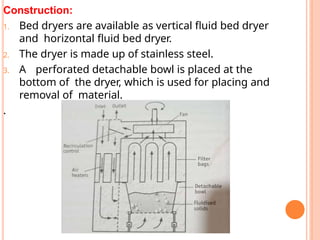
Construction:
1. Bed dryers are available as vertical fluid bed dryer
and horizontal fluid bed dryer.
2. The dryer is made up of stainless steel.
3. A perforated detachable bowl is placed at the
bottom of the dryer, which is used for placing and
removal of material.
.
4. fan is mounted in the upper part for circulating hot air.
5. Fresh air inlet, prefilter and heat exchanger are
connected
serially to heat the air to the required temperatures.
6. Bag filters are placed above the drying bowl
for the recovery of fines
Working
7. The wet granules to be dried are placed in the
detachable bowl .
8. The bowl is pushed into the dryer.
9. Fresh air is allowed to pass through a prefilter,
which subsequently gets heated by passing
through a heat exchanger.
10. The hot air flows through the bottom of the bowl.
Simultaneously fan is allowed to rotate.
5. The air velocity is gradually increased.
6. When the velocity of the air is greater than settling
velocity of granules, the granules remain partially
suspended in the gas stream.
7. The granules rise in the container because of high
velocity gas (1.5 to 7.5 metres per minute) and later
fall back in a random boiling motion. This condition is
said to befluidised state.
8. The gas surrounds every granule to completely dry
them.
9. The air leaves the dryer by passing through the bag
filter.
10.The entrained particles remain adhered to the inside
surface of the bags are which is shako remove the
entrained particles.
Uses :
Fluidised bed dryer is popularly used for drying of
granules in the production of tablets.
Advantages:
1. requires less time for complete drying, compared to
tray dryer.
2. available in different sizes with the drying capacity
3. drying containers are mobile, making handling
simple
and reducing labour costs
4. thermal efficiency is 2 to 6 times than tray dryer.
5. mixing efficiency is also high.
6. Hot spots are not observed in the dryer,
7. Used for thermolabile products.
8. can be used either as batch type or continuous type
 Disadvantages :
 Many organic powders develop electrostatic charges'
during drying.
 To avoid this, efficient electrical earthing of the
dryer is essential.

Fine particles may become en trained and
must be collected by bag filters
Related videos:
1. https://www.youtube.com/watch?v=vz4audqdx
5o
2. https://www.youtube.com/watch?v=6288nnB7
UFE
3. https://www.youtube.com/watch?v=9GN2R8ngl
Wc&t=17s
FREEZE DRYER/ LYOPHILIZATION
 Principle :
1. In freeze drying, water is removed from the frozen
state by sublimation, i.e. direct change of water
from solid into vapour without conversion to a liquid
phase.
2. The drying is achieved by subjecting the
material to temperature and pressures below
the triple point.
3. Under these conditions, any heat transferred is
used as latent heat and ice sublimes directly into
vapour state.
4. The water vapour is removed from the system by
condensation in a cold trap maintained at a
temperature lower than the frozen material.
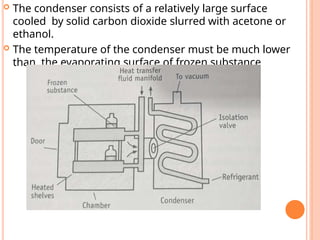
Construction :
 It consists of
1. Drying camber in which trays are loaded.
2. Heat supply in the form of radiation source, heating
coils.
3. Vapour condensing or adsorption system.
4. Vacuum pump or steam ejector or both.
 The chamber for vacuum drying is generally designed
for batch operation.
 It consists of shelves for keeping the material.
 The distance between subliming surface and
condenser must be less than the mean path of
molecules, which increases the rate of drying.
 The condenser consists of a relatively large surface
cooled by solid carbon dioxide slurred with acetone or
ethanol.
 The temperature of the condenser must be much lower
than the evaporating surface of frozen substance
Working :
 The working of freeze dryer consists of the following
steps.
1. Preparation and pretreatment
2. Prefreezing to solidify water
3. primary drying (sublimation of ice under vacuum)
4. secondary drying (removal of residual moisture under
high vacuum)
5. Packing
Preparation and pre-treatment :
1. The volume of solution introduced the container is
limited by its capacity.
2. Satisfactory freeze drying beyond a certain limit of
depth of
liquid is not possible
3. Therefore pre-treatment is eseential.
4. The solution is pre-concentrated under normal
vacuum.
5. This reduces the actual drying by 8 to10 times.
6. The final product becomes more porous.
Pre-freezing to solidity water
 Vials, ampoules or bottles in which the aqueous
solution is packed are frozen in cold shelves (about —
50 0C).

During this stage, cabinet is maintained at low
temperature and atmospheric pressure.
 The normal cooling rate is about 1 to 3 K/min so that
large crystals with relatively large holes are formed on
sublimation of ice.
 This also responsible for giving a porous product.
Primary Drying
(sublimation of ice under vacuum)
1. Material is spread in large surface for
sublimation.
2. The temp. & pressure should be below triple point of
water 0.0098 0C & 0.533 kPa (4.58 mmHg).
3. The temp. & pressure at which the frozen solid
vaporizes with out conversion to liquid is called
eutectic point.
4. Heat is supplied as latent heat and ice sublime to
vapour.
5. During this stage 98-99 % moisture is removed.
Secondary drying
(Removal of moisture under high vacuum)
1. During this stage traces of moisture is removed.
2. The temp. of solid is raised as 50-60 0C, but
pressue is lowered.
3. The rate of drying is very low and takes about 10-20
hrs.
Packing: after vacuum is replaced by inert gas, the
bottles & Vials are closed.
Uses: commonly used in production of injection,
solution and suspensions.
Used for drying blood plasma, bacterial & Viral
cultures, human tissue, antibiotics, plant
extracts, steroids, vitamins and enzymes.
Advantages.
1. Thermolabile material can be dried.
2. The product retains its bulk volume. It is porous and
uniform.
3. The reconstitution of the material is easy.
4. Denaturation does not occur.
5. Loss of volatile material is less.
6. Moisture level can be kept as low as possible
without decomposition.
7. Material can be dried in its final container such as
single
dose an multiple dose vials.
8. Sterility can be maintained.
Disadvantages:
1. Product prone to oxidation due to porosity and large
surface area. So product packed in vacuum.
2. Equipment and running cost is high.
3. Difficult for solution with non-aqueous solvents.
4. Time for drying is high.
Related videos:
https://www.youtube.com/watch?v=eE993Vs7j
8s
https://www.youtube.com/watch?v=gHOi_ioU
PTc

drying-200822174633 (1).pptx Drying Phusical pharamceutics I

  • 1.
    1 Dryin g Prepared by Ms. MariyambibiMandarawala Assistant professor, KSP,KPGU
  • 2.
    DRYING  Drying isdefined as the removal of small amounts of water or other liquid from a material by the application of heat. or  Drying is defined as the removal of all or most of the liquid by supplying heat to cause thermal vapourization. Drying VS Evaporation Drying Evaporation Final product is dry solid Final product is conc. Solution or suspension or wet slurry Vapour is removed at temperature below its boiling point Water is removed at its boiling point
  • 3.
    APPLICATIONS OF DRYING Preparation of bulk drugs : In the preparation of bulk drugs drying is the final stage of processing. A few examples are: dried aluminium hydroxide, spray dried lactose, powdered extracts.  Preservation of drug products : Drying is necessary in order to avoid deterioration. A few examples are: — Drug product Decomposition type Crude drugs of animal and vegetable origin chemical decomposition Blood products, skin, tissue Microbial growth Synthetic and semisynthetic drugs chemical decomposition Effervescent tablets (aspirin, penicillins) chemical decomposition
  • 4.
     Improved characteristics: Drying produces materials of spherical shape, uniform size, free flowing and enhanced solubility. Some specific areas of importance are: (1)Granules are dried to improve the fluidity and compression characteristics. (2) Viscous and sticky materials are not free flowing. Drying modifies these characteristics.  Improved handling : Removal of moisture makes the material light in weight and reduces the bulk. Thus cost of transportation will be less and storage will be efficient. If moisture is present, size reduction of drugs is difficult.
  • 5.
    TERMS IN DRYING Inwet solid water may be present as bound water and unbound water  Bound water (moisture) is the minimum water (moisture) held by the material that exerts an equilibrium vapour pressure less than the pure water the same temperature.  Unbound water (moisture) is the amount of water (moisture) held by the material that exerts an equ ilibrium vapour pressure equal to that of pure water at the same temperature.
  • 6.
    MECHANISM OF DRYINGPROCESS • Into the dryer, warm air stream is introduced to provide the latent heat. • This. heat is taken up by the material and the moisture evaporates. Drying is a three step process: 1. Heat transfer takes place from the heating medium to the solid material. 2. Mass transfer involves the transfer of moisture to the surface of .solids and subsequently vapourisation from the surface in to surrounding. 3. Transfer of relased vapour away from pharmaceutical material and out of drying equipment.
  • 7.
    THEORIES OF DRYINGMECHANISM Diffusion theory  Diffusion theory the rate of flow of water iis proportional to moisture gradient.  According to this theory, moisture movement may be as follows. 1. Water diffuses through the solid to the surface and subsequently evaporates into the surroundings. 2. Evaporation of water occurs at an intermediate zone, much below the solid surface, then vapours diffuse through the solid into air.
  • 8.
    Capillarity theory  Capillaritytheory is applicable to porous granu- lar solids with network of inter-connected pores and channels.  As the drying starts, a meniscus is formed in the capillary and exerts a force.  This is the driving force for the movement of water through pores towards the surface.  The capillary force is greater in small pores Compared to the large pores. Therefore, small pores pull more water from the larger pores and thus large pores get emptied first.  This theory is applicable to hygroscopic material.
  • 9.
    Pressure gradient theory Pressure gradient theory is applicable to drying of solids by the application of radiation.  The radiation generates internal heat interacts with the polarized molecules and ions of the material.  This field aligns the molecules in order, which are otherwise randomly oriented.  When the field is reversed, the molecules return to the original orientation giving up kinetic energy( heat) inside the solid surface and liquid is vaporised.
  • 10.
    EQUILIBRIUM MOISTURE CONTENT(EMC)  It is the amount of water present in the solid which exerts a vapour pressure equal to the vapour pressure of the atmosphere surrounding it.  Equilibrium moisture content in a wet mass is shown below.  The temperature and humidity of air kept constant so the solid may absorb of loose moisture
  • 11.
     When air( of constant temp. & humidity) is continuously passed over soild containing moisture more than EMC, the solid looses water continuously till EMC is reached. This phenomenon is called desorption.  When air ( of constant temp. & humidity) is continuously passed over soild containing moisture less than EMC, the solid absorbs water continuously till EMC is reached. This phenomenon is called sorption.
  • 12.
    MEASUREMENT OF EMC Procedure: 1.The solid samples are placed in a series of closed chambers such as desiccators. 2. Each chamber consists of solution (desiccant), where samples are exposed to different humidity conditions. 3. The exposure is continued until the material attains a constant weight 4. The difference in the final and initial weights gives the moisture content. 5. The moisture content is measured twice; before keep ing the material into the storage bin and while taking out the material.
  • 13.
     During storage,the material may lose/gain moisture. (hygroscopic) gaining or loosing (efflorescent).  Equilibrium moisture curve is drawn by taking relative humidity (%) on x-axis and moisture content on y-axis
  • 14.
    APPLICATIONS OF EMC 1.The EMC curve permits the selection of experimental conditions to be used for drying the product. 2. Drying should be stopped when the moisture content reaches the level of the EMC . 3. Over drying can be avoided, because overdried product quickly regains the moisture from the ambient conditions. 4. If the moisture content is to be reduced, the relative humidity of the ambient air must be reduced as a first step.  This can be done mechanically on a large scale using an air-conditioning system.  On scale dessiccators can be used.
  • 15.
    FACTORS AFFECTING EMC Nature of material: 1. Nonporous insoluble solids have an EMC of practically zero. e.g. talc and zinc oxide. 2. For fibrous or colloidal organic substances, the EMC values are high and variable. For example, cotton fabric has high EMC (10 to 15 %) under normal atmospheric conditions. 3. For porous solids, the EMC values are much higher and variable. The water may be held in fine capillaries that have no access to the surface.  Nature of air: 1. For air of zero humidity, EMC of all materials is zero. 2. As the temperature of air increases, the EMC of solid decreases
  • 16.
    TERMS IN DRYING Free moisture content: It is amount ofwater that is free to evaporate from solid surface. Free moisture content = total water content – EMC  % loss on drying (LOD) = mass of water in sample X 100 total mass of wet sample  % Moisture content = mass of water in sample X 100 mass of dry sample
  • 17.
    DRYING RATE  Dryingrate = weight of water in sample Time (Hrs) X weight of dry solid  Drying rate is plotted against the midpoints of the time period.  Drying rate curve is obtained by plotting FMC on x- axis and drying rate on y-axis..
  • 19.
    1. Initial Adjustment Period The time corresponding to AB represents the initial adjustment period.  During this period, the solids absorb heat and the temperature increases & the moisture begins to evaporate and thus tends to cool the drying solid.  After some time, the temperature stabilizes (heating and cooling rates become equal).  This temperature is equal to the wet bulb temperature of the drying air and is referred by the point B.
  • 20.
    • A’B’ representsa drying period when the sample is taken from reactor at high temperature to a dryer at a low temperature
  • 21.
    2. Constant rateperiod  The time corresponding to BC represents the constant rate period .  The temperature remains constant and rate of drying is constant.  The moisture evaporating from the surface is replaced by the water diffusing fromthe interior of the solid.  The rate of diffusion is equal to the rate of evaporation.  At this stage the temperature is similar to wet bulb temperature.  When all other variables are kept constant, the constant drying rate is in_dependent of the material being dried.
  • 22.
     As thewater is freely remove, particle size of the solids influences the drying rate.  The moisture content at the end of constant rate (point C) is referred to as the critical moisture content (CMC).  Critical moisture content is a point below which the movement of moisture from the interior is no longer sufficient to saturate the surface.  For any material, critical moisture content decreases with decreasing the particle size
  • 23.
    3. First fallingperiod 1. The time corresponding to CD represents the first falling rate period 2. During this period, the surface water is no longer replaced at a rate fast enough to maintain a continuous film on the surface. 3. Dry spots begin to appear and the rate of drying begins to fall off. 4. For first-falling rate period, the temperature of the solid surface is above the wet-bulb temperature. The point D is referred to as the second critical point.
  • 24.
     At thispoint, the film of surface water is completely evaporated
  • 25.
    4. Second fallingperiod  The time corresponding to DE represents the second Falling rate period.  During this period, the rate of drying falls even more rapidly than the first falling rate.  During this period, the rate of drying is dependent on the rate of diffusion of vapour of moisture to the surface of the solid.  During the period, the surface temperature approaches the temperature of dry air. Point  E is referred to as equilibrium moisture content.
  • 26.
     Beyond E,the drying rate is equal to zero. Hence temperature and moisture content remain constant.  Beyond Point E continued drying is waste of time & energy.
  • 27.
    TRAY DRIER  Principle Hot air is continuously circulated. Forced convection heating takes place to remove moisture from the solids spread in trays.  Construction: 1. It consists of a rectangular chamber whose walls are insulated. 2. Trays are placed inside the heating chamber. The number of trays may vary with the size of the dryer. 3. laboratory size driers may contain three trays, dryers of industry size may contain more than 20 trays.
  • 28.
    4. Each trayis rectangular or square and about 1.2 to 2.4 m2 in area. 5. Trays are usually loaded from 10.0 to 100.0 millimetres deep. 6. The distance between the bottom of upper tray and (upper) surface of the substance loaded in the subsequent tray must be 40.0 mm.
  • 29.
    Working: 1. Wet solidis loaded into trays. Trays are placed in the chamber. 2. Fresh air is introduced through inlet, which passes through the heaters and gets heated up. 3. The hot air is circulated by means of fans at 2 to 5 m/s. 4. The water is picked up by air. As water evaporates from the surface, the water diffuses from the interior of the solid by capillary action. 5. Moist air is discharged through outlet. 6. Thus constant temperature and uniform airflow over the material can be maintained for achieving uniform drying.
  • 30.
     Uses 1. Stickymaterials, plastic substances,. granular mass or crystalline materials, precipitates and pastes ,Crude drugs, chemicals, powders, granules can be dried.  Advantages: 1. handling of materials (loading and unloading) can be done without losses. 2. (2) Tray dryer is operated batch-wise. (a) Each batch of material can be handled as a separate entity. (b)The batch sizes in the pharmaceutical industry are relatively small (250 kg or less per batch) compared with the chemical industry (1000 kg or more per hour). (c)The same equipment is readily adjusted for use in drying a wide variety of materials. (d) Valuable products can be handled efficiently. 3. Temperature can be adjusted to meet the conditions of Thermo sen-sitve materials.
  • 31.
     Disadvantages: 1. Requiretime and labour to load and unload. 2. Time consuming process. 3. Dusty solids cannot be dried. Video links: 4. https://www.youtube.com/watch?v=fmrvZ1F9 x40 5. https://www.youtube.com/watch?v=TNtObZiI 8uo
  • 32.
    DRUM DRIER  Principle:  In drum dryer, a heated hollow metal drum rotates on its longitudinal axis, which is partially dipped in the solution to be dried.  The solution is carried as a film on the surface of the dryer and dried to form a layer, on account of steam heated drum.  A suitable knife scraps the dried material, while the drum is rotating.  Mechanism is simple evaporation.
  • 33.
     Construction: 1. Itconsist of hollow steel drum horizontally mounted made up of steel of 0.6 – 3 .0 diameter and 0.6 – 4.0 length whose external surface is smoothly polished. 2. Below the drum, feed pan is placed in such a way that the drum dips partially in to the feed. 3. On one side of the drum a spreader is placed and on the other knife is placed to scrap the dried material. 4. A storage bin (or a conveyor) is placed connecting the knife to collect the material in the storage bin.
  • 34.
    Working: 1. Steam ispassed inside the drum whose heat transfer coefficient is high. 2. Drying capacity is directly proportional to the surface area of the drum. 3. Heat is transferred by conduction to the material. 4. Simultaneously drum is rotated at a rate of 1-10 revolutions per minute. 5. The liquid material present in the feed pan adheres as a thin layer to the external surface of the drum during its rotation. 6. The material is completely dried during its journey in slightly less than one rotation 7. The dried material is scrapped by the doctor's knife, which then falls into a storage bin. 8. The time of contact of the material with hot metal is 6 to 15 seconds only.
  • 35.
     Parameters controlledin drum dryer  Speed of drum drier  Temperature of the feed  Film thickness  Steam temp. of the drum  Uses : used for drying solutions, slurries, suspensions, etc. The products dried are milk products, starch products, ferrous salts, suspensions of zinc oxide, suspension of kaolin, yeast, pigments, malt extracts, antibiotics, glandular extracts, insecticides, calcium and barium carbonates.
  • 36.
     Advantages: 1. Indrum dryer, drying time is less, only a few seconds. Therefore heat sensitive materials can be dried. 2. (Drum dryer occupies less space, as it is compact when compared to spray dryer. 3. As a thin film of liquid is formed on the large heating surface, mass transfer are high. & rates of heat transfer 4. The product obtained is completely dried and is in the final form. 5. It is used for continuous drying/processing.
  • 37.
    Disadvantages: 1. The initialpurchase cost and the maintenance cost of drum dryer are higher than spray dryer. 2. Maintenance cost of a drum dryer is higher than spray dryer. 3. Skilled operators are essential to control feed rate, film thickness, speed of rotation and temperature. 4. it is not suitable for solutions of salts with less solubility. 5. The heat treatment is higher than in spray drying. The solid product is less attractive. Videos: 6. https://www.youtube.com/watch?v=msGOevNYVL4
  • 38.
    SPRAY DYER  Principle: 1. In spray dryer, the fluid to be dried is atomized into fine droplets, on to a moving stream of hot gas. 2. The heating medium (hot air) is in contact with the material . 3. The temperature of the droplets is immediately increased and fine droplets get dried instantaneously in the form of spherical particles. 4. Drying takes place by simple evaporation rather than boiling. 5. This process completes in a few seconds before the droplets reach the wall of the dryer
  • 39.
     Construction : 1.It consists of a large cylindrical drying chamber with a short conical bottom, made up of stainless steel 2. An inlet for hot air is placed in the roof of the chamber. 3. Another inlet carrying spray-disk atomizer is set which is about 300 m in diameter and rotates at a speed of 3,000 to 50,000 revolutions per minute. Bottom of the dryer is connected to a cyclone separator.
  • 40.
    Working : Drying ofthe material in spray dryer involves 3 stages. (1) Atomization of the liquid. (2) Mixing of droplets. (3) Drying of the liquid droplets. (4) Recovery of the dried product
  • 41.
    Atomization of theliquid to form liquid droplets : 1. The feed is introduced through the atomizer by using suitable pump to form fine droplets. 2. The properties of the final product depend on the droplet. 3. Atomizer of any type; pneumatic atomizer, pressure nozzle and spinning disc atomizer may be used. 4. The rate of feed is adjusted in such a way that the droplets should be completely dried before reaching the walls of the drying chamber. At the same time, the product should not be over heated.
  • 42.
    Drying of theliquid droplets : 1. Fine droplets are dried in the drying chamber by supplying hot air through the inlet. 2. The surface of the liquid drop is dried immediately to form a tough shell. 3. The liquid inside must escape by diffusing through the shell at a particular rate. 4. At the same time, heat transfer from outside to inside takes place at a rate greater than liquid diffusion rate which allows the liquid to evaporate at a faster rate. 5. The temp. of air should be such that droplets should be completely dried before reaching drying chamber.
  • 43.
    Recovery of driedproduct 1. Centrifugal force of atomizer drives the droplets to follow helical path. 2. Particles are dried during their journey and finally fall at the conical bottom. 3. All these processes are completed in a few seconds. 4. Particle size of the final product ranges from 2 to 500 µm. 5. Particle size depends on solid content in the feed, liquid viscosity, feed rate and disc speed.
  • 44.
    Uses :  Spraydryers are used compulsorily when (1)the product is a better form than that obtained by any other dryer. (2) the quantity of the material to be dried is large, and (3)the product is thermolabile, hygroscopic or undergoes chemical decomposition.  Few products dried by spray dryer are: acacia, citric acid, hormones,soaps, adrenaline, coffee extract, detergents,milk,sulphur, blood extracts,vaccines.
  • 45.
     Advantages: 1. continuousprocess and drying is very rapid which completes within 3 to 30 seconds. 2. Labour costs are low. 3. Free flowing product of uniform spheres 4. Fine droplets provide large surface area for heat and mass transfer. 5. Product shows excellent solubility. 6. Either the solution or suspension or thin paste can be dried in one step to get the final product ready for package. 7. It is suitable for the drying of sterile products. 8. Reconstituted product appears more or less similar to the fresh material.
  • 46.
    Disadvantages:  Bulky equipmentwith high cost.  Such a huge equipment is not always easy to operate.  The thermal efficiency is low, as much heat is lost in the discharged gases. Related videos: 1. https://www.youtube.com/watch?v=6Jj4RkvgH0c 2. https://www.youtube.com/watch?v=BwxOYVdpneU 3. https://www.youtube.com/watch?v=sK1UbVveBK8
  • 47.
    FLUIDIZED BED DRYER Principle: 1. In fluidised bed dryer, hot air (gas) is passed at high pressure through a perforated bottom of the container containing granules to be dried. 2. The granules are lifted from the bottom and suspended in the stream of air. 3. This condition is called fluidized state. 4. The hot gas is surrounding every granule to completely dry them. Thus, materials or granules are uniformly dried
  • 48.
    Construction: 1. Bed dryersare available as vertical fluid bed dryer and horizontal fluid bed dryer. 2. The dryer is made up of stainless steel. 3. A perforated detachable bowl is placed at the bottom of the dryer, which is used for placing and removal of material. .
  • 49.
    4. fan ismounted in the upper part for circulating hot air. 5. Fresh air inlet, prefilter and heat exchanger are connected serially to heat the air to the required temperatures. 6. Bag filters are placed above the drying bowl for the recovery of fines Working 7. The wet granules to be dried are placed in the detachable bowl . 8. The bowl is pushed into the dryer. 9. Fresh air is allowed to pass through a prefilter, which subsequently gets heated by passing through a heat exchanger. 10. The hot air flows through the bottom of the bowl. Simultaneously fan is allowed to rotate. 5. The air velocity is gradually increased.
  • 50.
    6. When thevelocity of the air is greater than settling velocity of granules, the granules remain partially suspended in the gas stream. 7. The granules rise in the container because of high velocity gas (1.5 to 7.5 metres per minute) and later fall back in a random boiling motion. This condition is said to befluidised state. 8. The gas surrounds every granule to completely dry them. 9. The air leaves the dryer by passing through the bag filter. 10.The entrained particles remain adhered to the inside surface of the bags are which is shako remove the entrained particles.
  • 51.
    Uses : Fluidised beddryer is popularly used for drying of granules in the production of tablets. Advantages: 1. requires less time for complete drying, compared to tray dryer. 2. available in different sizes with the drying capacity 3. drying containers are mobile, making handling simple and reducing labour costs 4. thermal efficiency is 2 to 6 times than tray dryer. 5. mixing efficiency is also high. 6. Hot spots are not observed in the dryer, 7. Used for thermolabile products. 8. can be used either as batch type or continuous type
  • 52.
     Disadvantages : Many organic powders develop electrostatic charges' during drying.  To avoid this, efficient electrical earthing of the dryer is essential.  Fine particles may become en trained and must be collected by bag filters Related videos: 1. https://www.youtube.com/watch?v=vz4audqdx 5o 2. https://www.youtube.com/watch?v=6288nnB7 UFE 3. https://www.youtube.com/watch?v=9GN2R8ngl Wc&t=17s
  • 53.
    FREEZE DRYER/ LYOPHILIZATION Principle : 1. In freeze drying, water is removed from the frozen state by sublimation, i.e. direct change of water from solid into vapour without conversion to a liquid phase. 2. The drying is achieved by subjecting the material to temperature and pressures below the triple point. 3. Under these conditions, any heat transferred is used as latent heat and ice sublimes directly into vapour state. 4. The water vapour is removed from the system by condensation in a cold trap maintained at a temperature lower than the frozen material.
  • 54.
    Construction :  Itconsists of 1. Drying camber in which trays are loaded. 2. Heat supply in the form of radiation source, heating coils. 3. Vapour condensing or adsorption system. 4. Vacuum pump or steam ejector or both.  The chamber for vacuum drying is generally designed for batch operation.  It consists of shelves for keeping the material.  The distance between subliming surface and condenser must be less than the mean path of molecules, which increases the rate of drying.
  • 55.
     The condenserconsists of a relatively large surface cooled by solid carbon dioxide slurred with acetone or ethanol.  The temperature of the condenser must be much lower than the evaporating surface of frozen substance
  • 56.
    Working :  Theworking of freeze dryer consists of the following steps. 1. Preparation and pretreatment 2. Prefreezing to solidify water 3. primary drying (sublimation of ice under vacuum) 4. secondary drying (removal of residual moisture under high vacuum) 5. Packing
  • 57.
    Preparation and pre-treatment: 1. The volume of solution introduced the container is limited by its capacity. 2. Satisfactory freeze drying beyond a certain limit of depth of liquid is not possible 3. Therefore pre-treatment is eseential. 4. The solution is pre-concentrated under normal vacuum. 5. This reduces the actual drying by 8 to10 times. 6. The final product becomes more porous.
  • 58.
    Pre-freezing to soliditywater  Vials, ampoules or bottles in which the aqueous solution is packed are frozen in cold shelves (about — 50 0C).  During this stage, cabinet is maintained at low temperature and atmospheric pressure.  The normal cooling rate is about 1 to 3 K/min so that large crystals with relatively large holes are formed on sublimation of ice.  This also responsible for giving a porous product.
  • 59.
    Primary Drying (sublimation ofice under vacuum) 1. Material is spread in large surface for sublimation. 2. The temp. & pressure should be below triple point of water 0.0098 0C & 0.533 kPa (4.58 mmHg). 3. The temp. & pressure at which the frozen solid vaporizes with out conversion to liquid is called eutectic point. 4. Heat is supplied as latent heat and ice sublime to vapour. 5. During this stage 98-99 % moisture is removed.
  • 60.
    Secondary drying (Removal ofmoisture under high vacuum) 1. During this stage traces of moisture is removed. 2. The temp. of solid is raised as 50-60 0C, but pressue is lowered. 3. The rate of drying is very low and takes about 10-20 hrs. Packing: after vacuum is replaced by inert gas, the bottles & Vials are closed. Uses: commonly used in production of injection, solution and suspensions. Used for drying blood plasma, bacterial & Viral cultures, human tissue, antibiotics, plant extracts, steroids, vitamins and enzymes.
  • 61.
    Advantages. 1. Thermolabile materialcan be dried. 2. The product retains its bulk volume. It is porous and uniform. 3. The reconstitution of the material is easy. 4. Denaturation does not occur. 5. Loss of volatile material is less. 6. Moisture level can be kept as low as possible without decomposition. 7. Material can be dried in its final container such as single dose an multiple dose vials. 8. Sterility can be maintained.
  • 62.
    Disadvantages: 1. Product proneto oxidation due to porosity and large surface area. So product packed in vacuum. 2. Equipment and running cost is high. 3. Difficult for solution with non-aqueous solvents. 4. Time for drying is high. Related videos: https://www.youtube.com/watch?v=eE993Vs7j 8s https://www.youtube.com/watch?v=gHOi_ioU PTc