COLD STORAGE By K.DARSANA
The basic purpose of cold storage is to store the perishable food products at optimum
temperature to enhance the self life of the products.
Cold storages temperatures may vary from +10oC to –20oC and relative humidity may vary
from 90% to 98%.
For example, ice-cream is stored at - 20 ºC while milk is stored at 3-4 ºC. Similarly, many fruits
and vegetables are also stored in cold storages.
Benefits of a cold storage
Food product can be stored when their supply is plentiful and can be used during the period of
short supply.
Transportation of food stuff from one place to another place is possible.
Due to reduction of food spoilage by the use of cold storages, great saving in cost can be
achieved.
Based on their thermal incompatibility the produce is classified into:
Most perishable products, not sensitive to cold (0-4°C)
e.g. Apple, grape, carrot and onion
Vegetable produce moderately sensitive to cold (4-8°C)
e.g. Mango, orange, potato and tomato (ripened)
Vegetable produce sensitive to cold (>8°C)
e.g. Pineapple, banana, pumpkin and lady finger
The general features of a cold store operational programme (products, chilling and chilled storage and
freezing) include total capacity, number and size of rooms, refrigeration system, storage and handling
equipment and access facilities.
COLD STORAGE PRACTICES
In a cold store the following practices should be adopted:
(1) Temperature control
(2) Relative humidly control
(3) Condensation of water vapour
(4) Sanitation
(5) Air movement
(6) Stacking and material handling
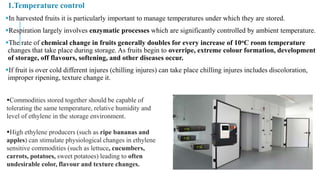
1.Temperature control
In harvested fruits it is particularly important to manage temperatures under which they are stored.
Respiration largely involves enzymatic processes which are significantly controlled by ambient temperature.
The rate of chemical change in fruits generally doubles for every increase of 10oC room temperature
changes that take place during storage. As fruits begin to overripe, extreme colour formation, development
of storage, off flavours, softening, and other diseases occur.
If fruit is over cold different injures (chilling injures) can take place chilling injures includes discoloration,
improper ripening, texture change it.
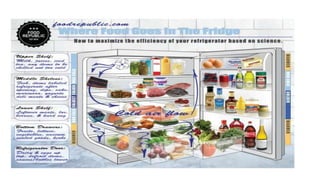
Commodities stored together should be capable of
tolerating the same temperature, relative humidity and
level of ethylene in the storage environment.
High ethylene producers (such as ripe bananas and
apples) can stimulate physiological changes in ethylene
sensitive commodities (such as lettuce, cucumbers,
carrots, potatoes, sweet potatoes) leading to often
undesirable color, flavour and texture changes.
2.Relative humidly control
Humidity control of air product is important in both short term and long term storages. In order to
avoided decay of the product due to associated micro-organisms, the relative humidity of air should be
maintained.
Dry air may cause weight loss in products, can affect appearance of the products, while very damp air
(moist air with high relative humidity) causes growth of micro-organism and various fungal disease.
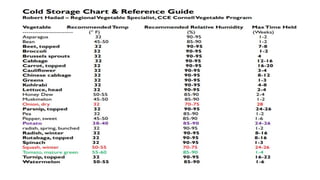
The relative humidity must be high enough to avoid excessive moisture loss from the product. In
general the relative humidity in the storage should be kept 85 – 90% for fruits, 90-95% for green
vegetables, and about 85-90% for other vegetables.
Higher than these values will incarnate decay and lower than these values will result in weigh loss.
3.Condensation of water vapour
The condensation of water vapour on products is one of the main concern especially when relative
humidity is high and when the temperature difference between air and product is high.
It is necessary to minimise this condensation which causes growth of microorganism on the food products.
Necessary steps must be taken to evaporate condensed moisture immediately.
4.Sanitation
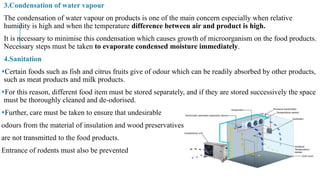
Certain foods such as fish and citrus fruits give of odour which can be readily absorbed by other products,
such as meat products and milk products.
For this reason, different food item must be stored separately, and if they are stored successively the space
must be thoroughly cleaned and de-odorised.
Further, care must be taken to ensure that undesirable
odours from the material of insulation and wood preservatives
are not transmitted to the food products.
Entrance of rodents must also be prevented
5. Air movement In cold storages
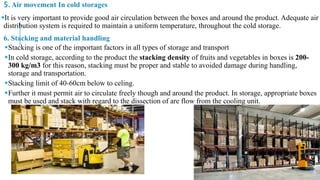
It is very important to provide good air circulation between the boxes and around the product. Adequate air
distribution system is required to maintain a uniform temperature, throughout the cold storage.
6. Stacking and material handling
Stacking is one of the important factors in all types of storage and transport
In cold storage, according to the product the stacking density of fruits and vegetables in boxes is 200-
300 kg/m3 for this reason, stacking must be proper and stable to avoided damage during handling,
storage and transportation.
Stacking limit of 40-60cm below to celing.
Further it must permit air to circulate freely though and around the product. In storage, appropriate boxes
must be used and stack with regard to the dissection of are flow from the cooling unit.
Cold Storage Precautions
The following should be avoided in cold storages:
1. Fluctuations of storage temperatures
2. Storing products beyond recommended time
3. Improper handling of food product.
4. Improper stacking.
5. Physical damage should also be avoided.
6. Contamination from other sources.
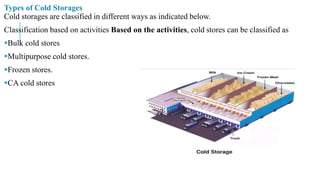
Types of Cold Storages
Cold storages are classified in different ways as indicated below.
Classification based on activities Based on the activities, cold stores can be classified as
Bulk cold stores
Multipurpose cold stores.
Frozen stores.
CA cold stores
Classification based on operating temperature of cold storage
I. Cooler and a temperature of 0oC and above.
II. Cooler and temperature just below 0oC (-2 or -3oC)
III. CA storage for long term storage of fruits and vegetables.
IV. Low temperature storage (around –20oC or even lower) with surplus refrigerating capacity of
freezing product.
Classification based on the time period
The cold storages can be classified into two categories, depending upon the time period for which foods
are kept.
Storages which are used for storing food stuff for a longer period of time.
Storages which are used to store food stuff for shorter period of time.
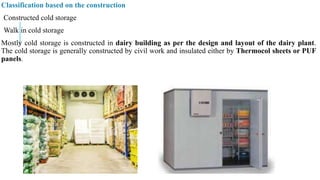
Classification based on the construction
Constructed cold storage
Walk in cold storage
Mostly cold storage is constructed in dairy building as per the design and layout of the dairy plant.
The cold storage is generally constructed by civil work and insulated either by Thermocol sheets or PUF
panels.
Types of Loads in Cold Storages
It is basic requirement to know the types of loads in the specific cold storage in order to find the
capacity of the refrigeration system for the cold storage.
It is necessary not only to cool the product to the storage temperature but also to meet the cooling
load due to various heat infiltrations taking place in the cold storage. Broadly, the total load is
divided into two categories as under.
Heat Conduction – Heat entering through the insulated
walls, ceiling, and floor;
Field Heat – Heat extracted from the produce as it cools
to the storage temperature;
Heat of Respiration – Heat generated by the produce as
a natural by-product of its respiration;
Service Load – Heat from lights, equipment, people,
and warm, moist air entering through cracks or through
the door when opened.
Sensible heat load
► Heat flow through walls, ceilings, floor, doors (structural heat gain).
► Heat gain from infiltration of air due to door openings and movement of products through
opening provided in the walls. For example, crates of milk enter in the milk cold storage through a gap
provided in the wall using conveyer. This load is kept minimum by using appropriate strips of flexible
plastic sheets to reduce the exchange of air.
► Heat received by workers working in cold storage. Though, it is very small as number of persons
working in the cold storage is very few. This load is very important in air conditioning system as it is for
providing comfort to large number of occupant.
► Heat load due to lighting and other motors used in the cold storage.
Latent heat load
► Latent heat load from infiltration of air.
► Latent heat generated from the stored products.
Cooling Load Estimation
The main objective is to determine what load will be generated in a cold store. The calculation of load of a cold
store plant is summation of no of heat sources.
 LATENT HEAT LOAD
 SENSIBLE HEAT LOAD
1. Structural heat gain (Qs)
Structural heat gain can calculated using following formula:
Qs = UA(Δ 𝑇)
Qs → heat gain (kw)
U → overall heat transfer coefficient (w/m2- o c)
A → area (cross-sectional area of roof, wall etc) (m2)
Δ𝑇 → temperature difference
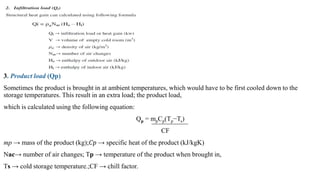
3. Product load (Qp)
Sometimes the product is brought in at ambient temperatures, which would have to be first cooled down to the
storage temperatures. This result in an extra load; the product load,
which is calculated using the following equation:
Qp = mpCp(Tp−Ts)
CF
mp → mass of the product (kg);𝐶𝑝 → specific heat of the product (kJ/kgK)
Nac→ number of air changes; Tp → temperature of the product when brought in,
Ts → cold storage temperature.;CF → chill factor.
Location of Cold Storage
The location of cold storage is important in terms of ease of product movement as well as operating
and construction cost of the cold storage. The cold storage room preferably is located on the cold
side of the plant. In case of more cold storages, all the cold storages should be located side by side to
reduce the cost of insulation in common wall of adjacent cold stores.
It should be located in such a way that finished product can be transferred to the cold stores easily and
finished products can be dispatched conveniently. In case of milk cold storage, conveyers are used to
transfer the milk crates directly from packaging machine.
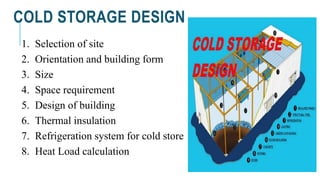
COLD STORAGE DESIGN
1. Selection of site
2. Orientation and building form
3. Size
4. Space requirement
5. Design of building
6. Thermal insulation
7. Refrigeration system for cold store
8. Heat Load calculation
1. Selection of site
General rule they should be in the shade of direct sunlight.
Temperature management during storage can be aided by constructing square rather than
rectangular buildings.
Rectangular buildings have more wall area per square meter of storage space, so more heat is
conducted across the walls, making them more expensive to cool.
Cold storage were cubical in shape in order to minimize the surface area.
2. Orientation and building form
– N-S direction
– W-E walls
– Surface to volume ratio less
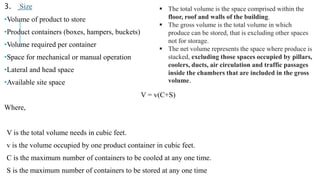
3. Size
•Volume of product to store
•Product containers (boxes, hampers, buckets)
•Volume required per container
•Space for mechanical or manual operation
•Lateral and head space
•Available site space
V = v(C+S)
Where,
V is the total volume needs in cubic feet.
v is the volume occupied by one product container in cubic feet.
C is the maximum number of containers to be cooled at any one time.
S is the maximum number of containers to be stored at any one time
 The total volume is the space comprised within the
floor, roof and walls of the building.
 The gross volume is the total volume in which
produce can be stored, that is excluding other spaces
not for storage.
 The net volume represents the space where produce is
stacked, excluding those spaces occupied by pillars,
coolers, ducts, air circulation and traffic passages
inside the chambers that are included in the gross
volume.
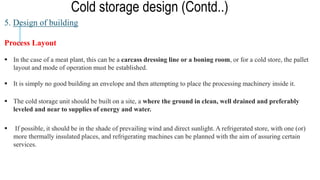
4. Space requirement
Storage space 3.4 m3/ton suitable for stacking and circulation of cold air
Chamber height -3 to 10 m
For loading and unloading distance between
Rack & rack - should not < 75cm
Rack & wall - least 20-25 cm
Ceiling & product shelf top - 30 cm
.
Cold storage design (Contd..)
5. Design of building
Process Layout
 In the case of a meat plant, this can be a carcass dressing line or a boning room, or for a cold store, the pallet
layout and mode of operation must be established.
 It is simply no good building an envelope and then attempting to place the processing machinery inside it.
 The cold storage unit should be built on a site, a where the ground in clean, well drained and preferably
leveled and near to supplies of energy and water.
 If possible, it should be in the shade of prevailing wind and direct sunlight. A refrigerated store, with one (or)
more thermally insulated places, and refrigerating machines can be planned with the aim of assuring certain
services.
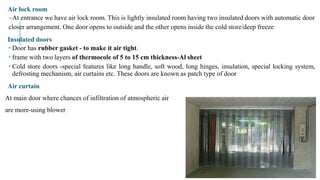
Air lock room
–At entrance we have air lock room. This is lightly insulated room having two insulated doors with automatic door
closer arrangement. One door opens to outside and the other opens inside the cold store/deep freeze
Insulated doors
 Door has rubber gasket - to make it air tight.
 frame with two layers of thermocole of 5 to 15 cm thickness-Al sheet
 Cold store doors -special features like long handle, soft wood, long hinges, insulation, special locking system,
defrosting mechanism, air curtains etc. These doors are known as patch type of door
Air curtain
At main door where chances of infiltration of atmospheric air
are more-using blower
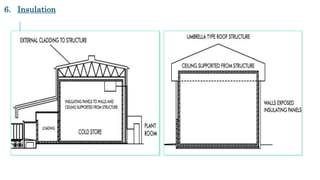
6. Insulation
Insulating materials
The materials having extremely low thermal conductivities are called insulating
materials. It is necessary to insulate the cold storages to prevent the entry of heat
through the walls, ceilings and floor of the cold storage when ambient air temperature is
higher than the cold storage temperature.
Insulation of cold storages is important to reduce the operating cost of the
refrigeration plant by reducing heat gain through structure of the cold storage.
Insulation is also necessary on suction pipe line of the refrigeration plant in order to
reduce the super-heating of suction gas.
Chilled water pipelines are also insulated to prevent surface condensation on the
pipeline.
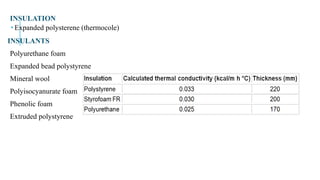
INSULATION
 Expanded polysterene (thermocole)
INSULANTS
Polyurethane foam
Expanded bead polystyrene
Mineral wool
Polyisocyanurate foam
Phenolic foam
Extruded polystyrene
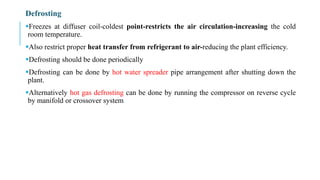
Defrosting
Freezes at diffuser coil-coldest point-restricts the air circulation-increasing the cold
room temperature.
Also restrict proper heat transfer from refrigerant to air-reducing the plant efficiency.
Defrosting should be done periodically
Defrosting can be done by hot water spreader pipe arrangement after shutting down the
plant.
Alternatively hot gas defrosting can be done by running the compressor on reverse cycle
by manifold or crossover system
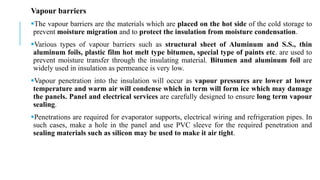
Vapour barriers
The vapour barriers are the materials which are placed on the hot side of the cold storage to
prevent moisture migration and to protect the insulation from moisture condensation.
Various types of vapour barriers such as structural sheet of Aluminum and S.S., thin
aluminum foils, plastic film hot melt type bitumen, special type of paints etc. are used to
prevent moisture transfer through the insulating material. Bitumen and aluminum foil are
widely used in insulation as permeance is very low.
Vapour penetration into the insulation will occur as vapour pressures are lower at lower
temperature and warm air will condense which in term will form ice which may damage
the panels. Panel and electrical services are carefully designed to ensure long term vapour
sealing.
Penetrations are required for evaporator supports, electrical wiring and refrigeration pipes. In
such cases, make a hole in the panel and use PVC sleeve for the required penetration and
sealing materials such as silicon may be used to make it air tight.
CHILLING INJURY
Is caused by low temperatures and generally affects fruits and vegetable, causing improper
ripening discoloration, texture change etc.
With a higher recommended storage temperature symptoms of this disorder are decayed. The
chill injury is dependent on storage temperature and storage time.
Chilling injury is particularly troublesome because symptoms are not visible immediately
on the product. Products that look heather in the store might have develop symptoms
during transportation or marketing.
Some of the examples of lowest safe temperatures are :
water melon – 4.4˚c
potatoes – 3.3oc
pumpkin – 10oc
cucumber – 7.2oc etc.

COLD STORAGE.pptx

  • 1.
    COLD STORAGE ByK.DARSANA
  • 2.
    The basic purposeof cold storage is to store the perishable food products at optimum temperature to enhance the self life of the products. Cold storages temperatures may vary from +10oC to –20oC and relative humidity may vary from 90% to 98%. For example, ice-cream is stored at - 20 ºC while milk is stored at 3-4 ºC. Similarly, many fruits and vegetables are also stored in cold storages. Benefits of a cold storage Food product can be stored when their supply is plentiful and can be used during the period of short supply. Transportation of food stuff from one place to another place is possible. Due to reduction of food spoilage by the use of cold storages, great saving in cost can be achieved.
  • 3.
    Based on theirthermal incompatibility the produce is classified into: Most perishable products, not sensitive to cold (0-4°C) e.g. Apple, grape, carrot and onion Vegetable produce moderately sensitive to cold (4-8°C) e.g. Mango, orange, potato and tomato (ripened) Vegetable produce sensitive to cold (>8°C) e.g. Pineapple, banana, pumpkin and lady finger The general features of a cold store operational programme (products, chilling and chilled storage and freezing) include total capacity, number and size of rooms, refrigeration system, storage and handling equipment and access facilities.
  • 4.
    COLD STORAGE PRACTICES Ina cold store the following practices should be adopted: (1) Temperature control (2) Relative humidly control (3) Condensation of water vapour (4) Sanitation (5) Air movement (6) Stacking and material handling
  • 5.
    1.Temperature control In harvestedfruits it is particularly important to manage temperatures under which they are stored. Respiration largely involves enzymatic processes which are significantly controlled by ambient temperature. The rate of chemical change in fruits generally doubles for every increase of 10oC room temperature changes that take place during storage. As fruits begin to overripe, extreme colour formation, development of storage, off flavours, softening, and other diseases occur. If fruit is over cold different injures (chilling injures) can take place chilling injures includes discoloration, improper ripening, texture change it. Commodities stored together should be capable of tolerating the same temperature, relative humidity and level of ethylene in the storage environment. High ethylene producers (such as ripe bananas and apples) can stimulate physiological changes in ethylene sensitive commodities (such as lettuce, cucumbers, carrots, potatoes, sweet potatoes) leading to often undesirable color, flavour and texture changes.
  • 6.
    2.Relative humidly control Humiditycontrol of air product is important in both short term and long term storages. In order to avoided decay of the product due to associated micro-organisms, the relative humidity of air should be maintained. Dry air may cause weight loss in products, can affect appearance of the products, while very damp air (moist air with high relative humidity) causes growth of micro-organism and various fungal disease. The relative humidity must be high enough to avoid excessive moisture loss from the product. In general the relative humidity in the storage should be kept 85 – 90% for fruits, 90-95% for green vegetables, and about 85-90% for other vegetables. Higher than these values will incarnate decay and lower than these values will result in weigh loss.
  • 7.
    3.Condensation of watervapour The condensation of water vapour on products is one of the main concern especially when relative humidity is high and when the temperature difference between air and product is high. It is necessary to minimise this condensation which causes growth of microorganism on the food products. Necessary steps must be taken to evaporate condensed moisture immediately. 4.Sanitation Certain foods such as fish and citrus fruits give of odour which can be readily absorbed by other products, such as meat products and milk products. For this reason, different food item must be stored separately, and if they are stored successively the space must be thoroughly cleaned and de-odorised. Further, care must be taken to ensure that undesirable odours from the material of insulation and wood preservatives are not transmitted to the food products. Entrance of rodents must also be prevented
  • 8.
    5. Air movementIn cold storages It is very important to provide good air circulation between the boxes and around the product. Adequate air distribution system is required to maintain a uniform temperature, throughout the cold storage. 6. Stacking and material handling Stacking is one of the important factors in all types of storage and transport In cold storage, according to the product the stacking density of fruits and vegetables in boxes is 200- 300 kg/m3 for this reason, stacking must be proper and stable to avoided damage during handling, storage and transportation. Stacking limit of 40-60cm below to celing. Further it must permit air to circulate freely though and around the product. In storage, appropriate boxes must be used and stack with regard to the dissection of are flow from the cooling unit.
  • 10.
    Cold Storage Precautions Thefollowing should be avoided in cold storages: 1. Fluctuations of storage temperatures 2. Storing products beyond recommended time 3. Improper handling of food product. 4. Improper stacking. 5. Physical damage should also be avoided. 6. Contamination from other sources.
  • 11.
    Types of ColdStorages Cold storages are classified in different ways as indicated below. Classification based on activities Based on the activities, cold stores can be classified as Bulk cold stores Multipurpose cold stores. Frozen stores. CA cold stores
  • 12.
    Classification based onoperating temperature of cold storage I. Cooler and a temperature of 0oC and above. II. Cooler and temperature just below 0oC (-2 or -3oC) III. CA storage for long term storage of fruits and vegetables. IV. Low temperature storage (around –20oC or even lower) with surplus refrigerating capacity of freezing product. Classification based on the time period The cold storages can be classified into two categories, depending upon the time period for which foods are kept. Storages which are used for storing food stuff for a longer period of time. Storages which are used to store food stuff for shorter period of time.
  • 13.
    Classification based onthe construction Constructed cold storage Walk in cold storage Mostly cold storage is constructed in dairy building as per the design and layout of the dairy plant. The cold storage is generally constructed by civil work and insulated either by Thermocol sheets or PUF panels.
  • 15.
    Types of Loadsin Cold Storages It is basic requirement to know the types of loads in the specific cold storage in order to find the capacity of the refrigeration system for the cold storage. It is necessary not only to cool the product to the storage temperature but also to meet the cooling load due to various heat infiltrations taking place in the cold storage. Broadly, the total load is divided into two categories as under. Heat Conduction – Heat entering through the insulated walls, ceiling, and floor; Field Heat – Heat extracted from the produce as it cools to the storage temperature; Heat of Respiration – Heat generated by the produce as a natural by-product of its respiration; Service Load – Heat from lights, equipment, people, and warm, moist air entering through cracks or through the door when opened.
  • 16.
    Sensible heat load ►Heat flow through walls, ceilings, floor, doors (structural heat gain). ► Heat gain from infiltration of air due to door openings and movement of products through opening provided in the walls. For example, crates of milk enter in the milk cold storage through a gap provided in the wall using conveyer. This load is kept minimum by using appropriate strips of flexible plastic sheets to reduce the exchange of air. ► Heat received by workers working in cold storage. Though, it is very small as number of persons working in the cold storage is very few. This load is very important in air conditioning system as it is for providing comfort to large number of occupant. ► Heat load due to lighting and other motors used in the cold storage. Latent heat load ► Latent heat load from infiltration of air. ► Latent heat generated from the stored products.
  • 17.
    Cooling Load Estimation Themain objective is to determine what load will be generated in a cold store. The calculation of load of a cold store plant is summation of no of heat sources.  LATENT HEAT LOAD  SENSIBLE HEAT LOAD 1. Structural heat gain (Qs) Structural heat gain can calculated using following formula: Qs = UA(Δ 𝑇) Qs → heat gain (kw) U → overall heat transfer coefficient (w/m2- o c) A → area (cross-sectional area of roof, wall etc) (m2) Δ𝑇 → temperature difference
  • 18.
    3. Product load(Qp) Sometimes the product is brought in at ambient temperatures, which would have to be first cooled down to the storage temperatures. This result in an extra load; the product load, which is calculated using the following equation: Qp = mpCp(Tp−Ts) CF mp → mass of the product (kg);𝐶𝑝 → specific heat of the product (kJ/kgK) Nac→ number of air changes; Tp → temperature of the product when brought in, Ts → cold storage temperature.;CF → chill factor.
  • 19.
    Location of ColdStorage The location of cold storage is important in terms of ease of product movement as well as operating and construction cost of the cold storage. The cold storage room preferably is located on the cold side of the plant. In case of more cold storages, all the cold storages should be located side by side to reduce the cost of insulation in common wall of adjacent cold stores. It should be located in such a way that finished product can be transferred to the cold stores easily and finished products can be dispatched conveniently. In case of milk cold storage, conveyers are used to transfer the milk crates directly from packaging machine.
  • 20.
    COLD STORAGE DESIGN 1.Selection of site 2. Orientation and building form 3. Size 4. Space requirement 5. Design of building 6. Thermal insulation 7. Refrigeration system for cold store 8. Heat Load calculation
  • 21.
    1. Selection ofsite General rule they should be in the shade of direct sunlight. Temperature management during storage can be aided by constructing square rather than rectangular buildings. Rectangular buildings have more wall area per square meter of storage space, so more heat is conducted across the walls, making them more expensive to cool. Cold storage were cubical in shape in order to minimize the surface area. 2. Orientation and building form – N-S direction – W-E walls – Surface to volume ratio less
  • 22.
    3. Size •Volume ofproduct to store •Product containers (boxes, hampers, buckets) •Volume required per container •Space for mechanical or manual operation •Lateral and head space •Available site space V = v(C+S) Where, V is the total volume needs in cubic feet. v is the volume occupied by one product container in cubic feet. C is the maximum number of containers to be cooled at any one time. S is the maximum number of containers to be stored at any one time  The total volume is the space comprised within the floor, roof and walls of the building.  The gross volume is the total volume in which produce can be stored, that is excluding other spaces not for storage.  The net volume represents the space where produce is stacked, excluding those spaces occupied by pillars, coolers, ducts, air circulation and traffic passages inside the chambers that are included in the gross volume.
  • 23.
    4. Space requirement Storagespace 3.4 m3/ton suitable for stacking and circulation of cold air Chamber height -3 to 10 m For loading and unloading distance between Rack & rack - should not < 75cm Rack & wall - least 20-25 cm Ceiling & product shelf top - 30 cm .
  • 24.
    Cold storage design(Contd..) 5. Design of building Process Layout  In the case of a meat plant, this can be a carcass dressing line or a boning room, or for a cold store, the pallet layout and mode of operation must be established.  It is simply no good building an envelope and then attempting to place the processing machinery inside it.  The cold storage unit should be built on a site, a where the ground in clean, well drained and preferably leveled and near to supplies of energy and water.  If possible, it should be in the shade of prevailing wind and direct sunlight. A refrigerated store, with one (or) more thermally insulated places, and refrigerating machines can be planned with the aim of assuring certain services.
  • 25.
    Air lock room –Atentrance we have air lock room. This is lightly insulated room having two insulated doors with automatic door closer arrangement. One door opens to outside and the other opens inside the cold store/deep freeze Insulated doors  Door has rubber gasket - to make it air tight.  frame with two layers of thermocole of 5 to 15 cm thickness-Al sheet  Cold store doors -special features like long handle, soft wood, long hinges, insulation, special locking system, defrosting mechanism, air curtains etc. These doors are known as patch type of door Air curtain At main door where chances of infiltration of atmospheric air are more-using blower
  • 26.
  • 27.
    Insulating materials The materialshaving extremely low thermal conductivities are called insulating materials. It is necessary to insulate the cold storages to prevent the entry of heat through the walls, ceilings and floor of the cold storage when ambient air temperature is higher than the cold storage temperature. Insulation of cold storages is important to reduce the operating cost of the refrigeration plant by reducing heat gain through structure of the cold storage. Insulation is also necessary on suction pipe line of the refrigeration plant in order to reduce the super-heating of suction gas. Chilled water pipelines are also insulated to prevent surface condensation on the pipeline.
  • 28.
    INSULATION  Expanded polysterene(thermocole) INSULANTS Polyurethane foam Expanded bead polystyrene Mineral wool Polyisocyanurate foam Phenolic foam Extruded polystyrene
  • 29.
    Defrosting Freezes at diffusercoil-coldest point-restricts the air circulation-increasing the cold room temperature. Also restrict proper heat transfer from refrigerant to air-reducing the plant efficiency. Defrosting should be done periodically Defrosting can be done by hot water spreader pipe arrangement after shutting down the plant. Alternatively hot gas defrosting can be done by running the compressor on reverse cycle by manifold or crossover system
  • 30.
    Vapour barriers The vapourbarriers are the materials which are placed on the hot side of the cold storage to prevent moisture migration and to protect the insulation from moisture condensation. Various types of vapour barriers such as structural sheet of Aluminum and S.S., thin aluminum foils, plastic film hot melt type bitumen, special type of paints etc. are used to prevent moisture transfer through the insulating material. Bitumen and aluminum foil are widely used in insulation as permeance is very low. Vapour penetration into the insulation will occur as vapour pressures are lower at lower temperature and warm air will condense which in term will form ice which may damage the panels. Panel and electrical services are carefully designed to ensure long term vapour sealing. Penetrations are required for evaporator supports, electrical wiring and refrigeration pipes. In such cases, make a hole in the panel and use PVC sleeve for the required penetration and sealing materials such as silicon may be used to make it air tight.
  • 31.
    CHILLING INJURY Is causedby low temperatures and generally affects fruits and vegetable, causing improper ripening discoloration, texture change etc. With a higher recommended storage temperature symptoms of this disorder are decayed. The chill injury is dependent on storage temperature and storage time. Chilling injury is particularly troublesome because symptoms are not visible immediately on the product. Products that look heather in the store might have develop symptoms during transportation or marketing. Some of the examples of lowest safe temperatures are : water melon – 4.4˚c potatoes – 3.3oc pumpkin – 10oc cucumber – 7.2oc etc.