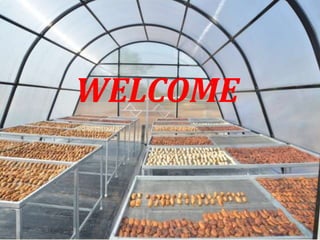
WELCOME
1
CONTENTS
Introduction
Drying Curve
Moisture Content
Methods of Drying
Classification of Dryers
Conclusion
Reference
2
INTRODUCTION
• Drying is the universe method of conditioning grain by removing
moisture.
• It is the oldest most common method of grain drying in agriculture.
• It is a essential process for conditioning the grains for safe storage.
• Correct drying method preserves the quality, nutritive value and
viability of grain.
• Drying involves both heat and mass transfer operations.
• Drying and Evaporation are the major moisture removal methods.
3
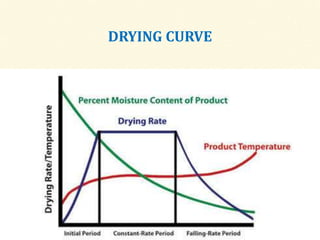
DRYING CURVE
4
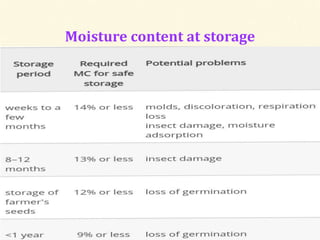
Moisture content at storage
5
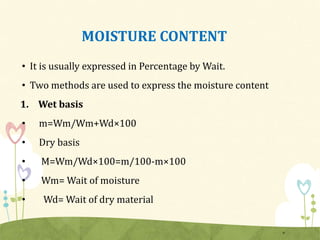
MOISTURE CONTENT
• It is usually expressed in Percentage by Wait.
• Two methods are used to express the moisture content
1. Wet basis
• m=Wm/Wm+Wd×100
• Dry basis
• M=Wm/Wd×100=m/100-m×100
• Wm= Wait of moisture
• Wd= Wait of dry material
6
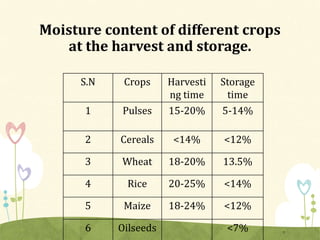
Moisture content of different crops
at the harvest and storage.
7
S.N Crops Harvesti
ng time
Storage
time
1 Pulses 15-20% 5-14%
2 Cereals <14% <12%
3 Wheat 18-20% 13.5%
4 Rice 20-25% <14%
5 Maize 18-24% <12%
6 Oilseeds <7%
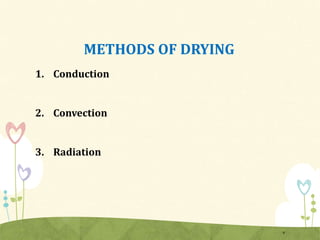
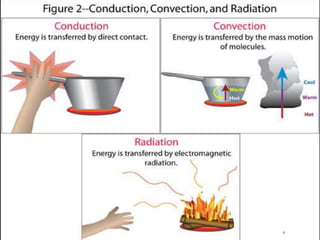
METHODS OF DRYING
1. Conduction
2. Convection
3. Radiation
8
9
CLASSIFICATION OF DRYERS
• Classification of grains based on two principles
1. Thin layer drying.
2. Deep bed drying.
1
Thin layer drying
• Limited to 20 cm of grain depth.
• Drying rate is independent of air velocity.
• The rate of drying is proportional to the difference
between the vapour pressure of moisture in the
grain and vapour pressure of moisture in the drying
air.
• All commercial flow dryers are designed on thin
layer drying principle.
11
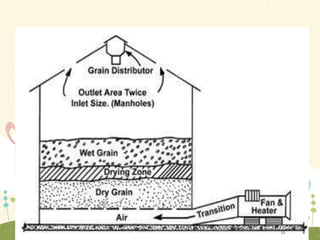
Deep bed drying
• The heterogeneous drying of grain in deep layer (more than 20
cm deep).
• The rate of moisture removal is maximum for the bottom layer
and decreased exponentially for subsequent layer.
• Dry air becomes cooler and moister as it moves up in the grain
bed.
• It has three zones
a. Dried zone.
b. The drying zone.
c. The wet zone.
12
13
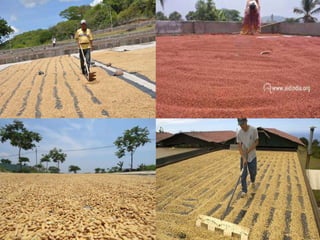
Sun drying
• This is traditional method of drying of crops and grains.
• Using the energy of the sun to remove moisture from the product.
• Major portion of crops is left in the field and threshing yard for
drying under sun.
14
Advantages of sun drying
• No fuel or mechanical energy is required.
• Operation is simple, operating costs are considerable.
• Viability, germination, baking quality are fully preserved.
• No pollution.
15
Disadvantages of sun drying
• uncontrolled, and non uniform drying, results in sun cracks in
kernels.
• Completely weather dependent, not possible round the clock and
round the year.
• More losses occur due to shattering, birds, rodents.
• Require large drying floor and large number of unskilled labor.
16
17
Mechanical Dryers
• The mechanical dryers are classified as :
1. Sack dryers ( Batch or Bin dryer).
2. Rotary dryers ( Batch or continuous).
3. Continuous flow dryers ( mixing type or non mixing type).
4. Tray type dryers.
5. Spray type dryers.
6. Freeze dryers.
7. Vacuum dryers.
8. Dielectric dryers. 18
9. Electrical dryers.
10. Infrared dryers.
11. Solar dryers.
12. Fluidised bed dryer.
19
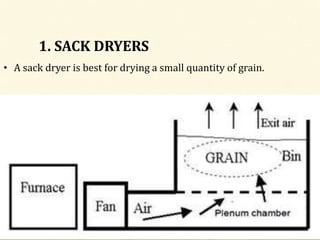
1. SACK DRYERS
• A sack dryer is best for drying a small quantity of grain.
20
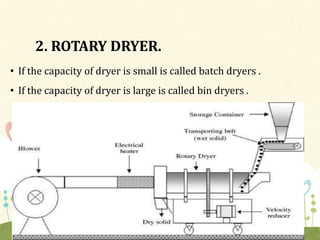
2. ROTARY DRYER.
• If the capacity of dryer is small is called batch dryers .
• If the capacity of dryer is large is called bin dryers .
21
22
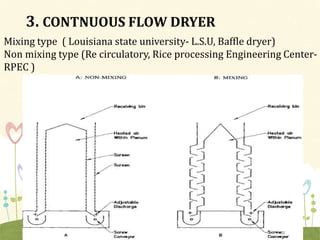
Mixing type ( Louisiana state university- L.S.U, Baffle dryer)
Non mixing type (Re circulatory, Rice processing Engineering Center-
RPEC )
3. CONTNUOUS FLOW DRYER
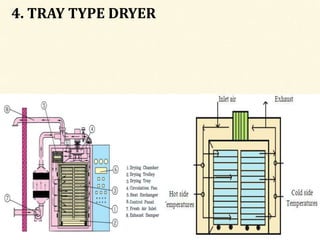
4. TRAY TYPE DRYER
23
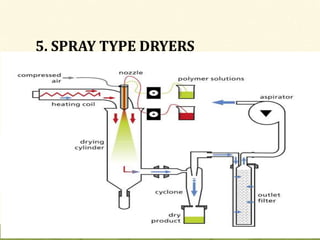
5. SPRAY TYPE DRYERS
24
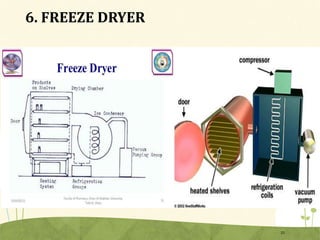
6. FREEZE DRYER
25
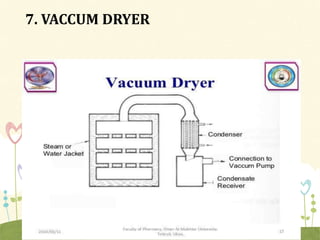
7. VACCUM DRYER
26
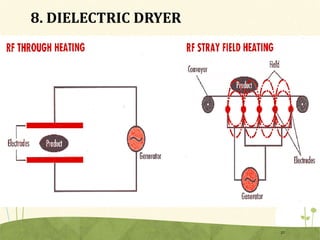
8. DIELECTRIC DRYER
27
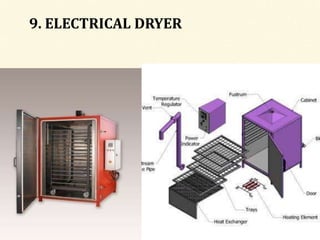
9. ELECTRICAL DRYER
28
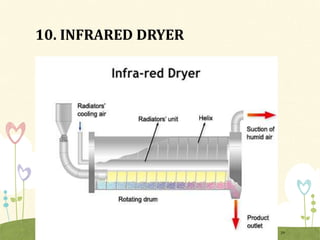
10. INFRARED DRYER
29
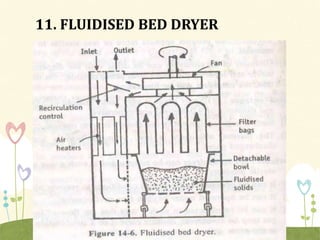
11. FLUIDISED BED DRYER
30
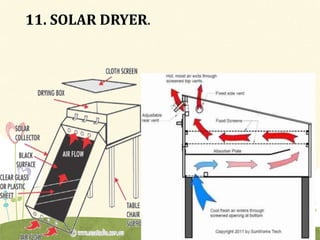
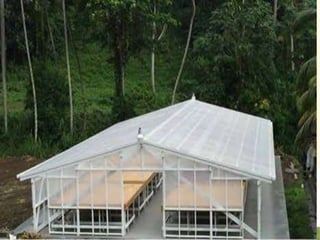
11. SOLAR DRYER.
31
32
CONCLUSION
As shown different crops should be stored at
different moisture contents. If moisture content is
more than the optimum deterioration increases
resulting in great loss. So dryers play an important
role in these days where food security is one of the
major problem.
33
• Submitted to,
• Dr.Nararayana Swamy,
• Dr.Shivabasappa,
• Dept of Agricultural engineering.
34
Submitted by,
Supriya M E
35

Dryers

  • 1.
  • 2.
    CONTENTS Introduction Drying Curve Moisture Content Methodsof Drying Classification of Dryers Conclusion Reference 2
  • 3.
    INTRODUCTION • Drying isthe universe method of conditioning grain by removing moisture. • It is the oldest most common method of grain drying in agriculture. • It is a essential process for conditioning the grains for safe storage. • Correct drying method preserves the quality, nutritive value and viability of grain. • Drying involves both heat and mass transfer operations. • Drying and Evaporation are the major moisture removal methods. 3
  • 4.
  • 5.
  • 6.
    MOISTURE CONTENT • Itis usually expressed in Percentage by Wait. • Two methods are used to express the moisture content 1. Wet basis • m=Wm/Wm+Wd×100 • Dry basis • M=Wm/Wd×100=m/100-m×100 • Wm= Wait of moisture • Wd= Wait of dry material 6
  • 7.
    Moisture content ofdifferent crops at the harvest and storage. 7 S.N Crops Harvesti ng time Storage time 1 Pulses 15-20% 5-14% 2 Cereals <14% <12% 3 Wheat 18-20% 13.5% 4 Rice 20-25% <14% 5 Maize 18-24% <12% 6 Oilseeds <7%
  • 8.
    METHODS OF DRYING 1.Conduction 2. Convection 3. Radiation 8
  • 9.
  • 10.
    CLASSIFICATION OF DRYERS •Classification of grains based on two principles 1. Thin layer drying. 2. Deep bed drying. 1
  • 11.
    Thin layer drying •Limited to 20 cm of grain depth. • Drying rate is independent of air velocity. • The rate of drying is proportional to the difference between the vapour pressure of moisture in the grain and vapour pressure of moisture in the drying air. • All commercial flow dryers are designed on thin layer drying principle. 11
  • 12.
    Deep bed drying •The heterogeneous drying of grain in deep layer (more than 20 cm deep). • The rate of moisture removal is maximum for the bottom layer and decreased exponentially for subsequent layer. • Dry air becomes cooler and moister as it moves up in the grain bed. • It has three zones a. Dried zone. b. The drying zone. c. The wet zone. 12
  • 13.
  • 14.
    Sun drying • Thisis traditional method of drying of crops and grains. • Using the energy of the sun to remove moisture from the product. • Major portion of crops is left in the field and threshing yard for drying under sun. 14
  • 15.
    Advantages of sundrying • No fuel or mechanical energy is required. • Operation is simple, operating costs are considerable. • Viability, germination, baking quality are fully preserved. • No pollution. 15
  • 16.
    Disadvantages of sundrying • uncontrolled, and non uniform drying, results in sun cracks in kernels. • Completely weather dependent, not possible round the clock and round the year. • More losses occur due to shattering, birds, rodents. • Require large drying floor and large number of unskilled labor. 16
  • 17.
  • 18.
    Mechanical Dryers • Themechanical dryers are classified as : 1. Sack dryers ( Batch or Bin dryer). 2. Rotary dryers ( Batch or continuous). 3. Continuous flow dryers ( mixing type or non mixing type). 4. Tray type dryers. 5. Spray type dryers. 6. Freeze dryers. 7. Vacuum dryers. 8. Dielectric dryers. 18
  • 19.
    9. Electrical dryers. 10.Infrared dryers. 11. Solar dryers. 12. Fluidised bed dryer. 19
  • 20.
    1. SACK DRYERS •A sack dryer is best for drying a small quantity of grain. 20
  • 21.
    2. ROTARY DRYER. •If the capacity of dryer is small is called batch dryers . • If the capacity of dryer is large is called bin dryers . 21
  • 22.
    22 Mixing type (Louisiana state university- L.S.U, Baffle dryer) Non mixing type (Re circulatory, Rice processing Engineering Center- RPEC ) 3. CONTNUOUS FLOW DRYER
  • 23.
    4. TRAY TYPEDRYER 23
  • 24.
    5. SPRAY TYPEDRYERS 24
  • 25.
  • 26.
  • 27.
  • 28.
  • 29.
  • 30.
  • 31.
  • 32.
  • 33.
    CONCLUSION As shown differentcrops should be stored at different moisture contents. If moisture content is more than the optimum deterioration increases resulting in great loss. So dryers play an important role in these days where food security is one of the major problem. 33
  • 34.
    • Submitted to, •Dr.Nararayana Swamy, • Dr.Shivabasappa, • Dept of Agricultural engineering. 34 Submitted by, Supriya M E
  • 35.