Salting & Drying of Fish
and Fish Meal
Submitted by:
Pinki Chowhan
3rd Year (5th Semester)
Regd. No.
213430103420003
Roll No. 34303421027
Subject Details:
Food Process Technology-II
Code: PC-FT501
Food Technology Department
Hemnalini Memorial College of Engineering
(Affilated by MAKAUT)
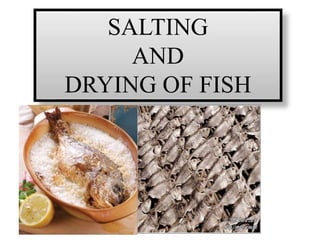
SALTING
AND
DRYING OF FISH
THEORY OF SALTING AND DRYING
THEORY OF SALTING
Salting is preservation of fish with
dry edible salt.
Salt absorbs much of water from
food and makes it difficult for
micro – organisms to survive.
Salt delays the activity of bacteria
or even inactivate them by
lowering the water activity.
THEORY OF DRYING AND
DEHYDRATION
DRYING
•Drying is one of the oldest
method of preservation of food.
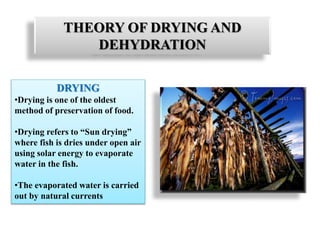
•Drying refers to “Sun drying”
where fish is dries under open air
using solar energy to evaporate
water in the fish.
•The evaporated water is carried
out by natural currents
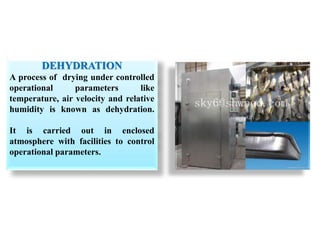
DEHYDRATION
A process of drying under controlled
operational parameters like
temperature, air velocity and relative
humidity is known as dehydration.
It is carried out in enclosed
atmosphere with facilities to control
operational parameters.
METHODS OF SALTING
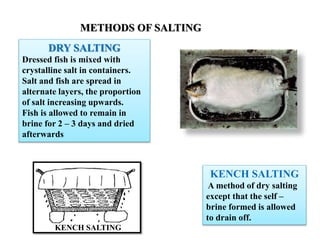
DRY SALTING
Dressed fish is mixed with
crystalline salt in containers.
Salt and fish are spread in
alternate layers, the proportion
of salt increasing upwards.
Fish is allowed to remain in
brine for 2 – 3 days and dried
afterwards
KENCH SALTING
A method of dry salting
except that the self –
brine formed is allowed
to drain off.
KENCH SALTING
BRINE SALTING
In this method of salting,
fish is kept immersed in
the in brine of desired
concentration for the
required time.
This a preliminary step to
smoking and canning
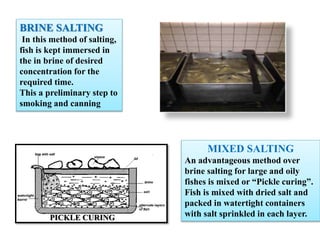
MIXED SALTING
An advantageous method over
brine salting for large and oily
fishes is mixed or “Pickle curing”.
Fish is mixed with dried salt and
packed in watertight containers
with salt sprinkled in each layer.
PICKLE CURING
METHODS OF DRYING
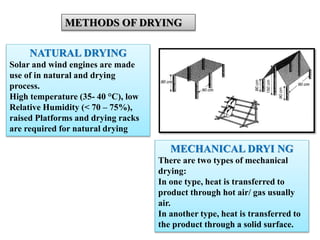
NATURAL DRYING
Solar and wind engines are made
use of in natural and drying
process.
High temperature (35- 40 °C), low
Relative Humidity (< 70 – 75%),
raised Platforms and drying racks
are required for natural drying
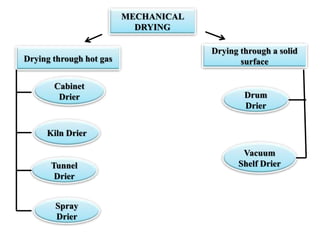
MECHANICAL DRYI NG
There are two types of mechanical
drying:
In one type, heat is transferred to
product through hot air/ gas usually
air.
In another type, heat is transferred to
the product through a solid surface.
MECHANICAL
DRYING
Cabinet
Drier
Kiln Drier
Tunnel
Drier
Drum
Drier
Vacuum
Shelf Drier
Spray
Drier
Drying through hot gas
Drying through a solid
surface
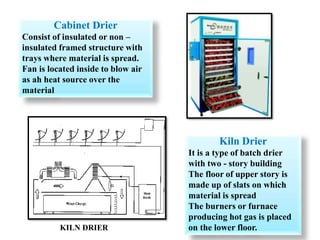
Cabinet Drier
Consist of insulated or non –
insulated framed structure with
trays where material is spread.
Fan is located inside to blow air
as ah heat source over the
material
Kiln Drier
It is a type of batch drier
with two - story building
The floor of upper story is
made up of slats on which
material is spread
The burners or furnace
producing hot gas is placed
on the lower floor.
KILN DRIER
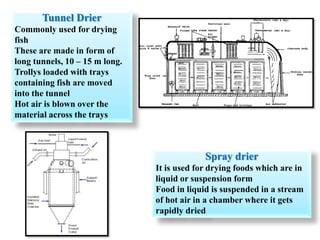
Tunnel Drier
Commonly used for drying
fish
These are made in form of
long tunnels, 10 – 15 m long.
Trollys loaded with trays
containing fish are moved
into the tunnel
Hot air is blown over the
material across the trays
Spray drier
It is used for drying foods which are in
liquid or suspension form
Food in liquid is suspended in a stream
of hot air in a chamber where it gets
rapidly dried
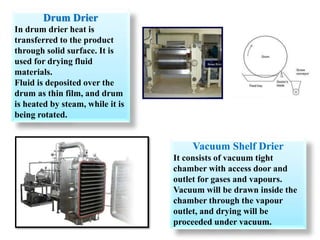
Drum Drier
In drum drier heat is
transferred to the product
through solid surface. It is
used for drying fluid
materials.
Fluid is deposited over the
drum as thin film, and drum
is heated by steam, while it is
being rotated.
Vacuum Shelf Drier
It consists of vacuum tight
chamber with access door and
outlet for gases and vapours.
Vacuum will be drawn inside the
chamber through the vapour
outlet, and drying will be
proceeded under vacuum.
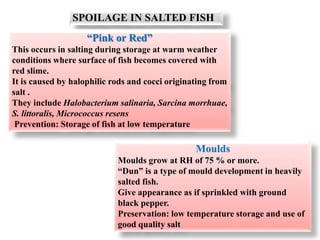
SPOILAGE IN SALTED FISH
“Pink or Red”
This occurs in salting during storage at warm weather
conditions where surface of fish becomes covered with
red slime.
It is caused by halophilic rods and cocci originating from
salt .
They include Halobacterium salinaria, Sarcina morrhuae,
S. littoralis, Micrococcus resens
Prevention: Storage of fish at low temperature
Moulds
Moulds grow at RH of 75 % or more.
“Dun” is a type of mould development in heavily
salted fish.
Give appearance as if sprinkled with ground
black pepper.
Preservation: low temperature storage and use of
good quality salt
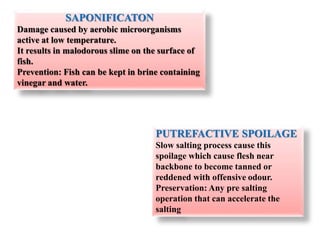
SAPONIFICATON
Damage caused by aerobic microorganisms
active at low temperature.
It results in malodorous slime on the surface of
fish.
Prevention: Fish can be kept in brine containing
vinegar and water.
PUTREFACTIVE SPOILAGE
Slow salting process cause this
spoilage which cause flesh near
backbone to become tanned or
reddened with offensive odour.
Preservation: Any pre salting
operation that can accelerate the
salting
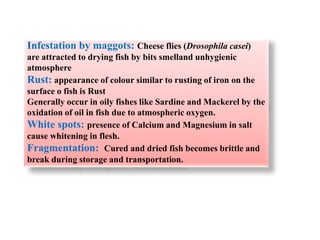
Infestation by maggots: Cheese flies (Drosophila casei)
are attracted to drying fish by bits smelland unhygienic
atmosphere
Rust: appearance of colour similar to rusting of iron on the
surface o fish is Rust
Generally occur in oily fishes like Sardine and Mackerel by the
oxidation of oil in fish due to atmospheric oxygen.
White spots: presence of Calcium and Magnesium in salt
cause whitening in flesh.
Fragmentation: Cured and dried fish becomes brittle and
break during storage and transportation.
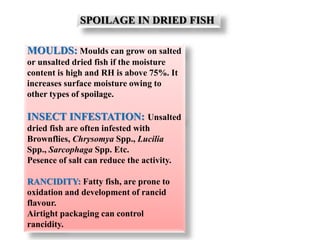
SPOILAGE IN DRIED FISH
MOULDS: Moulds can grow on salted
or unsalted dried fish if the moisture
content is high and RH is above 75%. It
increases surface moisture owing to
other types of spoilage.
INSECT INFESTATION: Unsalted
dried fish are often infested with
Brownflies, Chrysomya Spp., Lucilia
Spp., Sarcophaga Spp. Etc.
Pesence of salt can reduce the activity.
RANCIDITY: Fatty fish, are prone to
oxidation and development of rancid
flavour.
Airtight packaging can control
rancidity.
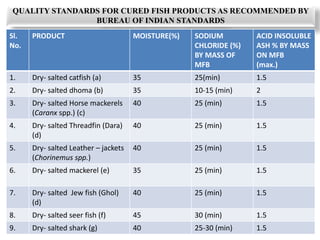
QUALITY STANDARDS FOR CURED FISH PRODUCTS AS RECOMMENDED BY
BUREAU OF INDIAN STANDARDS
Sl.
No.
PRODUCT MOISTURE(%) SODIUM
CHLORIDE (%)
BY MASS OF
MFB
ACID INSOLUBLE
ASH % BY MASS
ON MFB
(max.)
1. Dry- salted catfish (a) 35 25(min) 1.5
2. Dry- salted dhoma (b) 35 10-15 (min) 2
3. Dry- salted Horse mackerels
(Caranx spp.) (c)
40 25 (min) 1.5
4. Dry- salted Threadfin (Dara)
(d)
40 25 (min) 1.5
5. Dry- salted Leather – jackets
(Chorinemus spp.)
40 25 (min) 1.5
6. Dry- salted mackerel (e) 35 25 (min) 1.5
7. Dry- salted Jew fish (Ghol)
(d)
40 25 (min) 1.5
8. Dry- salted seer fish (f) 45 30 (min) 1.5
9. Dry- salted shark (g) 40 25-30 (min) 1.5
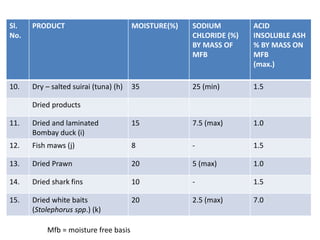
Sl.
No.
PRODUCT MOISTURE(%) SODIUM
CHLORIDE (%)
BY MASS OF
MFB
ACID
INSOLUBLE ASH
% BY MASS ON
MFB
(max.)
10. Dry – salted suirai (tuna) (h) 35 25 (min) 1.5
Dried products
11. Dried and laminated
Bombay duck (i)
15 7.5 (max) 1.0
12. Fish maws (j) 8 - 1.5
13. Dried Prawn 20 5 (max) 1.0
14. Dried shark fins 10 - 1.5
15. Dried white baits
(Stolephorus spp.) (k)
20 2.5 (max) 7.0
Mfb = moisture free basis
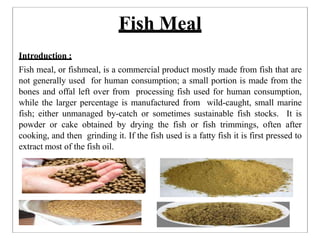
Fish Meal
Introduction :
Fish meal, or fishmeal, is a commercial product mostly made from fish that are
not generally used for human consumption; a small portion is made from the
bones and offal left over from processing fish used for human consumption,
while the larger percentage is manufactured from wild-caught, small marine
fish; either unmanaged by-catch or sometimes sustainable fish stocks. It is
powder or cake obtained by drying the fish or fish trimmings, often after
cooking, and then grinding it. If the fish used is a fatty fish it is first pressed to
extract most of the fish oil.
Preservation of the Raw Material :
All fisheries experience periods of glut and scarcity, leaving the fish meal factory at
times with no raw material to process and at other times with too much. Large amounts
of unprocessed material cause storage and odour problems; moreover spoiled material
becomes difficult to process and gives a lower yield.
No cheap, completely safe method of preservation has yet been found. Refrigeration is
not usually economic, and the known chemical methods of preservation have some
disadvantages. Sodium nitrate with formaldehyde is very effective, but unless its
addition is very carefully controlled poisonous nitrosamines can be formed when the
nitrite reacts with small amounts of trimethylamine in the fish; for this reason nitrite is
not used in the UK. Formaldehyde alone is quite effective in keeping the fish firm
enough for processing; it is most useful for species like sand eels that rapidly become
semiliquid soon after catching. Although the addition of about 0-2 per cent by weight of
formaldehyde is often enough to provide the required toughening effect, the
preservative effect is small at this dilution, and more formaldehyde may make the fish
too tough to process.
Environmental Impact :
Fish meal production is a significant contributor of over-fishing, and risks pushing
fisheries beyond their replacement rate. Some areas of the world, such as Western Africa,
have seen a large increase in fish meal production which in turn is hurting local fisheries
and driving fisheries into collapse
Manufacturing Fish Meal :
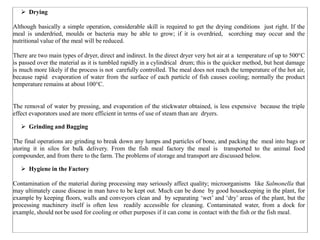
There are several ways of making fish meal from raw fish; the simplest is to let the fish dry in the sun. This method is still used, in
some parts of the world where processing plants are not available, but the product is poor in comparison with ones made by modern
methods. Almost all fish meal is made by cooking, pressing, drying and grinding the fish in machinery designed for the purpose.
Although the process is simple in principle, considerable skill and experience are necessary to obtain a high yield of high quality
product, and to make the plant efficient
 Cooking
When fish are cooked and the protein is coagulated, much of the water and oil runs off, or can be removed by pressing, whereas raw
fish lose very little liquor even under very high mechanical pressure. A commercial cooker consists essentially of a long steam
jacketed cylinder through which the fish are moved by a screw conveyor. Some cookers also have the facility for injecting steam
into the cooking material. The cooking operation is critical; if the fish are incompletely cooked, the liquor cannot be pressed out
satisfactorily, and if overcooked the material becomes too soft for pressing. No drying occurs during the cooking stage.
 Pressing
This stage of the process removes some of the oil and water. The fish are conveyed through a perforated tube whilst being subjected
to increasing pressure, normally by means of a tapered shaft on the screw conveyor. A mixture of water and oil is squeezed out
through the perforations and the solid, known as press cake, emerges from the end of the press. During the pressing process the water
content may be reduced from about 70 per cent to about 50 per cent, and the oil content reduced to about 4 per cent.
 Press liquor
After screening to remove coarse pieces of solid material, the liquor from the presses is continuously centrifuged to remove the oil.
The oil is sometimes further refined in a final centrifuge, a process known as polishing, before being pumped to storage tanks. The
refined oil is valuable and is used in the manufacture of edible oils and fats, for example margarine.
The water portion of the liquor, known as stickwater, contains dissolved material and fine solids in suspension which may amount to
about 9 per cent by weight. The solids are mostly protein and stickwater can contain as much as 20 per cent of the total solids in the
fish so that it is normally well worth recovering. The material is recovered by evaporating the stickwater to a thick syrup containing
30-50 per cent solids, and sometimes marketed separately and known as condensed fish solubles. More usually however the
concentrated product is added back to the press cake and dried along with it to make what is known as whole meal.
Fig : A typical process diagram
 Drying
Although basically a simple operation, considerable skill is required to get the drying conditions just right. If the
meal is underdried, moulds or bacteria may be able to grow; if it is overdried, scorching may occur and the
nutritional value of the meal will be reduced.
There are two main types of dryer, direct and indirect. In the direct dryer very hot air at a temperature of up to 500°C
is passed over the material as it is tumbled rapidly in a cylindrical drum; this is the quicker method, but heat damage
is much more likely if the process is not carefully controlled. The meal does not reach the temperature of the hot air,
because rapid evaporation of water from the surface of each particle of fish causes cooling; normally the product
temperature remains at about 100°C.
The removal of water by pressing, and evaporation of the stickwater obtained, is less expensive because the triple
effect evaporators used are more efficient in terms of use of steam than are dryers.
 Grinding and Bagging
The final operations are grinding to break down any lumps and particles of bone, and packing the meal into bags or
storing it in silos for bulk delivery. From the fish meal factory the meal is transported to the animal food
compounder, and from there to the farm. The problems of storage and transport are discussed below.
 Hygiene in the Factory
Contamination of the material during processing may seriously affect quality; microorganisms like Salmonella that
may ultimately cause disease in man have to be kept out. Much can be done by good housekeeping in the plant, for
example by keeping floors, walls and conveyors clean and by separating ‘wet’ and ‘dry’ areas of the plant, but the
processing machinery itself is often less readily accessible for cleaning. Contaminated water, from a dock for
example, should not be used for cooling or other purposes if it can come in contact with the fish or the fish meal.
The temperature during processing is normally high enough to kill any Salmonella present, but when a plant is
restarted after a stoppage there is likely to be moist meal standing in the plant that will not reach a high enough
temperature; for this reason it is now USA practice to recirculate the meal produced in the first 45 minutes after
starting again.
 Other Methods of Manufacture
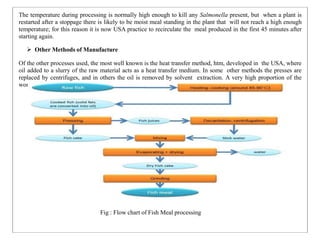
Of the other processes used, the most well known is the heat transfer method, htm, developed in the USA, where
oil added to a slurry of the raw material acts as a heat transfer medium. In some other methods the presses are
replaced by centrifuges, and in others the oil is removed by solvent extraction. A very high proportion of the
worlds fish meal is however manufactured by the process described above.
Fig : Flow chart of Fish Meal processing
Risks :
Unmodified fish meal can spontaneously combust from heat generated by oxidation of the
polyunsaturated fatty acids in the meal. In the past, factory ships have sunk because of such fires. That danger has
been eliminated by adding antioxidants to the meal.
As of 2001, ethoxyquin was the most commonly used antioxidant, usually in the range 200– 1000 mg/kg. One of
the antioxidants that has been used. There has been some speculation that ethoxyquin in pet foods might be
responsible for multiple health problems. However, most pet foods that contain ethoxyquin have never exceeded
this amount. Ethoxyquin has been shown to be slightly toxic to fish.
Storage and transport of fish meal :
Fish meal is not readily spoiled by bacterial action because of its low water content, and it has a very small bulk
compared to the fish from which it is made; indeed, these are two of the main reasons for making fish meal.
There is no need to refrigerate the meal in storage.
Fish meal is usually stored and transported either in sacks made of paper, hessian or plastics, or in bulk. Fish
meal in bulk is sometimes pelletized to make mechanical handling easier, since it does not flow readily as a
powder.
Fish oil present in the stored meal can react with oxygen in the atmosphere; the heat generated may damage the
meal nutritionally and, on occasion, cause the meal to catch fire. Fortunately this is now a rather rare occurrence,
due to the widespread use of antioxidants. Not all fish oils are equally reactive; some oily meals seem to require
antioxidant treatment; whilst others do not. The most commonly used antioxidant is ethoxyquin; the amount used
varies but is normally in the range 200-1000 mg/kg.
Fish meal made from fatty fish, however, will show a gradual decrease in fat content, as measured by extraction
with ether, unless antioxidants are present; this is because the fats slowly oxidize during storage and become
relatively insoluble in common organic solvents. Oxidized fat is less
valuable nutritionally because the animal cannot utilize it for its energy needs.
The risk of taint to the animal flesh is much reduced, however, once the fats are
oxidized. Protection against contamination during the manufacture of meal has
been mentioned; protection during storage is equally important. The floors,
walls and handling equipment in the store must be kept clean, and screens over
doors and windows help to keep out birds and rodents that may be carriers
of Salmonella organisms. Foot dips are sometimes provided to prevent workers
carrying harmful bacteria into the store. The risk of contamination is generally
much higher when handling meal in bulk, particularly during loading and
unloading of transport.
Composition and nutritional value :
Before examining the composition of the finished meal it is interesting to
consider the composition of the intermediate products. Figure 2 shows the
composition of the material at each stage of its flow through the process and is
based on the assumption that the raw fish contain 70 per cent water, 18 per
cent solids and 12 per cent fat. It can be seen that more drying occurs in the
evaporators than in the dryer.
Measuring the quality of fish meal :
Since fish meal contributes so many of the necessary ingredients of a diet, quality can be
measured only on the basis of specific components; no single laboratory test has been or
is likely to be devised that can give a total estimate of quality. Furthermore, all tests
other than feeding trials are rather artificial; the growth record of the animal is the best
standard. Feeding trials however are expensive and time consuming; thus the possibility
of using chemical or physical tests is attractive.
The pepsin digestibility test can distinguish between a very poor meal that has suffered
heat damage and a good, properly processed meal, but these could probably be
distinguished by colour alone; the test is thus of limited practical use.
A total amino acid analysis gives useful information about the meal but is very
expensive and tells nothing about the availablility of individual acids to the animal
being fed. Alternatively, the availability of a single important amino acid like lysine is
often measured; this is probably the most useful approach, but nothing is then known
about the other components. In short, there is no single comprehensive test for quality.
The requirements of the user may vary.
A very important measure of fish meal quality is its freedom from microorganisms that
cause disease in man by contaminating the animals he eats; Salmonella is generally of
most concern in this respect. The need for good housekeeping practice in the fish meal
factory and store has already been emphasized for this reason.
Thank
You

10560723.ppt

  • 1.
    Salting & Dryingof Fish and Fish Meal Submitted by: Pinki Chowhan 3rd Year (5th Semester) Regd. No. 213430103420003 Roll No. 34303421027 Subject Details: Food Process Technology-II Code: PC-FT501 Food Technology Department Hemnalini Memorial College of Engineering (Affilated by MAKAUT)
  • 2.
  • 3.
    THEORY OF SALTINGAND DRYING THEORY OF SALTING Salting is preservation of fish with dry edible salt. Salt absorbs much of water from food and makes it difficult for micro – organisms to survive. Salt delays the activity of bacteria or even inactivate them by lowering the water activity.
  • 4.
    THEORY OF DRYINGAND DEHYDRATION DRYING •Drying is one of the oldest method of preservation of food. •Drying refers to “Sun drying” where fish is dries under open air using solar energy to evaporate water in the fish. •The evaporated water is carried out by natural currents
  • 5.
    DEHYDRATION A process ofdrying under controlled operational parameters like temperature, air velocity and relative humidity is known as dehydration. It is carried out in enclosed atmosphere with facilities to control operational parameters.
  • 6.
    METHODS OF SALTING DRYSALTING Dressed fish is mixed with crystalline salt in containers. Salt and fish are spread in alternate layers, the proportion of salt increasing upwards. Fish is allowed to remain in brine for 2 – 3 days and dried afterwards KENCH SALTING A method of dry salting except that the self – brine formed is allowed to drain off. KENCH SALTING
  • 7.
    BRINE SALTING In thismethod of salting, fish is kept immersed in the in brine of desired concentration for the required time. This a preliminary step to smoking and canning MIXED SALTING An advantageous method over brine salting for large and oily fishes is mixed or “Pickle curing”. Fish is mixed with dried salt and packed in watertight containers with salt sprinkled in each layer. PICKLE CURING
  • 8.
    METHODS OF DRYING NATURALDRYING Solar and wind engines are made use of in natural and drying process. High temperature (35- 40 °C), low Relative Humidity (< 70 – 75%), raised Platforms and drying racks are required for natural drying MECHANICAL DRYI NG There are two types of mechanical drying: In one type, heat is transferred to product through hot air/ gas usually air. In another type, heat is transferred to the product through a solid surface.
  • 9.
  • 10.
    Cabinet Drier Consist ofinsulated or non – insulated framed structure with trays where material is spread. Fan is located inside to blow air as ah heat source over the material Kiln Drier It is a type of batch drier with two - story building The floor of upper story is made up of slats on which material is spread The burners or furnace producing hot gas is placed on the lower floor. KILN DRIER
  • 11.
    Tunnel Drier Commonly usedfor drying fish These are made in form of long tunnels, 10 – 15 m long. Trollys loaded with trays containing fish are moved into the tunnel Hot air is blown over the material across the trays Spray drier It is used for drying foods which are in liquid or suspension form Food in liquid is suspended in a stream of hot air in a chamber where it gets rapidly dried
  • 12.
    Drum Drier In drumdrier heat is transferred to the product through solid surface. It is used for drying fluid materials. Fluid is deposited over the drum as thin film, and drum is heated by steam, while it is being rotated. Vacuum Shelf Drier It consists of vacuum tight chamber with access door and outlet for gases and vapours. Vacuum will be drawn inside the chamber through the vapour outlet, and drying will be proceeded under vacuum.
  • 13.
    SPOILAGE IN SALTEDFISH “Pink or Red” This occurs in salting during storage at warm weather conditions where surface of fish becomes covered with red slime. It is caused by halophilic rods and cocci originating from salt . They include Halobacterium salinaria, Sarcina morrhuae, S. littoralis, Micrococcus resens Prevention: Storage of fish at low temperature Moulds Moulds grow at RH of 75 % or more. “Dun” is a type of mould development in heavily salted fish. Give appearance as if sprinkled with ground black pepper. Preservation: low temperature storage and use of good quality salt
  • 14.
    SAPONIFICATON Damage caused byaerobic microorganisms active at low temperature. It results in malodorous slime on the surface of fish. Prevention: Fish can be kept in brine containing vinegar and water. PUTREFACTIVE SPOILAGE Slow salting process cause this spoilage which cause flesh near backbone to become tanned or reddened with offensive odour. Preservation: Any pre salting operation that can accelerate the salting
  • 15.
    Infestation by maggots:Cheese flies (Drosophila casei) are attracted to drying fish by bits smelland unhygienic atmosphere Rust: appearance of colour similar to rusting of iron on the surface o fish is Rust Generally occur in oily fishes like Sardine and Mackerel by the oxidation of oil in fish due to atmospheric oxygen. White spots: presence of Calcium and Magnesium in salt cause whitening in flesh. Fragmentation: Cured and dried fish becomes brittle and break during storage and transportation.
  • 16.
    SPOILAGE IN DRIEDFISH MOULDS: Moulds can grow on salted or unsalted dried fish if the moisture content is high and RH is above 75%. It increases surface moisture owing to other types of spoilage. INSECT INFESTATION: Unsalted dried fish are often infested with Brownflies, Chrysomya Spp., Lucilia Spp., Sarcophaga Spp. Etc. Pesence of salt can reduce the activity. RANCIDITY: Fatty fish, are prone to oxidation and development of rancid flavour. Airtight packaging can control rancidity.
  • 17.
    QUALITY STANDARDS FORCURED FISH PRODUCTS AS RECOMMENDED BY BUREAU OF INDIAN STANDARDS Sl. No. PRODUCT MOISTURE(%) SODIUM CHLORIDE (%) BY MASS OF MFB ACID INSOLUBLE ASH % BY MASS ON MFB (max.) 1. Dry- salted catfish (a) 35 25(min) 1.5 2. Dry- salted dhoma (b) 35 10-15 (min) 2 3. Dry- salted Horse mackerels (Caranx spp.) (c) 40 25 (min) 1.5 4. Dry- salted Threadfin (Dara) (d) 40 25 (min) 1.5 5. Dry- salted Leather – jackets (Chorinemus spp.) 40 25 (min) 1.5 6. Dry- salted mackerel (e) 35 25 (min) 1.5 7. Dry- salted Jew fish (Ghol) (d) 40 25 (min) 1.5 8. Dry- salted seer fish (f) 45 30 (min) 1.5 9. Dry- salted shark (g) 40 25-30 (min) 1.5
  • 18.
    Sl. No. PRODUCT MOISTURE(%) SODIUM CHLORIDE(%) BY MASS OF MFB ACID INSOLUBLE ASH % BY MASS ON MFB (max.) 10. Dry – salted suirai (tuna) (h) 35 25 (min) 1.5 Dried products 11. Dried and laminated Bombay duck (i) 15 7.5 (max) 1.0 12. Fish maws (j) 8 - 1.5 13. Dried Prawn 20 5 (max) 1.0 14. Dried shark fins 10 - 1.5 15. Dried white baits (Stolephorus spp.) (k) 20 2.5 (max) 7.0 Mfb = moisture free basis
  • 19.
    Fish Meal Introduction : Fishmeal, or fishmeal, is a commercial product mostly made from fish that are not generally used for human consumption; a small portion is made from the bones and offal left over from processing fish used for human consumption, while the larger percentage is manufactured from wild-caught, small marine fish; either unmanaged by-catch or sometimes sustainable fish stocks. It is powder or cake obtained by drying the fish or fish trimmings, often after cooking, and then grinding it. If the fish used is a fatty fish it is first pressed to extract most of the fish oil.
  • 20.
    Preservation of theRaw Material : All fisheries experience periods of glut and scarcity, leaving the fish meal factory at times with no raw material to process and at other times with too much. Large amounts of unprocessed material cause storage and odour problems; moreover spoiled material becomes difficult to process and gives a lower yield. No cheap, completely safe method of preservation has yet been found. Refrigeration is not usually economic, and the known chemical methods of preservation have some disadvantages. Sodium nitrate with formaldehyde is very effective, but unless its addition is very carefully controlled poisonous nitrosamines can be formed when the nitrite reacts with small amounts of trimethylamine in the fish; for this reason nitrite is not used in the UK. Formaldehyde alone is quite effective in keeping the fish firm enough for processing; it is most useful for species like sand eels that rapidly become semiliquid soon after catching. Although the addition of about 0-2 per cent by weight of formaldehyde is often enough to provide the required toughening effect, the preservative effect is small at this dilution, and more formaldehyde may make the fish too tough to process. Environmental Impact : Fish meal production is a significant contributor of over-fishing, and risks pushing fisheries beyond their replacement rate. Some areas of the world, such as Western Africa, have seen a large increase in fish meal production which in turn is hurting local fisheries and driving fisheries into collapse
  • 21.
    Manufacturing Fish Meal: There are several ways of making fish meal from raw fish; the simplest is to let the fish dry in the sun. This method is still used, in some parts of the world where processing plants are not available, but the product is poor in comparison with ones made by modern methods. Almost all fish meal is made by cooking, pressing, drying and grinding the fish in machinery designed for the purpose. Although the process is simple in principle, considerable skill and experience are necessary to obtain a high yield of high quality product, and to make the plant efficient  Cooking When fish are cooked and the protein is coagulated, much of the water and oil runs off, or can be removed by pressing, whereas raw fish lose very little liquor even under very high mechanical pressure. A commercial cooker consists essentially of a long steam jacketed cylinder through which the fish are moved by a screw conveyor. Some cookers also have the facility for injecting steam into the cooking material. The cooking operation is critical; if the fish are incompletely cooked, the liquor cannot be pressed out satisfactorily, and if overcooked the material becomes too soft for pressing. No drying occurs during the cooking stage.  Pressing This stage of the process removes some of the oil and water. The fish are conveyed through a perforated tube whilst being subjected to increasing pressure, normally by means of a tapered shaft on the screw conveyor. A mixture of water and oil is squeezed out through the perforations and the solid, known as press cake, emerges from the end of the press. During the pressing process the water content may be reduced from about 70 per cent to about 50 per cent, and the oil content reduced to about 4 per cent.  Press liquor After screening to remove coarse pieces of solid material, the liquor from the presses is continuously centrifuged to remove the oil. The oil is sometimes further refined in a final centrifuge, a process known as polishing, before being pumped to storage tanks. The refined oil is valuable and is used in the manufacture of edible oils and fats, for example margarine. The water portion of the liquor, known as stickwater, contains dissolved material and fine solids in suspension which may amount to about 9 per cent by weight. The solids are mostly protein and stickwater can contain as much as 20 per cent of the total solids in the fish so that it is normally well worth recovering. The material is recovered by evaporating the stickwater to a thick syrup containing 30-50 per cent solids, and sometimes marketed separately and known as condensed fish solubles. More usually however the concentrated product is added back to the press cake and dried along with it to make what is known as whole meal.
  • 22.
    Fig : Atypical process diagram
  • 23.
     Drying Although basicallya simple operation, considerable skill is required to get the drying conditions just right. If the meal is underdried, moulds or bacteria may be able to grow; if it is overdried, scorching may occur and the nutritional value of the meal will be reduced. There are two main types of dryer, direct and indirect. In the direct dryer very hot air at a temperature of up to 500°C is passed over the material as it is tumbled rapidly in a cylindrical drum; this is the quicker method, but heat damage is much more likely if the process is not carefully controlled. The meal does not reach the temperature of the hot air, because rapid evaporation of water from the surface of each particle of fish causes cooling; normally the product temperature remains at about 100°C. The removal of water by pressing, and evaporation of the stickwater obtained, is less expensive because the triple effect evaporators used are more efficient in terms of use of steam than are dryers.  Grinding and Bagging The final operations are grinding to break down any lumps and particles of bone, and packing the meal into bags or storing it in silos for bulk delivery. From the fish meal factory the meal is transported to the animal food compounder, and from there to the farm. The problems of storage and transport are discussed below.  Hygiene in the Factory Contamination of the material during processing may seriously affect quality; microorganisms like Salmonella that may ultimately cause disease in man have to be kept out. Much can be done by good housekeeping in the plant, for example by keeping floors, walls and conveyors clean and by separating ‘wet’ and ‘dry’ areas of the plant, but the processing machinery itself is often less readily accessible for cleaning. Contaminated water, from a dock for example, should not be used for cooling or other purposes if it can come in contact with the fish or the fish meal.
  • 24.
    The temperature duringprocessing is normally high enough to kill any Salmonella present, but when a plant is restarted after a stoppage there is likely to be moist meal standing in the plant that will not reach a high enough temperature; for this reason it is now USA practice to recirculate the meal produced in the first 45 minutes after starting again.  Other Methods of Manufacture Of the other processes used, the most well known is the heat transfer method, htm, developed in the USA, where oil added to a slurry of the raw material acts as a heat transfer medium. In some other methods the presses are replaced by centrifuges, and in others the oil is removed by solvent extraction. A very high proportion of the worlds fish meal is however manufactured by the process described above. Fig : Flow chart of Fish Meal processing
  • 25.
    Risks : Unmodified fishmeal can spontaneously combust from heat generated by oxidation of the polyunsaturated fatty acids in the meal. In the past, factory ships have sunk because of such fires. That danger has been eliminated by adding antioxidants to the meal. As of 2001, ethoxyquin was the most commonly used antioxidant, usually in the range 200– 1000 mg/kg. One of the antioxidants that has been used. There has been some speculation that ethoxyquin in pet foods might be responsible for multiple health problems. However, most pet foods that contain ethoxyquin have never exceeded this amount. Ethoxyquin has been shown to be slightly toxic to fish. Storage and transport of fish meal : Fish meal is not readily spoiled by bacterial action because of its low water content, and it has a very small bulk compared to the fish from which it is made; indeed, these are two of the main reasons for making fish meal. There is no need to refrigerate the meal in storage. Fish meal is usually stored and transported either in sacks made of paper, hessian or plastics, or in bulk. Fish meal in bulk is sometimes pelletized to make mechanical handling easier, since it does not flow readily as a powder. Fish oil present in the stored meal can react with oxygen in the atmosphere; the heat generated may damage the meal nutritionally and, on occasion, cause the meal to catch fire. Fortunately this is now a rather rare occurrence, due to the widespread use of antioxidants. Not all fish oils are equally reactive; some oily meals seem to require antioxidant treatment; whilst others do not. The most commonly used antioxidant is ethoxyquin; the amount used varies but is normally in the range 200-1000 mg/kg. Fish meal made from fatty fish, however, will show a gradual decrease in fat content, as measured by extraction with ether, unless antioxidants are present; this is because the fats slowly oxidize during storage and become relatively insoluble in common organic solvents. Oxidized fat is less
  • 26.
    valuable nutritionally becausethe animal cannot utilize it for its energy needs. The risk of taint to the animal flesh is much reduced, however, once the fats are oxidized. Protection against contamination during the manufacture of meal has been mentioned; protection during storage is equally important. The floors, walls and handling equipment in the store must be kept clean, and screens over doors and windows help to keep out birds and rodents that may be carriers of Salmonella organisms. Foot dips are sometimes provided to prevent workers carrying harmful bacteria into the store. The risk of contamination is generally much higher when handling meal in bulk, particularly during loading and unloading of transport. Composition and nutritional value : Before examining the composition of the finished meal it is interesting to consider the composition of the intermediate products. Figure 2 shows the composition of the material at each stage of its flow through the process and is based on the assumption that the raw fish contain 70 per cent water, 18 per cent solids and 12 per cent fat. It can be seen that more drying occurs in the evaporators than in the dryer.
  • 27.
    Measuring the qualityof fish meal : Since fish meal contributes so many of the necessary ingredients of a diet, quality can be measured only on the basis of specific components; no single laboratory test has been or is likely to be devised that can give a total estimate of quality. Furthermore, all tests other than feeding trials are rather artificial; the growth record of the animal is the best standard. Feeding trials however are expensive and time consuming; thus the possibility of using chemical or physical tests is attractive. The pepsin digestibility test can distinguish between a very poor meal that has suffered heat damage and a good, properly processed meal, but these could probably be distinguished by colour alone; the test is thus of limited practical use. A total amino acid analysis gives useful information about the meal but is very expensive and tells nothing about the availablility of individual acids to the animal being fed. Alternatively, the availability of a single important amino acid like lysine is often measured; this is probably the most useful approach, but nothing is then known about the other components. In short, there is no single comprehensive test for quality. The requirements of the user may vary. A very important measure of fish meal quality is its freedom from microorganisms that cause disease in man by contaminating the animals he eats; Salmonella is generally of most concern in this respect. The need for good housekeeping practice in the fish meal factory and store has already been emphasized for this reason.
  • 28.