
TOPIC: PRESERVATION OF FOOD WITH
DRYING
 INTRODUTION :Drying is the oldest
method of food preservation .During
drying , the water content of the food is
reduced to critical level below which
microorganism cannot grow
 The principle behind drying is that sufficient moisture is
removed ,which is essential for growth of
microorganisms and for enzyme activity .removal of
moisture increases the storage life of the product due to
reduced water activity . If the moisture content is
reduced to 1to5 per cent then the product can be stored
for more than a year . The processing should be done
in such a way that the food value , natural flavour and
characteristic cooking quality of the fresh material are
retained after drying . A good dried product on
reconstitution with water should resemble the original
product
 Cheaper than other methods
 Does not require special facilities like
refrigeration
 Simple to store and pack
 Composition of raw materials
 Size , shape and arrangement of stacking of
produce
 Temperature , humidity and velocity of air
 Atmospheric pressure
 Heat transfer to surface
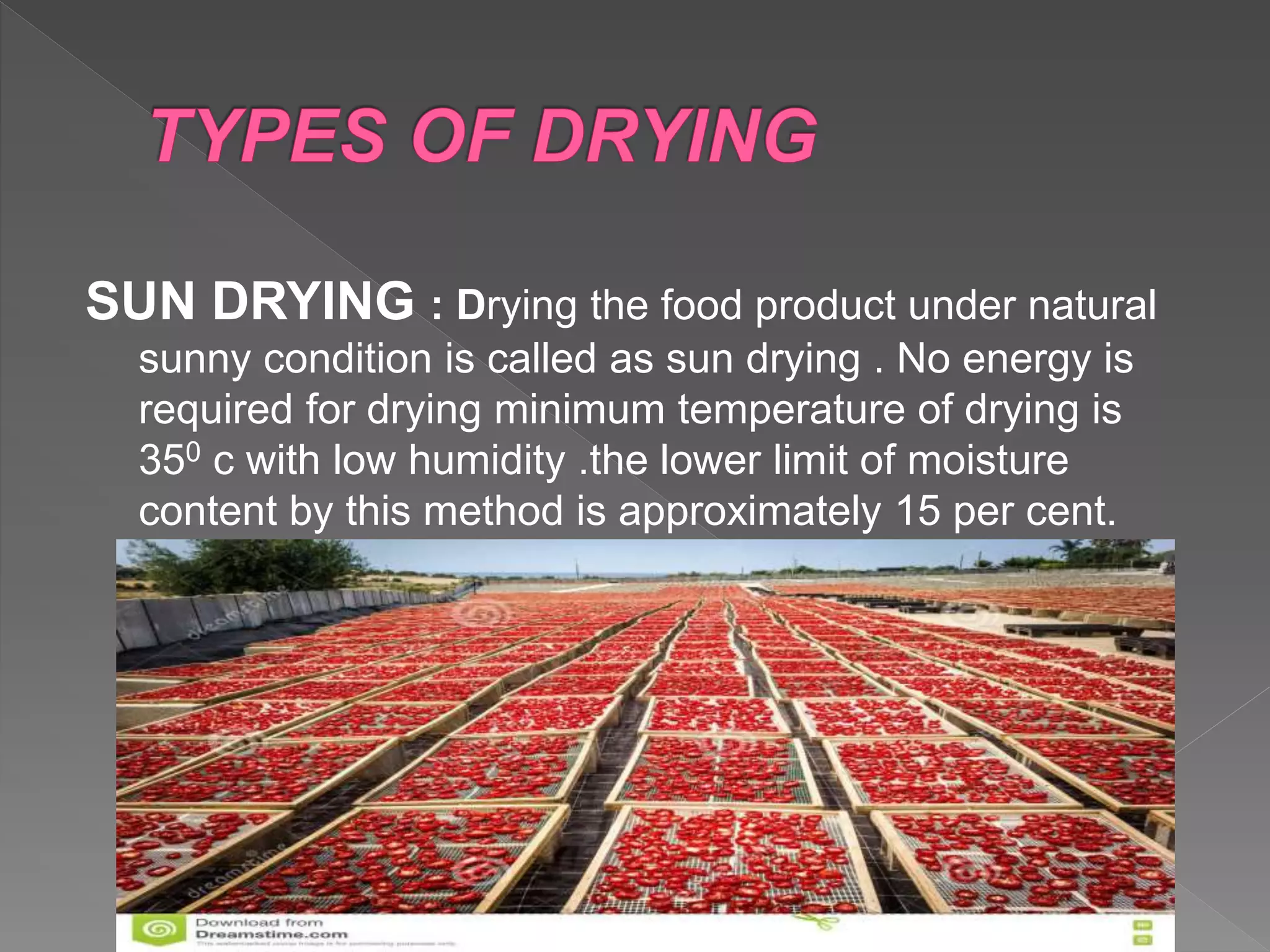
SUN DRYING : Drying the food product under natural
sunny condition is called as sun drying . No energy is
required for drying minimum temperature of drying is
350 c with low humidity .the lower limit of moisture
content by this method is approximately 15 per cent.
 SOLAR DRYING : solar drying uses designed
structure to collect and enhance solar radiation .
 1 . The absorption or hot box type driers in
which the product is directly heated by sun
2 . The indirect or convention driers in which
the product is exposed to warm air which is
heated by means of a solar absorber or heat
exchanger
SHADE DRYING :this kind of method is used
for foods which lose their color when
exposed to directly sunlight for drying .
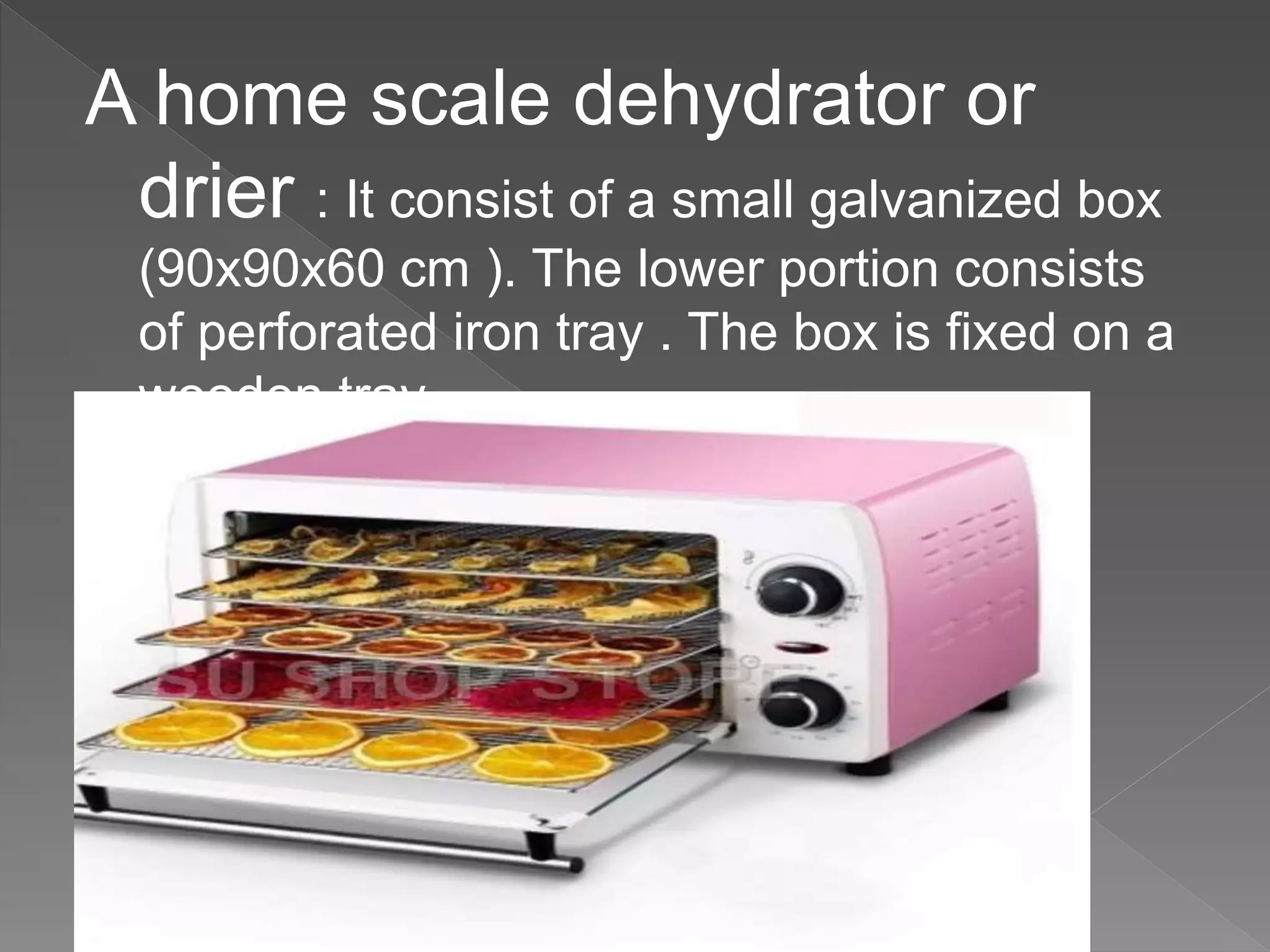
A home scale dehydrator or
drier : It consist of a small galvanized box
(90x90x60 cm ). The lower portion consists
of perforated iron tray . The box is fixed on a
wooden tray
OVEN DRYING : A convection oven with a
thermostatic setting of 600 c is suitable for
oven drying of fruits , vegetables , fruits
leathers and meats . This is kind of cabinet
drier
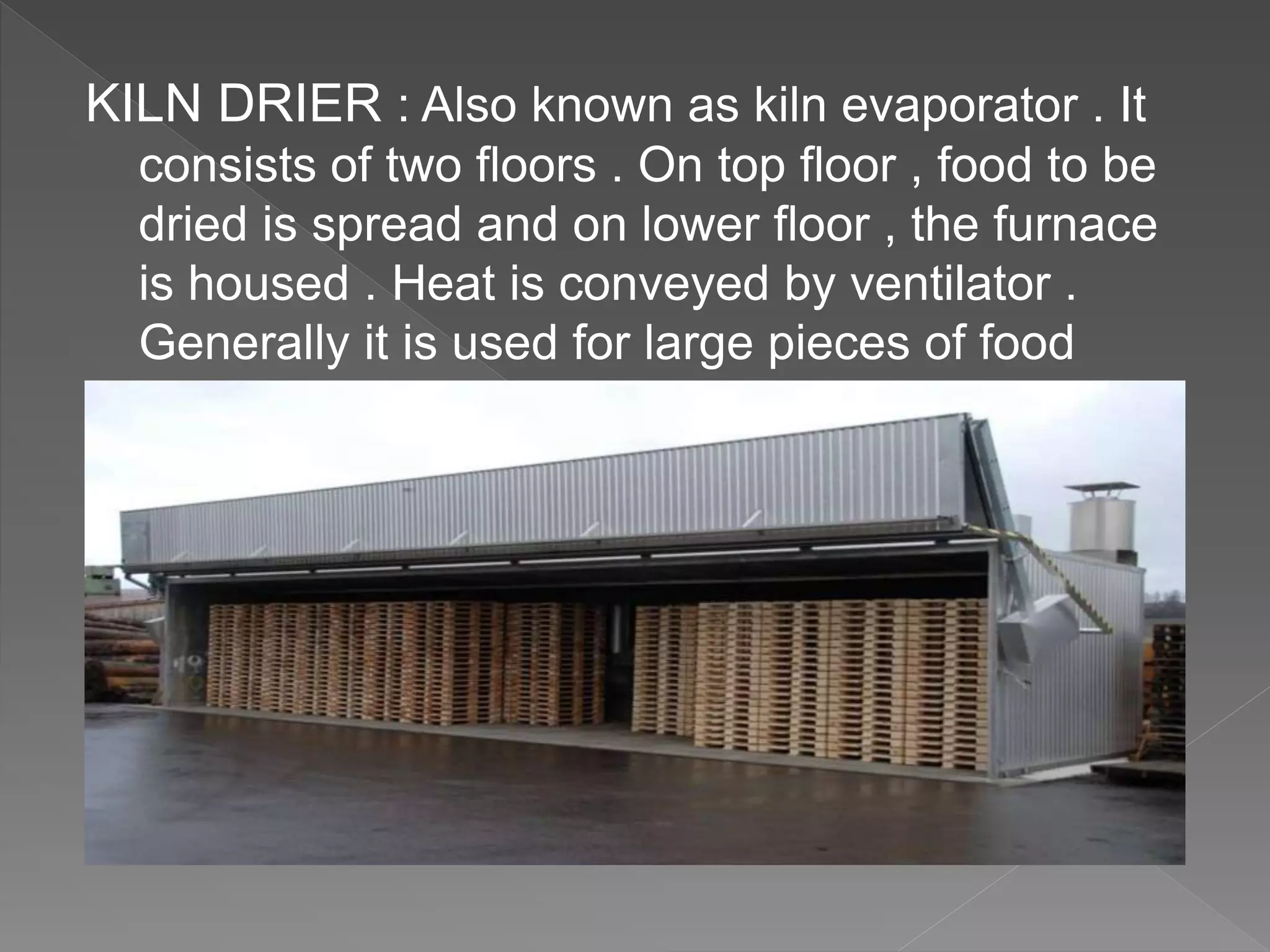
KILN DRIER : Also known as kiln evaporator . It
consists of two floors . On top floor , food to be
dried is spread and on lower floor , the furnace
is housed . Heat is conveyed by ventilator .
Generally it is used for large pieces of food
Tower drier :it is also called as stack type drier .
This drier consists of a furnace room containing
furnace ,heating pipes and cabinet in which
fruits are kept in perforated trays. Heating is
through steam coils placed between the trays.
The trays are interchanged as drying
progresses.
TUNNEL BELT DRIER: It consists of several
parallel sloping and narrow chambers above a
furnace room. Trays are passed on a conveyor
belt at upper end and removed at lower end. Air
for drying is circulated by fan.
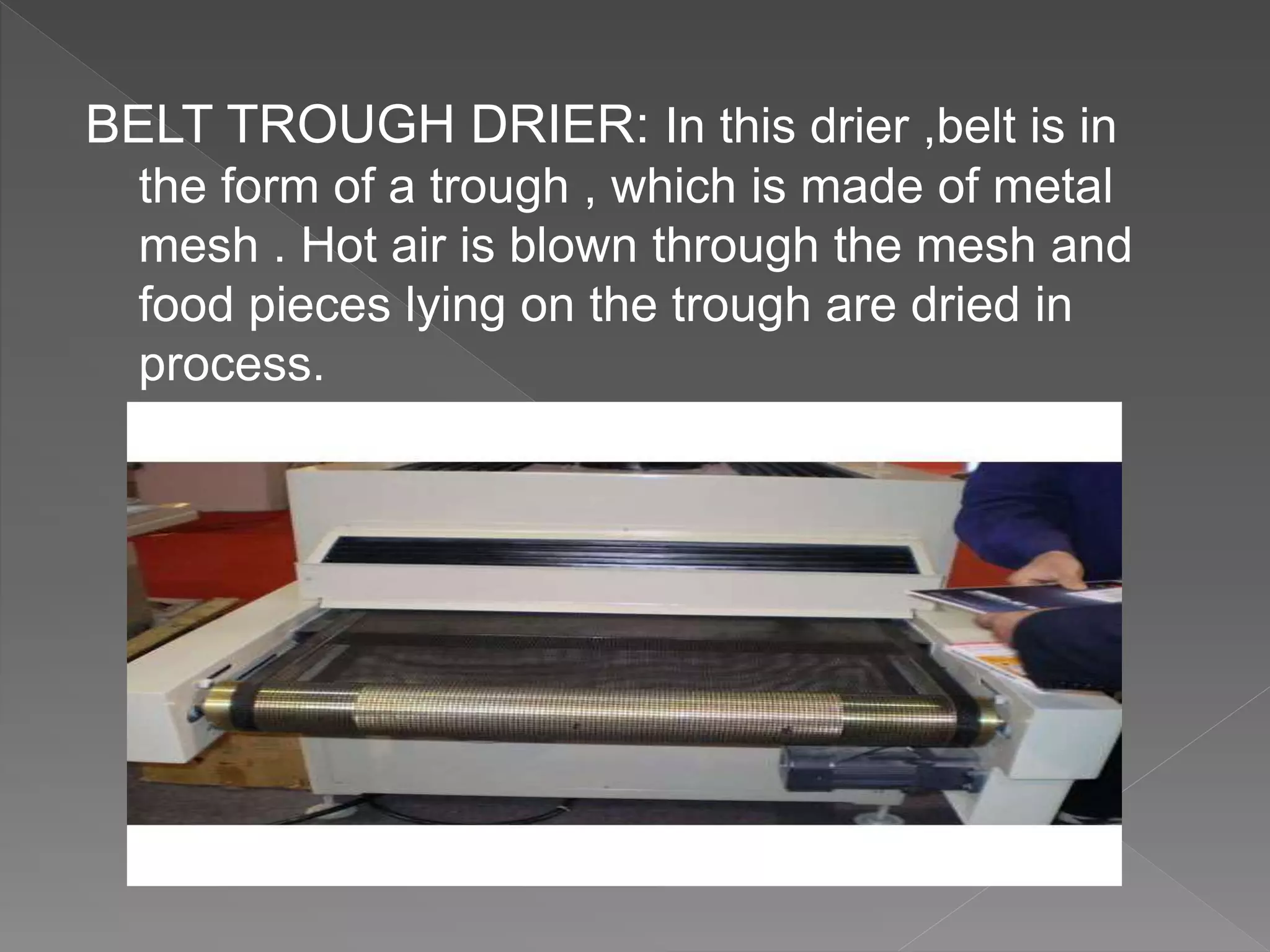
BELT TROUGH DRIER: In this drier ,belt is in
the form of a trough , which is made of metal
mesh . Hot air is blown through the mesh and
food pieces lying on the trough are dried in
process.
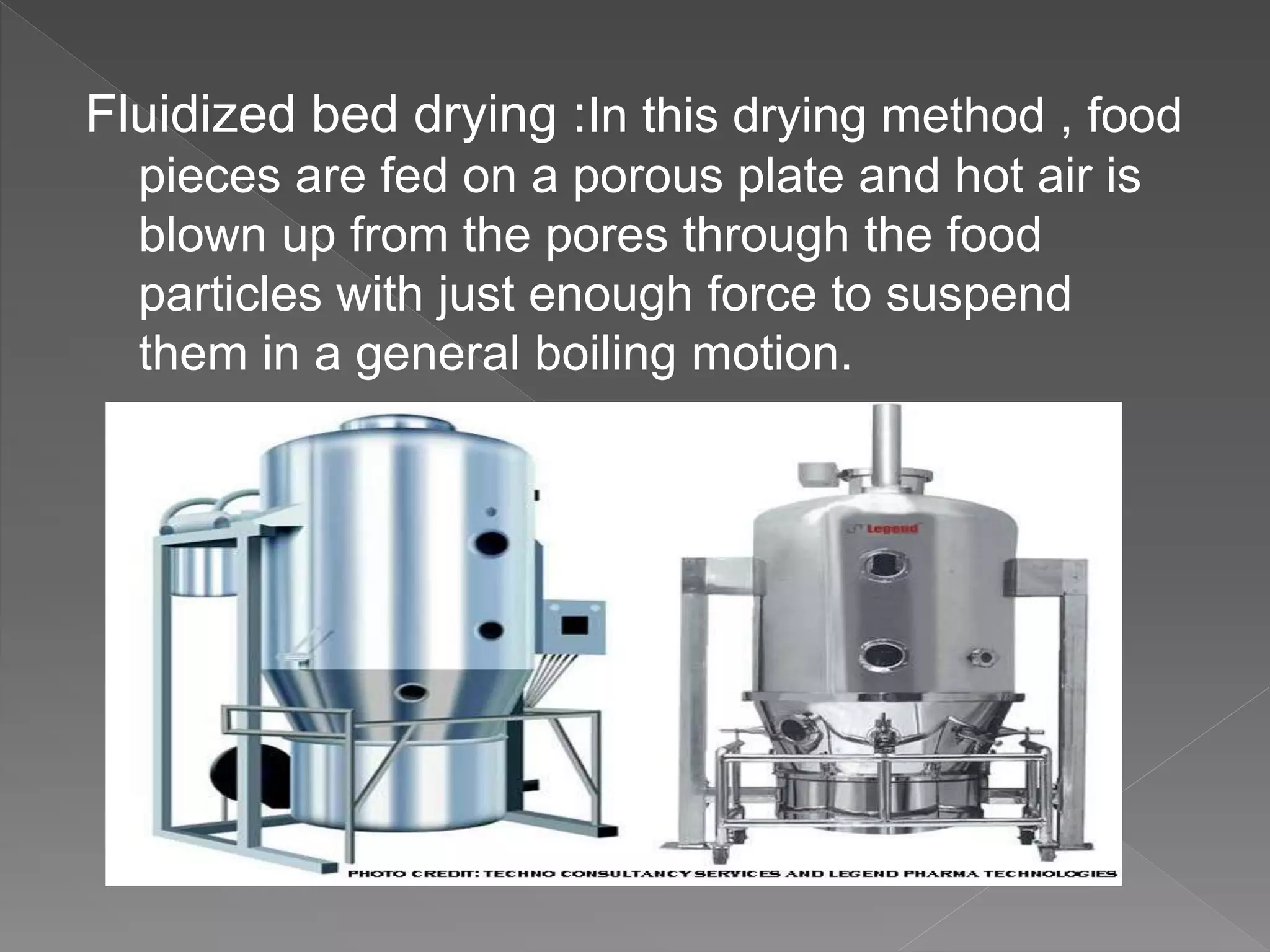
Fluidized bed drying :In this drying method , food
pieces are fed on a porous plate and hot air is
blown up from the pores through the food
particles with just enough force to suspend
them in a general boiling motion.
FOAM MAT DRYING: Pulps and concentrates
are dried by this method . Small amount of a
foaming agent are mixed with the fluid material
and whipped to form low density stable foam.
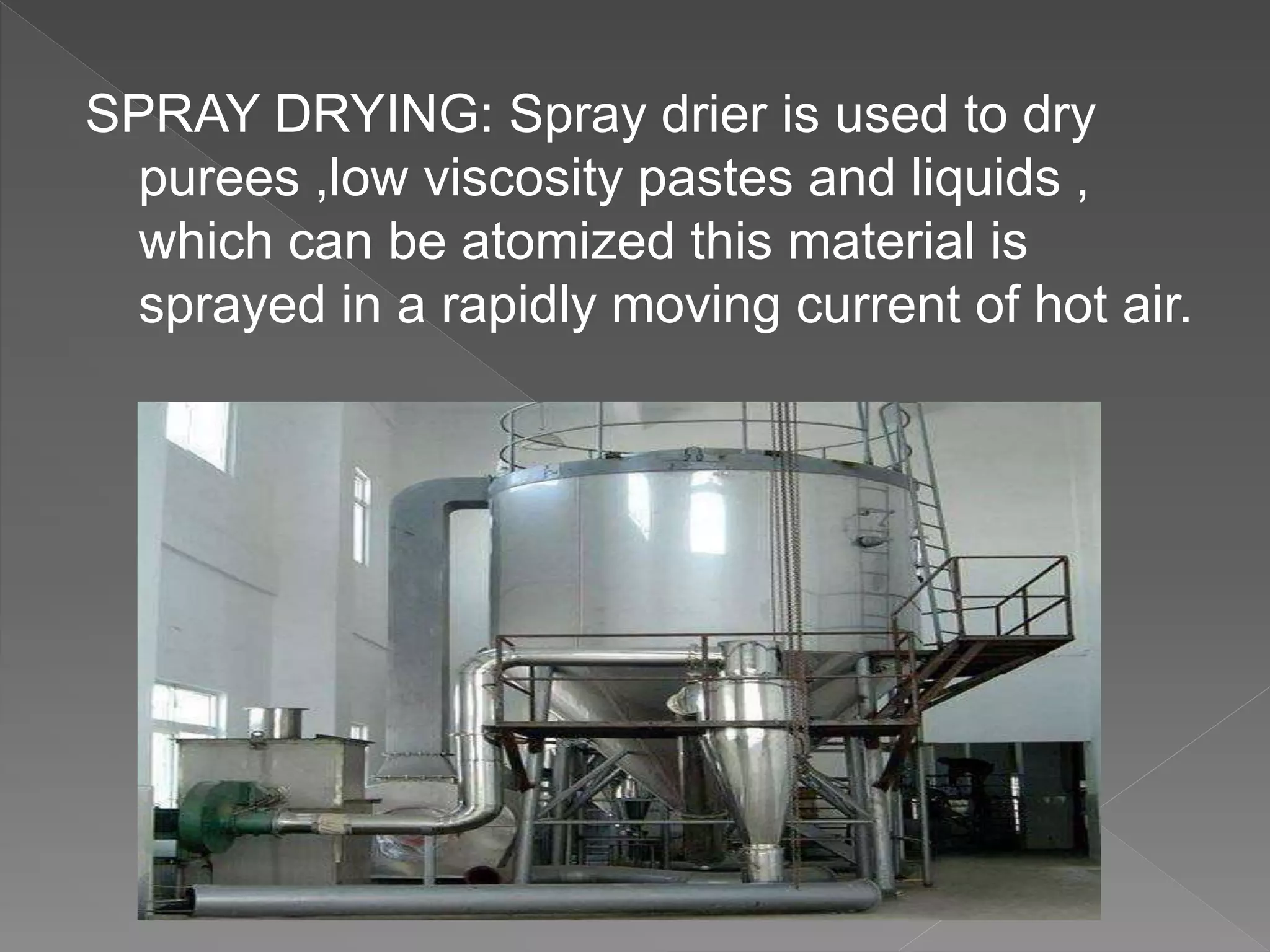
SPRAY DRYING: Spray drier is used to dry
purees ,low viscosity pastes and liquids ,
which can be atomized this material is
sprayed in a rapidly moving current of hot air.
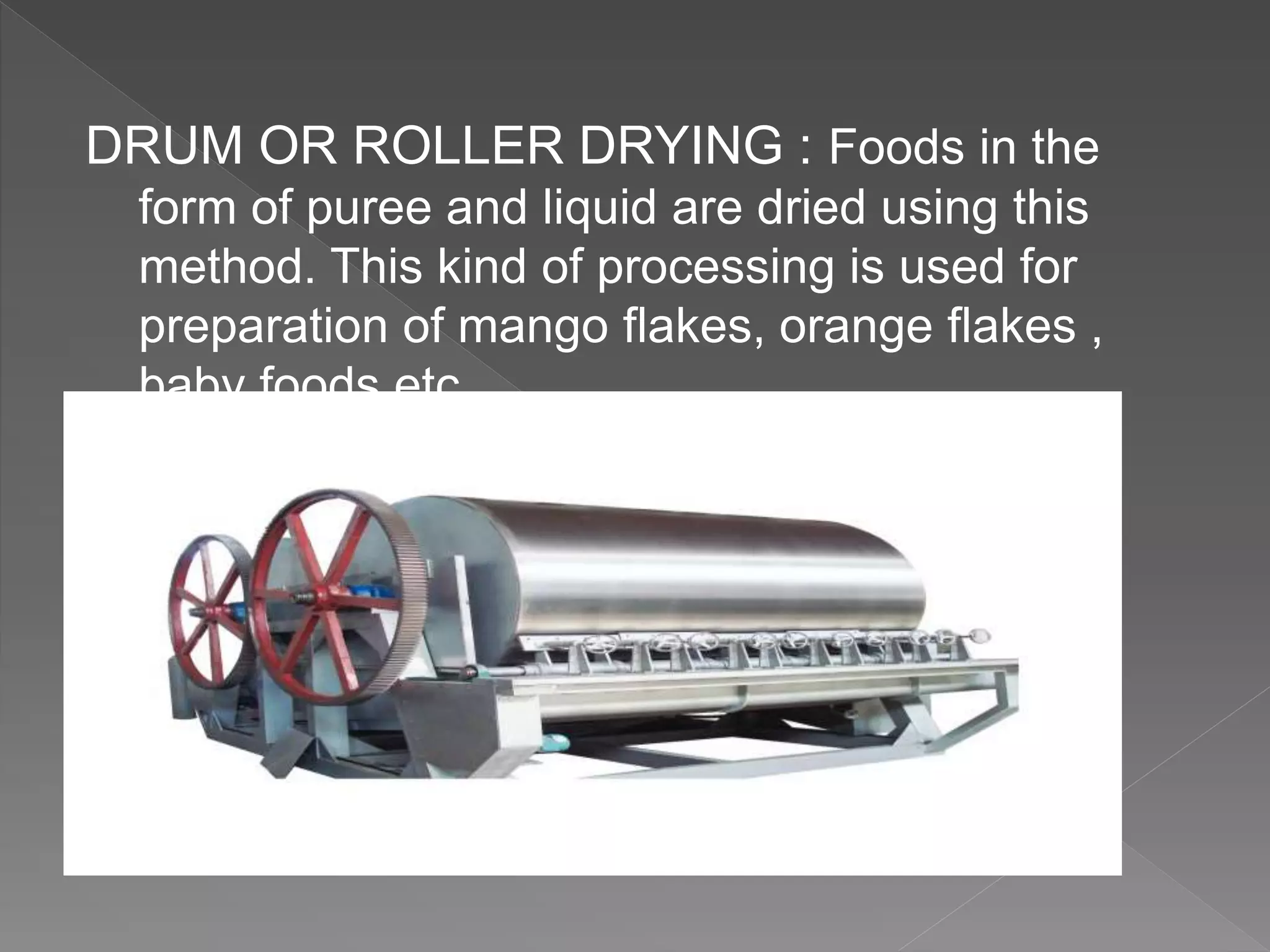
DRUM OR ROLLER DRYING : Foods in the
form of puree and liquid are dried using this
method. This kind of processing is used for
preparation of mango flakes, orange flakes ,
baby foods etc.
MICROWAVE DRYING: In this method
microwaves are used for dry the food
products.
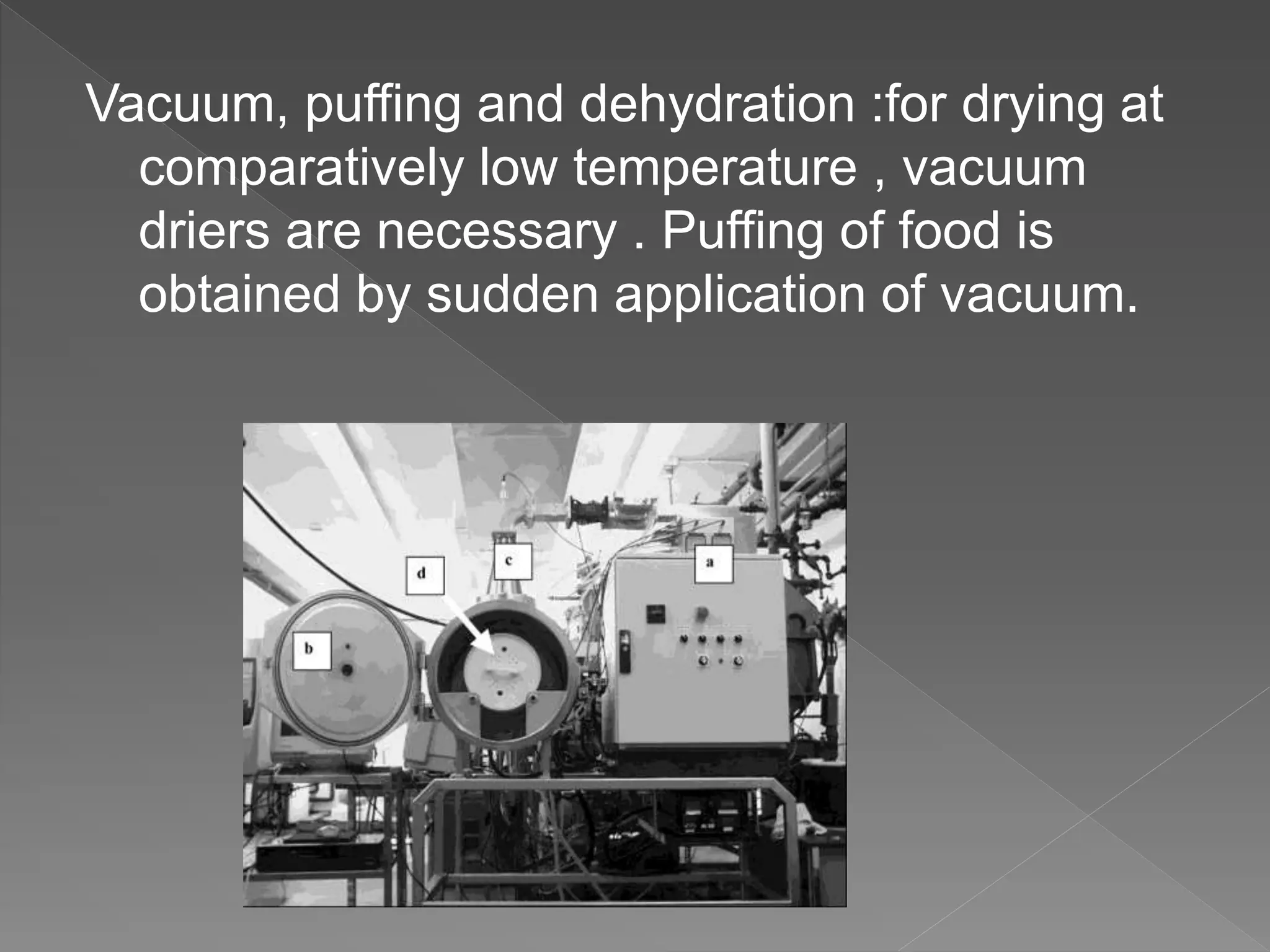
Vacuum, puffing and dehydration :for drying at
comparatively low temperature , vacuum
driers are necessary . Puffing of food is
obtained by sudden application of vacuum.
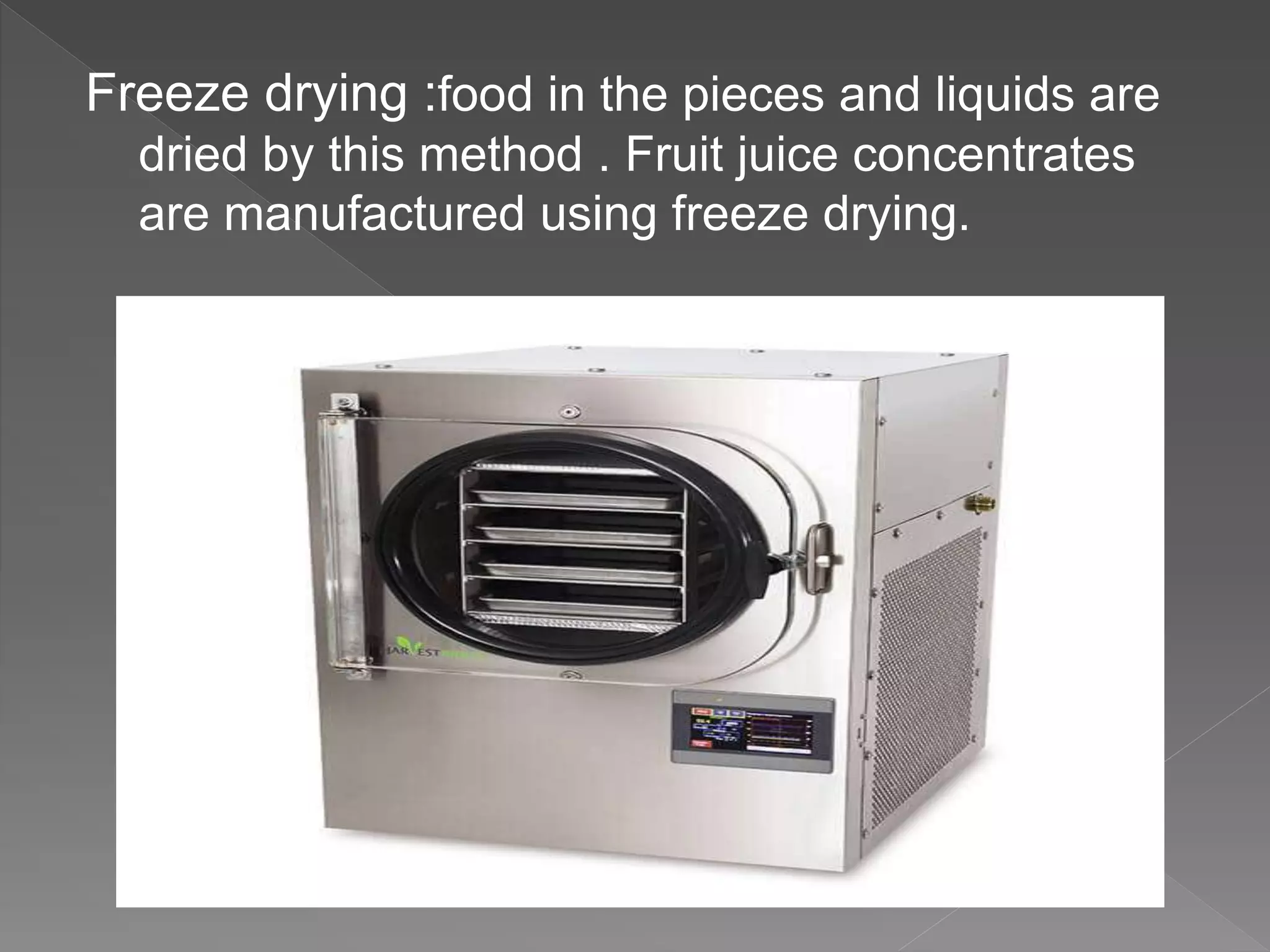
Freeze drying :food in the pieces and liquids are
dried by this method . Fruit juice concentrates
are manufactured using freeze drying.
Accelerated freeze drying : this is used for
drying pieces of food material without
disturbing their shape and texture. Product
has good reconstitution property , taste and
flavour.
PROCESSES OF DRYING :
1.Selection: Fruit should be in mature
condition, sound and firm. Different lots of
various maturity stages should not be mixed
together ; which results in poor dried
product.
2.Sorting: It is done to remove any decayed
parts.
3.Washing : Thorough washing of vegetables is
required to reduce microbial load.
4.Peeling : It can be done by peelers , knives
or by machines.
5.Subdivision of raw materials: It involves
cutting of fruits or vegetables. Uneven slices
results in poor quality end product.
6.Blanching: The product is partially cooked
when it is dipped in hot water. It helps in
inactivating enzymes and prevents
discoloration.
7.Sulphuring: It involves dipping the material in
1-2%KMS . Sulphur prevents mould growth
and preserve colour of light coloured
vegetables, repel insects.
 8.Drying : Product is kept for drying.
 9.Sweating: Dried product is kept in heaps in
a room for a few weeks for moisture
equilibrium.
 10.Packing: Plastic or polythene covers can
be used. Al foils, cardboard etc. can also be
used . Tin is not suitable for packing but can
be used after coating with inert gas like N2.
THANK YOU

Drying preservation

  • 1.
    TOPIC: PRESERVATION OFFOOD WITH DRYING
  • 2.
     INTRODUTION :Dryingis the oldest method of food preservation .During drying , the water content of the food is reduced to critical level below which microorganism cannot grow
  • 3.
     The principlebehind drying is that sufficient moisture is removed ,which is essential for growth of microorganisms and for enzyme activity .removal of moisture increases the storage life of the product due to reduced water activity . If the moisture content is reduced to 1to5 per cent then the product can be stored for more than a year . The processing should be done in such a way that the food value , natural flavour and characteristic cooking quality of the fresh material are retained after drying . A good dried product on reconstitution with water should resemble the original product
  • 4.
     Cheaper thanother methods  Does not require special facilities like refrigeration  Simple to store and pack
  • 5.
     Composition ofraw materials  Size , shape and arrangement of stacking of produce  Temperature , humidity and velocity of air  Atmospheric pressure  Heat transfer to surface
  • 6.
    SUN DRYING :Drying the food product under natural sunny condition is called as sun drying . No energy is required for drying minimum temperature of drying is 350 c with low humidity .the lower limit of moisture content by this method is approximately 15 per cent.
  • 7.
     SOLAR DRYING: solar drying uses designed structure to collect and enhance solar radiation .  1 . The absorption or hot box type driers in which the product is directly heated by sun
  • 8.
    2 . Theindirect or convention driers in which the product is exposed to warm air which is heated by means of a solar absorber or heat exchanger
  • 9.
    SHADE DRYING :thiskind of method is used for foods which lose their color when exposed to directly sunlight for drying .
  • 10.
    A home scaledehydrator or drier : It consist of a small galvanized box (90x90x60 cm ). The lower portion consists of perforated iron tray . The box is fixed on a wooden tray
  • 11.
    OVEN DRYING :A convection oven with a thermostatic setting of 600 c is suitable for oven drying of fruits , vegetables , fruits leathers and meats . This is kind of cabinet drier
  • 12.
    KILN DRIER :Also known as kiln evaporator . It consists of two floors . On top floor , food to be dried is spread and on lower floor , the furnace is housed . Heat is conveyed by ventilator . Generally it is used for large pieces of food
  • 13.
    Tower drier :itis also called as stack type drier . This drier consists of a furnace room containing furnace ,heating pipes and cabinet in which fruits are kept in perforated trays. Heating is through steam coils placed between the trays. The trays are interchanged as drying progresses.
  • 14.
    TUNNEL BELT DRIER:It consists of several parallel sloping and narrow chambers above a furnace room. Trays are passed on a conveyor belt at upper end and removed at lower end. Air for drying is circulated by fan.
  • 15.
    BELT TROUGH DRIER:In this drier ,belt is in the form of a trough , which is made of metal mesh . Hot air is blown through the mesh and food pieces lying on the trough are dried in process.
  • 16.
    Fluidized bed drying:In this drying method , food pieces are fed on a porous plate and hot air is blown up from the pores through the food particles with just enough force to suspend them in a general boiling motion.
  • 17.
    FOAM MAT DRYING:Pulps and concentrates are dried by this method . Small amount of a foaming agent are mixed with the fluid material and whipped to form low density stable foam.
  • 18.
    SPRAY DRYING: Spraydrier is used to dry purees ,low viscosity pastes and liquids , which can be atomized this material is sprayed in a rapidly moving current of hot air.
  • 19.
    DRUM OR ROLLERDRYING : Foods in the form of puree and liquid are dried using this method. This kind of processing is used for preparation of mango flakes, orange flakes , baby foods etc.
  • 20.
    MICROWAVE DRYING: Inthis method microwaves are used for dry the food products.
  • 21.
    Vacuum, puffing anddehydration :for drying at comparatively low temperature , vacuum driers are necessary . Puffing of food is obtained by sudden application of vacuum.
  • 22.
    Freeze drying :foodin the pieces and liquids are dried by this method . Fruit juice concentrates are manufactured using freeze drying.
  • 23.
    Accelerated freeze drying: this is used for drying pieces of food material without disturbing their shape and texture. Product has good reconstitution property , taste and flavour.
  • 24.
    PROCESSES OF DRYING: 1.Selection: Fruit should be in mature condition, sound and firm. Different lots of various maturity stages should not be mixed together ; which results in poor dried product. 2.Sorting: It is done to remove any decayed parts. 3.Washing : Thorough washing of vegetables is required to reduce microbial load. 4.Peeling : It can be done by peelers , knives or by machines.
  • 25.
    5.Subdivision of rawmaterials: It involves cutting of fruits or vegetables. Uneven slices results in poor quality end product. 6.Blanching: The product is partially cooked when it is dipped in hot water. It helps in inactivating enzymes and prevents discoloration. 7.Sulphuring: It involves dipping the material in 1-2%KMS . Sulphur prevents mould growth and preserve colour of light coloured vegetables, repel insects.
  • 26.
     8.Drying :Product is kept for drying.  9.Sweating: Dried product is kept in heaps in a room for a few weeks for moisture equilibrium.  10.Packing: Plastic or polythene covers can be used. Al foils, cardboard etc. can also be used . Tin is not suitable for packing but can be used after coating with inert gas like N2.
  • 27.