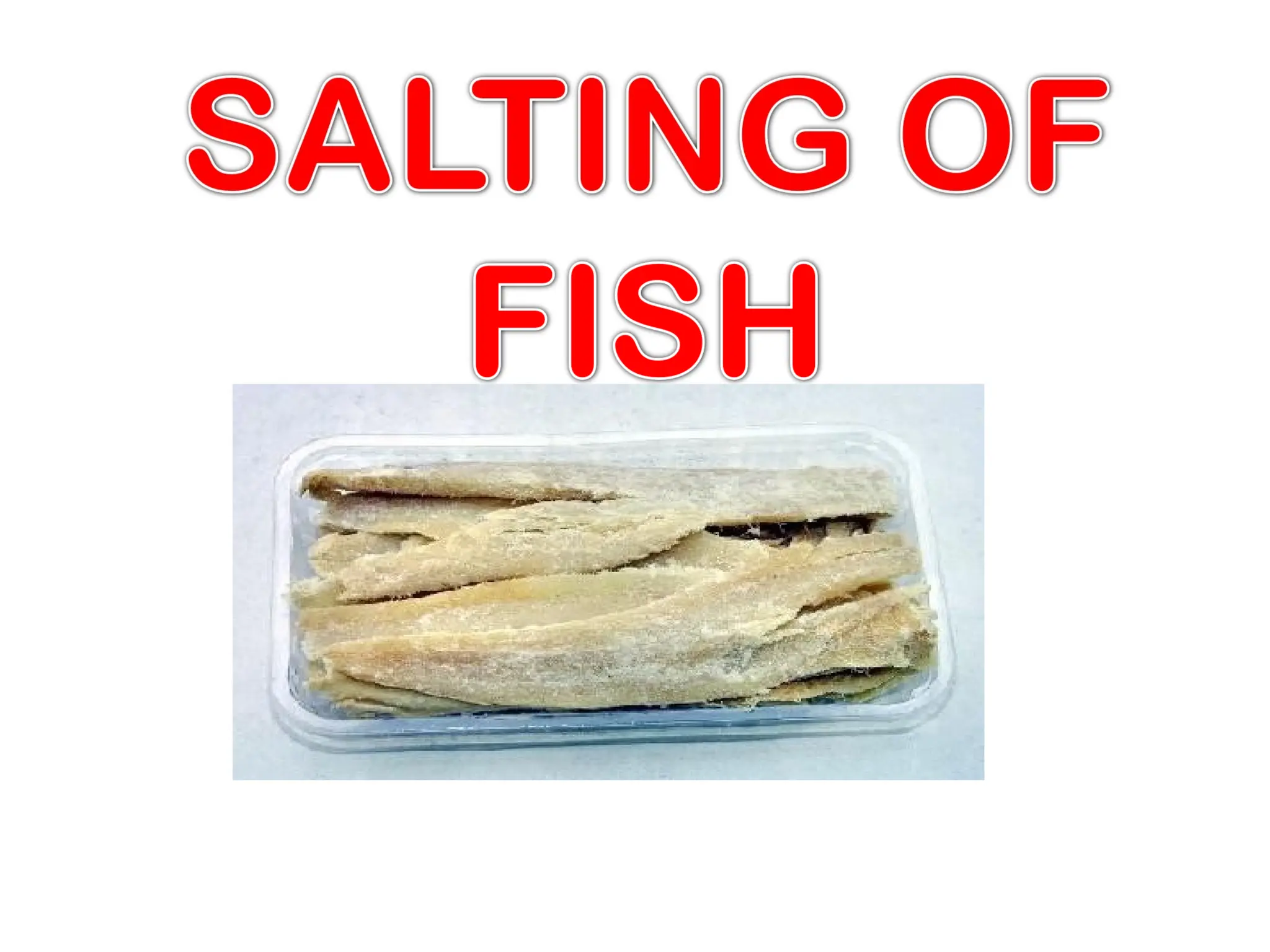
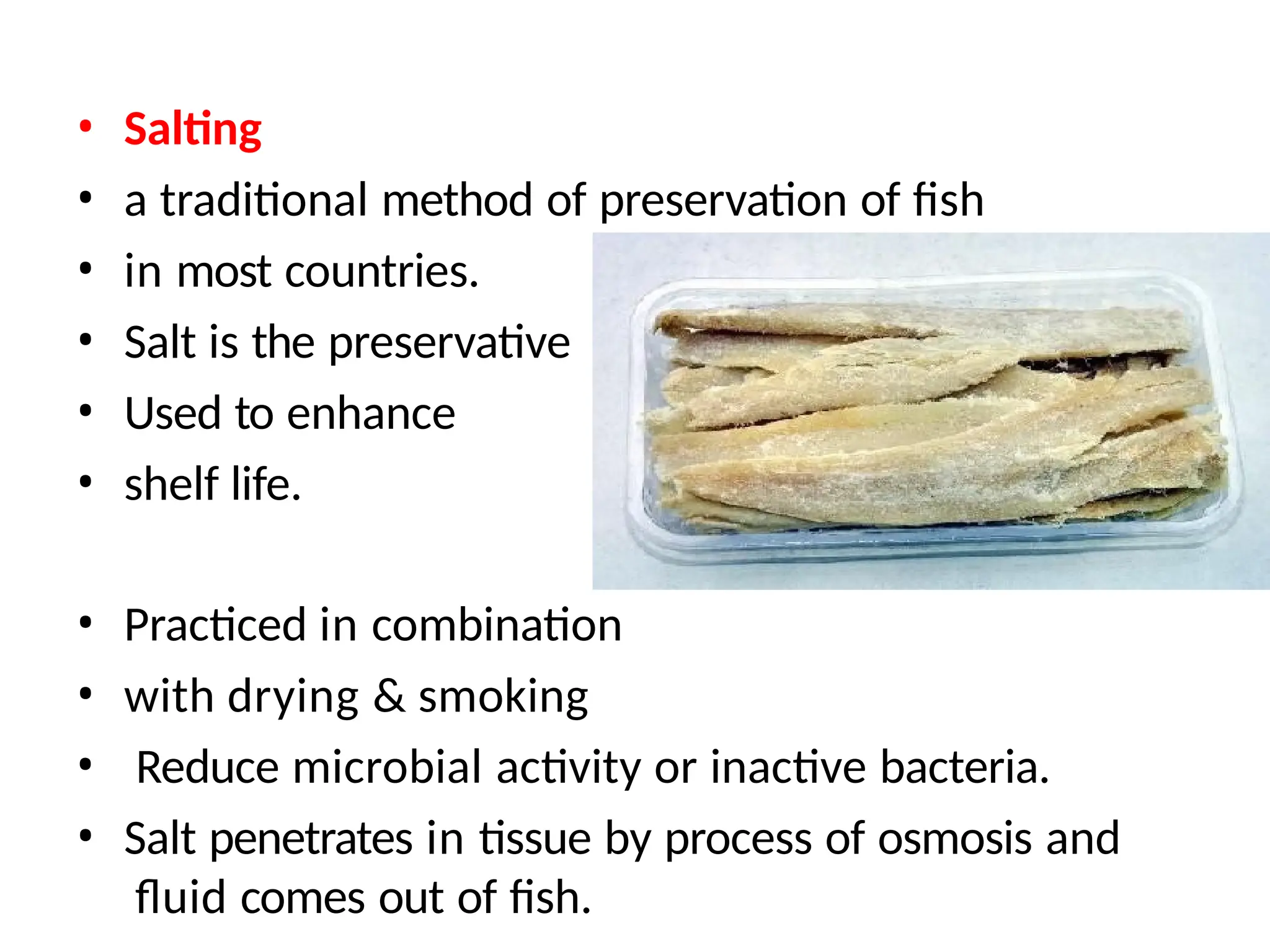
• Salting
• a traditional method of preservation of fish
• in most countries.
• Salt is the preservative
• Used to enhance
• shelf life.
• Practiced in combination
• with drying & smoking
• Reduce microbial activity or inactive bacteria.
• Salt penetrates in tissue by process of osmosis and
fluid comes out of fish.
• Advantages of salting/salt curing :
Does not require elaborate equipments.
Capital outlay is small.
Method is simple & comparatively inexpensive.
Salting applied to any type of fish.
Finished products don’t require special
storage facilities.
Reasonably good shelf life.
Nutritionally products are comparable to other fish
products.
• Salting & related water activity :
• When fish mixed with salt, some water removed
from flesh.
• Salt enters, water moves out by osmosis.
• Loss of water from fish flesh reduces aw.
• Process continues until equilibrium reaches between
conc of salt in fish flesh & surrounding brine.
• aw of saturated brine is 0.75.
• Fish flesh equilibrium with brine will have aw
similar to this.
• Sources of salt, composition & properties :
• Pure common salt : sodium chloride (NaCl)
• All commercial salt contains impurities & depend
upon source & production method.
• Common salts used :
• i) Solar salt : sea water / salt lake water
evaporated by action of sun & wind.
• contaminated with sand & may harbour bacteria.
• ii) Rock salt : mined from natural deposits,
contains varying % of salt (80-99%). Ground to diff
degree of fineness.
• iii) Brine salt : underground salt deposit brought
to surface in solution & evaporated.
• Chemical composition:
• commercial salt – NaCl (80- 99%)
• Ca & Mg chlorides, sodium sulphate & carbonate,
traces of copper & iron.
• Ca & Mg increase rate of spoilage.
• Fish salted in pure NaCl – soft texture & yellow
color
• Ca & Mg in 1 % conc. imparts white color & bitter
taste.
• Salt used should have at least 95% NaCl.
• Should be as dry as possible.
• Microbial quality :
• Solar salt : large no of halophiles.
• Halophiles cause red/pink discoloration on
wet/partially dried salted fish.
• Physical properties :
• Size of salt influence salting time.
• Fine grain dissolve more rapidly – rapid removal of
water from fish surface.
• Prevent penetration of salt inside fish flesh (salt
burn).
• Large & coarse salt crystals : less contact area &
affects dissolution.
• How salt cure fish :
• Initially fish surface sticky.
• Alters colloidal property of proteins & change nature
of hydration.
• At low conc. i.e. initial stage, Salting in, protein
swelling.
• At later stages, sufficient conc. of salt absorbed
inside, protein passed swelling stage.
• start to shrink, loose water from flesh.
• become hard in texture.
• Sod. chloride strong electrolyte, so release bound
Water of protein & affect its state.
• Sod. chloride exerts high osmotic pressure, causing
reduced moisture & plasmolysis of bacterial cell.
• Alters state of protein, block protein
nuclei, affecting enzymes.
• Protein becomes impervious to action of
enzymes.
• Enzymes destroyed/inactivated.
• Salt penetrates through dialysis mechanism until
equilibrium reaches.
• Salt affect physical state of fish.
• Salt preservative
• Effective preservative against MO & enzymes.
• Retards microbial property & chemical spoilage in
fish.
• 6-10% salt – prevents of most spoilage bacteria &
autolytic degradation.
• 20% or above conc– decomposition very slow.
• Halophiles require high salt conc. So may
survive.
• Factors influence salting time :
• Size & thickness : more thicker fish slower
salt penetration.
• Fat content : high fat – low salt uptake.
• Freshness : fresher fish – slower salt
penetration
• Temperature : higher temp – rapid salt uptake. 1%
increase in temp salting rate increases to 2,5 –
3.6%
• Salt tends to absorb moisture from atmosphere &
reach above 75% which may stop drying further.
• Maturing/ripening process :
• More significant in flavor development in
brine pickled fatty fish.
• Enzyme responsible may derive from digestive
system, fish muscle & bacteria growing on fish &
brine.
• Products of lipolysis & proteolysis are dominant
• Products from carbohydrate fermentation &
Maillard browning reaction also contribute in flavor
of ripened fish.
• Salting process :
• Preliminary to other processes like smoking, drying,
canning etc.
• Preparation of fish for salting :
• Varies based on size of fish.
• Whole surface of fish brought in contact with salt
for a successful salting.
• Washing fish to remove unwanted particles
• Dressing – gills, entrails removed. Fish split open
along vertibral column.
• Bleeding
• Throating
• Big fish – deep scores are made at several point,
filleted.
• Small fish – salted whole.
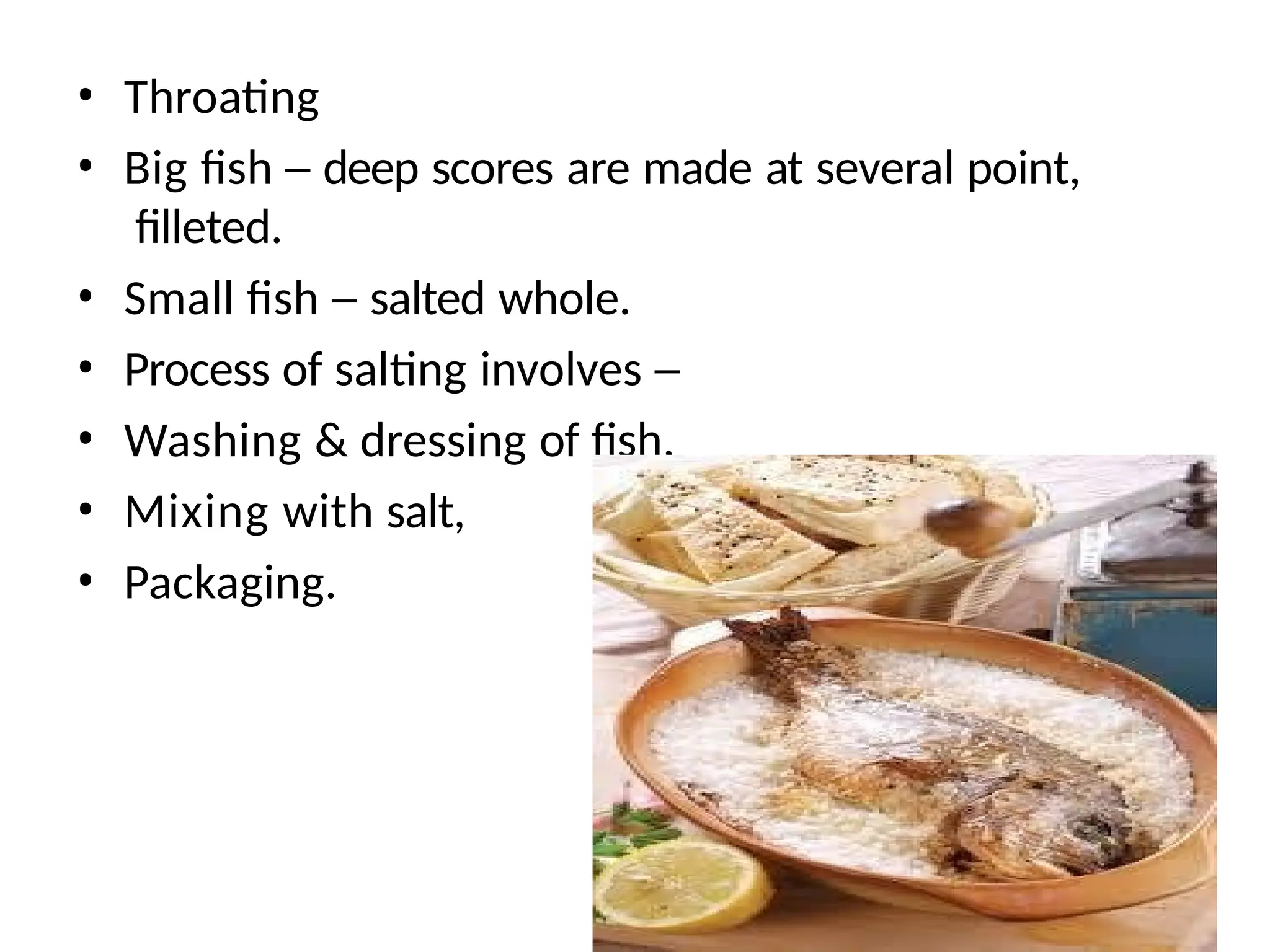
• Process of salting involves –
• Washing & dressing of fish,
• Mixing with salt,
• Packaging.
Methods of
salting
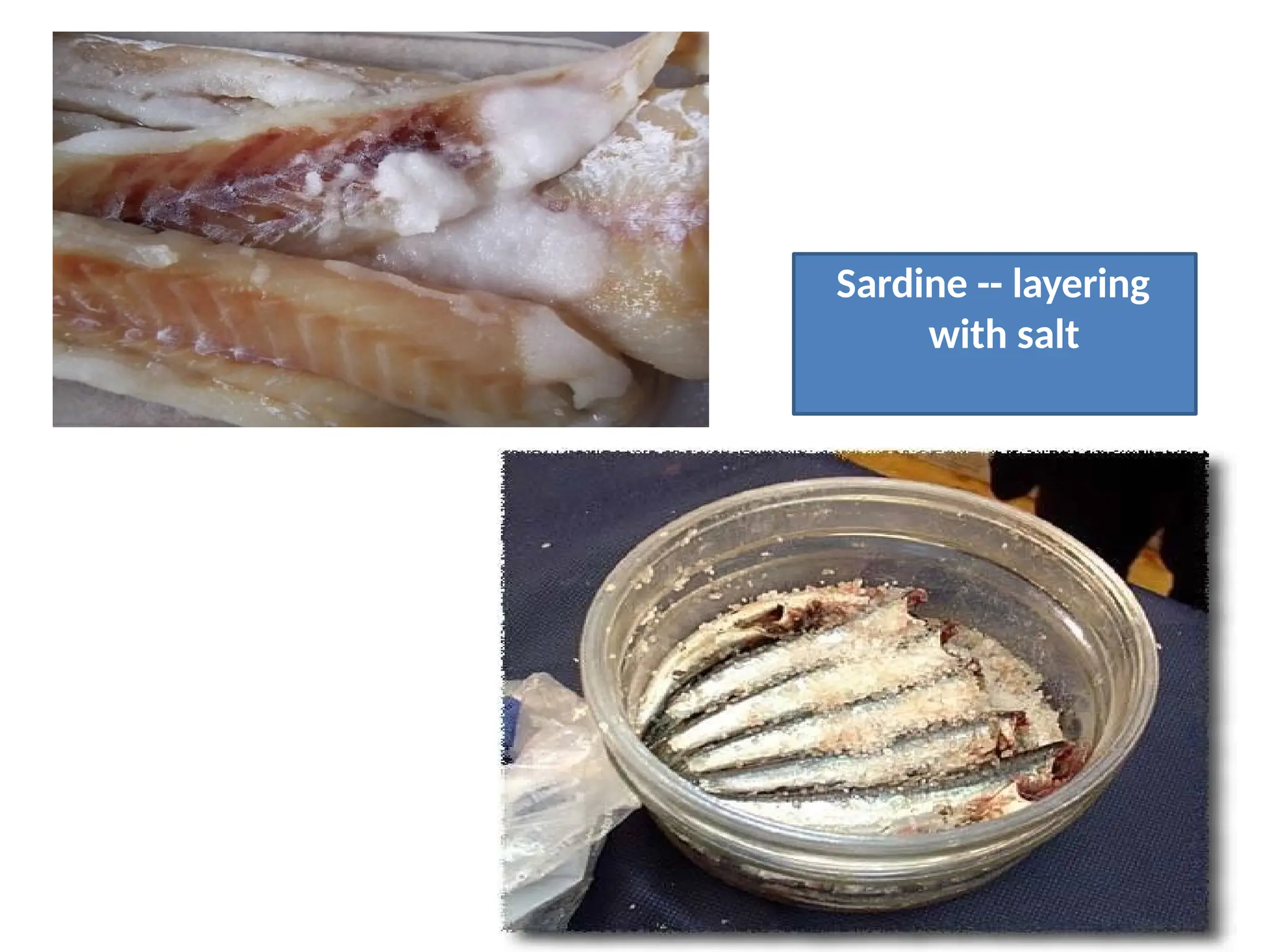
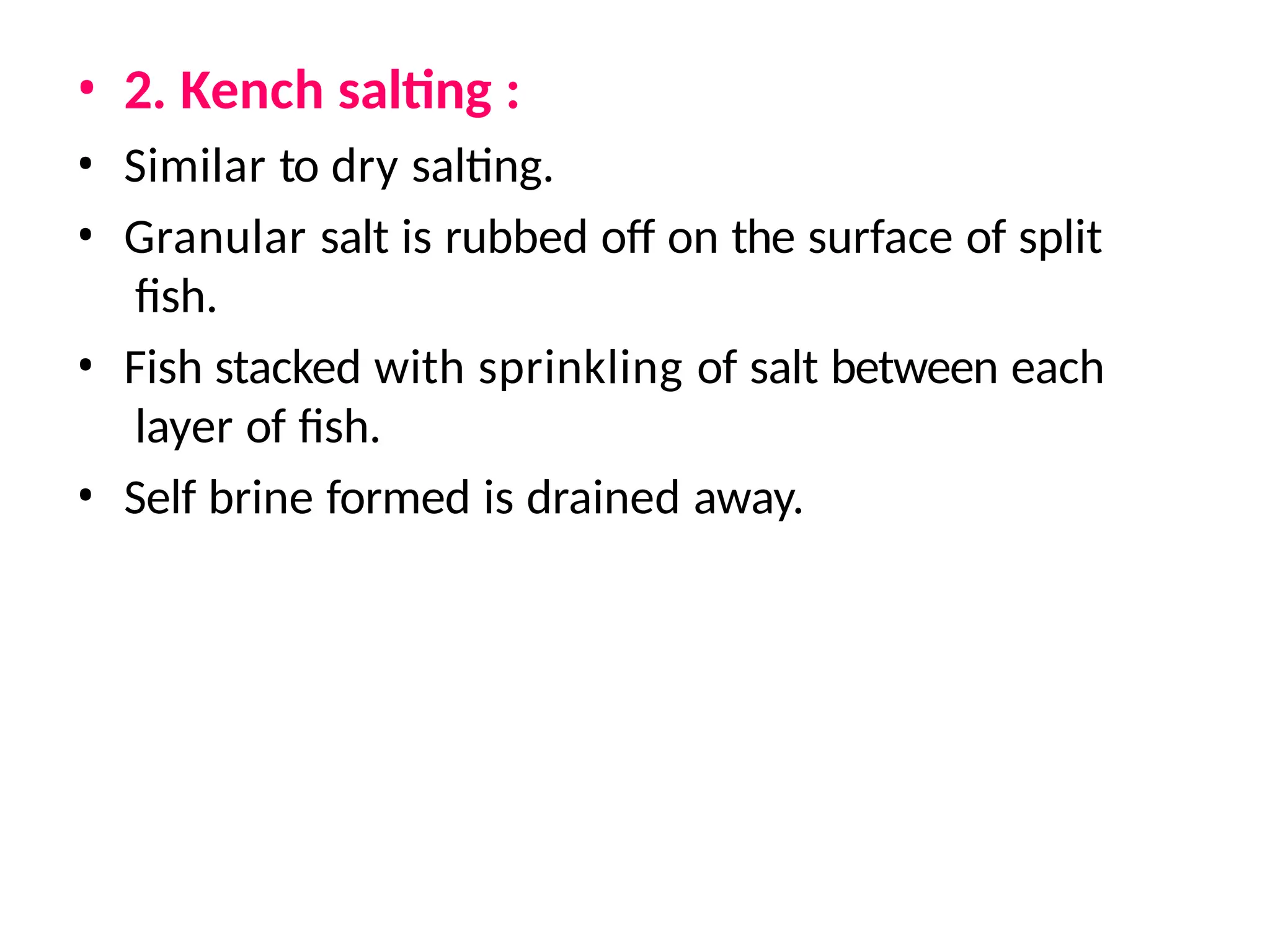
• 1. Dry salting :
• Dressed fish mixed with salt crystals in a container.
• Salt rubbed into the gill cavity & scores are made in
flesh.
• Salt spread at the bottom of container.
• Salt & fish in alternate layers.
• Natural brine formed not drained out & fish may
float on it.
• Weight is kept over the fish to keep it immersed.
• Fish in brine for 2-3 days & dried.
Sardine -- layering
with salt
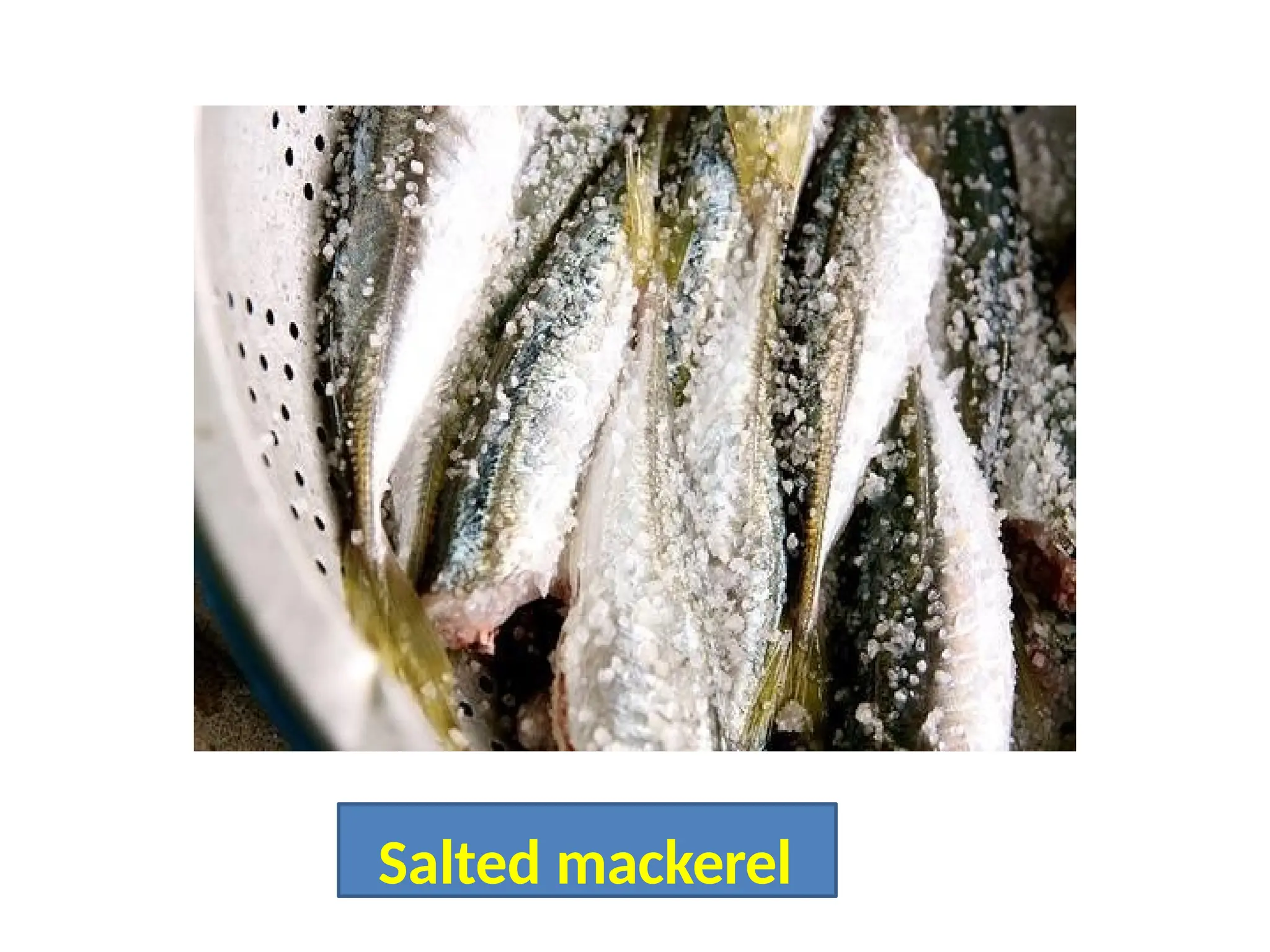
• 2. Kench salting :
• Similar to dry salting.
• Granular salt is rubbed off on the surface of split
fish.
• Fish stacked with sprinkling of salt between each
layer of fish.
• Self brine formed is drained away.
Salted mackerel
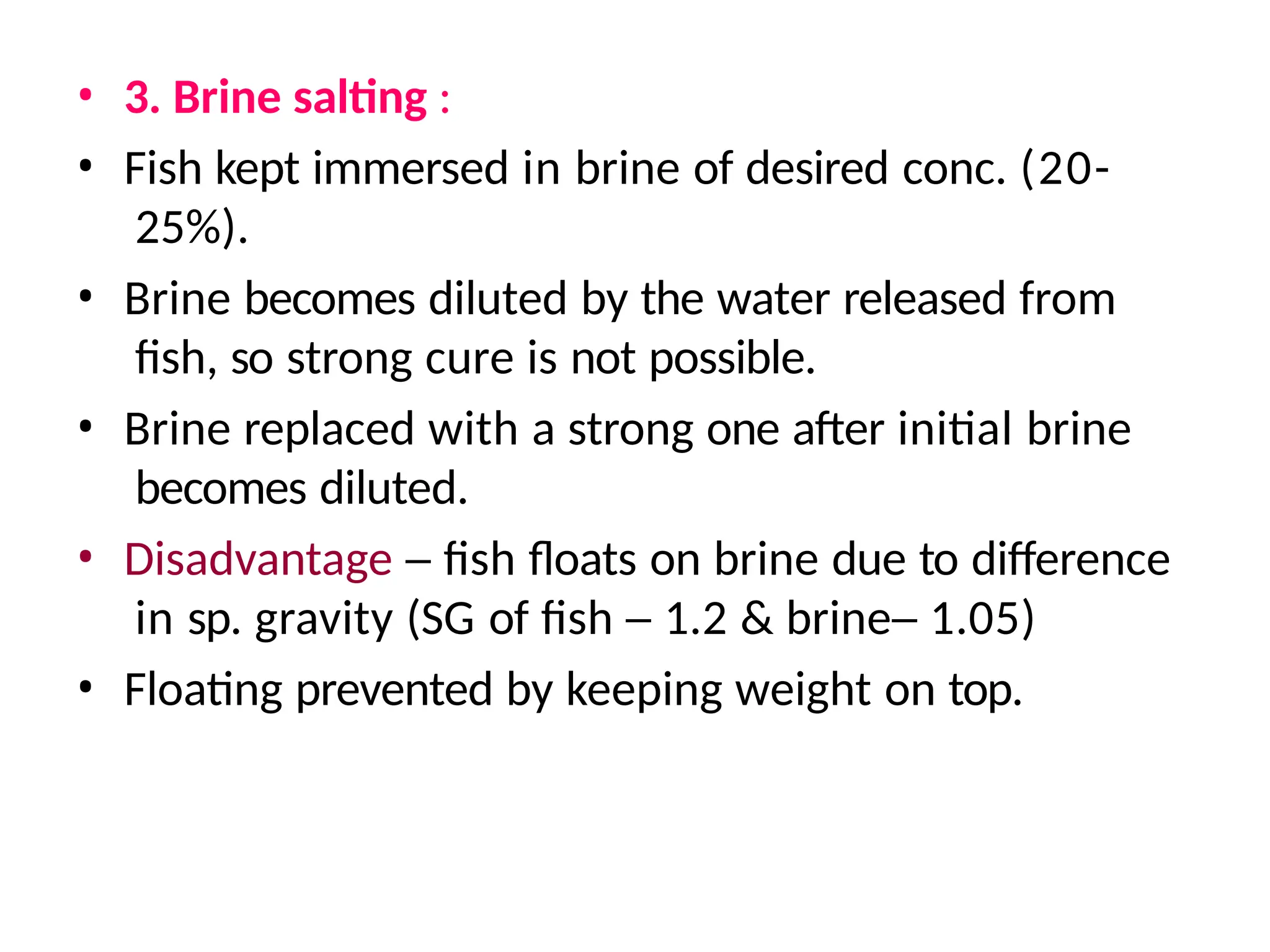
• 3. Brine salting :
• Fish kept immersed in brine of desired conc. (20-
25%).
• Brine becomes diluted by the water released from
fish, so strong cure is not possible.
• Brine replaced with a strong one after initial brine
becomes diluted.
• Disadvantage – fish floats on brine due to difference
in sp. gravity (SG of fish – 1.2 & brine– 1.05)
• Floating prevented by keeping weight on top.
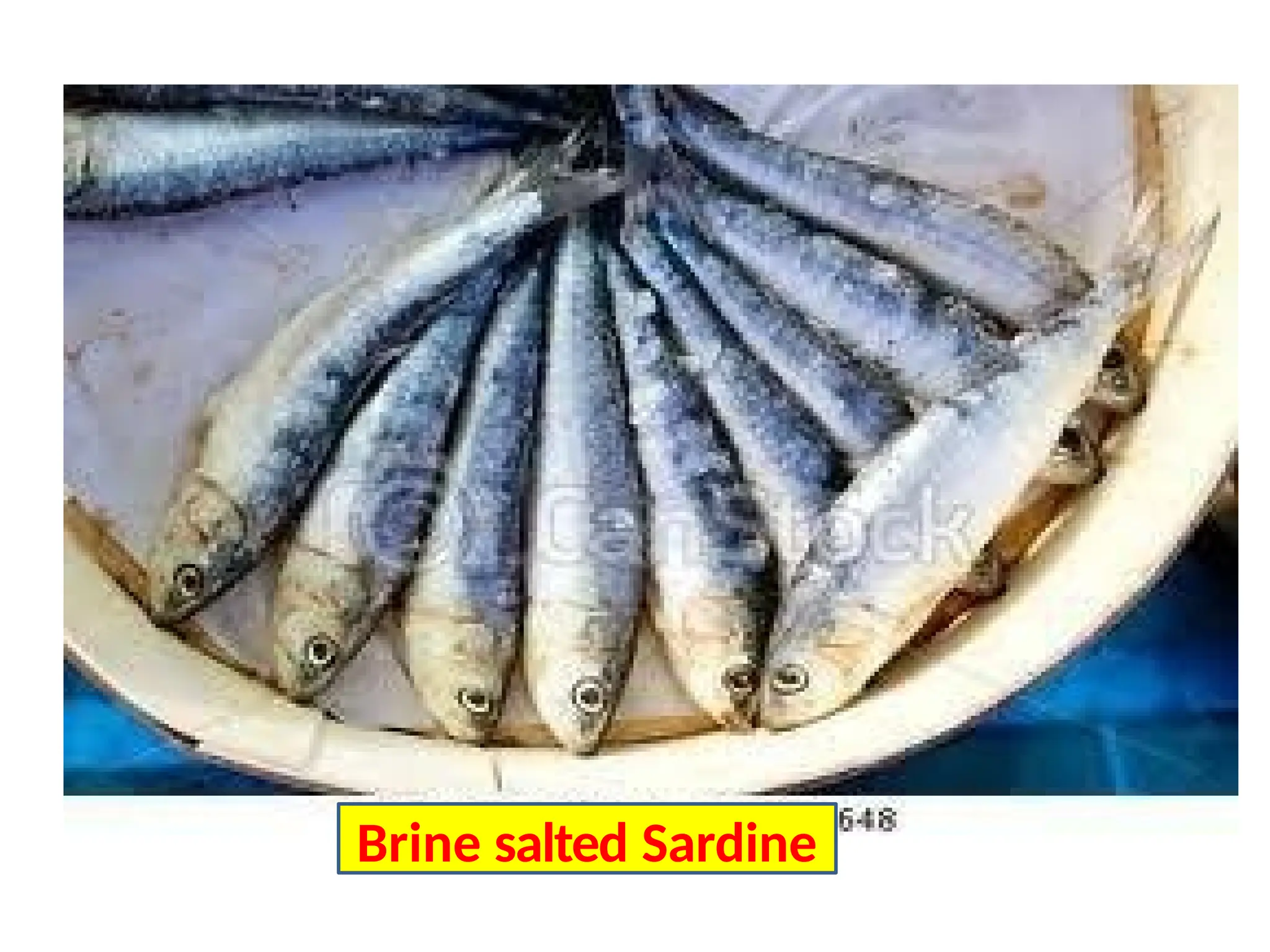
Brine salted Sardine
• 4. Mixed salting (pickled curing):
• Large/fatty fish – slow salting rate.
• Take long time for natural brine to form & cover fish
• May cause spoilage of fish in top layer before salt
penetrates in it.
• In MS fish packed in air tight container with salt
sprinkled between each layer.
• Then topped with saturated brine.
• A cover placed on top to hold fish under the surface
of the brine.
• Advantage -- fish completely surrounded by brine.
• Quickens salting process.
• Dry or kench salting generally not recommended for
use in tropical region.
• As fish is not covered with pickle/brine. So, fish may
be spoiled or susceptible to insect attack.
• Exposure of fish to air & presence of salt encourage
fat oxidation giving rise to discoloration & rancid
flavor.
• Saturated salt solution – 36 Kg of salt to every 100
kg of water at 25° C.
• Types of salted fish :
• i) Light salted fish : 20-30% of salt on dry wt basis.
• ii) medium salted fish : 30-40% salt on DWB.
• iii) Heavily salted fish : 40-45% salt on DWB.
• Types of salting :
• Based on condition of salting :
• i) Warm salting : fish temp around 15- 20°
C. followed in most tropical countries.
• ii) Chilled salting : fish salted after cooling to a
temp of 0- 5° C.
• iii) Cold salting : done by freezing fish in ice & salt
mixture to a temp of - 2 to - 4° C.
• Salting based on containers used :
• i) Vat salting : wooden vats or cement tanks are used.
• ii) Barrel salting : fish mixed with salt & kept
in barrel.
• iii) Pile salting : no containers used. Fish & salt
are piled in alternate layers on floor.
Spoilage in Salted
fish
• Common spoilage observed in salted fish are :
• 1. Microbial spoilage :
• i) Pink or Red discoloration :
• Bacterial spoilage.
• Common in salted fish in warm weather condition.
• Surface of fish covered by red slime, giving an
unpleasant odour.
• Colonies of bacteria appears red on surface of
fish.
• Causative agent is halophilic rod & cocci originates
mainly from solar salt.
• Halobacterium salinaria, H. cutirubum, Sarcina
morrhuae, S. littoralis, Micrococcus resens etc.
• Aerobic orgs & active in contact with air.
• Thermophiles. Do not grow below 10° C.
• Spoilage manifest as pink sheen on surface of
fish.
• Can be rubbed off at initial stage
• In severe cases may cause softening of fish by
protein denaturation giving ammoniacal off odour.
• Prevention :
• airtight packaging.
• Storing below 10° C.
• Use of Food grade salt.
• Treatment with formaldehyde or sulphur dioxide
vapours.
• Dipping in solution of sodium metabisulphite.
• ii) Dun spoilage :
• Caused by halophilic moulds.
• Grow profusely at RH 75% or more.
• Optimum growth temp is 30- 35° C.
• Occurs in heavily salted fish.
• Black, grey or brown spots on fleshy side of fish.
Appearance of sprinkled ground black pepper on
fish.
• Sporendonema epizoum, Wallemia sp.
• Optimum growth at 10-15 % salt conc., 75% RH &
25° C.
• Fish becomes soft & paves way for other spoilage.
• Solar salt main source.
• Prevention :
• Initially easily scraped or brushed away
• In severe infection 0.1% sorbic acid gives
protection
• Use of Good quality salt
• Low temp & humidity to be maintained.
• Well ventilated & dry storage condition.
• iii) Saponification :
• Damage by aerobic m.o at very low temp.
• Malodorous slime on surface of light salted fish eg.
Boxed herring in contact with air.
• Prevention is by keeping fish in brine containing
vinegar for some time.
• iv) Putrefactive spoilage :
• If salting is very slow.
• Longer time for salt to reach at centre.
• Putrefactive process in those region.
• Flesh near backbone gets tanned or reddened.
• Develop offensive putrid smell.
• Pre-salting operation like gutting, splitting etc.
can accelerate salt penetration & prevent tanning.
• Non-Microbial spoilage :
• i) Insect infestation :
• Occurs at early stage of drying.
• Diptera commonly called blowfly causes
infestation.
• Cheese flies (Drosophila casei) also associated.
• Adult flies lay egg on fish, hatches out in a day or
two & larvae (maggots) spread rapidly infesting
whole fish.
• Larvae metamorphose into red pupae from which
flies emerge.
• Prevention :
• Infested fish can be washed roughly in brine &
stored in uncontaminated container.
• If fish is put into brine, maggot floats on top, can be
collected & destroyed.
• Maintenance of handling & processing premises
clean & fly proof.
• Ensuring that fish is well covered during salting.
• Processing premises should be cool.
• Dipping dried fish in insecticidal solution of
pyrethins, piperonyl butoxide could control beetle
infestation.
• Some plant & plant extract act as insect repellant eg.
Neem, citrus peel, oils, peppers.
• ii) Rust :
• Oily fishes sardine, mackerel prone to rusting.
• Rusted iron like color, rancid flavor & unpleasant
taste.
• Brought about by oxidation of fat by atm O2.
• Cu & Fe in salt accelerate the process
• Initially rust on the surface of fish, later penetrates
into flesh.
• Prevention :
• When in surface can be easily washed away with dil
solution of sod bicarbonate.
• Keeping fish away from contact with air
• Cover fish with brine during salting.
• Pack & dry fish properly.
• iii) White spot :
• Presence of Ca & Mg salts cause whitening of flesh
of salted fish.
• white spots on surface occurs from crystals of
disodium hydrogen phosphate by enzymatic
breakdown of nucleotides.
• iv) Fragmentation :
• Cured & dried fish become brittle & break during
storage & transportation.
• Denaturation of protein, hollowing fish by insect
attack & use of spoiled fish for salting cause this.
• Use of fresh fish, avoiding physical damage & proper
packing can prevent this.

Salting of fish - Methods of fish preservation

  • 2.
    • Salting • atraditional method of preservation of fish • in most countries. • Salt is the preservative • Used to enhance • shelf life. • Practiced in combination • with drying & smoking • Reduce microbial activity or inactive bacteria. • Salt penetrates in tissue by process of osmosis and fluid comes out of fish.
  • 3.
    • Advantages ofsalting/salt curing : Does not require elaborate equipments. Capital outlay is small. Method is simple & comparatively inexpensive. Salting applied to any type of fish. Finished products don’t require special storage facilities. Reasonably good shelf life. Nutritionally products are comparable to other fish products.
  • 4.
    • Salting &related water activity : • When fish mixed with salt, some water removed from flesh. • Salt enters, water moves out by osmosis. • Loss of water from fish flesh reduces aw. • Process continues until equilibrium reaches between conc of salt in fish flesh & surrounding brine. • aw of saturated brine is 0.75. • Fish flesh equilibrium with brine will have aw similar to this.
  • 5.
    • Sources ofsalt, composition & properties : • Pure common salt : sodium chloride (NaCl) • All commercial salt contains impurities & depend upon source & production method. • Common salts used : • i) Solar salt : sea water / salt lake water evaporated by action of sun & wind. • contaminated with sand & may harbour bacteria. • ii) Rock salt : mined from natural deposits, contains varying % of salt (80-99%). Ground to diff degree of fineness.
  • 6.
    • iii) Brinesalt : underground salt deposit brought to surface in solution & evaporated. • Chemical composition: • commercial salt – NaCl (80- 99%) • Ca & Mg chlorides, sodium sulphate & carbonate, traces of copper & iron. • Ca & Mg increase rate of spoilage. • Fish salted in pure NaCl – soft texture & yellow color • Ca & Mg in 1 % conc. imparts white color & bitter taste. • Salt used should have at least 95% NaCl.
  • 7.
    • Should beas dry as possible. • Microbial quality : • Solar salt : large no of halophiles. • Halophiles cause red/pink discoloration on wet/partially dried salted fish. • Physical properties : • Size of salt influence salting time. • Fine grain dissolve more rapidly – rapid removal of water from fish surface. • Prevent penetration of salt inside fish flesh (salt burn).
  • 8.
    • Large &coarse salt crystals : less contact area & affects dissolution. • How salt cure fish : • Initially fish surface sticky. • Alters colloidal property of proteins & change nature of hydration. • At low conc. i.e. initial stage, Salting in, protein swelling. • At later stages, sufficient conc. of salt absorbed inside, protein passed swelling stage. • start to shrink, loose water from flesh. • become hard in texture.
  • 9.
    • Sod. chloridestrong electrolyte, so release bound Water of protein & affect its state. • Sod. chloride exerts high osmotic pressure, causing reduced moisture & plasmolysis of bacterial cell. • Alters state of protein, block protein nuclei, affecting enzymes. • Protein becomes impervious to action of enzymes. • Enzymes destroyed/inactivated. • Salt penetrates through dialysis mechanism until equilibrium reaches. • Salt affect physical state of fish.
  • 10.
    • Salt preservative •Effective preservative against MO & enzymes. • Retards microbial property & chemical spoilage in fish. • 6-10% salt – prevents of most spoilage bacteria & autolytic degradation. • 20% or above conc– decomposition very slow. • Halophiles require high salt conc. So may survive.
  • 11.
    • Factors influencesalting time : • Size & thickness : more thicker fish slower salt penetration. • Fat content : high fat – low salt uptake. • Freshness : fresher fish – slower salt penetration • Temperature : higher temp – rapid salt uptake. 1% increase in temp salting rate increases to 2,5 – 3.6% • Salt tends to absorb moisture from atmosphere & reach above 75% which may stop drying further.
  • 12.
    • Maturing/ripening process: • More significant in flavor development in brine pickled fatty fish. • Enzyme responsible may derive from digestive system, fish muscle & bacteria growing on fish & brine. • Products of lipolysis & proteolysis are dominant • Products from carbohydrate fermentation & Maillard browning reaction also contribute in flavor of ripened fish.
  • 14.
    • Salting process: • Preliminary to other processes like smoking, drying, canning etc. • Preparation of fish for salting : • Varies based on size of fish. • Whole surface of fish brought in contact with salt for a successful salting. • Washing fish to remove unwanted particles • Dressing – gills, entrails removed. Fish split open along vertibral column. • Bleeding
  • 15.
    • Throating • Bigfish – deep scores are made at several point, filleted. • Small fish – salted whole. • Process of salting involves – • Washing & dressing of fish, • Mixing with salt, • Packaging.
  • 16.
    Methods of salting • 1.Dry salting : • Dressed fish mixed with salt crystals in a container. • Salt rubbed into the gill cavity & scores are made in flesh. • Salt spread at the bottom of container. • Salt & fish in alternate layers. • Natural brine formed not drained out & fish may float on it. • Weight is kept over the fish to keep it immersed. • Fish in brine for 2-3 days & dried.
  • 17.
  • 18.
    • 2. Kenchsalting : • Similar to dry salting. • Granular salt is rubbed off on the surface of split fish. • Fish stacked with sprinkling of salt between each layer of fish. • Self brine formed is drained away.
  • 19.
  • 20.
    • 3. Brinesalting : • Fish kept immersed in brine of desired conc. (20- 25%). • Brine becomes diluted by the water released from fish, so strong cure is not possible. • Brine replaced with a strong one after initial brine becomes diluted. • Disadvantage – fish floats on brine due to difference in sp. gravity (SG of fish – 1.2 & brine– 1.05) • Floating prevented by keeping weight on top.
  • 21.
  • 22.
    • 4. Mixedsalting (pickled curing): • Large/fatty fish – slow salting rate. • Take long time for natural brine to form & cover fish • May cause spoilage of fish in top layer before salt penetrates in it. • In MS fish packed in air tight container with salt sprinkled between each layer. • Then topped with saturated brine. • A cover placed on top to hold fish under the surface of the brine.
  • 23.
    • Advantage --fish completely surrounded by brine. • Quickens salting process. • Dry or kench salting generally not recommended for use in tropical region. • As fish is not covered with pickle/brine. So, fish may be spoiled or susceptible to insect attack. • Exposure of fish to air & presence of salt encourage fat oxidation giving rise to discoloration & rancid flavor. • Saturated salt solution – 36 Kg of salt to every 100 kg of water at 25° C.
  • 24.
    • Types ofsalted fish : • i) Light salted fish : 20-30% of salt on dry wt basis. • ii) medium salted fish : 30-40% salt on DWB. • iii) Heavily salted fish : 40-45% salt on DWB. • Types of salting : • Based on condition of salting : • i) Warm salting : fish temp around 15- 20° C. followed in most tropical countries. • ii) Chilled salting : fish salted after cooling to a temp of 0- 5° C. • iii) Cold salting : done by freezing fish in ice & salt mixture to a temp of - 2 to - 4° C.
  • 25.
    • Salting basedon containers used : • i) Vat salting : wooden vats or cement tanks are used. • ii) Barrel salting : fish mixed with salt & kept in barrel. • iii) Pile salting : no containers used. Fish & salt are piled in alternate layers on floor.
  • 26.
    Spoilage in Salted fish •Common spoilage observed in salted fish are : • 1. Microbial spoilage : • i) Pink or Red discoloration : • Bacterial spoilage. • Common in salted fish in warm weather condition. • Surface of fish covered by red slime, giving an unpleasant odour. • Colonies of bacteria appears red on surface of fish. • Causative agent is halophilic rod & cocci originates mainly from solar salt.
  • 27.
    • Halobacterium salinaria,H. cutirubum, Sarcina morrhuae, S. littoralis, Micrococcus resens etc. • Aerobic orgs & active in contact with air. • Thermophiles. Do not grow below 10° C. • Spoilage manifest as pink sheen on surface of fish. • Can be rubbed off at initial stage • In severe cases may cause softening of fish by protein denaturation giving ammoniacal off odour. • Prevention : • airtight packaging. • Storing below 10° C.
  • 28.
    • Use ofFood grade salt. • Treatment with formaldehyde or sulphur dioxide vapours. • Dipping in solution of sodium metabisulphite. • ii) Dun spoilage : • Caused by halophilic moulds. • Grow profusely at RH 75% or more. • Optimum growth temp is 30- 35° C. • Occurs in heavily salted fish. • Black, grey or brown spots on fleshy side of fish. Appearance of sprinkled ground black pepper on fish.
  • 29.
    • Sporendonema epizoum,Wallemia sp. • Optimum growth at 10-15 % salt conc., 75% RH & 25° C. • Fish becomes soft & paves way for other spoilage. • Solar salt main source. • Prevention : • Initially easily scraped or brushed away • In severe infection 0.1% sorbic acid gives protection • Use of Good quality salt • Low temp & humidity to be maintained. • Well ventilated & dry storage condition.
  • 30.
    • iii) Saponification: • Damage by aerobic m.o at very low temp. • Malodorous slime on surface of light salted fish eg. Boxed herring in contact with air. • Prevention is by keeping fish in brine containing vinegar for some time. • iv) Putrefactive spoilage : • If salting is very slow. • Longer time for salt to reach at centre. • Putrefactive process in those region. • Flesh near backbone gets tanned or reddened.
  • 31.
    • Develop offensiveputrid smell. • Pre-salting operation like gutting, splitting etc. can accelerate salt penetration & prevent tanning. • Non-Microbial spoilage : • i) Insect infestation : • Occurs at early stage of drying. • Diptera commonly called blowfly causes infestation. • Cheese flies (Drosophila casei) also associated. • Adult flies lay egg on fish, hatches out in a day or two & larvae (maggots) spread rapidly infesting whole fish.
  • 32.
    • Larvae metamorphoseinto red pupae from which flies emerge. • Prevention : • Infested fish can be washed roughly in brine & stored in uncontaminated container. • If fish is put into brine, maggot floats on top, can be collected & destroyed. • Maintenance of handling & processing premises clean & fly proof. • Ensuring that fish is well covered during salting. • Processing premises should be cool.
  • 33.
    • Dipping driedfish in insecticidal solution of pyrethins, piperonyl butoxide could control beetle infestation. • Some plant & plant extract act as insect repellant eg. Neem, citrus peel, oils, peppers. • ii) Rust : • Oily fishes sardine, mackerel prone to rusting. • Rusted iron like color, rancid flavor & unpleasant taste. • Brought about by oxidation of fat by atm O2. • Cu & Fe in salt accelerate the process
  • 34.
    • Initially ruston the surface of fish, later penetrates into flesh. • Prevention : • When in surface can be easily washed away with dil solution of sod bicarbonate. • Keeping fish away from contact with air • Cover fish with brine during salting. • Pack & dry fish properly. • iii) White spot : • Presence of Ca & Mg salts cause whitening of flesh of salted fish.
  • 36.
    • white spotson surface occurs from crystals of disodium hydrogen phosphate by enzymatic breakdown of nucleotides. • iv) Fragmentation : • Cured & dried fish become brittle & break during storage & transportation. • Denaturation of protein, hollowing fish by insect attack & use of spoiled fish for salting cause this. • Use of fresh fish, avoiding physical damage & proper packing can prevent this.